Wu Wei/Martin Stegner/Janne Saksala: Pur ti miro (ECM New Series 2843)

Wu Wei
Martin Stegner
Janne Saksala
Pur ti miro

Wu Wei sheng
Martin Stegner viola
Janne Saksala double bass
Recorded October 2022
Teldex Studio Berlin
Cover: Fidel Sclavo
Executive producer: Manfred Eicher
Release date: November 21, 2025

Pur ti miro represents one of those rare convergences in classical music when disparate lineages find themselves speaking, almost accidentally at first, a common language. It begins with curiosity, as violist Martin Stegner and double bassist Janne Saksala, both members of the Berlin Philharmonic, step beyond their usual orchestral frame to meet Wu Wei, master of the sheng. His instrument—an ancient Chinese mouth organ whose history predates all the works played here—has been modified with keys for the modern ear, capable of whispering like breath against glass or expanding in a cathedral-like radiance. When Stegner encountered Wei in 2009, as he recounts in the album’s liner note, he felt something akin to recognition, as if this millennia-old voice, rendered anew, had been waiting patiently to show him a corner of the musical universe he had not yet visited.

Their collaboration began with long improvisations that felt like conversations between strangers who, little by little, discover that they share the same dreams. But the true spark arrived one day when Wei, without announcement or expectation, introduced Claudio Monteverdi’s Sì dolce è’l tormento to the group. The sheng’s timbre, at once reed-like and celestial, enfolded the melody in a new kind of vulnerability. Early music, that echo of distant rooms and candlelit courts, suddenly breathed with a startling immediacy. Hearing it was nothing short of a revelation for Stegner.

From this moment, a desire for a project to nurture that revelation without taming it grew. The idea of a trio emerged: sheng, viola, and cello. Yet Stegner wondered what might happen if the music’s lower roots reached even farther into the earth. And so, the cello was replaced in the imagination by a double bass, and eventually in reality by Janne Saksala, whose warm resonance, playful experimentation, and architectural sensibility offered the perfect counterweight to the sheng’s shimmering glow. What began as an artistic experiment became a living portrait of three musicians drawn together by curiosity, humility, and a willingness to let go of what they thought they knew.

The recording opens, fittingly, with Sì dolce è’l tormento, and one feels immediately the trust between them. The strings do not accompany the sheng, nor does the sheng simply ornament the strings; instead, they dissolve into one another, forming a single instrument with three voices. The mournfulness of Monteverdi’s melody gains new terrain. It feels less like lament and more like a story we have heard so many times in languages we do not speak, whose meanings we may sense only in the pauses between syllables. Here, at last, someone translates them for us in real time.

Johann Sebastian Bach’s Organ Trio Sonata No. 1 in E-flat major follows, and with it an architectural shift. The lively outer movements float and spin with a measured buoyancy, but it is the Adagio that becomes the trio’s proving ground. In that slow movement, the muted viola curls around the bright woodiness of the sheng, while the double bass expands the room so we may step inside the harmony itself. Bach’s geometries reveal themselves as bodies in motion, human-shaped and breathing. The Andante from the Organ Trio Sonata No. 4 in e minor deepens the sense of natural inevitability, a landscape in sound. The sheng is a waterfall glimpsed from afar, the viola a lone bird carving patterns into a gray sky, and the bass the mist that holds all of it in gentle cohesion. And when the title piece from L’incoronazione di Poppea at last appears, we recognize the sensation it carries: that life is forever repeating its own small operas, and we are simply pilgrims passing through the middle of one that has been running since long before we arrived.

At the center of the album sits Vivaldi’s La Follia, a theme-and-variation playground that allows the musicians to stretch not only their technique but their imaginative reach. Here, Wei’s sheng sounds at times like an accordion leaning into a waltz, at others like a human voice. Meanwhile, Saksala’s bass dances with kinetic clarity. When the trio slips unexpectedly into jazz-tinged territory, we catch a glimpse of what they can do when the score becomes a suggestion rather than a command. Echoes of Gianluigi Trovesi and Gianni Coscia drift through, blooming into a finale that approaches the exuberance of a Romanian folk dance.

Thus, it makes poetic sense to end with a folk song proper: Bruremarsj frå Beiarn, a Norwegian bridal march. The trio plays it with both reverence and wonder. There is a hint of sadness at the beginning, that ache of separation inherent in every union, the leaving of one home to build another. The sheng’s accordion-like hum traces a path between joy and nostalgia. In its gentle call, the future becomes something familiar, while the past turns mysterious and soft-edged, retreating into obscurity.

Throughout the album, even in the most composed selections, a spirit of improvisation remains. The players listen more than they declare. They treat each phrase not as a given but as a question waiting to be answered. And because none of the instruments carries an aggressively sharp tone, the ensemble moves within a spectrum of shadow rather than light. The absence of a violin removes any temptation toward brilliance for its own sake.

It seems no coincidence that Pur ti miro translates to “I gaze upon you.” Listening to this album, one feels watched, not with scrutiny but with tenderness. The music looks at us the way a friend might look across a quiet table, curious about what we will say next. It regards us openly, lovingly, holding its breath just long enough for us to understand that we, too, are part of this conversation.

Sokratis Sinopoulos/Yann Keerim: Topos (ECM 2847)

Sokratis Sinopoulos
Yann Keerim
Topos

Sokratis Sinopoulos lyra
Yann Keerim piano
Recorded February 2024
Sierra Studios, Athens
Engineer: Giorgos Kariotis
Cover photo: Jean-Marc Dellac
Produced by Manfred Eicher
Release date: October 17, 2025

There is nothing quite like the sound of the lyra when Sokratis Sinopoulos takes it in hand. The instrument exhales an ancient soul into the modern air, and few musicians draw from its strings such a fusion of myth and immediacy. From his quartet recordings, Eight Winds and Metamodal, this more intimate duo with pianist Yann Keerim distills their chemistry into an even deeper alchemy of tone and silence. Their collaboration of nearly twenty years has ripened into an art of pure intuition, where melody and freedom speak the same language.

At the album’s heart lies Béla Bartók, whose Romanian Folk Dances serve as both axis and atmosphere. Yet it is in “Vlachia,” one of four original pieces inspired by the Hungarian composer, where their vision truly unfolds, as melancholy and art relate like light through water. The piano’s chords rock gently, a cradle of memory, while the lyra hovers between waking and dreaming, resisting the lull of its own tenderness. “Valley,” by contrast, opens like a watercolor, the soul of the landscape awakening at dawn, when even the smallest stones remember their own luminosity. Between the modally inflected interlude “Mountain Path,” with its blues-tinted horizons, and the quietly breathing “Forest Glade,” the musicians walk among elderly oak, beech, and elm, each exhaling the voices of forgotten peoples, their songs hanging in the air.

The Romanian Folk Dances themselves are reimagined here as meditations on time’s elasticity. “In One Spot,” normally brief and fleeting, becomes a slow unfurling, each phrase examined as though through a magnifying glass instead of a telescope. What was once a dance is now an act of remembrance, a transmission through hands, hearts, and breath. Keerim’s improvisations shimmer with restraint, unveiling the dance as a living organism rather than a set of steps. “Sash Dance” begins like a gift being unwrapped, its introduction a flowering reverie, before the familiar theme emerges, tender as an heirloom passed from parent to child. Sinopoulos’s harmonic touch is radiant, his bow tracing lines that dissolve as soon as they are drawn, while Keerim decorates with the grace of rain gathering on the edge of a leaf.

A solo lyra ushers us into “Dance from Bucsum,” its lament carrying the weight of centuries. Gradually, it finds vitality again, as if memory itself were relearning its steps. The piano’s entrance is light breaking through foliage. “Romanian Polka” delights in this interplay, its bowings and pluckings coaxing the piano into a rhythmic embrace. The music feels rooted in the soil, yet perpetually on the verge of flight. “Fast Dance” is not so much quickened as transfigured. What was once earthy now becomes spectral, its pulse sifted through the mesh between moments.

“Stick Dance” closes the circle, beginning in abstraction before broadening into a spacious terrain of inspiration. There is such reverence here that one hesitates to call it an ending at all. In returning to the first of Bartók’s dances, the album folds time in upon itself, reviving what it has just allowed to rest. It becomes not a conclusion, but a threshold, suggesting that each listening might return us to the beginning with altered ears.

As Sinopoulos and Keerim write in the album’s booklet:

“Our Topos is where tradition meets the present, the Balkan Mountains meet urban space, the music of the countryside meets contemporary creation. Our Topos is where we meet and interact, shaping our individual and common identities.”

Indeed, Topos is less a location than a living field, a place where listening itself becomes part of the composition. Between the lines of melody and silence, we, too, are invited to breathe, to dwell, to remember. And as the final tone recedes, one wonders whether the music has ended at all or merely crossed into another realm, where echoes continue to shape the clouds, unseen but never lost.

Meredith Monk: Cellular Songs (ECM New Series 2751)

Meredith Monk
Cellular Songs

Meredith Monk & Vocal Ensemble
Ellen Fisher
Katie Geissinger
Joanna Lynn-Jacobs
Meredith Monk
Allison Sniffin
John Hollenbeck
Recorded January-March 2022 / March 2024
Power Station Studios, New York
Engineers: Kevin Killen (2022), Eli Walker (2024)
Assistant: Matthew Soares
Mixing: Eli Walker, Alexann Markus (assistant)
Cover photo: Julieta Cervantes
Recording producers: Meredith Monk and Allison Sniffin with John Hollenbeck
Executive producer: Manfred Eicher
Release date: October 17, 2025

All too often, women have been mythologically depicted as vindictive creatures who exist only to distract and destroy. Whether in the Sirens of the ancient Greeks or Tennyson’s Lady of Shalott, they sing, weave, and create in isolation, forbidden the pleasures of love, peace, and community. And while the work of singer and composer Meredith Monk has always been concerned with questions of agency, it was never made so clear to me as when the boxed set of her collected ECM recordings materialized in 2022. As the first album to appear since that watershed release, Cellular Songs doesn’t so much continue the journey as fold in upon itself, so that by the end, the listener is left with a compact flower of such potent expressivity that it seems capable of leading one’s ears in directions never thought possible yet which sound intimately familiar, as if remembered from a dream that preceded language.

Cellular Songs is the second part of a trilogy that began with On Behalf Of Nature, a work exploring our global ecosystem from a molecular vantage point. For Monk, the title names what is fundamental not only to life but to all of creation. “What is going on in the cell is so complex,” she writes, “and it’s a prototype of the possibility of what a society could be if you take those same principles and expand them.” As Bonnie Marranca suggests in her liner notes, composing and contemplation are synonymous, which makes Monk a meditator of worlds, one who reduces the act of communication to a microcosmic array of consonants, vowels, and blends. In this regard, it is difficult to imagine anything so biologically poetic as the opening “Click Song #3 Prologue,” in which Monk and her vocal ensemble (Ellen Fisher, Katie Geissinger, Joanna Lynn-Jacobs, Allison Sniffin, and Monk herself), with percussionist John Hollenbeck, get to the heart of things. Their tongue clicks are droplets in a distant cave, each carrying minerals and unfelt emotions until, over millennia, stalagmites rise as records of their passage. Like the three “Cell Trios” that follow, they constitute an internal code that locks into place. Flowing harmonies and dissonances encompass the breadth of life itself, a reality in which the voice is central, porous in its itinerant grace. 

Hollenbeck’s vibraphone appears organically in a handful of pieces, a trace element in the soil of this music. Whether documenting a universal grammar in the syllabically potent “Dyads,” playing alongside the piano in “Dive,” or bowing a glassy surface in “Melt,” it allies itself with the building blocks of existence, defying the horrific structures so often fashioned from them. It is the vein in every vocal leaf, seeking photosynthesis without flesh and treating entropy as the dissolution of time. Sniffin’s pianism is equally cathartic in “Lullaby for Lise,” where she joins Geissinger. Rather than leaning on lyricism to seek fantasy, it straddles the threshold between waking and dreaming, recognizing that lived experience is always a blend of both. I hear it as a song to a child not yet born, gestating and growing with all the possibilities of time in her blood and brain, opening her eyes at last in “Generation Dance.” Thus, she comes to know the vision of her mother and her mother’s mother, and as she exhales in “Breathstream,” Monk’s solo voice gives shape to inherited traumas, now able to be wielded in the name of healing.

In the unfolding of “Branching,” each voice becomes the first in an ever-multiplying lineage of wisdom. Speaking of rituals and sacrifices, their repetition serves not as comfort but as a catalyst born of a primeval, generative power. “Passing” finds those same figures trading off vocalizations with a precision that is open to nature’s chaos, while “Nyems” reveals the playfulness of communication for the ephemeral metaphor it truly is.

Given that nearly all of the work presented here is stripped of linguistic meaning, what a radical blessing to encounter the coherence of “Happy Woman.” Here, the feeling is one of transparency, yet also of quiet critique, an awareness of the many roles women inhabit, whether by choice or by force. The opening refrain and its variations (“I’m a happy woman,” “I’m a hungry woman,” “I’m a thinking woman,” etc.) are the stitches of a mother among mothers, quilting herself into the patchwork of history.

By the album’s end, the sacredness of vibration becomes paramount. From these humming atoms emerge animals, rivers, and clouds, leaving us to wonder where the so-called intellect fits into the larger picture. Because if a heartbeat is nothing without silence, then its divisions are where forgiveness begins.

Zehetmair Quartett: Johannes Brahms / op. 51 (ECM New Series 2765)

Zehetmair Quartett
Johannes Brahms / op. 51

Zehetmair Quartett
Thomas Zehetmair
 violin
Jakub Jakowicz violin
Ruth Killius viola
Christian Elliott violoncello
Recorded November 2021
Konzerthaus Blaibach
Engineer: Rainer Maillard
Recording supervision: Guido Gorna
Cover photo: Eberhard Ross
Produced by Manfred Eicher
Release date: October 17, 2025

After much-lauded recordings of works by Hindemith, Bartók, and Schumann, among others, the peerless Zehetmair Quartett returns to ECM to interpret Op. 51 of Johannes Brahms (1833-1897). In his liner notes for the album, Wolfgang Stähr characterizes the German composer as one who “wrote both much and little.” Cases in point are his string quartets, of which he quilled over 20 in his youth but later destroyed, leaving only the two featured on this recording, plus a third. As Brahms once related to his biographer, Max Kalbeck, “The boxes with those old manuscripts stood in Hamburg for ages. When I was there two or three years ago, I sat on the floor—entire walls were beautifully decorated with my scores, even the ceiling. I only had to lie on my back to admire my sonatas and quartets. It looked rather good, actually. But I tore it all down—better I do it than someone else!—and burned the rest along with it.” Work on these survivors began in the mid-1860s, but it was only in 1873 that his perfectionism conceded to the decision to call them complete. And so, we are left with, at best, mere intimations of what came before, shattered and reworked into collages of a mind slightly more in tune with its self-inflicted wounds.

The String Quartet No. 1 in C minor blossoms into exuberant life from the start, its gentle lead-in masking an almost volcanic energy beneath. This declamatory statement is not the setting of a tone but the breaking of it, snapping us out of a painful reverie into something more immediate—a real crisis rather than the arbitrary melancholy with which we tend to surround ourselves. The constant vacillation between urgency and resignation renders these proceedings a masterful exercise in tension and release. The sheer level of rhythmic and melodic invention is dazzling to behold, evolving into something beyond incidental. The Zhehetmair Quartett navigates every twist and turn with the precision of a film director who nevertheless allows his actors to make every scene leap from the screen.

Such heroism, however, is destined to fall, for even the romantic gestures of the second movement are not offered in hopes of fulfillment but rather in expectation of being forgotten. This undermining is what separates Brahms from the gigantry of such predecessors as Beethoven. He is uninterested in staid forms and inherited expectations. He speaks and lets his sentiments carry the day, rather than deferring to baskets with pretty little labels and easily identifiable contents.

In the third movement, a subdued yet altogether lively Allegretto, he unveils another facet of determination, all the more powerful for being caught in a web of its own making. A particularly gorgeous moment occurs when the quartet coalesces into a pizzicato dandelion, then blows its seeds far and wide. But if anything is left to wander offscreen, it is brought right back into focus with the final Allegro. Here, the camera zooms in, revealing every detail. It is a stunning conclusion that declares itself undeclarable.

While these quartets are quite violin-forward, as proven by the leading voices of Thomas Zehetmair and relative newcomer Jakub Jakowicz, violist Ruth Killius deserves admiration for providing the rudder that steers both vessels. Her sinewy strength is astonishingly present in the String Quartet No. 2 in A minor, of which the opening movement lets her sing with unbridled lyricism. The same must be said of cellist Christian Elliott, for whom this would be his last recording with the quartet before his untimely death earlier this year. His depth of color and texture is felt throughout, especially in the two central movements, where the instrument’s endurance is revealed in tonal breadth, muscular leaps of intuition, and smooth layers of binding energy.

In the finale, all signatures come to the fore, each a piece in a larger puzzle upon which light continues to fall. The violins are once again declamatory without feeling desperate, pointing instead to inspirations deeply internal and chaotic, funneled into a sound as interlocking as it is yearning to be free of its own design. Thus, the music leaves us behind, not with a sense of closure but of an ongoing trajectory, an arrow still in light. For in Brahms’s hands, drama has no fixed abode, only the upheavals of time itself, to which we all must ultimately succumb and from which, through performances such as this, we momentarily rise again.

Dobrinka Tabakova: Sun Triptych (ECM New Series 2670)

Dobrinka Tabakova
Sun Triptych

Maxim Rysanov viola
Dasol Kim 
piano
Roman Mints 
violin, hurdy-gurdy
Kristina Blaumane 
violoncello
BBC Concert Orchestra
Dobrinka Tabakova
 conductor
Fantasy Homage to SchubertOrganum LightSun Triptych
Recorded July 2021 at Watford Colosseum
Engineer: Neil Varley
Assistant engineer: Joe Yon
Whispered LullabySuite in Jazz StyleSpinning a Yarn
Recorded August 2020 at Meistersaal, Berlin
Engineer: Rainer Maillard
Mixed January 2025 by Manfred Eicher, Dobrinka Tabakova, and Michael Hinreiner (engineer) at Bavaria Musikstudios München
Cover: Fidel Sclavo
Album produced by Manfred Eicher
Release date: September 26, 2025

British-Bulgarian composer Dobrinka Tabakova returns to ECM with her second full program, following String Paths. That 2013 debut left an indelible mark, establishing her voice among many new listeners as one of immense humility intertwined with fortitude. Selections from the album were even included in the films Adieu au langage (Goodbye to Language) and Le livred’image (The Image Book), both directed by longtime ECM affiliate Jean-Luc Godard. But beyond these connections, it was clear that Tabakova was creating a world unto itself, a parallel dimension of sorts where chance operations and heartfelt intentions danced with graceful strength. All of which leaves someone in my position with the not-so-graceful task of trying to capture the breadth of her sound in the confines of the screen you are reading now. Not coincidentally, she begins her liner note for the present recording as follows: “Writing music and writing about music are distant cousins at best.” And yet, her melodies have a way of bridging the gulf between them with purposeful unfolding.

Violist Maxim Rysanov and pianist Dasol Kim open with two distinct chamber pieces. From the indrawn breath of Whispered Lullaby (2005), the viola opens its octave as a pathway into the piano’s flowering spirit. What starts as a whisper, however, develops into a robust expression of lucidity. Having been originally written for a children’s opera titled Midsummer Magic, it takes on that feeling of an incantation—a clue, perhaps, into its evocative intensity. Suite in Jazz Style (2009) represents the third suite written for Rysanov, following Pirin and Suite in Old Style, the latter of which appeared on String Paths. It’s also a natural homecoming, if you will, for a composer who started her journey as a child improvising on the piano. Its tripartite structure begins with “Talk,” a prime showcase for Rysanov’s mastery that proves him to be one of Tabakova’s most fervent interpreters, having known her since their shared time as students of the Guildhall School. There is a delightful freedom to the interpretation, which, despite its precision (if not because of it), makes the proceedings feel spontaneous. In the interplay between him and Kim, listening and speaking become one in the same.

After this upbeat introduction, “Nocturnal” spreads the charcoal dust of its balladry in thicker strokes. There is, nevertheless, a continuation of that same playfulness, a wry smile in the viola that is self-aware, if now a touch mournful. As the bow travels between sul ponticello and sul tasto gradations, it opens itself to fresh meanings in the piano’s embrace. Kim is the ever-attentive partner, rendering context as faithfully as a saxophonist wandering the streets of a rainy city after a gig. And in “Dance,” which eases into eartshot with percussive tapping, the impulse to move takes on a desire of its own to love and be loved. There is a vibrant microtonal approach here that feels sinewy and thoroughly connected, stepping into folkish territory one moment as easily as it leaps into modernism the next. Rysanov navigates these gymnastics with a rooted sense of architecture, swaying with every tectonic movement to protect the structural integrity at hand.

The Fantasy Homage to Schubert (2005) for strings presents a recontextualization of Schubert’s Fantasy in C major for violin and piano, transfigured and otherworldly. The metaphor is not arbitrarily chosen, either. One could easily imagine it as a lost soundtrack selection from 2001: A Space Odyssey, each shift of light and celestial body revealing both the alien and the familiar. Tempting as it is, I hesitate to call this “haunting,” as this would imply there was someone around to be haunted. Rather, it feels disembodied, having nowhere to go but outward, forever echoing into the depths of the universe. And yet, somehow, we are privy to its secrets. The appearance of violin and cello (soloists Nathaiel Anderson-Frank and Benjamin Hughes, respectively) is a slow-motion transmission from an extinct Earth finding its way to us in hypersleep.

Organum Light (2000), also for strings, places Tabakova at the helm of the BBC Concert Orchestra. Originally for five singers, it takes its inspiration from the viol consort pieces of Gibbons and Purcell. Despite a deep, rich pulse, sliding harmonics in the strings open our hearts to its truths.

Spinning a Yarn (2011) for solo violin and hurdy-gurdy features its dedicatee, Roman Mints, on both instruments. A ligament between past and future, it leaves us to walk the present on the resulting tightrope. The playful unpredictability of the hurdy-gurdy provides a tactile foundation for the violin’s storytelling. All of it feels incidental to some scene from centuries ago brought to life in moving pictures. One can almost see the fields being planted, the animals being kept, the children being raised. It also has a rocking motion that makes its consonances sing all the more sweetly.

Last is the album’s title piece for violin, violoncello and string orchestra. Composed in 2007, it first took life as “Dawn,” which Tabakova wrote for the 10th anniversary of Kremerata Baltica and in celebration of Gidon Kremer’s 60th birthday, later adding two further movements. Mints is retained here alongside cellist Kristina Blaumane, fronting the BBC Concert Orchestra under the composer’s hand. The sheer depth of sonority is wondrous, at once frightening and comforting. “Day” is an arpeggiated crystal of which each facet reveals a slightly different perspective. A Philip Glass-like architecture opens itself to adventurous harmonies, ending in a hush that slides without pause into “Dusk.” Here, the mood is more meditative, stretched to reveal the spaces in between the notes. Even in slumber, it knows the sun will return to give life once again, even if there is no one around to enjoy it.

At the end of her liner note, Tabakova writes: “I’d like to think that in the silence that follows music, there may be a fleeting sense that the internal world has spoken – not in certainty, but in presence, however fragile or incomplete.” And if there is anything to be found in the silence that follows this album, it is surely the need to fill it once again with what we have just heard, lest the linearity of time remind us that, one day, we will all stop singing.

Arvo Pärt: And I heard a voice (ECM New Series 2780)

Arvo Pärt
And I heard a voice

Vox Clamantis
Jaan-Eik Tulve
 conductor
Recorded 2021/22
at Haapsalu Cathedral, Estonia
Engineer: Margo Kõlar
Cover: Fidel Sclavo
Produced by Manfred Eicher
Release date: September 5, 2025

For we [are] strangers before thee, and sojourners, as [were] all our fathers: our days on the earth [are] as a shadow, and [there is] none abiding.
–1 Chronicles 29:15

Building on more than 25 years of working alongside Arvo Pärt (whose relationship with producer Manfred Eicher spans nearly twice that length), Vox Clamantis and conductor Jaan-Eik Tulve present a new recording of choral works drawn from sacred texts. Their last recording, The Deer’s Cry, was a watershed moment in the Estonian composer’s discography, as it simultaneously narrowed the frame and opened up wider possibilities of interpretation.

Although the program is varied in direction, it is wholly centered around a theme of humility, and nowhere more so than in the opening Nunc dimittis (2001). Its setting of Luke 2:29-32 tells the story of Simeon, who holds the baby Jesus in his arms, knowing that God’s promise to see Christ revealed before his death has been fulfilled. What begins as an intimate supplication, however, turns into a vast theological chordscape of meditations on the openness of God’s grace freely given to all. What is so striking about the voices is not only the shapes through which Pärt guides them in the score but also the depth of power in their fragility. When alone, they waver ever so slightly; when aligned with others, they fix their gazes heavenward. 

O Holy Father Nicholas (2021), taken from the Orthodox Prayer Book, was written for the opening of St. Nicholas Greek Orthodox Church and National Shrine at Ground Zero in New York City. Like the Bible itself, its covers grow worn with time; words wear off from handling yet remain unchanged, living and without contradiction. In seeking intercession, the choir allows the light of forgiveness to shine upon human depravity. The singing walks two distinct paths, each passing through like a pilgrim to destinations promised yet unseen. Such tensions reveal the shape of our sin, beautiful from a distance but gnarled and festering at close inspection. This contrast is a sobering one that places life at the center of an infinitely complex structure, of which belief lays the cornerstones.

Each of the Sieben Magnificat-Antiphonen (1988), recently heard arranged for strings on Tractus, speaks to a different manifestation of Christ. From the tender “O Weisheit” (O Wisdom) to the highs of “O Schlüssel Davids” (O Key of David), a full range of vocal and incarnational possibilities is examined through the lens of sound. Buried among them is “O König aller Volker” (O King of All the People), in which rhythmic circles reveal caesurae for glory to slip through like a quiet legion of angels. The stepwise movements that characterized the Nunc dimittis are to be found here in denser but no less translucent configurations.

Für Jan van Eyck (2019) is a rendering of the liturgical Agnus Dei (Lamb of God) based on the same section of the Berliner Messe and written for the restoration of the altarpiece of the van Eyck brothers’ Adoration of the Mystic Lamb, which was reopened in the Ghent Cathedral. Accompanied by Ene Salumäe on organ, it allows us a spell of awe before the magnitude of Christ’s sacrifice. So begins a sequence of shorter yet no less rich works that continues with Kleine Litanei (2015), which pays respect to Irish Benedictine monk, theologian, and philosopher St. Virgil (c. 700-784). Its fragments of traditional prayers shift between harmony and dissonance, evoking the tension of seeking spiritual comfort in a secular world. Last is the album’s title composition, And I heard a voice… (2017). It is, so far, the only Scripture that Pärt has set in his mother tongue. Based on Revelation 14:13, it concludes appropriately on an eschatological note, where the promise of eternal rest—a life without pain and suffering—is offered amid the wrath of the end times, leaving us with a most undefiled sense of hope.

Faith is not determined by the strength of one’s convictions but rather by the truth and integrity of what it worships. We can assert all the faith in the world in thin ice, but it will inevitably crumble beneath our feet. By the same token, we can have little faith in thick ice, and it will hold as we make our way safely across. Much of that truth comes alive in this music. As Christ says in Luke 17:6, “If ye had faith as a grain of mustard seed, ye might say unto this sycamine tree, Be thou plucked up by the root, and be thou planted in the sea; and it should obey you.” Let these choral works each be a mustard seed waiting to be watered by the listener’s tender regard.

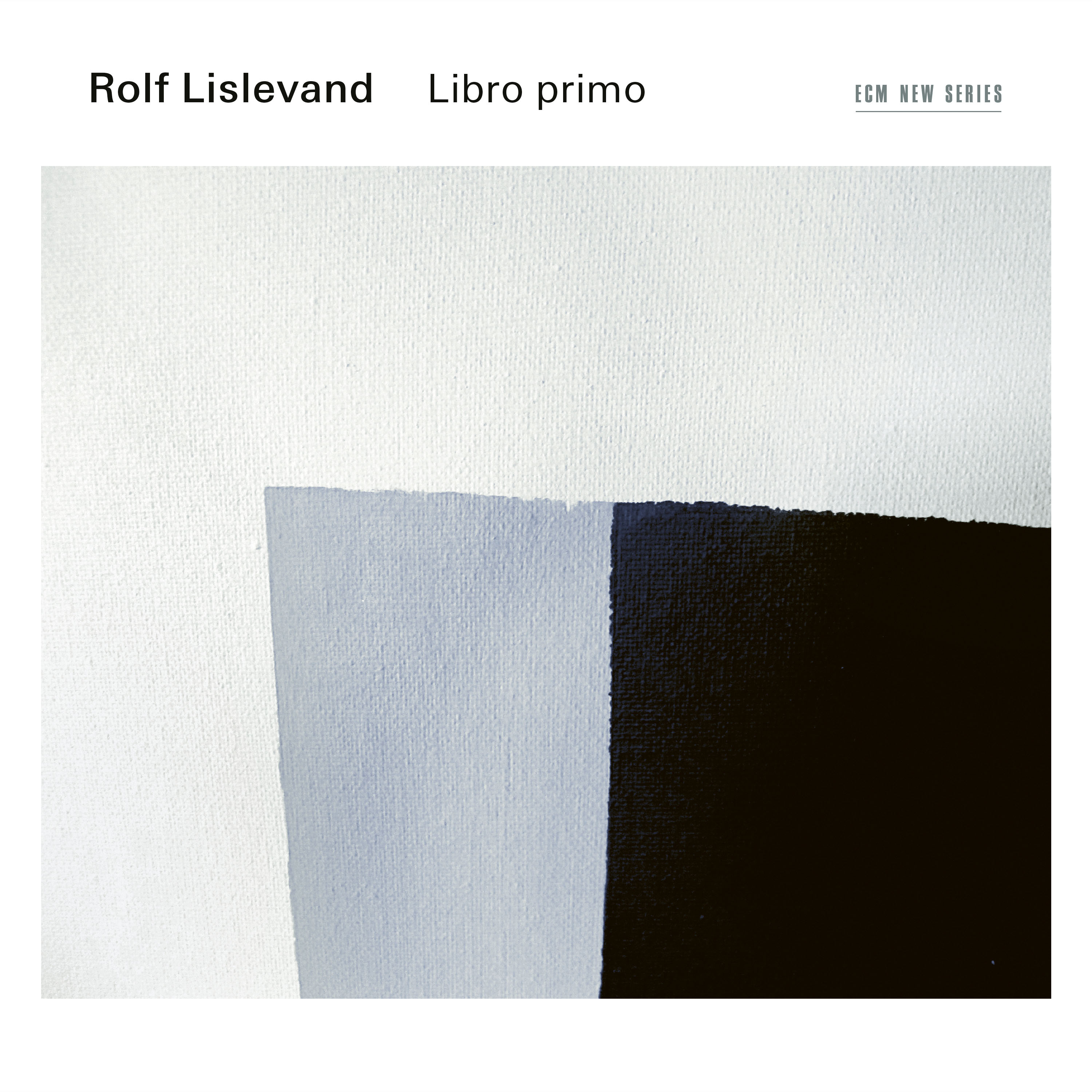
Rolf Lislevand: Libro primo (ECM New Series 2848)

Rolf Lislevand
Libro primo

Rolf Lislevand archlute, chitarrone
Recorded 2022-23
at Moosestudios, Evje, Norway
by Rolf Lislevand
Mixed October 2024
by Manfred Eicher, Rolf Lislevand, and Michael Hinreiner (engineer)
at Bavaria Musikstudios
Cover photo: Fidel Sclavo
Produced by Manfred Eicher and Rolf Lislevand
Release date: August 29, 2025

Nearly a decade after his last appearance on ECM, early music specialist Rolf Lislevand returns to the New Series with another solo program, shifting focus now from the court of Louis XIV to 17th-century Italy. The album’s title is a nod to Il libro primo, a musician or writer’s first volume of works that, as Lislevand notes in the album’s booklet, “can often hold the most inspired and radical creations of an artist.” Like the more formalized Opus primum, it carries a certain creative charge, affording listeners a glimpse into the artist’s most foundational thoughts in a realm of lively experimentation and recalibration of existing rules.

It’s also an exciting realm to explore for proving that the lutenist’s repertoire is far more vast and varied than the fairweather listener may mistake it to be. Take, for example, the program’s two opening works by Johann Hieronymus Kapsberger (c. 1580-1651) and Giovanni Paolo Foscarini (c. 1600-1647). Whereas the former’s Toccata terza greets the dawn like eyelashes fluttering into wakefulness, the latter’s Tasteggiata is its nocturnal other, revealing a strikingly modern atmosphere that Lislevand likens to the French impressionists and even to Carla Bley. Neither characterization is misplaced, given the improvisational elements incorporated into the present renderings, which allow for something ethereally raw to spring forth.

And what of the fantastical arpeggios that open Kapsberger’s Toccata sesta, added by Lislevand and seemingly drawn from the same well? In them is the promise of life and love, all unraveled with a meticulous sort of freedom. The mid-tempo feel of Kapsberger’s Toccata quinta strikes that same balance of flourishing and nourishing, never letting go of the Baroque’s architectural sensibilities.

A highlight is the Corrente con le sue spezzate of Bernardo Gianoncelli (d. c. 1650). Despite being the latest work on the program in terms of publication, dating to the end of his life, it is a veritable flower of a tune. With a clear bass line as pistil and sparkling ornamentations as petals, it sways to the wind of Lislevand’s organic touch. It also epitomizes the nuove musiche approach of the times, which went against the polyphonic grain of the Renaissance by favoring deeper rhythmic interplays through which staid motifs were recontextualized. One might liken such a movement to Hollywood’s propensity to remake its own cultural products, an impulse that (profit motives aside) points to the seemingly universal need to repackage the past in the aesthetics of the new so that audiences can connect to the same emotional content on more immediately relatable terms. 

Thoughtful inclusions are to be found in two Recercadas by Diego Ortiz (c. 1510-1576). Despite their spatial and temporal differences, Lislevand places Ortiz and Kapsberger on the same shelf for their syncopations and expressive colorations. Each spins increasingly complex relationships from deceptively simple beginnings, growing fractally with every reiteration.

Yet the pinnacle for me is Lislevand’s original Passacaglia al modo mio, which is at once a distillation and loving expansion of the passacaglia form. It combines many of the elements found in its surroundings, including a robust “left hand” in the bass and a lithe “right hand” in the overlying melody. It also changes faces multiple times from start to finish, its improvisational layers paying homage to Barbara Strozzi, Bach, Beethoven, and Keith Jarrett. All the while, it maintains a haunting sense of familiarity, especially in the concluding progression, which invites us into its circularity like a child comforted by a mother’s embrace.

Special mention must be made of the recording, captured in a barn in northern Norway by Lislevand himself, engineered by Michael Hinreiner, and mixed by both Lislevand and Hinreiner alongside producer Manfred Eicher in Munich. Although the archlute is primary, some of the pieces originated on the Baroque guitar and chitarrone (or theorbo), which is also played here and distinguished by its darker, more rounded tone. Instead of enveloping these instruments in a wash of artificial sound, the reverb draws out their inner essence with tasteful details of wood and strings.

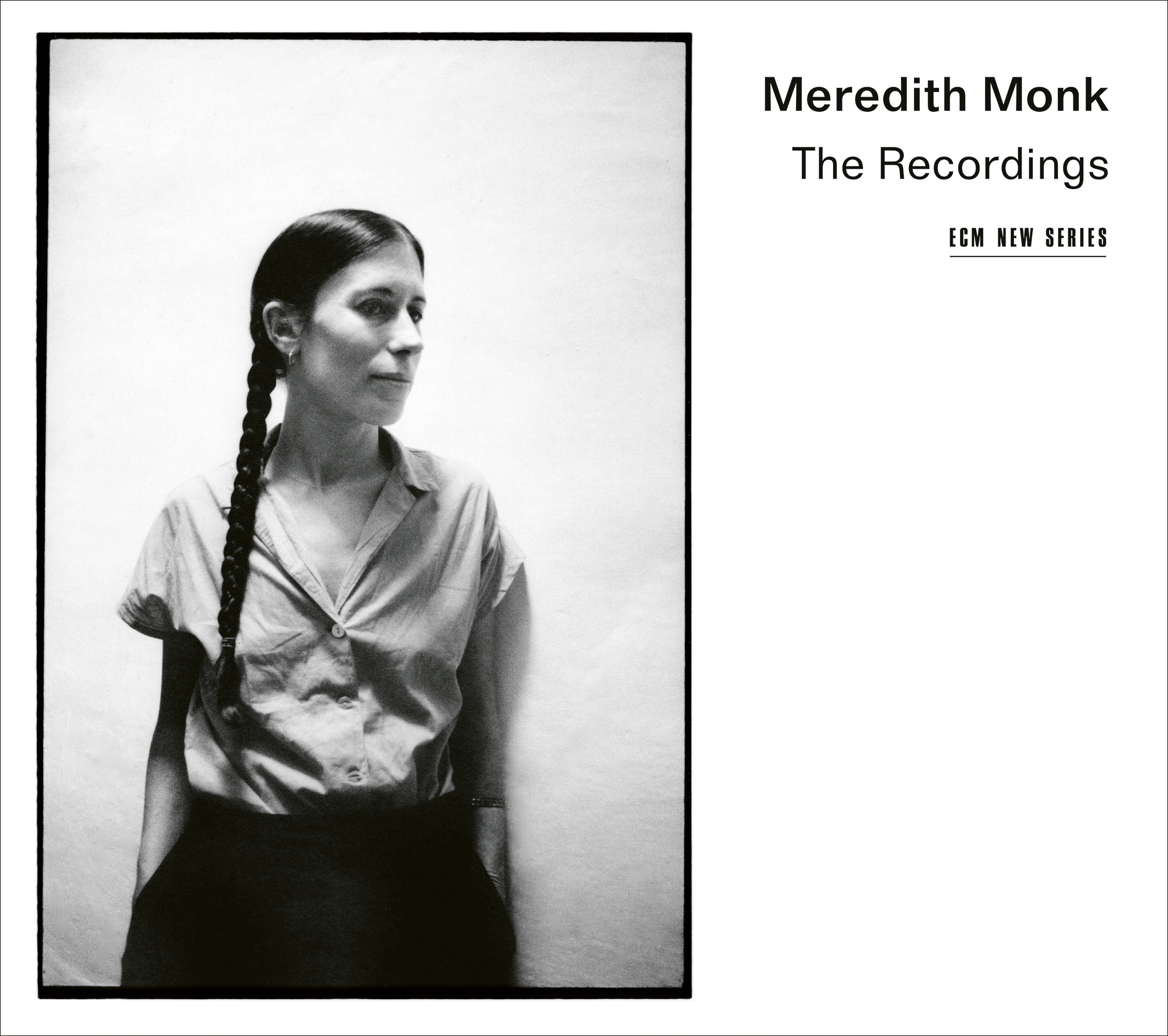
Meredith Monk: The Recordings (ECM New Series 2750)

In November of 2022, ECM released this boxed edition compiling all 12 of Meredith Monk’s New Series discs to celebrate her 80th birthday. The set also includes a 300-page book reprising the original liner notes, along with new texts and interviews, photographs, archival documents, press quotes, and more. The result is more than a commemoration but a testament to the strength of the human spirit to make itself heard even in the face of inevitable entropy.

Manfred Eicher speaks of two important organs in the composer and singer’s oeuvre: their inspiration and their visual quality. In both, she finds a perfect partner in the producer, who has honed this approach across the territories of other singular artists, though none with quite the same combination of whimsy, ritual, and universalism.

In his essay, “The Worlds of Meredith Monk,” Frank J. Oteri characterizes the music as follows: “It paradoxically feels as if it was created at the very beginning of time and yet sounds completely new.” And while the works recorded here are scores in their own right since so much of her output defies standard notation, there is, he observes, a consistency that transcends the frameworks of their articulation. As part of a “living repertoire,” they seek out our ears as if they were extensions of themselves, thoughts on opposite sides of the brain spinning a seemingly impossible neural connection across oceans of time.

In an artist statement titled “The Soul’s Messenger,” Monk speaks of what the voice was able to reveal to her in the absence of its cultural reference points:

“Sometime in the mid 1960s, as I was vocalizing in my studio, I suddenly had a revelation that the voice could have the same flexibility and range of movement as a spine or a foot, and that I could find and build a personal vocabulary for my voice just as one makes movement based on a particular body. I realized then that within the voice are myriad characters, landscapes, colors, textures, ways of producing sound, wordless messages. I intuitively sensed the rich and ancient power of the first human instrument and by exploring its limitless possibilities I felt that I was coming home to my family and my blood.”

In other words, the voice was no longer an expression of the physical; it was physicality incarnate. “I began playing with what a vocal gesture would be,” she continues. “How would the voice jump, spin, spiral, fall? How would I abstract the sound of a laugh, of sobbing, of shouting, into a musical phrase?” Since then, her ”daily work” has not been to refine her singing so much as open it to its unadulterated imperfections, for in them are veins of possibility. These “gifts from a larger and wiser realm” are dug up like archaeological discoveries after long periods of waiting, each an old world made new.

At the age of three, Monk was diagnosed with strabismus, whereupon her mother enrolled her in a Dalcroze eurhythmics program, a technique that integrates music with movement. This experience, she recalls, “influenced everything I’ve done. It’s why dance and movement and film are so integral to my music. It’s why I see music so visually.” It’s also why the body has figured so viscerally in her live performances. Movement, dance, and shaping of sound all come across in the studio, not least of all because of Eicher’s attention to detail and Monk’s willingness to see where it leads. Without the shadow of infirmity hanging in the balance, questions of perfection become self-fulfilling prophecies.

Nowhere is the beauty of being off kilter expressed with such genuine poetry as in 1981’s Dolmen Music. In an excerpt from an interview by Ingo Bierman for his video series ECM50 | 1969-2019, Monk describes working with Eicher on this seminal session and how, after laying down Gotham Lullaby, she recorded a second take after concerns over her voice cracking in the first:

“It was technically perfect, but it really didn’t have that spirit, the kind of magic that the first take had. I have always respected Manfred for recognizing that, because you can edit yourself out of existence and get everything right, but there is something about the emotional continuity that communicates more deeply.”

The chamber program of which it is a part is quite varied and offers as full a portrait of Monk as you’re likely to find in one place. From the koan-like humor of The Tale to the 24-minute title piece, a larger narrative unfolds in almost liturgical fashion, each a step toward mortal awareness, with dashes of urban morbidity thrown in where it counts.

A touching piece of ECM lore worth mentioning is that Collin Walcott was a dear friend and frequent collaborator of Monk early on. He was, in fact, responsible for introducing her to Eicher and served as co-producer for Dolmen Music (playing violin and percussion on the album as well), which, along with Turtle Dreams, was thus shepherded into the ECM New Series stable after the imprint was created.

Speaking of Turtle Dreams, it makes for an enchanting companion. Although Monk’s performances used to confuse critics for their equal incorporation of dance, theater, and music, this 1983 follow-up shows her ethos to be based in the sounding body. Where this album’s predecessor regarded primordial realities, this one reflects the dissonance of living in the city through what she calls “Manhattan folk music.” Its intimate combination of keyboards and voices is nonetheless grand in its emotional scope, a dance with silence that sustains itself on contradictions and their resolutions and leaves room for what she calls “places to breathe, live, and play.”

All of this feels like a prelude to Do You Be. Released in 1987, Monk’s third album for ECM contains a melange of pieces from The Games: a science fiction opera and Acts from Under and Above, while the album’s title piece is from Vessel: an opera epic. Its incorporation of explicit words rather than the liminal spaces of and between feelings with which she was normally concerned places us at the center of a quiet storm of communication. The culminating effect is one of the voice as an instrument of memory, a beacon of futures that come to us as warnings.

Not coincidentally, Book of Days (1990) expands on that metaphor with even greater intensity in reimagining the incidental music to Monk’s film of the same name. Having seen the film, I can confirm its sense of dislocation and engagement with the human condition writ large. The story, set in Medieval times, tells of a young Jewish girl named Eva who is transfixed by visions of the modern world. Finding little comfort in her grandfather’s Torahic interpretations, she seeks solace in a local madwoman before her entire village succumbs to the plague. At the end, workmen who inadvertently unearth the village centuries later find Eva’s clairvoyant drawings of humanity’s demise. More than a soundtrack, the album is cinema in and of itself, morphing into weighted pathos.

Such ruminations of desolation were even more firmly on Monk’s mind when, at the end of 1989, while in residence at the Leighton Artists Colony in Banff, Monk found herself looking out her window at the Canadian Rockies. Despite being there to work on her opera ATLAS, she took inspiration from the scenery and produced a set of a cappella pieces that would become Facing North (1992). Conceived as a duet for her and Robert Een, it is a reflection of a place of cold uncoverings. The opera itself also made its way onto ECM. Over the course of three acts, ATLAS (1993) tells the life of Alexandra Daniels, an explorer who learns that the real journey is internal. This ambitious piece shows a transparent approach to instrumentation. Unlike the bombastic walls of sound that can dominate canonical opera, its accompaniment emerges from within instead of being forced from without. Interestingly, Eicher and Monk decided to cut the opera’s conclusion. “In the live performance,” she admits, “it was a crucial part of the whole. In the audio form, it became more of an epilogue, which seemed to both of us to make too much of a closure instead of letting the listener remain in motion at the end of the journey.” Such is the quintessential expression of movement through music, and how the soul breaks through the cracks in our voices is indicative of the necessity of imperfection to reveal self-worth.

Said cracks run even deeper in Volcano Songs (1997). As manifestations of human archetypes, these metaphysical pieces pay deference to Monk’s ongoing ethos of “always trying to explore forms that balance rigor with freedom.” Her melding with singer Katie Geissinger is astonishing to behold. Another program of strong variety, it includes such vital works as New York Requiem and Three Heavens and Hells, both of which deal with the transience of life and our regard for human suffering. Similar themes are explored in mercy (2002) and Songs of Ascension (2011), both of which represent collaborations with sculptor and installation artist Ann Hamilton. Whereas the former is built around the idea that the mouth can harm as much as heal, the latter was originally performed in an eight-story tower designed by Hamilton. In both, the instruments are just as vocal as the voices (and vice versa) in their explorations of fragility. As I wrote in my original review of mercy, “Monk’s is not a world in which the voice is primary but rather a voice in which the world is primary.” I stand by that statement and would point to these as Exhibits A and B. Nestled between them is 2008’s impermanence. A distinctly chromatic work, it eschews standard narrative in favor of a feeling, a connection to somewhere beyond the immediacy of experience.

Piano Songs, released in 2014, is a remarkable cross-section of Monk’s life and career, with purity and sameness through difference in mind, containing such touchstones as Paris, a piece from 1972 that marks her return to the piano after focusing intensely on the voice, and Ellis Island from 1981, which ties history and memory into one inexorable package. Last is On Behalf of Nature (2016), which speaks for the voiceless, the abused, and the forgotten. It has the most connective tissue of all, bleeding as much through the leaves as from the soil in which they are born.

If any red thread can be said to run through the above tapestry, it is that selves were made to expand. However, part of being human is realizing that with that expansion comes the responsibility of charting our way through all the extra space. With Monk at our side, we can feel sure of placing our feet on loving ground.

Arvo Pärt: Tractus (ECM New Series 2800)

Arvo Pärt
Tractus

Estonian Philharmonic Chamber Choir
Tallinn Chamber Orchestra
Tõnu Kaljuste
 conductor
Recorded September 2022
Methodist Church, Tallinn
Engineer: Tammo Sumera
Design: Sascha Kleis
Produced by Manfred Eicher
Release date: April 25, 2025

“Fear not that thy life shall come to an end,
but rather that it shall never have a beginning.”
–John Henry Newman

The title of Tõnu Kaljuste’s lovingly curated program of works by Estonian composer Arvo Pärt comes from its leading composition, Littlemore Tractus. Like much of what is presented here, it is somewhat older (dating from 2000) but newly arranged by the conductor (in 2022). Scored for mixed choir and orchestra, it dramatizes words from the 1843 sermon “Wisdom and Innocence” preached by John Henry Newman in Littlemore, Oxford. In it, the English cardinal seeks refuge in the Lord, set apart from a world turning circles around its self-interest. Like a tornado in reverse, Pärt’s rendering transitions from destruction to the calm before the storm, serving listeners with something intangible. Even in the seven Greater Antiphons I-VII, a 2015 string arrangement of the Seven Magnificat-Antiphons from 1988, we can feel the tension between that which is touched and that which is felt. Each is a stained glass window, allowing us insight into that one place where light can only reach by grace: the heart. The last of these, “O Emmanuel,” is the magnificence of holiness distilled.

Cantique des degrés for mixed choir and orchestra (1999/2002) is a dynamic setting of Psalm 121, in which David looks to the Lord, ever sustaining and filled with life. Its parabolic structure, from internal to external and back again, ascends the steps to the Temple of Solomon, but casts a final look backward for want of other souls to save. The choir is recessive, never dominating the foreground even at its most glorious. This is followed by Sequentia for string orchestra and percussion (2014/2015). Originally written as part of the Robert Wilson production, Adam’s Passion, it offers a subliminal meditation on Christ’s death, burial, and resurrection. These Words… (2008) is scored for the same combination of instruments. No less expressive for its lack of text, it quotes Pärt’s own Psalom (last heard on 1996’s Litany) as an inward-looking catalyst.

L’abbé Agathon for soprano and string orchestra (2004/2008) is reprised from its appearance on Adam’s Lament in 2012, led by soloist Maria Listra in a much more intimate and contemplative interpretation. Based on a legend from the fourth century regarding an encounter between the Abbot Agathon and a leper (who is really an angel in disguise come to test his faith), it tells the story with programmatic flair, replete with a string-heavy transfiguration as the angel ultimately ascends heavenward.

The album ends with two supplications. Where Veni creator for mixed choir and orchestra (2006/2009) is a deep cry for forgiveness, Vater unser for mixed choir, piano, and string orchestra (2005/2019) sets the Lord’s Prayer. Thus, wisdom and innocence are shown to be things that none of us possesses except by the cross.

This is not music that one discovers but that one welcomes as a gift. From depth to depth, it anoints with the oil of understanding that God is indeed with us, wrathful yet forgiving of the harm we have inflicted upon his creation.