Ketil Bjørnstad: A Suite Of Poems (ECM 2440)

2440 X

Ketil Bjørnstad
A Suite Of Poems

Anneli Drecker voice
Ketil Bjørnstad piano
Recorded June 2016 at Rainbow Studio, Oslo
Engineer: Jan Erik Kongshaug
Produced by Ketil Bjørnstad
Release date: May 18, 2018

Following his song cycles Vinding’s Music and Sunrise, pianist and composer Ketil Bjørnstad expands his ECM presence once again with new settings, this time of words by Norwegian-Danish author Lars Saabye Christensen. Christensen’s verses, written in different hotel rooms and sent to Bjørnstad from around the world, seem destined to take form as the humbly titled A Suite Of Poems presented here.

Bjørnstad’s characteristic feel for texture, mood, and atmosphere is in peak form. In contrast to, say, his duo albums with cellist David Darling, which despite their sparse instrumentation speak of vast landscapes, now the spaces offered to us are astonishingly intimate. Quintessentially so is program opener “Mayflower, New York,” which paints a city recently kissed by rain and the lone tourist moving his pen in its sprawl. Like “Kempinski, Berlin,” it’s filled with small moments, each more personal than the last, as our proverbial traveler balances depth and weightlessness through the music itself. A perennial theme of travel is, of course, explored throughout the album, but so is its inextricable relationship to temporality. In “Duxton, Melbourne,” a tender musing on life’s unstoppable progression, vocalist Anneli Drecker winds her voice around hesitations, missed opportunities, and empty calendars to insightful effect.

A Suite Photo
(From left to right: Lars Saabye Christensen, Ketil Bjørnstad, Anneli Drecker; photo credit: Maria Gossé)

The fatigue of travel is also likened to time passages, and nowhere so poignantly as in “Palazzo Londra, Venice.” Here the narrator looks at his own unrecognizable face in the mirror, unable to connect with the self as he used to. Similar anxieties, as fed through fantastical imagery, haunt “Vier Jahreszeiten, Hamburg.” Ultimately, however, the focus is on details: the lost umbrella of “Mayday Inn, Hong Kong,” the forgotten ashtrays of “Lutetia, Paris,” and the handkerchiefs of “Savoy, Lisbon.”

On the somber end of the spectrum are “L’Hotel, Paris” and “Palace, Copenhagen.” The latter tells of Christensen’s (?) first time stepping into a hotel—on June 23, 1963, to be precise—and finds the boy scared and uncertain of the future. The piano writing is especially passionate, drifting from minor to major as Drecker sings of “the Danish sun behind us whipping up the rain from the cobblestones.” This contrastive dynamic is repeated in “The Grand, Krakow,” the suite’s most hopeful yet shaded turn. Other selections reveal a playful side to Christensen’s wordcraft, and Bjørnstad’s evocation of it. “Astor Crowne, New Orleans” is one whimsical example, in which Drecker navigates a bluesy drinking song.

The suite ends with “Schloss Elmau,” a piano solo that acts as both vessel of remembrance and farewell, a bidirectional portal that inhales the past and exhales the future, all the while praying for respite beyond the reach of any clock.

Erkki-Sven Tüür/Brett Dean: Gesualdo (ECM New Series 2452)

Gesualdo

Erkki-Sven Tüür
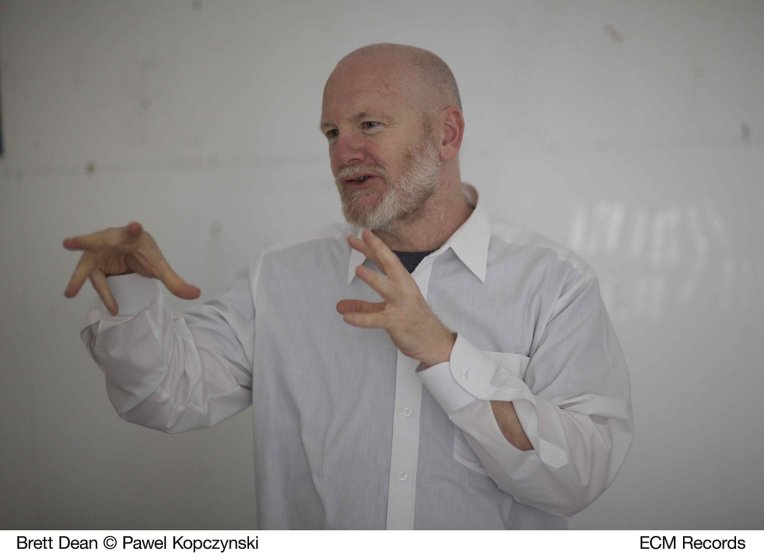
Brett Dean
Gesualdo

Estonian Philharmonic Chamber Choir
Tallinn Chamber Orchestra
Tõnu Kaljuste conductor
Recorded February 2014 at The Tallinn Methodist Church
Engineer: Maido Maadik
Edited and mixed December 2014 by Maido Maadik, Manfred Eicher, Erkki-Sven Tüür, and Tõnu Kaljuste
Produced by Manfred Eicher
Release date: September 18, 2015

I die, alas, in my suffering,
And she who could give me life,
Alas, kills me and will not help me…

These words, originally sung as Moro lassofrom the Sixth Book of Madrigalsby Carlo Gesualdo da Venosa (1566-1613), recede to let their notes carry on alone in a transcription for string orchestra by conductor Tõnu Kaljuste. This inward look, by proxy, of a composer whose trespasses have been relegated to an afterthought by his oeuvre newly emphasizes repentance trickling through the historical cracks. Echoes of that repentence, in both melody and metaphor, ripple across Carlo (1997). Written by Australian composer Brett Dean, here making his ECM debut, it marshals the Estonian Philharmonic Choir and Tallinn Chamber Orchestra via compressions of space and time. As displacements of the original seed multiply, we hear fear and trembling emerging from within, gradually pared down to morbid whispers and cries of pain, as if to recreate the crime scene that would define Gesualdo’s life, so that when his polyphony returns, it feels like self-deprecation.

Tüür

Given that Carlo is somewhat reminiscent of Erkki-Sven Tüür’s Requiem (1994), no other composer would feel so well included to round out the program. Tüür’s own arrangement of the motet O crux benedicta spotlights a younger Gesualdo, allowing a slightly more optimistic glow to escape. This is followed by L’ombra della croce (2014), a piece for strings that exists somewhere between Illusion and Passion (both from 1993), and Psalmody (1993/2011). This last piece draws a line back to In Spe, a prog-rock band Tüür led between 1979 and 1982. As a dialogue between electric piano, orchestra, and choir, it speaks more to the flesh than to the spirit, at the same time fashioning youth into a crucible of nostalgias. Throughout its 22 minutes, one encounters a chronology of Tüür’s compositional development, from architectonic tinkerer to mosaic master. There’s even a touch of American minimalism to keep the experience centered, well aware as Tüür is that music bleeds.

Dean

Because he is one of the ECM New Series’ integral figures, any new Tüür material on disc is cause for celebration. Yet this pairing with Dean exceeds expectation and heralds a true return to form, such that by its end the album reveals itself to be at once a homecoming from, and departure for, a long journey.

O sorrowful fate,
She who could give me life,
Alas, gives me death.

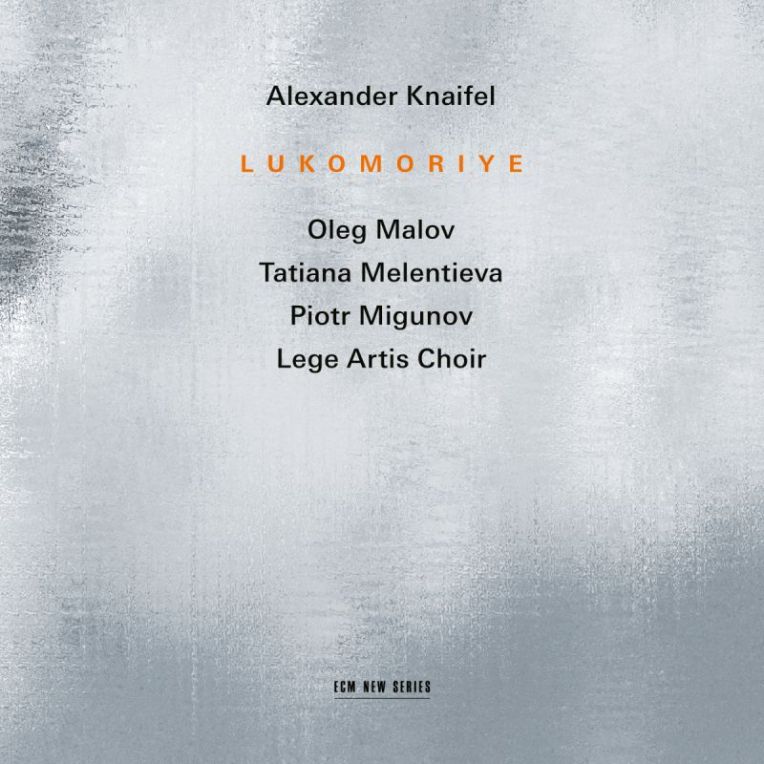
Alexander Knaifel: Lukomoriye (ECM New Series 2436)

Lukomoriye

Alexander Knaifel
Lukomoriye

Oleg Malov piano
Tatiana Melentieva soprano
Piotr Migunov bass
Lege Artis Choir
Boris Abalian conductor
Recorded February 2002 at The Smolny Cathedral, St. Petersburg
Engineer: Victor Dinov (St. Petersburg Recording Studio)
Recording supervision: Alexander Knaifel
Mastering: Boris Alexeev (engineer)
An ECM Production
Release date: April 20, 2018

As the fourth ECM New Series album dedicated to the music of Alexander Knaifel, Lukomoriye is both continuation and departure from previous discs. In the former sense, it pulls us deeper into the recesses of his faith; in the latter, it engages with more secular—though no less inspired—material. The program’s pillars rise from prayers to the Holy Spirit. Both O Comforter (1995) and O Heavenly King (1994) are written for choir, the second adding to that foundational grammar the punctuation of vibraphone and piano. Like Jeremiah in the pit, they look upward for grace. Their bead-like structure welcomes a thread of spiritual seeking, marking the passage of voices from firmament to soil as if to show us that the opposite trajectory is possible.

This Child (1997), played by pianist Oleg Malov, follows the Gospel of St. Luke. It opens with a single chord, played as if at a far corner of the room, before proximate notes finish the sentence. This sets up the Godly call and prophetic response, articulating questions that can only be answered by salvation. O Lord of all my life (2006), sung by bass Piotr Migunov to Malov’s electronically processed accompaniment, bonds itself with stillness. Through its 16 minutes of rewarding intimacy, Migunov sings with a vulnerability that recalls Sergey Yakovenko in Valentin Silvestrov’s Silent Songs. A prayer of St. Ephraim the Syrian, wherein humility is preached, and a poem from Pushkin, wherein idealism is crushed into a sinner’s prayer, render the sonic equivalent of a two-way mirror.

From the Word to the World, we are invited to A mad tea-party (2007), in which a heavily reverbed piano breaks its own suspension by the delicate play of a more immediate instrument, evoking both the frustrations and excitations of this pivotal scene in Lewis Carroll’s Alice’s Adventures in Wonderland. Such contrasts might be counted as child-like impulses were it not for the conscious use of silence, touches of percussion, and whispers. Kindred details abound in Bliss (1997), wherein the composer’s wife, soprano Tatiana Melentieva, revives Pushkin. Her voice masterfully captures every shade of mythological revelry at hand with barest support from Malov at the piano.As in the title composition (written in 2002 and revised in 2009), even fully formed sentences flit through trees like birds in search of a new dawn, taking on the magic of their surroundings as they travel ever inward.

The ghost of Pushkin lingers in Confession (2003/04). Here Malov intones the words inaudibly, exploring love, carnality, and desire through the keyboard instead, every note as delicate as the balance of flesh and glory that every composer faces, yet few of which channel with such humility.

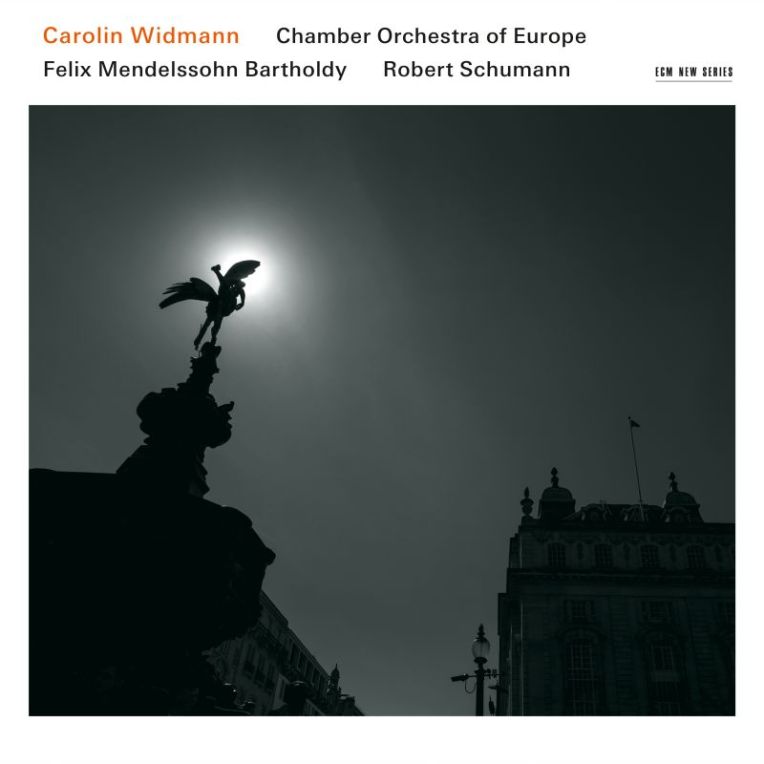
Carolin Widmann: Mendelssohn/Schumann (ECM New Series 2427)

Widmann Mendelssohn

Carolin Widmann
Mendselssohn/Schumann

Carolin Widmann violin, direction
Chamber Orchestra of Europe
Recorded July 2014, Festspielhaus Baden-Baden
Engineer: Rainer Maillard
Produced by Manfred Eicher
Release date: August 26, 2016

Until now, violinist Carolin Widmann has reexamined mostly chamber territories on ECM. For this disc, recorded in 2014 and released two years later, she leads the Chamber Orchestra of Europe as both director and soloist in a program of two marquee-worthy concertos by Felix Mendelssohn Bartholdy and Robert Schumann.

The opening theme of Mendelssohn’s Opus 64, composed in 1844, in addition to being one of the most recognizable in the Romantic violin repertoire, shines from Widmann’s interpretative sun like the dawn. What follows in this monumental movement, marked “Allegro molto appassionato,” is more than fiery sermon of the bow, but a full narrative rich with character development, conflict, and hyperrealism. As Jürg Stenzl writes in his liner notes, Mendelssohn was caught between something of a rock and hard place, unsure of whether to continue in the virtuosic fashion of Paganini or follow the orchestral persuasion of Beethoven. If anything, he struck an unprecedented balance between the two, allowing the soloist to shine while also giving the orchestra something lyrical and texturally relevant to say. The central movement—an Andante leading into a transitional Allegretto—is a lyrical bridge to the famous finale, across delicate leaps of intuition turn into robust statements of purpose. Playfulness undergirds every chromatic arc and emboldens Widmann’s benchmark performance with a subtle combination of grit and fluidity. That each of these three movements is shorter than the last is indicative of a distilling approach, whereby the composer peels away one unnecessary layer after another until an unblemished fruit remains.

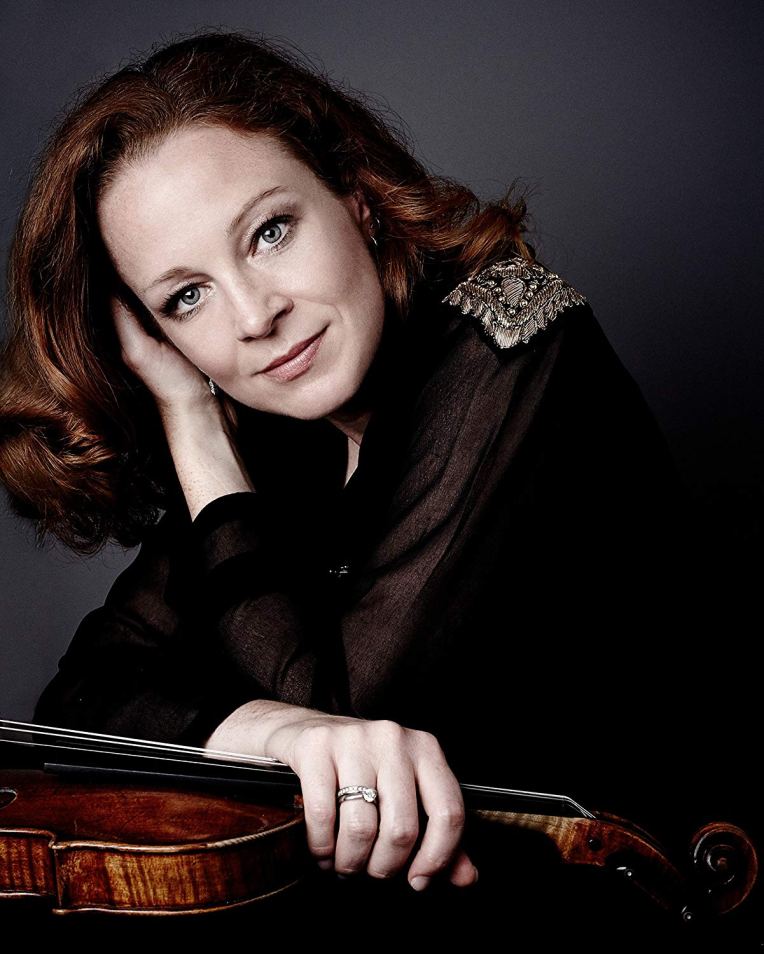
CW
(Photo credit: Lennard Rühle)

Schumann’s concerto of 1853, unlike Mendelssohn’s widely heralded masterpiece, went unpublished until 1937, dismissed as it was along with his late works as insubstantial. How much of that perception was due to musicological analysis and how much to a growing mythos around his mental downfall is difficult to quantify. Following in the immediate wake of his Opus 31 Fantasy, the concerto is both a return to form and an eschewing of it. If Mendelssohn’s first movement was a short story, then Schumann’s is a novella. Yet despite it gargantuan form, taking up nearly 16 minutes of duration in the present performance, it leaves more than enough room for the listener to find solace, reflection, and understanding. And despite its many colors, there’s a certain trustworthiness to its flow, as emphasized by Widmann’s choices of tempo and dynamics. The second movement, designated “Langsam” (slow), nevertheless speaks with urgency, while the restrained third dances but always keeps one foot on the ground. With bolder, more jagged lines, Schumann expands his vocabulary in and through the score. Widmann’s translations thereof make it understandable in any language.

Gavin Bryars: The Fifth Century (ECM New Series 2405)

The Fifth Century

Gavin Bryars
The Fifth Century

PRISM Quartet
Timothy McAllister soprano saxophone
Robert Young alto saxophone
Matthew Levy tenor saxophone
Taimur Sullivan baritone saxophone
The Crossing
Donald Nally conductor
John Grecia piano
The Fifth Century was recorded July 2014 at Gould Hall, Curtis Institute of Music, Philadelphia
Two Love Songs was recorded June 2015 at Saint Paul’s Episcopal Church, Philadelphia
Engineers: Andreas K. Meyer and Paul Vazquez (Digital Mission Audio Services)
An ECM Production
Release date: November 18, 2016

A shepherd, soldier, and divine,
A judge, a courtier, and a king,
Priest, angel, prophet, oracle, did shine
At once when he did sing.
Philosopher and poet too
Did in his melody appear;
All these in him did please the view
Of those that did his heavenly music hear:
And every drop that from his flowing quill
Came down, did all the world with nectar fill.
–Thomas Traherne

Before this 2016 release, the last ECM New Series album dedicated solely to composer Gavin Bryars was the 1994 masterpiece Vita Nova. What both discs lack in temporal proximity, however, they make up for in philosophical overlap.

Thomas Traherne’s Centuries of Meditations, written in the 17th century, yields the 2014 title composition. Scored for choir and saxophone quartet, this setting of a long-unknown English theologian distills what he calls the “essence of God” from glorious creation. The fifth and final century of Traherne’s mystical treatise examines relationships between finite bodies and infinite space, knowledge and ignorance, intimacy and grandeur: dichotomies Bryars has explored in And So Ended Kant’s Traveling In This World (1997) and Glorious Hill (1988), among others. The combination of reeds and voices is as seamless as it is variegated, leaving behind a trail so distinct as to feel antique. That said, the saxophone quartet is subdued in its presence and function, serving as guide rather than commentator, and reaching peak integration in the fifth of seven sections. Performed by the PRISM Quartet and The Crossing, under the direction of Donald Nally, these motifs carry enough weight to exist on their own yet cohere like a sacred text in which is wasted not a single word. While the poetry is rich throughout, the first lines of section III epitomizes the spirit of the piece: “Infinity of space is like a painter’s table, prepared for the ground and field of those colours that are to be laid thereon.” This echoes a theme laid out in the opening of Centuries proper: “An empty book is like an Infant’s Soul, in which anything may  be written. It is capable of all things, but containeth nothing.” Bryars evokes this very sense of purity corrupted by flesh in his harmonies, which remind us that dissonance can be beautiful when interpretation is treated as an act of humility rather than pride. And in that humility Bryars, like Traherne, finds joy.

Alongside this cathedral stand the smaller Two Love Songs. These 2010 settings for female choir of sonnets by Petrarch, a personal favorite of the composer, draw a dotted line between the Italian madrigal tradition and the melodic vibrancy of the language itself, which shimmers in the second song, “Solo et pensoso.” Here soloists Kelly Ann Bixby, Karen Blanchard, and Rebecca Siler arise like relics from a receding ocean in a world run dry with passion for want of transfiguration.

Kim Kashkashian: Arcanum (ECM New Series 2375)

2375 X

Kim Kashkashian
Arcanum

Kim Kashkashian viola
Lera Auerbach piano
Recorded October 2013, Radio Studio DRS, Zürich
Engineer: Peter Laenger
Produced by Manfred Eicher
Release date: September 30, 2016

The 24 Preludes, Op. 34, of Dmitri Shostakovich (1906-1975), not to be confused with his 24 Preludes and Fugues, Op. 87, comprise the first half of this fascinating diptych. Transcribed for viola and piano in 2010 by Russian composer Lera Auerbach (b. 1973), and rendered by Auerbach at the keyboard with Kim Kashkashian on the viola, the resulting forest of sound is one into which the listener is immediately dropped via chromatic parachute. The tone is familiar, comforting, and wise, dreaming in its C major cradle like the foundation of the world. Although there are certainly jagged choreographies to be savored (e.g., Nos. 5 in D major, 9 in E major, and 18 in F minor) such as only Shostakovich could have devised, a deeply felt sense of humor balances the spectrum in Nos. 6 (B minor), 9 (E major), and 15 (D-flat major). Kashkashian’s uncanny connection to her instrument is resolutely expressed in the lyrical turns of No. 7 (A major) and 17 (A-flat major). Yet whether marching through the thicker settlements of Nos. 13 (F-sharp major) and 14 (E-flat minor) or dancing joyfully in 24 (D minor), she keeps her ears as open as possible to opportunities of freedom.

Drawing out lines of articulation from within the piano’s own vocabulary and grafting them onto the viola is no small task, given their divergence of material articulation, and Auerbach has accomplished something subtle and wonderful with respect to her source. Highlights in this regard include the Prelude No. 21 in B-flat major, which holds its ground in the cross-current of interpretation, and 23 in F major, wherein Kashkashian’s pliant tone and color blossom remarkably well.

Our forward-leaning duo follows with the Auerbach composition from which this album gets its name. Written in 2013 and dedicated to Kashkashian, it shows an intimate understanding of the viola’s internal vocabulary. In an interview with NHK Television in Tokyo, excerpts of which are included in the CD booklet, Kashkashian describes the title as referring to “some knowledge that we have, which we may not necessarily verbalize or rationalize. This knowledge allows us to see the truth, to be guided, to seek answers.” Thus, Auerbach walks between knowing and unknowing, favoring pregnant questions over barren answers. Like the viola itself, it exists comfortably in a liminal space. Above all, it is a transfiguration of thoughts into notecraft. The first movement, marked “Advenio”(meaning “to arrive at”), defines itself in real time, content in the narrative potential of every moment. Its pauses speak volumes while its utterances waste no breath of meaning. The second movement, “Cinis” (“ashes”), treats darkness as tenderness, lifting tears from the face they cling to like decals in search of order. Its implications, almost fully formed, hang from the viola’s guttural dips and falsetto highs. “Postremo” (“at last”) embodies a thematic impatience as if trying to become the very object of its own desire. Through a linguistic approach to tempi, it unfurls a mosaic of neural pathways, as does the fourth and final movement, “Adempte” (“to rescue”), which indeed brings salvific understandings to bear upon karmic falsehoods. Like a pyramid carved in negative space, it embraces geometry as a way of life—a sensibility perhaps informed by Auerbach’s experience as a sculptor. Either way, she understands music’s physical consequences.

Tõnu Kõrvits: Mirror (ECM New Series 2327)

Mirror

Tõnu Kõrvits
Mirror

Anja Lechner violoncello
Kadri Voorand voice
Tõnu Kõrvits kannel
Tallinn Chamber Orchestra
Estonian Philharmonic Chamber Choir
Tõnu Kaljuste conductor
Recorded February 2013, Methodist Church, Tallinn
Recording engineer: Tanel Klesment
Mixed December 2014 in Tallinn by Maido Maadik, Manfred Eicher, Tõnu Kõrvits, and Tõnu Kaljuste
Produced by Manfred Eicher
Release date: March 18, 2016

Meticulously, motionlessly, secretly, he wrought in time his lofty, invisible labyrinth…. He eliminated certain symbols as over-obvious, such as the repeated striking of the clock, the music. Nothing hurried him. He omitted, he condensed, he amplified.
–Jorge Luis Borges, “The Secret Miracle”

Mirror documents a specially curated performance of music by Estonian composer Tõnu Kõrvits given on February 6, 2013. From a composer of great variety, here we find a microscopic array built around Estonia’s choral heritage. With particular emphasis on the music of Veljo Tormis, whom Paul Griffiths in his liner notes affirms “was evidently a father figure for Kõrvits, and there is something in this recording of a tradition being received by one generation from another,” the program treats human voices as expressions of soil and soul. Griffiths goes on to describe Tormis’s instinct to fortify what makes Estonia’s choral music unlike any other—a politically subversive move in a country wrapped in Soviet chains for much of the elder composer’s life. Such independent spirit peeks through the veneer of history in Peegeldused Tasasest Maast (Reflections from a Plainland). Written in 2013 for cello and choir, it is a fantasy on a song by Veljo Tormis with words by political poet Paul-Eerik Rummo. With a transparency as only the Estonian Philharmonic Chamber Choir can evoke, the voices weave a tapestry of shimmering shadows while the cello of Anja Lechner keeps them tethered like a prayer to earth-hugging flesh. A touch of kannel, an Estonian zither played her by Kõrvits himself, at the end foreshadows the instrument’s foregrounded presence in Tasase Maa Laul (Song of the Plainland). Cushioned in the forested voice of Kadri Voorand, this 2008 composition’s cries for peace and stability, planted in distant plains, reflect upon the suite for strings between them. Dating from 2010, Labürindid (Labyrinths) is as intimate as it is wide-ranging in feel and color, and shares a possible affinity with Erki-Sven Tüür, if in a more delicate vein. Over the course of seven parts, the last of which is like the watering of the preceding six seeds, Kõrvits paints with every bow in compound strokes of emotional transference.

Seitsme Linnu Seitse Und (Seven Dreams of Seven Birds) for cello, choir and strings, sets words by Maarja Kangro and Tõnu Kõrvits. Dating from 2009 and revised in 2012, this textural wonder, rightly described by Griffiths as “at once a choral suite and cello concerto,” finds voices stretched like a sky-blue page for Lechner’s avian cursive. Also in seven parts, it opens with fully formed life. The third part, which features a cello cadenza amid the whistling choir, is a dawn chorus in reverse, while the seventh shows unity through variation. Lechner’s playing, as always, is thoroughly considered, free yet controlled. As a translator, she understands what Kõrvits has not written into the score and draws out that subtext with utmost respect.

The last choral work is the Tormis-inspired Viimane Laev (The Last Ship). From 2008, its scoring for male choir, bass drum and strings, with words by Juhan Smuul, elicits a somber drama. Like Tormis’s finest oceanic excursions, including 1979’s Songs Of The Ancient Sea and 1983’s Singing Aboard Ship, it describes through the process of being described. Our postlude comes in the form of Laul (Song). Originally composed in 2012 for cello and (mostly pizzicato) strings, then revised for this performance, it is a fully contoured channel from light into darkness.

As in the Borges quote above, Kõrvits is one who reduces rather than elaborates. His notecraft is smooth as bone, given tendons and nerves through the listening.

Rolf Lislevand: La Mascarade (ECM New Series 2288)

La Mascarade

Rolf Lislevand
La Mascarade

Rolf Lislevand Baroque guitar, theorbo
Recorded April 2012, Auditorio Stelio Molo, Lugano
Engineer: Stefano Amerio
Produced by Manfred Eicher
Release date: May 20, 2016

Featuring music by Robert de Visée (ca. 1655-1732/33) and Francesco Corbetta (ca. 1615-1681), guitarist-composers in the employ of Louis XIV, this under-the-radar gem from ECM’s New Series finds Rolf Lislevand charting the divergent territories of the theorbo and Baroque guitar in a cross-hatched program.

Lislevand 1

De Visée’s sense of tactility is evident not only in Lislevand’s interpretations, but also in the writing itself. In Les Sylvains de Mr. Couperin and, especially, the piece from which the album derives its name, the theorbo’s emotional reach is fully examined. Their sounds are intimately connected to speech. “The dominant linguistic elements of French,” the performer writes, “are all there: the length of the musical syllables, the accents, created artificially by the ornaments, and above all the short, gestural, interleaved phrases constructed in a very clear rhetorical logic.” In this tongue he speaks semi-conversationally—never debating in the interest of affirmation but rather walking hand-in-hand around a question that chooses not to define its existence by an answer. The Chaconne en sol majeur is a masterstroke in this precise regard, laying down sonic sentences across a bridge of charm.

Lislevand 2

Corbetta, who served as de Visée’s teacher, flits above his own reflection in relatively whimsical yet philosophically inflected journeys. In the brilliant Partie de Chaconne en ut majeur, one can hear shades of the Iberian Peninsula, flamenco-like drama, and heart palpitations in a single strum. The focus on chording over individual voicings lends a dream-like quality. Indeed, whereas de Visée seems concerned with waking fantasies, here the colors are drawn from a whimsical font such as only closed eyes could contain. In this sense, the Caprice de Chaconne manifests the album’s most corporeal interests. Rooted as much in past as in future, it smiles as if to confirm the present moment as a magic of its own making. Not unlike the briefer Folie, it shines most when pausing for effect.

Here and there, Lislevand adds his own tasteful pieces, such as the “Intros” to Corbetta’sPassacaille en sol mineur and de Visée’s Passacaille en si mineur. They exist to strengthen an underlying sense of architecture, as indicative of a meticulous attention to time and its relationship to space. In service of that assessment, engineer Stefano Amerio went to great pains to recreate the halls of Versailles, where every inner detail of these instruments would likewise have blossomed like the hearts of those hearing them. Let those reverberations till the soil of yours in kind.

Eleni Karaindrou: David (ECM New Series 2221)

David

Eleni Karaindrou
David

Kim Kashkashian viola
Irini Karagianni mezzo-soprano
Tassis Christoyannopoulos baritone
Vangelis Christopoulos oboe
Stella Gadedi flute
Marie-Cécile Boulard clarinet
Sonia Pisk bassoon
Vangelis Skouras French horn
Sokratis Anthis trumpet
Maria Bildea harp
Katerina Ktona harpsichord
ERT Choir
Antonis Kontogeorgiou choirmaster
Camerata Orchestra
Alexandros Myrat conductor
Concert production: The Athens Concert Hall
Recorded live November 19, 2010 at Megaron (Hall of the Friends of Music), Athens
Recording engineer: Nikos Espialidis
Assistants: Bobby Blazoudakis, Alex Aretaios, and George Mathioudakis
Edited and mixed March 2016 by Manfred Eicher and Nikos Espialidis
Mastering engineer: Peter DePian
Produced by Manfred Eicher
Release date: November 18, 2016

The theatrical text of Davidcomes to us by way of an anonymous poet from Chios Island. After its rediscovery, it was published in 1979 in a critical edition by Thomas Papadopoulos of the Bibliotheca Vallicelliana, and premiered with music by Eleni Karaindrou the following year. Here it is documented in full from a performance in November 2010, given as part of a three-day celebration in honor of Karaindrou and her work.

Despite a Catholic sheen, Davidis sprinkled with comic touches, popular locutions, and lyricism, as many such stage dramas would have been in the 18th century when it was written. The “Overture” opens the door into a characteristically three-dimensional world. Between the pointillist harp (Maria Bildea) and legato viola (Kim Kashkashian), it describes enough space for the orchestra, flute, harpsichord, and oboe to leave their traces across the sky in a message—as yet wordless—that renders the world beneath it a tesseract for moral transfigurations. From this garden emerges the instrumental flowers of “Repentance” and “Compassion,” which together reveal a pasture dotted with the footsteps of our titular protagonist. The first blush of song comes in the form of “Devils.” In this indulgent tune, baritoneTassis Christoyannopolous frolics through an itinerary of exuberant accomplishments, thus shoring up a house of words against the winds of change about to blow. Through deft use of choir, which magnifies his self-inflation, Karaindrou mirrors the feel of an opera buffa, rifling through scenes as if in an emotional flipbook.

“David’s Entrance” softens the landing of mezzo-soprano Irini Karagianni, whose rounded tone offers solace by contrast in “The Good Things in Life,” a somber reflection on the fleeting nature of our existence. Of all the good that passes by, she sings, may hearts latch on the residue and other virtues let go so calm and slow. This is followed by the beauties of “When I See,” in which Karagianni’s voice reveals a deeper, more dramatic palette that eerily recalls the soundtracks of Zbigniew Preisner. Equally concerned with ephemeral things, its tenderness reverberates in “David’s Lament,” wherein Christoyannopolous and choir link a chain of calls and responses, dripping with regret: Hear my dirge, o woods, listen and sorrow. And at my funeral, trees, grieve and wilt.

In “Psaltes,” the climate darkens into a vesper. Sounding like a Gregorian chant, its concern with wonders balances the depressions that precede it: May these fires burn the spirits; may the arrogance of fear now cease. After a trumpeted “Procession,” we find ourselves swaddled in the beauty of “Angel,” wherein divinely personified virtue takes flight in harp and strings: May your sweet trills make mortals awaken and studiously your company take pains to follow. Even more processional, however, is the grand “Finale.” Here the Holy Trinity is invoked as the choir marches to Jerusalem in search of grace and calmer breezes.

Although one needn’t have the translations at their disposal to enjoy its pastiche, David is best appreciated with the CD booklet in hand, so that its finer nuances leap forthright into the very place where its sounds begin and end: the center of the heart.