Keith Jarrett: Sacred Hymns of G. I. Gurdjieff (ECM 1174)

ECM 1174

Keith Jarrett
Sacred Hymns of G. I. Gurdjieff

Keith Jarrett piano
Recorded March 1980, Tonstudio Bauer, Ludwigsburg
Engineer: Martin Wieland
Produced by Manfred Eicher

The exact date on which George Ivanovich Gurdjieff was born into this world is unknown. This is fitting, for to one who spent his life trying to unravel it, such mundane details would have been unnecessary in the grander scheme of things. Born in Armenia to a Greek father and Armenian mother, Gurdjieff traveled the world in search of fabled monasteries and the secrets they contained. Unlike many before and since, he succeeded. Yet more unlike many before and since, he packed that knowledge into his somatic consciousness until it burst like a supernova. Biographer John Shirley likens the Gurdjieff encounter to a cold shower, “a welcome shock of wakefulness” that leaves its deep, indelible traces in body and soul. Music was the dark matter of his cosmology and operated at the whim of an inarticulable law by which the listener felt compelled to turn oneself inside out, loosing previously bottled emotions into the open stars. Music was vibration, and vibration was life itself. In the hands of an artist like Keith Jarrett, I daresay it becomes something more.

Composed during Gurdjieff’s so-called “second period,” the music on this album arose from a fruitful block of the 1920s, which saw him and Russian composer Thomas de Hartmann together producing a treasure trove of melodies drawn from various folk music traditions and Russian Orthodoxy. The resulting selections are understatedly suited to Jarrett, spun as they seem to be from the kindred methodology behind his own solo improvisations, which construct from the ground down glorious caverns of sound, melody, and spirit. The strains of “Reading Of Sacred Books,” for example, unfold ever so gently, and yet rather than unveiling new territory simply open more and more doors within, each the mirror to a different face of our psyche. Ceremony and despair share the same sky; exaltations and poverty, the same ground. Each of these living moments winds itself like a string around the finger of spiritual forgetting. Jarrett negotiates these stark contrasts, and the connective tissue between them, with unwavering attention. Just listening to the brilliance with which he dialogues the punctuations of “Hymn To The Endless Creator” with the Debussean meditations of “Hymn From A Great Temple” and “The Story Of The Resurrection Of Christ” is wonder in and of itself. “Holy Affirming—Holy Denying—Holy Reconciling” perfectly describes the tripartite process of becoming that Jarrett enacts throughout, leaving us suspended in the final “Meditation.”

From the titles alone, one might think of these pieces as incidental music, when in fact the music is its own ritual, a collection of hymns to itself in a mise-en-abyme of faith. It is a multifaceted jewel of loosely bound energy that finds joy in emptiness. With due assurance and temerity, Jarrett proves it’s not music that is its own religion, but religion that is its own music.

<< Ralph Towner: Solo Concert (ECM 1173)
>> Keith Jarrett: The Celestial Hawk (ECM 1175)

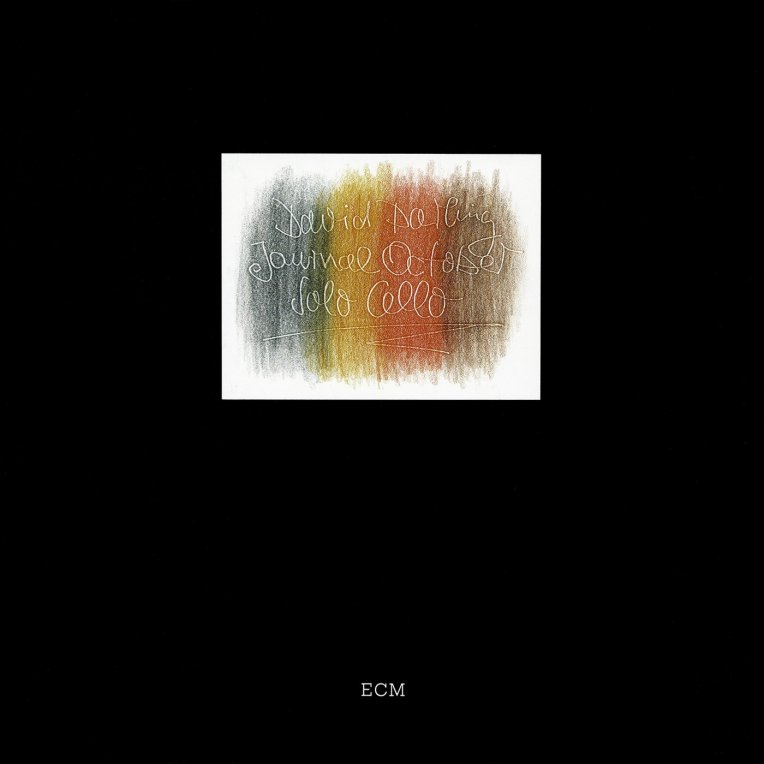
David Darling: Journal October (ECM 1161)

ECM 1161

David Darling
Journal October

David Darling acoustic and electric cello, voice, percussion
Recorded October 1979 at Tonstudio Bauer, Ludwigsburg
Engineer: Martin Wieland
Produced by Manfred Eicher

Having recently seen the film adaptation of James Redfield’s The Celestine Prophecy, which cycles through the book’s eight manifold insights on the path to another, the number nine is fresh in my mind. And so, as I pore through the sonic pages of David Darling’s Journal October on this fallen winter night, I inevitably see each of its nine tracks as an insight in and of itself. Darling’s music is one of ECM’s most invaluable treasures, and one could hardly find anything more beautiful than what he has left behind in its archive. His electric cello bays like a resurrected voice, an insight in and of itself into the lucidity of “Slow Return.” This introductory track is also the longest, drawing every jagged line like the echo of a mountainous horizon. From this potent doorway issues a host of transient forms.

Darling shifts the chronology of his recollections, grafting each to the new experiences of these studio performances. Their breath fills the album’s two solo cello improvisations, each of which cycles through grief’s most harrowing stages toward an inner peace. Rapture comes through in his involuntary vocalizations, in the dissonances that feed them. Darling foregrounds his body in “Solo Cello And Voice,” a self-division of high reaches and archaeological digs, while “Far Away Lights” gives us a taste of his pizzicato technique, which on his electric cello resounds like a tambura undone.

Two Darling touchstones—“Minor Blue” and “Clouds”—also make their first appearance in Journal October, both revisited in his masterful 8-String Religion. The former comes across with more impactful effect, less obscured by gossamer veils of reverb. The latter’s rocking ostinato buoys atmospheric vocals with vulnerable clarity, amplified harmonics ringing out with all the power of a waterfall compressed into a single string. The closing piece sails like an entire biography gathered into one vessel. Notes ascend into birdcalls, circling a teetering falsetto that reshapes the drone dynamic as one suspended rather than suspending.

This album began a walkabout of sorts that has borne some of ECM’s most humbling revelations. Such sounds still the heart and lure our inner eyes with their slow-motion lobs. Darling clears out the detritus of arrangement, the ornaments of song, and the obligations of tradition, forging an improvisatory path that is all his own. It may be trimmer than his later treks along more fluid paths, but his subtle intensities are all there, waiting to embrace the next aching spirit that comes along.

<< Steve Swallow: Home (ECM 1160)
>> Sam Rivers: Contrasts (ECM 1162)

Translating Time: Leonidas Kavakos Concert Review

Time
in places
becomes
so thin
you can see
through its
fading material.
–Lera Auerbach

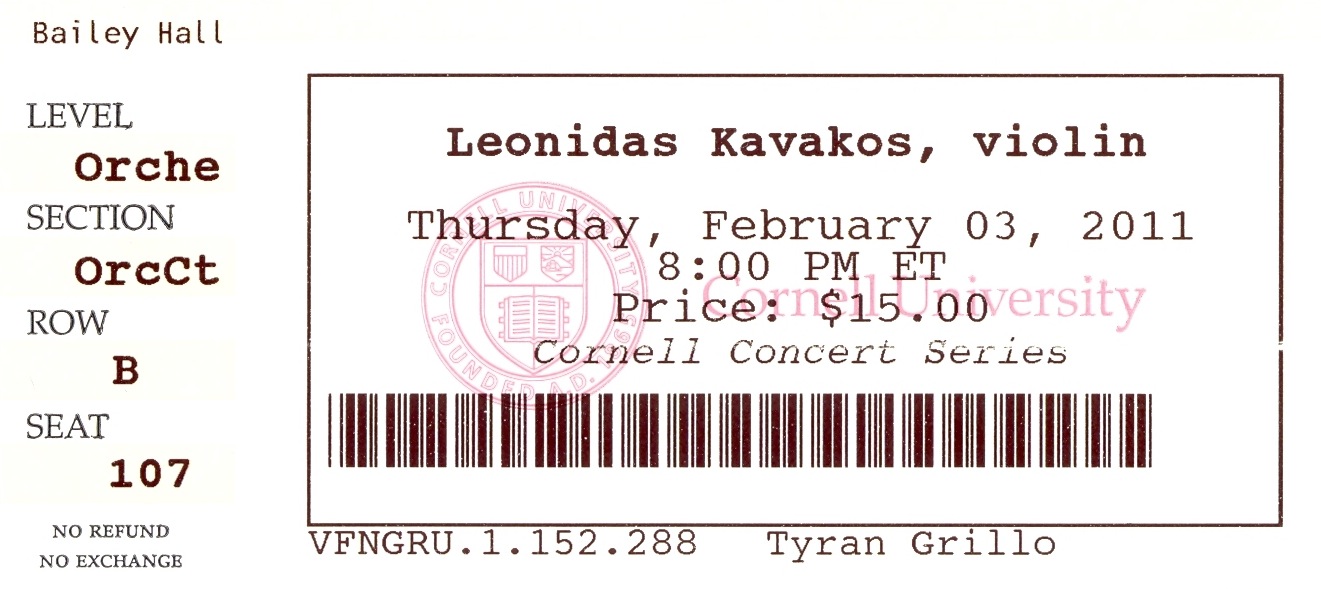
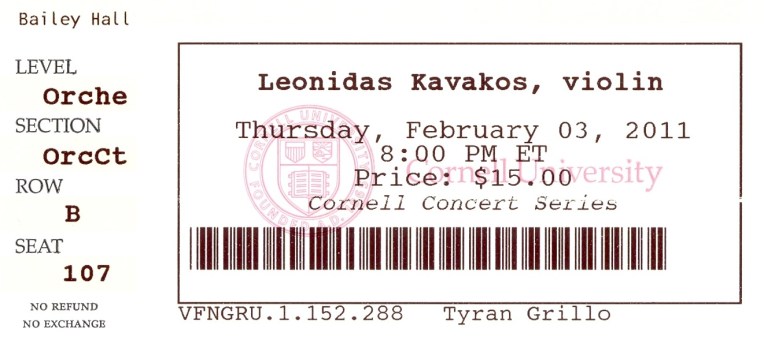
On Thursday, 3 February 2011, Cornell University’s Bailey Hall was graced by one of the world’s preeminent violinists. Having achieved this status through, among many other accomplishments, standout readings of Ravel’s Tzigane and the neglected works of Enescu (ECM, 2003) as well as his award-winning violin concertos of Sibelius (Bis, 1992) and Mendelssohn (Sony Classics, 2009), Athens-born Leonidas Kavakos has charted a rich swath of sonic territory. And therein lies the rub. With such a hefty cache of threads from which to spin his musical webs, a musician of Kavakos’s stature is faced with an unenviable amount of repertory choices. In a day and age when contemporary music is undergoing a deep shift into uncertainties and sometimes less-than-successful pastiches, this means a mounting challenge to give voice to underrepresented composers. Enter the music of Lera Auerbach, from whose Preludes for Violin and Piano, Op. 46 Kavakos and his accompanist, Enrico Pace, offered a hefty selection at the heart of the evening’s performance.
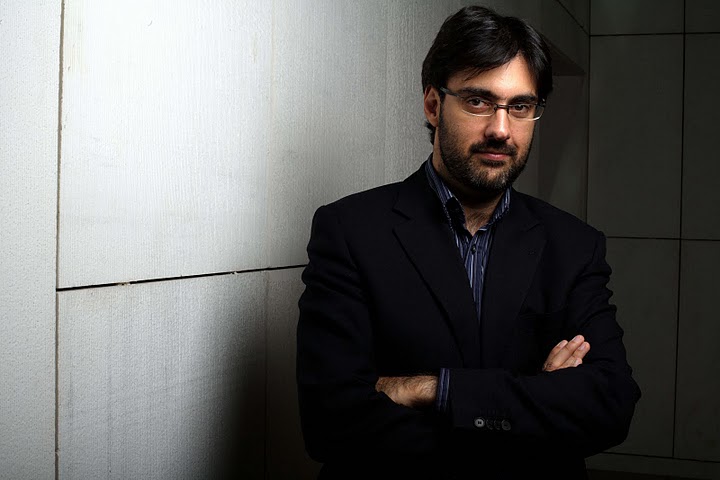
Leonidas Kavakos (Tchaikovsky Competition publicity photo)

Born in 1973 on the Siberian border and sufficiently endowed with the gifts of her predecessors (Schnittke comes immediately to mind) and contemporaries (particularly Kancheli and Silvestrov) alike, Auerbach has emerged as one of her generation’s most influential voices. She is also an accomplished poet in her native Russia, where her writings have already been incorporated into literary curricula as required reading. To be sure, the Preludes speak with a grammar uniquely their own. That being said, listeners of the parenthetically aforementioned may find her motivic paths well-worn. At some moments deliberately contrived and at others innocent, the Preludes have been called a Well-Tempered Clavier for the 21st century. Such comparisons do nothing, however, to obscure what is already her rather cloudy aesthetic.

Since composing her first major opera at age 12, Auerbach has been no stranger to the complexities of vocal representation, but negotiating the “voice” of a single violin set against its most intimate partner, the piano, is a poetry in and of itself. Hers is what I might call “postludinal incidentalism.” Put another way, the music plays like a requiem for one who has yet to pass, and nowhere more so than in the fleeting march that was the Prelude No. 1. Its metronomic beginnings and breathy ascents set the tonal contrasts for all that followed. The strident yet haunting pianism of No. 18 unraveled what Kavakos could not with merely four strings at his disposal. From the long sustains of No. 20 to the pseudo-romanticism of No. 12, each contributed a potent cell to the overall kaleidoscopic effect. Also intriguing were the morose etude-like scales of No. 16 and the turbulent Bach deconstruction built into No. 24.
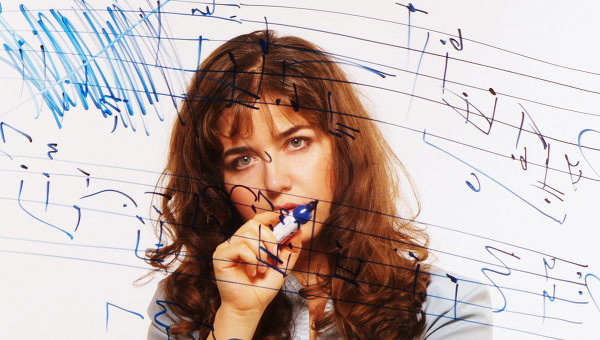
Lera Auerbach (photo courtesy of Auerbach’s official site)

Auerbach is a force to be reckoned with and one well adjusted to discerning contemporary audiences. Her plurivocity engulfs but never dominates. Unfortunately, many of her subtleties were lost in the shadows of the program’s opener. The origins of Prokofiev’s weighty Sonata No. 1 in F minor, Op. 80 in Stalinist Russia tend to mask this admittedly despondent work with associations of darkness and deprecation. Such interpretations are only underscored by the composer, who himself characterized the piece’s most recognizable motifs as “wind passing through a graveyard.” In the hands of our consummate duo, said wind was stilled in the eye of a storm that one could see but could not hear. The sonata’s four movements consisted of two pairs of Andantes followed by brisker counterparts. The funereal mood of the first struggled to hold its resolve in the glare of Kavakos’s glistening trills. Every double stop felt like an internal conversation over Pace’s Debussean tintinnabulations. The ensuing Allegro was pulled off with gusto. Staggered rhythms and crunchy arpeggios popped with requisite verve while a seesawing motif on the D and A strings seemed to caress the violin’s very architecture. And as the horsehairs went flying, I began to hear the music not as a conservation so much as conversion—from sentiment to statement, and from thought to action. The undulations of the third movement were accentuated by highs that glowed like hand-blown glass. So angelic was this passage that the final movement came almost as a shock, so that one now looked back on the Andantes as unrecoverable catharses. It also harbored an unexpected moment of whimsy when the sheer power required for this finale loosened a peg. As Kavakos stopped to retune, he graciously quipped, “It happens sometimes. We’ll try again.” And try again they did, giving an even sharper rendering the second time around. Amid more dangling horsehairs and gypsy flair, the duo finished with panache.

If any connection was to be drawn between the Prokofiev and Auerbach, it was that both were dark in theory but in practice danced on lines of light. Which leads us to Beethoven’s Violin Sonata No. 9 in A major, Op. 47 that concluded the program. Known as the “Kreutzer,” it was premiered in 1803 by its dedicatee, violinist George Bridgetower, with the composer at the piano. A subsequent disagreement prompted an outraged Beethoven to rededicate the piece to Rodolphe Kreutzer, the finest violinist of the time, who found the sonata “outrageously unintelligible” and refused to privilege it with his bow. If the first half of the evening’s performance felt curiously chosen, perhaps it seemed even more so in light of the inevitable “wow” factor that Kavakos and Pace unleashed through Beethoven. Wherever the variations ran, we could be sure that they never left their thematic mothers’ sights. And where the high notes from the Russians scintillated, here they trembled with a profound sense of emotional upheaval. This constant negotiation of tension and release worked its way into every lucid afterthought to spill from Pace’s fingers. The Andante, by contrast, unfolded in a slow skip. With protracted exuberance, every playful rumination from the violin found its better half in the keyboard. Kavakos’s delicacy made of these vignettes a window into the imagination of experience. Pace had us at A major with the raw statement that signaled the final Presto, and which worked through its anticipations with fortitude to the very end.

In spite of his reputation for symphonic density, as a chamber composer Beethoven clearly wanted his musicians to breathe. In the case of the Kreutzer, he accomplished this by placing strategic gaps throughout the score. These gaps allowed our musicians plenty of space in which to spread their wings together. This unity made all the difference and stretched a fine canvas upon which to brush in a lovely encore in the form of the “Garden Scene” from Korngold’s “Much Ado About Nothing” suite.

Kavakos’s instrument, an “Abergavenny” Stradivarius dating from 1724, was more than a mere vehicle for the music and provided a bird’s-eye view of the landscapes at hand. Sitting in the second row as I was, I could hear its every vulnerable detail. Its raspy highs and liquid lows coalesced into a formidable sound palette. Sadly, the same could not be said for the Steinway from which Pace struggled to elicit anything more than a muddy blur of sound, not to mention that anyone with perfect pitch would have cringed at the tuning problems in the lower register. Add to this an unpleasant squeak in the sustain pedal, and one begins to recognize Pace’s talents all the more for having poured on his meticulous attentiveness undeterred. The latter two issues at least were rectified during intermission, after which the Beethoven shimmered with noticeably brighter syncopations and octaval consonance.
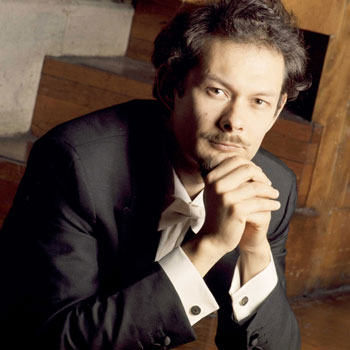
Enrico Pace (photo courtesy of Amadeus Online)

Pace is himself a native of Rimini, hometown of famed director Federico Fellini, who once said, “A different language is a different vision of life.” And perhaps nothing could better sum up the effect of this concert. Each piece inhabited such a distinctly “linguistic” space that it seemed the audience was hard-pressed to test its fluency across the board. At the very least, one can only admire the program’s adventurous spirit, even if it did not quite work as a whole. It also gave us the audible resumes of two performers at the peaks of their careers.

All in all, it was as fine a way to spend an evening as any, and I imagine that everyone walked away with mental tethers trailing behind them to an equally disparate selection of moments. As for this listener, though Kavakos is certainly a fiery performer when he wants to be, I left taking comfort in his conservatism, which continues to provide a valuable alternative to the histrionics of a Gidon Kremer or the technical favoritism of an Anne-Sophie Mutter. His restraint indicates a mind for which music is primary and its effects open to the indeterminacies of life itself.

(This review was published in its original form at the Cornell Daily Sun.)
Heiner Goebbels: Eislermaterial (ECM New Series 1779)

Heiner Goebbels
Eislermaterial

Ensemble Modern
Joseph Bierbichler voice
Recorded live October 1998 at Hebbel-Theater, Berlin
Engineer: Max Federhofer, SWR
ECM Records co-production with Ensemble Modern, Südwestrundfunk, Deutschlandfunk

“Fear is a false expression.”
–Hanns Eisler

Hanns Eisler (1898-1962) is the subject of Heiner Goebbels’s fascinating homage, which has become as beloved as the music that inspired it. Eisler was the third protégé, after Berg and Webern, of the Schönberg dodecaphonic school, and a German expatriate who fled with close friend/collaborator Bertold Brecht in the 1930s to the United States, where he would go on to compose two Oscar-nominated film scores (1943’s Hangmen Also Die!, for which Brecht also wrote the script, and None but The Lonely Heart one year later). Just as he was settling into his exile, however, Eisler was deported (he was among the first to find his name on the Hollywood blacklist), but not before a series of benefit concerts—sponsored by Aaron Copland, Roger Sessions, Charlie Chaplin, Igor Stravinsky, and Leonard Bernstein, to name an illustrious few—were given to raise funds for his defense. Virgil Thomson, writing for the New York Herald Tribune, said of the final program on 11 March 1948:

The impressiveness is due less to any profound originality, as in the case of his master, Arnold Schönberg, or in that of his sometime model, the German-language works of Kurt Weill, than to his graceful and to his delicate taste. Eisler’s music, whether the style of it is chromatic and emotional, diatonic and formalist, or strictly atonal in the dodecaphonic manner, always has charm. It has charm because the tunes are pretty, the textures bright and light, the expressive intentions thoroughly straightforward and clear. Eisler is that rare specimen, a German composer without weight. He uses no heaviness, makes no insistence.

When Eisler returned to East Berlin he penned the GDR’s national anthem amid a spate of intense musical activity, culminating in a Faustian opera that was characterized by Neues Deutschland as “a slap in the face of German national feeling” and therefore never completed. After the death of Brecht, Eisler’s disillusionment intensified and plunged him into depression, during which time he breathed his last.

Eisler and Brecht, 21 March 1950 (Bundesarchiv)

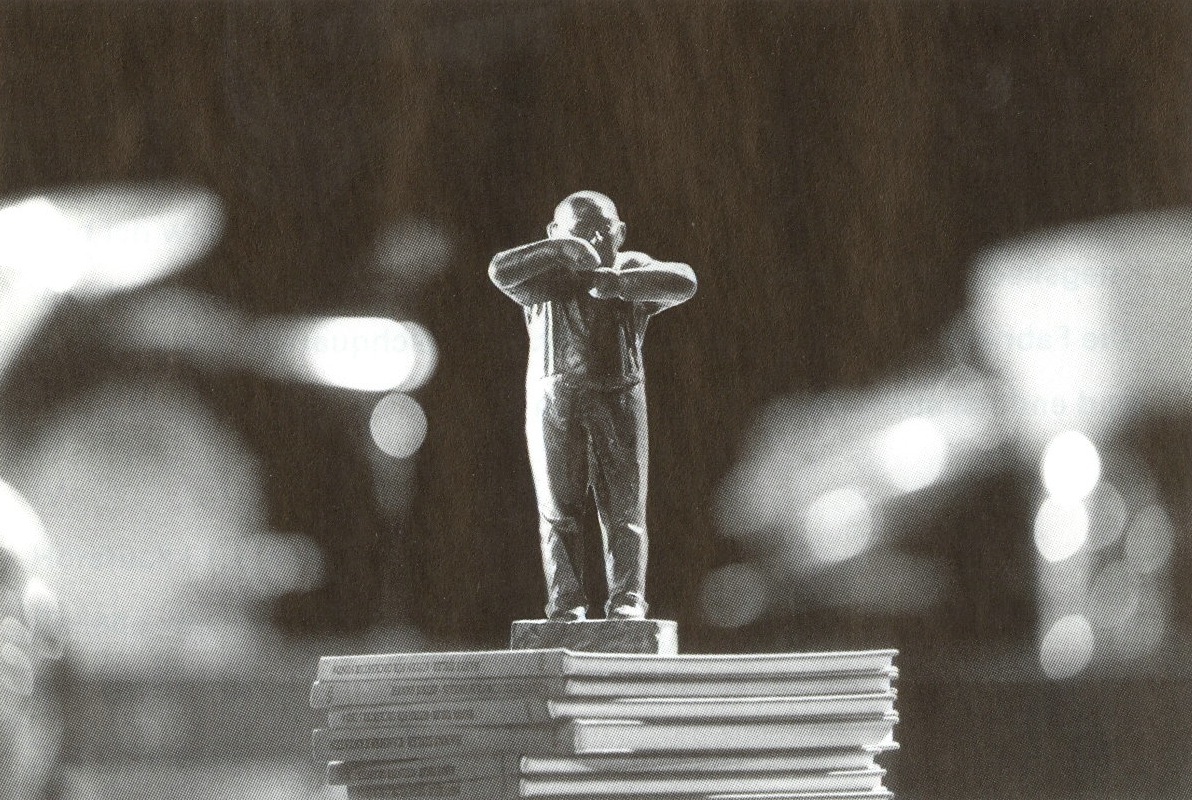
The dramaturgy of Eislermaterial calls for a small statue of its namesake to be placed at the center of the performance space: the surrogate conductor, standing in a field plotted like some gridless Go board. Befittingly, Eisler’s compositions make up the piece’s entirety. The resulting “assemblage” uses his many voices as raw materials for a tribute that shuns ideological heavy-handedness in favor of a bittersweet portrait comprised of lieder and relatively unknown instrumental pieces. The latter are artfully arranged and performed here by the discerning musicians of Ensemble Modern, who crack open the kinetic energy residing within. Of these, Suite for Septet No. 1 provides particularly delightful insight into this eclectic mind, while a fragment for string quartet is rendered all the more moving for being juxtaposed with a turn from his Orchestral Suite No. 3, which sounds like a big band falling down a flight of stairs. Wonderful.

Eisler statue, up close and in situ (photos by Matthias Cruetziger)

Surrounded as these are by nine of Eisler’s songs, they take on more than mere interludinal quality, rather embedding themselves like nodules of concentration. Eight of these are settings of poems by Brecht. Tones range from patriotic (Children’s Anthem) and nostalgic (And I shall never again see) to proletarian (Four Lullabies for Working Mothers), and cover such themes as adaptability (The Grey Goose), the visibility of privacy (Mother Beimlein), renewal (Of Sprinkling the Garden), and fatalism (War Song). On Suicide unfurls the set’s most pensive backdrop, both lyrically and musically:

In such a country and at such a time
There should be fewer melancholy evenings
And lofty bridges over the rivers
While the hours that link the night to morning
And the winter season too each year, are full of danger.
For having seen all this misery
People won’t linger
But will decide at once
To fling their too heavy life away.

A verse by Peter Altenberg closes the set with a melancholic picture of resignation: “Eventually, longing dies, too, / as blossoms languish in a cellar / waiting daily for a little sun.” The interpretations are sometimes augmented by stark contrasts, such as the scratchy free jazz solo of The Grey Goose and the morose rubato of Mother Beimlein. Singer Joseph Bierbichler makes no attempt to sing like Eisler and instead brings out subjective and endearing performances that are as genuine as they are vulnerable. Goebbels also includes two “Audio dramas,” making use of clips from the Eisler archive in true Glenn Gould fashion. In these we are treated to his thoughts on sound, culture, science, and contemplation, evoking an age of black and white imposed upon a world of horrid color.

The comprehensive booklet for Eislermaterial includes an interview with Goebbels, who credits Eisler with having jumpstarted his life in sound. Certainly, one need hardly look deeply to see the affinity. Not only did Goebbels find his own Brecht in Heiner Müller, but both he and Eisler have successfully united politics and music in such a way that one finds them impossible to separate in the listening and likewise to dilute in the thinking. Eisler was more than a Marxist cog with a creative streak, and no one is better suited than Goebbels to tell that story to its fullest. This is the most “filmic” of Goebbels projects and lends itself wisely to an aural and textual world bound by an undying love for theatre. A masterpiece on all counts and a crowd favorite among fans and newcomers alike.

<< Valentin Silvestrov: Requiem for Larissa (ECM 1778 NS)
>> Keith Jarrett Trio: Inside Out (
ECM 1780)

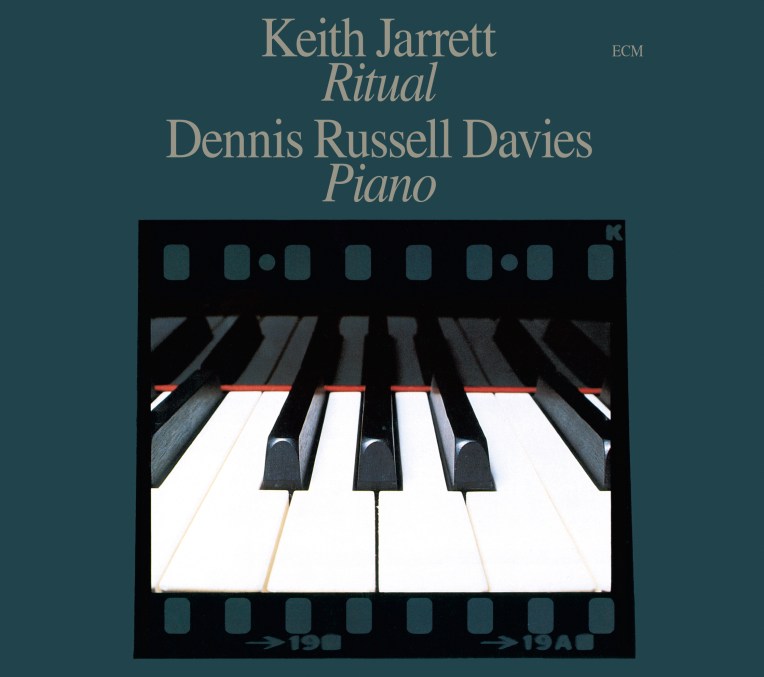
Keith Jarrett: Ritual (ECM 1112)

1112 X

Keith Jarrett
Ritual

Dennis Russell Davies piano
Recorded June 1977 at Tonstudio Bauer, Ludwigsburg
Engineer: Martin Wieland
Produced by Manfred Eicher

Ritual is something of an anomaly in the Keith Jarrett archive. It’s a solo album, as many of his best are, only this time it is pianist, conductor, and frequent collaborator Dennis Russell Davies at the keys playing a work penned entirely by Jarrett. The hallmarks of a Jarrett piano recital are all there—the rolling ostinatos, dense arpeggios, and profound doublings—yet are valenced differently under the rubric of “composition.” In this context, we get a sense of “once removed-ness” that might not present itself under improvisational circumstances. The piece’s modest 32 minutes are divided into two immodest parts. From the opening groundswell we get not only dense pockets of energy, but also nodes of emptiness. Put another way: the music’s glorious peaks share the same space as the shadowy valleys at their feet, thereby encompassing a harmonious middle ground. Like a geyser, its eruptions are predictable yet manage to enthrall every time. Despite its claustrophobic beginnings, Part 1 ends in bright solitude, like a room in which the curtain has been slowly opened to welcome the morning sun. Heavier chording marks Part 2, which resolves in a hopeful melancholy, but not before gelling the emotional plasticity of its precursor. This brings us full circle, ending on a solemn intonation of a single note.

Ritual is far more “regulated” than typical Jarrett fare, spun as it is from the surrogacy of another performer rather than through the alchemy of spontaneous creation (though there is, of course, some of each in the other). The results are captivating in their own way, stoked by every depressed key and lifted pedal. Its shapes are drawn not by what is, but what has been and will be. The present is invisible and lives on only as formless possibility, caught like a blown kiss in the cup of one’s hand.

<< Gary Burton: Times Square (ECM 1111)
>> Tom van der Geld and Children At Play: Patience (ECM 1113)

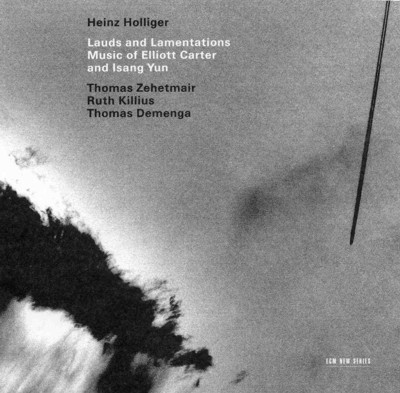
Lauds and Lamentations – Music of Elliott Carter and Isang Yun (ECM New Series 1848/49)

Lauds and Lamentations
Music of Elliott Carter and Isang Yun

Heinz Holliger oboe, English horn
Thomas Zehetmair violin
Ruth Killius viola
Thomas Demenga cello
Recorded September 2001 and February 2002 at Radio Studio DRS, Zürich
Engineer: Stephan Schellmann
Produced by Manfred Eicher

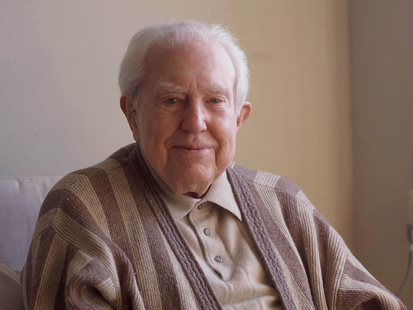
Elliott Carter is the Benjamin Button of contemporary music: the more he ages, the more youthful he seems to become. At the time of this writing, he’s still going strong at 102. That being said, his is not an endeavor to overcompensate for a fading mortality, but rather a deeper exploration into a key aesthetic of his entire output: possibility. What that possibility looks like depends entirely on the whim of the moment, the colors of scoring and performance that mark his oeuvre at all stages.

Elliott Carter (photo courtesy of The Arts Fuse)

The Oboe Quartet of 2001 is a quintessential example of Carter’s tightly wound exuberance. While distinctly “modern,” there is something downright fun about the piece. It is playful, inventive, and positively bursting with life. And who better than Heinz Holliger to act as its heliocenter? Here is a musician who not only plays the oboe as if it were a part of him, but who also brings a singular admiration for Carter to light in every measure. The quartet is a peanut gallery of moods, some meditative and others jarring, each more fascinating than the last. The final passages show especial and intensive concentration. After this 17-minute chunk of gravid whimsy, the 4 Lauds (1999/1984/2000/1999) for solo violin pat the cheeks of our comatose inner children into wakefulness. Each has its center—be it a note, an atmosphere, a statement, or a phrase—from which emanates a fresh start. A 6 Letter Letter (1996) for English horn in F scales a modest cliff, reaching at last with its final hand-crawl the horizontal plane it seeks. The tongue-in-cheek Figment (1994) for cello alone unfolds like a beautiful lie, for which its companion, Figment II: Remembering Mr. Ives (2001), provides gorgeous contrast with its lower microtonal vowels and high-pitched consonants.

Isang Yun (photo courtesy of Boosey & Hawkes)

The pairing of Carter with Korean dissident Isang Yun (1917-1995) is more than circumstantial. Theirs is an inexplicable sort of affinity. Where the former elicits winsome optimism, the latter drowns us in ceremony. Piri (1971) for solo oboe solo is a discipline in and of itself. Spurred by Holliger’s focused tone, it spins themes from the thinnest of fibers. This deeply internal sense of space and accumulation is expanded in Yun’s own Oboe Quartet of 1994, which skitters sideways like a crab on sand. Over three densely packed movements it starts in collective naivety before falling to its knees amid the slowed air raid sirens at its center. A potentially lucid finale is hinted at through a memorable trill shared between oboe and violin, only to crack under the pressure of earthbound agitations.

For the two oboe quartets featured on Lauds, we must thank Heinz Holliger, who asked both composers to write pieces for this neglected configuration, as yet “unchallenged” since Mozart. Both receive their world premiere recordings here and glisten with the golden seal of any benchmark achievement. The musicians on Lauds are all ideally suited to the material and its “linguistic” stumbling blocks. Thomases Zehetmair and Demenga (both ECM mainstays) and Ruth Killius (violist of the Zehetmair Quartett) round out the limitless talents of Holliger in a program that is sure to yield many new discoveries for years to come.

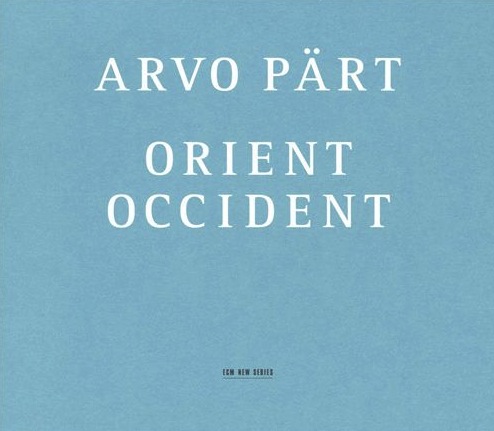
Arvo Pärt: Orient & Occident (ECM New Series 1795)

Arvo Pärt
Orient & Occident

Swedish Radio Symphony Orchestra
Swedish Radio Choir
Helena Olsson soprano
Tõnu Kaljuste conductor
Recorded May 28 – June 1 2001, Berwaldhallen, Swedish Radio, Stockholm
Engineers: Jan B. Larsson, Anders Hägglöf, and Rune Sundvall
Produced by Manfred Eicher

The name of Arvo Pärt has become something of an institution in the consumer culture of classical music. The “New Spiritualism” heralded by such seminal recordings as his Tabula rasa and Te Deum crystallized a sentiment that listeners were craving in the ruins of a postmodern malaise. Yet with this music came a host of expectations: it was supposed to heal us, guide us to an inner light, and provide an inexpensive and convenient means of achieving (temporary) peace. It was something to rely upon, a sonic friend that would never leave us. In believing this, however, we began to lose sight of our own powers and the tremendous dependence we were placing upon recorded media to wrestle with moral dilemmas in our stead. Beautiful and, yes, spiritual though these media are, they can never be a substitute for the enlightenment we read into them.

The frame of Orient & Occident captures the dark side of Pärt’s compositional moon. Stand too close to it, and its darkness overwhelms; too far and it becomes a mere block of shadow. Wallfahrtslied (Pilgrim’s Song), a German setting of Psalm 121, positions us at a median distance and allows us to appreciate the best of both worlds. Composed in 1984 in memory of the composer’s close friend, Estonian director Grigori Kromanov, and since revised for men’s choir and strings, it is a harrowing slice of emotion. The music seems to grit its teeth in a slow, seething discontinuation as voices lay themselves at the orchestral altar. Strings try to remain passive, yet cannot help but break free from their subordinate position with cries of supplication. Before long, they stretch themselves into the thinnest of layers, through which one may see the translucence of the “self” and the “other” and acknowledge that the same light passes through and gives both substance.

The seven-minute title composition, penned in 2000, is for strings only and continues the path that Pärt first began laying with Psalom and Trisagion. It is a grand statement, to be sure, but works its effect through tiny sonic miracles and primes us for the sojourn that awaits us in Como cierva sedienta (1998), a Spanish setting of Psalms 42-43 for women’s choir and orchestra. Exquisite winds recall 1989’s Miserere and rock like a cradle for soprano soloist Helena Olsson’s spiraling invocations. This is music firmly entrenched in its surroundings, while also content to break free from its compulsory resolutions. Strictly choral passages add pastoral unrest. Words tumble out of their own volition, filled with outbursts and infectious proclamations. Like the soul in this final Psalm, downcast even in the light of salvation, I realize that I fall into traps only of my own making. Every time I pull myself out of one, I am reminded that sounds like these are more than incidental to that struggle. Rather, they embody it to the fullest, a collective reminder of the physicality of living experience and the lessons it provides.

The title of Pärt’s eighth ECM album makes me think of colonialism and its feeble justifications for subversion. That being said, I don’t think this is what the music is about. It deals instead with the gap that links these two words and the sacrifices that fill it with song. It is the blood flowing through that emptiness, and we the plunger pulling back to suction out the contagion of enslavement that prevents us all from staring into the face of love.

<< Frode Haltli: Looking on Darkness (ECM 1794 NS)
>> John Surman/Jack DeJohnette: Invisible Nature (
ECM 1796)

Juliane Banse/András Schiff: Songs of Debussy and Mozart (ECM New Series 1772)

Juliane Banse
András Schiff
Songs of Debussy and Mozart

Juliane Banse soprano
András Schiff piano
Recorded January 2001, Reitstadel, Neumarket
Engineer: Stephan Schellmann
Produced by Manfred Eicher

Sometimes one can set aside the reputations of composers and simply enjoy their music. This recital of songs by Mozart and Debussy, performed by an equally unlikely pair in pianist András Schiff and soprano Juliane Banse, however, simply overflows with its creators’ indelible marks. With a hefty dose of poetry, from French symbolists to Goethe, at hand, we’re the lucky ones who get to connect the dots in a constellation of unusual proportions.

Schiff’s well-spaced articulations and Banse’s meticulous control of tone make for a most fitting vehicle for the evocative Beau soir (Beautiful evening) of Debussy that introduces the program. Clair de lune (Moonlight) very much recalls the songcraft of Poulenc and enchants with its opening line from Verlaine: “Your soul is a chosen landscape…” Such cerebral storytelling continues through Pierrot to the equivocal Apparition. Dissonances in En sourdine (Muted) and the almost Carmen-like pastiche of Fantoches (Marionettes) add bolder hues. Verlaine’s careful words reappear in C’est l’extase langoureuse (It is languorous ecstasy), in which Banse pines:

This soul which mourns
In the subdued lamentation,
It is ours, is it not?
Mine, say, and yours,
Breathing a humble anthem
In the warm evening, very softly?*

These songs are not without their programmatic gildings, as in the cascading pianism of Il pleure dans mon cœur (Tears fall in my heart) and the thrilling chording of Chevaux de bois (Merry-go-round). Many adjectives come to mind when trying to describe these miniatures, but the one that resounds most for me throughout this recording is: clear. Like fresh light poured upon the morning fields, they nourish like no other stimulant.

Where Debussy works in more horizontal, sinuous gestures, Mozart brings potent verticality. Though a few of his Lieder, such as Warnung (Warning), bristle with the stately charm we popularly associate with the Salzburgian wunderkind, we cannot help but be delighted by the playful strains of Der Zauberer (The sorcerer), which likens the flames of passion to the dark magic of an eager pursuer. The little fable of Das Veilchen (The violet) gives voice to the desires of its titular flower, who spots a frolicking shepherdess. The violet dreams of being plucked and pressed to her bosom, only to be trodden as she skips ignorantly past. Its last sentiments:

“If I must die, at least I die
Through her, through her,
Here, at her feet!”

The recital closes with Abendempfindung (Thoughts at eventide), in which Joachim Heinrich Campe bids his loved ones not to fall too deeply into grief upon his death, promising to be there with open hands to carry them into heaven:

Bestow a tear on me and be
Not ashamed to weep for me,
For this tear shall be the finest
Pearl within my diadem.**

These songs are simply fascinating, and all the more so for being programmed together. Within them are many discoveries to be had. Banse and Schiff are so exacting that one almost imagines the music as having been written for them. An altogether captivating album that is as capricious as it is austere.

* Translation by Winifred Radford.
** Translation by Lindsay Craig.

<< Alexei Lubimov: Der Bote – Elegies for Piano (ECM 1771 NS)
>> Giya Kancheli: Diplipito (ECM 1773 NS)

Zehetmair Quartett: Schumann (ECM New Series 1793)

Zehetmair Quartett
Robert Schumann

Zehetmair Quartett
Thomas Zehetmair violin
Matthias Metzger violin
Ruth Killius viola
Françoise Groben cello
Recorded August 2001, Radio Studio DRS, Zürich
Engineer: Stephan Schellmann
Producer: Manfred Eicher

Composed during the summer of 1842, Robert Schumann’s three string quartets bear dedication to Felix Mendelssohn and are his only chamber works without piano. A few years before their appearance, while sitting in on a series of quartet rehearsals led by Mendelssohn’s friend and concertmaster, Ferdinand David, Schumann was first struck by the greatness that Ludwig van Beethoven had brought to the form. Determined to match that greatness, he found himself obsessed by “quartettish thoughts” and ready to tackle the form at which he had long desired to try his hand. He set out on the daunting task of writing his first quartet. Sadly, this piece did not survive, but we do have the subsequent threesome that is his Opus 41, of which two have been recorded for this instant reference recording.

Schumann struggled with inner demons all his life in a constant balancing act between his burgeoning romanticism and intellectual acumen. It was only in Beethoven’s titanic and immovable reputation, says Martin Meyer in his liners, that Schumann turned to both internal and external sources for inspiration. Where Beethoven’s “absolute” approach seems to cast the greater shadow, this is as much due to the inordinate amount of light shed upon it as to any inherent superiority. Schumann’s programmatic idiosyncrasies provide as much fascination, and these the Zehetmair Quartet brings out at every turn.

The fluidity of the String Quartet No. 1 in A minor is surpassed only by that of the performance itself. The Mendelssohn-influenced Scherzo brings the gelatinous bones of the Introduction to vibrant life with palpable connective tissue. The results are playful yet graceful, honed in rustic elegance in spite of their aristocratic borrowings. After a speculative Adagio, we arrive at the scraping violin and resplendent tutti passages of the Presto. Such alluring energy leaves us in need of the Andante that opens the String Quartet No. 3 in A major. A beautiful legato theme, eerily similar to the central oboe/flute passage in Tchaikovsky’s “Waltz of the Flowers,” emerges in the violins. Zehetmair moves like a breeze across water, while the others capture every wave of sound with unbending accuracy. Muted strings in the second movement build to a rousing density that is easily the disc’s highlight. Pizzicato strings enchant in the third, while the masterful Finale inspires with its urgency.

With the string quartets Schumann tightened his grasp of modality in a careful exchange of sentiment. There is what Meyer calls a “clouded lyricism” throughout these ternary works that is enhanced all the more by the enlivening performances on this recording. And while the fact that it won the Gramophone Award for Album of the Year is no small consolation prize, it seems but an afterthought when reeling from the music that earned it.

<< Anouar Brahem: Le pas du chat noir (ECM 1792)
>> Frode Haltli: Looking on Darkness (
ECM 1794 NS)