Michael Galasso: Scenes (ECM 1245)

1245Michael Galasso
Scenes

Michael Galasso violin
Recorded October 1982, Tonstudio Bauer, Ludwigsburg
Engineer: Martin Wieland
Produced by Manfred Eicher

Born in Louisiana in 1949, Michael Galasso picked up his first violin at age 3. After debuting with the New Orleans Philharmonic at 11, he went on to forge a unique and fascinating career. As a longtime collaborator of Robert Wilson, he composed incidental music for a host of renowned productions, including an award-winning 1998 staging of Strindberg’s A Dreamplay, in addition to being involved in numerous sound installations in museums worldwide. Many will have encountered him as the film scorer for Wong Kar-wai’s In the Mood for Love, and most recently for Martin Provost’s Séraphine, but far too few have heard him on his own terms, divorced from the images he describes.

For his first solo album, Galasso gives us nine numbered “Scenes,” each the facet of an unfathomable jewel. It is an album to which I often played my violin by ear, trying to gain inner sight to its deeper complexities. And indeed, beyond its charming Philip Glassean veneer heaves a pair of expansive lungs that expel far more than they take in. The album has the feeling of a home recording, multi-tracked and with minimal processing applied. Despite being meticulously composed, it is also spontaneous in feel and refreshingly non-perfectionist. Some lines don’t quite sync up, as if what we hear were just a potent coincidence. From the hauntingly enigmatic (Scenes II and VI) to the whimsical (Scene III), we are privileged to stroll through this modest gallery of sound. Scene IV stands out with its boldly syncopated lead and subtle harmonizing. Others, like Scenes VII and VIII, tremble with incidental potential, seeming to spring forth from an as yet unrealized mise-en-scène. But it is the final Scene that remains closest to my heart, for its utter simplicity draws from a groundswell of bliss. Not unlike the solo work of Paul Giger, it has a magic all its own, an uncompromising sense of direction that can never be thwarted once it holds you.

Scenes is more than a soundtrack without images. Not unlike the shadow on the cover, its chapters are disembodied. We see only their negative selves, and hear only the sounds that animate them.

<< Jack DeJohnette’s Special Edition: Inflation Blues (ECM 1244)
>> Lester Bowie: All The Magic! (ECM 1246/47)

Paul Giger: Ignis (ECM New Series 1681)


Paul Giger
Ignis

Paul Giger violin, violono d’amore
Marius Ungureanu viola
Beat Schneider cello
Estonian Philharmonic Chamber Choir
Tõnu Kaljuste conductor
Recorded June 1998, Niguliste Church, Tallinn
Engineer: Mado Maadik
Produced by Manfred Eicher

This recording documents a melodious piece of happenstance. Having begun on rather different planes of ECM’s mortal coil, the roving Swiss violinist and the much-in-demand Estonian Philharmonic Chamber Choir gradually met at the center of a most sonically revelatory circle. The resulting Ignis is a hypnotic experience that reveals new secrets with every listen. For his first label project in seven years since 1992’s Schattenwelt, Giger reworks antique motivic fragments into larger wholes. As such, they become fully formed entities looking inward through the lens of an unparalleled violinism.

Organum,for string trio, inducts us into the album’s haunting universe. Bathed in a luxurious reverb and medieval sentiment, it plunges us deep into the nexus of what’s to come. Karma Shadub, the only original composition here, finds itself resurrected from its appearance on Alpstein to superb choral effect. The EPCC touches every layer with expert care, capturing the arpeggiated flair of the earlier version with a more nuanced legato style. Giger plays like a man possessed of something beyond physical description, filling as much space as the entire choir, if not more.

The following two pieces are drawn from 10th-century Benedictine plainchant. Tropus inverts the spectrum with the violin occupying the central axis around which the other voices reveal themselves. The choir fluffs its feathers, rising from the depths with ascendant violin improvisations, adding harmonic light to an already bursting image. Alleluja is a succinct instrumental statement of utter beauty, and boasts Giger’s skills on the viola d’amore. Last is the astonishing O Ignis. Structured around the selfsame piece by Hildegard von Bingen, it can also be heard on the Hilliard Ensemble/Jan Garbarek’s Mnemosyne. Presently, it is anchored by a gently lilting ostinato in the cello that soon flowers into a supernova of musical activity, carefully controlled by the binding threads of its voices.

This is a radically different sound for Giger, who seems to reinvent himself with every new effort, and one that should provide many discoveries to come. A gray, expansive, and utterly captivating experience awaits.

<< Tomasz Stanko: From The Green Hill (ECM 1680)
>> Franz Schubert: Sonate B-Dur op. posth. D 960 (ECM 1682 NS
)

Erkki-Sven Tüür: Flux (ECM New Series 1673)

Erkki-Sven Tüür
Flux

David Geringas cello
Radio-Symphonieorchester Wien
Dennis Russell Davies conductor
Recorded July and August 1998, ORF Studio, Vienna
Engineer: Anton Reininger
Produced by Manfred Eicher

ECM follows up its astonishing debut of Estonian composer Erkki-Sven Tüür with a program of further deconstructions. With his architectonic shovel, Tüür burrows out an idiomatic hovel for himself in the sands of today’s placid musical shores. Every motif is its own voice, building to powerful fruition from the smallest of sparks. To start, the Symphony No. 3 (1997) clicks its tongue with a delicate cymbal. Like the corona of a jazz dream, it wavers through a swarm of failed bass lines and reeds. The lower strings ascend in a brief march before being drowned by a vibraphone. The ensuing cloudbursts recall the composer’s wintry Crystallisatio. Percussion becomes more pronounced as stuttering rhythms break the first movement into pieces. In the second movement, a glockenspiel ruptures the high strings as a snare hit unleashes a brass menagerie. The flute emerges for a solo passage as strings process gently in the background. The string writing recalls Tüür’s Passion, albeit transposed to a different key. The symphony ends with a single note from the vibraphone, dripping like a water clock into mortal darkness.

Tüür’s aesthetic is so fractured that the concerto would seem an anachronism, but his Concerto for Cello and Orchestra (1996) epitomizes the very essence of his craft, planting as it does a single generative seed firmly in the soil of introspection. His background as a rock musician comes through noticeably in his bold rhythmic choices, while the piece’s single-movement structure ensures that its signals remain explicitly contained. The vibraphone reprises its vital role, oozing like plasma from an open wound. It is not the soloist that arises from within the orchestra, but much the reverse. And as the vibraphone weaves its way deftly through the orchestra’s open spaces, a single note on strings hints at relaxation. Tüür gravitates toward higher notes here, so that even in descending motifs the apex gains precedence as pedal point. He ends with a celestial cluster, a galaxy spinning out of control until it implodes.

Lighthouse (1997), for string orchestra, is one of Tüür’s most cinematic pieces, which, if we are to take the title literally, would seem to render its eponymous structure from the outside in. We track its light first, and the afterimage it leaves on the screen, only to be given view of the mechanism that turns and amplifies its voice in the night like a siren to the dark ships of its surrender. The lush scoring painfully picks apart and rebuilds the lighthouse, turning it inside out, so that its column is now made of light and its reassuring beam becomes the mortar of its foundation, sweeping its potent arm through the air and knocking everything in its path. This is not a violent piece but a purposeful one, sustained by architectural consciousness. It tells its story in hefty chunks, if always through the fog of recollection. Its agitation enacts a sort of tragedy, a body descending from its topmost rail, flailing its appendages helplessly before the sand engulfs its last breath. Yet the music is anything but morbid, only mournful in the realization of its own complicity in the ending of a life, and the beginning of a new one.

Tüür’s aphasic approach has made him one of the most sought-after composers of our generation, and not without good reason. His stable foundations allow him to build teetering creations that never quite tumble. His music works very much like thought, constantly rationalizing its decisions in hindsight. The most transcendent passages are always stirred so that they become muddled without obscuring individual colors. Despite the seemingly disparate elements of these mosaics, Tüür’s is not a process that imposes itself upon the elements at hand. Rather, it recognizes and values its inner life and the varied ways in which one can externalize it.

<< Zelenka: Trio Sonatas (ECM 1671/72 NS)
>> Charles Lloyd: Voice In The Night (ECM 1674
)

Arvo Pärt: Tabula rasa (Special Edition)

Tabula rasa SE

Arvo Pärt
Tabula rasa

Gidon Kremer violin
Keith Jarrett piano
Staatsorchester Stuttgart
Dennis Russell Davies conductor
The 12 Cellists of the Berlin Philharmonic Orchestra
Tatjana Grindenko violin
Alfred Schnittke prepared piano
Lithuanian Chamber Orchestra
Saulius Sondeckis conductor
Recorded October 1983, Basel; January 1984, Stuttgart; February 1984, Berlin; November 1977, Bonn
Engineers: Heinz Wildhagen, Peter Laenger, Eberhard Sengpiel, and Dieter Frobeen
Produced by Manfred Eicher
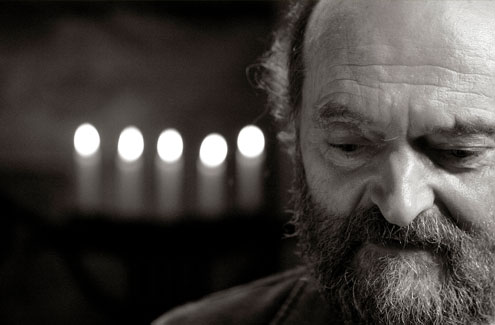
“The complex and many-faceted only confuses me, and I must search for unity. What is it, this one thing, and how do I find my way to it? Traces of this perfect thing appear in many guises—and everything that is unimportant falls away.”
–Arvo Pärt (photo courtesy of The Sonic Spread)

The composer
On 11 September 2010, Arvo Pärt welcomed his 75th year. To celebrate this milestone, ECM has rereleased its first New Series album in a special deluxe edition. When it first appeared in 1984, hardly anyone outside the composer’s native Estonia could have known what to expect from this modest cover of muted pastel and block lettering, but Tabula rasa has since taken on a life of its own. Yet behind the iconicity, word-of-mouth marketing, and a few choice celebrity endorsements (not least among them, R.E.M.’s Michael Stipe), Pärt’s music remains as it is: reverence in sonic form.
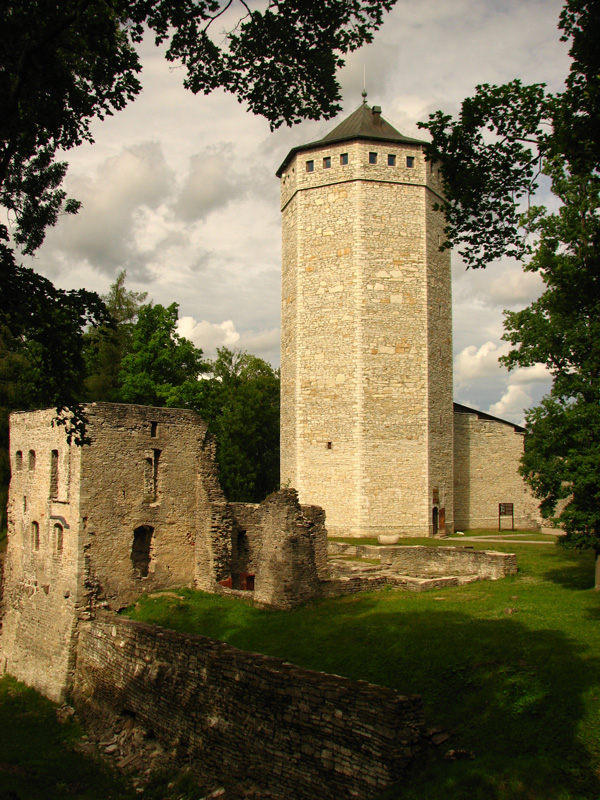
Paide Castle (photo by Liene Strautmane-Kaze)

Born in the small town of Paide, just outside of Tallinn, Pärt took his first musical steps at age seven and was already composing by his teens. He would later study with Heino Eller at Tallinn Conservatory, where he was characterized as one who “just seemed to shake his sleeves and notes would fall out.” The sixties found him at a critical juncture in his creative life. Disillusioned by the serialism with which his early works engaged, and which had earned him the red pen of Soviet censors, he fell into silence and personal reformation. According to biographer Paul Hillier, this silence has been the alpha and omega of his subsequent musical output. It is the silence of death, a reminder of our spiritual origins and of life’s fragility. Out of this nexus arose his signature “tintinnabuli” style, which finds its harmonic roots in the overtones of the struck bell. One finds its power in every note, and through an allegiance so delicate it knows no other shelter than the human heart.
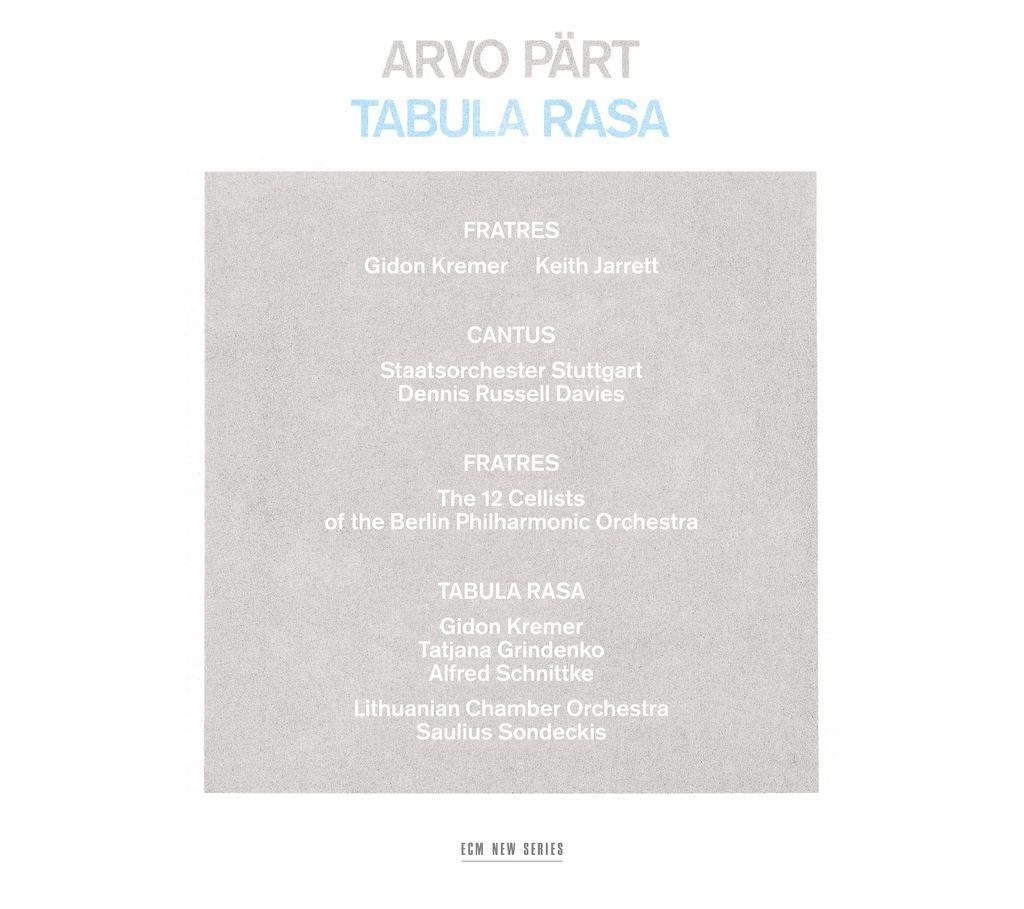
Tabula rasa original
Original cover
(ECM New Series 1275)

The music
Of the significant body of Pärt’s works represented by ECM, this album came relatively late in my listening. Nevertheless, its visceral power and openness to interpretation have yet to wane, for it has only grown with me. It is 1 a.m. as I sit alone in my study, listening to this seminal recording once again. I find myself filled with words but faithful to none of them. Each seems to go right through the music’s liquid surface.

We are graced with two strikingly different variations of Fratres. One of Pärt’s most successful compositions, it exists in many versions. The first represented here is for violin and piano (1980). The combined intuition of Gidon Kremer and Keith Jarrett shades this interpretation with frail determination. What begins as an energetic swoon of arpeggios soon coalesces into a dirge of heartrending poignancy in which pizzicato bursts puncture the visual landscape like dying flames. These percussive rituals are common to all incarnations of Fratres, and act as tactile pedal points. Passages bordering on the vocal swoop down to graze the piano’s gravid footsteps, even as we watch from a place neither near nor far. This is a space in which our ears and our emotions become one, and in this respect Fratres is an anthem for the spirit unafraid to drink its own tears. Title aside, for me there is something divinely maternal about this piece, especially as played by the 12 celli (1982) heard two tracks later. This version brings to light a clearer sense of the piece’s mathematical anatomy. The low grumbles of the piano are replaced here with the tapping of cello bodies. The air inside them is heard on its own terms, unfettered by the strings that lay just outside its escape routes. The cellists begin in whispers before proclaiming their tentative motif with due conviction. Each mirrored descent is a caress in a restless night, the knocking of wood like a boat listing slowly in darkening waters.

Bowing humbly between these two “brethren” is the Cantus In Memory Of Benjamin Britten (1977), a rarer secular piece from Pärt, who once said, “I have discovered that it is enough when a single note is beautifully played. This one note, or a silent beat, or a moment of silence, comforts me.” Nowhere is this truer than here, where a single tubular bell sounds that single note (an A) throughout, reflecting both the tonal and emotional veins of the piece. Having the score before me also reveals the silent beats that circumscribe the piece. Like the dead space between stars, this silence breathes with the potential for creation. Thematically the music is laid bare and layered with dizzying resolution, the sympathetic bell ringing as if from a great void. As homage to a composer in whom Pärt sought a kindred spirit, Cantus thrives with anguish and adoration. In its brief five minutes, it manages to reach past the listener into a realm where personhood is no longer relevant and music thrives on its own performance.

With Tabula rasa (1977), Pärt does more than wipe the proverbial slate clean, but spins from that same emptiness an open web of tangible effects. The title is both philosophy and mantra. Structurally speaking, none could be more appropriate. Violins circle one another like birds in flight before being awestruck by the haunting chimes of a prepared piano (played by the late Alfred Schnittke). Each successive eruption is deeper than the last, carrying with it the ghost of all that has come before. This piece is famous for having boggled its musicians on paper (“Where’s the music?” they are said to have cried), so bare did the score seem to them before being committed to fingers and bows. But once the music was given voice, it was clear that what had originally appeared porous was in fact pregnant with life-affirming rapture. Tabula rasa undergoes a dramatic change in its latter half as the violins begin to fade into the surrounding architecture. The carillon-like refrain of the prepared piano drops a child’s handful of crystals into water, naked and unassuming while also strangely coercive. By the end we are left in the company of solemn double basses, whose commentary seems but an afterthought to an experience that lies just beyond the grasp of words.
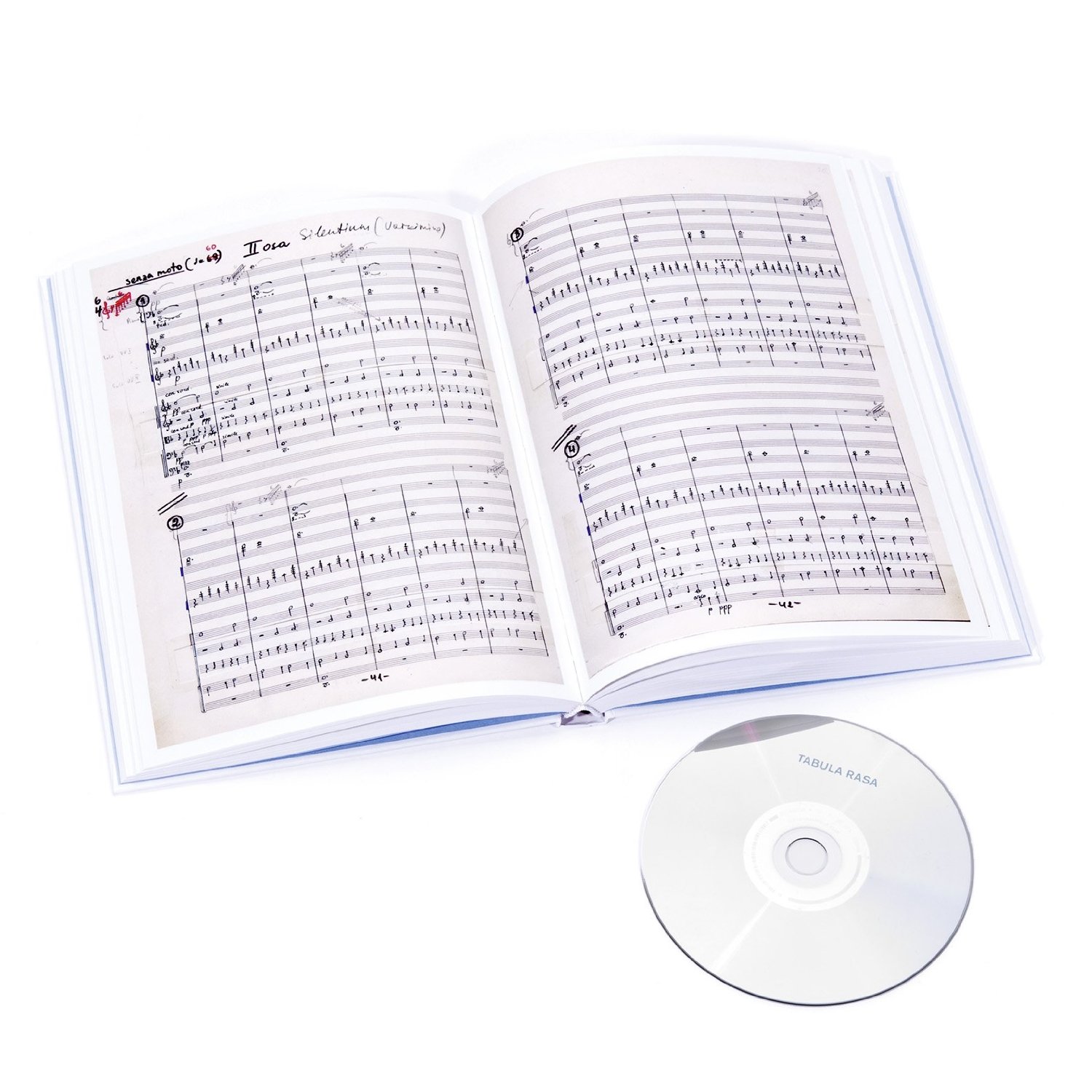
Open Tabula

The book
In his original accompanying essay, Wolfgang Sandner describes the music on Tabula rasa as a “curious union of historical master-craftsmanship and modern ‘gestus.’” The same might be said of this handsome Special Edition. Housed in a 200-page hardcover book, the album is given the royal treatment with full study scores for all four works therein, two facsimile autographs of its title work and Cantus, and a new introductory essay by Paul Griffiths. As an artifact it is a tangible intersection of passionate commitment to detail from all angles.

The scores in particular offer even non-musicologists vast insight into their inner workings. We see clearly before us the peaks and valleys of Fratres in chamber form, and the drone strung below its cello counterpart like a safety net. We see also the cosmic structure of the Cantus, like binary stars bound by mortality. And we can experience for ourselves that confrontation with emptiness that must have so perplexed the first interpreters of Tabula rasa. A cursory glance reveals further shades of understanding. For example, we find that, in Part 1 (“Ludus”), sometimes only double basses accompany the two violinists with no noticeable loss of orchestral density, and each ascent on the prepared piano in Part 2 (“Silentium”) stands out like a stairway into light.

To say that Tabula rasa has held up perfectly would be misleading, for it would imply that it possesses physical substance to be upheld. As a whole this album is more about spaces: of mourning, of self-reflection, of impermanence, of privacy in a violent world, of virtue and history, of weakness and flesh, and ultimately of life itself. It is the undoing of forced representation. It is the challenge of confession. It is the hardship of conflict and the joy of affirmation. It is the silent rendered audible, and the audible rendered silent.

It is you.
It is I.
It is.

<< Pierre Favre Ensemble: Singing Drums (ECM 1274)
>> Keith Jarrett: Trio Changes (ECM 1276)

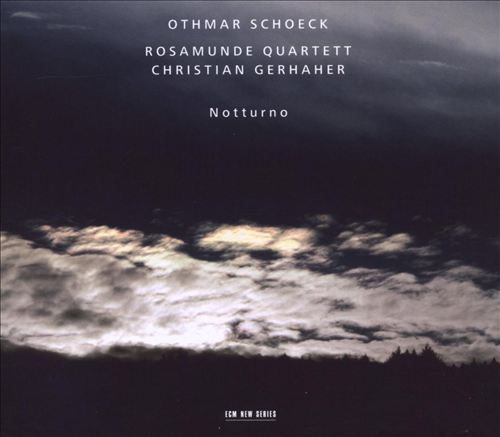
Othmar Schoeck: Notturno (ECM New Series 2061)

Othmar Schoeck
Notturno

Rosamunde Quartett
Andreas Reiner violin
Diane Pascal violin
Helmut Nicolai viola
Anja Lechner violoncello
Recorded December 2007, Historischer Reitstadel, Neumarkt
Engineer: Markus Heiland
Produced by Manfred Eicher

If you continue to dream
Forgetfulness will close your heart’s wound:
The soul sees its sufferings
And itself floats by.
–Nikolaus Lenau

Othmar Schoeck (1886-1957) was a Swiss composer whose musical journey came to a head in Notturno, his most intensely personal work. Schoeck was one of a generation of artists who set out to establish Switzerland as a major presence in European music. Like his contemporaries Arthur Honegger and Frank Martin, he sought to break free from the Brahmsian idealism with which many associated his countrymen in favor of a darker, more tragic stripe of sonic culture. An orchestral conductor and piano accompanist by profession, Schoeck was no mere dabbler in the compositional arts. Yet despite the fact that no fewer than eight operas, four hundred songs, and a smattering of instrumental works flowed from his pen, we hear so little of him on the concert stage. Says Chris Walton, author of Othmar Schoeck: Life and Works and of the album’s liner notes, “That Switzerland should have been home to the cutting edge of art might at first seem odd; but as much as it look to us to be at the center of the map of Europe, it has, in a real sense, long been situated at its ‘borders.’” Such contradictory geography is the seat of Schoeck’s output. At once gravid and untetherable, its rejection of overt nationalist or folk tendencies ripened the composer for easy dismissal during the inter-war years. Though staunchly allied to his homeland, his anti-cosmopolitan music is characterized more by its impermanence than by any socio-cultural currency.

Notturno was composed between 1931 and 1933, and sets the world-weary verse of Nikolaus Lenau (1802-1850) and one fragment by Gottfried Keller (1819-1890) for voice and string quartet. The cycle is threaded by an elusive leitmotif of regret over a failed extra-marital affair. There is a mournful quality to this music that one also finds, as Heinz Holliger points out in an introductory note, in the tearful lyricism of Alban Berg and Arnold Schönberg. Over the course of five movements, we find ourselves lost in a forest of shadows, hoping for any sign of moonlight to break the silence with its song. All we get, however, are words dripping with liquid night, each a cloud waiting to burst into storm. Replete with moisture, flora, and withered emotions, Lenau’s sentiments range from cynical (“In consternation I desired / That we both should die”) to resigned morbidity (“I love this gentle death”), but always with an “unmannered” (to borrow Holliger’s term) sadness. Bavarian baritone Christian Gerhaher shapes each syllable like a blind carver: that is, as if with his hands and in darkness.

The music is not without its twinge of hope in the fifth movement, in which Keller’s words drip like honey from Gerhaher’s lips. Listen to the gorgeousness of his high note, lifting us ever so briefly into dawn in the final lines:

My soul is as undefiled as a child and will not weigh down your shafts of light. I will keep my sights set on those distant places to where we will travel.

as the violins pour down like those very shafts of light, and try not to be moved. Still, by this point we have grown too used to Lenau’s tattered garments to shrug them off. We also know, as in his last words, that only sadness awaits us in place of sadness, such that solitude seems but a fantasy:

Oh, loneliness, how willingly would I drink
From your fresh forest bottle!

For all its darkness, this is a translucent recording. The performances are raw and impassioned, the Rosamundes adding to an already exquisite résumé. But the real merit here is its voice. Surely, the choice of Gerhaher was not accidental, as the young baritone perfected his technique with the great Liedermeister Dietrich Fischer-Dieskau, who happens to have been one of Schoeck’s most ardent interpreters. His presence establishes an unbroken chain between composer, score, and studio, at last linking the fortunate listener to nothing short of a hallmark achievement.

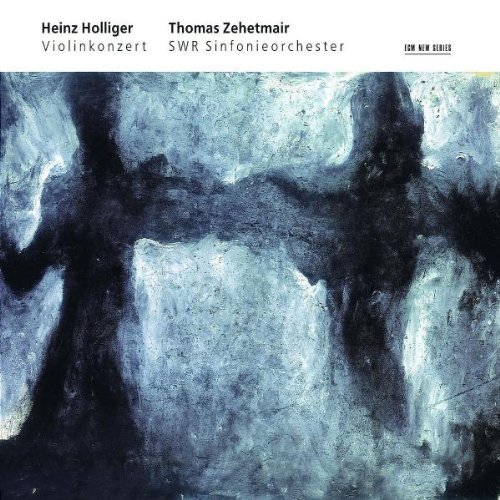
Heinz Holliger: Violinkonzert (ECM New Series 1890)


Heinz Holliger
Violinkonzert

Thomas Zehetmair violin
SWR Sinfonieorchester Baden-Baden und Freiburg
Heinz Holliger conductor
Ysaÿe
Recorded September 2002, Propstei St. Gerold
Engineer: Stephan Schellmann
Produced by Manfred Eicher
Holliger
Recorded December 2002, Konzerthaus Freiburg
Engineers: Helmut Hanusch and Ute Hesse
Co-production of ECM Records/Südwestrundfunk

The work of Swiss painter Louis Soutter (1871-1942) might have been forgotten were it for the efforts of such artists as Julian Schnabel and Arnulf Rainer, who cite him as a vital influence not only in their own creative lives, but also in the development of modern art at large. With this captivating ECM recording, composer Heinz Holliger pulls that thread just a little farther into the realm of the orchestra. His homage to the artist comes in the form of a Violin Concerto, which bears additional dedication to its performer here, Thomas Zehetmair. The concerto came to being when the composer was commissioned to write a commemorative piece for the 75th birthday of the Orchestre de la Suisse Romande. Once he discovered that Soutter had once been a violinist of the same entity, he needed no further impetus to evoke the artist’s already musical visuality. Holliger penned the concerto in three parts between 1993 and 1995, but later added a 17-minute “Epilogue” based on Soutter’s painting Before the Massacre. In this, Holliger swallows the soloist whole in favor of selfless anti-climax.

Holliger develops, as he is wont to, this sprawling work as if from a single droplet. With its ripple now audible, he combines reflections through which the exigencies of a single art are recast in the color schemes of private exhibition. The soloist, then, becomes a tattered traveler, a weary guide whose footsteps might very well continue to lead us on the right path even in the absence of a body to give them weight and signal. As the instrumentation becomes more self-aware, it conforms to the forces of language. Like a piece of silk surrendered to the wind it takes on the shapes of those forces. It is a sidelong glance, a skewed haunt in dissonant twilight, a ray of light in the trees where there is nothing else to see. The forest folds in on its heart, gnarled and rotting from the inside like a termite-infested house. Yet a certain peace also flows in those veins, something that captures and holds on to the light as nothing else can. Even at the densest moments the instruments sound vitally present as they fractal around the violin’s profoundly internal tracings. Starlight seems to glow from its F holes while in dialogue with hammered dulcimer and a bevy of percussion. It falls at the edge of dawn, spitting fire even as it speaks in ice, dotting the sky with flashes of supernovae, each the size of a pin’s head poked through the backcloth of a swooning catharsis (should the patient reader need a less uncertain comparison, think Berio’s Voci). It is a looming and gravid entity, one furiously alive even as it drains itself backwards into a high-pitched flight, joining a flock of microscopic kin into a universe where the wind rules in silence.

Following Holliger, who says of his Soutter variations, “I make no attempt to translate his painting into music: going out from it, I try to realize a ritual of annihilation,” we cannot simply open the concerto like a music box whose only melody is the cover painting. His is an ode to and of shadows, a gallery of emotional perforations, voices, and obsessions drawn in slow-motion charcoal, then burned to make more. The moment we avert our eyes and ears is when the music begins speaking to us…

Reflecting on Soutter’s life, the last 20 years of which were spent in a mental hospital, we may find ourselves wondering what moved him as a youth before his mind splashed its discoveries of erosion across the page. In the “Ballade” from Eugène Ysaÿe’s op. 27 Sonata for solo violin, which begins the album, we hear that youth epitomized. Its scintillating energy is made all the more visceral for Zehetmair’s flawless diction (a preview of things soon to come), by which he renders a virtuosic bumblebee’s flight (Rimsky-Korsakov need not apply) toward a fury of an ending. Again, the choice is calculated, for Soutter studied with Ysaÿe before replacing bow with brush, music with pigment and sweat. And though the sweat has long evaporated into overcast skies, the pigment remains, an open wound that smells of sound.

Paul Giger: Alpstein (ECM 1426)

1426

Paul Giger
Alpstein

Paul Giger violin
Jan Garbarek tenor saxophone
Pierre Favre percussion
Musicians from Appenzell (Switzerland) silvesterchlauseschuppel, schellenschötter
Recorded 1990/91 at Rainbow Studio, Oslo; 1990 at Trogen
Engineer: Jan Erik Kongshaug
Produced by Manfred Eicher

The first time I heard Swiss violinist Paul Giger, my soul might well have wept. His is a spiritualism beyond the trappings of human politics, a stage populated by human-animal hybrids, faceless musicians, and dancers of many forms. For this, his follow-up album, Giger is joined by saxophonist Jan Garbarek and percussionist Pierre Favre in a sonic portrait of his homeland. Delving into living folk traditions, this trio gives us as wintry a feeling as possible without ever stepping foot in into the Alps. Yet this is no mere sonic postcard, but a concerted effort to flip the land inside out and expose, as from under the logs we overturned as children, the life teeming within.

Anita's Alpstein
(Photo credit: Anita Brechbühl)

This music came into my life when I still had a violin in my hands. At the time, I was struggling with the idea of expressing my inner voice through an external instrument. Hearing Giger showed me it was possible, and this album’s second piece, Karma Shadub (Dancing Star), is something I played quite often in my ultimately futile attempts to emulate a sound that was beyond me. I even performed it once with an interpretive dancer at a high school assembly. Though the violin soon faded from my grasp, I remain ever in its shadow, a humble and open listener of its masters, of which Giger is a nonpareil example. Every dissolve of Karma reveals new visual combinations, each so rudimentary, so fundamentally alive. Garbarek’s throaty call dovetails with Giger’s in a symbiosis of dance and darkness. Alpsegen introduces the album’s first percussive colors. A caravan of metallic nomads, ranging from tambura to cymbals, processes across an ever-widening sound palette. Cowbells recede like ancestors as Giger leaps in evolutionary pirouettes. On Chuereihe, Garbarek revisits the herding calls that enthralled on Dansere, and climbs the peaks into which the cover photography beckons us. Giger’s violin here is sometimes insectile, sometimes onomatopoetic, but always anchored by Favre’s deepening drums. Chlauseschuppel gives us a taste of the Appenzeller bells, rung at the end of every year to ward off foul spirits as the new one is welcomed.

Silvesterchläuse by Vera Rüttimann
(Photo credit: Vera Rüttimann)

When I first heard Trogener Chilbiläbe, which closes the disc, its backdrop of urban sounds led me to believe it had been recorded in a church with the door flung open. Its inspiring solo cycles of fast runs and soaring meditations end with a slam, as if shutting out the noise of the outside world. Only later did I discover that the door in question belongs to a prison cell, and that the piece was recorded in the jail where Giger must serve out a few days of each year for refusing to pay military tax. As insightful as these biographical minutiae are, it is the Zäuerli, a haunting yodel particular to the Alpstein region making three appearances here, that is the album’s lifeblood. In order to evoke its polyphonic splendor via a single instrument, Giger taps his fingers on open strings, eliciting harmonics from within. These hidden voices are his aesthetic soil. As we come to be wrapped in their atmospheric blankets, we are awakened even as we slumber.

Alpstein is a cosmic alignment. Like all of the violinist’s albums, it is markedly different from the rest but digs just as deeply. Giger may not always look to the same future, but he does draw from the same mythic past. His playing is only one step removed from breath, for every stroke of the bow enriches the universe like air to a lung.

<< Kim Kashkashian: Shostakovich/Chihara/Bouchard (ECM 1425 NS)
>> Stephan Micus: Darkness And Light (ECM 1427)

Giya Kancheli: Magnum Ignotum (ECM New Series 1669)

Giya Kancheli
Magnum Ignotum

Mstislav Rostropovich cello
Royal Flanders Philharmonic Orchestra
Jansug Kakhidze conductor
Recorded December 1997
Produced by Manfred Eicher

Said Mstislav Rostropovich, to whom the opening work of this album is dedicated, of his longtime friend, “His natural element is the deepest mystical sorrow. Olivier Messiaen revealed for me the limitlessness and endlessness of time, and the same is true for Kancheli.” Chronological uncertainty seems to have been a core philosophy for the master cellist, whose sound grew only deeper toward the end of his life. Simi (1995) proves to be an ideal vehicle for his aging, yet ever robust sound. The title is Georgian for “string,” and indeed vibration is its universe. Pauses are left to the soloist’s discretion, and for this performance Rostropovich drew inspiration from Kancheli’s own halted style of speech. The music swirls in a crystal ball that, when occasionally shaken, snows down on a familiar motivic scene. Its imagery is stark and discomforting. A piano opens its chording like the death throes of an unfathomable organism. Brass-laden swells rupture its skin, immediately cauterized by an instrument of divine fire. Yet Simi is not without its hopeful intimations, as in the brief harmonic twinge at the 14’ mark. And while the cello’s presence dominates throughout, it is anything but the self-centered celebrant, comporting itself rather like one in mourning. That being said, the piece’s subtitle, “Joyless thoughts for violoncello and orchestra,” is something of a misnomer, for the cello also presents its own paradox: in the single performer lies the potential for multiple voices, and in the playing one finds undeniable ardor. In this instance, the cello is like a prism through which the composer’s light passes. The orchestra is no longer mere accompaniment, but an unraveling of the soloist’s heartbeat.

Magnum Ignotum (The Great Anonymous), written in 1994 for wind ensemble, double bass, and tape, has become one of Kancheli’s most widely played pieces. The response to a commission for which the composer was asked to incorporate Georgian folk music, Kancheli includes said music unmitigated, except by the technology of tape by which it is deployed. The opening recitation is of an Anchikhati priest, who seems to float above an almost funereal bassoon. Voices return in a 1930s field recording of three old men from West Georgia improvising in a haunting mezza voce called “ghighini.” Despite following a heavy orchestra piece, the modest scoring of Magnum Ignotum brings its own intensity, not least because every melodic line depends on the strength of the breath behind it. Thus invoked, the human body is unfolded through the vocal phenomenon that is the Rustavi Folk Choir, whose heartening rendition of the Trisagion hymn “Tsmindao Ghmerto” (Holy God) folds its hands to a clang of bells.

This is music concerned with its own ephemeral path, always skirting the edge of fleshly existence and the limitations upon which its life hinges. It is a candle flame holding on to its last flickers; it is also the puff of air that pulls it into smoke. An essential release from cover to disc.

<< John Holloway: Unarum fidium (ECM 1668 NS)
>> Bley/Peacock/Motian: Not Two, Not One (ECM 1670
)

Michael Mantler: Review (ECM 1813)


Michael Mantler
Review (1968-2000)

Robert Wyatt voice
Susi Hyldgaard voice, accordion
Michael Mantler trumpet
Bjarne Roupé guitar
Per Salo piano
Mona Larsen voice
Kim Kristensen piano, synthesizers
Jack Bruce voice
Per Jørgensen voice
Don Preston voice, synthesizers
John Greaves voice, bass
Karen Mantler voice, piano
Alexander Balanescu violin
Rick Fenn guitar
Marianne Faithfull voice
Nick Mason drums
Mike Stern guitar
Carla Bley piano, synthesizers, voice
Steve Swallow bass
Larry Coryell guitar
Tony Williams drums
Kevin Coyne voice
Chris Spedding guitar
Ron McClure bass
Terje Rypdal guitar
Jack DeJohnette drums
Don Cherry trumpet
Pharoah Sanders tenor saxophone
Jazz Composer´s Orchestra
London Symphony Orchestra
Balanescu Orchestra
Danish Radio Concert Orchestra
The Danish Radio Big Band
Chamber Music and Songs Ensemble
Radio Symphony Orchestra Frankfurt

Every once in a while, an album comes along that changes our view of what jazz, or any genre for that matter, can be. Review isn’t one of those albums. It’s much better.

One of contemporary music’s most accessible provocateurs, Michael Mantler is like an old friend and an enigma in one. ECM’s vital retrospective compresses over thirty years of his coal-throated sounds into a gallery of jagged diamonds. With a roster to make even the most eclectic enthusiast blush with delight, Mantler assembles a powerful resume of musical forces, intentions, artifacts, techniques, and emotional ammunition. He is the sonic equivalent of a Robert Altman or Peter Greenaway. Like the latter, he works with pictures within pictures, splashes refractions of time and place across his screens, enhances images with the written word. He makes audible the diaries of our intellectual journeys, folds every page into a paper airplane, and launches it from heights far beyond what we ever imagined as children.

From the first moments of the piano-driven, brass-infused jewel of musical concentration that is “Unsaid,” we feel the broad strokes with which Mantler paints, and the perpetual reinvention that cloaks his every move. No single mood dominates from thereon out. “Introductions,” for example, is a scrapbook of varied histories, of dislocation and dying joys, the story of a war-torn world in which home no longer remains a stable category. Against its beautiful harp-infused orchestral background, a kaleidoscope of characters airs its grievances. It’s as if one were to throw into a pot the music of Meredith Monk and Heiner Goebbels and watch what results. As this broth comes to a boil, we get a most potent whiff of unknown spices. Each instrument is its own flavor, adding a dash of autobiography to the thickening brew. This is a stunning piece, one exemplary of Mantler’s genius. “Solitudine / Lontano / L’Illuminata Rugiada / Proverbi” is a chain of laments splashing in the limpid pool of self-awareness, threading circumstance with the wave of a drunken stroll. A mournful violin lays itself down before a pause brings us to the more resolute “Speechless.” An unspoken word rolling off the tongue only when it is too late, it leads us to one of the album’s many insightful instrumental pieces. Said excerpt from “Folly Seeing All This” (1992) lifts its weight as a foot from mud, with no other choice but to step down and repeat the process. “Movie Two” (1977) is another magnificent incident, marked by nimble drumming from Tony Williams, heading a tight rhythm section beneath a crunchy guitar solo from Larry Coryell, not to mention Mantler’s own vividly imaginary trumpeting. A few briefer interludes make their voiceless presences known. “Love Ends (excerpt),” a bittersweet duet for clarinet and piano, is a memory one can’t quite picture. A treat from the unpretentiously titled “Alien” (1985) sports the nostalgic synths of Mothers of Invention keyboardist Don Preston. “Twenty” brims with the youth of its eponymous age. It acerbic electric guitar and heavy bass almost tumble over one another in their search for gold. But then there is “One Symphony” (1998), from which he hear but one fascinating orchestral snippet. Characterized by vibrant energy and mallet-heavy percussion, its jaunty instrumentation titillates at an intersection of the bowed, the blown, and the struck. Echoing pizzicato strings transcend the music’s outer barriers, puncturing its paper-like firmament with simulacra of starlight. “Preview” (1968) is another bundle of archival explosives. Its incendiary tenor sax solo, courtesy of the legendary Pharoah Sanders, runs amok, incurring not a few brass concussions along the way. And as the drums bubble from the earth around him like a latent volcano, Sanders astonishes with the intensity of his (in)difference.

Of all the vocal talent represented here, Robert Wyatt is foremost. His incautious duet with Susi Hyldgaard in “I’m glad you’re glad” is its own wonder. Here, a relationship’s self-reflexivity is thrown in its protagonists’ faces with veiled exclamations of happiness and return. Wyatt reads from Harold Pinter’s play Silence in “Sometimes I See People” (1976), twisting morose obsessions with social growth and fallacies of identity twist into a complicated braid. Another effective reading, this time run through a flange, in “The Sinking Spell” (from Mantler’s 1975/76 The Hapless Child) offers an Edward Gorey tale to the morbid believer in all of us. Its terrestrial charm, set aloft by flights on electric guitar, slingshots its sentiments across the universe toward vocal ends. Backed by none other than Carla Bley, Terje Rypdal, Jack DeJonette, and Steve Swallow, Wyatt stretches until he leaves his own nebular mark in the evening sky. A trio of miniatures—“PSS,” an excerpt from “Comrade,” and “A l’Abattoir”—featuring the voice of Marianne Faithfull makes for some further incisive dramaturgy. Behind a thinly processed veneer, each is a micro-opera of galactic proportions. Jack Bruce lays down his own heavy tracks with the words of Samuel Beckett in “Number Six – Part Four” (1973), in which he is paired with trumpeter Don Cherry. Finally, the lilting strings that introduce “It makes no difference to me” fade into their reverberant chamber behind indecisive voices, wandering in the confusion of split paths like the accordion that continues their journey when they fall silent. A love for recitative underscores these narratively minded pieces in brightest neon.

The real meta-statement, however, lies in “Understanding.” A piece about and of transition, it achieves its resolution through the fallibility of the utterance and its audio redeployment. It is a Tower of Babel laid on its side and spread thin into an auditory crepe. Mantler manages to be both cinematic and literary here, further skirting an undefined space between the two. As a translator myself, I feel this piece reaches for my heart like no other.

Mantler is a musical treasure, a singular voice comprised of many. His is not music that simply speaks to the listener, but music that speaks and listens to itself.