Paul Giger: Schattenwelt (ECM New Series 1487)

1487

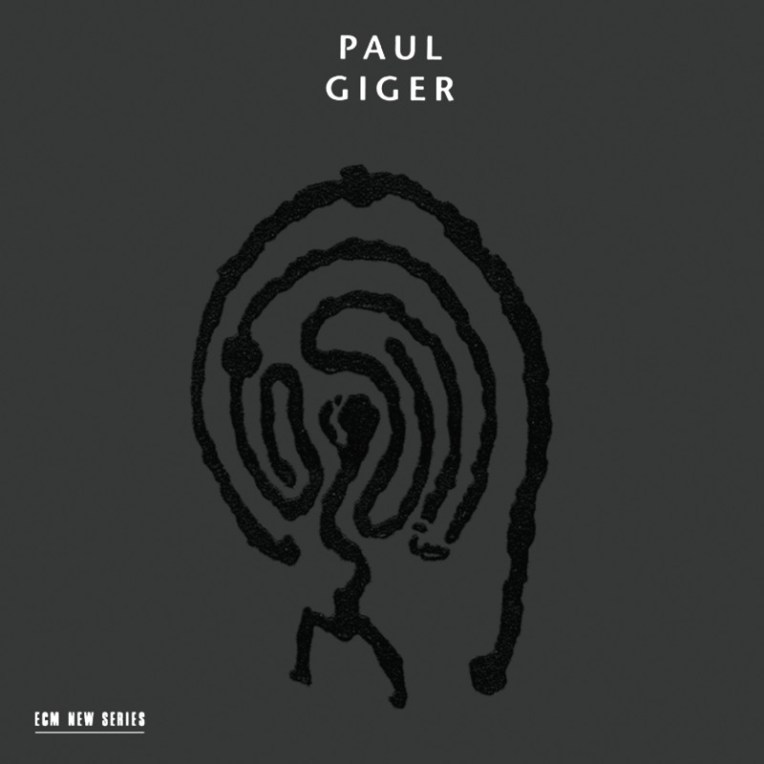
Paul Giger
Schattenwelt

Paul Giger violin
Recorded May 1992, Propstei St. Gerold
Engineer: Peter Laenger
Produced by Manfred Eicher

The Greek myth of the Minotaur and the Labyrinth lies at the heart of Schattenwelt (Shadow-world), the Swiss violinist Paul Giger’s third album for ECM and one of the label’s most enduring solo programs. The underlying narrative begins with Minos, son of Zeus and ruler of Crete, who wishes to sacrifice a bull in honor of Poseidon but cannot bring himself to do it once he beholds the glorious white creature given to him for that purpose. He decides to keep it, much to the consternation of his omniscient father, who as punishment imbues the bull with a power so dangerous that only Hercules is able to tame it. Minos’s wife Pasiphae is also struck (though not without an enraged Poseidon’s influence) by the bull’s uncanny beauty and couples with it, thus producing the bull-headed/man-bodied Minotaur. In a fit of jealousy and outrage, Minos imprisons this abomination in the labyrinth of Knossos, where the Minotaur is eventually slain by Theseus, son of Poseidon.

Giger approaches these events from the top down in his Seven Scenes from Labyrinthos, starting in the cosmos and ending in the underworld, effectively traveling in the opposite direction indicated by a rather different labyrinth in his ECM debut, Chartres. The architecture of “Dancing With The Stars” indicates a coalescence of matter out of nothingness. “Crane,” however, pulls us from its meditation into penetrating light. Notes ululate and waver like that titular bird, long associated with ancient labyrinths such as the one at Knossos. Thus do we get “Creating The Labyrinth,” a procession of rising sirens delineating an impossible path. “Birth Of The Bull” and “Fourteen Virgins” form a balanced pair. Where one is a celebration of life, the other represents the novennial sacrifice made to the Minotaur. “Death” is a chain of brooding arpeggios that beats faster toward a harmonic resolution before bleeding over into “Dancing In The World Of Shadows,” forging a seamless connection between consciousness and unconsciousness in a whirlwind of scraping stick-to-string contact.

Two refractions of the same light, Bay and Bombay (Good Night), circumscribe the program’s darkness like a compass. Where the first is airborne, its bow drawing out inner life from strings like human breath until it is but a rasp in the throat of Time, the latter expands that unseen dimension into spiritual quest. Across them all, Giger draws a careful brush.

The music of Schattenwelt possesses the kind of harmony one associates with an old stone sanctuary, its glassless windows allowing every word sung or spoken full disclosure into the world(s) beyond. His technique is outstanding yet subtle, as in a beautiful passage of Bombay during which he sustains a lead melodic line on one string while bouncing his bow for a rhythmic accompaniment on another. The result is a self-contained universe that is constantly looking in on itself, for it knows no other way. After all, what is a shadow-world but a realm in which individuals have sacrificed the light in favor of blameless creation?

<< Stephan Micus: To The Evening Child (ECM 1486)
>> Bley/Peacock/Oxley/Surman: In The Evenings Out There (ECM 1488)

The Hilliard Ensemble: Walter Frye (ECM New Series 1476)

Walter Frye

David James countertenor
Rogers Covey-Crump tenor
John Potter tenor
Gordon Jones baritone
Recorded January 1992, Stadtkirche Gönningen, Germany
Engineer: Peter Laenger
Produced by Manfred Eicher

This early ECM New Series offering chronicles the music of Walter Frye, a 15th-century English composer whose biographical details are as elusive as his music is captivating. He is survived by a significant handful of vocal works, of which the Hilliard Ensemble gives us a thoughtful cross section. Of these, the Ave regina is the most well known, though the Missa Flos regalis forms the backbone of this altogether revelatory album. The mass itself—which, in true Hilliard fashion is divided among a selection of motets—is a brooding flow of delicate harmonies, seamless “hand-offs,” and intimate exchanges. Its inward-looking tone invites the listener into a prayerful space in which worldly cares are both the source of one’s burdens and the key to absolving them. Frye’s motets are also indicative of a great craftsman at work. Sospitati dedit is a compelling processional prosa (i.e., a celebratory song chanted before the gospel during religious festivals—in this case the Feast of St. Nicholas) that is the most rhythmically adventurous piece on the album. The Salve virgo is another breathtaking setting and soothes with its melodious unfolding. Also of note are the lovely rondeau Tout a par moi and Myn hertis lust, one of the few surviving examples we have of Frye’s English ballades. As for the Ave regina, performed here in three- and four-part versions, one can only praise its brevity and exquisite construction.

The countertenor lines stand out in every piece, not only because of David James’s flawless singing but also because of the ways in which Frye weaves them into the choral fabric at hand. This top-heaviness lends the music a peculiar balance that is meticulously maintained throughout. Frye has been represented elsewhere by the Ferrara Ensemble on their fine disc Northerne Wind. Along with this effort by the Hilliards, one can only hope the future will direct more attention toward a composer who might have easily been trampled in the march of history.

<< Miroslav Vitous/Jan Garbarek: Atmos (ECM 1475)
>> Thomas Demenga: J. S. Bach/Sándor Veress (ECM 1477 NS)

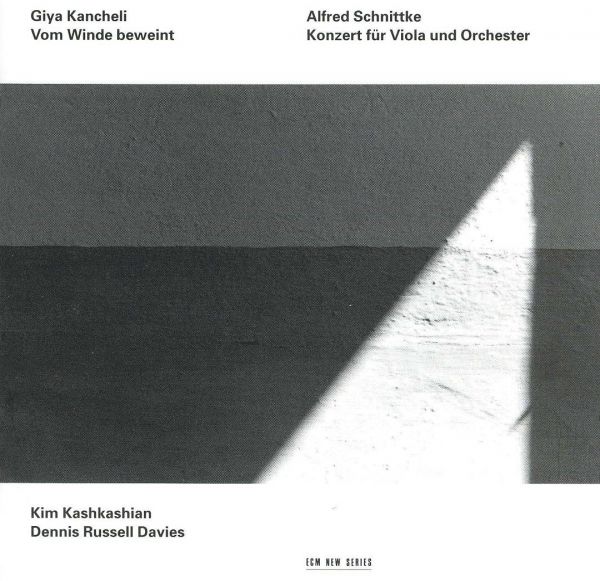
Giya Kancheli/Alfred Schnittke: Works for Viola and Orchestra (ECM New Series 1471)

Kancheli/Schnittke
Works for viola and orchestra

Kim Kashkashian viola
Orchester der Beethovenhalle Bonn
Rundfunk Sinfonie-Orchester Saarbrücken
Dennis Russell Davies conductor
Recorded November 1991, Beethovenhalle, Bonn (Kancheli)
Engineer: Peter Laenger
Recorded May 1986, Saarländischer Rundfunk, Saarbrücken (Schnittke)
Engineer: Helmut David
Remixed by Peter Laenger and Manfred Eicher
Produced by Manfred Eicher

This powerful record brings together two of the most seminal works for viola and orchestra of the twentieth century. Although these pieces are as different as they are similar, together they form a distinct balance of sentiment and execution.

Giya Kancheli: Vom Winde beweint (Mourned by the Wind)
Kancheli’s self-styled “liturgy” is an exercise in patience and surrender. Its opening slam of piano chords is a big bang in and of itself, and sets the stage for the soloist’s epic journey. Wilfred Mellers, in his liner notes, posits the viola’s emergence from such chaos as the “birth of consciousness.” And indeed, one can extrapolate from its startling abruptness the inklings of a life yet lived, fresh and devoid of self-awareness in the greater void of silence. The orchestra skirts the periphery, gradually uniting with the soloist. This contrast mimics the arbitrary stability of human values—at once sacred and mutable—so that moments of resolution always tread a downward slope. Luminous winds, a cosmic harpsichord, and trails of harmonics characterize the first movement. Brief horn blasts introduce the second, throughout which the viola wanders without fortitude into a minefield of piano and timpani, singing without carrying a tune. The harpsichord again works its galactic magic, feeding stardust into the viola’s arterial core. A passage of intense and sustained volume leads into an epic swan song. The third movement is brought forth on the strings of the harpsichord, the viola a mere flit of wings in the surrounding air. An oboe threads the hesitation like the beginning of an incomplete statement. The fourth movement is a violent implosion and balances out the first with its selfish gaze. As with seemingly every Kancheli composition, it ends as quietly as an evening breeze. One hears the rustling of leaves in the distance, only to find that it was a trick of the ears all along. Vom Winde beweint is rich with sharp dynamic peaks that are short-lived and sporadic, the hallmarks of an ode to process over progress.

Alfred Schnittke: Konzert für Viola und Orchester
For this monumental work, Schnittke has chosen to invert the standard concerto form, sandwiching an Allegro Molto between two Largos. The piece opens with a viola solo held aloft by shimmering orchestral waves. Every melodic line is like the root of an ever-growing tree of voices. In the second movement, the viola skips across a landscape of consonances and dissonances at the behest of a passively insistent harpsichord. Schnittke maintains the fascinating sense of rhythm and energy that distinguishes his faster turns, scratching at the surface of a larger unfathomable world. Harpsichord, flute, and viola congregate in a Mozartean danse macabre at the movement’s center. The strangely wooden pizzicato toward the end haunts as the piano jumps impatiently on its lower notes. The last movement gives the viola a demanding solo, which is eventually overtaken by horns and winds. A deep pause marks a change in intent. The harpsichord once again comes to the fore, the final cameo of a strong orchestral cast, before bowing to a beautifully dissonant double stop from the viola.

Schnittke would suffer a stroke just ten days after completing the score for his concerto.* Said the composer: “Like a premonition of what was to come, the music took on the character of a restless chase through life (in the second movement) and that of a slow and sad overview of life on the threshold of death (in the third movement).” Such narrative approaches to one’s own work speak of a pragmatic mind that seeks order in the flow of a creative life. Yet rather than a premonition, I experience the concerto as an affirmation of what one already knows. If Kancheli’s is an unanswered question, Schnittke’s is an unquestioned answer.

This is a profoundly emotional album, by turns confrontational and mournfully resplendent. Kashkashian brings her usual heartrending strength to even the subtlest gestures and is never afraid to betray the fragility of her pitch. The orchestras, under the direction of Dennis Russell Davies, are forces to be reckoned with that scintillate in a slightly distanced mix. A benchmark recording in all respects.

*My thanks to Christopher Culver for the correction.

<< Dmitri Shostakovich: 24 Preludes and Fugues (ECM 1469/70 NS)
>> Heinz Holliger: Scardanelli-Zyklus (ECM 1472/73 NS)

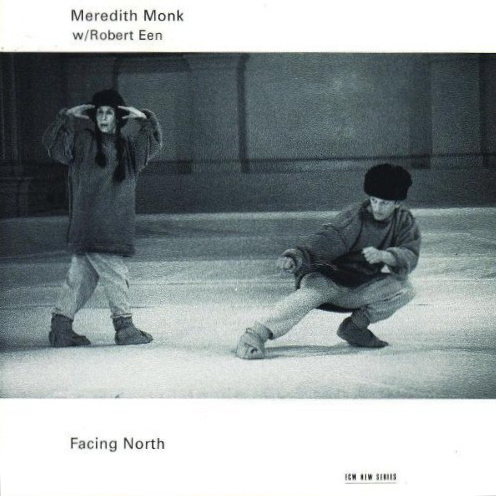
Meredith Monk: Facing North (ECM New Series 1482)

Meredith Monk
Facing North

Meredith Monk voice, piano, organ, pitch pipe
Robert Een voice, pitch pipe
Recorded April 1992, Rainbow Studio, Oslo
Engineer: Jan Erik Kongshaug
Produced by Manfred Eicher

While working on her opera Atlas during a residency in Banff, Meredith Monk found herself drawn to the Canadian wilderness just outside her window. Perhaps inspired by the stillness of snow and the silent steps of animals pressed into it, Monk developed Facing North out of a desire to evoke that same profound stasis, an opportunity to reconnect to something taken for granted. “As I worked,” she writes, “I tried to evoke the elemental, bracing clarity of the northern landscape. I realized then that ‘north’ is also a state of mind.” Monk’s multilayered compositions are always a state of mind, but Facing North is especially potent in this regard. The piece is distinguished by its dual landmarks. Two “Northern Lights” sections are played on pitch pipes and seem to function as invocations. Acting as artificial threads, they translate the breath into a vocal sound, substituting tracheae with factory-honed tubes and vibrating metal plates. Like the ritual sweeping of a temple, every strand seems to clear the stage for arrival, leading a modest procession into sacred space. The two “Long Shadows” sections, however, are vocally dominant, describing the ending of one journey and the beginning of another. These both upset and grant structure to the piece as a whole. Other movements bristle with creative fervor. “Chinook” is a medley of voiced postalveolar fricatives that circles around itself like two flies in the morning light, unable to figure out who is chasing whom. “Keeping Warm” is sung in short bursts. We hear movement, implied footsteps, some slapping of the body. It is rhythmic but not a dance; it is survival amid the elements. Sure to please is “Arctic Bear,” an open game of cries and hiccups, darkened by Een’s distant howls. In spite of its icy atmosphere, Facing North is equally about arid interiors drenched in endless daylight, illuminating the delicate cartography of the body and its relationship with the life-giving (and death-bringing) earth.

Two shorter selections round out the disc. First is a scaled-down version of Vessel: an opera epic. At its center lies the story of Joan of Arc, while at its periphery spreads the story of a landscape divided by human contact. Though it may not seem like it when caught up in the moment, Monk roams through a great number of techniques throughout this piece. An organ provides a lush backdrop to her gallery of overdubbed stuttering, fluid calls, playful cries, dirges, lullabies, overtone singing, flying leaps, and ululations. Last but not least is “Boat Song,” excerpted from the opera Recent Ruins. This is one of those quintessential Meredith Monk moments that is at once familiar and mysterious. It is the enigma of what lives and breathes inside us, veiled in darkness and in silence, yet given voice in the outer world.

Like so much of Monk’s music, everything on this album was conceived for the stage. As such, it is rife with spatial possibilities, limited only by the listener’s imagination. The melodies are extremely organic, following a path that existed long before there were feet to press it into being. Stepping into this album is like stepping into another dimension in which the same objects exist around us, seemingly unchanged, yet from which we can never completely extrapolate a sense of purposeful belonging. We may find a piece of ourselves floating above the voices of an entirely descriptive universe, yet even as we fly off into those lands where the sun shines brightest and longest, we can never find ourselves without listening to the endless nights of what our hearts prefer.

<< Keith Jarrett: Vienna Concert (ECM 1481)
>> Heiner Goebbels: La Jalousie (ECM 1483 NS)

Arvo Pärt: Miserere (ECM New Series 1430)

Miserere

Arvo Pärt
Miserere

The Hilliard Ensemble
David James countertenor
Rogers Covey-Crump tenor
John Potter tenor
Gordon Jones baritone
Paul Hillier director
Orchester der Beethovenhalle Bonn
Western Wind Chamber Choir
Dennis Russell Davies conductor
Sarah Leonard soprano
Christopher Bowers-Broadbent organ
Pierre Favre percussion
Recorded September 1990, St. Jude-on-the-Hill, London (Miserere, Sarah Was Ninety Years Old)
Engineer: Peter Laenger
Recorded December 1990 at Beethovenhalle, Bonn (Festina Lente)
Engineers: Peter Laenger and Andreas Neubronner
Produced by Manfred Eicher

For reasons perhaps too numerous to list here in full, Arvo Pärt’s Miserere remains my most cherished of the Estonian composer’s ever-growing book of masterworks. Suffice it to say that its magic lies in its stillness. For such an expansive piece—scored as it is for choir, soloists, organ, and ensemble—it is remarkably introspective. Its opening invocation of Psalm 51 fleshes out a corpus of spoken language made melody. A statement from the clarinet follows every word, not so much commentative as dialogic. Once harmony is introduced in the second vocal line, the pauses become even more gravid and rich in spatial detail. The soloists gather up all remaining threads, persevering through mounting tensions with the blunt instrument that is the interjected “Dies irae.” This is more than just a thunderous meditation. It is a wringing-out of the heavens, the earth a mouth gaping to catch all that drips down. Voices burst like supernovas around thunderous timpani, crashing into the oceans until only a tubular bell is left to caress the newly razed soil. The heartfelt baritone of Gordon Jones describes the ruins with mellifluous sensitivity. A wind section breathes through every pause like a ghostly antiphon and provides a dark interlude. As the soloists arise en masse, David James flares with his resplendent countertenor colors, whereas the deep intonation of soprano Sarah Leonard marvels amid the fumes of destruction. Another stunning interlude, this time introduced by Christopher Bowers-Broadbent on organ, coaxes the winds into more independent recitations, accentuated by a crystalline tambourine and triangle. We arrive to an a cappella passage that is transfiguration incarnate, each soloist pawing the air like a sleeping lion. The winds slog through the valleys, heavy sins in tow, while voices linger in the firmament. Leonard is unmatched in her ability to put her entire being into a high note, and the moment one finds at the 30:13 mark is perhaps her finest example. This touches off one of the most breathtaking lifts ever set to music, as all the voices scale a ladder of chaos into a world of silent order. Miserere is all about the “in between,” the lesson of interrupted thought, and our fearful awe over the mystery of creation.

Festina Lente (1988) for orchestra and harp is dedicated to Manfred Eicher. The title means “make haste slowly” and acknowledges the importance of flux in any creative endeavor. Like Eicher’s own aesthetic path, it is a resonant spiral that goes both downward and upward.

Awe is the operative concept in Sarah Was Ninety Years Old (1977/90). Drums cycle through an arithmetic exploration of high and low beats, cradling wordless passages from tenors Rogers Covey-Crump and John Potter. This process repeats until the organ makes its humble entrance, even as Leonard pushes her voice to dizzying heights. One would think such a piece might escape today’s trigger-happy musical culture, but I have recently encountered the drums from Sarah, as effective as they are surprising, being sampled by German electronic artist HECQ in his track “Aback,” off the wonderful album Night Falls.

This disc has been with me for nearly half my life. The Miserere in particular drew me into a love of singing. As a teenager I used to spend hours singing along alternately with the baritone and alto lines until the booklet yellowed and nearly fell apart from excessive handling (I even went so far as to purchase a backup, just so I would have a pristine copy on my shelf). After so much physiological engagement with its textual and aural shapes, it has become an integral part of my person. Listening reminds me that with each new step I take on the path to independence, I grow closer to who I have always been: a human soul sustained by all others in a world where time is infinitely malleable, and the only thing that’s real is my surrender to the moment.

<< Eleni Karaindrou: Music For Films (ECM 1429)
>> Christopher Bowers-Broadbent: Trivium (ECM 1431 NS)

Christopher Bowers-Broadbent: Trivium (ECM New Series 1431)

Trivium

Christopher Bowers-Broadbent organ
Recorded October 1990, Grossmünster, Zürich
Engineer: Peter Laenger
Produced by Manfred Eicher

I am a rider without mount, an ocean without waves, a horizon without dawn, nailed to myself, nailed to an absence in time which, after me, becomes the time of absence.
–Edmond Jabés, The Book of Questions

Avid Arvo Pärt listeners will be more than familiar with the profound talents of Christopher Bowers-Broadbent. The English organist has long held contemporary music in high regard, and has enriched the liturgical landscape with numerous commissions as well as his own compositions. With such a wealth of music available at the tips of his fingers (and toes), Bowers-Broadbent was faced with a daunting task: namely, crafting a personal take on music’s creative intimacy through one of its most leviathan instruments. The end result is, in his own words, a “performance about time and space.” As such, the reach, not the fleeting emotional effect, of his selections becomes paramount. Rather than lay out a program of short, varied pieces, he has turned inward, finding in the works of only three composers enough to describe a universe of ideas.

He first unveils the night sky with a quartet of pieces by Arvo Pärt. Trivium (1988) is like a constellation burning silently for our scrutiny. What remains flat on the stargazer’s map becomes three-dimensional in Bowers-Broadbent’s care. As with Pärt’s other tintinnabular quests, Trivium is both explorer and the landscape being explored. Its powerful middle section connotes a triune infrastructure, embodying the balance of divine order in every disturbance. The steady pulse of Mein Weg hat Gipfel und Wellentäler (1989) breathes with earthly lungs, even as it cradles a heart that can only be seen with a telescope. Its path stays true to the peaks and valleys of its title, taken from a poem by Edmond Jabés (Pärt would later rescore this piece in a version for strings and percussion that can be found on the ECM recording In Principio). Annum per annum (1980) is structured like a mass and brings that same sort of complementary vision to its stark dynamic contrasts. Pari Intervallo, composed in 1981, layers intonations in the higher register over a slow chromatic sway of transfiguration.

We are slowly brought back into our bodies with two of three voluntaries composed by Peter Maxwell Davies in 1976. These arrangements of sixteenth-century Scottish hymns seem to unpack, in a brief span of time, the mystery of faith. With enigmatic precision, Psalm 124 (after David Peebles) traces the contours of God’s raging waters with a touch of resignation, glorying in the safety of grace and retribution, while O God Abufe (after John Fethy) expresses even more succinctly the awe of a prayerful mind.

By the time we arrive at the final two pieces, each a spectacular arrangement of music by Philip Glass, we are well primed for the metamorphoses implied therein. Satyagraha renders the finale of Act III from the selfsame opera into a whirling dervish of stratospheric proportions. One can almost feel the air coursing through the organ’s pipes with every recapitulation. Dance IV, on the other hand, is a more extroverted piece that populates its periphery with movement and attractive forces. It ecstatically forms the center of the album’s galactic structure, drawing in countless voices until it reaches critical mass.

Bowers-Broadbent has the uncanny ability to take music that is seemingly histrionic and forge from it a host of instinctual meanings. From the wafting strains of Pärt’s sublime prostrations to the enlivening regularity of Glass’s exuberant leaps, we are treated at every moment to an august evocation of music for its own sake. All too often, it seems, organ recitals fall under our radar. Albums like this become the radar, and we the blips upon its screen: transient yet unmistakably there.

<< Arvo Pärt: Miserere (ECM 1430 NS)
>> Anouar Brahem: Barzakh (ECM 1432)

Hans Otte: Das Buch der Klänge (ECM New Series 1659)

Hans Otte
Das Buch der Klänge

Herbert Henck piano
Recorded September 1997, Festeburgkirche, Frankfurt am Main
Engineer: Markus Heiland
Produced by Manfred Eicher

“It is an old dream of mine that the nature of sounds is discovered and that they are not used in order to express something else.”
–Hans Otte

Hans Otte (1926-2007) was a German composer, pianist, and sound installation artist. A student of Paul Hindemith, he came to see the role of sound as a phenomenon in its own right, and seems to have treated his piano music as a crucible in which musical lexicons might be boiled down to their essential vocabularies.

Herbert Henck offers up this sweeping interpretation of Otte’s twelve-part masterwork, Das Buch der Klänge (The Book of Sounds), as a stunning example of what piano music can grow into when loosed from its binds and allowed to breathe of its own volition. The cycle was three years in the making, and exudes gentle and attentive care. Part I is remarkably consonant, seesawing between the same two chords while alternating with more quickly syncopated passages. From these first moments we get the sense of travel that comes to characterize the trajectory to follow. There is also a nostalgic air that one finds in many of John Adams’s earlier compositions (and especially in Phrygian Gates). Part II undulates in cascades, from which single notes call out with assurance and clarity. Part III returns us to the journey, its slowly applied chords pressing like footsteps into the soil. Part IV erupts in dramatic cloudbursts, bleeding into Part V, in which the same chords are deployed with more urgency. The piano sings here, knitting between its open strings the makings of a vocal tract. Part VI is a linear melody, each note dotting the darkness with a distant galaxy. Part VII is one of the most spiritual sections of the piece, and is like the ostinato of a more expansive composition that never develops into a lead line, but rather looks inward via more pinpointed notes within arpeggiated clusters. In dispensing with the imagined right hand, the music speaks for itself, as if to untie the binds of its inner heart so that each note may flow freely through its ventricles. Part VIII marks the return of cautious footsteps. This is the frustration of travel, the annoyances, delays, and logistic disconnects that are inevitable when experiencing any new culture, however adored. Part IX at last offers some reprieve, giving itself over into rest. It is the time of reflection, when the return seems all too imminent and the lessons learned have hardly had time to take root, and we come to realize that those moments of misunderstanding are the ones we cherish the most. Part X shines like the dawn. Only now do we realize this landscape may be forever lost to us, so we glory in every flaw and perfection alike while we still can, in the hopes of carrying it inside us when we leave. Throughout Part XII, one hears a little Satie peeking through in the finality of its playful departure. It is the quiet checkered landscape below on the return flight, the silent coastline receding behind the ship, the cloud of dust churning behind the bus, the slowly waving hand left behind at the train station. All such moments are brought to bear in Otte’s Buch, so that all we have left is this audible postcard on the back of which Henck has inscribed as much as could possibly fit in such a limited space. But the real beauty of this recording is that, as a tangible object, it can be held, turned in the hands, admired for its cover art, intellectually fed upon through its liner notes, and the journey repeated at any moment one wishes. It is music like this that reminds us of the pleasurable luxury of recordings and their didactic effect. They transport us to unseen locations, or conversely reconstruct those locations stone by stone in our very minds without us having to lift a finger. Most importantly, they allow us to appreciate the very real experiences we have in our own travels, and in doing so give us the gift of hindsight, reminding us of how memory shapes who we are.

Considering Henck’s often-eclectic approach, I was both surprised and reassured by his championing of Otte. Although Henck has always chosen fascinating material, the reductive power of this music is nothing short of revelatory. These sounds speak directly to the heart and feel as if they grew out of solitary nocturnal improvisations. Notions of minimalism are easily vanquished with a careful listen, which reveals a wealth of subtle details and variations peppered throughout. Through the infliction of its uneven terrain, the joys of arrival and the memories that linger once the destination has been found become one and the same. Henck plays with grace and fortitude, making explicit use of the sustain pedal and the instrument’s own internal space. This is music that looks simple on paper, but requires personal commitment to articulation, speed, timing, and volume. Thus, it becomes a magnifying glass into the musician’s, and the listener’s, sense of being. By far one of ECM’s finest achievements.

<< The Hilliard Ensemble: Lassus (ECM 1658 NS)
>> Mats Edén: Milvus (ECM 1660
)

Barry Guy: Folio (ECM New Series 1931)


Barry Guy
Folio

Maya Homburger baroque violin
Muriel Cantoreggi violin
Barry Guy double-bass
Münchener Kammerorchester
Christoph Poppen conductor
Recorded February 2005, Himmelfahrtskirche, München
Engineer: Peter Laenger
Produced by Manfred Eicher

Over the years, ECM New Series listeners will have variously encountered Barry Guy as composer, performer, and improviser. In Folio, we get to experience all three. I have always found his improvisatory role to be the most compelling, for it stirs my heart with communicative possibilities. And so, in the spirit of living in the moment, I share this review verbatim, as I dictated it while listening:

“Barry Guy is very much concerned with the internal, the biological nature of music. The seemingly sourceless energy it evokes through human contact enables us to question our own energy: whether it is divinely given or naturally ordained. While his epic explorations of thematic material by Diego Ortiz betray a more honed compositional reach, Guy still inhales the oxygen of indeterminacy. This music functions very much like memory: when one focuses on one memory, others try to creep in, sometimes courting unwanted associations, secrets we would rather not acknowledge…. Even at its most dynamic moments, this music is all about gentility and caution—not as a sign of fear…but as a way of life, a philosophy. The improvised ‘commentaries’ peppered throughout add a rich sense of bulk to the album’s presence…but one shouldn’t think they are any less substantial, for they wouldn’t be what they are without their source texts. They give the musicians a crisp field in which to ponder the emotional implications of what they have just played…to share those feelings with the listener rather than covet them unceremoniously. The ‘Folio’ pieces are richer in orchestral texture. They tap into a broader sensibility of the music’s own potential while also burying the possible egotism of the solo artist…in a lush balance of restraint and emotional surrender. Guy uses gimmicks briefly and wisely, and is never afraid to stutter. This is music that never edits itself. The commentaries are immediate responses. They do not simply act as arbitrary filler material, but rather speak to the lingering effects…grasping on to those effects before they fade out of sight and out of mind. And so, I think this is why Track 13 is called ‘Memory,’ for what is commentary but solidified memory shared with others…? And similarly, what is a review but a memory…a conscious chronicling of an experience that can never be recaptured, but only inadequately preserved in one person’s thought. For rather than a simple memory, I should like to share a record of my experience. This track also speaks to me in the same way we often search through our memories for an originating thought. Oftentimes, especially as we are going to sleep, we let our minds wander, only to backtrack, looking for that one sound or image or word or impression that launched our mental exploration…and this is perhaps what we stumble into in ‘Ortiz II,’ which in some way charts the frustration of our psychological imperfections, while also exploiting those imperfections to audible effect. This is an altogether intriguing album, which is always greater than the some of its parts, as it allows for the listener’s own reflection and for the compositional nature of personality to run amok, or slumber as it may, in pockets of empty space.”

Werner Bärtschi: W.A. Mozart/G. Scelsi/A. Pärt/F. Busoni/W. Bärtschi (ECM New Series 1377)


W.A. Mozart/G. Scelsi/A. Pärt/F. Busoni/W. Bärtschi

Werner Bärtschi piano
Recorded July 1988 at Kirche Blumenstein, Switzerland
Engineer: Andreas Neubronner
Produced by Manfred Eicher

In this ECM debut, Swiss pianist Werner Bärtschi offers up an intriguing and carefully conceived program. Having studied with Klaus Huber and Rudolf Kelterborn, Bärtschi brings a decidedly compositional attention to his playing that lends itself well to the material at hand. He begins with Mozart’s C minor Fantasie (1785), which, as the longest piece, reads like a single human life. It is not a simple reimagining of the past but a reliving of it, for to play the piano is to articulate a biography in sound, using the body in imitation of what bore those same feelings in “real time.” After such a piece, the Four Illustrations on the Metamorphoses of Vishnu (1953) by Scelsi may seem like a startling transition. Yet humble quartet presents us with a rare programmatic gesture from the Italian, whose microscopic approach actually balances out Mozart’s broader strokes and veils the turmoil of mortality behind the surface of the spirit made flesh. Bärtshi surprises us yet again with Arvo Pärt’s Für Alina. This early 1976 version is like a dream we question upon waking: Did we really hear it, or did the music rise in our minds out of an unspoken memory? And so, when we next encounter Mozart in the 1788 B minor Adagio, we hear him with fresh ears and open hearts. Rather that scoping out the Mozartean influence in the surrounding works, we see the latter funneling into the former. Bärtschi follows with a piece of his own, Frühmorgens am Daubensee (1986/88), realized during an early morning hike in the mountains surrounding the eponymous lake. In it we hear snatches of something upon the wind, distant conversations, activities, worldly movements, the beginning of an avalanche that never quite forms. This salves us nicely for the relative onslaught of Busoni’s 1921 Toccata, a masterful yet demanding unfolding of theme and counterpoint. After such a towering cascade of notes, Mozart’s B major Sonata (1783) is like a gentle return, a pair of hands lowering us slowly to the earth, leaving us to slumber in a blanket of solid ground.

Hans-Klaus Jungheinrich provides a beautifully conceived essay which, despite risking an overuse of the word “oriental” (it appears no less than five times in the liner notes), makes a viable case for Bärtschi’s musical choices as being firmly rooted in the spirit of magic and fantasy that engenders the program as a whole. Where Jungheinrich characterizes this as a piano recital of “Mozart and…,” I would go a step further and say it is equal parts “…and Mozart.” yet although Mozart bookends the recital and inhabits its fulcrum, his infrastructural presence is no more significant than the validation of the superstructure. As such, the continuity between these pieces is a narrative rather than formal concern—not a linear continuity, but one in which the potential for speech is equally present at every stage.

<< Dino Saluzzi: Andina (ECM 1375)
>> Heinz Reber: MNAOMAI, MNOMAI (ECM 1378 NS)