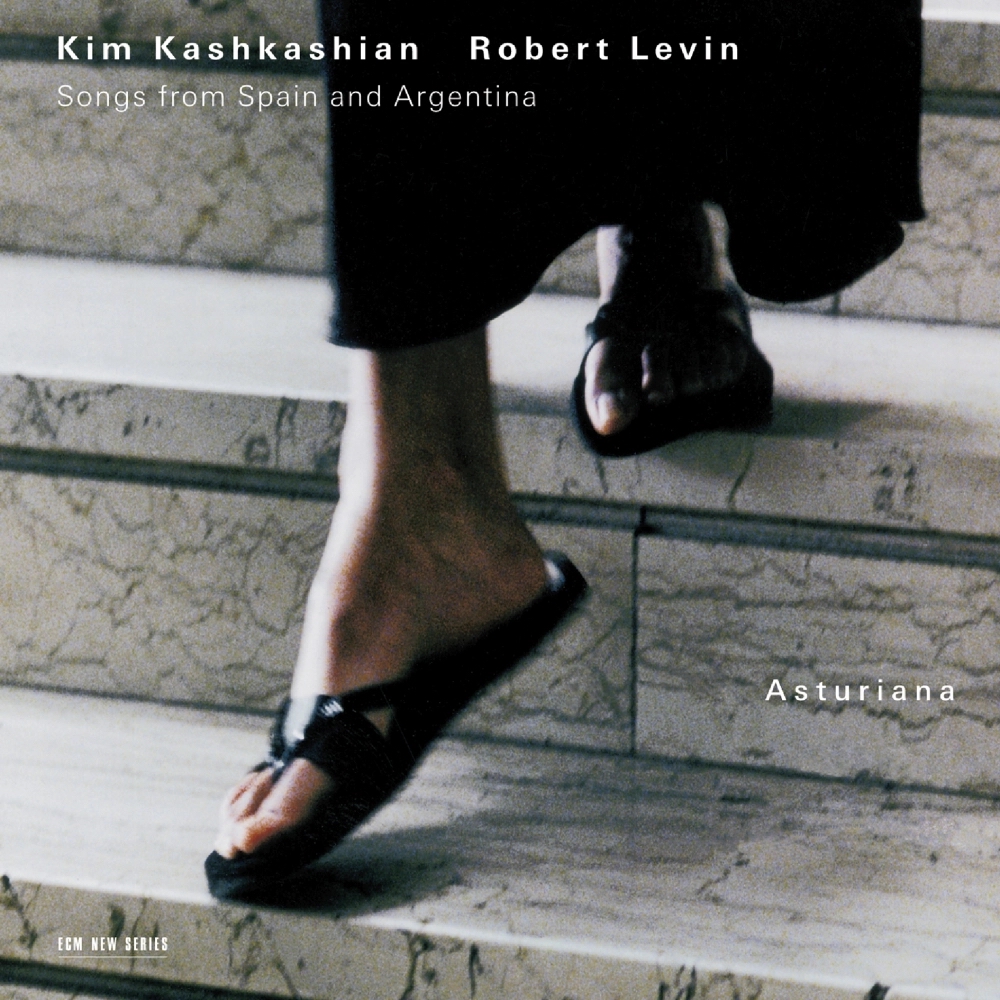
Kim Kashkashian/Robert Levin: Asturiana (ECM New Series 1975)

Asturiana: Songs from Spain and Argentina

Kim Kashkashian viola
Robert Levin piano
Recorded August 2006, Radio Studio DRS, Zürich
Engineer: Stephan Schellmann
Produced by Manfred Eicher

As it opened, the rose embraced the willow.
The tree loved the rose so passionately!
But a coquettish youth has stolen the rose.
And the disconsolate willow weeps for it. Ah!

What can we know of a text when its words are taken away from us? Is it forever lost, or does its ghost still linger? Do we simply replace it with another, or do we revive it in another form? In an expansive and carefully thought out program of Spanish and Argentinean folk songs adapted by a handful of famous and not-so-famous composers and arranged here for viola and piano, the subject of this review provides a simple answer to these questions: all of the above and more. The songs on Asturiana may be without words, but they want for nothing in communicative power. The booklet contains English translations of every song being rendered, if not sung, through Kim Kashkashian’s flawless touch and Robert Levin’s colorful accompaniment, thereby allowing us direct access to each melody’s interior life.

The title of Asturiana comes from its opening song, set by Manuel de Falla (1876-1946) as part of his Siete canciones populares españolas, and is probably the most well-known melody among the album’s twenty-three. This is also the first of three songs that appear twice, each time in a differently nuanced performance—the others being the whimsical “La rosa y el sauce” by Carlos Guastavino (1912-2000) epigraphed above, and heartbreaking “Triste” by Alberto Ginastera (1916-1983) from the fellow Argentinean composer’s Cinco canciones populares argentinas. The latter tells of a shunted lover who has only the shaded pool where he once gave his heart, and which now only reflects the face of a dejected man. Four songs by Enrique Granados (1867-1916) dramatize the loves of majos and majas, denizens of Spain’s lower class. From Xavier Montsalvatge (1912-2002) we get four of the Cinco canciones negras, which look beyond the composer’s Catalonian roots to the West Indies for their inspiration. Avid Mompou listeners will find much to admire in Montsalvatge’s melodic density and personal flair. Then comes the full cycle of de Falla’s Siete canciones, where the title track makes its cameo. Of these, “Jota” is the most exuberant and brims with the blissful naivety of young love, while Kashkashian’s rendition of “Nana” touches the heart as tenderly as any singer ever could (having sung some of these pieces in concert with classical guitarist Joseph Ricker, I can personally attest to this statement). After de Falla’s masterful arrangements, Ginastera’s “Triste” is reprised, followed by a selection of songs by Guastavino. These are the most poetic of the verses represented here, carried along by an almost mystical interest in naturalism and magic. The two final songs by Carlos López Buchardo (1981-1948) speak of deep communication and love’s self-destruction in the same breath.

These timeless, and timely, melodies come to life in Kashkashian’s utterly capable hands. As such, they become more than adaptations, but journeys into the heart of song. Kashkashian’s viola resonates like a deeply exhaling lung, and leaves us just as breathless. If the shortest distance between two points is a straight line, then her musicianship is the straightest line one could possibly drawn between the listener and the music contained on this superlative CD. May she never stop singing.

Heinz Holliger/Clara Schumann: Romancendres (ECM New Series 2055)


Heinz Holliger
Clara Schumann
Romancendres

Christoph Richter violoncello
Dénes Várjon piano
SWR Vokalensemble Stuttgart
SWR Stuttgart Radio Symphony Orchestra
Heinz Holliger conductor
Recorded February 2008, Auditorio Radio Svizzera, Lugano (Romanzen, Romancendres), and July 2007, Stadhalle Sindelfingen (Gesänge der Frühe)

Romance and ashes: not only do these two words comprise the portmanteau that is this album’s title, but they also describe the makeup of the music therein. We may easily praise Romancendres for the ingenious and fascinating concept that lies behind it, and would certainly be far from wrong in doing so. Yet we do well to recognize the passivity of its subjects who, having themselves returned to ashes, continue to inspire “romance” in countless listeners as the unwitting inspiration for new explorations in sound. Much of the album’s genesis stems from a fortuitous confluence of personages and events surrounding the year 1853, when a young Johannes Brahms first visited the Schumanns in Düsseldorf and the symptoms of Robert’s mental breakdown would soon become too obvious to ignore. The latter was, of course, the source of much dismay for his wife Clara, who even took to burning some of his final compositions for fear of tainting his legacy. From these biographical anecdotes Heinz Holliger has pieced together an audio scrapbook of cold facts and suppositions, culminating in a sort of verbal and instrumental detection that defies category.

Clara Schumann was perhaps the most underrated composer of the nineteenth century, albeit one of its most hailed performers. Her 1853 Drei Romanzen—originally for violin (swapped here for cello) and piano—are as enchanting as can be. Richter and Varjón achieve a remarkable separation between their instruments, coming together and separating with the practiced skill of longtime dance partners. The music flows in turns like a bubbling stream or a strong river current, never losing its pastoral edge in the face of more urbane resolutions.

Heinz Holliger’s identically scored Romancendres (2003) gives us a more cryptic, though no less emotive, look back in time. This work seeks to do more than recreate Robert Schumann’s Five Romances, among the handful of pieces silenced by his wife’s hands, and which exist only as they are described in a letter from violinist Joseph Joachim. Rather, they become a meticulous and bipartisan slog through the pathologies of both spouses. As if to make this duality clearer, the piano is played as much on its inner strings as it is topically, making for a subtle effect that is soon vanquished when the music snaps and looses its hidden energies. The playing, like the music, harbors a finely nuanced amalgam of sanity and infirmity. Having listened to this album numerous times, I’ve come to notice that the transition from Schumann and Holliger is hardly apparent anymore. In spite of the surface-level differences between the two, a like-minded connectivity remains evident throughout, at some moments interlocking while at others hanging only by a tendon.

In 1853, Robert Schumann composed five piano miniatures under the title Gesänge der Frühe (Songs of Dawn). Though written just weeks before the Romances, thankfully they survived. The original title for Schumann’s pieces was Diotima, the name given to Susette Gontard, with whom the poet Friedrich Hölderlin was in love and who inspired his magnum opus Hyperion. Incidentally, Schumann would write just one more work for piano: the Theme with Variations in E-flat, the central motif of which Schumann believed to have been dictated to him by a ghost, but which was actually one of his own, having made its most recent appearance in the slow movement of his Violin Concerto not one year earlier. A specter would also seem to haunt Holliger’s monumental piece for choir, orchestra, and tape, which takes more than its title from Schumann’s penultimate pieces. A consonant, almost parochial choral riff sits uneasily on a tenebrous drone before bleeding into a veritable gallery of echoes, voluminous peaks, whispered asides, distorted instruments, and percussive threads, making for a Scardanelli-Zyklus in miniature (in fact, this piece dates from 1987, placing it in the latter half of the cycle’s fruition). The orchestra functions as a repository of emotion, releasing its torrential conclusions in the final two movements.

The lack of English translations in the liner notes is somewhat frustrating—as when, for example, voices read off autopsy reports of Schumann and Hölderlin—even if the intent comes through all the same. Either way, this is no mere concept album but an album about concept, one concerned with the vestiges of insanity, destruction, and of the boundless creativity to be found in both.

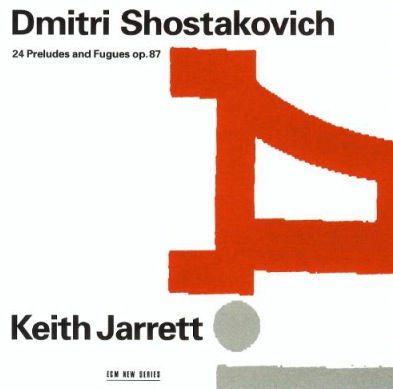
Shostakovich: 24 Preludes and Fugues – Jarrett (ECM New Series 1469/70)

Dmitri Shostakovich
24 Preludes and Fugues

Keith Jarrett piano
Recorded July 1991, Salle de Musique, La Chaux de Fonds
Engineer: Peter Laenger
Produced by Manfred Eicher

“When I first saw these pieces in a music shop, I knew I wanted to play them. I recognized the language. But when I started playing them, they were so close to me that I knew I had to record them.”
–Keith Jarrett

In 1950, during a trip abroad as a cultural ambassador, Shostakovich was treated to a performance of selections from Bach’s The Well-Tempered Clavier by pianist Tatiana Nikolayeva in Leipzig, where the composer had been asked to serve as a judge for the first International Johann Sebastian Bach Competition. Just two years later, Nikolayeva would have Shostakovich’s 24 Preludes and Fugues in hand as their dedicatee for the first public performance in Leningrad. Although one can hardly talk about these pieces without being aware of Bach’s shadow, I think it is precisely Bach’s shadow that Shostakovich is interested in here. In modern parlance one might say these are the “b-sides” of The Well-Tempered Clavier, a record of previously unreleased demos that refused to be lost to time. Like Bach, Shostakovich rallies through a lifetime of moods: from naivety (D major Fugue) to gentility (D major, B major, and F-sharp major Preludes); dawn (E minor Prelude) to destruction (B minor and G-sharp minor Preludes); death (F-sharp minor Fugue) to joy (E major and B major Fugues), resplendence (the standout A major Fugue), and playfulness (A-flat major Prelude and Fugue, B-flat major Prelude). The overall tone, however, is one of exuberance. Whenever this music isn’t dancing, it’s waiting to pick up its feet and resume. The carefully laid out balance of the entire work is clear not only in the distribution of slow and fast movements, but also in Jarrett’s dynamic pianism. He excavates the keyboard like an adult unearthing a time capsule buried as a child—such is the nostalgia folded into every note. From the punctuational bass notes of the E-flat minor Prelude to the poignancy of the F major Prelude and the smooth legato phrasing of the Beethovenian G minor Prelude, Jarrett negotiates a wealth of obstacles with the kind of fluidity that can only exist behind closed eyes. Moments of dissonance creep in only briefly, as if to remind us of perfection in that which is imperfect.

This is incredibly insightful music played by a musician who seems to see more in it than Shostakovich himself. In bearing his heart to us, Jarrett also bears the composer’s. Not only do Shostakovich’s 24 Preludes and Fugues make up one of the most important works of the twentieth century, but Jarrett’s performance and ECM’s flawless production also turn them into one of its most important recordings. Need I say more?

<< Keith Jarrett Trio: Bye Bye Blackbird (ECM 1467)
>> Kancheli/Schnittke: Vom Winde beweint (ECM 1471 NS)

Ambrose Field/John Potter: Being Dufay (ECM New Series 2071)

Being Dufay

Ambrose Field composer, live and studio electronics
John Potter tenor
Recorded 2007, Bishopthorpe, North Yorkshire, UK
Mixed 2008 at Rainbow Studio, Oslo by Manfred Eicher, Ambrose Field, and Jan Erik Kongshaug
Produced by Manfred Eicher

As one of Renaissance music’s most beloved figures, Flemish composer Guillaume Dufay (1397-1474) has been represented through a slew of fine recordings from such groups as the Hilliard Ensemble, the Medieval Ensemble of London, and Pomerium. Though known more for his sacred works, Dufay’s secular chansons find new life here in English electronic composer and performer Ambrose Field’s awe-inspiring soundscapes, with the Hilliard Ensemble’s John Potter at their center. Potter recorded a mere eight minutes of actual singing for an album just shy of fifty, and from this throated nucleus Ambrose Field has cultivated a lush molecular accompaniment.

Potter sings an alluring chanson, bathed in a tender drone, in the introductory Ma belle dame souveraine. Both the melody and its nebulous aura seem to come from a distance. This is one of the more minimal arrangements on the album and as such carries us gently into its unique sound. Je me complains boasts a more pronounced electronic presence with its flanged vocal samples and extended metallic fades. It feels very digital, ending in a viscerally epic swell of synthesized chords amid a fine weave of heavily processed voices. Being Dufay begins with a highly processed and extended vowel, and from this Potter emerges with a more clearly articulated “live” form of the same, spinning from this massive jumble of threads a clearly discernible path for us to follow. Certain phrases become looped before being swept away in a tide of reverb. This density soon relaxes into an even deeper stretch of sound as Potter’s samples flit in and out of view until he reemerges from the cosmic static to gently hang his melody from the clouds. Je vous pri comes into being like a resuscitated lighthouse, not so much piercing as caressing the darkness with its fortuitous light. Along with Je me complains, this track is most effective at shifting between Potter’s solo passages and their ghostly afterlife. It’s also teeming with distinctly organic sounds, as hints of percussion, water, and wind are carefully placed throughout. This ends in a swirl of repeated motif, caught like a song fragment in the net of time before being hoisted out of earshot. Presque quelque chose is an electronic interlude, hovering just beyond the threshold of life and bringing with it the promise of a singer’s dream. Sanctus is built around a sacred chant, undergirded by a bass note that cuts out like a broken radio. Potter’s voice morphs into that of a woman (an effect achieved through Ambrose Field’s painstaking digital modeling), filling the space with a virtual choir. La dolce vista is very much like the first track, giving Potter’s voice full reign of its territory as it glides into finality.

In these settings, one can really appreciate the well-roundedness of the chosen melodies. This isn’t Dufay in outer space, for there is still something undoubtedly earthly about all of this. Even so, the album may not be for everyone. Avid listeners of electronic music may feel more at home, while Renaissance purists may find the electronics outrageously intrusive and might prefer an ensemble of carefully chosen instruments. Yet I believe this album strikes a happy medium between two forms of musical expression that are not so entirely different from one another, and I would encourage even the most reluctant to immerse themselves in its wonders.

This is a conceptually stunning project, one founded on the melodic strength of its source material. In a day and age filled with debates over authenticity and scholarship, and in which so much of the music we have from the early Renaissance survives only in fragments or without clear indication of tempo or arrangement, how refreshing it is to see two musicians taking a strikingly different approach that is no less attuned to the spirit of the music, allowing it to freely wander its own contours without having to fit into those of another. Ambrose Field’s electronics are not “supportive.” Rather, they are an audible extension of something in the music itself and in Potter’s exquisite voice. Regarding his compositional process, Ambrose Field says:

“Whilst being important for my work, I have a general dislike of computers, preferring to find the right sounds first instead of undertaking extensive processing later. This can be a lengthy activity, but has the result that the electronics here highlight the contributions of humans, rather than machines.”

This isn’t just humility, for his statements are clearly evident in his respect for the tactile feel of analog equipment. The combination of digital and analog sounds strikes a fine balance between the former’s “cooler” tendencies and the latter’s heavy warmth, making for an overall effect that is, well, ambrosial.

These pieces are the exact opposite of timeless, beautifully enmeshed in their contemporary technology, be it a band of minstrels, a church choir, or, in this case, an ocean of electronic information. In Dufay’s time, these songs were the supreme form of sound manipulation. They worked in real time, pulsed with an immediacy that required only a willing ear. And in today’s audio landscape, electronics have become equally ubiquitous. We are therefore privileged to hear Potter’s voice unmasked in such unobtrusive company. Even in the longest stretches of synthesized sound, Potter’s presence haunts and provides the foundation for much of the synthetic drive, so that we are never too far from the vulnerable pulchritude of the human voice.

For the sake of live performance, filmmaker Michael Lynch created seven short subjects, one for each of these pieces, from which we are given only a few screen shots on the official site, and which one can sample below. Perhaps a DVD is in order?

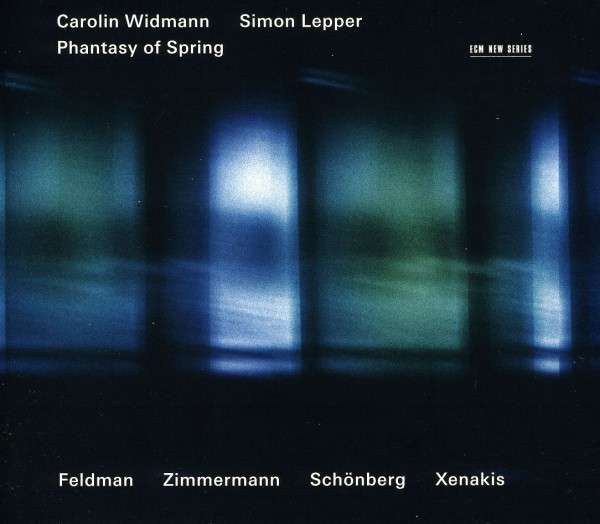
Carolin Widmann/Simon Lepper: Phantasy of Spring (ECM New Series 2113)


Phantasy of Spring

Carolin Widmann violin
Simon Lepper piano
Recorded October and December 2006 at Kölner Funkhaus
Engineer: Stefan Hahn
Executive Producer: Harry Vogt
Co-production ECM/WDR

In order to approach this album, we might ask ourselves: What is spring? While it is popularly associated with rebirth, if not a certain rise in sexual energy and interest, spring is also a prime season of mischief, one in which creatures great and small awaken from their slumber and do their best to placate their raging hunger. And just what does this have to do with this album’s diverse program? Precisely this: the above interpretations are the result of socially bound, and therefore limited, understandings of nature. The four composers represented in this program, I think, understood this in each his own way. And so, while these pieces may seem on the surface to be at most tangentially connected, they are in fact bound by a fearless approach to fallacy.

Morton Feldman’s Spring of Chosroes (1977) is an ideal opener in this regard. While it is the sparest, it suffers no lack of density. The aired spaces are gravid, deeply informed by Feldman’s idiosyncratic sense of time and the performances of our two musicians. Composer Bunita Marcus offers the following insight into the title of Feldman’s enigmatic piece:

The Spring of Chosroes was a sumptuous carpet reputed to have been made for the Sassanian King Chosroes I (sixth-century A.D.). Woven with silk, gold, silver and rare stones, the carpet depicted a garden akin to Paradise. The image of this legendary rug remained with Feldman throughout the composition, inspiring the isolated “gems” of sound, the translucent, interwoven harmonic timbres, and suggesting the form of the work.

This knowledge provides us with a fertile avenue through which to approach its sounds. While Feldman’s chamber pieces have often been laced with a charming sort of regularity, in Spring we find this regularity thwarted in favor of a highly stylized form of variation. By “variation” I mean not to imply the presence of any central theme, but use it in the sense of a degree of change: we are simply pointing our microphones to the winds and capturing the first fourteen minutes of melody that come along. Recording engineer Stefan Hahn is delicately attuned to the instruments in his first ECM endeavor. He gives Carolin Widmann a wide spread, placing her pizzicatos into markedly different spaces than their surrounding notes, thereby leaving a trail of musical breadcrumbs for the patient listener to follow. Widmann herself draws out some of the purest high notes I have ever heard from the instrument as she navigates Feldman’s vast array of meter changes (270 in a score of 388 bars) with apparent ease. At certain points Simon Lepper hits the uppermost keys to produce a hollow percussive sound, as if in foil to the violin’s subtle clarity. Clearly, however, this is no conversation in the way that most violin sonatas are. Marcus again:

Even when one instrument plays alone, we do not get the customary impression that the other is waiting to reply. Rather, Feldman is choosing to turn an ear to one instrument, then to the other; and at times we hear both together. It is through this selective listening that Feldman paces the unfolding dialogue.

Thus, what appears dialogic is really just a trick of shifting perspectives. Feldman’s music, while always provocative in its subtle ways, feels more tongue-in-cheek and blatantly contradictory here. Feldman was always adept at peeling away the skin of “academic” music and trying to see what may be lurking behind it, cowering in a corner of its own making. The music puts me in mind of a large, gangly, and awkward creature that has forgotten its way home, but which at the same time possesses such intoxicating beauty as to befuddle anyone it asks for directions.

The opening bars of the 1950 Sonate für Violine und Klavier by Bernd Alois Zimmermann act as a launching pad for an invigorating first movement of Bartókian dimensions. The second movement, though filled with fluttering high notes, is a rather brooding affair and lays its patchwork carefully. The final movement is an exercise in urgent virtuosity, ending with a most unforgettable trill and flourish, as if signing an enormous document with a quill of sound. Lepper works the piano through considerable changes, each of which is traceable back to its originary big bang, while Widmann breathes life into every dance of this spectacular sonata.

Even more erratic, and seemingly uninterested in resolution, is Arnold Schönberg’s opus 47, the Phantasy for violin with piano accompaniment of 1949, which began as a piece for solo violin to which he later added piano accompaniment. As one of his last compositions, the narrative trajectory of Phantasy veers into as many turns as the violin can allow. Tones seem to pull at one another, wrenching a tortured sort of melody from the realm of possibility. The piece works in clusters, an amalgam of “micro-compositions” that achieve unity only by virtue of existing on a printed score, of having a beginning and an end.

With Iannis Xenakis’s Dikhthas (1979), we immediately know we are in uncomfortable territory. The violin dances in circles, skirting the piano’s turgid interior like a mad prisoner. Moments of agreement are few and far between; moments of disagreement do no justice to the darkness; and separations are a given. Yet the piece isn’t as fatalistic as one would think. Like an overt camera zoom in a melodramatic film, the overuse of glissandi demonstrates the instability of note values and draws a jagged line under the piece’s contrived dual identity. Xenakis was one of the twentieth century music’s greatest game theorists. This impassioned performance allows us to experience one of his most intimate strategies as if for the first time.

Even if you have heard any or all of these pieces before, I guarantee these interpretations will give you much food for thought. Widmann’s incredibly fluid approach partners well with Lepper’s more pointillist one, and together they forge as vast a sound palette as one could imagine from a duo. By turns opaque and resplendent, this is a demanding album that should reap great benefits for the repeat listener.

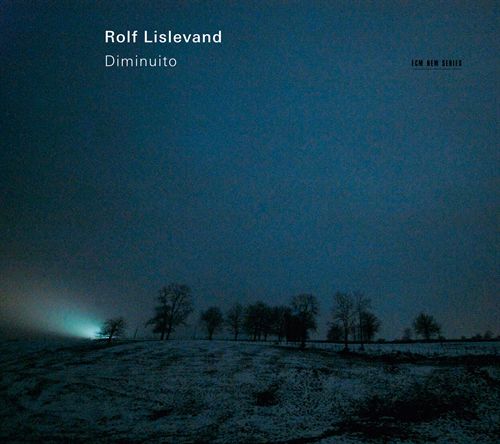
Rolf Lislevand: Diminuito (ECM New Series 2088)


Rolf Lislevand
Diminuito

Rolf Lislevand lutes, vihuela de mano
Linn Andrea Fuglseth voice
Anna Maria Friman voice
Giovanna Pessi triple harp
Marco Ambrosini nyckelharpa
Thor-Harald Johnsen chitarra battente, vihuela de mano, lutes
Michael Behringer clavichord, organ
Bjørn Kjellemyr colascione
David Mayoral percussion
Recorded October 2007 and May 2008 at Propstei St. Gerold

“To my way of thinking, reconstructions are fairly boring. Do we really want to pretend that nothing happened in music between 1550 and today? I think that would be intellectually dishonest. And the notion that people did not deal freely with their feelings until today is not only naive but arrogant.”
–Rolf Lislevand

For their second ECM album, following in the enormous footsteps of the fabulously received Nuovo Musiche, Norweigan lutenist Rolf Lislevand and his ensemble have pulled out all the stops. In polishing these tenacious gems of the Italian Renaissance to a fine sheen for a 21st-century audience, Lislevand has achieved a delicate balance between an illusory authenticity and the finely wrought mesh of his near-obsessive renewal process. The album’s title refers to a practice, common among the composers represented here, of adding ornaments to intabulations of popular madrigals and chansons. Because the melodies being altered would have been familiar to a 16th-century audience but not to a contemporary one, Lislevand has essentially mapped the source melodies onto their flashier counterparts, so that in the end we get a sort of conversation between source and adaptation made manifest in sound and performance.

The Ricercata prima of Vincenzo Capirola (1474 – after 1578) is an enchanting commencement, rendered all the more so for its wordless vocals and emphatic little chime. It is taken from the Capirola Lutebook, a vastly important document in the literature for its technical acuity and didactic pleasures. The works of Joan Ambrosio Dalza (fl. 1508) also survive as a testament to the early development of Renaissance luteny. His Saltarello and Piva make for two of the strongest showings on this altogether fine disc. The saltarello is a lively dance form dating back to the thirteenth century, while the piva was a popular basse (or “low”) dance at court in Dalza’s time. One could hardly ask for finer examples of either, and both scintillate in Lislevand’s invigorating arrangements. Giovanni Antonio Terzi (1560 – 1620) was more vocally inclined, as evidenced by the playful Petit Jacquet, a setting of the chanson by Jean Courtois. Although the words were not so fortunate as to survive, Lislevand simply wrote up his own: Little Jacquet is lost. Little Jacquet is out of sight, they have searched for him all over the place. He drives us crazy. The accompanying rhythmic twists seem to mimic Jacquet’s pitiful state, as well as the confusion his disappearance has caused. Susanne un jour is Terzi’s lute rendition of the chanson by Orlande de Lassus, telling the almost tragic tale of a Jewish woman falsely accused of adultery by two lecherous Babylonian elders when their advances toward are met with her vehement refusal. The last of the Terzi selections is a series of diminutions on Palestrina’s angelic Vestiva i colli and is easily the most beautiful piece on the album. Another standout moment in this eclectic program can be found in the form of La perra mora. Boisterous and joyful, this anonymous piece comes alive with the passionate exposition of its players.

Francesco Canova da Milano (1497 – 1543) was perhaps the most highly regarded lutenist of the sixteenth century. La Spagna, a popular dance tune of the day, saw its title headed by many composers, but of these da Milano’s version in canon was the most enduring, as one can clearly hear. The Recercada settima of Diego Ortiz (c. 1510 – c. 1570) is a sprightly romanesca and comes from a composer whose extant works consist mainly of music for viola da gamba and a large collection of sacred polyphony. His Recercada segunda is a carnivalesque romp through a crowded piazza and the Recercada quinta is a tour de force of virtuosic runs and varied articulation. Thomas Robinson (fl. 1600) is the only English composer represented here, and his Passamezzo Galliard is a stately air that is far from out of place among its present company. Alondo Mudarra (1510-1580), being a Spanish composer, was a proponent of the vihuela, and as such brings an attractive flavor to an otherwise lute-dominated course. His Fantasía que contrahaze la harpa en la manera de Ludovico sets a piece for harp by the enigmatic “Ludovico el del arpa,” minstrel to Ferrando III of Aragón. The anonymous Tourdion, with its echoes of bagpipes and jigs of the northern isles, brings the album to an exhilarating climax.

Diminuito is bathed in the lush acoustics of St. Gerold and sounds absolutely spectacular. The vocal presence of Trio Mediaeval’s Linn Andrea Fuglseth and Anna Maria Friman is to the album’s overwhelming credit, helping to recapture a bygone spirit in territories that instruments alone can only dream of traversing. The accompaniment as a whole is spot-on (the percussionists’ negotiation of inherent hemiolas adds an especially dramatic punch) and one could never praise Lislevand enough for his dynamic sensitivity. This is an album that opens itself further with every listen and one to be cherished for a lifetime.

Walter Fähndrich: Viola (ECM New Series 1412)

Walter Fähndrich
Viola

Walter Fähndrich viola
Recorded November 1989, Kirche Blumenstein, Switzerland
Engineer: Peter Laenger
Produced by Manfred Eicher

The name of Walter Fähndrich is not likely to provoke many nods of recognition. This is unfortunate, given that the Swiss composer and violist has been a fervent artist for nearly four decades. A teacher of improvisation and designer of sound installations, Fähndrich seems to prefer the indeterminacy of real-time human interaction over recordable media and gives us this rare glimpse into his open reach. The album consists of four pieces in five tracks, each simply demarcated in Roman numerals. A swaying rhythm dominates a beautiful string of overtones in “IV.” “II” distinguishes itself by its daunting 24-minute length and rapid arpeggios that work their way into a glorious spiral. Occasional passages played sul tasto (i.e., over the fingerboard) are particularly striking for their almost bell-like quality. The overall effect is nothing short of meditative. Fähndrich scrapes at the strings in “III” to produce a veritable symphony of avian peeps and insectile chirps in the album’s most organic diversion. “VI” a call-and-response of harmonics and fuller notes. To end, Fähndrich reprises “IV” in a longer take. Yet rather than closing a circle, it seems to open itself to the enchanting uncertainties of indeterminacy.

One could say that Fähndrich has done here for the viola what Paul Giger has done for the violin, if in a more “secular” vein. Whereas Giger’s cogitations soar, those of Fähndrich crawl into subterranean caverns where a neglected beauty echoes unseen. Like Giger, he makes use of extended techniques, albeit far more minimally. His bowing is precisely controlled and full of infectious energy. This was never an easy album to come by in the States, and I only got my copy during a sojourn to Vienna in the winter of 2002. Thankfully, advances in online ordering have solved that problem, which means that an entirely new generation can explore these uniquely pensive sounds.

<< John Abercrombie: Animato (ECM 1411)
>> Edward Vesala: Ode To The Death Of Jazz (ECM 1413)

Karlheinz Stockhausen: MICHAELs REISE (ECM New Series 1406)

Karlheinz Stockhausen
MICHAELs REISE

Markus Stockhausen trumpet
Suzanne Stephens bassett-horn
Ian Stuart clarinet
Lesley Schatzberger clarinet, bassett-horn
Michael Svoboda trombone, baritone horn
Kathinka Pasveer alto flute
Andreas Boettger percussion
Isao Nakamura percussion
Michael Obst synthesizer
Simon Stockhausen synthesizer
Karlheinz Stockhausen sound projection
Recorded December 1989, Nedeltschev Studio, Cologne
Engineer: Jan Erik Kongshaug

Karlheinz Stockhausen’s MICHAELs REISE (Michael’s Journey) makes up the second act of Donnerstag aus Licht (Thursday from Light), the first opera in the German composer’s 29-hour Licht cycle, and follows the archangel Michael as he treks across this mortal coil. In this 1984 version for soloists we are treated to a more reductive, though no less effective, take on what was originally a larger orchestral affair. A percolating opening statement from a varied brass section introduces the potency of Stockhausen’s highly mathematical approach. From this cacophonous opening we get a string of drones, pulled like taffy until it slowly sags into the yawning mouth of oblivion. A muted trumpet raises its hand to be recognized, breaking the surrounding silence with affirmation. We find ourselves in a street where the signs have been forgotten, a place where language no longer applies, and only the numerically inclined may press on—and indeed, at key points the musicians offer whispered numbers to the ether. There is anger in the air, but its source is long extinguished; smoke where there was never a fire. The journey seems infinite but is over in the blink of an eye. Cobblestone streets overlap with skyscrapers and uninhabited tundras; children fade into wolves, village elders, and back into children; music becomes one with speech and time. And throughout this melding of dimensions, every instrument holds on to its equation as if it were a secret to be coveted.

A perusal of the instrumentation is enough to give one a sense of the tonal colors to be expected, and I can only hope the above describes the feeling of the recording more than its sound. Stockhausen, sadly lost to the world in 2007, has been accused of being many things: everything from brilliant (“One of the most important composers of the twentieth century”) to overly ambitious (“A 29-hour opera cycle?!”) to utterly self-indulgent (see, for example, critical reactions to his Helicopter Quartet). For me, his risks were always supported by a steady dedication to his craft, turning seemingly gimmicky conceptual arrangements into acts of wonder. True to his aleatoric roots, Stockhausen never failed to pursue a line of thought to its most logical conclusion. His son Markus, who would go on to create a handful of inventive albums for ECM, is cosmic here on the trumpet. Then again, as the center of such an astrologically oriented piece, one would almost have to be. The same goes for his “teammates,” each of whom exhibits an intimate understanding of the composer’s great vision. Anyone unsure of how to approach Stockhausen’s music from the outside in may wish to start here, from the inside out.

<< ECM New Series Anthology (ECM 1405 NS)
>> Shankar: Pancha Nadai Pallavi (ECM 1407)

Meredith Monk: Book of Days (ECM New Series 1399)

Meredith Monk
Book of Days

Robert Een voice, cello
Ching Gonzalez voice
Andrea Goodman voice
Wayne Hankin voice, großer Bock, hurdy-gurdy, bass recorder
Naaz Hosseini voice, violin
Meredith Monk voice, keyboard
Nicky Paraiso voice
Nurit Tilles piano, keyboard, hammered dulcimer
Johanna Arnold voice
Joan Barber voice
John Eppler voice
Toby Newman voice
Timothy Sawyer voice
Recorded June 1989 at Clinton Studios, New York
Engineer: James Farber
Produced by Manfred Eicher

“I work in between the cracks, where the voice starts dancing, where the body starts singing, where theater becomes cinema.”
–Meredith Monk

Meredith Monk is generally described as an avant-garde artist of many talents. Of her many talents there is no question, but what exactly makes her “avant-garde”? The Random House Dictionary defines the term as meaning “of or pertaining to the experimental treatment of artistic, musical, or literary material.” This raises another question: What does it mean to be experimental? The same dictionary gives us: “founded on…an act or operation for the purpose of discovering something unknown or of testing a principle.” At the risk of reading too much into semantics, I would venture to say that Monk is anything but avant-garde, for she is interested neither in discovering the unknown nor in proving suppositions. Rather, she reveals that which has been obscured by, as well as changed by, history. She interrogates the subjective over the empirical and its effect on the flow of intercontinental relations. Thus do we get Book of Days (1988), a marriage of music and moving images that covers such broad yet related topics as nuclear holocaust, AIDS, eschatological wonder and trepidation, and the cyclical nature of time. The idea for Book of Days came to Monk one afternoon in the summer of 1984, when she was overcome by a black-and-white vision of a young Jewish girl in a medieval street. This same figure would become the locus for much of the film’s traumatic crossfire, amid which the girl has visions of her own, only for her they are of a grave and violent future. She soon encounters a madwoman (played by Monk herself) and discovers in her that one kindred spirit in a world headed for annihilation.

The film’s soundtrack was later reworked into the studio version recorded here and scored for 12 voices, synthesizer, cello, bagpipe, hurdy-gurdy, piano, and hammered dulcimer. The music of Book of Days also wavers between past and future, rendering the present all but graspable. These temporal concepts are accordingly reflected in the arrangements of each itinerant section. A triptych of monodies (“Early Morning Melody,” “Afternoon Melodies,” and “Eva’s Song”) mark the passage of the sun in the sky, the contrast of dark and light. This diurnal atmosphere is further underscored with the hurdy-gurdy-infused “Dusk” and the smooth braid of vocal beauty that is “Evening.” This chronology culminates with the delicate “Dream,” an all-too-brief reprieve from the threat of Armageddon, before opening into “Dawn.” The five scattered pieces that make up “Travellers” constitute time as diaspora, each its own lilting pseudo-canon of both hummed and open-mouthed syllables. The fourth section, subtitled “Churchyard Entertainment,” fleshes out the thematic core of the entire work in its most fully realized form. In a similar vein, “Fields/Clouds” unfurls an ethereal carpet of synthesized organ for a procession of contrapuntal voices, with Monk soaring above all like a predatory bird riding a thermal. Time’s fragility is expressed in “Plague,” a rhythmic chant of whispers, hisses, tisks, and heavy breathing: the universe in a pair of lungs. Encompassing all of this is “Madwoman’s Vision,” a masterpiece of composition and performance that flits nimbly from creaking aphasia to elegiac commentary. The album fades to black with “Cave Song,” alluding perhaps to Plato’s shadows and the illusory nature of our attachments.

The markedly instrumental approach to the human voice embodied by this ensemble lends itself beautifully to the subject matter at hand. In choosing to eschew words entirely, Monk peers more deeply into the oracular interior of her music. Relying on nascent phonemes such as “na” and “la” in lieu of recognizable vocabularies, she complicates the linearity of her effected nostalgia. Book of Days is all the more haunting for reducing that nostalgia to a liquid state and scooping up as much of it as possible before it seeps out of sight through those very cracks where her music is born.

<< Charles Lloyd: Fish Out Of Water (ECM 1398)
>> Keith Jarrett: Paris Concert (ECM 1401)