Jörg Widmann: Elegie (ECM New Series 2110)

Jörg Widmann
Elegie

Jörg Widmann clarinet
Deutsche Radio Philharmonie
Christoph Poppen conductor
Messe and Elegie
Recorded June and July 2008, Congresshalle (Messe) and SR Studio 1 (Elegie), Saarbrücken
Engineers: Thomas Raisig and Thomas Becher
Fünf Bruchstücke
Recorded May 2009, Klaus-von-Bismarck-Saal, WDR Funkhaus, Köln
Engineer: Günther Wollersheim
Executive producer: Manfred Eicher

At 39, German composer and clarinetist Jörg Widmann has already established himself as a formidable talent. If his studies under Hans Werner Henze, Heiner Goebbels, and Wolfgang Rihm have left any noticeable influence in his work as composer, it’s the cellular approach at which he is so skillful. His experience as a performer with such ECM regulars as András Schiff, Kim Kashkashian, and Heinz Holliger, not to mention his sister, violinist Carolin Widmann, make him a natural fit for the label in both capacities. Though Widmann has been widely praised for his chamber works, on this survey we get only the Fünf Bruchstücke (1997) for clarinet and piano, and for which he is joined by none other than Mr. Holliger at the keyboard as he explores the extended capabilities of his instrument. His subtle clicks and arcing gestures provide the hum to the piano’s rattle at every turn. We feel these things and more scuttling just beneath the surface, holding on to sounds as idols of whimsy, each blown and deflated like a balloon that refuses to expand and will never know the catharsis of the pop. Among his first published pieces, they give us direct insight into his eclectic flourish…


(Photo by Felix Broede)

…and all the more so for nesting between two leviathan orchestral pieces. Played to astonishing effect by the Deutsche Radio Philharmonie under the baton of Christoph Poppen, his 2006 Messe buries us with immediate and bone-stressing volume, yet somehow retaining, not unlike the Dies irae from Arvo Pärt’s Miserere, the softness of a petal. This is the first of a handful of references, which would seem to include also Górecki’s Third Symphony (note the Contrapunctus I). These allusions are as robust as they are transient, rising as they do from an ocean of great depth and color. Even in the absence of words, the piece abounds with voices. Widmann’s string writing is patient and awakens by a lone violin, as quiet as the opening was loud. Pastoral cries from winds exhale in watery strains. Bows flicker through consciousness like dragonflies. Each step becomes a window of spiritual reflection, a string of dawns, ferocious as lions jumping from the sun. Swollen joints in the Trinitarian body find unconditional love in the crucifixion, sacrifice rendered divine and tipped by fingers of humility and faith. Shadow masquerades as light, and light blinds itself. Reaching the resurrection at last, a promise of life wraps itself in autumn before unfurling a banner of exodus beneath an all-seeing eye, within and without, everywhere and nowhere, in the glitter of the lachrymose.

The 2005 title composition stretches those tearful remainders into lenses of contact. Peering through contorted sighs and unspoken things, reeds, bellows, and high strings dance across a bridge of burning meteorites, each a needle without thread. An operatic current prevails. One can feel characters ambulating about the stage, hiding behind curtains and whispering erratic secrets into the spotlight, which stays lit even after the music ends.

If Widmann’s landscapes seem not so well defined, it is because his intentions (or so I imagine) forego the platitudes of anticipation in favor of an organic, distilled approach. Poppen brings precisely that feel of ebb and flow, drawing out from these performances a viscous and dynamic energy. Holliger’s involvement, too, is fortuitous, for here is a voice that, given time, might very well prove to be his equivalent.

Paintings Unseen: Sifting through Stifter with Heiner Goebbels

Heiner Goebbels
Stifters Dinge
Heiner Goebbels conception, direction
Recorded October 20/21, 2007 by Willi Bopp, Grand Théâtre de la Ville de Luxembourg
Edited and mixed July 2010 by Max Federhofer (SWR) and Heiner Goebbels
Executive producer: Manfred Eicher

“Language cannot represent thought, instantly, in its totality; it is bound to arrange it, part by part, in a linear order.”
–Michel Foucault

How can the pen be mightier than the sword when the page is the most hurtful weapon? It is not that the flesh receives the pen, but that the eyes swallow words into the soul, their blades wreaking havoc in a place where dying utterances thrash, unnoticed, for want of lips and tongue. There is something to be felt here, pondered like sun and moon in the same sky, only to slip from grasp, tether to a dream. In that state of half-sleep we are hyper-aware of sounds that make us. We turn them inside out and hold them to our ears, each a vacated conch shell. Were we able to peer into the shadows of those porcelain folds, we might encounter composer Heiner Goebbels tinkering in the deepest crevice, his fingernails clicking like camera shutters at the dawn of time.

Such is the veil that stands between us and Stifters Dinge (Stifter’s Things), the 2007 installation piece that would be enigma were it not for the clarity of its presence. It is many things. It is everything. It is the power of speech turned on its head and spun until it is a single color. The voice of Claude Lévi-Strauss excavates the work’s ethos, at once underscoring and disavowing our need for discovery, the rarity of adventure in a global network mapped and catalogued to every conceivable end. It is also a regression into a past where the truest blanks in our physiological scripts remain. These blanks play host to other notable figures. William S. Burroughs levels his critique of inner fire into social ice. Malcolm X speaks of division, fragmentation of power, splitting of the master’s tools. Goebbels weaves in field recordings from Papua New Guinea, Greece, and Colombia, archives of travel and lost communities, shades of Bach and monoliths. Bobbing along these waves is the constant ghost of one Adalbert Stifter, the eponymous 19th-century Austrian writer who, like Henry David Thoreau, heard nature as the musical amalgam of machine and biome that it is.

The piece is, above all, an experience—Goebbels calls it a “performative installation”—that abets the evolutionary processes it unravels and reties into permeable sculpture. The gentle logic of it all is indeed linguistic. We feel ourselves caught up in its locks and thorns. But the human is hidden, falling into ruin among the crust and residue of progress. It is an irrigation system that draws forth the atmospheres of solids. Drones of screen and sand, of distortion and touch: these are its faces.

The piano looms large, both literally onstage and figuratively as the consummation of the gallantry it burns to ash. As a mouthpiece of elitist spirit, its heft trembles under contact. As a technological pest, it is so impervious that only practice, mastery, and ultimately submission are its effects. It is an artificial ecosystem that somehow becomes parthenogenetic. As the soundtrack to smoke, it enfolds us, settles in with our bacteria. Stifters Dinge, then, is an astonishing concept that fully alerts us to the astonishment of concept.

“Language refuses but one thing,
to make as little noise as silence.”
–Francis Ponge

“Is there such a thing as three-dimensional music?” asks Wolfgang Sandner. In ECM’s audio version of Stifters we have one answer.

The fog (1) flaunts a wave of mystery, given traction by the distant bass beat of a techno house, pulsing like our zeitgeist through avenues of youthful expression, bodily movement, and philosophical naïveté. The salt (2) chips away at our ear canals and offsets the arterial spice trade with the attention of rot hidden in every city’s foundation. The water (3) speaks in drips, opening us to the metronome’s deception. In every deposit we startle a different facet of the same visage. The wind (4) carries sailors’ incantations: sinewy, mineral. A recurring clutch, an audio checkmark spinning us on our axes of interpretation. A prayer for the nameless, for the bodiless, for the motionless. The trees (5) whisper through punctured tires and forest tales. Piano chords rest on the fulcrums of frozen pasture. Anxieties fade, crystalline, into the aching heart of the beast. The thing (6) abrades its hide with strings, in each a keystone of intent that opens its mouth and sings nothing. The rain (7) does not pour but weeps, finding its way through crags, abandoned houses, and blackened farms. It soaks the earth, churning, sneezing diagrams into every root. It is the thunder (8) that falls, unleashing torrents of political rhetoric. The sound (9) emotes from a muffled source, its life written in a phonograph’s needle and spoken through a black-and-white broadcast. The piano kicks like a sleeping dog. And while the storm (10) hails morose arpeggios, it also closes itself to the possibility of air and cracks instead along fault lines that far outdate the means of their articulation. A foot drags through leaves and curls around the coast (11). A blink extends, every lash a piece of driftwood pillared between heaven and earth. A pressure gauge, valve and open throat, thump of a Tell-Tale Heart and tick of an Ingmar Bergman clock. In the exhibition of objects (12), we find that many such curios have fallen through the cracks and gathered at the bottom of this tub, washed down a drain of silence.

“So we have destiny to thank for permitting us to be what we will become to each other.”
–The Brothers Quay, The Piano Tuner of Earthquakes

In light of these evocative possibilities, of which I have sketched hardly the crescent of a thumbnail, I search for concrete language with which to describe that which is coated like so many dusty attics. For this, I go to the source. Mr. Goebbels answers the following questions I posed via e-mail:

1. There is a sense of “opening” in your music that, like a painting, offers a window into its own world. In your mind, where does this opening lead?

To the listener’s imagination.

2. Often in your work, and especially in Stifters Dinge, I feel a sense of unsettling, of things coming apart. And yet, there is still unity. The music, the theatre—it all holds together. How do you balance these two seemingly contradictory aspects? Or are they part of the same sound, image, and word?

I think it’s a sometimes-unconscious contrapuntal (counterpoint) strategy, in the best possible 18th-century sense.

3. How did you approach the CD version versus the museum version? What special characteristics of the CD as a visual and sonic package influence the physical experience of Stifters Dinge?

The CD recording offers a very direct and detailed “view” of the machines and instruments; you can hear things which you will not be able to perceive in the live performance because of visual distraction or spatial distance.

4. Was there anything about Stifters Dinge that surprised you when you experienced the final result?

Yes, everything. I didn’t start this project with a vision. Just with a question: Are the performative installation and music possible without any performer? The answer is the result.

5. On that note, is there a “final” result, or does it always shift and evolve? Does it still surprise you?

What still surprises me is the range of experiences from audiences. These are the actual “center” of the piece.

6. Which elements from your previous work are present in Stifters Dinge? Which elements are new?

There is a strong continuity in all my work regarding the use of acousmatic voices, the use of documentary recordings. What’s new is the heavy, overall machine-like construction.

7. I am so grateful not only to you for creating such visceral and reactive art, but also to Manfred Eicher for believing in it so strongly. Because of him, I have discovered it. Can you briefly discuss how you first met Mr. Eicher and how he has influenced your activities and way of thinking?

I met him for the first time in the late seventies/early eighties in concerts. Since The Man In The Elevator (1987) we’ve had a sort of exclusive partnership based on friendship, with inspiring talks on all art forms, literature, music, film, etc. And during these exchanges he was the one who drew my attention to Francis Ponge’s “The Pine Wood Notebook” (in Ou bien le débarquement désastreux) or to Samuel Beckett’s “Worstward Ho” (in I went to the house but did not enter).

For further answers, I turn to filmmaker Marc Perroud, whose documentary The experience of things, Heiner Goebbels charts the development and realization of Stifters from the turnstiles of the brain to the stages of reality. As Goebbels informs the camera, he sought to eschew the use of actors, to build a “free area” of intensity for the public. For him, composition and stagecraft go hand in hand. “I’m not a visionary or someone who has a clear idea of what he wants to do,” he goes on to say. “I always react strongly to what I see.” The lack of prepared material allowed for merging between technical and artistic processes. The situation created the music.

As one interested in the infinity of theatre, Goebbels sees the art form not as a means of “narrowing vision” but as an “open channel” for fresh experiences. Placing action behind details is his fascination. Communication thrives here in song, in text, in stasis, cracked to reveal the sound that is its blood: “We understand things better when they are placed at a distance and are more aware of their structure when we focus on abstraction.” Stifters ritualizes nature. Land and water become one. Things are not only objects, but are the unfamiliar, a space of curiosity to which Goebbels holds a magnifying glass. The machines speak, he listens.

For a more user-friendly synopsis of Stifters Dinge, visit ECM’s background page.
To watch a trailer of Marc Perroud’s documentary and find ordering information, click here.

Miklós Perényi: Britten/Bach/Ligeti (ECM New Series 2152)

Miklós Perényi
Britten/Bach/Ligeti

Miklós Perényi violoncello
Recorded November 2009, Auditorio Radiotelevisione svizzera, Lugano
Engineer: Stephan Schellmann
Executive producer: Manfred Eicher

I first encountered Benjamin Britten’s opus 87, the 1971 Third Suite for solo cello, as played by Steven Isserlis, and in the towering company, no less, of John Tavener’s The Protecting Veil. Whereas there it came across as an unexpected, if enchanting, epilogue to the Virgin Classics release in question, here it opens an unquestionably cohesive program at the horsehairs of Hungarian cellist Miklós Perényi. Heard previously on ECM for a survey with András Schiff of Beethoven’s music for cello and piano, here he offers a distillation, a community of symbols rich in affect and unity. As Paul Griffiths notes, Perényi “is playing the cello to present music by Britten, Bach and Ligeti, and at the same time playing music by Britten, Back and Ligeti to present the cello.” Such is the circle of life—a circle that smiles and winks as much as it keens and weeps—that guides his craft and abets full disclosure of Britten’s abounding curiosity in the first of many shorter movements, its pizzicato mantra whispering beneath gravid suspensions from the bow. But there the solemnity ends, as the cello leaps from its pitted stasis and drapes itself like a ribbon from a branch swaying in the wind of the third movement. The fourth gives the most obvious shades of Bach, dancing through a jagged fifth and eighth, and swirling into the distended groans of the ninth.

In light—or is it dark?—of this flowing palindrome, the D-major Sixth Suite of J. S. Bach unfolds in an architecture as naked as Perenyi’s instrument. If its Prélude were any more immaculate in its affirmations, then its balance would crumble. The final note, here drawn without vibrato in pure and throated song, leaves us poised heavenward for the Allemande’s seesawing descent. A will to live pervades, seeming to clutch at earthly things as might a pauper’s hands to trinkets and baubles. The Sarabande is a thing of beauty (one that puts me in mind of Ingmar Bergman’s film of the same name) and passes us through the mimetic Gavottes before double stops galore surround us in the final Gigue.

György Ligeti’s Sonata (1948/53) expresses, like much of his chamber music, a world of ideas in relatively microscopic terms. Although a touch of humor nuances the title (this “Sonata” only has two movements), the goings on feel like darkness upon darkness. Alternating between lute-like strums and mournful bowings, the first half lends brightness to the second, which at its fulcrum returns to the fingers, spinning lyric from prisms and breath.

Perényi is that rare cellist who plays Bach as if for the first time while approaching less performed works like Britten’s as if they’ve always been here. It is the solitary pursuit of melody and time through an instrument corporeal, of which the cello is infant, elder, and every age between.

Duo Gazzana: Five Pieces (ECM New Series 2238)

Duo Gazzana
Five Pieces

Natascia Gazzana violin
Raffaella Gazzana piano
Recorded March 2011, Auditorio Radiotelevisione svizzera, Lugano
Engineer: Markus Heiland
Produced by Manfred Eicher

Beautiful teeth sung behind the trees
Finely shaped ears were between the clouds
Iridescent nails blended with water
Kicked off a pebble
All like footsteps
–Shuzo Takiguchi, trans. Noriko Ohtake

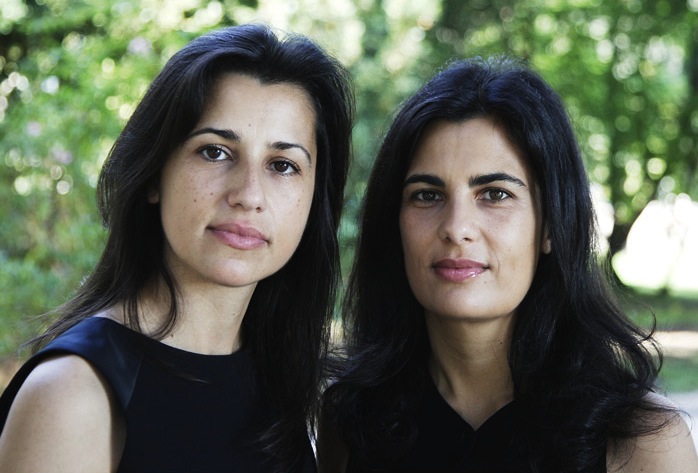
Natascia and Raffaella Gazzana are sisters in more ways than one. Having performed together since they began their classical educations, as Duo Gazzana they have been impressing audiences since the 1990s with the galactic swirl of their milk-and-coffee blend. It is perhaps no coincidence, then, that their sororal sound and abiding interest in modern music would lead them to ECM producer Manfred Eicher, who has seen fit to oversee their recording debut of a program that includes works by Tōru Takemitsu, Paul Hindemith, Leoš Janáček, and Valentin Silvestrov. I recently “sat down” (inasmuch as one can via e-mail) with the Gazzanas, who were gracious enough to expound at some length on the questions tickling this voracious listener’s brain.

The violin/piano repertoire is so vast. How did you begin to conceive of such a refreshing program? Were you looking at it in terms of obscurity versus knowability, or simply playing what you love?

Thanks for calling it “refreshing”! We liked the idea of proposing pieces not so often played, excluding perhaps the Janáček sonata. This became possible with the ECM label, which generally offers its listeners “unusual” music. We particularly enjoy playing all the pieces in this program, and each has its own reason for being on the CD. While Janáček and Hindemith were part of our usual repertoire, we encountered Takemitsu relatively late. We came to know Silvestrov’s music through the several ECM recordings that Manfred Eicher encouraged us to listen to. We were immediately captivated by his delicate and evocative writing.

Does the music in this program, as a whole, tell a story? If so, what you hear, see, or feel in it?

The four composers, so apparently far from one another in age and background, tell similar stories with different languages. We liked the idea of giving this program a direction by moving from central European expressionism (Hindemith), through Janáček’s tormented postwar sonata and the gentle approach of Silvestrov, and finally into the far eastern refinement of Takemitsu’s music, loaded with that French influence that takes us back to where we began. A travel through old and new stories, with plenty of different nuances!

Takemitsu’s Distance de fée (1951) is indeed all about nuance. Its Debussean magic lures us into twilight from Raffaella’s first chord. Natascia’s cotton-spun tone wafts across time and space like pollen in darkness—which is to say, unseen yet felt at the bridge of a nose, gracing the forehead with the promise of an unattainable daybreak. She waits, the wind seems to say, as if there were no alternative but to run with her into the future. Harmonics cry like birds in the boughs of our unrest and end where we began, a palindrome in the night.

With such evocative threads to unravel, I ask the Duo how they approach this young piece from a then relatively new composer, one navigating the moral topography of the postwar era with decidedly French tools. Are these geographical slights of hand, I wonder, important to keep in mind?

We have great affinity for Japanese literature and culture and were curious to learn as much as possible about their different aspects, in which ancient traditions are so well integrated with advanced technology. We approached Takemitsu just before a long tour we held in Japan a couple of years ago. It was the right occasion for us to play the new, refined music that we wanted to offer to such an audience. Distance de fée, inspired by a surrealistic poem of Shuzo Takiguchi, is an early piece in which, still searching for more personal and original writing, he was strongly influenced by French music, and Messiaen in particular. Takemitsu himself once described the process as “reciprocal action, musical art re-imported to Japan.” His fascination for impressionistic music came from the fact that harmonies of modal scales, so dear to French composers, had been at the base of traditional Japanese music for centuries. Both cultures were united by a keen sense of tone, for pictorial and naturalistic elements. Nevertheless, he only took inspiration from the great Frenchman’s modes to transpose and create a world properly Japanese. The philosophical concept of MA, so distant from our culture, in music can be translated as the “art of no sound” or “art of the vacuum,” by which is born an inseparable relation of continuity rather than opposition between music and silence. Silence surrounded by sound adds tension and gives unity. You can hear this right from the beginning of the composition: we are immediately transported into a suspended world rising from nowhere. There are no real melodic lines but fragmented motivic cells alternating with pauses on the violin. They are never truly developed but are reiterated literally or with little variations supported by the rich harmonies of the piano’s ever-changing chords. In a way they represent the world around us from which the composer extracts but a segment.

That one finds all of this and more in six-and-a-half minutes of music is a testament not only to the composer, but to the performers who sensitively tease out these subtleties in thought and gesture.

And while the shift to Hindemith’s Sonata in E may seem like a dramatic one, the expressivity of the writing and the playing bears itself out with likeminded attention to color. The first movement of this 1935 diptych is like lost children running off into the sunset, trailing shadows of superstition and leaving footprints like barely audible commas before the languid search of the second surges forth at an equine clip to find them.

If in Hindemith we find a quick and easy resolution, then in the Janáček Sonata of 1914 (rev. 1921) we find a composer who revels in the uncertainty and internal reflections leading up to it. The violin’s silvery threads foreshadow the quiet aftershocks in the final Adagio, along the way sharing a variety of interactions with piano. Sometimes they walk parallel paths while at others seem blissfully indifferent. The second movement takes us on a journey not unlike Takemitsu’s, the coil set to spring from Raffaella’s rainfall into the starkly contrasting Allegretto, for which Natascia shades those memorable punctuations with individuality and purpose.

It is tempting to quarantine Janáček from the surrounding company, but to my ears his sonata is a mixture, and then some, of everything else in the program. That you were able to draw out that kinship is wonderful. What is your take on Janáček?

We have always admired Janáček for his intensity in writing music rich with twists and turns. You could distinguish him from any other composer. Beside his moodiness he is always capable of drawing captivating melodic material, mostly marked by sadness and sorrow. That makes us think of him as a poet of his people, Czechoslovakia being so often bereft of freedom. We used to listen to his chamber music very often: his string quartets dense with impassioned lyricism and dynamics, his fairytale-like cello sonata, his deeply touching piano sonatas and miniatures. Before getting to know the sonata we play, we saw Kát’a Kabanová at the opera. It is the tragic story of a young woman and her attempts to escape from a stifling environment and marriage. Driven by remorse, she throws herself into a river. It was a nice discovery to recognize soon after many themes borrowed from that opera in the violin sonata. It became a source of liberation for our playing.

One of the most striking turns in the Janáček takes place in the concluding Adagio, during which the violin is asked to speak in echoes. Seeing as the sonata ends with this effect, what does it signify to you?

The final Adagio is perhaps the most tragic movement of the sonata. The piano plays a sad, gently nostalgic melody in octaves, rather resigned, in a kind of rough but quiet mood. The violin, with its nervous interventions, gives a restless strength to the music. We would rather speak of a real dialogue between the two instruments more than an echo effect. Indeed the violin points out the increasing anxiety that reaches its natural climax toward the end of the movement, where the piano plays tremolos con forza and the violin a very expressive ascending melody. A quieter atmosphere is finally restored with both instruments agonizing over the nervous violin fragments with which the sonata began.

Nervousness would seem farthest from the sound-world of Valentin Silvestrov, who in his Five Pieces (2004) builds a nest of long flexible motives. His music always seems to rise from nowhere, as if birthed from some infinite yearning, realized only through the fleshiness of instrument and human touch. And what demands, if any, might this quality place on the performers?

Silvestrov’s music is pervaded by a sense of nostalgia, pure tenderness, and touching simplicity. Almost paradoxically this simplicity is achieved by the interpreters with great efforts, because of the numerous and detailed indications in each bar of the score. Maintaining awareness of all these dynamics does nothing to stop the musical flow in its organic atmosphere. Everything has to sound like as if it were wrapped in distance, through the balance of the instruments; the shrewd use of long, half, and una corda pedaling throughout; continuous rubato, sudden accelerando and suspensions. Dynamics range from pianissimo to piano, with small peaks never going beyond mezzo-piano. The approach suggested by the composer is that of extreme delicacy toward the instruments. Indeed we tend to think of caressing our piano and violin. Maybe the best definition of this sublime Ukrainian composer is given by Wolfgang Sandner in the refined booklet of our CD, where you can read that Silvestrov was able to catch the flower at the edge of the path left by Schubert in his musical wanderings…

And in that opening Elegie we do, in fact, wander that same path. The flower is heartening, drawing us on a canvas without even seeming to touch it. Certain themes (e.g., the Serenade) seem to call not to us, but from us, and are all the more inescapable for it.

Natascia, I adore your pizzicato technique yet we hear so little of it. We get a taste in the Silvestrov Intermezzo, evocative and tiptoeing through shadow. What does it feel like to bring out this splash of color, so dramatic against the palette of which it is such a brief part?

I appreciate very much the possibility that Silvestrov allows interpreters of his music to develop many different techniques for both the right and the left hand. The Intermezzo pizzicato technique creates a completely new atmosphere. It gives the piece a separate and defined character in comparison with the previous Serenada and the following Barcarole. As we can see in the score, Silvestrov writes many musical indications and dynamic marks on each pizzicato to give a precise meaning to the piece. That’s a great opportunity for a musician to serve a musical idea with all the means at her disposal.

This sense of service, of offering something to the listener, flows through every movement, floating quietly through the Barcarole on bittersweet currents into the concluding Nocturne, a long and winding signature to this aural love letter.

There something arboreal and forested about all the sonic choices taken on this endearing record. We can hear it in Natascia ringed tone of her instrument and in the clarity of separation (especially in the lower register) that Raffaella elicits from hers. Each note rises like a silent trunk, even as it falls like the leaves from its boughs. There is also the sense of casting that Paul Griffiths so poetically articulates in his liner notes, of composers drawing lines between themselves and idealized, faraway places, and brought home again through individual expression.

To play this music with such color as you do, is it fair to say that you draw upon personal experiences and emotional understandings, as might stage actors, when performing?

Music is a means of communication. The life of a person is constantly changing. Every day we receive different stimuli according to what we see, what we listen to, who we meet…. Personal experiences and emotional understandings become meaningful through music. That is why it is so important for us to dedicate spare time to our interests that may not be so apparently related to music. We both hold university degrees: Raffaella in Italian Literature and Musicology, Natascia in Visual Arts. We study, respectively, Japanese and Russian language, because we are very fond of cultures so different from ours. We had the chance to grow up in a house full of Latin and Greek books because our parents taught both in high schools. We like reading, listening to music, and watching good cinema. Music gives us the great opportunity to travel, to see different countries and their ways of living, to learn and exchange opinions. Life and music are absolutely intertwined.

Can you tell us what it was like to record for ECM? How did Manfred Eicher approach you for this recording? What did he bring to the project? How did he encourage you? 

ECM is a legendary label, synonymous with high quality recording, attention to detail, elegance, refinement, and courage in programming. It was an honor and a privilege for us to make our recording debut for such a prestigious label. We had the chance to record in Lugano’s RSI Studio, one of the most reputed and acoustically perfect for classical music. Beside all these technical considerations, the most important thing was the professional relationship we established with producer Manfred Eicher. He told us from the beginning that the recording process starts long before the studio session. Indeed, we contemplated our CD program for almost a year before stepping into the studio. He encouraged our decision to play music from the twentieth and twenty-first centuries. Thanks to him, we discovered Silvestrov’s music, which has now become part of our concert repertoire. We felt very focused but completely at ease during the recording session. That is because Mr. Eicher, as a musician first and a producer second, understands the needs of artists and helps tremendously with his inspiration at just the right time, during such delicate moments.

Are you both ECM fans? If so, what artists, composers, or albums do you most admire and why?

Yes we are! We think ECM’s greatest merit is bringing the public “new” music of different geographical areas by contemporary composers that would probably never be heard so widely otherwise. There are many ECM New Series discs we listen to quite often, with great interpreters such as Gidon Kremer, András Schiff (whose account of Janáček,A Recollection,is one of our top favorites), and the Keller Quartett (Die Kunst der Fuge). We love Kim Kashkashian, whose playing is very near perfect in most of her recordings. We would single out, though, the double-CD set of Hindemith’s viola sonatas or the Brahms viola-and-piano masterpieces, to say nothing of her touching interpretations of the Shostakovich sonata, Schnittke’s concerto, and all of the Kancheli and Mansurian recordings. Silvestrov and Kancheli are the composers we appreciate most among many others for being so different and intimately touching. Jazz-wise we enjoy Keith Jarrett’s early solo records and Tord Gustavsen’s Nordic flavors.

To listen to samples, click here. To learn more about Duo Gazzana, click here.
Thomas Demenga plays Bach/Veress (ECM New Series 1477)

Thomas Demenga
plays works of Johann Sebastian Bach and Sándor Veress

Hansheinz Schneeberger violin
Tabea Zimmermann viola
Thomas Demenga cello
Recorded December 1991 at Kirche Seon, Switzerland
Engineer: Teije van Geest
Produced by Manfred Eicher

Although this album is the second of five on which cellist Thomas Demenga boldly pairs the cello suites of J. S. Bach with chamber works from modern composers, it was the last to reach my ears. As a longtime admirer of Sándor Veress—whose music I discovered, no less, on Heinz Holliger’s champion recording for ECM—I was excited to sit down and mull over this disc at long last.

Under Demenga’s bow, Bach’s Suite No. 1 for Solo Cello in G Major flickers with candlelit intimacy, honed like the wood from the instrument through which it emotes in that distinct and mineral tone. One imagines the room where it was first practiced, walls dancing in a quiet play of light and shadow: the player’s arched head, swinging hands, lithe fingers curling about the neck of the one who sings. As to the later suites, Demenga brings a unique mix of fluidity and rusticity to his sound, but above all pays attention to negative spaces in a way that any accomplished Bach interpreter must. We hear this in the pauses of the Courante and in the substantial attentions of the Sarabande, which he suffuses with a downright soulful air. And through the subtle dramatic shape he imparts to the Menuets he dances his way to a reflective brilliance in the Gigue.

With this perfect tetrahedron so thoughtfully folded before us, Veress’s 1935 Sonata for Violin may seem to break the symmetry. Yet the sonata, among Veress’s first published works, more importantly reveals an economy of notecraft on par with the Baroque master. Its slow-fast-slow structure betrays a more complex and organic geometry that begins with a jig of Bartókian proportions and seeps through the Adagio’s quicksand, only to rise again, grabbing the tail of gorgeous gypsy air into the fresh air of the final leap. Violinist Hansheinz Schneeberger, who made his ECM debut with Demenga on the latter’s first Bach pairing, plays this jewel with an intensity and focus familiar to anyone who enjoys Kim Kashkashian’s take on solo Hindemith. Despite the meager comparisons I’ve attempted to draw to other such composers, this music thrives with a forward-looking robustness all its own.

The light at the end of this tunnel comes in the form of Veress’s Sonata for Cello. Composed in Baltimore, the 1967 piece also takes a three-movement structure, this time marked “Dialogue,” “Monologue,” and “Epilogue,” which, as Holliger notes in an accompanying essay, takes us through an inner turmoil on the path toward self-liberation. For me, the most solitary movement is the Dialogue. Its dirge-like density betrays an ecstatic turmoil while keeping a hand cupped to the ear of some cherished and unrecoverable stillness. By contrast, the Monologue seems almost resolute as it traces fingers blindly through the ashes, from which the final movement rises in its own agitated way with assertion on the tongue. As a student of Veress, Holliger no doubt took on some of his mentor’s quirks, and the influence of said Epilogue rings clearly in Trema.

Violist Tabea Zimmermann joins the roster for the Trio for Violin, Viola and Cello, backing us into 1954. The 20-minute piece takes two movements, the first of which moves like molasses into a dulcet and spectral territory ahead of its time, while the second brings the patter of urgency to a journey of immense detail and brilliance.

Of this journey the lowly reviewer can make no definitive claims. Naysayers of the modern may make a delightful discovery or two along the way, even as they cling to Bach, while defenders of the twentieth century will immediately recognize that its music would be nowhere without him. Either way, I can only commend Demenga and ECM for an ongoing commitment to bring their programming alive with the benefits of (im)possibility.

<< The Hilliard Ensemble: Walter Frye (ECM 1476 NS)
>> John Surman/John Warren: The Brass Project (ECM 1478)

Heiner Goebbels: La Jalousie / Red Run / Herakles 2 / Befreiung (ECM New Series 1483)

Heiner Goebbels
La Jalousie / Red Run / Herakles 2 / Befreiung

Heiner Goebbels
Ensemble Modern

Christoph Anders narrator
Recorded May 1992 at Performance Studios, Frankfurt am Main
Recording engineers: Leslie Stuck and Andreas Neubronner
Mixed and edited at Rainbow Studio, Oslo
Engineer: Jan Erik Kongshaug
Produced by Manfred Eicher

Sometimes music is so theatrical that it needs no stage or actors to enlighten its listeners. If such music comprised a genre in and of itself, composer Heiner Goebbels would be one of its most idiosyncratic masters. Along with Michael Mantler, Goebbels represents a theatrical strand in the ECM universe that challenges the reviewer attempting to describe it, yet which is perfectly clear once it reaches the ears. My first encounter came through Surrogate Cities, a dazzling piece of music theatre that remains the yardstick by which I’ve measured all Goebbels experiences since. That being said, the more I hear, the more I recognize the futility of such comparison, for in his decidedly textual sound there is equal room for any and all sentiments to frolic, dance, and weep.

La Jalousie places four pieces of ranging character at the capable hands of Ensemble Modern, whose interpretations thrum with the utter embodiment that so distinguishes it from likeminded groups. The title composition for sixteen musicians, subtitled “noises from a novel,” already betrays Goebbels’s fascination with language as toolkit. His source is a work by Alain Robbe-Grillet (who famously wrote the script for Alain Resnais’s 1961 Last Year at Marienbad), in which the protagonist’s suppressed jealousy comes to vivid life on the page. Goebbels nurtures a description portion thereof and attempts to reconstruct it in acoustic terms. The genesis of this piece bursts forth from a rustling of conductor’s pages and unfolds from its compressed chaos a menagerie of guitar, piano, and winds. These are but clothing lines, however, for piles of freshly laundered samples: birds, frogs, and other secrets of the marshlands move in and out of the fray. A car door slams in retrospect, a voice seeming to relive this difficult dream in ominous reflection. The animals’ voices are an indigestion of the soul, stirring ever so disconsolately beneath this veneer of solitude. The clack-clock of footsteps pokes through the piano’s dampened commentary. An overblown oboe bears the imprint of Heinz Holliger’s Studie über Mehrklänge and leads us into a narrative passage underlined by crashing piano and synth shamisen (the synthesizer continues to bear witness to much of the goings on in varying gradations of convention). This brings us to an ending tinged by hope and submersion and a reprise of those restless pages.

In the wake of this palindrome, the nine songs for eleven instruments of Red Run come across rather comfortingly. This concert reduction of a ballet opens with a trio of drums, keyboard, and electric guitar in a deceptively simple pocket of jazz club anxiety. Improvisation abounds in this acute deconstruction of the popular. Tracing horns resolve themselves into a focal point of rumbling breath; a lilting violin arches its back from a bed of nails, drawing a sustained line from its dreams into the measured steps of its waking life: these handfuls and more share an edge, scattered like ashes in the wake of a trumpet’s derisive calls.

Herakles 2 (for five brass players, drums and sampler) takes a section of Heiner Müller’s play Zement as another structural prompt for music without words. The pedantic beginnings are just a front to a flipbook of superbly detailed constructions, each a building block in a crumbling tower of sound. The music trips over some quiet harrumphs from the tuba on the way toward Befreiung (Liberation). Goebbels composed this concertante scene for narrator and ensemblein celebration of the 200th anniversary of the French Revolution. Excerpting anti-liberal diatribes from Rainald Goetz’s anti-liberal play Krieg, he paints an insistent call to arms, where hugs turn into defense mechanisms against the blight of direct and noted perception. This is an unrelenting piece, ringing with the glass and bangles and spent energies of a zeitgeist now mute with self-realization. As Goebbels himself admits, with this piece he does not intend “to resolve for the audience the political tension contained in these texts but unleash it for individual confrontation.” And perhaps, in the end, individual confrontation is what the Goebbels experience is all about. Like a language stripped of its consonants, leaving only a sea of diacritical marks, his is a book without page numbers. Through it we face the emptiness of our texts, of our very bodies, and know that within emptiness beats a heart dying to create.

<< Meredith Monk: Facing North (ECM 1482 NS)
>> Hal Russell: Hal’s Bells (ECM 1484)

The Dowland Project: Romaria (ECM New Series 1970)


The Dowland Project
Romaria

John Potter tenor
Miloš Valent violin, viola
John Surman soprano saxophone, bass clarinet, tenor and bass recorders
Stephen Stubbs baroque guitar, vihuela
Recorded January 2006 at Propstei St. Gerold
Engineer: Markus Heiland
Produced by Manfred Eicher

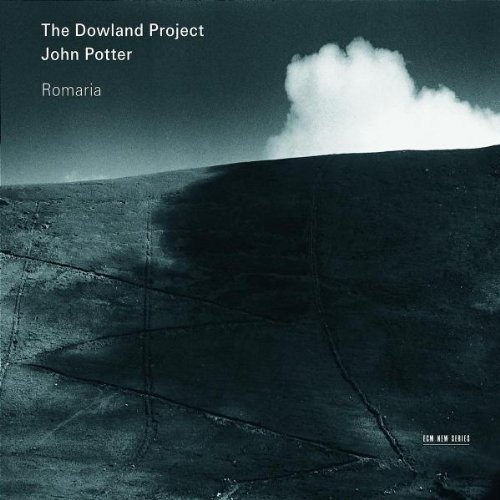
The atmosphere of Romaria, the Dowland Project’s third album for ECM, is exactly like its cover: monochromatic, with a splash of cloud over a stretch of scored earth. Stripping down its ethos to barest elements, the Project takes up plainchant, anonymous monody from the Carmina Burana manuscript, and Iberian folk songs, spinning from them a lush improvisatory world sprinkled with troubadour songs and motets from, among others, Orlando di Lasso and Josquin Desprez. The new addition of Slovak violinist Miloš Valent makes for a sustained and burrowing sound that blends uncannily with Stephen Stubb’s strings.

Got schepfer aller dingen starts us off with a brood, setting the tone for a somber yet somehow vigorous album. Where this vigor comes from is hard to say. Could it be in John Surman’s hopeful bass clarinet in Veris dulcis? Or perhaps in Stubb’s plucked accompaniment in Ora pro nobis? Yet further in John Potter’s aching vulnerability in Lá lume? Whatever the source, it’s clear that the versatility and depth of songcraft here is as delicate as a moth’s wing in a lantern’s flame.

Potter, it must be said, is the heartbeat of this album, drawing out from the instrumental surroundings a most thorough vocal line. The instruments seem to grow from his soil, particularly in Dulce solum, seeming to constitute the touch of breath through lips and mind. Similarly, Der oben swebt sways like the wind in the barley, carrying up in its wisps of recollection the promise of a lively day.

Much of the album is free-flowing and at times so organically realized (note, for example, In flagellis) that one wonders if the original melodies didn’t also arise in this unscripted fashion.The instrumental Saudade is another highlight that showcases the inspiring talents of Surman, whose soprano enlivens the darkest corners of Kyrie Jesus autem transiens and Ein iberisch Postambel to mesmerizing effect. Sometimes, the instruments recede just slightly, as in O beata infantia, allowing for Potter’s voice to carve its own tracks.

Listening to an album like this, one realizes the potency of the songs chosen, existing either in fragments or thicker sketches. Freedom is given to the performer, allowing new voices to come through. Each is but a drop in a larger body of water, necessary yet invisible in its surroundings.

Heinz Holliger: Lieder ohne Worte (ECM New Series 1618)

Heinz Holliger
Lieder ohne Worte

Thomas Zehetmair violin
Thomas Larcher piano
Ursula Holliger harp
Recorded June 1996 at Radio DRS, Zürich
Engineer: Stephan Schellmann
Produced by Manfred Eicher

After an already healthy representation of the compositional prowess of Heinz Holliger, ECM decided to put out this disc pairing some of his earliest work from the sixties with that of decades later, thereby providing an engaging survey of a musical mind that turns like a kaleidoscope: holding tight to symmetries so that it might fragment their interiors in ever-novel, I would say linguistic, combinations. For indeed, language is what Holliger is all about. From the poetry that inspired him as a youth to the poetry that he creates as an adult, the Swiss composer revels in every portion of his mental reserve to fish out some of the most heartfelt music of the twentieth century.

The tactility of Holliger’s instrumental renderings always seem to have something of the human voice about them. Every cell is marked by the potentially vulnerable transfiguration of form, a breaking down or “clearing of the throat” by which the musical moment is rendered chalk-like in the face of its own palimpsestial illusions. The two sets of Lieder ohne Worte that embrace this disc turn the standard violin/piano duo inward, ever refracted toward a conversation comprised entirely of afterthoughts. Although generally light, it sometimes dips into urgent proposals to which the only desired answer can be a heavy silence. Both instruments become frames. The two Intermezzi recall Holliger’s 1982 Duo for violin and cello, linking adverbial phrases with descriptive trails. Songs without words, yes, but aren’t they always, for once they escape the lips they have already transcended the limitations of their shaping toward more distant reverberations.

In the Sequenzen über Johannes I, 23 for harp (played to perfection by wife Ursula), Holliger’s trademark fractures are filled by the plasma of fingertips, while the Präludium, Arioso und Passacaglia for the sameblush with savory dexterity. With the restrained ferocity of a classical guitarist, Ursula evokes an elastic space in which the life of any single note is determined by its distance from the body.

Two solo pieces fill in the eye sockets of this sonic skull. On the left is the winking Trema in a version for violin. Anyone used to the original for cello is sure to be caught up in the stark new textures. Where the cello draws that trembling forth from deep within its bowels, here it issues from the nostrils of a head animated by vehement denial. Yet in that denial is an unspoken (and unspeakable) commitment to self-reformation, to the idea that within the brain there is enough room to squeeze in all life experience into a single synapsial firing. The expediency of the lie is betrayed by its brevity. On the right are the three drowsy piano miniatures that make up Elis. In these vibrant fits there are only dreams. Rather than try to smooth them into a unified narrative, Holliger allows their worth to come clambering into our attention at whatever pace it chooses. A few extended techniques, like the hitting of a dampened string, emit flashes of color in an otherwise monochromatic field.

Holliger is notable for being a composer duly aware of the importance of space: between notes, between pieces, between selves. The stillness thereof is so heavy that, rather than falling like a stone, every note floats like a particle of windblown pollen. And in the hands of such astute performers, we begin to feel windblown ourselves.

<< Joe Maneri Quartet: In Full Cry (ECM 1617)
>> György Kurtág: Játékok (ECM 1619 NS
)

Alexei Lubimov: Messe Noire (ECM New Series 1679)

Alexei Lubimov
Messe Noire

Alexei Lubimov piano
Recorded May 1998 and December 2000 at Radio Studio DRS, Zürich
Engineer: Peter Laenger
Produced by Manfred Eicher

Messe Noire was the second ECM recital debut for Russian pianist Alexei Lubimov, following his enigmatic debut, Der Bote. It remains one of his freshest and most luminous programs, forging from the composers of his homeland what Reinhard Schulz describes in his liner notes as “a cosmos in which free spirits gather together.” The image is apt, for in the “Hymn” of Igor Stravinsky’s Serenade in A (1925), which opens the disc, we do indeed encounter a galactic ocean of impressions. From the gentle reverie of lost love to the grumbling belly of despair, it encapsulates Stravinsky’s penchant for emotional directness, as in the processual Romanza that follows and all the way through to the frayed Finale. The Sonata No. 2 op. 61 (1943) of Dmitri Shostakovich rather chooses ebullience as its quill, and marks with it a playful inter-relationship between the left and right hands in a volleying of motifs. An off-kilter Largo leads us to a plaintive Moderato, which provides one of the more sustained, gloomier contractions on the album.

Sergey Prokofiev’s Sonata No. 7 op. 83 (1942) introduces characteristic buoyancy before quickly fading into a quieter spell, inhabiting the after-effect with the oral passion of a missionary. This ebb and flow of pensive dips is the sonata’s overall modus operandi, epitomized most movingly in the Andante. This dynamism is only strengthened by Lubimov’s mature sense of syncopation. The boisterous reverie that is the final Precipitato brings that same play of weight and lightness to bear on more wistful statements. After this rousing feast, we are treated to desert in the form of Alexander Scriabin’s Sonata No. 9 op. 68 (1913). Marking time with seemingly reserved energy, its gorgeous contours actually build toward an arresting resolution.

What connects these four towering works is precisely what separates them. Over a spread of personal and social politics three decades in the making, they remain unscathed (if somewhat neglected), breathing with vibrant life at Lubimov’s fingertips.

<< Maneri/Phillips/Maneri: Tales of Rohnlief (ECM 1678)
>> Tomasz Stanko: From The Green Hill (ECM 1680
)