Erkki-Sven Tüür: Oxymoron (ECM New Series 1919)


Erkki-Sven Tüür
Oxymoron

Pedro Carneiro marimba
Leho Karin violoncello
Marrit Gerretz-Traksmann piano
Vox Clamantis
NYYD Ensemble
Estonian National Symphony Orchestra
Olari Elts conductor
Ardor recorded March 2003 at Estonia Concert Hall, Tallinn
Engineer and recording producer: Maido Maadik
Produced by Eesti Radio
Salve Regina, Dedication, Oxymoron recorded June 2006 at Estonia Concert Hall and Issanda Muutmise church, Tallinn
Engineer: Margo Kõlar
Recording supervision: Helena Tulve
Executive producer: Manfred Eicher

Oxymoron is ECM’s fourth album dedicated entirely to the exciting music of Estonian composer Erkki-Sven Tüür. Each of its four pieces is recorded here for the first time.

The album opens with his 2005 Salve Regina for male choir and ensemble. Beginning with a plainchant-like tenor line amid pattering hand drum and dissonant clusters, it blossoms into the creeping breath of organ, whose quivering configuration leaves us primed and centered for Ardor. This concerto for marimba and orchestra (composed 2001/02) is characterized by engaging, halting rhythms and quick clusters splayed against a terse backdrop. The marimba would be enough to carry itself on its own, and seems not to need the orchestral accompaniment, but the harmonics of the flute, signaling a sustained drone from orchestra in the second movement, prove that Tüür knows what he is doing. As he traces each finely shaped footstep of percussion in the softer sands of the ensemble at large, the sound becomes fuller, more urgent and demanding, reaching a drummed frenzy in the sustained tone that concludes, only to die in a wisp of tide.

Dedication (1990) for violoncello and piano is the earliest piece on the album and is an especially welcome addition to ECM’s ongoing Tüür survey, which now tunes our ears to his uniquely detailed approach to chamber idioms at last. Here are his melodic skills at their most potent, at once straightforward and crafty.

The 2003 title piece on which the album ends is exactly what it professes to be, fusing contradictory gestures of form and execution in a seamless whole. The overall effect is colorful, almost jazzy, and intensely involving.

Tüür’s typically unstable lines are so alive that they develop their own biological signature through a wealth of successive properties. Here is a voice never content in being still, one that is always challenging itself, growing toward something infinite and nourishingly whole.
Thomas Larcher: Ixxu (ECM New Series 1967)

Thomas Larcher
Ixxu

Rosamunde Quartett
Andrea Lauren Brown soprano
Christoph Poppen violin
Thomas Demenga violoncello
Thomas Larcher piano
Recorded July 2005, August-Everding-Saal, Grünwald
Engineer: Markus Heiland
Produced by Manfred Eicher

Illness is many things. Indisposition, an amalgamation of cause and symptom, a clinical mystery and emotional nightmare. Thomas Larcher seems less interested in these polarities, however, and more in the sinews that connect them. For him, the notion of illness lives by a fragmented language. Ixxu, ECM’s second disc dedicated to the work of the Austrian composer, is thus a force to be reckoned with. It’s not that each of these world premiere recordings is particularly weighty, but more so that the sheer difficulty of their interpretation and execution is palpable. This is not for mere effect, but rather done in the interest of expanding musical languages to the point of distention. In the composer’s words: “I’m not interested in using shock techniques to flaunt the novelty of my architecture. I want to arrange and enhance the elements so as to produce new expressive values.”

The title string quartet (1998-2004), for one, proves that Larcher’s is a unique compositional voice when such distinction is sometimes hard to come by. He is rhythmically astute, melodically complex, and simply tantalizing to listen to. High-pitched whispers make for organic contrast to the music’s underbelly, culminating in the final movement with haunting charm. Another string quartet, Cold Farmer (1990), ends the album in Hartke territory, with just a touch of Schnittke and Riley to be found in due measure. Its equal dose of whimsy and magical realism make for a composition that would easily fit into the Kronos Quartet’s repertoire, and which completes the frame around the album’s masterful center. In the hands of the ever-capable Rosamunde Quartett, these pieces glitter.

My illness is the medicine I need (2002) for soprano, violin, violoncello and piano is indeed a most competent stroke in the realm of textual settings—these, medical patient statements found, of all places, in a Benetton Colors magazine. Soprano Andrea Lauren Brown embodies in its deft unraveling the very reenactment of a quantifiable cause, so that one’s illness indeed does becomes the only source for its cure. This is symptomatic music par excellence, and pairs well with Mumien (2001/02) for violoncello and piano. What begins as a staccato agitation ends up a handful of threads drawn into a single focused line. The rhythmic integrity of Larcher’s piano is a constant presence, while Thomas Demenga’s cello is the empathic observer, clarifying intentions with every turn of phrase.

The music of Ixxu has the quality of certain nursery rhymes: on the surface playful, perhaps full of holes, yet betraying an amazing wealth of morbid fascination just beneath the surface. Make these your bedtime stories, and you won’t be disappointed.

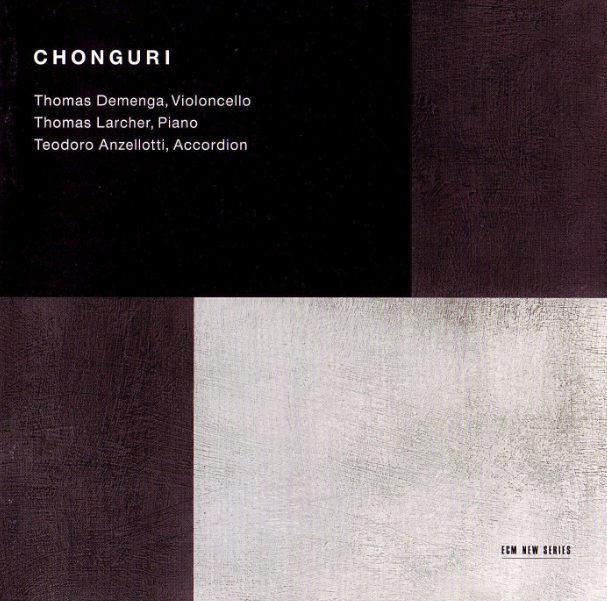
Demenga/Larcher/Anzellotti: Chonguri (ECM New Series 1914)


Chonguri

Thomas Demenga violoncello
Thomas Larcher piano
Teodoro Anzellotti accordion
Recorded August 2004 at Clara-Wieck-Auditorium, Sandhausen bei Heidelberg
Engineer: Teije van Geest
Executive producer: Manfred Eicher

Cellist Thomas Demenga offers up a colorful program of encores in Chonguri. From the pizzicato tour de force of the title piece by Sulkhan Tsintsadze, which imitates the selfsame four-stringed instrument of the composer’s native Georgia, it’s clear we’re in for a lively and eclectic treat. Pianist Thomas Larcher accompanies Demenga for most of the program, which includes nods to the familiar and not so. Of the latter, Catalonian composer Gaspar Cassadó’s Danse du diable vert is among the more spirited pins in the album’s geographic and chronographic spread. Two Chopin nocturnes give us a taste of home, in a manner of speaking, with the c-sharp minor presented to us in one of the more beautiful arrangements one is likely to find (though I’ll always be partial to Bela Banfalvi’s). The balance here is superb. A dash of Webern keeps us on our toes, his three Little Pieces sparkling with a charm that is, I daresay, romantic. Of romance we get plenty more in the three Fauré selections sprinkled throughout, of which Après un rêve is a highlight, and in Liszt’s evocative La lugubre gondola.

Four Bach chorales, in Demenga’s arrangements, for which he is joined by accordionist Teodoro Anzellotti form the album’s roof.Sounding somewhere between an organ and a hurdy-gurdy, the sheer depth of tone from Demenga’s cello in these is inspiring.He also offers two pieces of his own, of which the programmatic New York Honk is a delightful end.

Demenga’s playing is such that one can feel the lineage that binds all of this music together into a masterful patchwork as idiosyncratic as it is (seemingly) inevitable. Such programming epitomizes the ECM New Series spirit insofar as it charts the contemporary while paying due respect to the antique in what amounts to one of Demenga’s finest recordings to date and a label landmark.

Silvestrov/Pärt/Ustvolskaya: Misterioso (ECM New Series 1959)

Misterioso

Alexei Lubimov piano
Alexander Trostiansky violin
Kirill Rybakov clarinet
Recorded May 2005, Historischer Reitstadel, Neumarkt
Engineer: Stephan Schellmann
Produced by Manfred Eicher

Alexei Lubimov has been painting himself quite the somber niche in ECM’s New Series catalogue, and perhaps nowhere more so than with Misterioso. This suitably titled disc brings the Russian pianist together with two younger colleagues—clarinetist Kyrill Rybakov and violinist Alexander Trostiansky—for a program of splendid contrasts.

We begin at the end, as it were, with Valentin Silvestrov’s Post scriptum (1990) for violin and piano. Like much of the composer’s later work, it manages to sound like a quotation without, in fact, being derivative—a reference to the abyss in which the creative spirit dances. In this vastly self-referential universe, the balance between drama and gentility breathes in shadowy cascades and pizzicato afterglows. The piano acts as core, while the violin etches upon it signs of its own becoming. Between alternating contacts and separations, the piece eschews sequential development in favor of hopping reflections. Where the Andantino shows a profoundly respectful sense of melody, constructing with minimal elements a fully fleshed organism of song without words, the third and final movement picks up on the plucked themes of the first, sounding almost synthetic in its precision before total dissipation.

Silvestrov’s 1996 title composition is the most cerebral piece on the record. Scored for “solo clarinet (with piano),” the piece is dedicated to Evgeny Orkin, a musician adept at both instruments, thereby necessitating the same demands on the contemporary solo performer. What may seem on the surface an elusive piece quickly turns, however, into something geometric, even gritty. Through its protracted twenty minutes we find ourselves at an impasse of time and space. The structure is sporadic, yet bound, every sub-section joined by the barest of chains. It is the temerity of creative life and of the existence that engenders it. Delicate flutters from the clarinet speak of an era beyond the now. Breath is expelled without notes, expressing more solitude than wind. It is the base level of the utterance, a song reduced to its core constituent.

One might think there would be no need for another version of Arvo Pärt’s Spiegel im Spiegel (1978), but in this for clarinet and piano we find ourselves regaled anew by its simple, mirrored beauties. The faster treatment here gives it something of a romantic quality and allows it to congeal against the constant threat of silence that embraces it from all directions.

Considering the mastery encoded into every moment of Galina Ustvolskaya’s 1949 Trio for clarinet, violin and piano, it’s no wonder the piece remains one of the greatest for its combination. The dynamism of its contours bespeaks a surface tension so resilient that its fulfillment (enhanced by the unification of the album’s three musicians at last) rings genuine and unforced. A jovial sense of play is at work here, skirting an edge between exuberance and emotional turmoil. At moments the syncopation recalls Shostakovich (unsurprising, considering that Ustvolskaya was his student), making for an intense danse macabre. The central Dolce wanders like a creeping shadow into all-consuming thought, and seems to echo the beauties with which the program began, while the final movement, marked Energico, throws us into a murky spiral, crashing in a punctuation of deflated purpose.

We end with another Ustvolskaya piece, the 1952 Sonata for violin and piano. Over the course of its nearly 20-minute single movement, we listen as a staggering entity, drunk with regret, turns in on itself, stretching thin like taffy until barely connected to the breath that animates the album as a whole.

Nicolas Gombert: Missa Media Vita In Morte Sumus – The Hilliard Ensemble (ECM New Series 1884)


Nicolas Gombert
Missa Media Vita In Morte Sumus

The Hilliard Ensemble
David James countertenor
Rogers Covey-Crump tenor
Steven Harrold tenor
Andreas Hirtreiter tenor
Gordon Jones baritone
Robert Macdonald bass
Recorded May 2002 at Propstei St. Gerold
Engineer: Peter Laenger
Executive producer: Manfred Eicher

A rightful successor to Josquin Desprez, with whom he studied, Nicolas Gombert had been long neglected at the time of this recording. The mass represented here, split as it is among a choice selection of motets, is exemplary of his gift for rewriting. His vocal lines are characterized by their restlessness, both in terms of composition (the virtual lack of rests in the score) and mood (in its constant search for resolution).

How do Hilliards bring their own sensibility to music already so fine? By doing what they always do so well: allowing their entire beings to resonate with every note they sing. Augmenting their usual quartet, the Hilliards welcome bass Robert Macdonald and tenor Andreas Hirtreiter (making a trio of tenors for three of the motets herein) for this long-overdue recording. Macdonald’s presence is especially felt in the six-part motet, Media vita in morte sumus, that opens the program. Like much of what follows on this disc, the music is dark and bottom-heavy. This doesn’t mean, however, that moments of light are nowhere to be found, for in the escalations of tense polyphony that abound there is the illumination of obscurity. Like a stained glass window, one comes to know it through its variations in opacity and translucence, and then only through a glow whose source remains as intangible as the reverence that gave it life.

Gombert takes the Media vita in morte sumus as source for his five-part Missa Media Vita. Scattered among a selection of motets, the voices of the Missa tumble into one another in a music resigned to its own finitude. Harmonies tend toward the dissonant and tight, so that moments of consonance shine with an airy quality that seems to bypass the mind completely and head straight to the prayerful heart. There is gravity in this music, both in its sense of seriousness and in terms of force. One need listen no further than the Kyrie, which through its introductory tenor line shifts the angle of light to a gallery of rolling landscapes. Between the subtler interactions of the Sanctus and the continued magic of the tenor lines in the Agnus Dei, one cannot help but hear in their amen(d)s a visceral resolution.

Throughout the remaining motets, the brilliance of David James steals the heart, especially in O crux, splenidor cunctis. His duetted lines with tenors in the Salve Regina seem also to fly, scanning pasture for supplication. Unexpected changes await in Anima Mea, which moves with the timidity of a newly baptized child, while the closing Musae lovis, a tribute to Josquin, surrounds us in folds of ever-changing breath.

Gombert’s is music one can easily get lost in. In doing so, the listener learns to shut out the individual voice in favor of the grander tabernacle it embodies. His motives work in ropes more than threads. Like members of a shepherd’s flock, herded by divine command, they may not understand the constitution of the voice that guides them, but through the sound alone they know to press on with their brothers and sisters into the setting sun.

Rolf Lislevand: Nuove musiche (ECM New Series 1922)


Rolf Lislevand
Nuove musiche

Rolf Lislevand archlute, baroque guitar, theorboe
Arianna Savall triple harp, voice
Pedro Estevan percussion
Bjørn Kjellemyr colascione, double-bass
Guido Morini organ, clavichord
Marco Ambrosini nyckelharpa (viola d’amore a chiavi)
Thor-Harald Johnsen chitarra battente
Recorded October 2004 at Rainbow Studio, Oslo
Engineer: Jan Erik Kongshaug
Produced by Manfred Eicher

Anyone expecting a straight-off rendition of Baroque material from Rolf Lislevand’s ECM debut will, I hope, be pleasantly surprised by this eclectic and immaculately rendered program. Lislevand is that rare musician of early music who tries not to reconstruct that which cannot be reconstructed. Rather, he speaks to the spirit of things, is vitally interested in the intersection between the historical and the personal. Authenticity, we then find, is in this context not about accuracy but about a willingness to open oneself to the possibilities unwritten in a given score.

The titular “nuove musiche” terms a challenge among certain thinkers of the seventeenth century, whose dismissal of sixteenth-century polyphony led to a favoring of the pared-down rhetoric that forms the basis of this recording. Giovanni Girolamo Kapsberger, Domenico Pellegrini, Girolamo Frescobaldi, Alessandro Piccinini, Luys de Narváez, Bernardo Gianoncelli are composers who exemplified this nascent attitude, and their music comprises a luscious and life-affirming statement. Writes Lislevand in his liner notes, the nuove musiche “grew out of sound and musical silence in space. As in all music, the musician is forever inseparable from the sound of his instrument or voice. The space in which the sound arises is like the surface on which a picture is drawn: it is the canvas on which a painting emerges, or the time and space from the beginning to the end of a movement in a dance.” This seemingly reduced template did, in fact, enable in the musician greater freedom of improvisatory expression, and it is this spirit that moves every gesture of the present recording. Kapsberger’s Arpeggiata addio sets a tone dripping with atmosphere. From Pedro Estevan’s delicate percussion to Arianna Savall’s wordless voice, flowing over an oceanic ensemble, it haunts as it unfolds. So begins a journey that seems to flow more deeply with every breath taken, every string plucked, every bow drawn. Yet it is Pellegrini, whose masterful explorations of the passacaglia form make up the bulk of the album, who enlivens this program to its highest marks. A smattering of other passacaglias, including a beautiful nugget from Frescobaldi, and the fascinating Toccata cromatica close this crystalline album like a clasp on a locket.

An album this good, this unique, can only feel like a new life, so imbued is it with an innate force that energizes as much as it soothes the weary soul. Lislevand and his ensemble play to the needs of a music that so achingly wants to be heard. The recording sparkles, every trembling on the fingerboard and quiet breath coming through. Some of engineer Jan Erik Kongshaug’s finest work.

Stephen Stubbs: Teatro Lirico (ECM New Series 1893)


Stephen Stubbs
Teatro Lirico

Miloš Valent violin, viola
Erin Headley viola da gamba, lirone
Maxine Eilander Spanish and Italian harps
Stephen Stubbs chitarrone, baroque guitar
Recorded February 2004 at Propstei St. Gerold
Engineer: Markus Heiland
Produced by Manfred Eicher

After his successful collaborations with John Potter’s Dowland Project, American lutenist Stephen Stubbs at last leads his own ensemble with Teatro Lirico. The resulting efforts seek to express the completeness and spiritual heights of the human voice. His medium thereof on this particular album is “La Folia” (a dance and chord pattern popularized in the sixteenth century, connoting madness and empty-headedness through an improvisational and virtuosic aesthetic), the Italian Sonata, and a nod to more obscure Slovak sources.

Whereas an album like Rolf Lislevand’s Diminuito is the spirit of a trope, Teatro seems the spirit of an age. Like an age, its borders are as porous as the politics of those who delineate them, yet at the same time their very arbitrariness gives us insight into the larger meanings we may ascribe to them. Sonatas by Arcangelo Corelli on the Folia theme form the backbone of the adventurous program. As a trope, the Folia tends toward the cyclical in its musical progeny, so that the first of two group improvisations to follow taps into its intertextuality, finding within that delicate balance of intent and creative expression an ideal way to understand its architecture. The variations for harp and Baroque guitar speak to this same instinct, each variation an expression of infinitude.

The harmonic tensions of Giulio Caccini’s 1601 Amarilli, mia bella take on an even greater significance when played out against such wellsprings of free expression. One can almost hear the singing that inhabits the background of pieces like the Adagio from Maurizio Cazzati’s Balletto Quarto, in which the retraction of lead and bass lines reveals vast content. The meat of this fascinating journey comes in the form of Carlo Farina’s Sonata Seconda detta la desperata for violin and continuo, which bristles with Biber-like quality. That same sense of compressed drama (from an age in which the musical universe needed only a chamber to find purchase) reveals the visceral plenitude of every instrument. Thus heard, seen, and felt, their voices can live again. It all comes to a head in a Suite by Johann Caspar Horn from an anonymous Slovak manuscript before ending with Arpeggiata a mio modo (2004) in a loom of threads, sounding almost like a Gustavo Santaolalla dirge.

The performances on Teatro Lirico are impeccable, enhancing the lute’s newness at every turn—which is precisely why an album of Renaissance finds its way onto ECM: the here and now is what it’s all about.

Tigran Mansurian: String Quartets (ECM New Series 1905)


Tigran Mansurian
String Quartets

Rosamunde Quartett
Andreas Reiner violin
Simon Fordham violin
Helmut Nicolai viola
Anja Lechner violoncello
Recorded May 2004 at Propstei St. Gerold
Engineer: Markus Heiland
Produced by Manfred Eicher

It was not until his 40s that Tigran Mansurian at last wrenched out the two string quartets presented on this captivating disc. Already known for his labored approach, the Armenian composer has given us in these works something deeply profound and lasting for the genre. Yet in listening to this music, one gets the sense that genre is farthest from his mind. Both quartets are solemn statements for late friends David Chandschian and Eduard Chagagortzian. “The basic idea is to develop a musical style out of the principles of the Armenian language,” says first violinist Andreas Reiner, “and especially out of its stylized expression of grief.” With this in mind, we find that Mansurian’s capillary approach is like an expression of social power, whereby the bane of politics and displacement is dissolved in the tincture of an unfettered melody, in its careful arrangement of musical lines through the discovery of some emotional truth. Each strand of these quartets bows like a spider’s web cast in the wind, tethered to something behind the clouds.

Although both quartets take a three-movement structure, with two somber skins surrounding an active middle, any articulations of shape and size are rendered in moonlight alone, for these quartets are decidedly nocturnal, emphasized by their watery reflections. The Allegretto of the String Quartet N° 1 (1983-1984), for instance, reflects the glow of a moon obscured rather than its direct glittering light. It is unerring in its consistency, in its residual presence. The Agitato unfolds with an unsettling grace, anchored down by an active yet firmly earthbound cello line. This erratic dance is strangely consolatory. A descent carries us into quieter recapitulations, during which the viola sings with singularity. Any rhythmic urgency therein is picked apart by siren calls blending into the Maestoto. Moments of confluence in tutti add graceful flourishes to the inscription, ending in solace.

Mansurian’s quartets describe a world in which both the surface and the interior of the self, and of the material objects with which that self engages, are one and the same, participating as they do in a wider mediation between flesh and spirit. It is a reciprocal relationship, a symbiosis of sound and its notation. And so, the opening Andante of the String Quartet N° 2 (1984) is, while an inversion of the often declamatory instatement of a new piece, appreciative of the shadow that lies within, so that by its end we are not filled with anticipation but rather with the acceptance of the awakening pizzicati and dynamic phrasings in the Larghetto. The final Andante also works its way in spindles, threads spun by candlelight in an evening where silence becomes audible as the humming of the plains, the trees, and the beating of one’s own heart.

The Rosamundes end this already full program with a more recent work. Testament (2004) bears dedication to producer Manfred Eicher, whose tireless efforts in spreading the wonders of such composers as Mansurian is duly felt here. This single Lento moves like an organ with its solemn vocal qualities, bringing us into communion with the promise of a misted evening star.

Many composers can make the individual voices of a string quartet sing, but how many can make them breathe? This music is respiration incarnate. It has been speaking to us since time began. We need only open our lungs to take it in.

Trio Mediaeval: Stella Maris (ECM New Series 1929)


Trio Mediaeval
Stella Maris

Anna Maria Friman soprano
Linn Andrea Fuglseth soprano
Torunn Østrem Ossum soprano
Recorded February 2005 at Propstei St. Gerold
Engineer: Peter Laenger
Recording producer: John Potter
Executive Producer: Manfred Eicher

For their third ECM outing, the sopranos of Trio Medieaval set their vocal sights to 12fth- and 13th-century French and English (mostly conductus) chants, nestling within these a newly commissioned mass from Korean-born Sungji Hong. That the former (with one exception) performed here were never meant to be sung—or, for that matter, heard—by women at the time of their composition matters not when basking in the vitality of this recording: further proof that music is open to all who touch it, just as those who are touched by it become open to all.

In her liner notes, Nicky Losseff rightly speaks of sweetness, for one cannot help but savor in the fragrant wash of polyphony that is the opening Flos regalis virginalis. This, along with the protractions of Veni creator spiritus and the Beata viscera, comprise some of the program’s most affecting moments. Haunting also are the sustained drone of O Maria, stella maris and the transportive strains of Dou way Robyn.

Yet the most crystalline pillars in this house of mist and time resolve themselves in Hong’s beautiful Missa Lumen de lumine. Written in 2002 and dedicated to the Trio, it grows like vines in ruins grown truer with age. Like the light of its title, this mass is composed of prismatic strands, some of which unify in single threads of chant and others of which refract, visualizing the nature of their own splitting. Between the heavenly Gloria and Agnus Dei, one is left drifting in these precise rhythms and changes. Hong is highly respectful of the texts of the Mass Ordinary and forms of each line a secret braid, ending often with a subtle flourish in the spirit.

Anonymity in music is purity, filled with hope and the sparkle with wisdom. It allows us to strip music of its egotism and appreciate it as something out of place, if not out of time, and therefore of the world. In listening, we become the music’s inhabitants, not in a relationship of power, but of recognition. When paired with a highly composed work like Hong’s, the surrounding chants indeed take on a luminous quality, forever drawn to a heaven of undying voices. This is the magic that Trio Mediaeval brings to every note sung, and this just might be the most intimately appropriate album with which to begin that journey.