Anja Lechner: BACH/ABEL/HUME (ECM New Series 2806)

Anja Lechner
BACH/ABEL/HUME

Anja Lechner violoncello
Recorded May 2023, Himmelfahrtskirche, Munich
Engineer: Peter Laenger
Cover photo: Sam Harfouche
Produced by Manfred Eicher
Release date: October 18, 2024

A solo program is never a solitary endeavor. While it may nominally include a lone performer—in this case, cellist Anja Lechner, in her first such recording—it is ultimately a conversation with the music, engineer, producer, and oneself. And in the trifecta of composers assembled here, we are included in that conversation. Throughout the opening swoon of A Question, one among a handful from former Scottish mercenary Tobias Hume (c. 1579-1645), and its companion piece, An Answer, the beginning and the ending become indistinguishable. (I also like to think that the answer comes unintentionally in the snatch of bird song heard at the end of the latter track.) Harke, Harke features pizzicato colorations and bow tapping—and may, in fact, be the first score to feature a col legno instruction—for delectable contrast. These pieces are from Hume’s 1605 collection of dances and miniatures, “The First Part of Ayres,” welcoming us into a sound-world that begs uninterrupted listening.

German pre-Classicalist Carl Friedrich Abel (1723-1787), another viol master who returned to the form a century and a half later, yields two vignettes in d minor. Where his Arpeggio is an enchantment, shining across the strings in refracted sunrise, the Adagio is a piece of paper blown down a cobbled street by the wind of an oncoming storm.

Against this backdrop, the Cello Suite No. 1 of Johann Sebastian Bach (1685-1750) is a piece of a fallen star. In the Prélude, there is enough shadow to remind us that even the most joyful discoveries depend on sorrows, rendering their contours all the more pleasurable to behold. Lechner wields her bow as the weaver does a shuttle. From where she sits, the frays of the tapestry’s backside are within reach, while from our perspective, it is richly and coherently patterned. As the Allemande shapes the clouds and sky, the Courante and Sarabande populate the valley below with equal measures of vibrance and infirmity. In the Menuet, we encounter the tinge of old age, where eyes still sparkle with the naivety of youth even as they are tempered by the cataracts of regret. The final Gigue frees the soul from its cage.

Given how heartfully Lechner renders all of this, moment by precious moment, how can one not reflect upon her spirit of exploration and improvisation through a career as varied as her repertoire? We are all the more blessed by her ability to pull life from her instrument as one draws water from a well. Like the composer himself, even when repeating the same format in the Cello Suite No. 2, she holds the power of variation incarnate. This Prélude is a drop of ink preserved in water, holding its color and identity no matter how much the Allemande may jostle it. Lechner maintains a level voice, holding firm to the horizon so that the occasional flight toward the sun or dive toward the ocean floor feels all the more novel. In that sense, the Courante is as vivacious as the Sarabande is funereal, each a stage setter for the final footwork.

Further aphorisms from Hume, each addressing a different facet of the human condition, conclude the recital. By turns playful and sensual, they delight with such titles as Hit It In The Middle and Touch Me Lightly. The strongest musculature is reserved for A Polish Ayre, which reminds us of just how physical the cello can be. Throughout these interpretations, Lechner is ever the shaft of light to its prism, splitting a spectrum of mastery that can only flourish behind closed eyes. The result is an act of great intimacy built over years of trust with ECM and its listeners, giving her soil to plant a variegated garden of nourishment. She has the dirt under her nails to prove it. Let the water of our high regard be its rain.

Evgueni Galperine: Theory of Becoming (ECM New Series 2744)

Evgueni Galperine
Theory of Becoming

Evgueni Galperine electronics, sampling
Sergei Nakariakov trumpet
Sébastien Hurtaud violoncello
Maria Vasyukova voice
Recorded 2021/21, Studio EGP, Paris
Engineer: Aymeric Létoquart
Mixed November 2021, Les Studios de la Seine, Paris
by Evgueni Galperine, Manfred Eicher, and Aymeric Létoquart
Cover painting: Lorenzo Recio
Album produced by Manfred Eicher
Release date: October 21, 2022

If a composer is an author, then Evgueni Galperine is one who allows characters, actions, and places to speak themselves into logical corners, then breaks those corners to let the vacuum of space have a say. Based in Paris since 1990, the Russian/Ukrainian composer cites the language of cinema as his creative crucible. His first project in that regard was Andrey Zvyagintsev’s Loveless, a soundtrack he wrote sight unseen. (ECM listeners may remember another Zvyagintsev film, The Return, and its music by Andrey Dergatchev.) In the present program, Galperine tears his mise-en-scène from the pages of life itself. Whether reworking prerecorded material or responding to instruments in the moment, this “augmented reality of acoustic instruments” connects events of importance in his life. Aided by the contributions of Sergei Nakariakov (trumpet), Sébastien Hurtaud (cello), and Maria Vasyukova (voice), he breaks the electro-acoustic mold as he defines it, careful not to step on any shards left by the process to regard the partial reflections they offer.

Much of the work is personal, giving us glimpses into the experiences that have shaped his movements in the world. The most poignant is “This Town Will Burn Before Dawn,” for which Galperine imagined himself combing through the rubble of a destroyed futuristic city. “This simple idea took on a whole new meaning with the invasion of Ukraine,” he says, “the land of my father and of my childhood.” And while hope is found, it is unreachable. A cello stretches its arms but finds no contact in return, only an imagining of light amid ringing bells. Like “Soudain, le vide” later in the album, it is a requiem as much for the living as the dead. The flesh, it seems to whisper, is inseparable from shadow. “Oumuamua, Space Wanderings” is a more ambitious but no less intimate self-examination. Inspired by the oblong asteroid that enchanted the world with possibilities of interstellar contact in 2017, it writes its origin story with a Jon Hassell-esque morphology, nestled in an overlay of bright digital signatures and a seeking spirit.

With other influences ranging from Claude Debussy and Dmitri Shostakovich to György Ligeti and Arvo Pärt, a listening mind is clearly at work. Having such a list at hand prompts me to seek other paths of connection. The bellowing of low horns in “Cold Front” evokes the dawn-kissed expanse of Hans Zimmer, while the trumpet of “After The Storm” exhales like the foggy tropes of Ingram Marshall. To be sure, the high strings and beautiful dreams of “La lettre d’un disparu” make for an easy parallel with Pärt’s Tabula rasa. But they also bring me back to my first encounter with Three Pieces in the Olden Style by Henryk Górecki. If anything, my deep kinship with the Polish composer’s broad oeuvre rings truest for me throughout Theory of Becoming. I feel it in the translucent veil of “Kaddish” and the unrelenting textures of “The Wheel Has Come Full Circle”—not simply in terms of structure but in Galperine’s sense of time. It’s like he stretched out Old Polish Music thin enough to see the sun through without letting it rip, giving us a diffuse lens through which to regard the precariousness of our existence.

Even when the inspirations are of a more imaginative persuasion, they feel no less real. A childlike wonder reigns supreme in “Don’t Tell.” This melange of whistling, percussive clicks, trembling strings, and celesta is a record spinning backward. It cradles a flute like a newborn sibling, ending in a unified song of well-being. Lastly, “Loplop im Wald” refers to the magical bird solely capable of traversing Max Ernst’s mysterious painted forests. Tenser and moonlit, its Morse code trails ever outward into a calling of escape, hoping nature won’t come crashing down on itself before the journey can be completed.

With such a profoundly familiar sense of imagination to regard, we are left with only ourselves as companions, conversing until we implode as sound itself.

Delian Quartett/Claudia Barainsky: In wachen Traume (ECM New Series 2743)

Delian Quartett
Claudia Barainsky
In wachen Traume

Claudia Barainsky soprano
Adrian Pinzaru violin
Andreas Moscho violin
Lara Albesano viola
Hendrik Blumenroth violoncello
Mikhail Timoshenko baritone
Matthias Lingenfelder second viola
Andreas Arndt second violoncello
Recorded October 2021, Abtei Marienmünster, Konzertsaal
Engineer: Friedrich Wilhelm Rödding
Cover photo: Woong Chul An
Album produced by Guido Gorna
Release date: June 21, 2024

Im wachen Traume tells an old story in new terms. The title (“In a waking dream”) references Frauenliebe und Leben, op. 42, by Robert Schumann (1810-1856), whose eight-part song cycle serves as the program’s centerpiece. This setting of eight poems by Adelbert von Chamisso (1781-1838) about a woman’s tragic fate is arranged for soprano and string quartet by late composer Aribert Reimann (1936-2024) for those performing it here—another clue to the album’s name. In 2018, while drifting off to sleep, Reimann heard the song cycle in his head with a string quartet instead of a piano. Unable to relinquish the idea, he completed the present version in under two months.

In his liner notes, violinist Andreas Moscho describes a dual theme of love and death. “None of the works selected here,” he observes, “were originally conceived for string quartet. In all of them, however, the string quartet seems to return home.” Reimann enhances the score with careful yet natural adornments, rendered telepathically by the Delian Quartett and soprano Claudia Barainsky. “Helft mir, ihr Schwestern” (Help me, my sisters) and “Süßer Freund, du blickest” (Sweet friend, you look) lend themselves so organically to the format that one can hardly imagine them any other way. Highlights include the chordal exchanges and trembling cello of “Er, der Herrlichste von allen” (He, the most wonderful of all), the pizzicato accents of “Ich kann’s nicht fassen, nicht glauben” (I cannot grasp it, believe it), and the glassy harmonics of “An meinem Herzen, an meiner Brust” (On my heart, at my breast). Barainsky emotes with a seasoned charm that feels utterly genuine. She is an embodied vocalist who understands that texts must be first spoken to be sung.

The one poem not included by Schumann is Chamisso’s ninth, “Traum der eignen Tage” (Dream of my own days), in which the wisdom of old age is offered as a gift to one whose life still lies ahead. Perhaps no more fitting connection could be made to the works by William Byrd (c. 1543-1623) and Henry Purcell (1659-1695) pillowing this Schumannic gem. While these luminaries of Renaissance and Baroque eras might seem unlikely companions, one can hardly deny that the Venn diagram of their shared interest in worldly things makes their spiritual complements stand out all the more.

As the music of Byrd, in arrangements by Stefano Pierini, demonstrates, this dichotomy is crucial. Diametric vignettes like “Sing joyfully” and “Ave verum corpus” are proof positive of the Delians’ uncanny sympathy, while “Jhon come kisse me now” (a bawdy lyric reconstructed from Byrd’s own harpsichord variations) drips with honey from Barainsky’s lips. Meanwhile, the latter’s rendering of “Out of the orient, crystal skies” shines in its telling of the nativity, while the strings evoke the humility of the manger. In the tender “Lullaby, my sweet little baby,” Barainsky is joined by baritone Mikhail Timoshenko to rebuke King Herod’s tragic decree (represented in vocalise) from the point of view of the Virgin Mary.

The two singers join forces further back in time for Purcell’s “Hear my prayer, O Lord.” With Matthias Lingenfelder and Andreas Arndt seconding on viola and cello, respectively, they create a wordless but no less ecclesiastical sense of grandeur. Preceding them are the Pavane and Chaconne, both in G minor, each an interlocking canvas of pastel and charcoal, and between them, “When I am laid in earth” from the opera Dido and Aeneas (also arranged by Pierini). Barainsky lays bare her respect for the tragedy, nevertheless finding beauty in it. And is that not how we survive?

Heinz Holliger/Anton Kernjak: Éventail (ECM New Series 2694)

Heinz Holliger
Anton Kernjak
Éventail

Heinz Holliger oboe, oboe d’amore
Anton Kernjak piano
Alice Belugou harp
Recorded October 2021 at Radiostudio Zürich
Engineer: Andreas Werner
Cover: Fidel Sclavo
Co-production ECM Records / Radio SRF 2 Kultur
Release date: September 22, 2023

Dear dreamer, help me to take off
Into my pathless, pure delight
By always holding in your glove
My wing, a thin pretence of flight.

The vocalise is a form that, by modern definition, refers to a singing exercise focusing on melody over meaning. If it begs the need for words, it is only because we are accustomed to the notion that songs require them. In this instrumental program, oboist Heinz Holliger deconstructs the concept and reassembles it with apocryphal gems and other building materials from the 20th century. Pianist Anton Kernjak (last heard on Holliger’s Aschenmusik) leads as much as he follows in their co-search for lyrical forms.

It is Kernjak who introduces us to a forest of snow-covered trees in Maurice Ravel’s Pièce en forme de Habanera (1907). Holliger’s oboe is the wanderer who sings only when no one else is around, leaving behind a trail of crumbs not to be found but in the hopes they will bear fruit come spring. Thus, we are shown a way forward. The Sonate op. 166 (1921) of Camille Saint-Saëns, one of his last pieces, cuts across the grain of Romanticism with blades of light. From measured frolic to a march across time, it might just be his truer swan song.

A freshness as of twilight brushes
Against you as you flutter me,
And each imprisoned wing-beat pushes
Back the horizon tenderly.

From André Jolivet, who Holliger cites as the genuine successor to Edgar Varèse, we get the mysterious Controversia (1968). Originally dedicated to Heinz and Ursula Holliger, it replaces the latter with Alice Belugou on the harp. The relationship between the two instruments is one of tension without release. The oboe trembles, and the harp writhes, their dance a language unto itself. Belugou’s harmonics point toward points of starlight, while the double reed takes solace in tracing them for want of images. Holliger’s tone is unparalleled; his window racks but never shatters, offering a kaleidoscopic point of view.

It’s dizzying: shivers run through space
Like an enormous kiss, which, mad
At being born for no one’s face,
Can not discharge, nor yet subside.

The Vocalise-Étude (1935) of Olivier Messiaen offers yet another perspective. Holliger once played it in the composer’s presence while rehearsing for a performance of Des canyons aux étoiles he was to conduct. As the story goes, Messiaen’s enthusiasm led him to include it in the Concert à quatre, dedicated to Holliger, Yvonne Loriot, Catherine Cantin, Myung-Whun Chung, and Mstislav Rostropovich. As magical as it is brief, it breathes alongside the Morceau de lecture(1942), an etude for the oboe sight-reading exam at the Conservatoire National de Paris later expanded upon in the song cycle Harawi (“L’Amour de Piroutcha”).

Ravel’s Kaddisch (1914), from Deux mélodies hébraïques, sets the Jewish prayer for the dead. Although it wears a shawl to cover the eyes and mouth, it grasps delicately at light. Its companion is the Vocalise-Étude «Air» op. 105. Written in 1928 by Darius Milhaud, a student of Charles Koechlin, it is a veritable haiku.

Don’t you feel heaven is shy? It slips,
Blushing, a piece of laughter stifled,
Down by the corner of your lips
To hide in my concerted fold.

Syrinx (1913) by Claude Debussy takes on a new guise here. Originally a flute solo, it no longer feels “incidental” (as it was originally played off stage as an interval to a stage production) and dances on its own terms. Holliger chooses the oboe d’amore for this interpretation, as he also does for Koechlin’s Le repos de Tityre op. 216/10 (1948). If one is bone, the other is flesh. Following this dyad are further vignettes by Jolivet, Debussy, and Saint-Saëns, whose Le rossignol (1892)—quoted in the second movement of the late oboe sonata heard earlier—carves its own vessel.

This sceptre rules the banks of rose
And pools of evening’s golden mire,
This flying whiteness that you close
And land beside a bracelet’s fire.

Holliger and Kernjak save the best for last in the Sonate op. 23 (1936) of Robert Casadesus. Better known as a pianist, he remains lesser known as the fairly prolific torch bearer of Fauré and Ravel that he was. As Holliger recounts in the liner notes, he received this hidden treasure in autograph copy form from his teacher, Émile Cassagnaud. Though now in print, it is rarely performed. The piano writing alone is astounding. Airy in feel yet overflowing with imagery, it leans into jazz without ever losing its footing. From the cinematic middle movement to the rousing Allegro vivo that finishes, one cannot help but feel a new emotional horizon being drawn.

Incidentally, the album’s title comes from the poem “Another Fan” (Autre Éventail) by Stéphane Mallarmé, interspersed throughout this review. Like the spines that give the object its shape, these carefully chosen pieces allow the musicians to stretch their projection screens, each the first frame of a biography yet to be told.

Valentin Silvestrov: Maidan (ECM New Series 2359)

Valentin Silvestrov
Maidan

Kjiv Chamber Choir
Mykola Hobdych 
conductor
Recorded 2016
St. Michael’s Cathedral, Kjiv
Engineer: Andrij Mokrystkij
Cover photo: private collection
Recording produced by Kjiv Choir Productions
Release date: September 30, 2022

At the core of German existentialist Martin Heidegger’s philosophy was a concept he called “thrownness” (Geworfenheit). Although he meant it to express the uncontrollable immanence of being born into a specific time and place, it has since taken on connotations of suffering and hardship, without which life would never be defined. On Maidan, Valentin Silvestrov’s third all-choral program for ECM New Series, we witness the composer thrown from his private spiritual light into secular shadow.

Sung once again by the Kjiv Chamber Choir under the conduction of Mykola Hobdych, Silvestrov’s writing takes on a political layer he never wished it to have. The title refers to the “Euromaidan,” or the “Revolution of Dignity,” as it is known in Ukraine, signaling the government’s refusal to associate itself with the European Union in 2014 and a precursor to Russia’s invasion on February 24, 2022. Witnessing these events unfold, Silvestrov, then 84, took solace in song. With the alarm bells of St. Michael’s Cathedral sounding a rare alarm in the background, he reclothed the naked body of nationalism with verses from Ukrainian poet Taras Shevchenko (1814-1861) and liturgical texts.

The album’s bulk is reserved for Maidan 2014, a “cycle of cycles,” which melts the words of the Ukrainian national anthem (penned by Pavlo Chubynsky) into five different molds. Its opening proclamation—“Ukraine’s freedom has not yet perished, nor has her glory…”—takes on more of its intended meaning than ever, crying in the wilderness against the onslaught of a regime surrounding itself in self-fulfilling icons.

In response to such inflations of power, much of what fleshes out the remaining spaces is scriptural in origin. “Give Rest, O Christ, to Thy Servants,” for example, speaks with the voice of the Savior on the cross, who forgave his enemies as he died by their hand. We feel surrounded by the spears of those who would deem him a blasphemer and usurper of authority. Individual singers and choir mirror this dynamic, balancing the alto-led vigil of “The Lord’s Prayer” with the Belarusian folk song-inspired “Lullaby.” These embody the same contradiction of “Lacrimosa,” which awaits a blessed hope in the thorns of a world without it. Like the soloist in “Holy God,” giving praise, honor, and glory to the one on high, they understand that no evil can ultimately overcome the power of faith. Even the wordless “Elegy” makes its deference palpable.

Few composers articulate silence with sound (and vice versa) like Silvestrov, as demonstrated by three collections from 2014 (Four Songs), 2015 (Triptych), and 2016 (Diptych). These settings of Shevchenko range from robust (“The Might Dnieper”) and reproachful (“Come to Your Senses”) to fable-like (“A Cherry Orchard by the House”) and altruistic (“To Little Mariana”), reaching their darkest resignations in “My Testament,” in which the narrator requests, “When I am dead, bury me / In my beloved Ukraine.” Thus, the music suggests that wickedness in high places is truer than we care to admit.

Since Silvestrov now sees the world as Maidan, releasing this music to a wider audience feels appropriate. No longer is it chained to the narrow vision of a particular historical moment but rather the delicate swan song of something dying in all of us lest we fail to have room for hope when the chance arises. “After all,” he says, “the louder the mortars and canons roar, the softer the music becomes.” Therefore, his goal is not to evoke the chaos of war; he is a shield for peace, standing his ground in its storm.

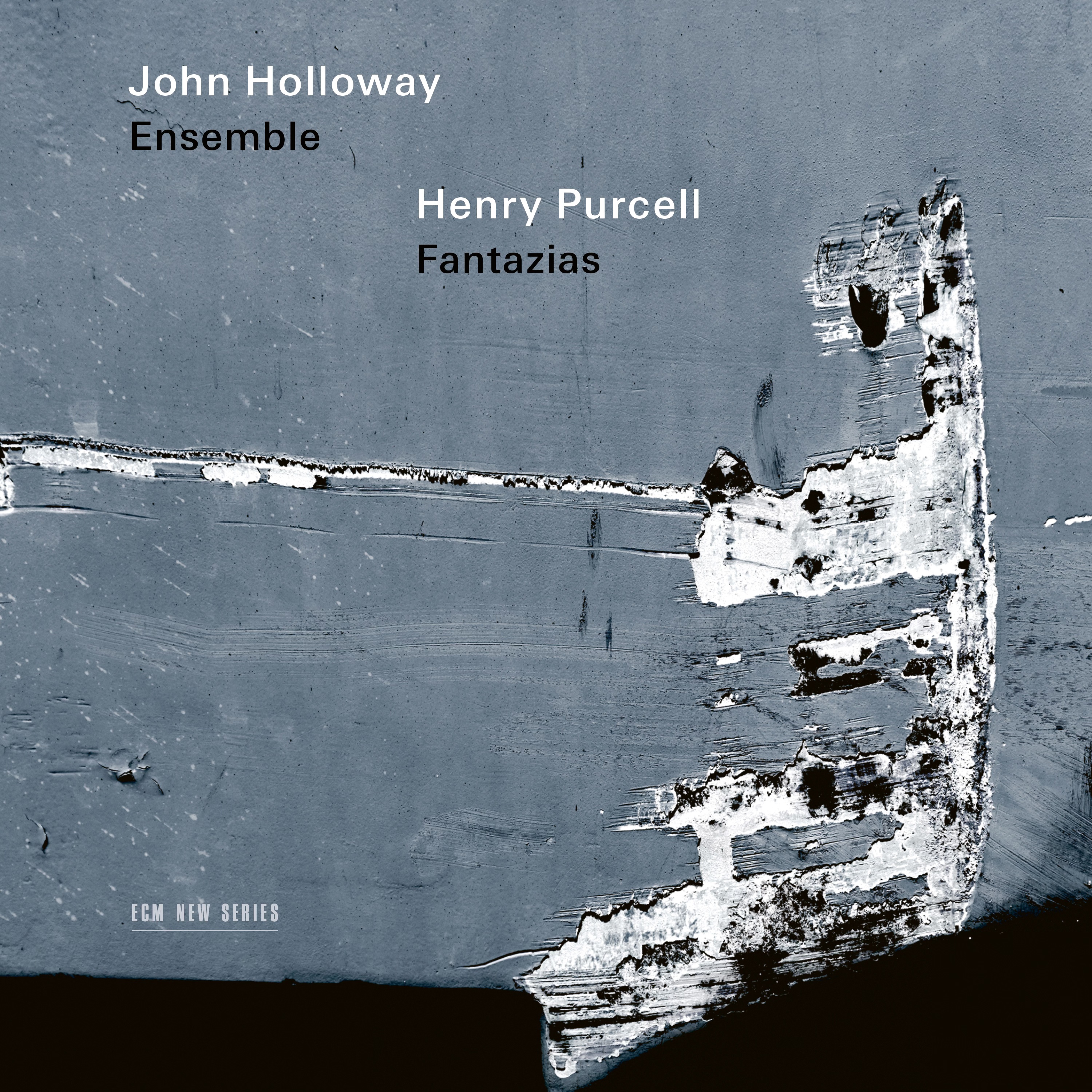
John Holloway Ensemble: Henry Purcell – Fantazias (ECM New Series 2249)

John Holloway Ensemble
Henry Purcell: Fantazias

John Holloway violin
Monika Beer viola
Renate Steinmann viola
Martin Zeller violoncello
Recorded March 2015 at Radiostudio DRS, Zürich
Engineer: Stephan Schellmann
Cover photo: Thomas Wunsch
Produced by Manfred Eicher
An ECM/SRF2 Kultur coproduction
Executive producer (SRF): Roland Wächter
Release date: September 22, 2023

Henry Purcell (1659-1695), best known for his operas, was no less a formidable composer of instrumental music. His Fantazias are the pinnacle of the form, rich in their intermingling of counterpoint and polyphony. By the time Purcell put these to paper in 1680, the fantasia was over a century old. Despite being honed into a science by such estimable predecessors as William Byrd, William Lawes, John Jenkins, and Matthew Locke (whom Purcell replaced as “composer in ordinary with fee for the violin to his Majesty,” Charles II), it had fallen out of favor. Violinist John Holloway calls the present collection “a personal farewell to a kind of music, which in Purcell’s own chamber music would soon be superseded by sonatas.”

Leading an ensemble that includes violists Monika Beer and Renate Steinmann and cellist Martin Zeller, Holloway regards these 12 gems through a jeweler’s glass, cherishing every occlusion as a testament to its crafting through time. We encounter them here out of sequence, beginning with the river’s flow of No. 10. The sound is both creamy and metallic, sometimes allowing dreams to peek above the surface while at others pushing them into the mysteries of the current. Like No. 4, it affords a special sort of grace, pivoting from a seamless introduction into an intricate unfolding without changing skins. The ensemble matches with a palette that is equal parts shimmer and shadow.

Indeed, while these strings owe much of their grace to the composing, one cannot discount the players’ lifeblood. Like actors in a stage play, they embody these “characters” from within. In No. 6, for instance, Holloway’s violin laments like an agent of mourning while the others cross-hatch that inward focus with extroverted streaks of illumination. This dynamic reverses as the urgency heightens, and Holloway grabs hold of the future while the lower strings keep vigil to avoid forgetting the past. No. 9 is its companion in spirit: Even when it dances, it casts hedonism into the fire. Nos. 7 and 8 are equally wondrous in their contrasts, and their slips into dissonance reveal an improvisatory heritage, making them feel spontaneous, raw, and passionate.

In his liner notes, Holloway says, regarding the English composer’s handling of the form, that Johann Sebastian Bach “would certainly have acknowledged it as equal to his finest achievements in this art.” This is perhaps nowhere more obvious than in No. 5, the knotwork of which immediately suggests The Art of Fugue. Sitting on its right hand and left are Nos. 11 and 12. As translucent as they are viscous, they constitute a trinity of resolution that begs for more yet offers salvation only through silence.

While the above pieces are in four parts, Nos. 1-3 are in three. More intimate in form but no less expansive in scope, each is a dip into the heart of a creator whose font ran dry too soon.

Robert Levin: Mozart – The PIano Sonatas (ECM New Series 2710-16)

Robert Levin
Wolfgang Amadeus Mozart: The Piano Sonatas

Robert Levin fortepiano
Recorded February 2017 and Feburary 2018
Großer Saal, Salzburg Mozarteum Foundation
Engineer: Markus Heiland
Cover: Fidel Sclavo
Produced by Manfred Eicher
Release date: September 16, 2022

Wolfgang Amadeus Mozart (1756-1791) is as much an enigma as an indelible emblem of what it means to be “classical.” In this seven-disc boxed set, a monumental achievement dedicated to one whose own achievements were nothing less than monumental, pianist Robert Levin offers a conspectus of the piano sonatas on the very fortepiano Mozart played from 1785 until his death and on which he composed The Magic Flute and his Requiem. Built by Anton Gabriel Walter in 1782, it speaks as one traveling out of time with a message of space.

Like much of Mozart’s writing, the music in these sonatas resulted from improvisations he later noted from memory—a spirit that Levin captures with charming honesty. The pianist’s historically informed approach heightens this effect, seeking to, in his own words, “revive a documented tradition” of embellishing repeats that goes back to C.P.E. Bach, whom Mozart greatly admired. Despite a fixed tripartite architecture across the board, there is great variation in mood, scope, and difficulty.

While Mozart is often cast as a poster child of vivaciousness, each sonata is best savored for its rich, sweet center. In these slower movements, genius bobs above and below the surface of a mind whose depths we can only begin to comprehend. We get a hint of this already in the Sonata No. 1 in C major, of which the Andante, nestled in neo-Baroque surroundings, is the music box of a childhood we’ve long forgotten.

Should that metaphor hint at immaturity, let such an illusion be shattered by a vision of the prodigy it manifests and which steps boldly into the foreground in the Sonata No. 2 in F major, cradling an Adagio that is the sonic equivalent of a precious stone. Even the Sonata No. 3 in B-flat major, with its lockstep opener and one-two punch of a conclusion, cannot steal the quiet thunder of the central movement between them. Such controlled ferocity must have been obvious to the composer himself when beginning his Piano Sonata No. 4 in E-flat major with an Adagio, pointing to the influence of Joseph Haydn, whose own sonatas he had then recently discovered.

Over the next four sonatas, expositions of stateliness and pastoralism bow to the dynamic brilliance of the Sonata No. 6. This D-major triptych is a stage drama in concentrated form, culminating in the final theme and variations. Spanning 15 minutes, they comprise the collection’s longest stretch, suggesting an orchestral sensibility.

This brings us to the pinnacle of Mozart’s engagement with the form: the Sonata No. 9 in A minor. Written in 1778, soon after the death of his mother, Anna Maria, its first movement sits on the throne of the collection. Morphing from extroversion to introversion and back again, its changes nourish Levin’s insights as a performer. The Andante here is the most holistic. Bursting into moments of passion but always returning to baseline, it sets up the concluding Presto and leaves us where we started: in wondrous anticipation. Along with its younger sibling, the Sonata No. 10 in C major, this is the form perfected.

Even “greatest hits,” including the Sonata No. 11 in A major, reemerge as hidden gems. The universally known Alla Turca lends itself to listening without prejudice, the familiar becoming new under Levin’s fingertips. Whether in the famous Allegretto grazioso of the Sonata No. 13 in B-flat major or the opening of the Sonata No. 16 in C major, Levin goes straight to the heart of these pieces so that we can feel them on their terms again.

The Adagio of the Sonata No. 12 in F major is a revelation, as is the Fantasia in C minor. Both soar in the present recording. The Sonata No. 18 in D major is among the shortest of the set, nevertheless a depth charge in its own right. The closing Allegretto is especially savory, and Levin handles it as an organic farmer would his finest crop.

Sprinkled throughout are unfinished sonata fragments newly completed by Levin and informed by his scholarly and creative approach to idiom. The sonata movement in C major is a pluralistic wonder. Another in B-flat major reveals a shimmering and ambitious architecture, while the last in G minor proceeds boldly from impressionism to realism. All three are a testament to what makes Mozart so comforting—namely, that he always has the destination in mind before his first step hits the ground.

What a gift for the seasoned and unseasoned alike, as fresh as the day it leaped forth from the soul of a life that, though cut short, was destined to resonate for all ages.

Paul Giger: ars moriendi (ECM New Series 2756)

Paul Giger
ars moriendi

Paul Giger violin, violino d’amore
Marie-Louise Dähler harpsichord, chest organ
Pudi Lehmann gongs, percussion
Franz Vitzthum alto
Carmina Quartett
Matthias Enderle violin
Susanne Frank violin
Wendy Champney viola
Stephan Goerner violoncello
Recorded January 2015
Chiesa Bianca, Maloja
Engineer: Peter Laenger
Guggisberglied was recorded 2021 in Walenstadt
Cover photo: Jan Kricke
An ECM Production
Release date: August 26, 2022

The music of Paul Giger became a part of my blood when I first encountered 1989’s Chartres. Not since J. S. Bach’s Sonatas and Partitas had I understood just how architecturally robust the violin could be, to say little of 1993’s Schattenwelt, which introduced his violino d’amore, a custom instrument with five main and six sympathetic strings. If those early albums were temples of the spirit, then ars moriendi is a waystation of the flesh—if not vice versa. The ambiguity of such distinctions gives the album a timeless charge. Across the pages of its cavernous imaginings, Giger writes a real-time scripture of inspiration, building on echoes of lives before and since.

His mythologically tinged Guggisberglied, reinterpreting a popular Swiss folk song of unrequited love and the life one gives up in its name, follows a tracking shot of the human form, shifting in varying degrees of inevitability between innocence and decay. Cradled by the hush of flowing water, what we once saw as shadows are now the shadows of shadows. Such subtlety of framing and placement of subjects is possible only in one whose mind works as a camera. Giger looks within from without, the tones of other cultures beating his drum. The violin body is a percussive force, a multitracked orchestra of emotional instruments. Giger also plucks the lower strings in qanun fashion. Currents of molecular awareness caress the riverbank, praying for a peaceful transition into lifelessness.

The latter sentiment connects to the overarching title. “In the late Middle Ages,” explains Giger in a liner note, “a literary genre of devotional books illustrated with woodcuts flourished under the name ‘ars moriendi.’ They gave instructions on how to ‘die well.’ The purpose of this tradition was to attune the soul to the ‘art of dying’ in order to save it for eternity. Music is also an ars moriendi, an exercise in the ‘becoming’ of a note, of ‘being’ in sound and of ‘passing’ into silence—or into an inner reverberation.” These concepts refer to a triptych of Tyrolean painter Giovanni Segantini, subject of the eponymous documentary by Christian Labhart, for which Giger wrote the music. Selections from that soundtrack take up much of the present album, including three stages of Agony. In the company of percussionist Pudi Lehmann (gongs, singing bowls, frame drum, and conch shell), keyboardist Marie-Louise Dähler (harpsichord and chest organ), and the Carmina Quartett, he builds a tower of wonder one layer of stone at a time until time itself is suspended. As ice dissolves into water and further into steam, the violino d’amore opens light to reveal its individual colors, loosening the bonds of the material within the immaterial through the inherent art of refraction. Zäuerli mit Migrationshintergrund is rooted in the Swiss yodel, harking to 1991’s Alpstein, albeit in far subtler clothing.

Transcriptions of Bach carry over from the film, including two for violin and harpsichord (the choral prelude “Ich ruf’ zu dir, Herr Jesu Christ” and the Largo from the Sonata No. 4 in c minor), angling the mirror of our lives into a cell of collective memory where melodies play on repeat. There is also “Erbarme dich” from the St. Matthew Passion, as sung by alto Franz Vitzthum in a breathtaking arrangement for violin, chest organ, and strings. Vitzthum’s beauties culminate in Giger’s Altus solo II, stitching ground to sky with threads of silver. In the harpsichord’s tactile light, a mournful catharsis takes shape. Like M. C. Escher’s Rind, it suggests a face. Whether forming, unraveling, or holding its own against a patchwork of clouds, its eyes remain fixed on memory.

Heiner Goebbels: A House of Call (ECM New Series 2728/29)

Heiner Goebbels
A House of Call – My Imaginary Notebook

Ensemble Modern Orchestra
Vimbayi Kaziboni conductor
Recorded September 2021
by Bayerischer Rundfunk
Prinzregententheater, München
Engineer: Clemens Deller
Recording engineer: Gerhard Gruber
Mixed and mastered by Clemens Deller, Heiner Goebbels, and Gerhard Gruber
Cover photo: Gérald Minkoff
Executive producer: Manfred Eicher
Release date: August 26, 2022

With A House of Call, Heiner Goebbels peels back his most significant layer of multimedia music for the stage. This self-styled “imaginary notebook” incorporates archival recordings of prayers, songs, and other speech acts into dialogic relationships with a full orchestra. Much of what we hear is old and anonymous, barely hanging by a thread of preservation and never imaginable in a concert setting. And yet, here it all is, wired together like some elaborate lie detector of our shared past, pinging with increasing frequency to signal every denial of complicity by proxy. Tempting as it might be to view such a project through an archaeological or ethnographic lens, to do so would strengthen the very contradictions it wishes to dilute in its reckonings of time and place. “The music is a direct response to the complexity and roughness of the voices,” says Goebbels in his liner note, pointing also to the radiance thereof against the opacity of present traumas.

Across four thematic assemblages, the Ensemble Modern Orchestra, under the direction of Vimbayi Kaziboni, draws upon an intimate relationship with Goebbels to bring his vision of death to life. Part I, “Stein Schere Papier” (Rock Paper Scissors), cites Pierre Boulez’s orchestral work Répons as foundation, magnifying its call-and-response principle with glimpses of Goebbels’s art rock band Cassiber from the same period (the early 1980s). The initial stirrings of a privileged crowd indicate the biological venues we often fail to maintain. The instrumental colors are fluid, attentive to detail, and indicative of various styles pouring from many portals at once. The story of Sisyphus, as retold in Heiner Müller’s “Immer den gleichen Stein” (Always the same stone), wraps the orchestra in a chameleonic skin. And as the street noise of a Berlin building site from 2017 stirs up a vortex of unread manifestos, faded newspapers, and other detritus, we begin to treat all words as fair game.

Part II, “Grain de la voix,” borrows from the Roland Barthes essay of the same name, in which the French philosopher asserted the power of language to shield oneself against the glare of mortality. Ghosts from the Caucasus region open their lungs, strings trembling beneath the surface as a violin leaps in sporadic response. Thus, the hypocrisy of destroying the questions of culture to answer them is outed. When more modern recordings, like that of Iranian musician Hamidreza Nourbaksh intoning Rumi from 2010, reveal themselves, they take on a volition that blinds the orchestra’s feeble attempts at imitation. The juxtaposition is critically self-aware, a score written in scars. The evocation of Komitas and Armenian soprano Zabelle Panosian hints at the spiritual planes being razed in addition to the physical, as scrutinized in Part III, “Wax and Violence.” The title refers to the wax cylinders weaponized by pseudoscientific ideologues whose voracious appetite for the “exotic” was only the beginning of their consumption. In particular, Hans Lichtenecker’s xenophobic aural documents of the very people German soldiers would later destroy through genocide pull us by the ears. A recording of school children in the Namibian village of Berseba is even more haunting and spawns a big-band catharsis—if falsely so called, for what do we have to be released from by comparison? The effect is even stronger in the laments and incantations of Part IV, “When Words Gone,” wherein Amazon rituals conducted in lost languages blend into lines from one of Samuel Becket’s last texts amid digital whispers.

The danger of all this is reading the wrong kind of sorrow into everyone we hear. We latch on to familiar names like life preservers, forgetting that the nameless have been speaking truth all along. And so, while it would be easy to call this the pinnacle of Goebbels’s work, it might be more appropriate to see it as his valley of the shadow of death. We walk through it, guided by hands unseen, in faith that hope awaits us on the other side. But to get there, we must be willing to face the hostile forces of collective memory, thick with the mud of misunderstanding.