Sarah Leonard/Christopher Bowers-Broadbent: Górecki/Satie/Milhaud/Bryars (ECM New Series 1495)

Górecki/Satie/Milhaud/Bryars

Sarah Leonard soprano
Christopher Bowers-Broadbent organ
Recorded June 1992, Hofkirche Luzern
Engineer: Peter Laenger
Produced by Manfred Eicher

Not many record labels would produce, let alone conceive of, an album consisting mainly of works for soprano and organ. I am glad to say that ECM did not back away from such a challenge, and in the process left one of its most indelible musical marks on the classical landscape. Of the four composers represented here Bryars is the only ECM mainstay, but he is in fine company indeed.

Henryk Górecki’s O Domina Nostra (1982-1985/90), conceived as an apostrophe to the Black Madonna of Jasna Góra, emerges from and recedes into a profound stasis. An earthly low pedal D on the organ is paired with triads descending from the cosmos, leaving us caught in the middle. Our only guide is the bare text and the voice that articulates it:

O Domina nostra
Claromontana
Victoriosa
Regina nostra Maria
Sancta Maria ora pro nobis

Oh, our Lady
Of the Bright Mount,
Victorious
Our Queen, Mary
Holy Mary, pray for us

Amid this murky swirl a soprano scours her lowest range, trying to pull herself from the depths of some unnamable crisis. She proclaims her joy in faith, as if each new utterance might touch a hope that its predecessors failed to reach. She returns to the opening invocation, closing on a supplicative “O Domina.”

The epic Messe des Pauvres (1895), or Mass for the Poor, by Erik Satie is, like much of the composer’s paradoxical output, both representative of the eclecticism for which he is known and something of an anomaly. According to Wilfrid Mellers’s liner notes, early on in his compositional career Satie “sought to reintegrate the disintegrated materials of tradition by juxtaposing fragments of melody and chord-sequences without obvious relation to one another or to development.” Thus do we get the Messes des Pauvres, a piece rooted in plainchant, sans the theological overload such a comparison might imply. Normally the organ is accompanied by unison voices, but forgoes them here. The piece rarely lingers, as if the four limbs required of its performance were seeking a point of unity through which to gain access to something far more mystical. Yet the piece also questions the mystical, and with a levity that indulges our skepticism. The music is wrought with such beautiful indecisiveness that moments of resolution seem intrusive. Only when the organ bares its teeth midway through is the power of this indecision fully realized. The heavy feet of an overarching sarcastic glory trample even the fluted reverie that follows.

The diptych of miniatures that is Darius Milhaud’s Prélude I/II (1942) is charmingly rustic and prepares us for the masterpiece that awaits us. The lead melodies are like the ramblings of shepherds, whose carefree desires can only go so far before the flock disperses beyond containment. The rhythms move like a human figure, as graceful as they are imperfect.

Which brings us to this album’s pièce de résistance: Gavin Bryars’s The Black River (1991). The text, culled from Jules Verne’s Twenty Thousand Leagues Under the Sea, is told from the viewpoint of Professor Aronnax as he describes the many underwater life forms that escort the mighty Nautilus through a vast underwater current from which the piece gets its name. Bryars successfully makes of this passage a world unto itself, one not subterranean but submerged. A languid introduction from the organ opens our ears to the soprano’s entrance as she propels herself through a subdued tour de force of intonation, melody, and atmosphere. The melody sustains itself through a constantly shifting mosaic of moods, in which recapitulation is found only in the organ at the end.

Sarah Leonard sings with rare beauty, and her rich voice is laced with a nasal quality that burrows into the very marrow of the listener’s bones. Her high note in The Black River sends shivers down the spine (and do keep an ear out for the haunting overtone she unwittingly produces at the 13:18 mark in the same piece). Christopher Bowers-Broadbent is the perfect foil, eliciting from the organ a delicacy I have heard nowhere else. This will always be one of my most beloved New Series recordings.

<< Messiaen: Méditations Sur Le Mystère De La Sainte Trinité (ECM 1494 NS)
>> Aparis: Despite the fire-fighters’ efforts… (ECM 1496)

Bach: Das Wohltemperierte Klavier, Bücher I & II – Jarrett (ECM New Series 1362/63 & 1433/34)

Keith Jarrett never ceases to astound me: not because of his chameleonic ability to shift between jazz and classical music, but by the sheer passion and commitment he brings to both. On these recordings of Bach’s The Well-Tempered Clavier, Jarrett proves himself to be a more than consummate classical performer. That being said, I don’t think Jarrett is out to “prove” anything here. Neither does he seem interested in laying to rest—despite critiquing others’ approaches, particularly Glenn Gould’s, in his liner notes—the ongoing debate of authenticity regarding the interpretation of Bach (and if you ask me, perhaps not even Bach ever played Bach “authentically,” tailoring as he did his keys and tempi to the occasion). What Jarrett does seem interested in is taking his ego out of the equation as much as possible. And while one cannot, of course, completely disavow a performer’s presence, this presence can be intrusive and overblown all the same. For what it’s worth, Jarrett toes the line between restraint and levity, humbly approaching the music from below rather than attacking it from above. Essentially a series of preludes and fugues written for keyboard students and enthusiasts, The Well-Tempered Clavier consists of generally short pieces, each its own microcosm of energy and ideas. Jarrett opts for a no-frills approach, though he has made a bold decision in recording the first book on piano and the second on harpsichord. Nevertheless, whatever novelty there is of “Jarrett playing Bach” wears off quickly, allowing the listener to focus on the music rather than dissect the performance thereof. Quite simply, this is a singular talent playing music by a singular composer.

ECM 1362_63

Johann Sebastian Bach
Das Wohltemperierte Klavier, Buch I (ECM New Series 1362/63)

Keith Jarrett piano
Recorded February 1987
Engineer: Martin Wieland
Produced by Manfred Eicher

Book I opens with one of the most significant musical utterances of the Bach catalogue: the Prelude and Fugue in C major (Gould’s recording of which was deployed into space on the Voyager Golden Record). Jarrett plays these with a strong sense of forward motion that sets the tone for a beautifully articulated journey through every major and minor key of the chromatic scale. Jarrett excels in the faster movements, of which notable examples are the G major and B-flat major Preludes, as well as the Fugue in E minor. But he shows an equal aptitude for those quieter moments, able to switch from sprightly (Prelude and Fugue in F major) to ponderous (Prelude and Fugue in F minor) in one fell swoop. Other gems in the latter vein include the C-sharp major Prelude, to which Jarrett brings a flowing pace that is fast enough to excite while also allowing the notes to breathe; the languid C-sharp minor Fugue; the sensitively handled E-flat major Fugue; the E-flat minor Prelude with its dexterous simplicity and emotive ritard; and the intimate A-flat major Fugue. Throughout Book I, Jarrett revels in his love for rhythm and a relatively bare aesthetic. The sound quality is accordingly muted, the piano recorded as if it were a harpsichord. Jarrett takes time with his trills, and while some might disagree with his pedal choices, for the most part they add a welcome splash of color.

<< Keith Jarrett Trio: Still Live (ECM 1360/61)
>> Tamia/Pierre Favre: de la nuit … le jour (ECM 1364 NS)

… . …

ECM 1433_34

Johann Sebastian Bach
Das Wohltemperierte Klavier, Buch II (ECM New Series 1433/34)

Keith Jarrett harpsichord
Recorded May 1990
Engineer: Peter Laenger
Produced by Manfred Eicher

Book II ushers in an entirely different sound when the piano is abandoned for harpsichord. Jarrett’s choice to do so may seem arbitrary, but I like to think it was more deeply thought out. On the surface Book I is more elegiac and perhaps therefore amenable to a pianistic performance. Book II, however, offers more in the way of the grinding syncopations and dance-like diversions more often associated with the instrument for which it was written. Where the piano seems an expansive medium, the harpsichord is a supremely tactile one that arrests us with its plucked immediacy, and the relay from one to the other gives us the luxury of both worlds, as it were. From the dazzling C-sharp major Prelude to the lush F minor Fugue, Book II is replete with gorgeous moments. The C-sharp minor Fugue is another wonderfully syncopated affair with jarring half-turns and unexpected phrasing. The harpsichord holds its own here in a variety of moods, ranging from vivacious (Prelude in D minor) and stately (E-flat major and A minor Fugues) to perpetual (E minor and A major Fugues,; Prelude in G major) and resplendent (Fugue in G major), while the final B minor Fugue caps things off with a rousing flourish.

<< Anouar Brahem: Barzakh (ECM 1432)
>> Arild Andersen: Sagn (ECM 1435)

… . …

At every moment during the 4+ hours it takes to get through The Well-Tempered Clavier, Jarrett allows the music into his heart and releases it verbatim. He exercises little dominance over the score and follows it as closely as he can. Where some interpreters turn these purely didactic exercises into showpieces, Jarrett lets them stretch their limbs and remain comfortable where they are. Oddly enough, the fact that Jarrett had already been playing Bach for 22 years before recording Book I, and the harpsichord for nine before recording Book II, has done little to staunch the flood of insults thrown his way for even attempting such a feat. Yet I find much of the criticism leveled against him to be rather self-defeating. “He’s so pretentious,” people say, “trying to establish himself as a serious classical pianist when everyone knows he’s a jazz musician,” but then in the same breath call him out for not taking a more avant-garde approach to the canon. What these hypocrisies fail to acknowledge is the kindred spirit Jarrett brings to one of the most monumental works in Western art music. We do well to remember that Bach was also a master of improvisation and that his skills as such were at the heart of his comparably prolific output. I, for one, have heard many recordings of The Well-Tempered Clavier, and would never resort to calling any of them bad, uninspired, or somehow incorrect, for what and where is the “original” interpretation to which they might be compared? Regardless of whether or not one cares for what Jarrett has done with Bach, his utter devotion to the music at hand reduces the debate to a simple matter of preference over quality. And so, when Jarrett proclaims that “This music doesn’t need my help,” I propose that we take him seriously. What this music does need is our help, which we can offer by setting aside our own pretensions and listening with open minds.

Werner Pirchner: EU (ECM New Series 1314/15)

ECM 1314_15

Werner Pirchner
EU

Werner Pirchner accordion, bass-vibes, voice
Ernst Kovacic solo-violine
Kurt Neuhauser cathedral organ
The Vienna Wind Soloists
Vienna Brass Quintet Prisma
Recorded 1984-1986, Tonstudio Ströher, Innsbruck; Vienna; Tirol; Lend
Engineer: Hanno Ströher
Produced by Manfred Eicher

Werner Pirchner (1940-2001) is not a name likely to be well known outside of his native Austria. A multi-instrumentalist with strong jazz roots, Pirchner devoted much energy in the latter part of his life to strict composition, leaving behind an oeuvre of 130 works. This double album, one of the earliest in ECM’s New Series, is a delightful potpourri and a charming record of a unique musical career.

The Sonate Vom Rauhen Leben (Sonata of a Harsh Life) features the composer on the accordion. The music is mysterious, like folk music from afar. Pirchner’s playing is elegiac, highly descriptive, and paints with dense strokes. Loneliness mounts with each section, as if the music were resigned to live and die for itself. Streichquartett Für Bläserquintett (String Quartet for Wind Quintet) balances playful abstraction with comic determination, harrumphing its way through a slideshow of waltzes and tongue-in-cheek adventures. All the more satirical given that Pirchner uses a Tyrolean slave song as its thematic core. The music sounds like a wind section without orchestra, so vast is its implied periphery. Next is Good News From The Ziller Valley, a three-part jig for solo violin that abounds in microtonal harmonies. This is followed by the pointillist Kammer-Symphonie “Soirée Tyrolienne”, a programmatic exposition that sounds like it belongs in a ballet or stage production. Do You Know Emperor Joe is a series of delightfully syncopated vignettes for brass ensemble. This pieces bears its dedication to “Joseph II., the only monarch with the nickname ‘Menschenfreund’ and to Fritz v. Herzmanovsky-Orlando, author of ‘Kaiser Joseph and the Station-Master’s Daughter.’” The audience in this live recording is in stitches and seems to be enjoying itself thoroughly, making us wonder what we missed by not having been there. The mood changes with Two War-& Peace-Choirs, the first of which sounds like something out of Meredith Monk’s vocal world, while the second revels more overtly in the feel of its text—especially in its trilled Rs—and ends with a humorous “Amen” from a deep bass. This is appropriately followed by Kleine Messe Um “C” Für Den Lieben Gott, a dirge for solo organ that seems to pick up on a grander scale where the accordion left off at the album’s intimate beginnings. We end with the brilliant Solo Sonata for Bass-Vibes, played to perfection again by our composer.

It’s hard to know what of make of EU. On the one hand it’s a fascinating cross-section of a very idiosyncratic composer. Pirchner’s innovative approach is apparent at every turn and escorts his listeners through an amusement park of moods. On the other hand some of the pieces do drag on a bit, making sustained interest an occasional issue. Pirchner embodies a unique paradox: where some minimalist composers take repetitive motives and make them sound highly varied, he somehow takes a wide variety of musical elements and makes them sound repetitive. At its best moments Pirchner’s music is uninhibited and just plain fun; at its worst it feels ultimately insubstantial, like an afternoon nap cut short. That being said, the music is also fraught with pauses, leaving much time for listeners to ponder the implications of what they’re hearing. Pirchner’s skills are particularly obvious in the shorter pieces, his bass-vibes sonata the clear standout in this regard. Part III of the selfsame sonata is a stroke of genius matched by an equal level of performance. And speaking of performance, the musicianship, tuning, and recording quality throughout are positively superb.

As I bask in the whimsy of EU for this review, a summer thunderstorm unleashes its ominous fury over my roof, providing a stark contrast to the delightful sounds in my ears. This seems like just the sort of irony that Pirchner would appreciate, one that milks the unpredictability of life for all it’s worth and says in response, “Yeah, I can work with that.”

Incidentally, for a wonderful rumination on Pirchner and his music, check out Stephen Smoliar’s post at The Rehearsal Studio.

<< Miroslav Vitous: Emergence (ECM 1312)
>> Kim Kashkashian/Robert Levin: Elegies (ECM 1316 NS)

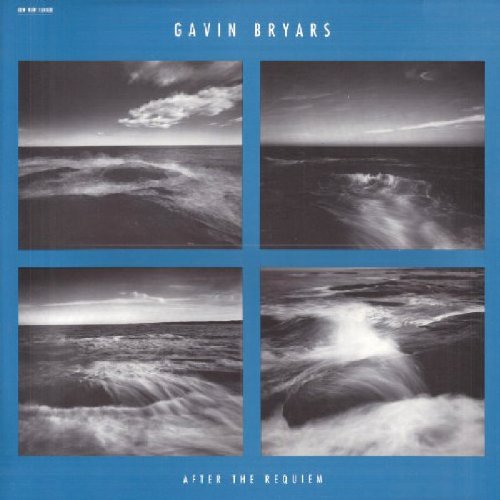
Gavin Bryars: After the Requiem (ECM New Series 1424)

Gavin Bryars
After the Requiem

Bill Frisell electric guitar
Alexander Balanescu violin, viola
Kate Musker viola
Tony Hinnigan cello
Roger Heaton clarinet, bass clarinet
Dave Smith tenor horn, piano
Gavin Bryars bass
Martin Allen percussion
Simon Limbrick percussion
Evan Parker soprano saxophone
Stan Sulzmann soprano saxophone
Ray Warleigh alto saxophone
Julian Argüelles baritone saxohpone
Recorded September 1990, Rainbow Studio, Oslo and CTS Studio, London
Engineer: Jan Erik Kongshaug
Produced by Manfred Eicher

Stepping into the territory of Gavin Bryars is like coming home, so familiar are the morphemes with which he composes his musical language. One of the most significant recordings in the Bryars catalogue, this disc offers a fine condensation of his spirited and nostalgic sensibilities.

After the Requiem dates from 1990 and follows his Cadman Requiem of the previous year. After completing the latter, which was written for the Hilliard Ensemble in memory of Bryars’s friend Bill Cadman, Manfred Eicher suggested that Bryars spin an instrumental postlude from the requiem’s latent fibers, thus giving us the title piece of this brooding and gorgeous album. Scored for two violas, cello, and electric guitar, After the Requiem offers a distinct take on the state of mourning it so affectionately recreates. Like the gravelly strings that open the piece, the mood is raw and unbounded. Frisell’s guitar sears the darkness like the northern lights with a slow and lustrous fire, bleeding spectral life force into the evening sky. The strings gather momentum, as if to coax the guitar toward the horizon, chasing the memory of an afternoon that can no longer be recovered. Frisell plays as if he were bowing the guitar, drawing out an amplified sustenance that nourishes the vocal hunger of his accompaniment. Where the strings seem to mimic voices, the guitar mimics the strings, ad infinitum. The piece slows about midway through, burrowing even deeper into contemplative soil, at which point Frisell wrenches out some grinding low tones from the lower register of his axe. What would be but one voice lost in a power chord more forcefully played rings here with the humility of supplication. Before long the guitar lets out more substantial tones and shifts to an aerial shot of the same landscape. The earth recedes, leading into the most beautiful moment of the piece, during which the guitar drops from a soaring high note. One can hear, indeed almost taste, the meticulous care that went into this performance. The music fades, as if sending off a spirit to a realm where life continues of its own accord. The continuity between instruments here is such that there are almost no audible gaps between them. And while all the musicians play with consummate grace, Frisell is nothing short of astonishing. Despite the polished feel of the piece it was the result, as Bryars makes clear in his recording diary, of much refinement and experimentation on Frisell’s part, working closely with the composer to achieve the ideal effect.

The Old Tower of Löbenicht. This piece, composed in 1986, is the early version of an instrumental interlude for a yet-to-be-realized opera adapted from Thomas DeQuincey’s The Last Days of Immanuel Kant. Says Bryars, “It occurs at a point in the opera where Kant is disturbed at the way in which growing poplar trees have obscured the view of a distant tower which ‘he could not be said properly to see…but (which) rested upon his eye as distant music on the ear—obscurely, or but half revealed to the consciousness.’” The music is meant to evoke Kant’s divided response to the tower’s presence and obfuscation, hence the nocturnal bass clarinet and ominous bells that dominate the first half. The music moves like a barge through ice flows. Its signals ring across the waters to the mainland, traversing coastline, steppes, mountainous terrain, barren fields, contaminated pools. A solemn piano appears with a rhythmic and minimal motif, rocking between two-part harmonies, as Balanescu solos beautifully on violin, at times doubled by Roger Heaton on bass clarinet. This progression is landmarked by a plucked bass and vibraphone. Bryars weaves a few audible strands of light into the otherwise requisite darkness, where constellations are but a memory lost to annals of history. The music very much resembles the trajectory of Glorious Hill, another Bryars masterpiece. The sheer clarity of Balanescu’s tone, at once thin and rich with melodic substance, is the binding thread. As the piece ends, a marimba flutters like butterfly wings in and out of our sonic purview, leaving behind a litany of bells while a bass clarinet scrapes the bottom of its available registers.

Alaric I or II (1989) is scored for two soprano saxophones, one alto, and one baritone. “The title,” Bryars tells us, “comes from the name of the mountain, Mount Alaric, in South West France, opposite the Chateau where I spent the summer [composing this piece]. No-one seemed to know which of the two ‘King Alarics’ the name referred to.” Alaric I or II is an exercise in virtuosity, requiring of the players a variety of techniques, including long bouts of circular breathing and controlled multiphonics. As with the rest of the album, this piece builds slowly yet with purpose. After a series of languid dissonant clusters the alto sax sketches a theme in its haunting surroundings. Suddenly, the two soprano saxes launch into a rhythmic arpeggio, lending a Philip Glassian flavor to the palette. Soon this thins out in a more contemplative air, pausing on a resolved chord, further darkened and reformed into a new beginning. Another rhythmic section begins as the baritone sax raises its throaty call. From this point a steady energy is maintained by at least one instrument as the others play over or around it: one lead is immediately switched off for another, typically between alto and soprano. An evocative fluttering technique signals a close as the quartet subsides into quiet agreement, hermetically sealed and indistinguishable from the rest of the rocky cove. The musicianship here is superb, the saxophonic sound rendered with precision. At times this piece shares an affinity with the brief saxophone quartet in Michael Nyman’s soundtrack for The Piano and would be equally suited for some incidental purpose. Although this is a fairly minimal piece, it evokes a range of atmospheres and images. Its energy moves in peaks and valleys, opening the earth’s bindings just a little further to smell its ink-blotted pages. It’s like a captain’s log floating unseen in the wake of shipwreck, plowing the waves for days before the water turns it into invisible molecules.

Allegrasco (1983) is an “operatic paraphrase” of Bryars’s first opera Medea. It is another larger ensemble piece that opens humbly with piano and clarinet. Brooding strings wrap their arms around the central melody. A bell intones; the strings grow louder; the clarinet snakes its way around like a loose scarf caught in a strong but silent wind. A playful passage ensues, a dance in a silent film. The guitar grows into a more supportive voice, dropping remnants of the album’s title piece into this limpid pool. Allegrasco is a series of finely wrought vignettes, each turning like a musical waterwheel. The music is never still, as if at the whim of an unseen narrative force. We graze the shoreline with each musical gesture, sometimes sinking, sometimes floating.

Bryars’s music practically begs for imagery, if only the listener’s own. It is corroded, antique, and accrues value with age. One hears it anew every time, for it holds a world of possibility.

<< Gesualdo: Tenebrae (ECM 1422/23 NS)
>> Kim Kashkashian: Shostakovich/Chihara/Bouchard (ECM 1425 NS)

Paul Hillier: Proensa (ECM New Series 1368)


Paul Hillier
Proensa

Paul Hillier voice
Stephen Stubbs lute, psaltery
Andrew Lawrence-King harp, psaltery
Erin Headley vielle
Recorded February 1988, Stuttgart
Engineer: Peter Laenger
Produced by Manfred Eicher

“I’ll write a song without great force
and not of me or other source
and not of love or youth, of course:
nothing at all.
I’ll write it sleeping on my horse
so’s not to fall.”

–Guilhèm de Peitieus

The title of this fascinating project from Paul Hillier refers to the southern French region of Provence, where the lyric poets of the troubadour tradition from which the album culls its music once flourished. Utilizing extant fragments of Provençal texts and melodies, Hillier and his musicians reconstruct a visceral program of songs.

As the earliest troubadour whose work still survives, the appearance of Guilhèm de Peitieus (fl. 1071-1126) first on the program makes for an intuitive choice. Farai un vers is the fifth of his eleven extant songs. The arrangement opens with a delicately strummed psaltery, stretching and detuning in reaction to Hillier’s narration as Stephen Stubbs’s lute creeps in from some unseen realm. The effect is unsettling, rather like the imminent death related in the poem being spoken. Hillier luxuriates in each word like a story in and of itself. “My song is sung, I don’t know how,” he says in the last verse, walking a path without melody with words that are nothing but melodious.

Reis glorios, by Giraut de Bornelh (c. 1138-1215), is a planh, or secular lament, written in honor of Raimbaut d’Aurenga (c. 1147-1173). Known as the inventor of the trobar leu, or “light” style, Giraut showcases his formulaic precision in this piece. With a refrain of “Fair companion…” he mourns the King’s absence: singing would seem to matter little in a world without him. This song evolves over peaks and valleys, drawing out a luscious voice from their depths, and ends with a beautiful solo from Erin Headley on the vielle.

Raimon de Miraval (fl. 1180-1220) was also a master of trobar leu. Of his extant collection of forty-five songs, an unprecedented twenty-two have retained their melodies. Unlike his contemporaries, Raimon was more interested in the “courtliness” of courtly love than in the love it both ennobled and constrained. In Aissi cum es genserpascors, Raimon is woefully fed up with the ways in which women of the court discourage their mercy-seeking friends, thereby permitting access to the most unworthy suitors. “Thus courtly song falls silent,” he laments, “and out come accusations and mad tumult.” Knowing full well that he could rat these ladies out, he would rather plead for mercy himself “From her who has the savor of all goodness,” thus implicating himself in the vicious cycle he so despises. The music begins softly and pointillistically, condensing into the resonant strum of Andrew Lawrence-King’s harp. From this cloud a voice issues, singing its self-deprecating song. The music is dynamic, if secondary to the language it supports, and fades once the voice has spent its spell.

Marcabru (fl. 1130-1150) is among the earliest known troubadours. His poetry is critical—at times lewdly so—of aristocracy and what he saw to be its twisted concept of love. Of his works that survive there are four melodies, in addition to three possible contrafacta (i.e., melodies interchangeable with more than one text). In L’autrier una sebissa, written as a pastorela (an often humorous Occitan lyric known for depicting knights’ attempts at seducing shepherdesses), the prototypical shepherdess refuses the advances of a knight for reasons of class. He tries a variety of tactics with which to win her over, but to no avail. “I am pained because the cold pierces you,” he says. To which she quips,

“Thanks to God and my nurse,
It does not concern me if the wind ruffles my hair,
For I am cheerful and healthy.”

He offers his company for her loneliness, of which she expresses no remorse. Perhaps she is of noble extraction? But alas, she sees her entire family “going back to sickle and plow.” He chalks up their coupling to the ways of nature, only to be met with the following admonition:

“The fool seeks his foolishness,
The courtly, courtly adventures,
And the peasant boy, the peasant girl;
Wisdom is lacking in any place (circumstance)
Where moderation is not observed,
So say the ancients.”

Whereas moments before the knight had proclaimed her unmatched beauty, he know declares her to harbor the most deceitful heart in the land. This elicits her cryptic final word:

“Sir, the owl promises you
That one man gapes before the painting
While the other expects reward.”

Such songs were a direct commentary on what Marcabru saw as lust’s inherent absurdity. This song has a catchy melodic lilt to it, consisting of refrains interlaced with instrumental interludes. Hillier carries full weight here through a melody that lingers long after its consummation.

Bernart de Ventadorn (fl. 1145-1180), master of trobar leu and formalizer of cansos (standard three-part songs), boasts forty-five extant poems, of which eighteen also have music. Be m’an perdut arises from a gorgeous harp solo. Voice and lute double each other throughout this repetitive lament of lost love. Hillier sings:

“Like some great trout that dashes to the bait
Until he feels love’s hook, all hot and blindly
I rushed toward too much love, too rash to wait,
Careless, till ringed in by love’s flames I find me
Seared as by furnace fires upon a grate.”

These post facto realizations tug at the heartstrings, as relevant as ever in their ability to elicit the listener’s concern. The only way in which one may find joy in this pain, Bernart tells us, is to embrace it:

“In luck and honor, let her still be blest,
And I her lover, liege and servant ever
Whether that makes her joyful or distressed.”

I daresay most of us can hear an echo of our own experience in these words, if not also in the way they are sung.

Can vei la lauzeta, also by Bernart, opens like the previous song, save for the added presence of a vielle droning in the background. The speaker of the poem sees a skylark, whereupon he feels great envy for the rapture the bird so readily enjoys:

“Alas, I thought I’d grown so wise;
In love I had so much to learn:
I can’t control this heart that flies
To her who pays love no return.”

As a result, he swears off women forever. “Now that I distrust them, one and all,” he asserts, “I’ve learned too well they’re all the same,” even as we know he will fall again. The music is in a Dorian mode that captures the destructive spiral of its subject.

Of Peire Vidal (fl. 1175-1205) we also have forty-five songs, twelve with melodies. Pos tornatz sui is a song of contradictions, of finding solace in life’s tribulations:

“Here is joy for all my tears;
Boldness springs from my worst fears;
Having lost, I’ve gained much more
And though beaten, won my war.”

Through every foul turn Peire finds a pathway to change. This is, I would argue, the most spiritual poem represented here, insofar as it acknowledges the impermanence of human concerns over illusionary social allegiances.

By the end of the Crusades the barons of southern France were financially and emotionally drained, leaving no resources for the patronization of song (for more on this, see Robert Kehew’s introduction to Lark in the Morning: The Verses of the Troubadours). It was in this climate that Guiraut Riquier (fl. 1254-1292), considered the last of the Provençal troubadours, composed Be’m degra de chantar (“It Would Be Best If I Refrained From Singing”), in which he signals the passing of the troubadourian era:

“Now no art is less admired
Than the worthy craft of song.
These days the nobles’ tastes have run
To entertainments less inspired.
Wailing mingles with disgrace:
All that once engendered praise
From the memory has died:
Now the world is mostly lies.”

I can think of no more powerful statement to capture the demise of this rich musical art, and Hillier appropriately speaks it without the company of instruments.

If any single word could be applied to this album, it would be “haunting.” This is not to imply that it is a particularly “dark” album, but one that seems to occupy a space uninhabitable by the living. This music breathes at the very edges of our consciousness, which is perhaps why it is so vocally driven, for only through the frailty of the voice can its strengths be expressed. The language is similarly peripheral, with its shades of cognates and other etymological minutae. The arrangements get under the listener’s skin, evoking an atmosphere at once so antiquated as to be unrecoverable while also so modern that it could exist at no other time but the (recorded) present. The spirit of the music is easy to see, if difficult to place, for it is something felt on a physiological level, residing in our sense of collective history. The music unfolds in a way that is always aware of its origins, leaving us to question our own.

<< Masqualero: Aero (ECM 1367)
>> Heiner Goebbels: Der Mann im Fahrstuhl/The Man In The Elevator (ECM 1369)

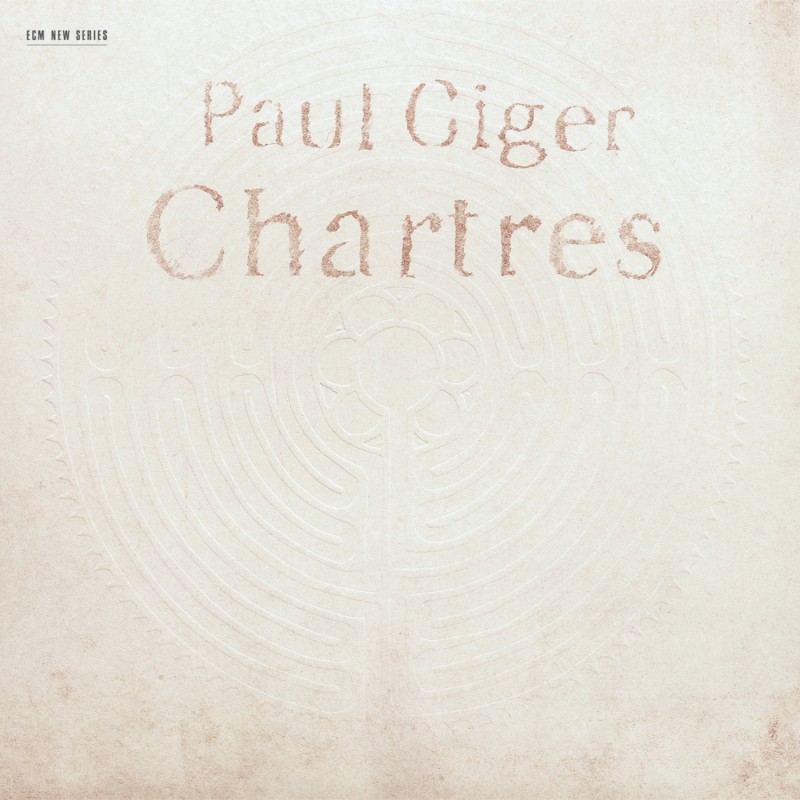
Paul Giger: Chartres (ECM New Series 1386)

1386

Paul Giger
Chartres

Paul Giger violin
Recorded at summer solstice 1988 inside the crypt and upper church of the cathedral of Chartres
Engineer: Peter Drefahl
Produced by Manfred Eicher

Describing the music of Paul Giger is like trying to draw with one’s eyes closed: one can only go so far before the shapes begin to break down. Of the violin Giger possesses an unparalleled understanding, which he brings to every interaction with it. Melodically these pieces are mature, singing and shouting and praying their way through a virtuosic lifetime of exhalation. Giger paints a veritable image of the cathedral, hollowing from the inside out with the edge of his bow, respecting the space that gives the music life.

Each section of this chiefly improvised work was recorded in respective titular areas of the cathedral at Chartres. “Crypt I+II” arises from a breath, played sul ponticello at the threshold of clarity. Occasionally these whispers vocalize into declarations of a chromatic and hymnic theme, the overtones of which Giger molds with great skill. After this introduction the violin trembles as Giger grazes the strings with his fingertip, coaxing multiphonic echoes from their solace. In “Crypt III” he presents the theme more straightforwardly and with pronounced regularity. A touch of vibrato and a hint of vulnerability add color to this sacred song. Giger lays down a sort of bass line to his melodizing as the atmosphere takes a liturgical turn. This is followed by “Labyrinth,” a superbly played dance akin to Irish fiddling that lapses just as quickly into a keening lamentation. This bipolarism continues as Giger puts his extended technique to work midway through the piece, playing the violin percussively on the fingerboard while tapping the strings with his bow for a harmonic overlay. This passage requires careful attention to appreciate the “micromusic” being performed. In “Crossing” we encounter the same material that began the album in ascendant reformation. Giger runs his fingers through the octaves, halting at regular intervals to relate the theme underlying them at every turn. Each pass travels higher, stretching the possibilities of the violin’s harmonic register. Additional voices offer dense harmonies that seem to depend from the cathedral’s lofty rafters for as long as they can in order to convey the ecstasy of their desire. Strings pull at one another, one wishing to rise and the other to remain earthbound, so much beauty is there to tempt them in either direction. Ultimately we are left in a space neither terrestrial nor empyreal. The theme returns, a bird circling overhead, eyes always on the ground below, locking on us, the lowly observers. This crosses over into aching reverie. The final movement, “Holy Center,” is also the most mysterious. Locking into the cathedral’s “key note,” its resonance is self-nourishing, and builds in vocal density through soul and body.

As gorgeous as it is, we can never forget that such sounds exist solely in the realm of the human, and that perhaps only mean something to those who inhabit it. This is also what imbues it with spiritual significance. Here is music created for its own sake, if not forsaken for its own creation.

<< The Hilliard Ensemble: Perotin (ECM 1385 NS)
>> Egberto Gismonti: Dança dos Escravos (ECM 1387)

Hindemith: Viola Sonatas – Kashkashian/Levin (ECM New Series 1330-32)

Paul Hindemith
Sonatas for Viola/Piano and Viola Alone

Kim Kashkashian viola
Robert Levin piano
Solo sonatas recorded 1985-86, Kirche Seon, Switzerland and Karlshöhe, Ludwigsburg, Germany
Engineer: Stephan Schellmann
Sonatas for viola and piano recorded 1986, Feste Burg Kirche, Frankfurt, Germany
Engineer: Peter Laenger
Produced by Manfred Eicher

“The viola is commonly (with rare exceptions indeed) played by infirm violinists, or by decrepit players of wind instruments who happen to have been acquainted with a stringed instrument once upon a time.”
–Richard Wager

If ever a recording could put Wagner’s infamous statement to rest, this would be it. Simply overflowing with musical brilliance, it remains one of the finest examples of what the viola is capable of. Kim Kashkashian’s technique and passion are almost palpable and one can only marvel at the humble respect she brings to both. The viola doesn’t simply exist somewhere between violin and cello, forever doomed to be second rate to both. It is, rather, an utterly dynamic and rich musical object, and the ways in which Hindemith unravels its subtler intonations in these sonatas is nothing short of monumental. Every chapter tells us something new, until the linguistic possibilities of the music represented in this eclectic set are exhausted.

Sonate op. 31,4
The first movement is a virtuosic leap through microtonal harmonies and energetic flights of fancy. Kashkashian negotiates these with such conviction, they sound spontaneously composed. As evocative as the music is, it is difficult to picture anything while listening to it, existing as it does in a sound world fashioned from the innards of its own body. And in this fashion it proceeds, drawing from its ligaments, veins, and arteries a broader musical circulation that extends one’s sense of self beyond the instrumental and into the metaphysical. Kashkashian ends with a dramatic flourish, as if to punctuate the ineffability of belonging. The second movement is a mournful monologue. This, Kashkashian plays with heartfelt sensitivity, much in contrast to the raw strength with which she attacks the opening movement. She extracts from her instrument sounds and emotions that are deeply ingrained in the wood itself, brought forth through the strings just as breath is spun into voice through the throat. She does this not so much with the “effortlessness” often ascribed to virtuosi, but rather makes audible her long hours of dedicated practice, her struggles to wrench from this neglected instrument an entirely orchestral palette of atmospheres. The third movement opens with double stops and a linear introduction of the theme before venturing off into beautiful variations and idiosyncratic counterpoint. Again, Hindemith shows a fondness for tight harmonies, for the spatial potential between adjacent notes. The theme is a fascinating melody, devoid of context and therefore unbounded. As Kashkashian builds her energy, the music regresses into its constituent melodic parts before taking pause. The next section of the third movement is marked “Langsam,” and is an accordingly pliant interlude that hangs in the air like a piece of windblown pollen. Kashkashian plays it as if sharing a new discovery. The final passage springs from the solace of the tangential middle with almost Pan-like exuberance. We see in this music a certain quality of “understanding,” a mischievous surrender to the will of compositional potential.

Sonate op. 25,1
This second sonata erupts with a series of portati, which are dissonant enough to catch our attention with discomfort but which eventually resolve themselves in airy double stops. Here we find beauty not only in those moments that provoke consonance, but perhaps even more so in those moments swirled like knots in a tree. The second movement is another earthy meditation that allows the listener to focus on every sound contained in the lone string. We find in this movement a robust patience. There is no sadness here, only the room in which to deal with our own faults. Through these singular notes we are given a glimpse of what such a process might look like. The third movement is a violent dance that climbs the ladder of its own expression before hurtling itself into a vale of doubt. It is a short foray that dies as quickly as it is born. The final movement begins slowly and with a beauty that is only heightened in the aftermath of the previous display of suicidal vigor. Kashkashian draws out each note into a linear phrase before accentuating it with another. This kind of lilting pattern continues throughout, lending a dirge-like quality to a fitting conclusion.

Sonate 1937
This sonata is like a lesson in biology, highlighting the fluidity between skin and the musical score. The first movement is a convoluted organism indeed. It undulates with its own respiratory rhythm, shaping itself as a voice might in a debate or argument, and in doing so perfectly captures the details of its own fallibility. This is followed by another heartfelt slow movement, as nocturnal as it is bright. The mood changes quickly as the playing erupts into a more frenzied exhibition, plying the listener with forced resolution and the impatience that drives it. The ensuing calm segues into a beautiful pizzicato passage, which exploits all the resonance residing within the viola’s, and the performer’s, body. Soon the bow is returned to the strings, laying out a delicate tessellation of finality. We finish with a somber and somewhat indecisive third movement.

Sonate op. 11,5
This sonata begins with a rather terse opening statement, both in length and in mood. It is as if we have been given a contentious opinion that we can’t quite figure out, but which we know is fraught with danger. The movement has a touch-and-go quality that comes to a head with an obligatory and theatrical exit. The second movement climbs even as it descends, a Jacob’s Ladder toy in sound. As gripping as Hindemith’s faster movements are, it is in these downtempo moments that he displays his greatest deftness, so engaging are they in their fortitude, in their ability to imply the inexpressible, in their wantonness for melody and articulation, and in their remarkable ability to highlight the joys of self-discovery. The Scherzo is a stone changing directions in mid air as it skips across water. It is playful; not in the sense that a child might play, but in the sly intelligence of social agency that is part and parcel of adulthood. A masterful miniature, to be sure. The 11-minute epic that is the last movement also moves very organically. It dances and glides—opening its melodic gills to whatever might pass through them before erupting into gorgeous runs across the fingerboard that simply revel in the melodic possibility they so artfully carry—and moves like a folksong.

After such an exposition of prowess on the viola alone, the gentle introduction of a piano changes things considerably. While a certain level of restraint is to be expected from the accompanist, Robert Levin draws his playing through the viola’s almost vocal cartography, astutely aware of the dialogic nature of their music-making. The recording from hereon out is strikingly different. The viola remains quite present while the piano seems far away, as if playing on the other side of the room, thereby opening the spatial possibilities of the music and further contrasting the intimate pointillism of the solo sonatas with the broader strokes of the accompanied. At times the piano and viola would seem to be talking to themselves, as if after a long argument between a couple that has been together for so long that, no matter what they say, their voices blend with an exacting harmony.

Sonate op. 11,4
The opening Phantasie is stunningly beautiful, lapsing into moments of passive romanticism even as it unravels more overblown threads. The second movement is comprised by a jaunty theme with variations and fleshes out the sonata form in uniquely ecstatic ways. The finale with variations brings itself even closer to the inherency of the first two movements, only to lower into mysterious asides that seem to hover around the edges of its introduction.

Sonate op. 25,4
This sonata brims with a Bartókian jouissance, at once sylvan and nomadic. The viola enters, a dancer waiting for just the right moment to let loose her footwork. The piano responds with a playful challenge, which the viola answers wholeheartedly and with due respect. This rhythmically dynamic and challenging movement ends with a light touch of pizzicato. The second is full of tragedy, proceeding at a crawl through an indefinable wreckage that, while familiar to us, is also something we can never experience because it is not our own. The finale is filled with drama and screeching tremolos, and sings with the conviction of a mountaineer. The third movement is a boisterous exposition that ends with a few lines in unison and a soaring high note to finish.

Sonate 1939
This last sonata begins as if in mid-phrase, jumping right into its melodies with careful abandon. The piano and viola play off each other rather explicitly, holding fast to connection and release. Whereas this movement is filled with playful moments, plucked diversions, and pianistic revelry, the second plants its feet firmly on the path and rushes toward its finale. The third movement, another Phantasie, ruptures the music’s icy surface like the sticks on the album’s cover. As we come to a close, the sound cracks like an egg.

Of the many solo sonatas for various instruments composed since the time of Bach, it is Hindemith’s that most concretely capture a likeminded spirit. While Paganini’s caprices, for example, model Bach on the surface, they are essentially showstoppers meant to test the technical limits of whoever dares perform them. The solo violin works of Ysaÿe are also closely allied with Bach. Ysaÿe draws more specifically and overtly, and in doing so pushes away from Bach in the process. By contrast, Hindemith chose colors from his own palette. In the same way that Bach revitalized the violin and the cello, Hindemith forged a space for the viola. I hear no evidence in these sonatas to suggest that Hindemith was in any way attempting an imitation. He was, rather, exploring his own territory with unbridled honesty. Thankfully, Kashkashian has given us this landmark performance to enjoy to our hearts’ content. Her playing is by turns robust and delicate, her tone impeccable, her technique assured and minimally adorned.

It has been said that, as a performer, one develops a certain appreciation for a given piece of music that the listener can never access, for the performer learns a piece from the inside out. What separates Kashkashian from the rest is her willingness to let the listener in on the performer’s appreciation, and on the different levels of which such an engagement is comprised. We feel every detail as we would feel our own.

<< Gary Burton Quintet: Whiz Kids (ECM 1329)
>> Keith Jarrett: Spirits (ECM 1333/34)

Valentin Silvestrov: Sacred Works (ECM New Series 2117)

Valentin Silvestrov
Sacred Works

Kiev Chamber Choir
Mykola Hobdych conductor
Recorded 2006 and 2007, Cathedral Of The Dormition, Pechersk Lavra, Kiev
Engineer: Andrij Mokrytskij

ECM’s New Series has a love for living composers, of which Valentin Silvestrov is a personal favorite. While already highly regarded in the former Soviet Union, Silvestrov has seen a revival of sorts through his substantial representation on the label. This selection of choral music showcases a recent turn in the Ukrainian’s compositional path, written as it was at the urgent behest of conductor Mykola Hobdych. Easily worthy of a place alongside Rachmaninov’s All-Night Vigil, these pieces abound with moments of aching profundity.

The album opens like a flower, shedding a petal with every new voice that enters. A bass intones, navigating the complex shape circumscribed by the reverberant space, as the choir responds to the soloist’s articulations. The latter sings in a subdued manner, stripping the basso profundo aesthetic down to its core, much in the spirit of Silvestrov’s Silent Songs. The choir lifts, leaving our entire landscape changed: season, time of day, climate—all of it falls away for just a few moments before we sink back down into the density of our own being. Buoyant women’s voices spiral like galaxies; an ambrosial tenor solo gives way to broader considerations, tightening like knotwork before being wrapped in the gauze of redemption; an alto transcends the hush of the choir, carrying with it the existential kindling that sparks its emotive nature.

Silvestrov’s music exists in a state of perpetual ascent, and perhaps nowhere more so than here. The choir acts as one organism, lending the frequent solos a recitational air. These are not unlike Christ’s words in red in a modern Bible: somehow distinct from their textual periphery while also constitutive of it. After listening to this album it’s difficult to recall the gaps between pieces, flowing as they do into an extended statement. By the same token, each is its own icon suspended, safe among the clutter of our anxieties. Bid to choose, I would single out “Christmas Song,” “Bless O Lord,” “The Creed,” and the two deconstructions of the Bach/Gounod Ave Maria (especially the first, with its haunting whispers) as particularly moving examples of Silvestrov’s craft. The Kiev Chamber Choir sings with passionate restraint and intuition, its dynamics fluid and under beautiful control. At moments the singers practically break at the seams, inhaling and exhaling the space of their recording venue, where every nuance of breath is amplified in its union with others.

Those wanting to warm up to Silvestrov’s “metamusical” style may adjust more easily to these melodically rich miniatures. Yet there is still so much alluded to here that never reaches fruition. Rather than being a distraction, however, this technique adds depth and honesty. This is music of the night, streaked as if with time-lapsed stars, a mise-en-abyme of divine reflection.

Those who like what they hear may also want to check out the enchanting Twenty-Seven Choruses by Bartók, of which the original Hungaroton Classic recording is still the benchmark.

Thomas Demenga plays Bach/Holliger (ECM New Series 1340)

Thomas Demenga
plays works of J. S. Bach and Heinz Holliger

Thomas Demenga cello
Heinz Holliger oboe
Catrin Demenga violin
Recorded September 1986, Kirche Blumenstein, Switzerland
Engineer: Jakob Stämpfli
Produced by Manfred Eicher

With this disc Swiss cellist Thomas Demenga inaugurated a five-album series, each of which pairs a different Bach cello suite (the last contains two) with more contemporary material. While one might easily see the Bach as “filler” in an otherwise intriguing series of modern selections (or vice versa), there is something refreshing about Thomas Demenga’s project that pushes it far beyond the realm of gimmickry.

First is a tripartite selection of works by the inimitable Heinz Holliger, who along with the likes of Kaija Saariaho is, in this reviewer’s humble opinion, one of the more important composers of our time. From its opening bars the Duo für Violine und Violoncello exhibits Thomas and sister Catrin Demenga’s superb dexterity and dynamic control. The music jump-starts immediately with a forceful pizzicato from the cello as the violin swells from silence like an automaton whose siren is slow and sure. After this intro the duo begins a subtle interplay of trembling leaps, foreshadowing the timid Trema soon to come. The regularity of the opening is buried here, the execution more melodic. The instruments remain relatively stationary, looking up through a canopy of notes at a vast sky. But then the violin circles above, the cello arising with it before both descend into silence, at which point they are resuscitated by the same linear melody in slightly different scales, like a transparency bumped ever so slightly out of alignment. This process is quiet at first, but suddenly accelerates, as if drawn to an invisible source of inspiration. The journey grows ever higher before reaching its plateau: an aerie of vultures whose scavenged collection lies heaped on the forest floor. The piece ends with a brief series of false starts, ending on the third escape.

Studie über Mehrklänge für Oboe solo is a classic for the instrument, and one of those rare pieces that is firmly rooted in the conceptual yet which is also “musical” and a joy to listen to (I have seen apparently conservative audiences mesmerized by its effects). The piece requires of the oboist—in this case Holliger himself—to engage not only in circular breathing almost throughout, but also to overblow the instrument, creating an array of multiphonics, which Holliger shapes into a highly compositional palette. The highlight comes with Holliger’s fluttering technique toward the end and the series of weaving tonal lines that follow, gathering speed as they are jostled from one side to the other in a wilting exploration of the woodwind’s demise. The piece fades in a single high tone, briefly exposing its constituent harmonics.

Trema für Violoncello solo is, as its title implies, a traumatic piece. Demenga handles it studiously, bringing an intensity to the playing that seems to grow from the notes themselves. The piece shivers, running even as it stumbles, hoping and waiting for that moment when all else has expired, leaving the moonlit night to carry its secrets into the dawn, when nothing but art is alive. Demenga has managed to pull off an extraordinary feat here, implying through sound and technique the entire narrative of which the music is composed. There is nothing wasted in Trema, as every note seems to connect to the last and to the one forthcoming, collapsing as a figure who can no longer face the world.

After such a draining piece we arrive at Bach’s Suite No. 4 in Es-Dur für Violoncello, and hear its counterpoint as if for the first time. Regardless of one’s familiarity with the suites, in the context of such pairings they take on a host of new colors. Demenga plays competently and without flourish, interested only in drawing out the music’s inner darkness. His playing of the Sarabande is particularly beautiful and speaks of a musician not lost, but found therein.

Of course, it is only when human involvement and intervention brings such music to our ears that we feel inclined to see it as a part of us. The trajectory of performance is determined by many choices on the part of composers, musicians, and listeners. Nothing is achievable for the solo artist without some awareness of these gaps. What distinguishes performers are the ways in which they seek to fill them. Thus, with every nuance, Demenga gives a great gift not only to us but to the composers, whose work multiplies with every listening experience.

The recording is top-notch overall, but particularly crystal clear in the Bach. We hear every finger tap and sympathetic effect, every rustle of movement that goes into its steady sound. This is a New Series classic in my book and a prime example of ECM’s often bold programming choices.

<< Edward Vesala: Lumi (ECM 1339)
>> Thomas Tallis: The Lamentations Of Jeremiah (ECM 1341 NS)