Oregon: Crossing (ECM 1291)

Oregon
Crossing

Paul McCandless oboe, bass clarinet, soprano saxophone, English horn
Glen Moore bass, flute, piano
Ralph Towner Prophet 5 synthesizer, piano, cornet, classical guitar, 12-string guitar, percussion
Collin Walcott tabla, percussion, sitar, snare drum, bass drum
Recorded October 1984 at Tonstudio Bauer, Ludwigsburg
Engineer: Martin Wieland
Produced by Manfred Eicher

Anyone who’s ever wondered what all the Oregon buzz was about need only listen to the first 30 seconds of “Queen Of Sydney” to recognize the signature beauty they created. Their ability to fashion such a polygonal sound from its simple ostinato is something to cherish and typical of the group’s quiet charm. In this gentle weave of sustained melodic and percussive colors, one finds a storm waiting to undress itself in the light of dawn. Collin Walcott’s tabla uncorks a fine groove in “Pepe Linque” as Paul McCandless dances his soprano sax through a cloudy corridor toward the “Alpenbridge.” This track is the sonic equivalent of Walcott’s cover photograph, walking steadily above the clouds in a space where civilization is nothing more than a passing notion. Further joys course through the veins of “Travel By Day” and the softly peaking wave of “Kronach Waltz.” As its title would imply, “The Glide” goes down easy, thanks in no small part to bassist Glen Moore’s smooth lines. “Amaryllis” then curls its acoustic fingers around a softly swelling rope of sound, pulled higher by an ethereal oboe into the glistening title track, which ends in a delicate conversation.

Crossing is even more highly evolved than Oregon’s self-titled predecessor for ECM. So much of this music lives in the sky, treating its earthen vamps as mere springboards for the comfort of suspension. Crisp with equal parts sunshine and pastoral night, it is a fitting ode to the diurnal. A real treat for the ears, yet even more so for the soul.

<< Everyman Band: Without Warning (ECM 1290)
>> Dave Holland Quintet: Seeds of Time (ECM 1292)

Everyman Band: Without Warning (ECM 1290)


Everyman Band
Without Warning

Marty Fogel tenor, soprano, alto saxophones, clarinet, flute
David Torn guitars, effects
Bruce Yaw electric bass
Michael Suchorsky drums, synthesizer
Recorded December 1984 at Bearsville Studios, Bearsville, New York
Engineer: Mark McKenna
Produced by Hans Wendl

After the mind-numbing crunch of the Everyman Band’s self-titled debut, and considering the title of this follow-up, little did I expect the sprightly charm of “Patterns Which Connect.” This smooth opener is as uplifting as heck, due not least to Bruce Yaw’s rubber band bass line Marty Fogel’s soaring tenor. “Talking With Himself,” on the other hand, seems to begin in the middle of a stream of improvisatory energy, but continues with an openness that is nothing if not welcoming. Guitarist David Torn grinds his axe on flint stone and spits plenty of flame, but is content in periodically laying down his torch so as not to obscure Michael Suchorsky’s keen drumming. Like a spoon through porridge, “Multibluetonic Blues” works viscous nourishment into edible consistency, blending the tenor saxophone’s soulful brown sugar crust before the searing heat can burn it black. “Celebration 7” sounds like a plugged klezmer tune and shows the band in fine attunement, as does the whimsy of “Trick Of The Wool.” The album’s most appropriate title comes from “Huh What He Say,” which from an initial drawl finds linguistic traction in Fogel’s throwback of a solo. “Al Ur” caps things off with another vibrant sponge that soaks up all of the goodness that surrounds it.

This could easily be described as a killer of an album, were it not for the fact that it gives rather than takes life away. Along with Neighbourhood and Travels, it is among ECM’s more feel-good albums. Like a comedy of manners disguised as a film noir, it titillates behind an artful gloss.

<< Keith Jarrett Trio: Standards, Vol. 2 (ECM 1289)
>> Oregon: Crossing (ECM 1291)

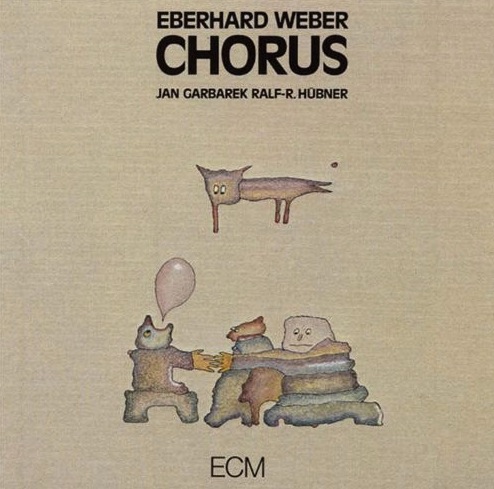
Eberhard Weber: Chorus (ECM 1288)


Eberhard Weber
Chorus

Eberhard Weber bass, synthesizer
Jan Garbarek soprano and tenor saxophones
Ralf Hübner drums
Recorded September 1984 at Tonstudio Bauer, Ludwigsburg
Engineer: Martin Wieland
Produced by Manfred Eicher

One might easily switch the title of Eberhard Weber’s Chorus with that of Fluid Rustle and none would be the wiser. Where the latter brims with voices and color, this relatively monochromatic effort is more like a shift of clothing in the shadows. Until this point, Weber’s ECM projects had been inclined toward epic statements. These ranged from overwhelmingly sun-drenched reveries (The Following Morning) to moonlit fields of introspection (Later That Evening). With the release of Chorus, however, Weber reached a new level of intimacy. Joined only by Jan Garbarek on soprano and tenor saxophones and Ralf Hübner (one of Germany’s most important jazz drummers), Weber pares his sonic brush for a new kind of script.

Over the course of seven unnamed parts, we find all the staples of the Weber experience. The, yes, fluid electro-bass and synth drone of Part I will be familiar to the Weber enthusiast, only here we encounter something quite different. Where before these territories engulfed us, now they are painted inside us. Similarly, every note from Weber’s bass in Part II is a ripple that finds only slight resistance from our inner walls as it expands toward the oncoming night, but ever with the dawn in mind. Garbarek floats his gorgeous lines one drop at a time, melting through the doublings of Parts III and IV and on to the arco strains of Part V. This scribbled palette cleanser slides into the pulsing depths of Part VI. Here the band achieves something special, making for the suite’s most powerful nodes of emotion. The final part eases us into a lovely thread of electric piano that makes this one of Weber’s most perfect constructions and beyond reason enough to own the album.

As I revisit Chorus for this review, the police sirens loudening and fading outside my window remind me of the transformative power of its music, which makes of those sirens a bird of light screaming across the canvas of the sky. Like the fade on which it ends, it leaves its body behind—a kite cut from its string which, instead of falling, continues floating ever higher until it burns quietly in the sun.

<< Bill Frisell: Rambler (ECM 1287)
>> Keith Jarrett Trio: Standards, Vol. 2 (ECM 1289)

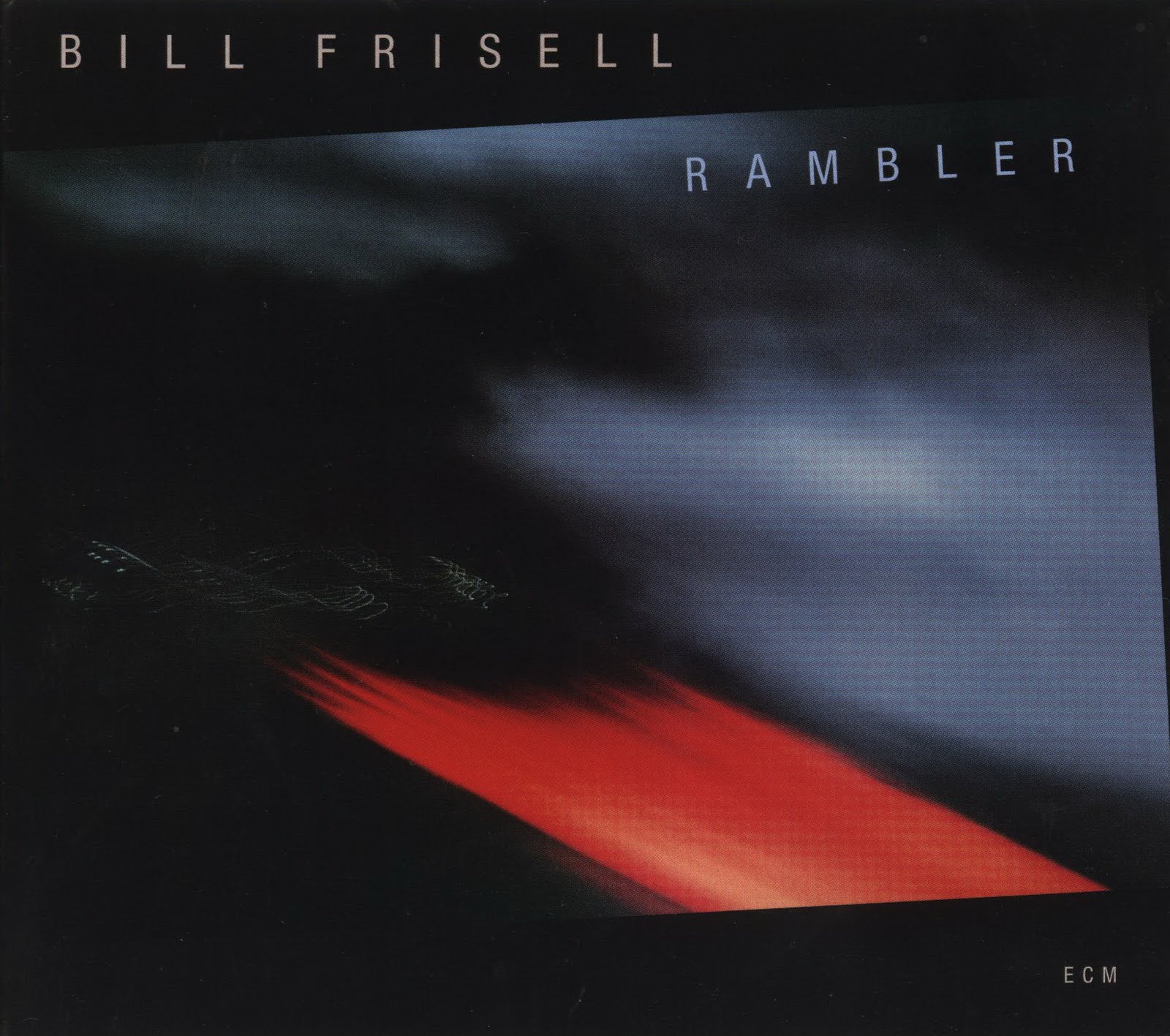
Bill Frisell: Rambler (ECM 1287)

Bill Frisell
Rambler

Bill Frisell guitar, guitar synthesizer
Kenny Wheeler trumpet, cornet, fluegelhorn
Bob Stewart tuba
Jerome Harris electric bass
Paul Motian drums
Recorded August 1984 at Power Station, New York
Engineer: James Farber
Produced by Manfred Eicher

If you’re like me, then you were introduced to the prodigy of guitarist Bill Frisell through the work of John Zorn’s groundbreaking Naked City outfit. In that context, Frisell was able to stretch his skin in ways that he never has before or since. Or so I believed until I only recently began to explore his back catalogue on ECM. The summit of these early explorations is shared by 1983’s In Line and Rambler. Where the former seemed to burrow into the deepest recesses of his craft, the latter travels far and wide, not least through the presence of some fine sidemen: Kenny Wheeler on three kinds of brass, Paul Motian on drums, Jerome Harris on electric bass, and, perhaps most notably, Carla Bley band regular Bob Stewart on tuba. Stewart’s pomp is especially enlivening, teasing out as it does Frisell’s penchant for not taking himself too seriously. The tuba threads an unwavering smile through the morbid march that is “Music I Heard” and adds earth tones to the silvery palette of the title track. The latter is quintessential among Frisell’s output. The lovely webbed slink of his guitar and gorgeous Wheelerian dialogues carries us in strums and strides to an ethereal conclusion. The band also abides by humor in the hokey and lumbering “Tone.” This, the album’s opener, gives us a taste of the mesh that is Frisell’s style, one strung with long threads of algae, picked up and spun by his band mates in kind. Through the tree swing sway of “When We Go” and the tongue-in-cheekily titled “Wizard Of Odds” we encounter Frisell’s flowery side, ever enhanced by Wheeler’s squeals and stops. The campiness of “Resistor” is tempered by the welding torch of Frisell’s electric and the laser of Wheeler’s trumpet, while “Strange Meeting,” fettered by a pleasant bass line, draws itself into an incisive Synclavier sound. As vital as Frisell is to this date, one feels him most in the compositions. Wheeler and Harris are the real stars, and let us not shut our eyes to Paul Motian’s sparkling threads.

Rambler is a significant album for showing the world a remarkable guitarist on his own terms, and through a set of compositions as distinct to his sound-world as the clouds are to the sky.

<< Shankar: Song For Everyone (ECM 1286)
>> Eberhard Weber: Chorus (ECM 1288)

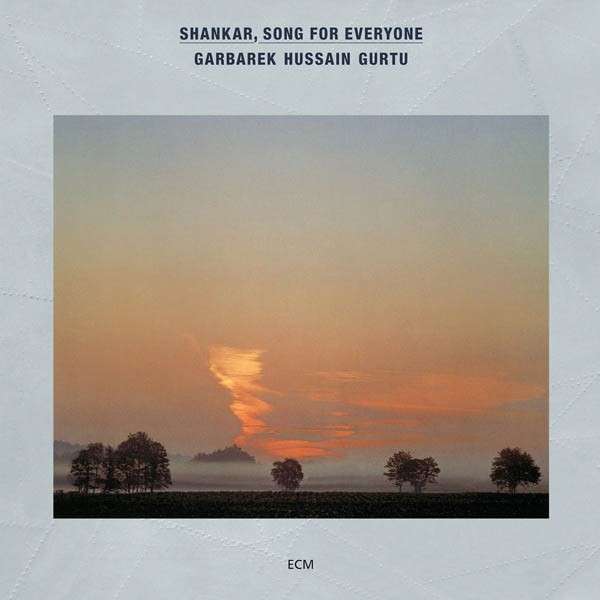
Shankar: Song For Everyone (ECM 1286)

Shankar
Song For Everyone

Shankar 10-string double violin, drum machine
Jan Garbarek soprano and tenor saxophones
Zakir Hussain tabla, congas
Trilok Gurtu percussion
Recorded September 1984 at Rainbow Studio, Oslo
Engineer: Jan Erik Kongshaug
Produced by Manfred Eicher

Shankar and Jan Garbarek’s previous collaboration, Vision, opened many people’s ears to the more fruitful possibilities of idiomatic blends. And while that initial project yielded a fascinating album in its own right, I always felt it lacked something I couldn’t quite articulate. With Song For Everyone, that lack becomes clear once Trilok Gurtu and Zakir Hussain level the playing field with their earthy rhythms. In their presence, electric violin and saxophone can soar even higher, knowing there will always be a ground to return to. As if to underscore this point, Shankar also employs a drum machine, as in the delightful “Paper Nut” that inaugurates us into the album’s universe. Shankar’s Philip Glassean harmonies and flexible dips form a sling that shoots us in slow motion toward the Visionary galaxy of “I Know,” where his sparkling pizzicato lines are reinvigorated by the presence of tabla. Garbarek has hardly ever sounded as clean as he does here. He digs deep into his emotional and technical reserves and proves his chameleonic abilities, such that whenever he returns with the theme in tow, it is always as if from a long journey. This enchanting track also exemplifies the coalescence of which these two musicians are so worthily capable. “Watching You” reinstates the drum machine, which is immediately valorized by Shankar’s likeminded precision (even when multi-tracking, he sounds like one instrument). Ascendant chording provides ample uplift for Garbarek’s rainbow arcs. The violin solo here proves that Shankar’s mastery comes not from the top down, but from the inside out. He makes the most demanding passages seem effortless and the simplest seem complex, as in “Conversation.” Here his virtuosity enhances Garbarek at his adaptive best. After the anthemic jubilation of the title track, “Let’s Go Home” comes across as introverted, though no less energetic. “Rest In Peace” ends the album with bowed heads. It is a slow dissipation of cloud, a gentle breeze of the heart, the empty chambers of a body in which music is the only tangible spirit.

<< Bruno Ganz: Hölderlin – Gedichte gelesen von Bruno Ganz (ECM 1285 NS)
>> Bill Frisell: Rambler (ECM 1287)

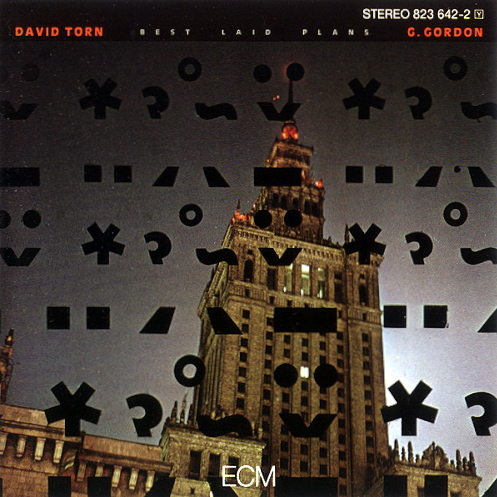
David Torn: Best Laid Plans (ECM 1284)

David Torn
Best Laid Plans

David Torn guitars
Geoffrey Gordon percussion
Recorded July 1984 at Rainbow Studio, Oslo
Engineer: Jan Erik Kongshaug
Produced by Manfred Eicher

David Torn is one of the more indefinable guitarists on planet Earth and has left an alluring hatching of marks on ECM’s wall. Vivid among them is this unusual session with percussionist Geoffrey Gordon. Their pastiche navigates a territory that lies somewhere between Elliott Sharp, Steve Tibbetts, Terje Rypdal, and Bill Frisell. Torn’s electric is a storm of spirals and tails, surges and dissolves. The smooth arpeggios and inevitable disruptions of “Before The Bitter Wind” and the title track project a life lived through dreams and nightmares alike. The glow of “The Hum Of Its Parts” unfolds through Torn’s itching and pliant core, dramatized by Gordon’s highly connected tabla. One highlight, if in name only, is “Removable Tongue,” a guitar solo that twists its way around a relatively melodic caduceus and seems to have a good influence on “In The Fifth Direction,” which is perhaps the most unified blend of rhythm and texture on the album. After the sweltering heat rash of “Two Face Flash,” Torn rattles the firmament with “Angle of Incidents,” every grating cry a search for lost questions to extant answers.

Torn’s playing is a unique beast. It is oblique in such a way that, even when fully formed, it remains somehow distant, calling to us as if from the future and gone by the time we catch up. The best we can do is to stand where we are and wait for its evocative disintegration.

<< Paul Motian Trio: it should’ve happened a long time ago (ECM 1283)
>> Bruno Ganz: Hölderlin – Gedichte gelesen von Bruno Ganz (ECM 1285 NS)

Chick Corea: Voyage (ECM 1282)

Chick Corea
Voyage

Chick Corea piano
Steve Kujala flute
Recorded July 1984 at Tonstudio Bauer, Ludwigsburg
Engineer: Martin Wieland
Produced by Manfred Eicher

Steve Kujala is a flutist of exceptional ability known for his “bending” and other extended techniques, which immediately distinguish his sound from anyone else’s. After touring with Chick Corea in the early eighties, the two of them stepped into the studio to record Voyage, a shuffled yet modest deck of three Corea originals and two freely improvised interludes. Though a suitable companion to Red Lanta, this duo session could hardly be more different. As musicians both well versed in the avant-garde, Kujala and Corea forge an undeniably cerebral brand of magic. The lushness of “Mallorca,” for example might easily blind us to the microscopic approach of “Star Island,” for where the former dances like some ethereal Flamenco reflection, threaded by birdsong and fast-forwarded tongue fluttering, the latter is a piano solo that indeed takes form like a dollop of land in an oceanic expanse. It is also the deeply beating heart of the album, a stunning piece of wizardry that could easily run its entire course without ever growing fatigued. Corea continues this subdued brilliance in his intro to “Free Fall” before Kujala makes his theatrical entrance, singing to us of days and years gone by. This is much in contrast to “Diversions,” a far more abstract intertwining of airy improvisations which, even after their rousing finish, leave us scrambling for narrative traction. “Hong Kong” is also very abstract, but by way of its title at least gives us a place to hold on to. Like that city’s bustling streets, connections come and go as they please, sometimes utterly unaware of one another in the constant blur of lights, faces, and smells.

This is a highlight in the Corea discography on any label and an ideal opportunity to discover, as I did, a flutist of outstanding innovation along the way.

<< Michael Fahres: piano. harfe (ECM 1281 NS)
>> Paul Motian Trio: it should’ve happened a long time ago (ECM 1283)

Egberto Gismonti/Nana Vasconcelos: Duas Vozes (ECM 1279)

Duas Vozes

Egberto Gismonti guitars, piano, flutes, dilruba, voice
Nana Vasconcelos percussion, berimbau, voice
Recorded June 1984 at Rainbow Studio, Oslo
Engineer: Jan Erik Kongshaug
Produced by Manfred Eicher

Sometimes I wonder. I wonder what forces were at work to have brought two brilliant music makers like Egberto Gismonti and Nana Vasconcelos together on this earth. I wonder what energies nourish their spirits any time the two of them step into the studio, alone or otherwise. I also wonder how a surefire recipe for continued enchantment could come out of the oven as this misshapen improvisation session from 1984. Neither musician has ever needed a definitive structure around which to coil his respective song in order to be captivating (just listen to, for example, the breadth of freedom in Gismonti’s Solo or Vasconcelos’s Saudades), but during the first few steps of Duas Vozes I find myself craving it. It’s not that the images painted therein aren’t unique, only that the colors with which they are painted simply don’t blend. Thus is the album’s first half the backside of a one-way mirror: we can see through its devices, even if the microphones can’t. Thankfully, in the latter half we come face to face with a reflection that shows us only the depth of our awe.

Our first confusions arise in “Aquarela Do Brasil,” which begins playfully enough, but quickly degrades into six long minutes of Vasconcelos’s whooping (compare his sparing use thereof on “Carneval Of The Four”). “Rio De Janeiro” also breaks its promise when, after the lively pulse that opens it, Gismonti’s guitar wanders in circles without ever enlarging any of them. And while much of this sounds like outtakes between jam sessions, there are some flashes of brilliance in which these longtime friends explore insanely microscopic avenues of their craft, particularly during a passage for which Gismonti plays the little strings at top of his instrument. The cavernous flute of “Tomarapeba” opens the portal just a little more, as do Vasconcelos’s calls from the treetops in “Dancado.”

It isn’t until “Fogueira” that we get something undeniably special, something far beyond what I would already have expected. Its balance of restraint and full-out effusiveness blossoms with a Ralph Towner-like sensibility, Vasconcelos adding masterful color all the while. With this, the portal is thrown open, letting in the floodlights that are “Bianca” and “Don Quixote.” In the latter, Vasconcelos’s insectile tongue-fluttering adds the perfect environmental touch, even as Gismonti unveils his piano for a final stretch of droning brilliance.

For an album that is only half the masterpiece it could have been, how it ever came to be included in ECM’s Touchstones series would seem unwarranted were it not for its destination. But even if we aren’t quite sure about how it gets there, Duas Vozes is worth your attention for that destination alone.

<< Pat Metheny Group: First Circle (ECM 1278)
>> Jack DeJohnette’s Special Edition: Album Album (ECM 1280)

Pat Metheny Group: First Circle (ECM 1278)

Pat Metheny Group
First Circle

Pat Metheny guitars, synclavier guitar, guitar synthesizer
Lyle Mays trumpet, synthesizers, piano, organ, bells
Steve Rodby acoustic bass, bass guitar, drum
Pedro Aznar voice, guitar, percussion
Paul Wertico drums, percussion
Recorded February 15-19, 1984 at Power Station, New York
Engineer: Jan Erik Kongshaug
Produced by Pat Metheny

By the release of First Circle, expectations for the Pat Metheny Group surely ran high, but with the appearance of new drummer Paul Wertico (replacing Danny Gottlieb) and Argentine percussionist Pedro Aznar (who took the place of Nana Vasconcelos, and whose vocals elevated the group to new levels) the results coalesced into something timeless. Don’t let the hokey “Forward March” fool you, however. Everything that follows is as solid as it gets. Were you to map out a flow chart of listeners’ favorites here, the largest field would likely be taken up by the effervescent title cut. And while indeed this vocalese-laden train of stunning pianism from Lyle Mays and Metheny’s equally locomotive acoustic is a glorious masterstroke if there ever was one, one can hardly refuse the wide vistas of “Yolanda, You Learn” or the heartrending brushwork of “If I Could,” one of the most utterly beautiful statements Metheny has ever recorded. “Tell It All” and “End Of The Game” hark back to Offramp, the latter especially in its soaring synth guitar lead. Both are spurred along by a gentle guiding hand, born of a palpable synergy and given traction in Wertico’s fantastic timekeeping. Although Metheny’s presence is vivid throughout, for me it is Mays who gilds this project with its distinguishing colors. And hats off to Aznar, whose singing in “Más Allá” (this album’s “What Game Shall We Play Today?”) adds another highlight. It’s fantastic to hear lyrics being added sparingly to the Metheny universe, if only because his melodic lines already describe so much without them. Aznar shines again in “Praise,” thereby ending things with a revelry more than worthy of its title. Listen to this already.

<< John Adams: Harmonium (ECM 1277 NS)
>> Egberto Gismonti/Nana Vasconcelos: Duas Vozes (ECM 1279)