Old And New Dreams: Playing (ECM 1205)

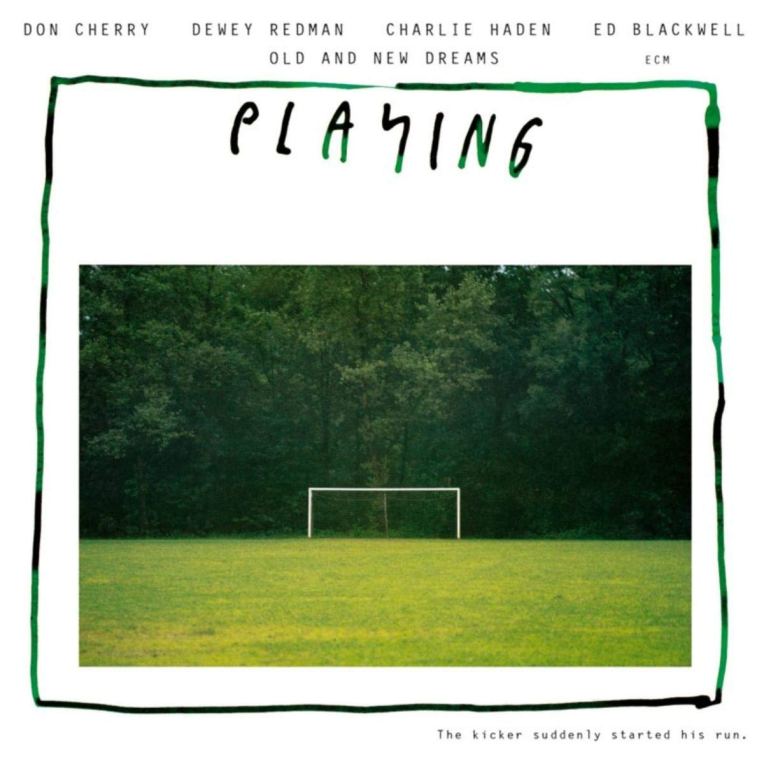
ECM 1205

Old And New Dreams
Playing

Don Cherry trumpet, piano
Dewey Redman tenor saxophone, musette
Charlie Haden bass
Ed Blackwell drums
Recorded live, June 1980, Theater am Kornmarkt, Bregenz (Austria)
Engineer: Martin Wieland
Produced by Manfred Eicher

This fantastic set, recorded live in Austria, is the place to start for anyone wanting a glimpse into the attic of Old And New Dreams. The playing is on point, the crowd riled, and the stakes high. From that first lively jump into “Happy House,” one of three extended Ornette Coleman tunes, we are plunged into the group’s quintessential sonic parameters. Lithe syncopations from Dewey Redman relate to Ed Blackwell’s drumming like family, while the free-flowing trumpeting of Don Cherry loosens its grip on predictability for a style that is utterly devoid of pretense and ever eager to communicate. Charlie Haden’s melodious plasticity completes a formula that carries through to the last drop. Just listen to the gut-wrenching tenor solo in “New Dream,” the liquid horns and percolating toms of “Broken Shadows,” where Redman’s musette also unfurls for a fantastically CODONA-like sound, and tell me there isn’t something special going on here.

Cherry drops a groovy hit of his own with the pointillist “Mopti,” of which the infectious pianism from the composer and attuned percussion delight. Redman contributes “Rushour,” the album’s most incendiary flush. The incredible saxophonism and expansive lyric trumpeting spread their joys far and wide. The title track comes from the hand of Haden, around whose spine horns weave like a medical caduceus before being lobbed back into their familiar station like ping-pong balls at the ready.

Considering the heft of talents assembled here, the results are weightlessly executed. This shows not weakness or lack of fortitude, but the maturity everyone brings to the sonic table. This is a solid date from musicians who know the business inside and out, and then some. About as good as it gets. Reissue, anyone?

<< Egberto Gismonti: Sanfona (ECM 1203/04)
>> Gallery: s/t (ECM 1206)
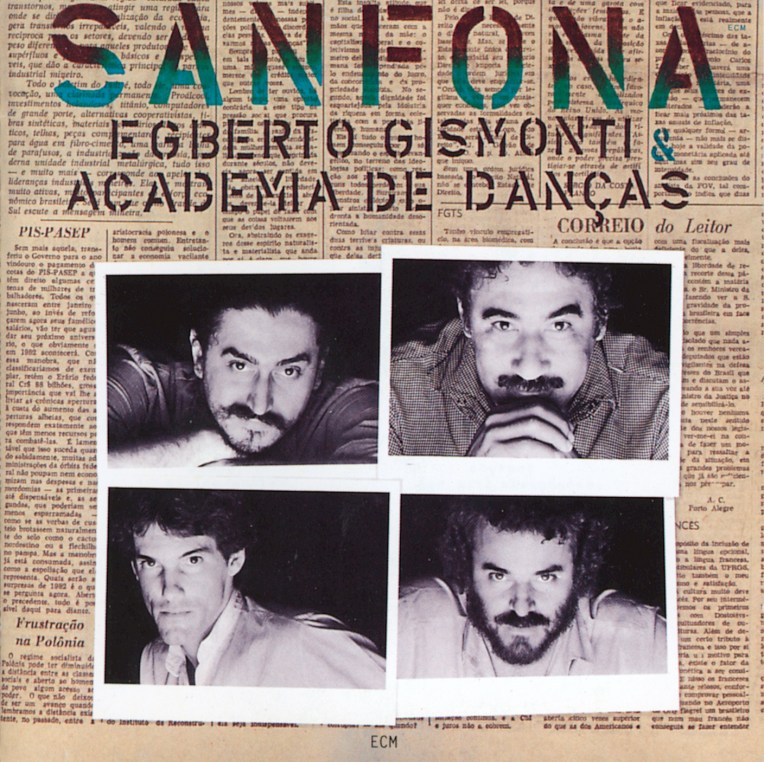
Egberto Gismonti & Academia de Danças: Sanfona (ECM 1203/04)

ECM 1203_04

Egberto Gismonti
Academia De Danças
Sanfona

Egberto Gismonti piano, guitars, Indian organ, voice
Mauro Senise saxophones, flute
Zeca Assumpção bass
Nene drums, percussion
Recorded November 1980 at Talent Studio, Oslo, and April 1981 at the Amerika Haus, München
Engineer: Martin Wieland
Produced by Manfred Eicher

For his third ECM effort, renaissance man Egberto Gismonti offers a classic diptych. The first half is a heaping helping of originals played with his Academia de Danças quartet, the second a live solo set from Munich. One can hardly listen to Gismonti at his best without being there to catch every story as it falls through the cracks. Everyone’s story will be different. Here’s one:

The accentuating winds of “Marcatu” waft past our noses. The scent is moist, hinting at lichen. Our breathing quickens us as we climb into thinner air, compensated by a majestic and quiet beauty in all directions. Gismonti’s piano introduces itself as the traveler who will be our guide. As he works his magico on the keys, bass (Zeca Assumpção) and drums (Nene) assume his lead, leaving Gismonti running with a saxophone (Mauro Senise), and us, following close behind. Every gesture of “10 Anos” is another footstep tracing the outskirts of a place unknown. And without knowing it, we have become one person. We wish to introduce ourself to the new community in the vale, into which we have now crossed. Drums nip at our heels as we find ourselves propelled by the downward slope. We are welcomed with ceremony in “Frevo.” But then, a lone figure cuts through the celebration, bringing with him the possibility of destruction. Instead, he shows us the wisdom of local ways, observing proper form in the presence of new life, the possibilities of love, and the realities of an ever-changing kinship. As the forest yields ancestors’ whispers, that their progeny might better survive, so too are voices encamped here among their people, where fires burn low and judgments even lower. Yet somewhere in the shadows, the saxophone lies in wait, trickster in disguise. Whatever mischief lies in store, however, is dispelled by the crystalline joys of “Lôro.” Here we find rebirth, brought forward to a council of harmony.

A four-part tribute follows, an epic in true Gismontian fashion. This time around, his guitar returns cloaked in the shadows of pianism, carried by an airborne saxophone. Every fluted note is an ensnared animal, gift of the hunt and of the gather. Recounting those undeniable moments of community that embraced us, we hear the voices of our own past in the harmonium, bleeding into guitar and drums. From this tenderness emerges “De Repente,” an engaging 12-string interlude that could give Gustavo Santaolalla a run for his money any day. And run it most certainly does, as if after spending time in the village, we find our heart also ensnared, only now by the life we abandoned on our way to getting here. And so, we take these feet and put them to the ground as quickly as they will, running hand-in-hand with the person we once were. The Ralph Towner-like diction here makes for one of Gismonti’s most captivating solo pieces. In our wake we leave the lamenting “Vale Do Eco.” The newly escaped continues in our place, lost and alone. In “12 De Fevereiro” we become her lullaby as she lays herself among the ferns and slumbers. And there she stays until a new village grows in her place, her dream at last realized in “Carta De Amor” before making her final leap into a rare green flash that halos the setting sun.

This album is a perfect example of what “World Music” really should be: not music of this, or any, world, but music that is a world in itself. Arguably Gismonti’s best date on any label and an essential one for your collection.

<< Keith Jarrett: Invocations/The Moth And The Flame (ECM 1201/02)
>> Old And New Dreams: Playing (ECM 1205)

Keith Jarrett: Invocations/The Moth and the Flame (ECM 1201/02)

ECM 1201_02

Keith Jarrett
Invocations/The Moth and the Flame

Keith Jarrett pipe organ, soprano saxophone, piano
Recorded November 1979 at Tonstudio Bauer, Ludwigsburg (The Moth and the Flame) and October 1980 at Ottobeuren Abbey (Invocations)
Engineer: Martin Wieland
Produced by Manfred Eicher

Among ECM’s many mainstays, Keith Jarrett would seem to have been given the most freedom, and it is within that freedom that he excels. In this fascinating double album, a standout even in his extensive résumé, Jarrett fleshes a sparse skeleton with intimate venation. The first half consists of Invocations, a meditative dialogue between organ and soprano saxophone. The latter alone bookends this antiphonal “text” with self-effacing distance. Equal parts hope and doubt, every word both a star and the supernova that ends it, Invocations ranks among Jarrett’s most introspective works. Of the organ solos, “Mirages, Realities” is the profoundest example. Building over a steady pulse, it is more akin to Arvo Pärt’s Mein Weg hat Gipfel und Wellentäler than to anything in the Jarrett oeuvre. In its lilting phrases, one finds a backward fall into a void where only sound describes reality. On the other hand, the lofty chords and denser architectures of “Power, Resolve” and “Celebration” clearly recall Jarrett’s Spheres. The most affecting verses, however, are to be found when organ and saxophone unify, especially in “Recognition,” which stretches the listener in opposing directions, only to meet in self-realization.

After the suspensions of the program’s first half, the five-part The Moth and the Flame floats a thousand pianistic lotuses—and with no less grand a sweep. Between the heartland spirit that permeates Part II and the iron-and-air elegy that is Part V, Jarrett maps out a tessellation of emotion, not unlike the spirals of Staircase. He winds his way with mirth through every dip of flight, splitting prismatically at the center in Part III. Like a spinning top, its myriad emotions funnel into a single point, wobbling until equilibrium is achieved.

This album, as much as any other in the Jarrett landscape, shows a deep commitment to personal development. He plows these instruments like the fields of his very heart. He is that moth, drawn to a musical flame which, rather than burning him, fuels his humanity all the more.

<< Jan Garbarek: Eventyr (ECM 1200)
>> Egberto Gismonti: Sanfona (ECM 1203/04)

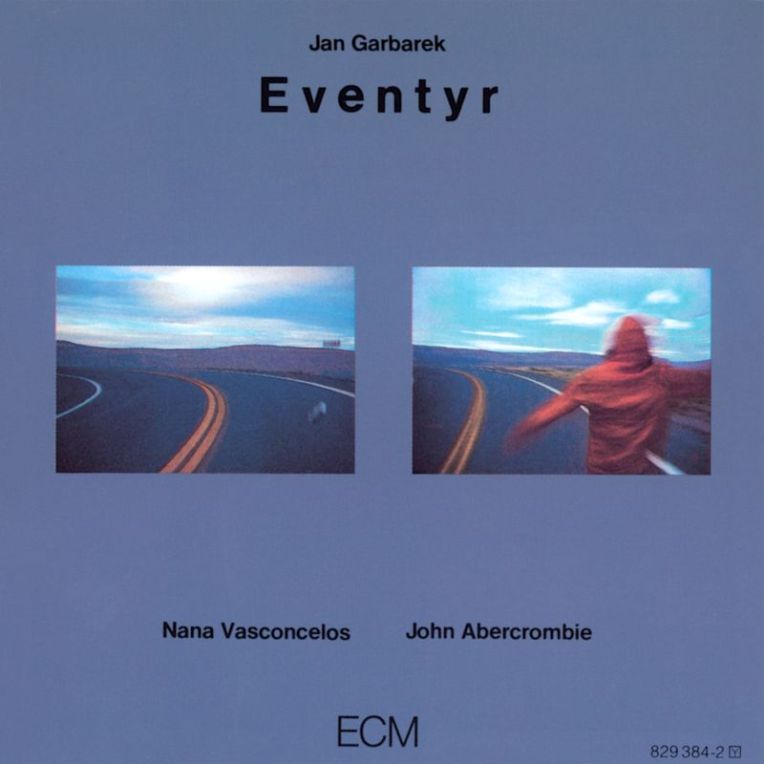
Jan Garbarek: Eventyr (ECM 1200)

ECM 1200

Jan Garbarek
Eventyr

Jan Garbarek tenor and soprano saxophones, flutes
John Abercrombie guitars
Nana Vasconcelos berimbau, percussion, voice
Recorded December 1980 at Talent Studio, Oslo
Engineer: Jan Erik Kongshaug
Produced by Manfred Eicher

A strange flute it was! It emitted a note as sustained as the whistle of a steam-engine, but much more powerful. It penetrated through the whole manor, over the gardens, the woods, for miles out into the countryside, and with the sound of it came a great gust of wind roaring.
–From “Everything In Its Right Place” by Hans Christian Andersen (trans. L. W. Kingsland)

Eventyr means “adventure.” Classical listeners may also recognize it as the name of Frederick Delius’s lovely 1917 tone poem, which is often translated as “Once Upon A Time” to underscore its origins in the folk tale collections of Norwegian scholar Peter Christen Asbjørnsen. Here, the name adorns one of Jan Garbarek’s most recondite efforts to date and, like its own “Once Upon A Time,” houses a world of lessons and signs for those willing enough to interpret them. Joined by John Abercrombie and Nana Vasconcelos, he spins a string of seven improvisations, rounded out by a standard, “East Of The Sun And West Of The Moon” (Brooks Bowman), that doesn’t so much end the album as open us to its nebulous center. In that center we encounter swirls of majesty as only he can draw. With almost liquid fire and ever-insightful phrasing, Garbarek brings his deepest considerations to the nearly 12-minute “Sora Maria” that is its primordial soup. His interplay with Abercrombie resolves into a vague continent, where only the playful refractions of “Lillekort” resolve themselves into separate entities. Vasconcelos’s pliancy is the animating skeleton of the title track, in which his gravelly voice and ritualism exudes from every gamelan hit. In “Weaving A Garland,” tenor sax and guitar paint a rolling horizon of vegetation. Such shorter tracks as this and “The Companion” comprise the more potent incantations amid the long-form spells that otherwise dictate the album’s vocabulary. Transcendence comes in the form of “Snipp, Snapp, Snute,” a sparkling menagerie of triangles and wooden flute that works its light into a crepuscular sky. Through it we see in fine detail the inner life of three musicians whose nets run far into the cosmic ocean, where only transformation awaits in the catch.

<< Katrina Krimsky/Trevor Watts: Stella Malu (ECM 1199)
>> Keith Jarrett: Invocations/The Moth And The Flame (ECM 1201/02)

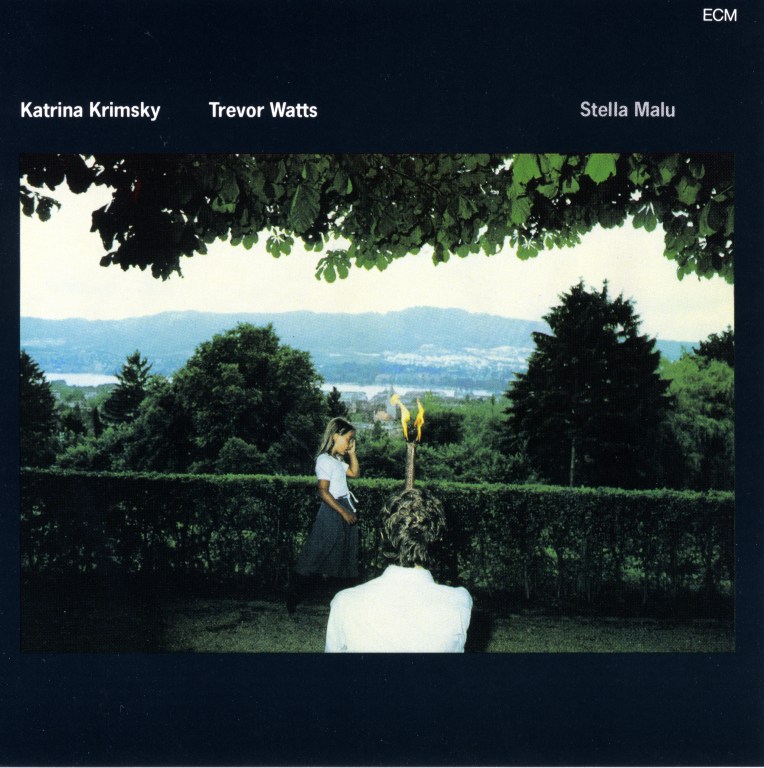
Katrina Krimsky/Trevor Watts: Stella Malu (ECM 1199)

ECM 1199

Katrina Krimsky
Trevor Watts
Stella Malu

Katrina Krimsky piano
Trevor Watts soprano and alto saxophones
Recorded March 1981 at Tonstudio Bauer, Ludwigsburg
Engineer: Martin Wieland
Produced by Manfred Eicher

Classically trained pianist and composer Katrina Krimsky began her distinctive musical career in 1968, when she joined Terry Riley and friends to record the world premiere of In C for Columbia Records. Since this momentous occasion, she has thrived as a commissioned performer, collaborator, and pedagogue. In this, her only album for ECM, she paired her venerable skills with those of English saxophonist Trevor Watts. These two voices, both pluralistic and utterly descriptive, coalesced into an unforgettable 38-minute contemplation of melody and space.

Having just recently seen Joshua Redman and Brad Mehldau in concert, the unique possibilities of saxophone and piano are fresh in my mind, and as I listen to this superb album anew I hope these possibilities continue to be explored (on that note, the more adventurous may want to check out Watts’s stimulating collaborations with Veryan Weston). Krimsky’s astrologically minded pianism is the heart of Stella Malu and so well engenders Watts’s free-flowing lines. Between the billowing vapors of “Mial” and the slice of exuberance that is “Villa In Brazil,” we find ourselves not so much caught as draped by the veils therein.

The reach of these two musicians stretches farthest in “Duogeny” and “Moonbeams.” The first is a stunner, rich in potent notecraft and development. It is also a fluid mixture of the mystic and the bluesy, pockmarked by a rain of reveries. The second breathes even more organically through the richly muted intonation of Watts’s alto. Beneath the latter’s solos, Krimsky leaves the sustain pedal down, allowing every breath to resonate in open strings.

Krimsky has two solo pieces, including the nostalgia-laden title track. But it is “Song For Hans” that captivates me most of all. It ripples with cinematic reality, sounding like an epilogue to a lost Theo Angelopoulos film. Watts enters the darkness alone in “Rhythm Circle.” This short but sweet soprano excursion swirls in its own afterimages. Along with the duet “Crystal Morning,” it steers into the album’s briskest territories, combing the fields like a persistent wind on its way to the sea.

For lack of a better comparison, Stella Malu falls somewhere between Keith Jarrett’s Gurdjieff tribute and John Surman’s Upon Reflection. The outdated, even if haunting, echo applied throughout in postproduction may irk some listeners, even as it coats the music with an historic charm. Regardless, it stands as one of ECM’s finest and an album that reveals more to be thankful for with every listen.

<< Steve Eliovson: Dawn Dance (ECM 1198)
>> Jan Garbarek: Eventyr (ECM 1200)

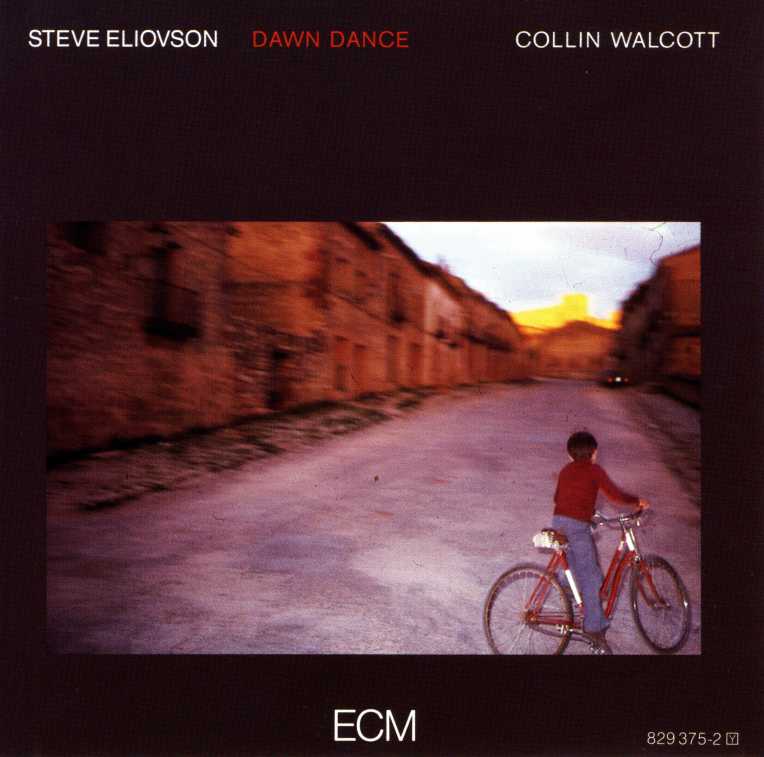
Steve Eliovson: Dawn Dance (ECM 1198)

ECM 1198

Steve Eliovson
Dawn Dance

Steve Eliovson acoustic guitar
Collin Walcott percussion
Recorded January 1981 at Tonstudio Bauer, Ludwigsburg
Engineer: Martin Wieland
Produced by Manfred Eicher

This album is something of a legend in the annals of ECM lore, as it was the only ever recorded by the fantastically talented Steve Eliovson. With Collin Walcott on percussion for support, the since unheard-from guitarist carves lasting impressions that can now be thankfully heard on CD. The experience begins in “Venice” (as in California), where the guitar speaks with tabla like two continents connected by tectonic plates beneath an ocean. Eliovson’s sonorities are pristine, especially in “Earth End” and in “Slow Jazz,” where the precision of finger placement and the occasional bent note add a soulful turn of phrase. The album’s portal is “Awakening,” a submarine communion of gongs that closes one door while opening another. The title track is buoyed by a glimmering triangle and arpeggios from an internal guitar, while the external speaks in tongues with the various percussive accents that flit in and out of its view. “Song For The Masters” and “Wanderer” share likeminded ostinatos, more flexible melodic leads, and the occasional sitar-ish twang. The unambiguously titled “Africa” seems to prance across the map on which we opened, the all-steel sound visceral and true. Two gorgeous closers—“Memories” and “Eternity”—whisper their promises like secrets, falling with the autumn leaves into seasons as yet unnamed.

Sparse anecdotal evidence paints of Eliovson the portrait of a regretful artist, a man who was compelled to sell his worldly possessions (including the instruments of his trade) and return to his native South Africa. Yet we can also take pleasure in knowing that he left this one document, a jewel of quiet magnificence. Better to have been given this single completed journey than a series of false starts.

<< Meredith Monk: Dolmen Music (ECM 1197 NS)
>> Katrina Krimsky/Trevor Watts: Stella Malu (ECM 1199)

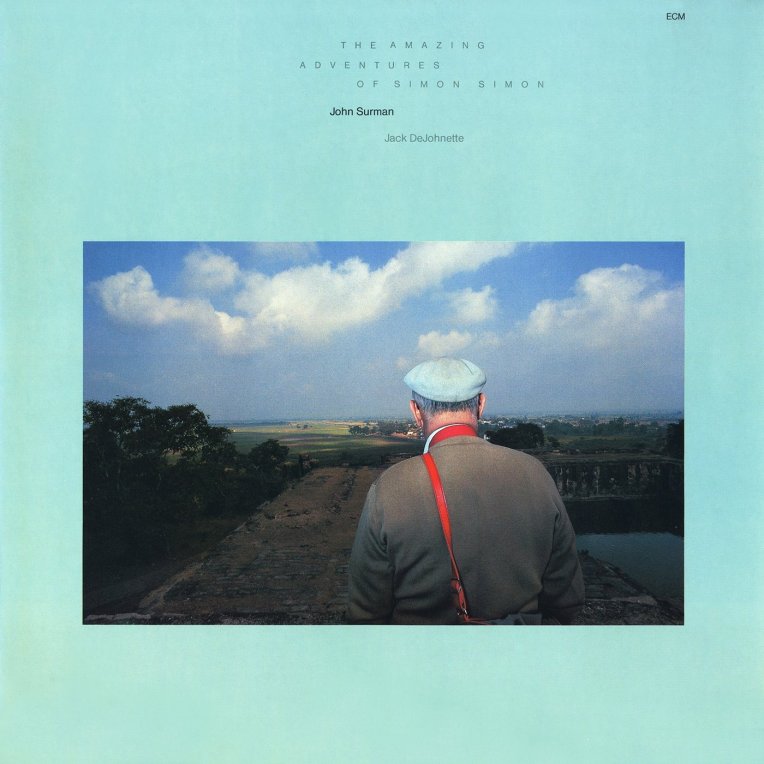
John Surman/Jack DeJohnette: The Amazing Adventures Of Simon Simon (ECM 1193)

ECM 1193

John Surman
The Amazing Adventures Of Simon Simon

John Surman soprano and baritone saxophones, bass clarinet, synthesizer
Jack DeJohnette drums, congas, electric piano
Recorded January 1981 at Talent Studio, Oslo
Engineer: Jan Erik Kongshaug
Produced by Manfred Eicher

When reviewing jazz albums, I tend to abbreviate the word “saxophone” as “sax.” Yet somehow, when describing the music of John Surman, only the full spelling seems appropriate, for he as well as anyone fleshes out the inner architecture of the instrument in whatever form it may assume in his proficient hands. One might say likewise about drummer Jack DeJohnette, whose array of talents fully arches the backbone of the eight originals and one folk tune (the arboreal “Kentish Hunting”) on this curiously titled album. A delicate sequencer washes over us first in “Nestor’s Saga (The Tale of the Ancient)” along with bass clarinet amid awakening drums. Such tonal contrasts are a running thread through “Merry Pranks (The Jester’s Song),” “The Pilgrim’s Way (To The Seventeen Walls),” and the lumbering “Within The Halls Of Neptune.” Like some lost klezmer dream, floating on illumined clouds, these tunes step over vast plains before setting foot upon mountaintops. The finest moments are to be found in the soprano work, featured to varicolored effect in “The Buccaneers” and most engagingly in “Phoenix And The Fire.” DeJohnette holds his hands to the pianistic fire in “Fide Et Amore (By Faith And Love),” each chord a glowing ember beneath the bare feet of Surman’s baritone. “A Fitting Epitaph” mixes two drops of clarity for every one of forlornness and leaves an airy aftertaste in the sequencer’s final rest. This first in a continuing collaboration between two of ECM’s finest has aged well and is a good place to start on this intriguing duo.

<< Rypdal/Vitous/DeJohnette: To Be Continued (ECM 1192)
>> Goodhew/Jensen/Knapp: First Avenue (ECM 1194)

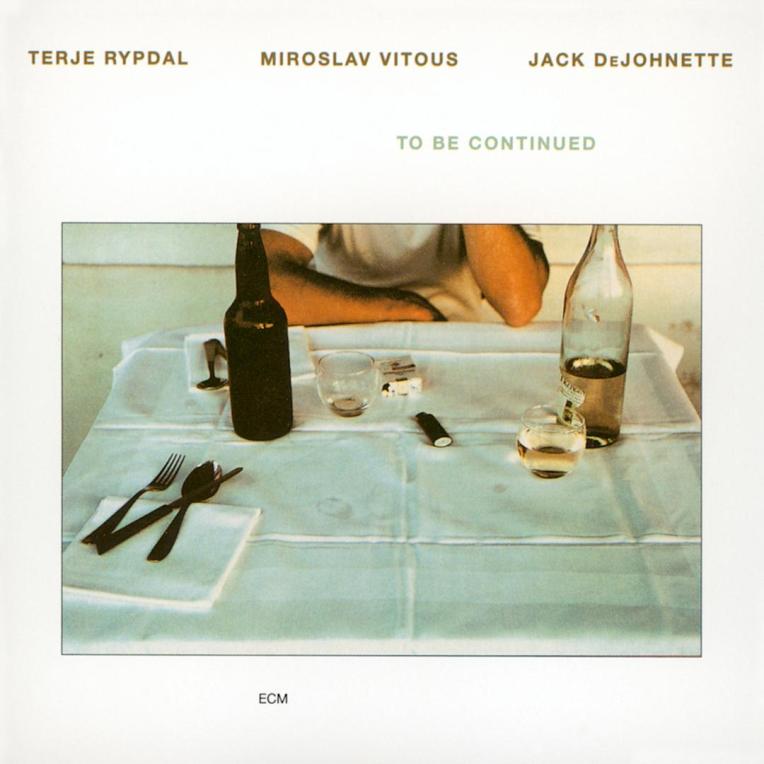
Rypdal/Vitous/DeJohnette: To Be Continued (ECM 1192)

ECM 1192

To Be Continued

Terje Rypdal electronic guitars, flute
Miroslav Vitous acoustic and electric bass, piano
Jack DeJohnette drums, voice
Recorded January 1981 at Talent Studio, Oslo
Engineer: Jan Erik Kongshaug
Produced by Manfred Eicher

Nearly three years after their first collaboration, Terje Rypdal, Miroslav Vitous, and Jack DeJohnette unwrapped the ghostly sunset that is To Be Continued. The most spine-tingling moments therein thrive at half the speed of life. The intensities of “Maya” must be heard to be believed, for in them we see the night sky in negative image. Likeminded pulchritude prevails in “Topplue, Votter & Skjerf” (Hat, Gloves & Scarf), easily one of Rypdal’s most awesome committed to disc. His hands fade as soon as they are laid, leaving only the trace by which he elicits every note.

Don’t be mistaken, however, in thinking this is another lazy morning session. Rather, it dances to the tune of DeJohnette’s propulsion in “Mountain In The Clouds,” to say nothing of Vitous’s fanciful colors in the title track. For “This Morning” in particular, crosshatched by electric bass and flute, DeJohnette seems to want to draw the others into more finely grained conversations, only to get pixilated versions thereof. Yet these unformed images allow us to supply our own dreams, so that by the time we reach the haunting “Uncomposed Appendix,” in which he sings with and through his piano, we are already converted.

Though the album is brimming with sharp production and electronically enhanced instruments, there is something purely elemental about it. Its stew of metal, wood, and air wafts like the scent of plane trees in summer and leaves a taste of copper in the mouth.

<< John Abercrombie Quartet: M (ECM 1191)
>> Surman/DeJohnette: The Amazing Adventures Of Simon Simon (ECM 1193)

Pat Metheny & Lyle Mays: As Falls Wichita, So Falls Wichita Falls (ECM 1190)

Pat Metheny
Lyle Mays
As Falls Wichita, So Falls Wichita Falls

Lyle Mays piano, synthesizer, organ, autoharp
Pat Metheny electric and acoustic 6- and 12-string guitars, bass
Nana Vasconcelos berimbau, percussion, drums, vocals
Recorded September 1980 at Talent Studio, Oslo
Engineer: Jan Erik Kongshaug
Produced by Manfred Eicher

Listening to any Pat Metheny album for the first time is like finding a long-forgotten photograph, interleaved in a dusty book marked to the brim with the marginalia of a past life. And just when one thinks that feeling might dull over time, Metheny whittles from the vast block of wood that is his genius a masterpiece like As Falls Wichita, So Falls Wichita Falls, on and through which the Missouri-born guitarist begins to expand his reach to “global” proportions. His Instrument—with a capital “I”—and his playing of it define supernovas of emotional distance in the most compact lines. From these he unspools spectrums upon spectrums.

Where many of his albums might open with a shout of joy, a heavy acoustic rhythm, or a sweeping grandeur, the 20-minute title track’s genesis lies in the ambience of a field recording. We hear a crowd, a voice chanting taals, the rasp of shakers. Thus (dis)located, Metheny begins to map this human web through the drone of Lyle Mays. Only then, from thunderous rumblings, does his slack guitar take our hand and lead us through the crowds. With a drum machine at his side, Nana Vasconcelos clothes us in local colors. The electronic accents and attentive sense of evocation evoke Steve Tibbetts as the band coalesces into a shimmering, autoharp-laden catharsis. Riding a leviathan of strings, a voice recites numbers, as if in code. With the sounds of children at play still in our ears, the upbeat “Ozark” crests into the wave of extroverted Americana that is Metheny’s standby. Mays at the keys makes this stage, gliding effortlessly along a landscape tessellated by a rainbow of impressions. “September Fifteenth” is as intimate as the last is expansive, a prayer for Bill Evans, who left us on the selfsame date while the album was in session. The pianism of Mays (for whom Evans was a formative influence) could hardly be more fitting. To be sure, it glitters like the rest, only this time with the beads of falling tears. The title of “It’s For You” lends delight to the cover montage. If its colorful combination of sounds is meant to brighten our mood after the mournful turn that precedes it, then it certainly does the trick. Metheny’s signature electric traces in silhouette every footprint leading into the mystical shores of “Estupenda Graça,” where he sketches for us a more diffuse version of street on which we began.

Some have remarked on the “regrettable” cover art and the title that brands it, but I for one believe it to accurately illustrate Metheny’s process. Making or receiving a phone call is a form of travel in itself, for those precious moments of communication seem to collapse the two spaces that both speakers inhabit. And which of us has not, when experiencing something sonically profound, held up a phone so that the person on the other end could get some sense of the experience? “It’s For You” isn’t just a catchy phrase; it’s a thank you for the listener.

<< Jack DeJohnette’s Special Edition: Tin Can Alley (ECM 1189)
>> John Abercrombie Quartet: M (ECM 1191)