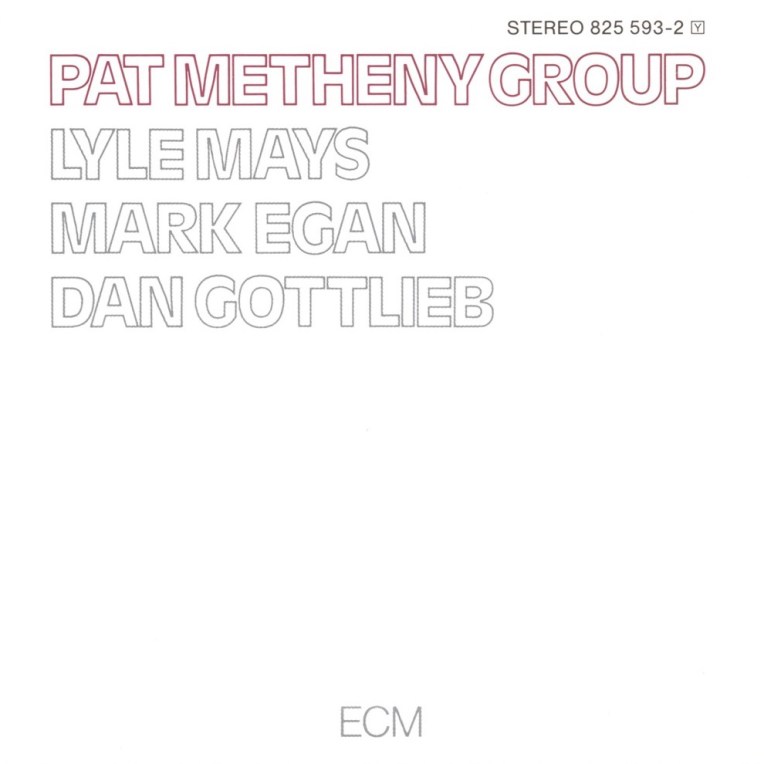
Pat Metheny Group: s/t (ECM 1114)

ECM 1114

Pat Metheny Group

Pat Metheny 6- and 12-string guitars
Lyle Mays piano, oberheim synthesizer, autoharp
Mark Egan bass
Dan Gottlieb drums
Recorded January 1978 at Talent Studio, Oslo
Engineer: Jan Erik Kongshaug
Produced by Manfred Eicher

There’s no mistaking a Pat Metheny album, and along with running mates Lyle Mays, Mark Egan, and Dan Gottlieb, the experience is unforgettable. From its inaugural moments, the group’s self-titled debut overflows with radiance. Ironically, this was one of the last PMG albums to cross my ears. During my first listen, the seamless combination of guitar and keyboard on “San Lorenzo” in its original guise was enough to show what I’d been missing, for clearly it had already kicked up the ECM ethos up a notch or two. This quiet revelation is further enhanced by the synth lead, gently skating its way across a surface that glitters with an artfully placed autoharp (which presages the sound of Metheny’s Pikasso guitar). Egan’s weighty but smooth bass works magic through the unmistakable lyricism of Mays’s pianism as both are swept favorably along by Gottlieb’s foamy breakers. And there is Metheny himself, whose own waves scorch the shorelines of our expectations with fragrant sunset. There is much to be found here in the way of timeless material, such as “Phase Dance,” another formative cell of the PMG canon. Buoyed by a seesawing bass, effortless soloing from Metheny and Mays scintillates over tight drumming. The wide open spaces of “Jaco,” named for the bassist and early collaborator Jaco Pastorius, veer our attention to a savvy and vigorous funk from which Metheny spins his web with both the grace of a ballerina and the raw emotive power of a blues guitarist. The following tune, “Aprilwind,” is as elegiac as the previous is jubilant. This solo guitar lozenge, wrapped in bittersweet introspection, proves a brief medicinal corrective to the positively acrobatic “April Joy.” A dream within a dream, it awakens our senses to a life renewed. But perhaps none is more uplifting than “Lone Jack,” in which an upbeat narrative flair and superb ground line make for a perfect sling with which to hurtle Metheny’s flames for one arousing final lap around the firmament.

Metheny’s sound has a bright and fluid posture that never fails to work its way into our hearts. No matter what mood we are in before pressing PLAY, we can always be sure of finishing with a smile. This is life-affirming music that stays true to itself no matter what the weather. One sometimes speaks of “desert island discs”—i.e., albums that are indispensable in our listening lives. This is beyond that, for once we hear it we have it with us always.

<< Tom van der Geld and Children At Play: Patience (ECM 1113)
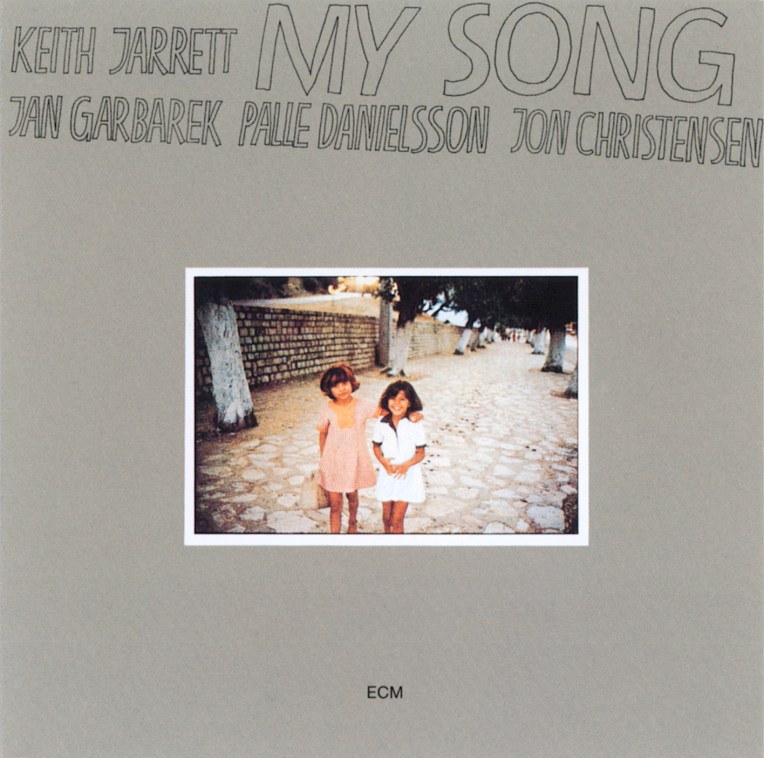
>> Keith Jarrett: My Song (ECM 1115)

Keith Jarrett: Ritual (ECM 1112)

1112 X

Keith Jarrett
Ritual

Dennis Russell Davies piano
Recorded June 1977 at Tonstudio Bauer, Ludwigsburg
Engineer: Martin Wieland
Produced by Manfred Eicher

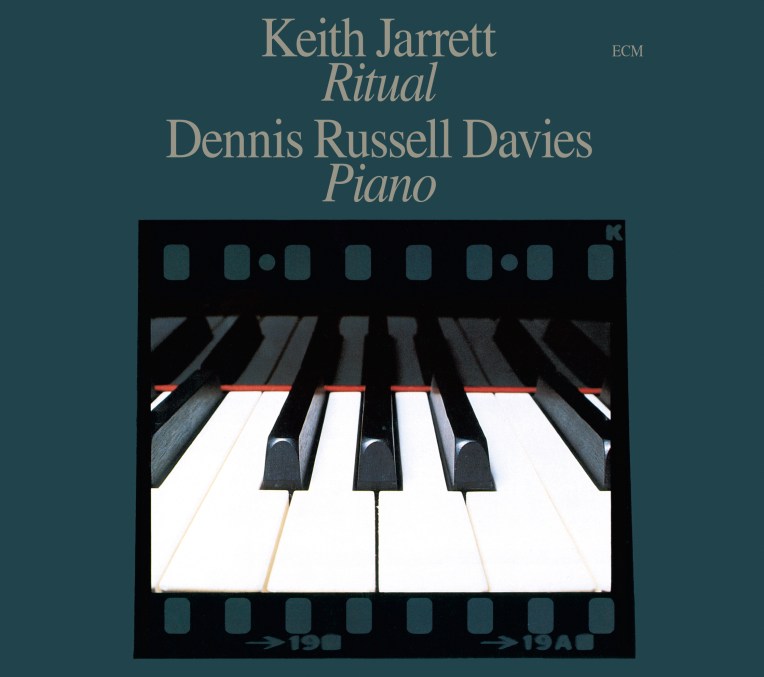
Ritual is something of an anomaly in the Keith Jarrett archive. It’s a solo album, as many of his best are, only this time it is pianist, conductor, and frequent collaborator Dennis Russell Davies at the keys playing a work penned entirely by Jarrett. The hallmarks of a Jarrett piano recital are all there—the rolling ostinatos, dense arpeggios, and profound doublings—yet are valenced differently under the rubric of “composition.” In this context, we get a sense of “once removed-ness” that might not present itself under improvisational circumstances. The piece’s modest 32 minutes are divided into two immodest parts. From the opening groundswell we get not only dense pockets of energy, but also nodes of emptiness. Put another way: the music’s glorious peaks share the same space as the shadowy valleys at their feet, thereby encompassing a harmonious middle ground. Like a geyser, its eruptions are predictable yet manage to enthrall every time. Despite its claustrophobic beginnings, Part 1 ends in bright solitude, like a room in which the curtain has been slowly opened to welcome the morning sun. Heavier chording marks Part 2, which resolves in a hopeful melancholy, but not before gelling the emotional plasticity of its precursor. This brings us full circle, ending on a solemn intonation of a single note.

Ritual is far more “regulated” than typical Jarrett fare, spun as it is from the surrogacy of another performer rather than through the alchemy of spontaneous creation (though there is, of course, some of each in the other). The results are captivating in their own way, stoked by every depressed key and lifted pedal. Its shapes are drawn not by what is, but what has been and will be. The present is invisible and lives on only as formless possibility, caught like a blown kiss in the cup of one’s hand.

<< Gary Burton: Times Square (ECM 1111)
>> Tom van der Geld and Children At Play: Patience (ECM 1113)

Dave Holland: Emerald Tears (ECM 1109)

ECM 1109

Dave Holland
Emerald Tears

Dave Holland double bass
Recorded August 1977 at Talent Studio, Oslo
Engineer: Jan Erik Kongshaug
Produced by Manfred Eicher

The upright bass is, of course, a fixture of many jazz ensembles, in which it often “solos” but only over or surrounded by other instruments. Strange, then, that the thought of it on its own should be such a difficult one to swallow (no pun intended). Where most musicians might have fallen back on the comfort of overdubbing and other postproduction trickery, Dave Holland stepped boldly into the limelight (pun intended) with Emerald Tears. Although the album does retain a certain novelty factor by its very concept, even in the hypothetical presence of a tradition of solo bass recordings one imagines it would stand out for its broad palette and ingenuity.

Six of the album’s eight selections bear Holland’s name as composer. “Spheres” and “Under Redwoods” are the two contemplative interlocutors. The former volleys melodic cells between lower thrums and a harmonic pedal point. Quick fingerwork from both hands adapts the instrument to constantly shifting desires for a sound that is fragmented yet immediately relatable. The latter spreads a wider net that is more experiential than autobiographical.

The heavily lilting intro of the title cut declares its state of mind with ceremonial regularity, even as it bends to the whim of improvisation. A flick of the finger gives off a burst of virtuosity. “Combination” is, not surprisingly, a relay between bowing and plucking. This is the outlier of the program and for me doesn’t work quite so well as the rest. Nevertheless, its timbral variety is only heightened by its surroundings. In this vein, and far more effective, are the extended techniques of “Flurries,” which liquefy the strings even further. “Hooveling” is a most characteristic Holland bass line that could easily inaugurate a full-blown quintet piece, but is used instead as a hook into scattered monologues. Of the two non-Holland cuts, the post-bop wings of “B-40/RS-4-W/M23-6K” (Anthony Braxton) give plenty of lift. One might feel tempted to populate the sky around it with clouds shaped like drums, sax, and piano were it not for Holland’s rewarding density. Urgency is regained in “Solar” (Miles Davis), which maps its paths in jagged strokes across an already erratic geography.

Emerald Tears is more than a love song to its instrument. It is a free journey with definite returns, each a touchstone along the way. It takes a few listens to pick out the album’s motives, but they’re surely there, pristine and flowing. I think for the right mood this is a perfect album to put on and let carry you away. Either way, it is a striking and exemplary solo achievement bearing one of jazz’s most distinctive creative signatures.

<< Paul Motian Trio: Dance (ECM 1108)
>> Terje Rypdal: Waves (ECM 1110)

Art Lande and Rubisa Patrol: Desert Marauders (ECM 1106)

ECM 1106

Art Lande and Rubisa Patrol
Desert Marauders

Art Lande piano
Mark Isham trumpet, horns
Bill Douglass bass, flute
Kurt Wortman drums
Recorded June 1977 at Tonstudio Bauer, Ludwigsburg
Engineer: Martin Wieland
Produced by Manfred Eicher

Desert Marauders represents the final iteration of pianist Art Lande’s Rubisa Patrol quartet, which over its flash-in-the-pan tenure produced a solid, if modest, body of imaginative work. For this recording Kurt Wortman replaces Glenn Cronkhite on drums and provides plenty of adhesive for otherwise free-floating themes and ideas. His stop-and-start playing engages Lande in exciting conversation throughout the groovy opener. At 16 minutes, it is more main course than appetizer, but whets our expectations all the same with its vivid prime directive while offering food for thought via Mark Isham’s serpentine melodies. Bassist Bill Douglass works us back into the swing of things with consummate fortitude. After this epic journey, “Livre (Near The Sky)” feels like a piece of heaven. Driven by the fluid trumpet of its composer in the only non-Lande composition on tap, it’s a piece of and about imagination. Each piano chord is a branch to which Isham glues his own improvised leaves. We feel the entire tree swaying in the winds of an oncoming storm, the first drops of which hit our forehead in the piano of “El Pueblo De Las Vacas Tristes.” As it comes down in placid sheets, it flows at the feet of camels and worn sandals. Lande lays out the loveliness over his rhythm section in a blend of oil and chalk pastels. Douglass doubles Isham on flute in “Perelandra” for some airier moments. “Sansara” is a throwback of sorts. Its solid, infectious pianism, lively trumpeting, and tender bass solo combine for a smooth and rousing finish to a fine effort all around.

<< Abercrombie/Holland/DeJohnnette: Gateway 2 (ECM 1105)
>> Eberhard Weber Colours: Silent Feet (ECM 1107)

Gary Burton: Times Square (ECM 1111)

ECM 1111

Gary Burton
Times Square

Gary Burton vibes
Steve Swallow bass guitar
Roy Haynes drums
Tiger Okoshi trumpet
Recorded January 1978 at Generation Sound Studio, New York
Engineer: Martin Wieland
Produced by Manfred Eicher

Of vibraphonist Gary Burton’s roving quartets of the seventies, the assembly on Times Square is unique for the presence of Tiger Okoshi. The Japanese trumpeter’s collaborations with Burton caught the attention of many an ear and launched a fruitful career that has led to his current associate professorship at Berklee School of Music. Comfortable in both standard and fused territories, Okoshi brings a tenderness that is as biting as the leader’s vibes are liquid.

The band jumps right into the thick of things with a pair of Keith Jarrett tunes. Between the machine-gunned snare of “Semblance” and the balladic “Coral” we can already see the range of Okoshi’s flexibility. Not to be overlooked, however, is the straight-from-the-heart lyricism Burton unravels and reties in “Careful” (Jim Hall). This moves along swimmingly from the start and holds its shape through the itinerant bass of Steve Swallow, who provides five thoughtful originals for the album’s remainder. Okoshi shines again in “Peau Douce,” as does drummer Roy Haynes. Yet in this group overrun with talent from all sides, it’s Swallow who burns the midnight oil. Take, for instance, his lithe solo in “Radio” or the tightly wound core of “Como En Vietnam,” both not to be missed. And speaking of midnight, the selfsame track proves to be as sweet a palate cleanser as one could hope for. “True Or False” is also sure to bring a smile with Haynes’s whimsical solo couched between two fleeting punctuations.

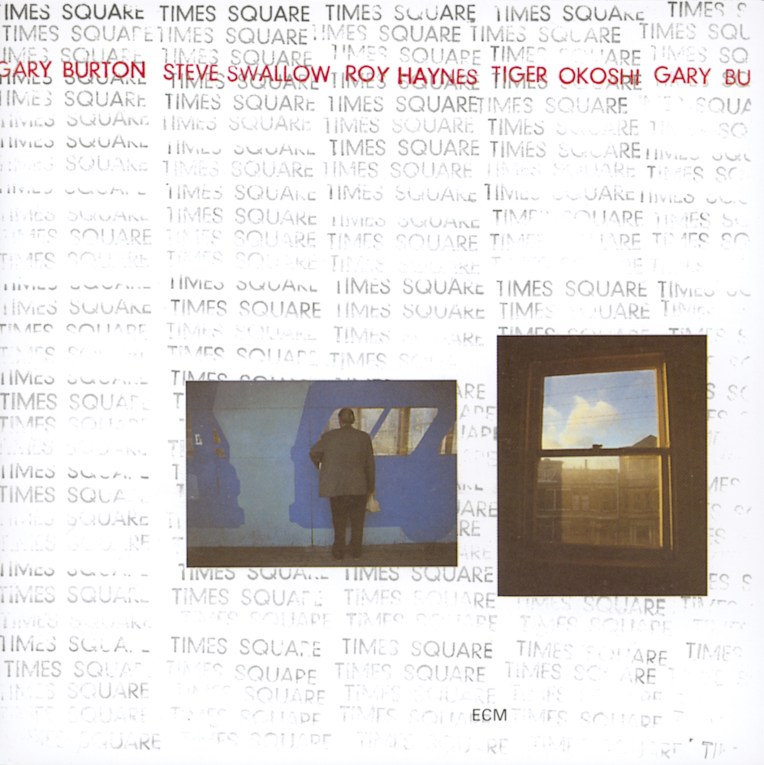
Whenever Burton is involved in any musical project, one can rest assured that the melodies will be there for you, lurking in every patch of light and shadow alike. The gentle persuasions of he and his band mates preserve a nostalgic snapshot of the album’s namesake, where the onetime flowing bustle has since been clouded with noise and unrelenting visual overload. This dose of sonic clarity is all we need to make sense of the confusion.

<< Terje Rypdal: Waves (ECM 1110)
>> Keith Jarrett: Ritual (ECM 1112)

Terje Rypdal: Waves (ECM 1110)

Terje Rypdal
Waves

Terje Rypdal electric guitar, keyboard, synthesizer
Palle Mikkelborg trumpet, fluegelhorn, RMI, tac piano, ring modulator
Sveinung Hovensjø basses
Jon Christensen drums, percussion
Recorded September 1977 at Talent Studio, Oslo
Engineer: Jan Erik Kongshaug
Produced by Manfred Eicher

One is often tempted to appreciate Terje Rypdal through the lens of some icy Nordic mystique that, while certainly supported by the sleeves that adorn his music, may ultimately be a myth. Either way, there is something to be said for the biting winds that blow through his sonic landscapes. I would like to present Waves, however, as a corrective to this assumption, for it emanates nothing but heat. Much of that heat comes courtesy of trumpeter Palle Mikkelborg, whose legendary reputation bears auditory bounty throughout.

Much of the album’s blurry spirit takes bodily form in “Per Ulv.” Combining a delightfully dated drum machine and quasi-Afrobeat percussion from Jon Christensen with the mellifluous bass of Sveinung Hovensjø, it opens itself to Rypdal’s searing flights. Mikkelborg’s quick fingers fuel the fire, which calms to a smolder in “Karusell,” where he marks his territory with breath rather than exaltation, trading off guttural statements with Rypdal’s softened twang. Mikkelborg even contributes a composition of his own in “Stenskoven,” a raunchy carnivalesque that might as well have switched titles with its predecessor. The title piece depends from lines of cymbals and snare and is supported by organ. Over this synthesized bliss, Rypdal and his cohorts weave a loose and lyrical song. “The Dain Curse” takes a tripartite structure. A clean bass line and flanged chording from guitar waft around the muted horn of a distant horizon, only to be cracked by Christensen like an egg of rock that oozes yolky guitar solos before being poached into stillness. “Charisma” reprises the organic river of “Waves,” into which Rypdal trails his fingers, leaving ephemeral shapes on the water’s surface. Cymbals drop like seeds, only to be washed away in the current, their potential life leaving like ghosts via the haunted trumpet.

If we imagine the cover photograph as having any bearing on what lies within, then the music is neither the trees nor the mist that envelops them. Rather, it is the sun that blinds us to both throughout the album’s gradual evaporation.

<< Dave Holland: Emerald Tears (ECM 1109)
>> Gary Burton: Times Square (ECM 1111)

Gateway 2 (ECM 1105)

ECM 1105

Gateway 2

John Abercrombie guitar, electric mandolin
Dave Holland bass
Jack DeJohnette drums, piano
Recorded July 1977 at Talent Studio, Oslo
Engineer: Jan Erik Kongshaug
Produced by Manfred Eicher

In this era of tawdry sequels, it’s almost difficult to believe that John Abercrombie, Dave Holland, and Jack DeJohnette could have surpassed the profundity of 1975’s seminal Gateway. I say “almost” only because each member of this dream trio has yet to let this committed listener down and always comes to the studio bearing a basket overflowing with fresh ideas. Not only do the results of this 1978 follow-up not disappoint, they ascend into their own category.

At first we aren’t sure what to think in the carefully executed half-sleep of the 16-minute “Opening.” Amid tinkling icicles Abercrombie’s guitar wavers above the bass as it gradually forms intelligible words out of the scattered letters with which we are confronted. The process is so intensely organic that we find ourselves being lulled into its speech-like rhythms. As the snare becomes more forthcoming with its intentions, Holland fleshes out its implications with a tantalizing loop, through which Abercrombie hooks his song with a sound that is wiry yet ethereal. Just as engaging in his supportive statements, he provides ornamentation for Holland as DeJohnette rides with fierce precision into a fine solo of his own. The steam of malleted cymbals condenses into the following “Reminiscence.” Holland and Abercrombie blend into a larger instrument in this pensive track that sounds like the acoustic shadow of Pat Metheny’s “Midwestern Night Dream” (see Bright Size Life). “Sing Song” is another dose of milk-and-honey goodness. Wonderfully nuanced drumming here from DeJohnette uplifts even as it placates. Meanwhile, Abercrombie leans back into an ergonomic continuity that soon plateaus into an engaging turn from Holland, whose quintessential bass line in “Nexus” opens the band to a limber display of virtuosity. Abercrombie is again transcendent in this tower of syncopation, from which trails the Rapunzel-like strands of a limitless creative cache. DeJohnette’s piano turns “Blue” into an ending that is as bitter as it is sweet.

For those who haven’t heard this unit’s first album, I recommend doing so before settling into this one. Not because either is “better” than the other, but only because the development between the two is more readily appreciated when experienced chronologically. In any case, Gateway 2 is its own animal that thrives best in the habitat of our appreciation.

<< Richard Beirach: Hubris (ECM 1104)
>> Art Lande and Rubisa Patrol: Desert Marauders (ECM 1106)

Richard Beirach: Hubris (ECM 1104)

ECM 1104

Richard Beirach
Hubris

Richard Beirach piano
Recorded June 1977 at Tonstudio Bauer, Ludwigsburg
Engineer: Martin Wieland
Produced by Manfred Eicher

Classically trained pianist Richie Beirach has created some of ECM’s most melodically engaging music. His first solo album is a keepsake to be treasured for its melodic detail and structure. “Sunday Song” embraces the album at either end with heartache and never lets go, even in silence. Within its fibrous interior, Beirach spins thematic funnels from vivid ostinatos. Floating in its liquid center is the title piece, which if anything is circumscribed and modest. No single mood dominates, thereby allowing the listener the benefit of continual reassessment. One feels the music developing in multiple and simultaneous directions, such that a destination cannot always be inferred. Between the speculative considerations of “Osiris” and “Future Memory” and the narrow syncopations of “Leaving,” one finds a range of brushstrokes at the musician’s employ. The aerial dissonances of the latter piece leave particularly indelible impressions upon the mind’s palimpsest. “Koan” is a colorful and erratic interlude and stands equidistant from the likeminded “Rectilinear.” Beirach scales his greatest heights in “The Pearl,” which he buffs to a blinding shine with arresting key changes, only to be refracted in a haunting traipse through the “Invisible Corridor.”

With no one to answer to here, Beirach’s notecraft is pared down to the core and given free reign. These vignettes are atmosphere itself, bound to their titular prompts while also shedding them in favor of absolute expression.

<< Jack DeJohnette’s Directions: New Rags (ECM 1103)
>> Abercrombie/Holland/DeJohnnette: Gateway 2 (ECM 1105)

Jack DeJohnette: New Rags (ECM 1103)

ECM 1103

Jack DeJohnette
New Rags

Jack DeJohnette drums, piano
John Abercrombie electric guitar, electric mandolin
Alex Foster tenor and soprano saxophones
Mike Richmond bass, electric bass
Recorded May 1977 at Tonstudio Bauer, Ludwigsburg
Engineer: Martin Wieland
Produced by Manfred Eicher

Directions was a short-lived unit from the evolving mind of drummer Jack DeJohnette, who on this ECM joint proved once again that his deftness at the keyboard is almost on par with his mainstay. New Rags features the same line-up (John Abercrombie on electric guitar and mandolin, Alex Foster on reeds, and Mike Richmond on basses) as 1976’s Untitled, sans Bernhardt. Our frontman meanders into the thick of things with three originals, of which the title track bristles with luscious work from Richmond in a steady interplay with all. The consistent improv comes to a head at the halfway point, where Foster pulls his fingers as if in a vast string game by way of transition. We lapse into a brief, somnambulant carnivalesque before merging back on track as Abercrombie leads the charge, loosing a thematic call to arms that concludes in delight. An energetic groove awaits us in “Minya’s The Mooch,” in which sax and guitar are more than happy to hop onto the rhythmic bandwagon. Energies subside as quickly as they flare, leaving Abercrombie to hang in space like the brightest star on a cloudy night. Meanwhile, the elegant sax trio of “Lydia” is a short but sweet diamond in the rough that is sure to win your heart.

Foster counters with two sucker punches of his own. “Flys” is an upbeat number with attentive chording from Abercrombie. The final “Steppin’ Thru,” however, outshines the others combined in a 10.5-minute exposition with the raw intensity of an Everyman Band. Abercrombie wrenches out the album’s best solo here, more than willing to take us along for the ride. The energy accumulates with a funky electric bass before fading out, having no other recourse to finish.

While perhaps not as melodically solid as its previous effort, New Rags lives up to the group’s name. With purposive commitment and forward-looking arrangements, DeJohnette serves up another piping hot dish of auditory comfort food.

<< Kenny Wheeler: Deer Wan (ECM 1102)
>> Richard Beirach: Hubris (ECM 1104)