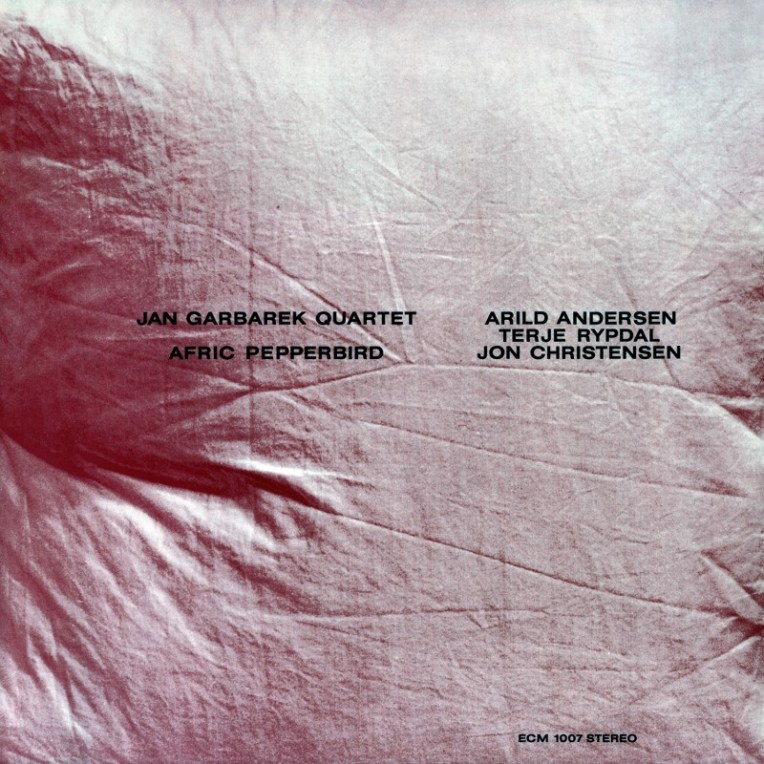
Jan Garbarek tenor and bass saxophones, clarinet, flutes, percussion Terje Rypdal guitar, bugle Arild Andersen bass, african thumb piano, xylophone Jon Christensen percussion
Recorded September 22/23, 1970 at the Bendiksen Studio, Oslo
Engineer: Jan Erik Kongshaug
Produced by Manfred Eicher
Release date: January 1, 1971
Saxophonist Jan Garbarek has changed with time and age, but already in Afric Pepperbird, his first album for ECM and one that would instigate an unbreakable association with the label, he invites us into a world that is playful yet mature. Half of the album is made up of miniatures, “Skarabée” and “Mah-Jong” the most precise and delicate among them, laced as they are with drummer Jon Christensen’s distinctive cymbal work and overall compositional sensibility. “MYB” and “Concentus,” for their part, drop like seeds into the album’s fertile soil. Bassist Arild Andersen’s steady bass line assures us the title track can swing with confidence, pouring on Saharan charm like fresh honey, while “Blow Away Zone” features an adventurous Terje Rypdal on guitar and an ether-wrenching solo from Garbarek, who squeezes his way through an opaque tornado of bass and drums. Clocking in at twelve-and-a-half minutes is “Beast Of Kommodo,” a rewarding romp of gargantuan proportions. Garbarek gives his all, mixing roars with fluted reveries with equal conviction. The set bows out with “Blupp,” a smile-inducing froth of percussion and vocals that doesn’t so much describe its title as demonstrate it.
This may very well be the quintessential Garbarek album for those who normally don’t care for his style. Whatever your taste in jazz, whatever your opinion on Garbarek and the label he calls home, this is a spirited and robust effort worthy of your attention.
<< Wolfgang Dauner: Output (ECM 1006)
>> Robin Kenyatta: Girl From Martinique (ECM 1008)
Wolfgang Dauner piano, effects (ring modulator), keyboards (Hohner Electra-clavinet C) Eberhard Weber bass, cello, guitar Fred Braceful percussion, voice
Recorded September 15 and October 1, 1970 at Tonstudio Bauer, Ludwigsburg
Engineer: Kurt Rapp
Produced by Manfred Eicher
Release date: December 1, 1970
An early outlier in the ECM catalog, Output convulses with as much originality as it did when it was first released. Wolfgang Dauner, perhaps better known as founder of the United Jazz + Rock Ensemble (which saw ECM greats Eberhard Weber, Kenny Wheeler, and Charlie Mariano pass through its doors), assembles a modest trio of talent for this classic 1970 studio free-for-all. The end result is humor, brilliance, and chaos rolled into one. Most of the album flirts with any number of possible paths, the sole exception being “Nothing To Declare,” a straight-laced tangent into jazzy territory in which Dauner has a field day with his modulator. “Mudations” and “Brazing The High Sky Full” are cryptic bookends, while tracks like “Abraxas” whet our appetite with provocative flavors.
Superb, if jumbled, musicianship and strong attention to detail are the order of the day. Dauner does wonders with limited means, Braceful sheds his skin whenever possible, and this is a far cry from the Weber of languid orchestral suites. Not an easy listen for the faint of heart, but one that will give back what’s put into it and, like the fully opened cover, gathers its power from another dimension.
<< The Music Improvisation Company: s/t (ECM 1005)
>> Jan Garbarek Quartet: Afric Pepperbird (ECM 1007)
Derek Bailey electric guitar Evan Parker soprano saxophone Hugh Davies live electronics Jamie Muir percussion Christine Jeffrey voice
Recorded on August 25-27, 1970 at Merstham Studios, London
Engineer: Jenny Thor
Produced by Manfred Eicher
Release date: November 1, 1970
Derek Bailey is a pioneer of British free improvisation, and although this is one of his earliest recordings, it houses much of what he would come to be known for: microscopic precision, a love of empty space, a supremely fractured aesthetic, and a subtle disregard for the rules. As with his later solo outings and fruitful collaborations with John Zorn and other bastions of the avant-garde, Bailey brings full commitment to the table in this early, digitally reissued ECM recording. Yet how to describe it? A possessed duck call tripping down a flight of stairs into a pile of discarded instruments? A broken jack-in-the-box heavily amplified on cheap speakers? A radio being tortured to give up its innermost secrets? None of these comes close to mapping the album’s rambling course. Still, the results are consistent. So much so that track titles like “Packaged Eel” do nothing to deepen our understanding of the goings on. As can be expected from the roster, the musicianship is of indisputable quality. Evan Parker awes with his outbursts of indiscernible melody while Bailey cultivates an anonymous approach, cutting in and out from behind a surgeon’s mask.
The Music Improvisation Company is nothing more or less than what one makes of it. Its difficulties are also what make it go down smoothly. A mysterious morsel that yields a new flavor with every taste.
<< Marion Brown: Afternoon Of A Georgia Faun (ECM 1004)
>> Wolfgang Dauner: Output (ECM 1006)
Marion Brown alto saxophone, zomari, percussion Anthony Braxton alto and soprano saxophones, clarinet, contrabass clarinet, Chinese musette, flute, percussion Bennie Maupin tenor saxophone, alto flute, bass clarinet, acorn, bells, wooden flute, percussion Chick Corea piano, bells, gong, percussion Andrew Cyrille percussion Jeanne Lee voice, percussion Jack Gregg bass, percussion Gayle Palmoré voice, piano, percussion William Green top o’lin, percussion Billy Malone African drum Larry Curtis percussion
Recorded August 10, 1970 at Sound Ideas Studio, New York City
Engineer: George Klabin
Produced by Manfred Eicher
Release date: November 15, 1971
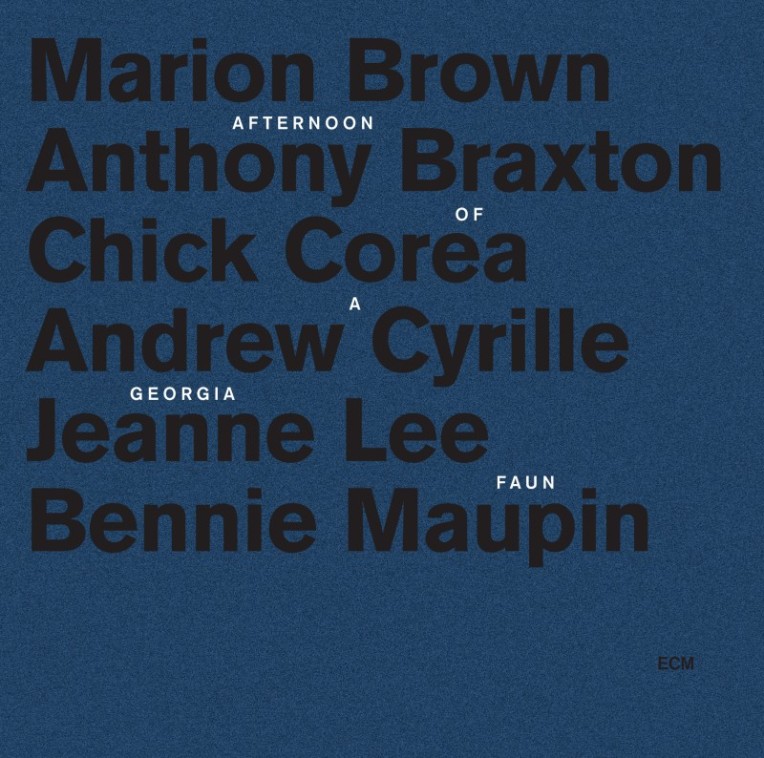
A subtle congregation of clicks, pops, breaths, and whistles eases us into this challenging yet rewarding recording from a mobile group of musicians, many of whom—Jeanne Lee, Anthony Braxton, Chick Corea, Bennie Maupin, and Marion Brown himself—are now household names in the avant-garde circuit. Over 35 minutes we are treated to a distilled experience that jumps, flies, and slithers its way through a forest of sounds. The arrangements are heavy on reeds and percussion, with star turns from one severely abused piano and a smattering of aphasic human voices who seem bent on reducing all communication to wit and circumstance. The music is indeterminate and uncompromising and unleashes its full torrent only in the second movement, “Djinji’s Corner.” Slide whistles, snares, and bass join in the cacophony as a voice intones, “Listen to me. Can you hear?”—at last giving us some vocabulary to latch on to as we suffocate under a voracious avalanche.
Original cover
Not an album for the faint of heart,Afternoonis indicative of the brave decisions ECM was already making on its fourth release, and on it one begins to hear inklings of the space for which ECM would soon come to be known. It is also meticulously recorded. Every detail comes through (for example, when a percussionist picks up bell and rings it, we clearly hear it being returned to a cloth-dampened surface). Describing the sound of this album is, I imagine, as difficult as it was to lay it down in the studio. The sheer range of implied space is impressive, made all the more so for its organic textures. A masterpiece of free jazz and well worth the chance for the adventurous listener.
<< Paul Bley Trio: Paul Bley with Gary Peacock (ECM 1003)
>> The Music Improvisation Company: s/t (ECM 1005)
Peter Stock bass Franz Volhard cello Thomas Stöwsand cello, flute Johannes Krämer guitar Thomas Cremer percussion, clarinet Alfred Harth tenor saxophone, clarinet, trumpet Dieter Herrmann trombone
Recorded on December 13, 1969 at the Nettekoven Studios, Frankfurt am Main
Produced by Just Music and Manfred Eicher
Release date: May 1, 1970
Just Music was the moniker for a rotating West German collective whose musical “happenings” were a nascent challenge to mainstream sociopolitical strictures. Although the classical training of these musicians is readily apparent from their technical prowess, the opening outburst tells us we’re in for something less rule-bound. Alfred Harth tears the ether with his sax amid wordless chanting as a cornucopia of musical ideas is thrown into our ears. That said, these two 20-minute free-for-alls weave a quietude broken only by the occasional peak of intensity.
Alternate cover
Released in 1969, this self-titled date was the second for ECM Records and is still out of print. It remains a veritable zoo of musical languages in which each dialect is its own animal: caricature of an impossible ideal. Sax and trombone roar like elephants; the flute is a bird that would just as soon go into feathery convulsions as fly; the cellos are reptilian; the bass lumbers like a lion from its den; drums trip over themselves like a drowsy bear; and a guitar chatters with the insistence of an agitated monkey. This leaves only the human voices, a mockery in and of themselves. Just Music flips through a mental file of everything learned at the academy, scribbling in addendums of extended techniques for good measure. Where one moment finds us in our comfort zones, the next proves our power of direction to be fallible, forcing us to wander everyday streets as if for the first time.
I hesitate to call this controlled chaos, for it is no less illustrative of the chaos of control. We may not understand what we have just witnessed, but can’t help sifting through the wreckage with curiosity.
<< Mal Waldron: Free at Last (ECM 1001)
>> Paul Bley Trio: Paul Bley with Gary Peacock (ECM 1003)
Keith Jarrett piano
Recorded October 30, 2002, Metropolitan Festival Hall, Tokyo
Directed by Kanama Kawachi
Over a career spanning nearly 70 recordings for ECM alone, Keith Jarrett has established himself as one of the world’s most inimitable and revered musicians. We marvel at his music-making, at his technical prowess and innovation, but rarely do we get to experience the physiological creativity so vital to what he does. For this concert, Jarrett’s 150th in Japan, the one and only has given us a primary source in video form, a clearer glimpse into the complexity of his craft. On the surface Jarrett is a lone pianist whose humble frame elicits some of the more towering improvisations one is ever likely to hear, and here we get to see what lies beyond that surface to the fiery core that sustains him. As he quietly takes the stage the house lights dim to circumscribe the piano, leaving Jarrett and his instrument suspended in darkness.
He blows on his hands and draws an abstract veil over our eyes and ears. What we hear is serial, boastful yet self-deprecating, and, while not entirely accessible, betrays total commitment to a challenging trajectory. Jarrett works his way through a dense cloud of notes, as if searching for the perfect one, which he finds and intones as his face contorts in mimicry of the depths plied with every repetition.
This instigates an ecstatic passage of finger pedaling, which eventually brings Jarrett to the piano’s outermost reaches. He plays a single high and low tone together before returning to the center, as if he were gently embracing every note available to him before singling out a privileged few.
We then enter the most emotional portion of the concert. Jarrett cannot help but sing along, as much in deference as we are to the sounds flowing through him. At this point we come to realize that the opening jumble was nothing more than a search for any fragment he might be able to expand into a larger narrative, and that this is the tale we are about to hear. As Jarrett begins the next section, someone claps. He stops and listens carefully before scrapping everything in favor of a new idea. What follows is an agitated catharsis that gradually beats itself into a more elegiac shape. So ends Part 1.
Part 2 is more like what we have come to expect from a Jarrett solo concert: protracted, pastoral bliss. With lips puckered and brow furrowed, Jarrett dives headfirst into a quiet maelstrom of beauty, precursor to a grinding tangent that stops as suddenly as it develops. In spite of the serious approach he manifests in his performance style, Jarrett is not without his lighter moments. He even flirts with the audience’s attentions at one point during the concert. He has just played a delicate high note to close an epic improvisation. Applause begins, but he signals silence, only to play that same note a final time. He smiles and says, “That’s it.”
From this laughter he emerges with a brilliant cascade to close. Not wanting to leave his audience without something familiar, he returns to the stage for three encores: Danny Boy, Old Man River (Jerome Kern), and Don’t Worry ‘Bout Me (Art Tatum/Count Basie)—all of them pulled off with unparalleled intuition.
Those wanting to get more out of the Keith Jarrett experience need look no further than this DVD. The camerawork and recording are simple and direct, capturing the full range of expressions and contortions at Jarret’s disposal, and the crisp sound ensures that we hear every surrender. Jarrett shows a profound respect for what he plays, be it a standard or something composed on the spot. The image of his spotlit piano is the perfect metaphor: the musical alchemist toiling over his crucibles while his admirers fall awestruck into shadow. That being said, it’s easy for us to over-romanticize Jarrett’s process, to wonder where he goes when he improvises with such fluidity. Thankfully in Tokyo Solo we no longer need to wonder, for in a performance such as this we share the same space.
Robin Kenyatta flute, alto saxophone, percussion Wolfgang Dauner Clavinet, piano Arild Andersen bass Fred Braceful drums
Recorded October 30, 1970 at Tonstudio Bauer, Ludwigsburg
Engineers: Kurt Rapp and Karl-Hermann Hinderer
Produced by Manfred Eicher
Release date: March 15, 1971
One night, after a gig in Harlem, a budding saxophonist by the name of Robin Kenyatta was approached by none other than Bill Dixon, who expressed an admiration for the young reedman’s skills and would soon introduce him to the likes of John Coltrane. Thus began a colorful and fascinating career that intersected with ECM for this album alone. The currently out-of-printGirl From Martinique shows Kenyatta at his most experimental, and the results are a mixed bag. The title track is the weakest, laden as it is with a hackneyed “psychedelic” reverb, though Kenyatta’s flute skills are in fine form here and are a joy to hear. So much so that I would have been happier listening to him play unaccompanied, perhaps in a more naturally resonant space. And while the piece does come into its own in the home stretch, it feels like too little too late. Thankfully, “Blues For Your Mama” is more straightforward with its heavy Clav bassline, priming a killer sax solo. “Thank You Jesus” sounds like a gospeller’s good dream turned bad, spicing things up with such brilliant chaos during the fadeout that one wonders where the session continued to travel after the mixing knob was turned down. The Caribbean-flavored “We’ll Be So Happy” is groovy and understated, a beautiful track that might easily have been extended to fill the entire album with no loss of interest. Kenyatta returns to the flute as an echoing Clav leads out with a mystical touch.
Kenyatta, who passed away in 2004 at the age of 62, was a standout player in the 1970s free jazz scene, and his intuition and improvisatory chops are in full evidence here. Yet in some ways this recording leaves something to be desired. The dated electronics and paltry arrangements question the need for support in its first half. The album is overproduced and, while archivally significant, shows a label (and a musician) still trying to find its voice. That all being said, the album grows with every listen as its nuances come to the fore, and rewards the patience put into it. Anyone without access to the original vinyl may want to check outStompin’ at the Savoy (1974) or the funk-infusedGypsy Man (1972) for a taste of Kenyatta’s more commercially successful (and thereby more readily available) projects before plunking down a few bills for this blast from the past.
Eberhard Weber bass, cello, ocarina Rainer Brüninghaus piano, synthesizer Peter Giger drums, percussion Ralf Hübner drums Ack van Rooyen fluegelhorn Cellos of the Südfunk Symphony Orchestra Stuttgart
Recorded December 1973 at Tonstudio Bauer, Ludwigsburg
Engineers: K. Rapp and M. Wieland
Produced by Manfred Eicher
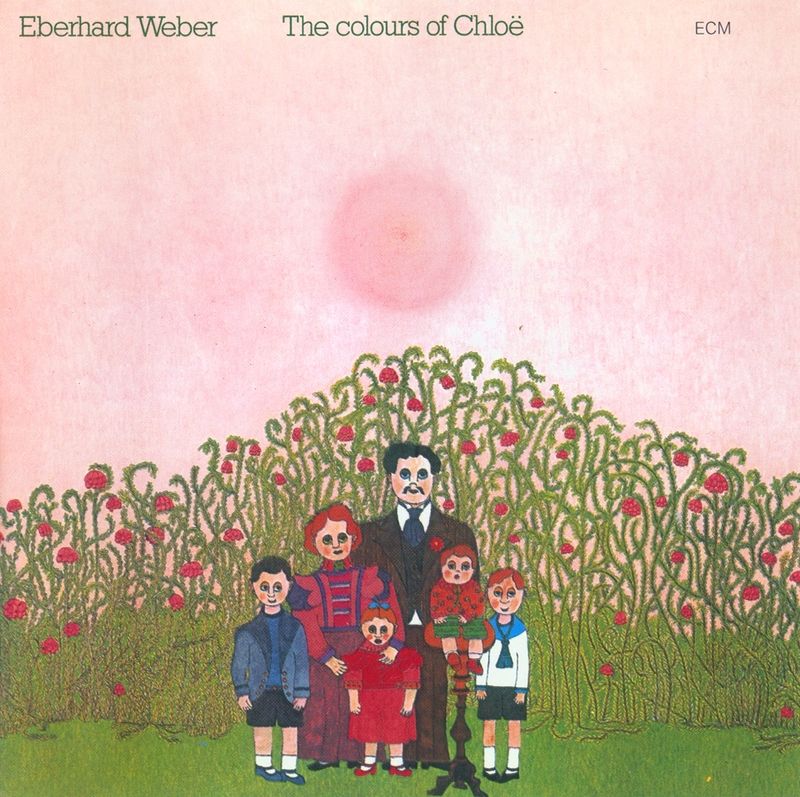
Listening to an Eberhard Weber album, one can always count on an immersive experience. This is especially true in his first as frontman. From its enigmatic title and charming cover to its fine musicianship and well-conceived instrumentation, The Colours of Chloë remains an ECM classic and may just be the perfect introductory album for those looking to know why the label was so influential even in its infancy. In a span of 4 compositions and 10 times as many minutes Weber produces a veritable mélange of flavors, textures, and, of course, colors. On that note, “More Colours” gives us just that as Weber’s bass cuts a slow swath of orchestral goodness. The title track features an ethereal ocarina* that swirls into a resplendent piano solo from longtime Weber collaborator Rainer Brüninghaus. “An Evening With Vincent van Ritz” draws from the same palette as the first track, but soon breaks into a run with some inspired drumming and a stellar fluegelhorn solo by Ack van Rooyen, while “No Motion Picture” reprises the spacey feel of the title track and shows Weber at his most profound. Not to be forgotten, Brüninghaus also has some breathing room here and provides some of the more transcendent moments in this all-too-brief journey.
Although a glance at the cover art or lineup may not exactly cry “Jazz!” Weber knows where he and his instrument stand. The music is firmly rooted in the genre’s orthodox structural standby: i.e., a solid thematic framework with plenty of room for improvisation along the way. While compositionally astute, Weber’s greatest strength is his “eye” for sound. His feel for blending instruments is highly idiosyncratic and backed by an obvious passion for music-making. His distinctive combination of bass, piano, percussion, horns, and strings is such that no one instrument or group is ever dominant for too long. Each musician is only as good as his altruism toward the ensemble as a whole. That being said, one cannot help but marvel at Weber’s signature sound at the heart of it all, or at his uncanny playing that walks the line between affirmation and mourning. This album is not to be missed.
*Thanks to Rasmus Sylvester Bryder for this correction.
<< Jan Garbarek: Witchi-Tai-To (ECM 1041)
>> Bennie Maupin: The Jewel In The Lotus (ECM 1043)
Keith Jarrett piano Charlie Haden double-bass
Recorded March 2007 at Cavelight Studio
Mastered at MSM Studios
Produced by Keith Jarrett and Manfred Eicher
“This is spontaneous music made on the spot without any preparation save our dedication throughout our lives that we won’t accept as a substitute. These are great love songs played by players who are trying, mostly, to keep the message intact. I hope you can hear it the way we did.”
–Keith Jarrett
We sometimes think that the older we get, the more complicated we become, and that in our complexity we have more ammunition with which to defend our individuality in a dying world. This album proves that maturity is about filtering out all that distracts us from being who we are and finding just the right melody, taking comfort in the method over the message. The title of the first track, “For All We Know,” says it all. That two musicians, walking such different paths, can come together and create something so powerfully understated, so viscerally unfettered, is a testament to the creative potential of knowledge and the gift of life that allows it. Recorded in Jarrett’s home studio, this is more than just The Melody At Night, With You with an added bass. It is a heartfelt meditation on the philosophy of experience, a direct statement regarding the lives of its performers. This album might as well be called “Jazzmine,” for that’s exactly what it is: a mine of tried-and-true standards, each plucked carefully from the surrounding rock and arranged in a row of sparkling gems.
The album is generally mellow, but always effective. Tracks like “Where Can I Go Without You” brim with soulful introspection. Others like “One Day I’ll Fly Away,” “I’m Gonna Laugh You Right Out,” and “Goodbye” talk of resignation, filling our cup with unkept promises in the hopes that one final showing will make up for all of them. It is a bittersweet sadness, born from the pain that comes with loving someone who is too far away to requite, much less know of, that same love. “Body and Soul” strikes a delicate balance between recollection and regret and just grazes the edges of dissonance, giving certain traction to the tune. Jarrett sings as he spins a subtle energy. In this track we also get the most unmitigated bass solo, Jarrett merely providing the punctuation marks to Haden’s poetry. “No Moon At All” is more upbeat, a touch more joyful. And yet we come to realize this joy has been lost upon us with the passing of time. Haden’s solo here revels in the simple things that bring it melodic joy. Perhaps not coincidentally, this is one of the shorter tracks, further reminding us that our happiest moments are also the most fleeting. Last but far from least is “Don’t Ever Leave Me,” a comforting ballad that closes the album in near silence.
Over thirty years in the making, Jasmine was already a classic before Jarrett and Haden ever stepped into the studio to record it. It is as if the music had already existed and our dynamic duo merely needed to catch up with it. As Jarrett observes, Haden singularly embodies a “dichotomy between control and letting it go,” laying down righteous melodies that at once support and lead the way. Haden’s renderings are supremely gentle, the subtlest retouches on an already masterful painting. His solos go down easy like good advice, while Jarrett’s gorgeous supporting chords put that advice into action. Jarrett himself adopts a more autobiographical approach that manifests itself in a uniquely laid-back passion. He displays an intuitive sense of rhythm in the left hand, and with his right weaves variegated threads through the four-stringed loom of Haden’s bass. This mesh produces an unmatched synergy: take one variable away and you are left with an unsolvable equation.
The album jacket could hardly express more visually the magic that resides within its sleeve. Each rectangle, separate but also sharing the same line, is like the life of its respective musician. Neither is perfectly straight at the edges; a life drawn in freehand, as all lives are. There is an eternity contained in each, and yet for an indeterminate amount of time these two lives intersect, and from that overlap comes music so transparent that only its borders remain clear. For the musicians those borders are their instruments. Heavy and tangible, they respond only to the touch of those who know them best. For the listener those borders are the song titles, each telling a different side of the same story.
This is an album in the past tense, every sound a memory caught in the branches of our curiosity. Jarrett and Haden would seem to prize nostalgia above all—not by putting it on a pedestal, but by laying it at the pedestal’s feet. And while each track essentially follows the same format—i.e., a democratic entrance, a piano introduction followed by adlibbing, and solos from Haden and Jarrett before the two equalize—the formula never grows tedious, if only because its subtle negotiations speak volumes of an invisible history. And that is exactly the point. They’re not trying to break new ground here, but to see what can still be built upon the old ground before it disappears. And why not, for their materials are still resilient, pliant, and reliable. Listen to Jasmine for its quiet charm, for the way it sings without words, for the tireless care it embodies, but above all listen to discover just how honest music can be. Jarrett puts it best when he says: “An ecstatic moment in music is worth the lifetime of mastery that goes into it, because it can be shared.” How fortunate we are to be on the receiving end.








 Between Sound and Space: ECM Records and Beyond