50 for the 50th: ECM’s Anniversary Touchstones

Anniversary Touchstones I

The word touchstone dates from the late 15th century, denoting a special black quartz used to test the quality of gold alloys by the streaks left behind on its surface. While it has retained its metaphorical usage as a criterion by which the quality of something—in this case, music—is measured, it feels especially apt in the context of ECM Records. The German label has always been about the object as art, if not also art as object, and through its associative chain of cover imagery, recording technology, and curated musicianship has honed a finely grained stone in its own right across which any other discography might be drawn across to judge its efficacy.

ECM released the first series of Touchstones in 2008. Numbering 40 in total, each album was a world unto itself. It only feels appropriate that ECM should revisit the idea this year in celebration of half a century’s creative operation with a series called “50 for the 50th.” Like its predecessor, this new collection gives opportunities for veteran listeners to revisit old friends and newcomers to make new ones. Label stalwarts Keith Jarrett and Arild Andersen rest comfortably alongside such legendary outliers as Mike Nock and Bill Connors. This alone relegates the choice of banner titles to the realm of near-impossibility.

One thing we can reliably measure is the cartography of cultural, instrumental, and regional depth in these 50 artful selections. Like the cardboard gatefolds in which they are now packaged, each is a streamlined presentation of otherwise uncontainable forces. Some of the farthest reaching of those forces can be found on Bennie Maupin’s The Jewel In The Lotus. Already the subject of a much-needed reissue when it found its way onto CD for the first time in 2008, this 1974 masterpiece marked the only ECM appearance of pianist Herbie Hancock and introduced drummer Billy Hart to the label’s nexus. Alongside drummer Frederick Waits, Headhunters percussionist Bill Summers, Mwandishi bassist Buster Williams, and trumpeter Charles Sullivan, the latter just two months away from Carlos Garnett’s Black Love, Maupin’s reed playing spans the gamut from romantic to extraterrestrial.

Another unmissable album is David Darling’s Cello (1992), which features the titular instrument in both its acoustic and custom 8-string electric forms. The set is entirely improvised, built around deceptively simple arpeggios and motifs from which he unravels some of the most beautiful music to be found anywhere. Floating blissfully between jazz and classical, Cello further treats the border around either category as permeable, as so many other artists under producer Manfred Eicher’s purview have.

Primary among the genre-defiers is Louis Sclavis, whose quintet effort Rouge is graciously included in the new Touchstones. Released the same year as Cello, it finds the reed player and composer in the company of violinist Dominique Pifarély, bassist Bruno Chevillon, pianist François Raulin, and drummer Christian Ville. Rouge is significant for being Sclavis’s first for ECM. “It was my doorway into this very famous label,” Sclavis tells me by phone, “and the beginning of a very long story. Over the years it has become more and moreimportant for Manfred and I to work together and I record almost every one of my projects with him. It’s vital for an artist to have a label that follows you and all your iterations. In addition to helping me and so many other artists find their musical paths, recording for ECM has the added advantage of placing your music into hands all around the world. He fights to keep as many CDs in circulation as possible, so something you recorded thirty years ago is still available. This means the world to me, as I would consider every album I’ve done to be equally important on a personal level.” The inclusion of Rouge and all its wonders is proof positive of this philosophy and speaks to the vitality of ECM as an archive in recorded sound. It also reminds us that neither these nor any other 50 albums plucked from a catalog of over 1600 no more represent ECM than ECM represents them. The circularity of that relationship is the key to their longevity and more than justifies their trajectory into every fortunate ear.

Anniversary Touchstones II

(This article originally appeared in condensed form in the November 2019 issue of DownBeat magazine.)

Rabbia/Petrella/Aarset: Lost River (ECM 2609)

Lost River.jpg

Lost River

Michele Rabbia drums, electronics
Gianluca Petrella trombone, sounds
Eivind Aarset guitar, electronics
Recorded January 2018, ArteSuono Studio, Udine
Engineer: Stefano Amerio
Produced by Manfred Eicher
Release date: May 31, 2019

the cold water, the black rushing gleam, the
moving down-rush, wash, gush out over
bed-rock, toiling the boulders in flood,
purling in deeps, broad flashing in falls…
–Robert Duncan, “Styx”

The trio assembled on Lost River was suggested by ECM producer Manfred Eicher, who recognized in their combination something extraordinary. Largely improvised, the music takes shape as much in retrospection as in the spontaneity of given moments. In the intimate tradition of such artists as Jon Hassell (especially in the final track, “Wadi”) and Nils Petter Molvær, yet with a free-flowing energy uniquely their own, these ten tracks circle like birds of prey with in-built thermals who need no other nourishment than the beauty of being heard. In the nexus between Michele Rabbia (drums, electronics), Gianluca Petrella (trombone, sounds), and Eivind Aarset (guitar, electronics), a world unto itself unfolds.

Every amorphous facet of said world is predicated on water in a particular state of being, if not also the state of being imparted to physical bodies in relation to water. Such titles as “Flood” and “What Floats Beneath” turn weeping into a physical substance from which nourishment may be gathered while sailing on a flow of tears. The latter assemblage recalls the biological ambience of Aarset’s Dream Logic, its movements fluid yet latticed by fragmentary impressions whose new coherence is born. Other rivers take form throughout. Where in “Styx” the groaning trombone and voices from afar sound like something out of a science fiction film, “Fluvius” filters pacificism through a twilit arpeggio and brews it into a tea of melodic potency. The title track is the most metaphysical of them all: a float between realms, finding purchase at the molecular level.

“Night Sea Journey” plunges deepest, wherein shifting tectonic plates release repeating signals and itinerant breathing. Field recordings of melting ice and other ballets of renewal animate “What The Water Brings,” while the inchoate “Flotsam” answers those questions of thaw with new life. All of this finds origin, however, in the misty “Nimbus,” which opens with an almighty inhalation. Details emerge from its oceanic possibilities, each grasping a current of wind that might take it to land. Instead, they cohere—suddenly, cinematically—into a vessel in their own right, cutting through waves of electronic processing. A bass line tears up coral and memory, gripping the magma of a long-forgotten volcano to show us its glow before it cools. And so, along for the ride, we leave behind a trail of islands, each smaller than the last, until only a pebble remains: a final token of its own demise.

Below is a video from 2010 documenting an early incarnation of this project at Teatro Astra in Torino, featuring the same trio with Gianluca Lo Presti and longtime ECM photographer Roberto Masotti processing live images in tune with the music being played. Although of a more eruptive quality than what’s documented here, it shines with the excitement of discovery.

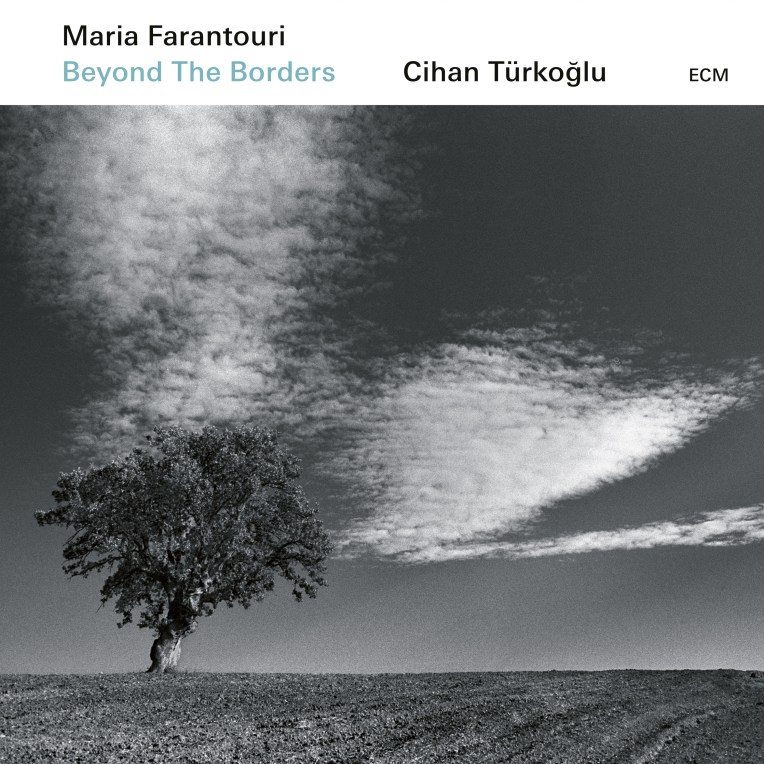
Maria Farantouri/Cihan Türkoğlu: Beyond The Borders (ECM 2585)

2585 X

Maria Farantouri
Cihan Türkoğlu
Beyond The Borders

Maria Farantouri voice
Cihan Türkoğlu
saz, kopuz, voice
Anja Lechner 
violoncello
Meri Vardanyan kanon
Christos Barbas
ney
İzzet Kızıl percussion
Recorded June 2017, Sierra Studios, Athens
Engineer: Giorgos Karyotis
Produced by Manfred Eicher
Release date: June 21, 2019

“Everything flows.
Out of one thing there comes unity,
and out of unity one thing.”
–Heraclitus

The project documented on Beyond The Borders was born when Greek singer Maria Farantouri first heard Cihan Türkoğlu, a saz virtuoso of Anatolian extraction who had been living in Athens for ten years. After proposing the idea to ECM, producer Manfred Eicher helped shape the program into its present form, debuting it as part of the 2017 Athens Festival. For this live performance, they are joined by Anja Lechner on cello, Meri Vardanyan on kanon, Christos Barbas on ney, and İzzet Kızıl on percussion. Their collective sound is distinctly individual, like a soul of many cities and eras compressed into the flesh of a single body.

Most of the songs are traditional treasures from the lands of Turkey, Armenia, Lebanon, and Greece. Each tells a story preserved by centuries of reiteration, and achieves relevance as a cool drink of water in today’s political firestorm. The scintillating arrangement of “Drama köprüsü” (The Bridge of Drama) finds both Türkoğlu and Farantouri singing the life of Hassan, a legendary Robin Hood-like figure who went rogue after slaying his superior, stealing from the rich and giving to the poor while shadowing the village just to glimpse the woman to whom he was once betrothed. The Sephardic ballad “Yo era ninya” (I Was a Girl) tells of a highborn maiden ruined by a deceitful man. A mournful quality made resolutely genuine by Farantouri’s delivery, as if sung through a cloud, makes this a standout among standouts. Lechner’s cello is remarkable, a red thread drawn through shadows of time.

From Armenia we receive “Kele kele” (Strolling), an anonymous song preserved by Komitas Vardapet around the turn of the 20th century. In it, a lovelorn girl sings: “I am dying for your footsteps, my precious.” An extended intro from Vardanyan paints a wide terrain on which to seek the traces of her loved one. Not all is so gloomy, however, as the Macedonian wedding song “Triantafylia” (Upon the Rosebush) works from a quiet introduction to an energy powerful enough to shine unscathed through a pessimistic future. “Wa Habibi” (My Beloved), a Christian hymn from Syria and Lebanon, unravels with a lifetime’s worth of experience in every throaty word.

The program is rounded out by songs written specially for Farantouri with music by Türkoğlu and words by Agathi Dimitrouka. “Dyo kosmoi mia angalia” (Embraced Worlds) takes Eros as its theme and evokes loving attributes via kanon, in which are felt reflections of sunlight upon a body of water whose surface is a portal between realms. “Ta panda rei” is a setting of Heraclitus, whose blurring of parts and wholes, of lives and life itself, yields percussive details from Kızıl and breaths from the ney of Barbas. Between “Lahtara gia zoi” (Yearning for Life), an empathic song for the uprooted, and “Anoihtos kaimos” (A Secret Yearning), a surreally uplifting dream, we feel the connective tissue of death and life as if it were the very substance of our hearts. With every beat, we get closer to this music, even as it follows its own path through the tragedies of our world.

Stephan Micus: White Night (ECM 2639)

White Night

Stephan Micus
White Night

Stephan Micus guitars, duduk and bass duduk, cymbals, kalimba, sinding, dondon, voice, cane whistles, nay
Recorded 2016-2018 at MCM Studios
An ECM Production
Release date: April 26, 2019

Though the purity of the moonlight has silenced both nightingale and cricket,
the cuckoo alone sings all the white night.
–Anonymous, Japanese

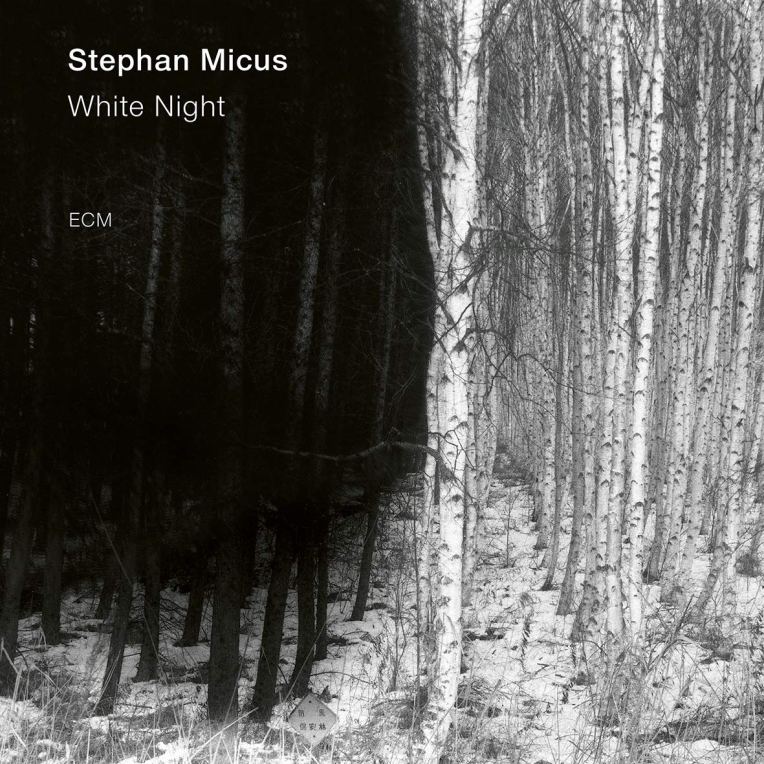
White Night is Stephan Micus’s 23rd solo album for ECM and might just be his most inwardly focused. Figuring centrally in this sojourn is the kalimba, which through various incarnations hosts us at six of the ten waystations marking our path.

The bronze kalimba—a modern version of this ancient instrument—makes magical appearances in “The Forest” and “The Bridge.” Both tracks feature purely phonic vocalizations. The latter song multiplies the kalimba by four and adds the sinding, a West African harp with cotton strings that resonate through a gourd. As one of his most evocative pieces to date, it seeks meaning in selfless regard. Other vital stars in this constellation include “The Poet” (kalimba, sinding, voice), in which the voice primes soil for harvest; “The River” (2 kalimba, duduk), which elicits gamelan-like textures and suspends the duduk in gentle persuasions of moonlight; and “Fireflies” (kalimba, sinding, 13 Indian cane whistles, 7 voices), which renders the earth an altar for vocal offerings. And then there is the kalimba solo “All The Way,” touched by the souls of a faraway people. Each is a journey within a journey, a story within a story, a prayer within a prayer.

Framing the album are “The Eastern Gate” (5 fourteen-string guitars, bass duduk, Tibetan cymbals, steel-string guitar) and “The Western Gate” (5 fourteen-string guitars, bass duduk, sinding, Tibetan cymbals). Their fourteen-string guitars have a slack, liquid quality, which by virtue of their human construction (they are designed by Micus) reveal more-than-human energies. Harmonics speak of realms beyond the senses, while the bass duduk tenders its grace. From one gate to the other, we embrace the world in the span of 50 minutes, starting the cycle anew. Along the way, we stop to view “The Moon,” wherein a role that might normally have been filled by lone shakuhachi finds a multivalent replacement in the double-reed duduk. Like the nay that appears alongside the Ghanaian dondon (or talking drum) in “Black Hill,” it is a thought made incarnate by contact of skin and breath.

Marc Sinan/Oğuz Büyükberber: White (ECM 2558)

2558 X

Marc Sinan
Oğuz Büyükberber
White

Marc Sinan guitar, electronics
Oğuz Büyükberber clarinet, bass clarinet, electronics
Recorded October 2016, Rainbow Studio, Oslo
Engineer: Jan Erik Kongshaug
Produced by Manfred Eicher
Release date: May 18, 2018

No matter where I am yet I shall not forget our mournful songs,
Shall not forget our steel-lettered books which now have become prayers,
No matter how sharply they pierce my heart our wounds so soaked with blood,
Even then I love my orphaned and my bloodied, dear Armenia.
–Yeghishe Charents

On White, German-Turkish-Armenian guitarist Marc Sinan and Turkish clarinetist Oğuz Büyükberber join more than forces, blending history and all-but-forgotten biographies into a mosaic of reckoning. After working together in the much larger ensemble of Hasretim: Journey to Anatolia, they now present their first recording as a duo, and the result of their collaboration is one of the most ghostly albums to be released on ECM in recent years.

The program consists largely of a suite by Sinan entitled upon nothingness. Combining field recordings from 1916 of Armenian prisoners of war in German detention camps, it is divided into colored subsections of yellow, blue, green, white, and red. The field recordings add a sense of mystery, trickling from cracks in the wall around this unthinkable past while also seeming to scale said wall from a peaceable future. Caged folksongs—each a cry for freedom in places where such a concept feels as distant as the sky—act as catalysts for our two performers, who in their present clarity touch the looking glass of retrospection as if it were a talisman close to breaking. Electronics flood the air, foregrounding inner turmoil.

Sinan’s guitar is multivalent, at one moment tracing a barbed yet invisible border of hatred around the afflicted while the next igniting that ring as a halo of grace. Tents and squalid conditions peak from the images of a lost era like glaciers whose tips only hint at the immense traumas fanning out beneath the surface of a collective amnesia. As lost souls whose only hope is to be grasped like wisps of creative thought, their echoes give rise to electronic embraces wider than any arms of flesh could accommodate. In the album’s eponymous “white” section—a guitar piece written by Büyükberber and transformed by Sinan—we encounter shooting stars, forced to observe from a darkness without ornament.

Interspersed throughout is Büyükberber’s five-part there. Painting a more straightforward, though no less inspired narrative, it strikes a free jazz kaleidoscope, opening windows into windows into windows. Sheltered by their fragmentary architecture, symbiosis becomes the norm, and we as individual agents the exceptions taking in their stories as if they were our own.

Areni Agbabian: Bloom (ECM 2549)

2549 X

Areni Agbabian
Bloom

Areni Agbabian voice, piano
Nicolas Stocker percussion
Recorded October 2016, Auditorio Stelio Molo RSI, Lugano
Engineer: Stefano Amerio
Produced by Manfred Eicher
Release date: April 26, 2019

Patience is more important now…

Bloom marks the ECM debut of a God-given talent. Areni Agbabian, an Armenian American from Los Angeles, is far more than any biographical sketch might seek to define her, if only because her art points to at least two futures for every past in which it is tangled. As a singer, she is equal parts Meredith Monk and Kate Bush, and in that respect embodies the power of wordless improvisation to tell as much of a story as a crafted lyric. As a pianist, she treats keys as seeds and by her touch inspires them to sprout feathers in place of leaves. As a songwriter, she gathers all of these metaphors in a sacred circle, and by that act offers them as prayers to the forces flowing through her. For this album, she is joined by percussionist Nicolas Stocker, whose textural sensibilities open their arms to whatever impulses arise in the studio.

The album’s cycle of life begins in the fullness of adulthood with the bipartite “Patience.” Its combination of muted piano and brushed snare meshes around Agbabian’s sung mantras, which just as soon pivot into unexpected territories with messages written in blood, tenderness, and possibility. She returns occasionally to auras of meaning, but connects them spontaneously to innermost chambers. “A time to be with you as a time to pray,” she intones, and in that call to psychological arms gives us all the shielding we need to fend for ourselves in a world run emotionally dry. As the first drop in a sprinkling of lyric-based pieces—which also includes the astonishingly cinematic “The Water Bride,” a folk tale rendered in spoken word, and “Mother,” an anthem for all humankind—it is an ocean in the making.

More often, Agbabian takes shelter in absence of words. Drawing a thread of continuity through such diverse selections as the traditional Armenian hymn “Anganim Arachi Ko,” the folk melody “Garun a,” and the original “Seeing More,” she traces that string to a mirror, in whose surface it seems to continue on forever into darkness. In each of these songs she takes a pondering look into the truth of the human condition, naked and vulnerable to pain, and by her very acknowledgment opens herself to intimacies of creation. The latter are best expressed in the fully improvised “The River,” in which she and Stocker add grooves of their own to the other’s sonic fingerprints and which yields the percussionist’s solo vision of “Colored,” which also finds a partner in his haunting “Light Effect.”

Agababian’s pianism shines brightest in “Petal One” and “Petal Two,” both of which presage the natural imagery of “Full Bloom,” and in two further pieces, “Rain Drops” and “Whiteness,” born of suggestions made by producer Manfred Eicher in the studio. But despite the album’s title, we know that most of what we hear is only some of what we get. Like the pinecone held before her face in the cover photograph, Agbabian reveals only the corner of a smile and leaves us free to imagine its curve into melodies yet to be gifted.

Marco Ambrosini/Ensemble Supersonus: Resonances (ECM 2497)

2497 X

Marco Ambrosini
Ensemble Supersonus
Resonances

Marco Ambrosini nyckelharpa
Anna-Liisa Eller kannel
Anna-Maria Hefele overtone singing, harp
Wolf Janscha Jew’s harp
Eva-Maria Rusche harpsichord, square piano
Recorded November 2015, Auditorio Stelio Molo RSI, Lugano
Engineer: Lara Persia
Album produced by Manfred Eicher
Release date: June 21, 2019

Nyckelharpa virtuoso Marco Ambrosini returns to ECM with a project as successful as it is ambitious. In Ensemble Supersonus, he has forged a far-reaching prism through which to shine the light of his neglected forte, and by its rainbow effects a wealth of reimagined material. For Resonances, he is joined by Anna-Liisa Eller on kannel, overtone singer Anna-Maria Hefele, Wolf Janscha on Jew’s harp, and harpsichordist Eva-Maria Rusche.

The album opens with Ambrosini’s unaccompanied “Fuga Xylocopae.” As the keystone to the geometry that follows, it renders an entire world of possibilities, and from that panoply frames eleven further scenes, each more painterly than the last. In its wake, Heinrich Iganz Franz Biber’s “Rosary” Sonata No. 1 gets a chemical peel, touched by Hefele’s blinding inner-space and Rusche’s sparkling plectra. Through it all, Ambrosini’s abilities delight, touching off minutiae that one would never have guessed to be lurking in Biber’s psyche. Music by Johann Jakob Froberger (an e-minor Toccata played on square piano) and Girolamo Frescobaldi (a Prelude and Toccata with added nyckelharpa) flesh out the Biberian zeitgeist.

Although released in 2019, this album was recorded in 2015, one year after the ensemble’s present lineup cohered in a mutual search for ancient and modern music with such Baroque modes as their fulcrum. From the Medieval mysticism of Hildegard von Bingen’s O Antiqui Sancti, made manifest by Hefele’s liminal voicing, to the starkly visual writing within the group, nothing in the program is out of place. In the latter vein, Janscha contributes three compositions: Ananda Rasa, Fjordene, and Ritus. The first and last are statues come to life, actors moving across a silver screen, while the second is a Jew’s harp solo of deepening soul. Rusche adds her own: the kinetic and vivacious Erimal Nopu, a buoyant polyphony of spirits that seems inspired as much by 17th-century harmonies as by Manuel de Falla. As does Hefele, whose 2 Four 8 is a forest of overtones through which a full moon shines.

The traditional Swedish “Polska” widens the ensemble’s meeting ground like antique machinery oiled to renewal. Ambrosini sighs and sings, treating laments as messages in a bottle cracked open only in dreams. Another standout in this fantastical regard is “Hicaz Hümâyan Saz Semâisi” by Veli Dede, whose music has intersected with ECM before via Anouar Brahem’s Conte de l’incroyable amour. Its modal beauties are familiar and forever searching, thus proving that, for all its backward glances, Ensemble Supersonus is looking resolutely forward, as I hope we can to a follow-up in the future.

Julia Hülsmann Trio: Sooner and Later (ECM 2547)

Sooner and Later

Julia Hülsmann Trio
Sooner and Later

Julia Hülsmann piano
Marc Muellbauer double bass
Heinrich Köbberling drums
Recorded September 2016 at Rainbow Studio, Oslo
Engineer: Jan Erik Kongshaug
Produced by Manfred Eicher
Release date: February 24, 2017

Julia Hülsmann returns to ECM bearing the flag of the phenomenal trio that marked her label debut as leader. Rejoined by bassist Marc Muellbauer and drummer Heinrich Köbberling, she paints one fully fleshed image after another, leaving not a single brushstroke unnoticed. Such artistry abounds in the album’s opener, “From Afar.” One of four originals by Hülsmann, it signals a theme of itineracy, inspired in no small part by her travels with the band in North and South America, China, and Central Asia. The latter geography reveals deepest influence in “Biz Joluktuk,” a melody by a 12-year-old violinist from Kyrgyzstan named Rysbay Abdykadyrow. In addition to its melodic beauties, it’s also a quintessential example of how movement connects humanity in the spirit of allusion. Hülsmann’s “J. J.” and “Soon” are especially head-nodding tracks, sparkling like a disco balls in some cerebral night club. “Der Mond” ties a beautiful ribbon around it all for a final swing of the compass. “Thatpujai” is a standout track. This introverted homage to German jazz pianist Jutta Hipp (1925-2003), whose name was anagrammed into the present title, is built around transcriptions of Hipp’s solos and goes straight to the heart.

Köbberling and Muellbauer contribute two tunes apiece. Where the drummer’s “You & You” is a rhythmically savvy and sunlit tune brimming with welcome, “Later” is a groovier affair, replete with complex changes, superb bassing, and sumptuous piano voicings. The bassist walks an enchanting path in his “The Poet (for Ali),” as if turning the desert into a giant piece of sheet music in wait of each step to notate it. “Offen,” by contrast, flips the scales into a tropical climate and finds Hülsmann weaving her mantras one pregnant word at a time.

Rounding out the set is an arrangement of Radiohead’s “All I Need,” which by its gentle suggestions rewrites the parameters of the trio’s boundaries while also deepening them in their place.

Gary Peacock Trio: Tangents (ECM 2533)

Tangents

Gary Peacock Trio
Tangents

Marc Copland piano
Gary Peacock bass
Joey Baron drums
Recorded May 2016, Auditorio Stelio Molo RSI, Lugano
Engineer: Stefano Amerio
Produced by Manfred Eicher
Release date: August 25, 2017

Following the 2015 debut, Now This, Gary Peacock helms his trio with pianist Marc Copland and drummer Joey Baron once again into pristine waters. As if by force of metaphor, the trio indeed coheres like a finely made vessel in the set’s opener, “Contact.” The first of five Peacock originals, it opens with the bassist by his not-soon-to-be-lonesome, a voice with something to say. As Copland’s postmodern lyricism and Baron’s scintillating cymbals step into frame, we find ourselves moving from doorway to outside world. Throughout Peacock’s other compositions, whether in the evocative “December Greenwings” or the narrative title track, his bassing rises and falls as a city breeze while Copland fills in the footsteps of every pedestrian footprint below. And in the enthrallments of “Tempei Tempo” and “Rumblin’” he blossoms into jagged grooves that only reinforce their adhesive qualities with every rhythmic turn.

For this session, Baron pens the rightfully bubbling “Cauldron,” a sonic stew that goes down one hearty morsel at a time. His detail-rich drumming proves to be an intuitive foil for Copland’s chord voicings, as well as for Peacock’s ebullience. “In And Out” is another Baron creation that finds the drummer in lithe duet with Peacock. Copland contributes his own “Talkin’ Blues,” which by its sharp turns and fancy footwork glides over a uniquely joyous terrain.

The trio’s resplendent takes on nocturnal standards like Alex North’s “Spartacus” and Miles Davis’s “Blue In Green” show us only what masters can do with the masters when recorded by the masters, while between them breathes the freely improvised “Empty Forest.” This gentle yet no-less-formidable beast of a tune hangs its stars from every tree to replenish a foliage withered by time.

Remarkable about Tangentsis how equally each player contributes to the overall sound. One could write its roster on a wheel, spin it at any moment, and find enjoyment by focusing on whatever name it lands on. Everyone is as much a listener as a crafter of that which is heard, a chaser of the same muse whose love of communication is as indelible as the sentiments conveyed here.