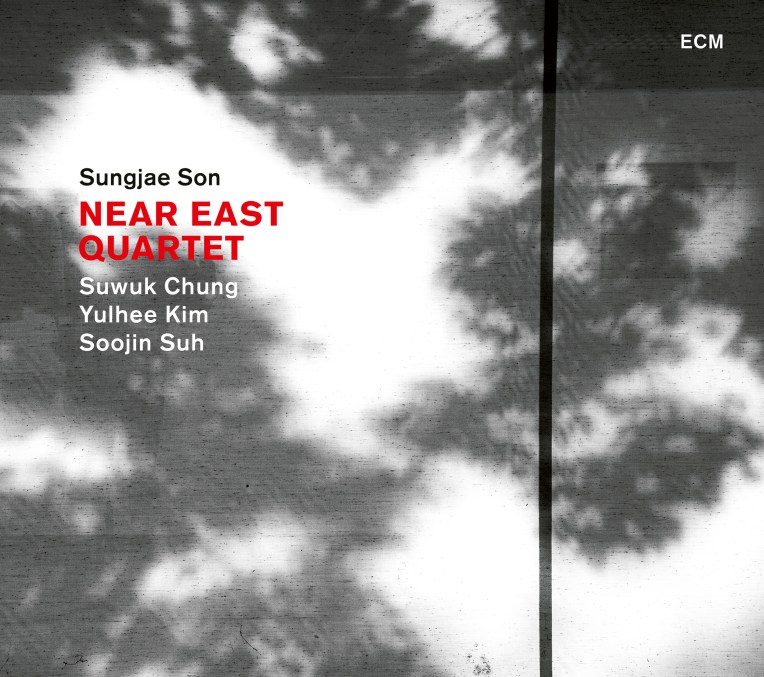
Sungjae Son: Near East Quartet (ECM 2568)

2568 X

Sungjae Son
Near East Quartet

Sungjae Son tenor saxophone, bass clarinet
Suwuk Chung guitar
Yulhee Kim vocal, percussion
Soojin Suh drums
Sori Choi traditional Korean percussion on “Baram”
Recorded December 2016, Stradeum Studio, Seoul
Engineer: Rick Kwan
Mixed by Nicolas Baillard, Manfred Eicher, and Sun Chung at Studios La Buissonne, Pernes-les-Fontaines
Produced by Sun Chung
Release date: August 31, 2018

Saxophonist/composer/bandleader Sungjae Son and his Near East Quartet splash into ECM territory with this phenomenal debut. Joined by guitarist Suwuk Chung, singer-percussionist Yulhee Kim, and drummer Soojin Suh, he charts new paths along old maps, bringing traditional Korean music, or gugak, into the stratosphere of improvisation. It’s a unique concept not explored on the label since Then Comes the White Tiger, but with a freshness all its own. The concept is in the name, which came at the suggestion of Chung. In the guitarist’s words: “We’re all born and raised in an Eastern country, but our identity is very much Westernized. Not by choice of our own, but of the world that made us. So we can’t really say our music is from the ‘East.’ Rather, it feels like we’re standing somewhere near it.” This push and pull of identity politics is expressly felt in the set’s two Korean folk songs. Where “Mot” zooms in like a cinematic close-up on a young woman picking lotus seeds, the seafaring “Pa:do” evokes the undulation of waves, both literal and figurative. Son’s bass clarinet in the former moves full dark over desolate landscape while Suh’s drums in the latter illuminate details where few others would find purchase. The ability of both to embody what they articulate is marvellous.

In response to the question of combining traditional Korean music and jazz, Son tells me by email that for him jazz “is all about different cultures meeting together from the start. It’s only natural for me to bring something from my own cultural background into jazz that I love. East and West share the beauty of sound and the beauty of silence. As for what makes Korean traditional music distinct, I can only say that it embraces empty space instead of filling it in.” And embrace it they certainly do in “Ewha.” This opening track is a portal of welcome into a sound-world that’s equally physical and immaterial. Its mood is so initiatory that it’s all one can do to close one’s eyes against the glare of its forthrightness. It shares body heat as a way of shedding the skin of expectation for something uniquely honest.

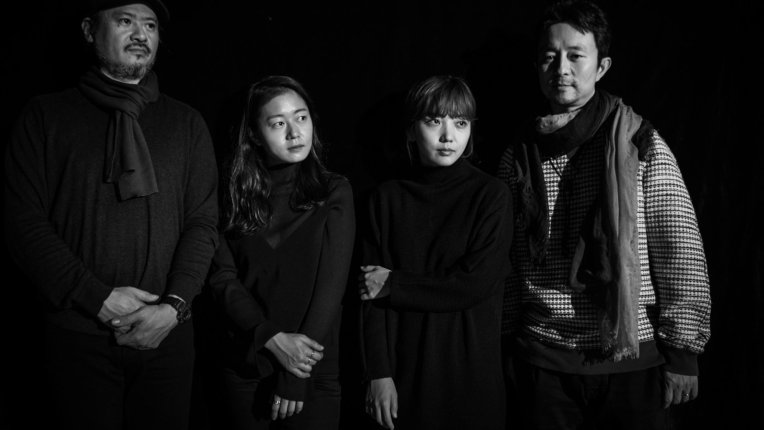
NEQ
(Photo credit: An Woong Chul)

Just as the modern elements emphasize their ancient counterparts, so do the ancient shed light on the modern. In that respect, however, Son has little to say with regard to the Korean jazz scene: “My quartet doesn’t sit squarely in the Korean jazz scene, which is small enough as it is and has no place for outsiders like us. It hasn’t been easy, but we’ve made due by creating our own scene.” Listening to tracks like “Baram,” for which Sori Choi joins on traditional percussion, it’s impossible to disagree. The first in a handful drawn from the orally transmitted Pansori epics, it’s told from the viewpoint of a lover wishing for word from the one who has left her behind, yet whose dedication results in a fatal beating when she refuses a local magistrate. Her only hope is to reunite with her true love in another life. Kim sings with audacity and emotional integrity, embraced by a cosmic pond of guitar and lured by the percussion’s death knells. As also with the urgency of “Galggabuda” and patient intensity of “Jinyang,” each word feels like a sonorous wound. That said, Son attributes no special thematic significance to the chosen texts. “The language itself,” he says, “has its own color and rhythm that brings a different atmosphere to the music. There’s no point in understanding the meaning of the lyrics in my music.” To be sure, we can just as easily feel its pulse as if it were our own without translation.

This feeling of human connection is only enhanced by producer Sun Chung, whose gentle hand is felt by its very absence. “He never tried to guide us or anything,” recalls Son. “He just believed in our music. We recorded new songs that no one has heard before. Even we didn’t know what was going to happen. But during the recording, I felt like he already knew exactly what needed to happen. At one point I asked him, ‘Sun, why don’t you say something?’ To which he responded, ‘I’m not here to speak. I’m here to support whatever it is you want to do.” Although such freedom of expression is palpable throughout, it’s especially evident in “Garam” and “Ebyul.” Like currents flowing between islands, they make long distances seem surmountable by mere strum of guitar, brush of drum, or whisper of reed. Each is a dream turned inside out until we can step through it in reality, breathing in words as sacrifice and exhaling melody as reward.

When I ask Son what he hopes listeners will experience in this album, his answer is as straightforward as the music it describes: “Somethin’ else.”

John Abercrombie Quartet: Up and Coming (ECM 2528)

Up and Coming

John Abercrombie Quartet
Up and Coming

John Abercrombie guitar
Marc Copland piano
Drew Gress double bass
Joey Baron drums
Recorded April/May 2016 at Avatar Studios, New York
Engineer: James A. Farber
Assistants: Thom Beemer and Nate Odden
Produced by Manfred Eicher
Release date: January 13, 2017

The quartet of guitarist John Abercrombie, pianist Marc Copland, bassist Drew Gress, and drummer Joey Baron, last featured on 2013’s 39 Steps, returns for the final ECM album to be released before the bandleader’s death. As if we ever needed a reminder of why his art was more than its own musical country but a continent unto itself, this gorgeous swan song fulfills that duty and then some.

Each facet of Up and Coming pays tribute to Abercrombie’s meteoric development as a musician, and by the brushwork of his bandmates renders a group portrait quite unlike any other in the business. On “Joy,” we’re introduced to their symbiosis in spades. As wind currents of guitar and piano flow over each another, they trace a cymbal-kissed shore and its trail of bass footprints. If joy abounds here in name, so does it also in spirit on “Flipside,” of which an understated brilliance showcases the quartet at its straightforward best.

If “Sunday School” is a lesson in grace and doctrinal congruity, wherein Abercrombie shines with a quiet light and sparks a particularly introspective solo from Gress, the title track is a more secular campaign led by the guitarist’s liquid-mercury call to arms. In likeminded spirit, Copland contributes two tunes written for this session. Where “Tears” rows a classically inflected river that finds Abercrombie and Gress wielding the most delicate of improvisational oars, “Silver Circle” elicits a funk-infused passion.

Channeling Bill Evans in their rendition of the Miles Davis standard “Nardis,” the band begins without rhythm, floating in reverie before landing into sunlit fields. And there we find Abercrombie cartwheeling away in “Jumbles.” Here, as until now, Baron’s splashing cymbals are the leitmotif of a palpable scene.

It goes without saying that this album’s title is most ironic, given that such playing can only be forged by those who’ve been around the block more than a few times. From beat one to none, Up and Coming is a fitting end to an unparalleled legacy—one, I sincerely hope, of more in the wings of ECM’s archives.

JAQ
(Photo credit: Bart Babinski)

Tarkovsky Quartet: Nuit blanche (ECM 2524)

Nuit blanche

Tarkovsky Quartet
Nuit blanche

François Couturier piano
Anja Lechner violoncello
Jean-Marc Larché soprano saxophone
Jean-Louis Matinier accordion
Recorded April 2016, Auditorio Stelio Molo RSI, Lugano
Engineer: Stefano Amerio
Produced by Manfred Eicher
Release date: April 7, 2017

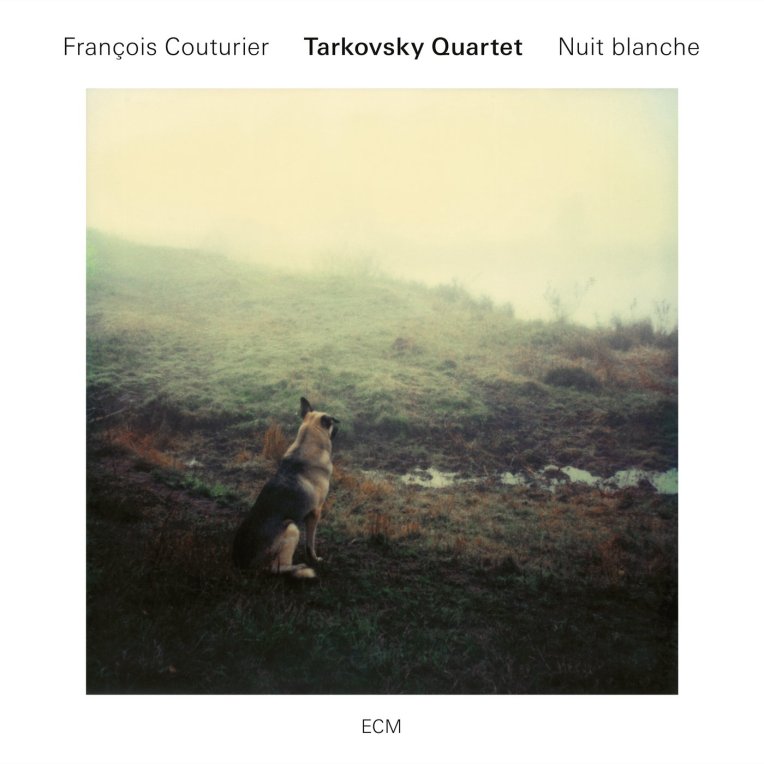
When opening our eyes, do our minds turn to thoughts of waking? Nuit blanche, the latest from pianist François Couturier’s ever-deepening Tarkovsky Quartet, answers this question with a possibility of dreams. It’s clear not only in the tracks variously titled “Rêve,” “Dream,” and “Traum,” but also in the blurring of corporeal borders such linguistic costume changes imply. In those pieces, each fitting into a larger improvisational puzzle, we get lost just to be found.

In so much of the connective tissue that holds together these vital organs, this quartet’s ethos blossoms vividly. A gentle urgency in the title track’s cello, singing at merest touch of Anja Lechner’s bow and tempered by the cross-hatching of Jean-Louis Matinier’s accordion, provides ample preparation for the soprano saxophone of Jean-Marc Larché to unfold its wings one feather at a time. As if to drain that metaphor of its itineracy, tracks like “Soleil sous la pluie” and “Fantasia” evoke a feeling of suspension. Taps of bow on strings and of knuckles on hollow body play out a dialogue of mechanical sins and immaterial salvations, each detail a poem without words. The latter piece’s transcendence recalls the levitation scene in The Sacrifice, and by that association adds a touch of spirit to vessels of the flesh, turning in on itself until the two are indistinguishable in glory.

Whether in more direct references such as “Dakus,” inspired by Tōru Takemitsu’s Nostalghia (itself written in memory of the director), or the distinct nostalgias of “Urga,” every ruined landscape we encounter here is, as in the wasted Zone of Stalker, a blanket of broken futures over a memory too joyous to contain. Couturier’s unaccompanied “Daydream” and “Nightdream” are likewise liminal, at once floating and sinking in a stream of imagined silence. Between them is “Cum dederit delectis suis somnum,” plucked from Antonio Vivaldi’s Nisi Dominus and passed like a torch from bow to reed with all the sanctity it demands.

If, as Andrei Tarkovsky himself once said, “the sounds of this world are so beautiful in themselves that if only we could listen to them properly, cinema would have no need for music at all,” we might also say that the music of this quartet named for the Russian auteur, if watched properly, would have no need for imagery at all. Then again, one can’t help but treat it as a projection screen for internal scenes, each more personal than the last. And so, ending as we began, with the eyes as fulcrums between dreaming and waking, never knowing where to draw a line between the two yet confident that no level of imagination can do justice to what they see, we walk into sunset, knowing that all we need to make it a sunrise is stand on our heads.

Benedikt Jahnel Trio: The Invariant (ECM 2523)

The Invariant

Benedikt Jahnel Trio
The Invariant

Benedikt Jahnel piano
Antonio Miguel double bass
Owen Howard drums
Recorded March 2016 at Rainbow Studio, Oslo
Engineer: Jan Erik Kongshaug
Produced by Manfred Eicher
Release date: January 13, 2017

Five years after their 2012 ECM debut, pianist Benedikt Jahnel, bassist Antonio Miguel, and drummer Owen Howard return to form while also expanding the parameters of what’s possible within it. A clue, perhaps, into this calling-card title—The Invariant—through which implications of constancy are playfully cross-hatched by their own unraveling. It’s all there in the pianism that opens “Further Consequences,” laying the stones for a spiraling staircase into the heart. Here, in this innermost sanctum, is where the torch of interpretation is passed from performers to listeners. The urgency of Miguel’s bassing is softened by the entrance of Howard’s brushes, which by their gentle persuasion soften the temperature into cooler streams of consciousness.

All of this lays a grand carpet for the introverted groove of “The Circuit,” in which the trio swings gently enough that one barely senses its passage through crowded city streets. It’s a transfiguration of time through space, and of space into time itself, a psychological wormhole between modes of creation. But regardless of whether the atmosphere at the other end is the funkier “Part Of The Game” or the fragmentary “Interpolation One,” the deeply arranged “Mirrors” or the balladic “En Passant,” Jahnel and company separate rope into filament at every turn. They also leave themselves open to suggestion, as in the case of “For The Encore.” Originally intended to close out the set, producer Manfred Eicher felt its steady triangulation of pulse, free-floating midsection, and bass soliloquy worthy of earlier placement.

The boldest circle here, however, is “Mono Lake,” of which an insistent beat and diecast melody hold the surrounding muscles together as a ligament. Like the album in the fullness of its being, it flirts with infinity in a collective song so resolutely out of body that words struggle to catch its shadow.

Quercus: Nightfall (ECM 2522)

Nightfall

Quercus
Nightfall

June Tabor voice
Iain Ballamy tenor and soprano saxophones
Huw Warren piano
Recorded December 2015 at Cooper Hall, Frome
Engineer: Mike Mower
Mixed at The Soundhouse Studios, London
Engineer: Gerry O’Riordan
Produced by Iain Ballamy and Huw Warren
Release date: April 28, 2017

The flowers left thick at nightfall in the wood
This Eastertide call into mind the men,
Now far from home, who, with their sweethearts, should
Have gathered them and will do never again.
–Edward Thomas

Four years after a 2013 debut on ECM, the trio known as Quercus deepen their mission in this follow-up gospel. Unlike singers whose tone may be described as silken, sultry, or smoky, June Tabor treats her voice as would a metallurgist an alloy. Together with saxophonist Iain Ballamy and pianist Huw Warren, she yields new admixtures at every turn, each more elemental than the last.

High crests among the program’s traditional selections include two songs collected by Somerset folklorist Ruth L. Tongue (1898-1981). “On Berrow Sands” and “The Shepherd And His Dog” showcase Warren’s exquisite pianism, the former with such oceanic clarity that one can almost smell the ghosts of dead sailors taking flight among the seagulls as Tabor recreates their sacrifices. In “Once I Loved You Dear (The Irish Girl),” she mines the ore of words, handing it to us without polishing away the dirt of its forgotten slumber. As stolen love takes flight into darker realities, Tabor gouges out superficial wounds and fills them with the bronze of self-reflection.

All of these are branches to the roots of “Auld Lang Syne,” which opens the album in a cradling of words. Tabor steps out of time, pulling aside the curtain of night just a sliver to let the past bleed through. Ballamy illustrates that transition beautifully, adding deeper evocations of trauma through his tenor in “The Manchester Angel” and maternal love in “The Cuckoo.” He also contributes his own composition, “Emmeline,” in a circling duet with Warren, echoing the form taken in Warren’s own “Christchurch.” Both fit naturally into their surroundings, as does the jazz standard “You Don’t Know What Love Is,” an evergreen dipped in silver. And whether turning West Side Story’s anthemic “Somewhere” into something mysterious or making Bob Dylan’s “Don’t Think Twice It’s Alright” uniquely her own, Tabor communicates so vividly as to render every stalk of wheat, every stone and animal bone in the fields beyond. Such music, then, is never about inclusion but extension of a tradition whose torch glows only in the human heart. An intimate and special experience that could have been created by no other.

Sokratis Sinopoulos Quartet: Metamodal (ECM 2631)

2631 X

Sokratis Sinopoulos Quartet
Metamodal

Sokratis Sinopoulos lyra
Yann Keerim piano
Dimitris Tsekouras double bass
Dimitris Emmanouil drums
Recorded July 2018 at Sierra Studios, Athens
Engineer: Giorgos Karyotis
Produced by Manfred Eicher
Release date: March 15, 2019

Athens-based lyra virtuoso Sokratis Sinopoulos returns to the quartet that earned him deserved acclaim on 2015’s Eight Winds. With pianist Yann Keerim, bassist Dimitris Tsekouras, and drummer Dimitris Emmanouil, he once again brings the ancient and the unexpected into harmony. At the heart of Metamodal is its eponymous suite, divided into three parts: “Liquid,” “Illusions,” and “Dimensions.” From its quiet hole emerges a snake of melodic origin whose tongue flickers always in search of the next note. Behind the insistence of Sinopoulos’s playing, clay drums and bass erode a stony topography. As background and foreground intermingle, dances speak not of a celebratory present but of an unrecoverable past.

Before any of this takes shape, “Lament” opens the album proper with an arco bass drone, over which the lyra weeps, while a wave of piano caresses a distant shore, at once mournful of the footprints it destroys and hopeful of clearing the slate for new ones. Thus, Keerim lifts memories of those who once walked along those sands, their souls drifting to a land where the bodies they once inhabited were forbidden entry. Such transcendence is echoed in “Red Thread,” wherein the band paints a restrained yet dynamic canvas on which once-divisive politics now blend until their edges disappear.

If hope is to be found, it’s in “Walking” and “Dawn.” But the hope is fantasy. Still, the musicians hold fast to it like refugees their cultural identities, knowing as they do that illusions of safety are as real as one makes them out to be. And so, “Transition” is an appropriate title not only for the tune it names, but also for the aesthetic of Sinopoulos and his fellow travelers, who as a unit look two steps ahead with each remembered. As in the freely improvised “Mnemosyne,” they carry uncertainty like a treasure as they walk into the future, leaving footprints in the sand as an ephemeral record of their traversal.

(This review was first published in RootsWorld online magazine. The original link is here.)

Trio Mediaeval & Arve Henriksen: Rímur (ECM 2520)

Rímur

Trio Mediaeval & Arve Henriksen
Rímur

Anna Maria Friman voice, Hardanger fiddle
Linn Andrea Fuglseth voice, shruti box
Berit Opheim voice
Arve Henriksen trumpet
Recorded February 2016, Himmelfahrtskirche, München
Engineer: Peter Laenger
Produced by Manfred Eicher
Release date: March 3, 2017

If fate would send me around the world
far away from you,
I would yet, with tears, send you a sigh
that belongs to you.

The title of Rímur, Trio Mediaeval’s seventh album for ECM, takes its name from a longstanding tradition of Icelandic rhyming verses, passed down orally from generation to generation until reaching their present incarnations in a program that meshes three distinct voices with a fourth: that of trumpeter Arve Henriksen. In this artful sequence of chants, hymns, and folk songs drawn from Scandinavian sources, the quartet reimagines music as it might have swept across northern landscapes during bygone ages whose histories are renewed in these melodic survivors.

Because improvisation has always been a vital component of Nordic folk tunes, the leaps of intuition required of their interpretation are in-built into the music. And while saxophonist Jan Garbarek’s collaboration with the Hilliard Ensemble will draw obvious comparison—and, to be sure, fans of that project will want to own this one as well—it’s very much its own world, tracing a continental fringe that runs crosswise to that ECM classic.

The Icelandic material yields the most ghostly effects—not only because of a certain transparency, but more importantly because of Henriksen’s ability to see in it what few others might. Whether rising like the stream of a quiet fountain in “O Jesu dulcissime,” a highpoint of the disc for its vocal blending and Hardanger fiddle accents, or unraveling inner spirit in “Morgunstjarna,” a hymn to God’s only begotten Son in confirmation of grace, Henriksen reveals unforced harmonies, by turns balladic and martial. Other highlights include the original “Krummi,” the traditional Swedish shanty “Du är den första,” and the anonymous chant “Alma Redemptoris Mater.” In each of these, he extends the wingspan of expectation while yet cooling us in a familiar shade. In his absence, Friman, Fuglseth, and Opheim are spotlighted by a handful of vocal pieces, including some especially evocative material from Norway. Of these, the wedding tune “Brureslått” features some of the most stillness-inducing singing the trio has ever recorded.

At the heart of this recording are substantial hymns to Saints Birgitta (Sweden), Magnus (Orkney), and Sunniva (Norway). The first, by 14th-century Swedish composer Nils Hermansson, epitomizes the dynamics that make Trio Mediaeval such a unique ensemble. The way in which they spin from a single voice a sonority beyond triplicate measure is exquisite, even as Henriksen adds a voice of his own, at first in lockstep then in untethered flight. In the other hymns, they sail equally selfless waters. Would that we were able to turn their metaphorical vessel into a reality, docked far beyond the world’s storehouse of hatred by a braid of divine inspiration.

Colin Vallon Trio: Danse (ECM 2517)

Danse.jpg

Colin Vallon Trio
Danse

Colin Vallon piano
Patrice Moret double bass
Julian Sartorious drums
Recorded February 2016, Auditorio Stelio Molo RSI, Lugano
Engineer: Stefano Amerio
Produced by Manfred Eicher
Release date: January 13, 2017

For their third ECM recording, pianist Colin Vallon, bassist Patrice Moret, and drummer Julian Sartorious climb even deeper down the rabbit hole of their creative integrity. The music here was recorded without headphones, allowing the musicians to map open-bordered sonic territory. Meticulousness flows through “Sisyphe,” in which the dialogue between instruments follows the pulse of a vaster circulatory system. Such subtle insistence as that expressed in this opening track shows up that much more vividly on our listening radars. We know the end because he hear it in the beginning.

Titles are as much suggestive of an inner spirit as of the skin in which that spirit resides. Case in point would be “Tsunami,” which from insistent beginnings regresses into a memory of the quake that set it off. Moret’s centrifugal bassing is unassuming enough that we might not even be aware of its force until we’re caught in it, while Sartorious brings a three-dimensional realism to every curling tendril of water. And while the tune does build to peak intensity, one never senses danger. “L’Onde” is a distant companion, and after some cinematic ellipses transitions into a playful center before returning to form. The title track likewise undoes its own promises by meeting expectation halfway with something that, while rhythmically sound, nevertheless dislocates its own body.

“Smile” takes a more geometric approach, flitting through changes of key in the way a face might through emotions. Sartorious is a wonder, his distorted repetitions existing only to reveal the smallest disparities between them. The same holds true of “Tinguely,” the only contribution of Moret’s pen, in which prepared piano bejewels the very shadows on the way to a high-energy build. In much of what follows, including the melodic highlight “Morn” and the collectively improvised curio cabinet that is “Oort,” one encounters understated exuberance, a montage approach to memory, and deepest respect for the foundational arpeggio. For these reasons and too many more to articulate, Vallon’s is one of the most unpretentious piano trios in existence, and Danse further proof of its staying power in the ECM canon as a quiet but impression-heavy tesseract of sound. Let us hope it spins as long as we do.

Ralph Towner: My Foolish Heart (ECM 2516)

My Foolish Heart

Ralph Towner
My Foolish Heart

Ralph Towner classical guitar, 12-string guitar
Recorded February 2016, Auditorio Stelio Molo RSI, Lugano
Engineer: Stefano Amerio
Produced by Manfred Eicher
Release date: February 3, 2017

Any new solo album from Ralph Towner is reason to celebrate. Even more so when you consider the guitarist and ECM veteran was just shy of his 76th birthday at the time of this recording. Not that one would know it by the joie de vivre that infuses even its quietest moments. In the opening “Pilgrim” we find Towner at his quintessential best, gluing a mosaic of disparate scales. There’s a domestic feeling to this piece, as if the occasional strums were the sounds of a straw broom moving across a wooden floor.

Towner’s playing can always be counted on for tactility, unafraid as he is to let details shine through. This is especially true of “I’ll Sing To You,” one of the set’s most melodic tunes, and in which every scrape of calloused fingers is captured in vivid close-up. As a composer, he excels in evoking a title’s movement or feeling. To wit: the sashaying gait of “Saunter” and the Baroque-inspired footwork of “Dolomiti Dance.” Of a kindred spirit are the two tracks featuring 12-string. Where “Clarion Call” is filled with stops and starts, thus working its magic through interruption of a spell, “Biding Time” echoes with reflective purpose.

Both “Shard” and “Rewind” are standbys from the Oregon songbook, and by their inclusion speak to the will of nostalgia. The latter tune ends the album with undulations of narrative. Before that we are treated to “Blue As In Bley.” Dedicated to Paul Bley, who passed away not long before Towner stepped into the studio, it’s a complex and finely wrought piece, which like the improvisations of its dedicatee cohere by magic of immediacy. A smattering of briefer pieces injects the discs of this musical spine with extra fluid. Of these, “Ubi Sunt” is a highlight for its choral beauty.

The title song by Victor Young has long been a source of inspiration for Towner, who revisits it here in humility. In his hands it feels like an old video watched in quiet ponderance. Every scene is a chance at renewal, proof that not only songs but also their interpreters can grow better with age.