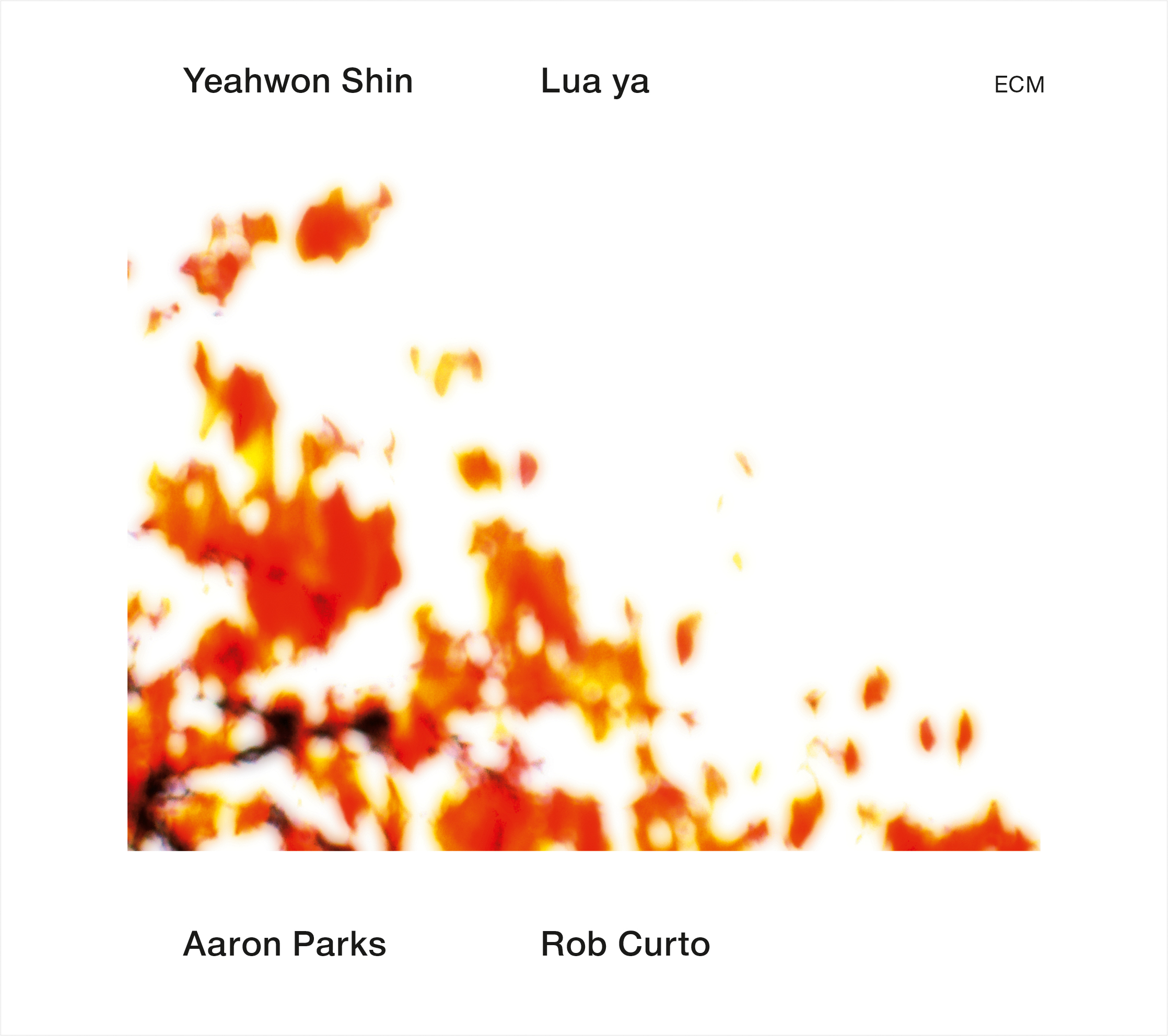
Yeahwon Shin: Lua ya (ECM 2337)

2337 X

Yeahwon Shin
Lua ya

Yeahwon Shin voice
Aaron Parks piano
Rob Curto accordion
Recorded May 2012 at Mechanics Hall, Worcester, MA
Engineer: Rick Kwan
Mixed at Rainbow Studio, Oslo by Jan Erik Kongshaug, Manfred Eicher, and Sun Chung
Produced by Sun Chung

If we can believe poet Federico García Lorca, who in a 1928 lecture entitled “On Lullabies” claimed that “Spain uses its saddest melodies and most melancholy texts to darken the first sleep of her children,” then we can also believe in a culture where lullabies nourish the growing soul. Of the latter persuasion are those offered by Yeahwon Shin on Lua ya. Shin’s selections give voice to transitions of darkness to light, spirit to flesh, dependence to independence, and all with a grace of expression that pretends nothing. Although best known as a Brazilian music specialist (her 2010 self-titled debut was nominated for a Latin Grammy), the singer rejoins accordionist Rob Curto and, for the first time, pianist Aaron Parks, in an enchanting survey of Korean children’s songs.

“The album’s theme is the remembrance of childhood,” Shin tells me in an e-mail interview. “I would like the listeners to have the freedom to imagine the story themselves.” In light of this invitation, we may still feel the need to tread lightly, for each song is of such fragile constitution that it would seem to crumble at the slightest mishandling. Then again, the music blossoms with such strength—a strength born of unconditional love—that it also feels impervious to misunderstanding. As in the opening improvisation, called simply “Lullaby,” it crafts a world of tracings and starlight. Parks’s pianism introduces the landscape across which Shin’s voice emerges as a maternal whisper, carrying with it the histories of countless mothers before, and the countless more to follow, in life’s eternal cycle.

Yeahwon Shin
(Photo credit: John Soares)

Shin grew up enchanted by the music of Egberto Gismonti, who along with the iconic Tom Jobim spun the tapestry of her appreciation for Brazilian music. She looks back even further to Chopin and Bach, composers who informed her first love—the piano—as fundamental inspirations in her development as an artist. “I like Korean traditional music, as well,” she says. “I am strongly bonded to Korea’s rhythmic patterns. I still want to discover more about this music.” Lua ya is a new step in precisely this direction. It is also a return to origins. For Shin, what seems most important in life is that which imparts it: “My parents are very important figures in my life. I respect my father’s wisdom, my mother’s unlimited love and spirit of self-sacrifice. They are not musicians, but the way they express themselves by singing shows a pure love for music. I have always wanted to feel that way in music.”

To be sure, Shin’s filial respect echoes in the songs passed down from her own mother, whose voice is forever preserved in memories of a family that was always singing. Of those songs directly passed down, “Island Child” is among the album’s most emblematic. Syllables roll off the tongue from both singer and instrumentalists until language ceases to matter. Indeed, Shin is at her most powerful when singing wordlessly (as she does here, and in “Moving Clouds”), as one needs not struggle against the elastic of linguistic barriers. “The Orchard Road” is another descendent of personal experience and shows the trio at its densest. Shin’s breathy storytelling develops over a rustic backdrop, as affecting as it is brief.

If Lua ya feels less like a cycle and more like one continuous song, it’s because it was, at the behest of producer (and Shin’s husband) Sun Chung, conceived and realized as a concert, played from start to finish with no edits. Chung acted as both audience and director when the performance was being recorded in Mechanics Hall in Worcester, Massachusetts. His presence is palpable in the album’s dynamic flow. Also present are Shin’s attentive accompanists, both of whom take her voice as a compass takes magnetism.

(Click here to see this article as it originally appeared in RootsWorld magazine, where you can also hear samples.)

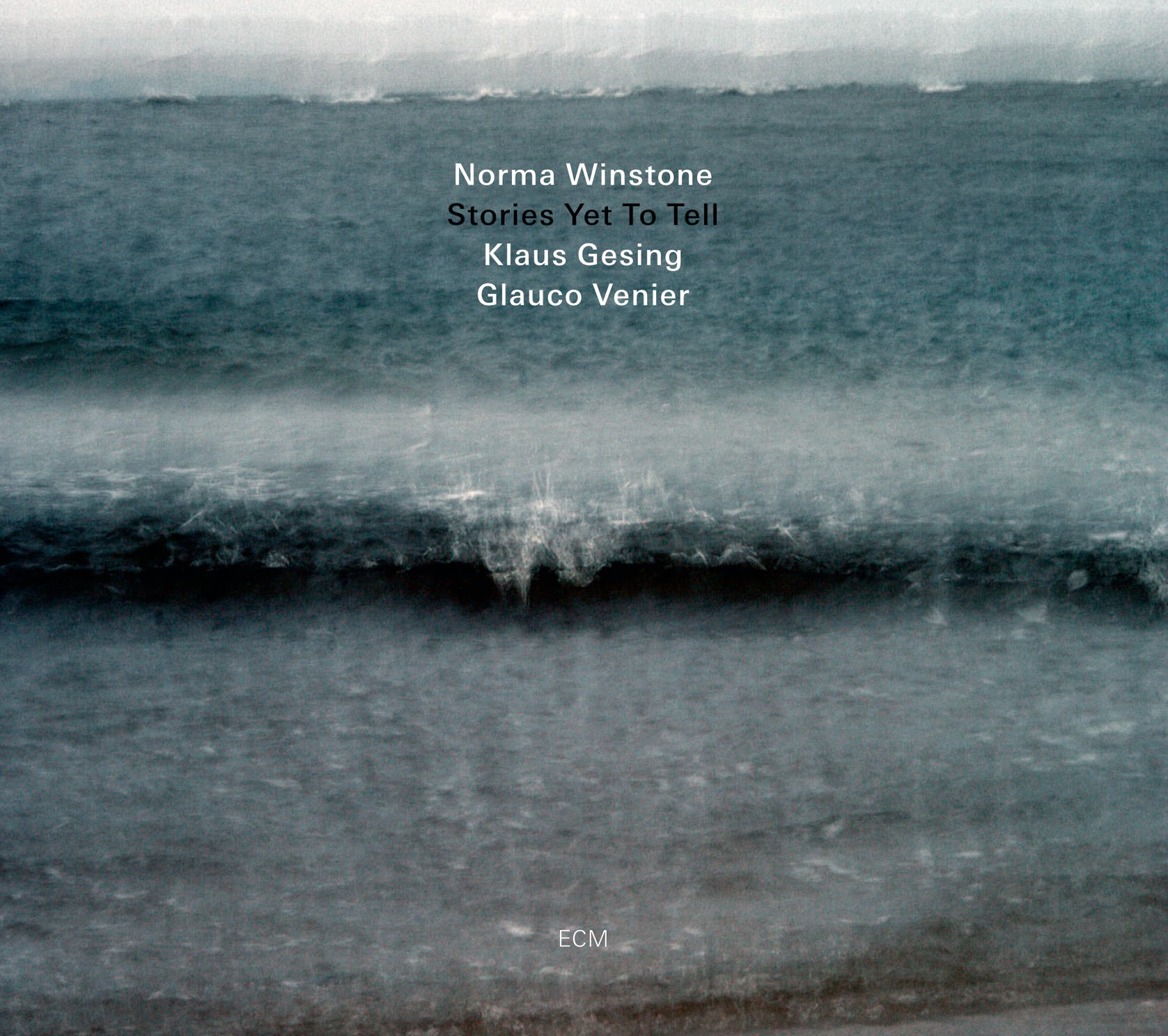
Norma Winstone: Stories Yet To Tell (ECM 2158)

Stories Yet To Tell

Norma Winstone
Stories Yet To Tell

Norma Winstone voice
Klaus Gesing bass clarinet, soprano saxophone
Glauco Venier piano
Recorded December 2009 at Arte Suono Studio, Udine
Engineer: Stefano Amerio
Produced by Manfred Eicher

While walking home on 8 October 2014, I was listening to Norma Winstone’s Stories Yet To Tell on my iPod. The opening song, “Just Sometimes,” had already enchanted me with its tender traversal of the heart’s shadowed chambers. Its bittersweet emotions lingered on in my mind as the second track, “Sisyphus,” held my ears captive. Named for the Corinthian king of Greek mythology forced to endlessly roll a giant boulder up a hill, the song evokes the curse of repetition in Glauco Venier’s pianism and the vain hope of breaking free in the tension of Klaus Gesing’s bass clarinet. While immersed in the atmosphere of this music, I felt a tap on my shoulder. I pressed PAUSE, removed my headphones, and turned to see my friend Andy, who had terrible news: our dear mutual friend Taylan had committed suicide that morning.

In the weeks following this tragedy, my iPod remained stuck halfway through “Sisyphus,” stymied like my desire for listening. By the time I returned to the song, I couldn’t help read the myth into Taylan’s untimely end. His life, it seemed, had thrown one boulder too many in his path, and he’d grown tired of rolling them upward in vain. While learning to cope with my grief, I was also comforted by the album’s title. It was a gentle reminder that, although he was gone, stories of Taylan’s legacy as a musician (he was an electronics genius for whom Evan Parker’s The Eleventh Hour was a life-changing record) had yet to be told. It was only a month later that I had the courage to continue where I’d left off in “Sisyphus,” which will forever be for me an elegy.

It’s not entirely morbid, however, to read a certain understanding of mortality into Winstone’s craft, singing as she so often does of moments that are fleeting, captured only through imagination. In the sadness of “Among The Clouds,” the retrograde of “Goddess,” and the wordless farewell of “En mort d’En Joan de Cucanh,” Winstone and her attuned trio understand that directions below are written in scripts above. Each song searches for meaning in a world that so often denies the divinity of simplicity. Furthermore, Winstone’s lyrics, especially in “Rush” and “The Titles,” linger on impermanence and, like the second, break down the theatrical stage of experience into its component parts.

In a few tracks, Winstone uses her voice as wordless instrument, employing melodic flight paths in the service of folk songs and lullabies. And even when she does inhabit the domicile of language, as in the tender “Like A Lover,” she does so with an insightful balance of coarse action and empty heroism, all the while keeping fear at bay with the shapes of her mouthing. She demonstrates that those of us still living must recognize that death is not an end but the first sentence in a story waiting for the spark of remembrance to reveal its narrative arc.

(To hear samples of Stories Yet To Tell, click here.)

Taylan
Taylan Cihan
(June 13, 1978 – October 8, 2014)

Tafelmusik Brings Otherworldly Sound to Cornell

??????????
Tafelmusik
The Galileo Project: Music of the Spheres
Bailey Hall, Cornell University
November 15, 2014
8:00pm

English physicist Norman Robert Campbell once wrote, “Science would not be what it is if there had not been a Galileo, a Newton or a Lavoisier, any more than music would be what it is if Bach, Beethoven and Wagner had never lived.” This statement has rarely been so obvious as it was on Saturday night, when Toronto-based Tafelmusik proved distinction as one of the world’s finest Baroque ensembles with its presentation of The Galileo Project. The orchestra’s double-bass player, Alison Mackay, conceived the program when she was invited to commemorate the 400th anniversary of Galileo Galilei’s astronomical telescope. The result could hardly have been more apt, for the Italian astronomer’s love of physics was known to extend almost as deeply into the heart of music as to the heavens that set it beating. Father Vincenzo, in fact, passed on to his son a love for the lute, an instrument Galileo continued to play throughout his final years, blind though he was and under house arrest for heresy by order of the Inquisition.

Tafelmusik’s performance—last of the fall Cornell Concert Series—was a master class in pastiche, shuffling evocative readings (courtesy of actor Shaun Smyth) of Shakespeare, Ovid, Kepler and Galileo himself, among others, into a contemporaneous playlist, all while images from the Hubble and tasteful computer-generated sequences were being projected onto a circle suspended at stage rear. Even more delightful was the fact that Tafelmusik played without scores. Originally a logistical necessity brought on by the low lighting required for the visuals, this dynamic liberated the 17-member orchestra—save for its bench-bound harpsichordist—in remarkably creative ways. Choreographic variations grew organically out of sonic ones and found the musicians sometimes among the audience, playing in the wings of the hall, or ambulating about the stage in veritable planetary orbits. These movements further translated into conversational banter, which on occasion threw the two cellists into intense dialogues or, as in the case of the Vivaldi concerto that opened the program, goaded the violin soloists with syllogistic zeal. The musical infrastructure was thus pillared by its most popular culls, by which was served a delectable assortment of incidental music by Lully, Monteverdi, Purcell and Rameau, all leading to the glorious sinfonia from J. S. Bach’s 29th cantata.

Central to the program’s conceptual integrity, however, was something quantifiable by no mere intersection of sound and science. It was, for lack of a more effective connotation, the timeless “spirit” of invention, observation and revolution that made every note sing. In this respect, some of the darkest moments of the concert were also its most compelling, as when a narrative description about the death of Galileo’s beloved daughter gave way to a toccata for solo lute composed by his younger brother Michelangelo. The intimacy of this downtime said more about celestial mysteries than the numbers employed to explain them.

Tafelmusik’s slogan may be “World-renowned, Future-bound,” but The Galileo Project showcased an unbreakable bondage to the past in kind. The end effect continues to reverberate in this reviewer’s mind, which nevertheless labors to return the favor in these constellations of words and hopes that, somewhere in the universe, Mr. Galilei was listening.

(See this article as it originally appeared in The Cornell Daily Sun here.)

Steve Kuhn Trio: Wisteria (ECM 2257)

Wisteria

Steve Kuhn Trio
Wisteria

Steve Kuhn piano
Steve Swallow bass
Joey Baron drums
Recorded Sptember 2011 at Avatar Studios, New York
Engineer: James A. Farber
Assistant: Tim Marchiafava
Produced by Manfred Eicher

Pianist Steve Kuhn, bassist Steve Swallow, and drummer Joey Baron make sweet music together, for sure, but an unquantifiable feel for that music is what sets this dream trio apart, and nowhere so clearly as in the lion’s share of Kuhn’s tunes presented on Wisteria. The complexities thereof become more readily apparent in these core settings. Above all, “Adagio” reveals a triangle within a triangle within a triangle. First is Baron’s sparkling pool, next bordered by Swallow’s equilateral bassing, all molded by Kuhn’s resounding redraws, and with a multi-dimensional sound enhanced to crystalline effect by engineer James Farber, fewer geometries could be more sublime. Further gems last heard on Promises Kept include the study in contrasts that is “Morning Dew,” the lyrical “Pastorale” (then again, when is Kuhn not lyrical?), and that album’s title cut, which achieves here even greater densities than in the former’s orchestral couch.

Wisteria is not without its groovier moments (cf. “A Likely Story”), but tends toward the softer end of the spectrum whenever possible. This only serves to gel the intensity of emotion throughout. Exemplary in this regard is the album’s opener, “Chalet,” in which the trio’s mesh sets a unified tone. It also reveals the inimitable presence of Swallow, whose early solo unlocks much of the joy about to ensue, and whose two contributions—“Dark Glasses” and “Good Lookin’ Rookie”—span the horizon from solemn to ecstatic, sunset ochre to raindrop blue, with class.

Three standalone tracks complete the set. Carla Bley’s “Permanent Wave” lays on the nostalgia so thick that you’ll swear you heard it a long time ago, with a drink in hand and only a memory to keep you company. “Romance” (by Brazilian singer-songwriter Dory Caymmi) brims with blind affection and proves yet again just how masterfully Kuhn approaches the art of the finish. And then there is the title track by Art Farmer, in whose band Kuhn and Swallow played half a century ago. This shadow-swept reverie says it all with so little.

Wisteria is about as positive as jazz gets. So much so that one can feel the smiles rippling all around as one pebble after another is dropped into the sacred font of improvisation from which each of these musicians so artfully drinks, and with enough tenderness to go around for even the most resilient soul.

(To hear samples of Wisteria, click here.)

Stefano Battaglia Trio: The River of Anyder (ECM 2151)

The River of Anyder

Stefano Battaglia Trio
The River of Anyder

Stefano Battaglia piano
Salvatore Maiore double-bass
Roberto Dani drums
Recorded November 2009, Auditorio Radiotelevisione svizzera, Lugano
Engineer: Stefano Amerio
Produced by Manfred Eicher

Stefano Battaglia always seems to have a root planted in mythical worlds. Where often he embraces those worlds as hidden inspirations, here the Italian pianist turns them inside out, yielding the journey that is The River of Anyder. Named for the river of Thomas More’s Utopia, the word “Anyder” is a pun meaning “waterless.” Like the music spun from its current, it embodies a contradiction between word and action. With this in mind, we might very well dismiss this album’s track titles altogether, for they mark not a mapping but a deconstruction of space by way of melody and affect.

Battaglia 1

We may indeed recognize “Minas Tirith” as the capital of Gondor in Tolkien’s The Lord of the Rings and imagine its fortress hewn in white rock. But then we might miss out on the music’s decidedly ashen palette, the wide-mouthed net of shadows cast by Battaglia’s ascending arpeggios in unity with bassist Salvatore Maiore, or the cymbals of drummer Roberto Dani rattling like coins in a giant’s pocket. We may hear the poetry of Rumi suffused in “Ararat Dance” and “Ararat Prayer,” risking too deep a reading by ignoring their already ornate surfaces, the standalone evocations of Maiore’s bassing, or the gilding of inaction that holds it all together.

We may get swept away by two tracks referencing the mythical island of Bensalem in Sir Francis Bacon’s New Atlantis, but fail to see that the trio’s interactions at moments leave the earth altogether. From the soft padding of his left hand to the tireless runs of his right, Battaglia navigates a profoundly varied topography with the freedom of one who walks without compass, who stops the wind and redirects it with every step taken. Whether contemplating the prayerful disposition of Hildegard von Bingen in the droning “Sham-bha-lah” or rowing the currents of the title track, Battaglia and his bandmates somehow slingshot around the dark side of the moon every time, placing them far from where they started.

Perhaps the only unity between spirit and production is “Anywhere Song.” This defining track concludes the set with a vision from Oglala Sioux Black Elk, who from atop the highest mountain sees all children of earth under one tree. It is, perhaps, the album’s deepest message: that in this tangle of keys, strings, and sticks, something so humble as a so-called jazz trio can look beyond its means and into the face of origins that compels those means to begin with. These are musicians who tell story and scripture alike.

The River of Anyder, then, is more than a catalogue of allusions. It is a pacifist’s statement, a bid for peace for a world in pieces.

(To hear samples of The River of Anyder, click here.)

Ketil Bjørnstad: Remembrance (ECM 2149)


Remembrance

Ketil Bjørnstad
Remembrance

Ketil Bjørnstad piano
Tore Brunborg tenor saxophone
Jon Christensen drums
Recorded September 2009 at Rainbow Studio, Oslo
Engineer: Jan Erik Kongshaug
Produced by Manfred Eicher

Ketil Bjørnstad’s Remembrance came together at the suggestion of producer Manfred Eicher, who convened the Norwegian pianist-composer in the studio with legendary drummer Jon Christensen and master saxophonist Tore Brunborg for a set of 11 naturally unfolding ballads. Although Bjørnstad and Christensen had famously worked together on The Sea, and despite the music’s arpeggiated undercurrents, the feeling is not so much of water as of sky, with a touch of horizon for reference. Certain portions (Part V, for example) may approach the coast, but their vessels ultimately skim cloud and vapor, not ocean.

Interactions between the three musicians are globular and free-forming, but root themselves in Bjørnstad and Christensen (it was a recording of them, in fact, that inspired Eicher’s vision of this project to begin with). And so, by the time we encounter their gorgeous duetting in Part VI, we know that we have reached the true heart of the album—not only for being the numerical middle but also for distilling a vision of textural clarity. Here, as throughout, Bjørnstad’s soft backpedaling gives full attention to the drummer’s sunglow. Christensen drums with characteristic impressionism, but also with a sense of voice that few others bring to the kit. Parts VII and IX explore further possibilities in the duo, each attuned to the adaptive forces of the other’s creative play.

Despite the musicians’ ability to paint with luminescent urgencies, the trio settings are most unified at a whisper. Brunborg’s reed stretches a tether between emotional territories in the remaining tracks, each more lyrical, more soulful, than the last, until their nostalgic petals break bud in the aerials of Part XI. The songs with Brunborg are also the album’s tenderest. It’s as if the addition of a distinctly air-born voice elicits a ripple effect of empathy from the two percussion instruments, a regression into childhood sensibilities. And yet, beautiful as the melodies are, Remembrance is a must-have for fans of Christensen. If you’ve ever laid stick to cymbal, you’ll know why.

(To hear samples of Remembrance, click here.)

Paul Motian: Lost In A Dream (ECM 2128)

Lost In A Dream

Paul Motian
Lost In A Dream

Chris Potter tenor saxophone
Jason Moran piano
Paul Motian drums
Recorded live February 2009 at the Village Vanguard, New York
Engineer: James A. Farber
Produced by Manfred Eicher

Drummer Paul Motian, saxophonist Chris Potter, and pianist Jason Moran: the kind of dream you want to get lost in. This equilateral triangle of melody, form, and affect came together at Motian’s behest for a week of performances at New York’s Village Vanguard, from which he and producer Manfred Eicher culled the present disc. These live morsels reflect a cross-section of Motian’s career as both performer (by this point having shared about a decade of history with Potter and a single performance with Moran) and composer (all the tunes, some new and some old, are by Motian, except for a sweet take on Irving Berlin’s “Be Careful It’s My Heart”).

Among the album’s many benefits, it’s particularly wonderful to hear Potter, a player known for his robust command and dynamism, emote with such artful delicacy. In both “Birdsong” (last heard on TATI, in the company of Enrico Rava and Stefano Bollani) and “Mode VI,” Potter elicits tons of emotional power by his restraint. In the latter tune especially, which opens the album with a whisper, he fans the trio’s creative pilot light in pastels and charcoals. He also knows when to set the horn aside, letting Moran and Motian play on as a duo, drums brushing away the piano’s footprints in a dance as melodic as anything elicited at the keyboard. Motian is indeed the core of this music’s being, turning on a ballerina’s toe in a light made audible by breath, reed, and chamber.

If not obvious already, Motian and his bandmates are as much painters as they are musicians. Their evocative skills turn simple titles like “Casino” and “Blue Midnight” into moving pictures. A lone figure sits at the betting table, a losing hand before him. The only real comfort comes from the piano bar, the music of which slices through his inebriation like a paper cut, an Ace of Spades flicked toward the heart, where it remains lodged in hopes that something other than its pip might bleed. The looseness of such moments best exemplifies the photo montage on the album’s cover, which teases out regularity from city streets. (At one point, Potter and Moran lapse into simple scales, as if to remind themselves that even abstraction begins with practice.) Here is where the musculature of the trio becomes paramount, as tactile as its subject matter is ethereal.

The title track is the most grounded tune. Moran’s playing is sumptuous here. The gently insistent rhythm hints at swing, but shelves catharsis for another day. “Ten,” by comparison, ups the heat with a bubbling, rubato energy that draws the crowd. It is the exhale to the inhale of “Drum Music” and “Abacus,” established tunes that reference Motian’s classic Le Voyage. Where one unleashes a torrent of startlingly fractal music, the other cradles the most masterful turn of the set in the form of Motian’s solo. Bookended by thematic confirmations, it is the genius of an artist speaking as one with his instrument rather than through it. It lingers on the palate long after the finish, drawn through the concluding “Cathedral Song” beneath the skim of Moran’s night sailing and Potter’s hymnal moon.

This trio, in this context, emotes so tenderly that it might collapse in on itself were it not for the strength of its bones. It speaks to us as it speaks to the cosmos: without the need for translation. Your body comes pre-equipped to decode its poetry, and when you buy this album, you are giving yourself a sacred gift. If you love jazz, then do your heart some good and bring these sounds home. A masterpiece, pure and simple.