Michael Mantler: For Two (ECM 2139)

For Two

Michael Mantler
For Two

Bjarne Roupé guitars
Per Salo piano
Per Salo recorded June 2010 at Studios La Buissonne, Pernes-les-Fontaines
Bjarne Roupé’s guitar tracks recorded August 2010 at home, Copenhagen
Mixed and mastered September/October 2010 at Studios La Buissonne by Gérard de Haro and Nicolas Baillard
Produced by Michael Mantler

Following the monumental Review and CONCERTOS, Vienna-born composer Michael Mantler intersects once again with ECM in an especially intimate project. For Two documents 18 duets written for jazz guitarist Bjarne Roupé and classical pianist Per Salo in a chemical reaction of, respectively, free improvisation and through-composed material. The resulting compound lures a microscope over the crucible of a uniquely cellular approach, which by these vignettes boil down Mantler’s equal footing in multiple registers.

Most impressive is the musicians’ rhetorical clarity, which despite a separation in training elicits an enchanting cross-fertilization. You might hear the jagged Duet One and think you have the album’s ensuing architecture pegged. But then Duet Two counters with a denser fusion of chord voicing and pointillism, while Duet Six reaches an almost bluesy union of form and content. Roupé’s fingers on the electric guitar are just as exploratory as Salo’s on the keyboard, so that rare passages of unison, as those in Duets Seven and Fifteen, feel more like departures than returns. Roupé’s hard-won crooning over Salo’s insistent finger pedaling in Duet Eight digs deepest into the fertile soil of Mantler’s umwelt, where perceptions of meter and matter switch places.

The beautiful Duet Ten discloses the responsiveness of composer and interpreters alike. Its brevity only serves to enhance the restless core of it all, that creative spark in which resides the potential to flare. Some may burn more brightly than others, but not one emits a hue it was never meant to emit. The notion of integration behind these pieces, then, is something born of their circumstances. In this case, the studio is not a meeting place but a funnel of ideas, from the end of which emerges unpredictable mixtures. Elements of stealth lurk in the shadows of Duets Fourteen and Sixteen, but always with an exit strategy in hand. Theirs is not a code to be broken. It is a break to be coded, a fracture in the window of time that mends itself in Duet Eighteen by molten notecraft.

Thus, the duet functions as a single organism that divides through the fortune of iteration.

(To hear samples of For Two, click here.)

Wolfert Brederode Quartet: Post Scriptum (ECM 2184)

Post Scriptum

Wolfert Brederode Quartet
Post Scriptum

Wolfert Brederode piano
Claudio Puntin clarinets
Mats Eilertsen double-bass
Samuel Rohrer drums
Recorded May 2010, Studios La Buissonne, Pernes-les-Fontaines
Engineers: Gérard de Haro and Nicolas Baillard
Produced by Manfred Eicher

Four years after their ECM debut, Wolfert Brederode and his quartet go Post Scriptum. The bandleader takes most of the composing credit with seven tunes to his name, the first four of which start with something of a 20-minute suite. “Meander” puts us on the right path at the encouragement of the pianist’s foundations. In this track especially, he evokes the same richness of progression and insight as Tori Amos at the keyboard. Bassist Mats Eilertsen and drummer Samuel Rohrer flesh out this unfurling skeleton as clarinetist Claudio Puntin jumps from branch to branch, snagging not a single feather along the way. Like so much of what follows (an exception being the piano-drums duet “Sofja”), emphasis is on the quartet sound, a multifaceted wonder that fronts each player in equal turn. Whether highlighting arid hand percussion and arco bassing in “Angelico” or crosstalk of piano and cymbals in “November,” the unity is uplifting and consuming. Through it all, Brederode’s comping weaves a caravan out of thin air, transporting Puntin’s precious melodic cargo. The title track is as surreal as it is brief, a haze of rhythm and reason that moves like a lotus along a river. Among the remaining Brederode originals, the groovy “Inner Dance” is a highlight. Anchored by pliant bass lines and soft touches from inside the piano, and with a clarinet that shines like a desert moon, it beats like the heart of a gentle giant. “Silver Cloud,” too, emotes tenderly, patterning the air in the manner of a Japanese woodblock print.

Eilertsen’s contributions, though more abstract, are no less engaging. The rattling interiors of “Aceh” yield dampened bass notes from Brederode, which resound with distant explosions of poetry. The babbling brook of “Brun” lends an air of spring to the canvas, while “Wall View” juxtaposes the rhythm section’s pointillism with Puntin’s legato phrasings. He and Roher offer a tune apiece, one a river of melodic beauty and the other a twisted network of roots and soil.

The landscapes of the Brederode Quartet are unfamiliar and unpopulated. This dynamic actualizes their movements by the grace not of cartographers but of artists who paint for the future, confident that eyes may hear the music of every brushstroke as a memory of a shared antiquity.

Easily another of ECM’s Top 10 of this century.

(To hear samples of Post Scriptum, click here.)

Zsófia Boros: En otra parte (ECM New Series 2328)

En otra parte

Zsófia Boros
En otra parte

Zsófia Boros classical guitar
Recorded August 2012, Auditorio Radiotelevisione svizzera, Lugano
Engineer: Stefano Amerio
Produced by Manfred Eicher

Hungarian guitarist Zsófia Boros is a revelation. Having found in ECM an ideal venue for her playing, she is able to unfold her wings in quiet strength. Perhaps taking cue from Cuban composer Leo Brouwer, who saw the guitar as a boundless orchestra and whose music is prominently featured in her debut program for the label, Boros plays her instrument as if it were a piano. Each finger is independent of the others, but connected by a network vaster than the sum of its parts.

Boros 1

The shorter pieces of the program are also its deepest, and include the gorgeous faceting of Brouwer’s “An Idea,” the very simplicity of which allows Boros’s expressive gifts to shine. The same holds true for “Ecrovid” by Vienna-born composer Martin Reiter. It’s a jewel of a piece, steeped in an innocence that fades into a chain of unresolved statements. And in “Eclipse” (by Dominic Miller, an English guitarist born in Argentina), Boros bonds every color change to an overarching spectrum of song-like paths.

Furthest afield, geographically speaking, is the tender slice of contrast that is Ralph Towner’s “Green and Golden,” which despite the title is more about texture than color. Its lines curl ever inward, each a strand of physical synaesthesia. Towner’s braids make fine company for the muted spirals of “Te vas milonga” by Argentine composer Abel Fleury and the Brazilian standard “Se ela perguntar” by Dilermando Reis. Freshened in the acoustics of the Lugano studio, each forms, along with the engineering brilliance of Stefano Amerio and Boros’s obvious humility, an artisanal triangulation of effort to liberate an unadulterated spirit.

One can hardly forget in the longer pieces the distinctly shaded lyricism of Spanish composer Francisco Calleja’s “Canción triste.” The beauty thereof lies not only in the tune but also its feeling of history. It’s as if the composer had been waiting with his guitar beneath a storm cloud so that he might catch the music in the sound hole and grow it like a plant. Although the combination of production and performance is fine throughout, here especially one notices an immediate genius as Boros and the Amerio/Eicher team emphasize the warmth of the guitar’s lower end and the clarity of its upper registers in mutual separation. A meditative rubato glow gives this piece a generative character that pours from the fingers. Also pouring from the fingers are the cascades of “Callejón de la luna.” Written by Spanish composer Vicente Amigo, this piece sails the vessel of its flamenco inspirations toward wider waters: a story of lovers circling the earth until they meet again. Flamenco touches echo also in “Cielo abierto” by Argentine composer Quique Sinesi, but in even more refracted form. For while the percussive acuity and variation of technical flourish makes this a standout for its substantive atmospheres and melodic robustness, its brilliance is to be found more so in its balance of sinking and floating.

The album’s heart beats through Brouwer’s “Un dia de novembre,” which clarifies an uncommon gift for narrative. Brouwer is a master storyteller, and at these fingertips his characters come to life in tangible ways. At one point, Boros leads a rhetorical shift into more rolling motifs with the insistence of a single note. That she does this with such lack of force speaks to the sanctity of her relationship with the guitar. A variation of the same track ends album in somber skies, but beyond them an assurance brought only by dreams that the dawn will bring with it a feeling of return.

(To hear samples of En otra parte, click here.)

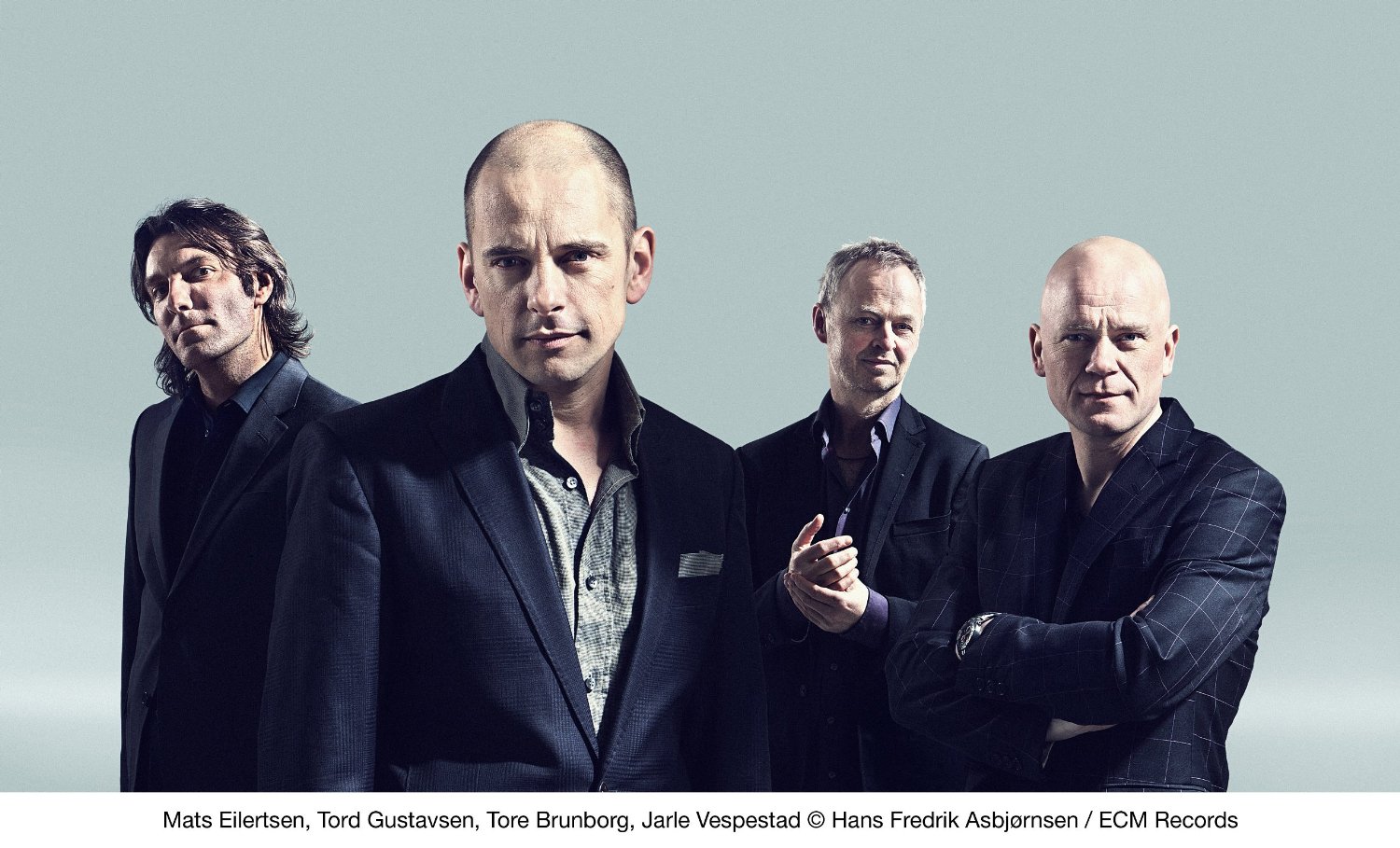
Tord Gustavsen Quartet: Extended Circle (ECM 2358)

Extended Circle

Tord Gustavsen Quartet
Extended Circle

Tord Gustavsen piano
Tore Brunborg tenor saxophone
Mats Eilertsen double bass
Jarle Vespestad drums
Recorded June 2013 at Rainbow Studio, Oslo
Engineer: Jan Erik Kongshaug
Produced by Manfred Eicher

Norwegian pianist Tord Gustavsen’s sixth ECM album concludes his second trilogy for the label, this in a quartet setting with saxophonist Tore Brunborg on tenor, bassist Mats Eilertsen, and drummer Jarle Vespestad. Gustavsen’s—and producer Manfred Eicher’s—sense of timing and sequence is more crystalline than ever, yielding a crossroads of melody and circumstance that will be at once familiar and progressive to seasoned listeners.

“Right There” bids gentle welcome in trio, Eiltersen’s melodic tracery standing out early on for its unforced hand. It’s a fitting introduction to one of Gustavsen’s most indistinctly distinct efforts to date, ending as it does with a question answered by the 11 tracks that follow. The Norwegian hymn “Eg Veit I Himmerik Ei Borg” (A Castle in Heaven) adds Brunborg’s tenor into the mix, one voice capping a rising tide of them. Vespestad’s underlying propulsions emphasize the theme’s airiness with their scuffling groove. “Entrance” is a free improvisation based on elements that have previously caught the band’s working orbit. Brunborg and Gustavsen work off each other’s nerve impulses down a spinal helix. And in a variation of the same track, Eilertsen provides a tactile foundation for the divine considerations therein, allowing Brunborg to unchain himself from the congregation.

“The Gift” and the album’s remaining tunes embody everything that makes Gustavsen’s writing exactly that: an offering to those who would listen without prejudice. This is a characteristically slow-motion spelunk for the trio, who as a unit express what only individuals in harmony can. With a touch worthy of an archaeologist, Gustavsen and his bandmates unearth one geode after another but leave them unbroken, so that their inner jewels become the subject of contemplation rather than of material obsession. “Staying There” evokes the title of the trio’s Being There, preaching but also practicing a gradation of continuity between projects, eras, and spaces of development. Brunborg’s melodizing, in combination with the rhythm section’s oceanic support and Gustavsen’s tidal comping, gives depth of voice to the music’s heartland.

“Silent Spaces” is one of two solos. This one is from Gustavsen and calculates an inter-dimensional telemetry, whereby distances are measured by angles between notes, by that which remains unsung. Eilertsen’s solo “Bass Transition” is likewise a ladder disappearing into cloudy sky.

“Devotion” rearranges a choral piece Gustavsen was commissioned to write in a liturgical context. In its present form, the music sings by inhaling. More of the trio’s classic dynamics bleed through in “The Embrace,” expanded by the soulful gilding of Brunborg’s bell. But even this one—and this is the magic of Gustavsen’s art—has sacred overtones, stemming from a faith in the sounds. That said, the full quartet achieves a unique balance of structure and substance in “Glow,” across which each musician glides like the blade of a skate on a frozen pond: their coming together produces only the smoothest pathways of travel. All of which leaves “The Prodigal Song.” This bittersweet letter draws its signature in forest ink and proves yet again that Gustavsen ends every album by extending another circle into the unknown. For just when you think it couldn’t get any more beautiful, it swings around and taps you on the shoulder.

(To hear samples of Extended Circle, click here.)

Nils Økland/Sigbjørn Apeland: Lysøen – Hommage à Ole Bull (ECM 2179)

Lysøen

Nils Økland
Sigbjørn Apeland
Lysøen – Hommage à Ole Bull

Nils Økland violin, Hardanger fiddle
Sigbjørn Apeland piano, harmonium
Recorded September 2009 and January 2010 at Villa Lysøen, Hordaland, Norway
Recording engineer and editing: Audun Strype
Album produced by Manfred Eicher

Fiddler Nils Økland and pianist Sigbjørn Apeland offer a studied take on the legacy of Ole Bull (1810-1880), a violinist of classical renown who brightened the folk music of his native Norway like no other musician after him. The present album is named for the little island off Norway’s western coast where Bull built a summer home for his wife and daughter, a place he’d longed for since childhood and where he would die only a few weeks upon realizing his dream to live there. Økland and Apeland were privileged to have access to instruments once owned and played by the Bull family for this recording, the first ever to be made at the Lysøen villa. Taking inspiration from the man Edvard Grieg once called a musical savior, the duo paints an idiosyncratic portrait using traditional and original pigments between daubs of Bull’s own, and all with a flair for adlibbing that is true to form. On that note, the musicians cite ECM greats Arild Andersen, Jan Garbarek, and, more recently, Frode Haltli as inspirations for likewise tapping folk veins in their improvisatory mining.

Traditionals take up most of the canvas, with the appropriately titled “Stusle Sundagskvelden” (Dismal Sunday Evening) opening in somber gesso. Its relay between fiddle and piano crafts a mood so potent, one almost feels it as a mist. Along with “I Rosenlund under Sagas Hall” (In the Rose Grove Under the Hall of Saga), it is the only folk track to employ this instrumental combination. The latter is a dirge-like piece that transitions into the famous “La Folia” without missing a beat. The rest, with two exceptions, pair fiddle with Bull’s own harmonium. This joining of forces—one earthly, one heavenly—is well suited to the material, which ranges from the rustic strains of “Sylkje-Per” (and its solo piano variation) and “Jeg har så lun en hytte” to the ethereal “Eg ser deg utfor gluggjen” (I See You Outside the Window).

The Bull songbook, such as it is, gives only barest insight into the kind of musician he must have been, but in the hands of these players I gather we come closer than by any other available means. Of the four tunes featured, “La Mélancolie” is another shaded, inward tracing. It’s also utterly beautiful and, in this arrangement, is possessed of a cinematic glow. The harmonium adds unusual propulsion to such pieces, and to others, like “Sæterjentens Søndag” (The Herdgirl’s Sunday), a similarity of extremes, from the subterranean to the extraterrestrial.

Økland and Apeland offer two duo originals. “Belg og slag” features tapping of the bow, which draws a line of inquiry to every answer. “Grålysning” (Daybreak) is a prettier circling of airs and sunlight. Økland’s solo “Solstraum” is reminiscent of Paul Giger’s Alpstein, its energies bright against Apeland’s “Tjødn,” a piano solo of eventide. The program rounds out with a fiddled rendition of Grieg’s famous “Solveigs sang.” At Økland’s bow, the strings sing this melody as if for the first time, even though, as with the rest, we feel that we have heard it before. Like Bull himself, it is a musical wanderer whose shadow leaves behind a trail to follow.

(To hear samples of Lysøen, click here.)

Marc Johnson/Eliane Elias: Swept Away (ECM 2168)

Swept Away

Marc Johnson
Eliane Elias
Swept Away

Eliane Elias piano
Marc Johnson double-bass
Joey Baron drums
Joe Lovano tenor saxophone
Recorded February 2010 at Avatar Studios, New York
Engineer: Joe Ferla
Produced by Eliane Elias and Marc Johnson

Although bassist Marc Johnson and pianist Eliane Elias are the heart of this distinctly melodic album (only their names appear on the cover), let us not ignore the atmospheric contributions of saxophonist Joe Lovano and drummer Joey Baron, whose completion of the quartet thus featured lends a sweeping quality to these mostly original tunes. With the latter contributions in full effect, Elias’s lush, classic sound and Johnson’s ever-thoughtful navigations ring that much more authentically.

The working trio of Johnson, Elias, and Baron produces five delectable tracks, of which “One Thousand And One Nights” and “B Is For Butterfly” are the most upbeat. Where one is engaging and modal, the other emits springtime warmth. Elias’s comping is dense but never invasive, lending context to her partner’s bass solos with a love shared both within and without the studio. One may read signs of this connection throughout the title track, in which Johnson’s prosody serves as yang to Elias’s poetic yin. These intimate settings prove fine vehicles for Elias, but none so nostalgic as “Inside Her Old Music Box” nor so impressionistic as “Foujita.”

With Lovano the band curves inward—more spaciously yet with lesser travel. This is no small feat, considering the powers of evocation possessed by each member. “It’s Time” introduces Lovano to the record’s sound-world and references Michael Brecker, in whose memory the tune was written, with richness. “When The Sun Comes Up” and “Sirens Of Titan” are jewels in their own right, contrasting hills of awakening with valleys of darker energies. Whether spurring the drums to lively enterprise or stretching intergalactic wormholes into sonorous infinity, Elias abounds. “Midnight Blue,” for difference, portraits a softer romance, the following “Moments” even more so, Lovano swaying like the night itself with the assurance of a touch shared by two.

Johnson’s solitary rendition of the American folksong “Shenandoah” closes out this well-rounded album with poise and purpose. In addition to being an autobiographical look back to the bassist’s Midwestern roots, it leads with equal footing into a future where one never need go far to find a song to sing.

Swept Away is a flawless reckoning of intuition and compositional integrity. The engineering, courtesy of a crack team at New York’s Avatar Studios, processes each cymbal hit as if it were the only thing sounding, while every channel around it remains clear and alive. Fresh yet familiar, sparkling yet serene, this is the kind of record you want to come home to.

(To hear samples of Swept Away, click here.)

Paul Bley: Solo in Mondsee (ECM 1786)

Solo in Mondsee

Paul Bley
Solo in Mondsee

Paul Bley piano
Recorded April 2001 at Schloss Mondsee, Austria
Engineer: Jan Erik Kongshaug
Produced by Manfred Eicher

The release of Solo in Mondsee in 2007 marked the 75th birthday of Paul Bley, and his first solo recording since 1972’s Open, To Love. Like the first, it owes its existence to producer Manfred Eicher, who on both occasions lured Bley onto solitary terrain. This time, the Montreal-born pianist sits at a massive Bösendorfer last heard under the fingers of András Schiff in a New Series program of Schubert’s C-major Fantasies. The instrument equally suits Bley’s preference for long sustains, as made lucid in the album’s opening statement: a resonant hit of the lowest strings. From this he summons ghosts of familiar songbooks, and bodies of those more distant, across ten so-called “Variations,” whose only theme is the absence of one.

Bley’s craft is an admixture of the ethereal and the gravid. He works from a palette so expansive that perhaps only Keith Jarrett has matched it in this unaccompanied format, and with tenderness so beguiling it tightens the ribcage to hear it. The freedom of his exponentially refreshing playing imbues the first numbered section with declamatory sparkle. Like Variation IV, it evokes warmth in winter by a peerless ballet of touch and tendon.

In contrast to these sweeping narratives, Bley gives props to whimsy on a handful of Variations. There are the dissonances and chromatic ladders of II, the centrally focused III, and the busier V and VIII, the eddying of which evokes the end of a waterfall. Variation VI is an especially brilliant turn for its fusion of the epic and the intimate. Its densities never occlude, but allow the light to sing over a flourishing undercurrent. The tenth and final Variation possesses an almost teasing quality, but leads toward a fragile, shape-shifting meditation.

Bley finger-walks on water and gifts solace in return, turning the world into a chamber, and the chamber into a universe.

<< Robin Williamson: Skirting The River Road (ECM 1785)
>> Yves Robert: In Touch (
ECM 1787)

Konitz/Mehldau/Haden/Motian: Live at Birdland (ECM 2162)

Live at Birdland

Konitz/Mehldau/Haden/Motian
Live at Birdland

Lee Konitz alto saxophone
Brad Mehldau piano
Charlie Haden double-bass
Paul Motian drums
Recorded live at Birdland, New York, December 2009
Engineers: James A. Farber, Paul Zinman, Nelson Wong, Sean Mair, SoundByte Productions Inc., NYC
Mixed at Avatar Studios by James A. Farber and Manfred Eicher
Assistant: Akihiro Nishimura
Produced by Manfred Eicher

On December 9 and 10, 2009, New York’s legendary Birdland jazz club hosted a quartet of three sages and one acolyte for a string of ad hoc performances. Altoist Lee Konitz, bassist Charlie Haden, and drummer Paul Motian, being of the older generation, brought lifetimes of experience to their respective instruments, but more importantly a willingness—if not a need—to share their wisdom with those of the up and coming. That said, pianist Brad Mehldau was already well established in the scene when he laid fingers to keys for this unusual gathering and proved himself a masterful chameleon within a jazz of patience that asks only the same in return from its listener.

With only six tunes to the album’s credit, there’s plenty of meat on the bone. Konitz’s signature sound swoons from the first in the ballad “Loverman,” his alto’s rounded tone sounding more like a soprano than its larger cousin. Haden and Motian make for a phenomenal rhythm section, sectioning rhythm as they do into base components. Motian’s brushes are the opposite end of Haden’s plunking color wheel. Meldau, for his part, goes wherever the winds may take him. At one point he inverts the standard solo, using the right hand to comp and the left for melody, and with a polish so radiant that the album might as well come with a pair of sunglasses. Haden’s reflection is likewise true to form, seeming to float beyond the stage by virtue of some slick postproduction.

George Shearing’s “Lullaby Of Birdland” comes as a subtle energy boost. Konit’z beauteous stream of consciousness over a cool back end scouts a prime location for Meldau, whose dense pockets give up handfuls of gold. His right hand has a mind of its own here, straying but always holding a tether line back to the fundament. Haden’s soliloquy is a remarkable stop of the journey. It’s a solo that keeps up the appearances of the tune while unraveling dreams of others in real time. This time the engineering is more forward, even as the musicians look back with angels of nostalgia on their shoulders.

Konitz introduces a spontaneous rendering of the Miles Davis classic “Solar.” The loose coalition that ensues works a collage-like magic very much like the album’s cover: mixing signatures that are familiar yet made novel by their overlap. Meldau’s complex and mind-altering denouements find balance in Haden’s contemplations, leaving Motian free to flail toward smooth finish.

“I Fall In Love Too Easily,” a ballad made famous by Frank Sinatra, turns down the lights but ups the tension. Konitz, soulful as ever, is the central candle of this altar in a vigil for a love that might have been, but wakes up bright and early for “You Stepped Out Of A Dream.” Here the band holds every detail in mind, as also in a glowing version of Sonny Rollins’s “Oleo.” Motian and Konitz set the stage in duet for the most endearing portion of the set list. Meldau thickens the stew, throwing his chords like spices and watching them mingle, as underneath Haden’s subdued funk culminates in a chiming brilliance.

It’s sobering to realize that, as of this review, half of the album’s roster is no longer with us. Haden and Motian may be gone, but their sounds will live on as long as there are ears to hear them.

(To hear samples of Live at Birdland, click here.)

Billy Hart: All Our Reasons (ECM 2248)

All Our Reasons

Billy Hart
All Our Reasons

Mark Turner tenor saxophone
Ben Street double bass
Ethan Iverson piano
Billy Hart drums
Recorded June 2011 at Avatar Studios, New York
Engineer: James A. Farber
Assistant: Fernando Lodeiro
Produced by Manfred Eicher

It’s no coincidence that Billy Hart’s surname is homophonous with “heart,” because this album is filled with it. From the simpatico yet open-ended musicianship to the flowing compositions, his quartet knows exactly where it’s at…and where it isn’t. In the latter vein, the bandleader-drummer emotes as much on the inhale as on the exhale, selectively deploying bursts of illustration. Pianist Ethan Iverson and bassist Ben Street make their first ECM appearances, while tenorist Mark Turner and Hart himself represent two very different intersections with the label: respectively, with the Fly Trio and the Charles Lloyd Quartet.

It’s Lloyd, in fact, whose influence is most apparent in “Ohnedaruth,” the first of three tracks penned by Iverson. Despite being based on John Coltrane’s “Giant Steps” (Ohnedaruth was Coltrane’s adopted spiritual name, a Sanskrit word meaning “compassion”), the balance of viewpoints between Hart and Turner is, both here and across the album’s full spectrum, so strong that I could easily imagine a duo flight in the vein of Lloyd and Billy Higgins’s Which Way Is East. Hart is staggered (and staggering), deciphering Iverson’s chromatic twists like a locksmith jiggling his way into Street’s fixed grooves. Turner’s studied approach spreads virtuosities as the icing of a delicately layered cake. Iverson is as bold as a composer as he is understated as a pianist. Even when given the spotlight, as in his Paul Bley-inspired “Nostalgia For The Impossible,” he opts for an inward quality that allows Hart’s brushes to sing. Iverson’s alchemy is naked and slow, and all the more impactful for it. His solo interlude, “Old Wood,” cuts the corner pieces of the larger puzzle.

Turner offers up two tunes of his own. “Nigeria” takes inspiration from Sonny Rollins’s “Airegin.” Its wing-beat opening fades from theme to solo, Hart taking a downright spiritual path of expression. As a drummer, Hart can be at once free and meticulous, but as a musician he combines molecule after molecule into the audible compound of this track’s flowering architecture, all while Turner and Iverson open every window to let in a flood of sunlight. Street, meanwhile, responds to gradations of the passing day. “Wasteland” opens with an acrobatic introduction from its composer and floats along its own ripples through the other instruments toward the opposite shore.

Hart shares his gifts on four originals. On the whole, they reap distinction from the incantational properties of his playing. One by one, they till the soil with a uniquely shaped implement every time. His most artisan spade breaks ground in “Song For Balkis,” which inspires his musicians in turn. Turner’s tone is bracing and wrought in spirit magic, working busily to transmit the messages his fingers receive into mortal recognition. Iverson tears up patches of earth and replaces them with sound. His pianism, restless and responsive, breaks every mold that clutches it. Hart, for his part, carves directly into the bedrock something beautiful. A rustic feel pervades the funkier blues that is “Tolli’s Dance,” which from modest foundations builds a tower to the sun—only this one isn’t made of brick, rivet, and lime, but of slick rhythm and rhyme. Hart’s “Duchess” and “Imke’s March” are by turns ecstatic and revelatory. The latter’s bee-wing delicacy wears such personal clothing that one can envision its colors with eyes closed and ears open.

All Our Reasons has plenty of reasons to discover, appreciate, and enjoy. But most important among them is the realization that mastery exists only when egos get left at the door. This is music for the soul, because only the soul knows how to detach itself from harmful desires that would get in the way of the experience.

(To hear samples of All Our Reasons, click here.)