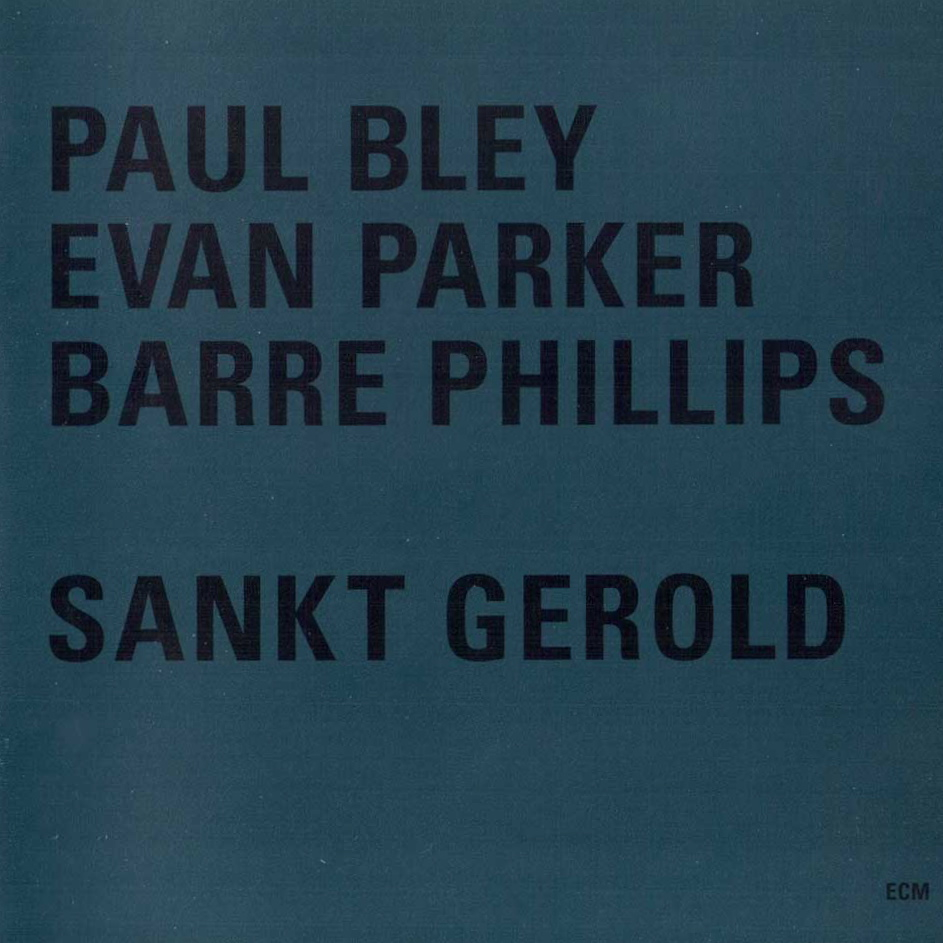
Bley/Parker/Phillips: Sankt Gerold (ECM 1609)

Sankt Gerold

Paul Bley piano
Evan Parker tenor and soprano saxophones
Barre Phillips double-bass
Recorded April 1996, Monastery of Sankt Gerold
Engineer: Jan Erik Kongshaug
Produced by Manfred Eicher and Steve Lake

Time Will Tell was not only the title of ECM’s first document between pianist Paul Bley, saxophonist Evan Parker, and bassist Barre Phillips, but also a premonition realized live in the confines of Sankt Gerold, from which this follow-up borrows its own. The Austrian monastery has hosted many label recordings by groups such as the Hilliard Ensemble, and here the voices are just as distinct. These are musicians who learn how to fly by jumping from the tree, leaving us to gawk on the forest floor. The improvisation that ensues may be free, but from it we are not, buried by the sands of its ephemeral hourglass.

The twelve variations of Sankt Gerold lure us into enchanting freefall with deep, fluttering calls. In these beat the rhythms of worms and larvae, the breaths of a chrysalis, frozen yet somehow alive, hiding its transformations behind a scrim of bark. Steps share the floor with broom strokes and memories created in the moment. This time around the emphasis is as much on solo turns as on groupthink, with the most potent scoops of gravity from Bley, whose sleepwalks play like a kitten who gets only more tangled the more he tries to work through the yarn. Only here, escape would mean silence, a breaking of the line that otherwise holds us fast to the moment. Parker solders our attention with feats of sustained energy. In it we hear ourselves breaking and mending simultaneously, our souls rendered amorphous clots brought to life by embouchure and circular breathing. Philips embarks on the darkest prismatic sojourns, even if they are lit by creativity aflame. His is the meditative center of these infusions, the embryo of some percussive entity that sings as it beats. Together, the trio winds pathos-rich fuses, the ashes of which turn matches into oracles.

To speak of these tracks individually is like trying to extract one letter from the album’s Prussian cover: each needs the others to speak. This music throws open doors of insight to let in the night and day of its containment—beyond it not a room but an infinite body of which we hear one cell dividing. Like affirmation of an unrequited love, one finds its heart by getting lost in it.

<< Terje Rypdal: Skywards (ECM 1608)
>> Lena Willemark/Ale Möller: Agram (ECM 1610
)

Terje Rypdal: Skywards (ECM 1608)

Terje Rypdal
Skywards

Terje Rypdal electric guitar
Palle Mikkelborg trumpet
Terje Tønnesen violin
David Darling cello
Christian Eggen piano, keyboards
Paolo Vinaccia drums, percussion
Jon Christensen drums
Recorded February 1996 at Rainbow Studio, Oslo
Engineer: Jan Erik Kongshaug
Produced by Manfred Eicher

If Terje Rypdal’s instrument is his axe, then he has ground it to an edge like no other, and perhaps few places so finely as on Skywards. The result of a Lillehammer Festival commission, his jeweled exposition is an aural thank you note to the unquantifiable contributions that ECM has made, via producer Manfred Eicher, to the Scandinavian soundscape. One could hardly script a more fitting lineup for such a task. Joining the Norwegian renaissance man are trumpeter Palle Mikkelborg, cellist David Darling, drummers Paolo Vinaccia and Jon Christensen, violinist Terje Tønnesen (heard recently on If Mountains Could Sing, and Christian Eggen on keyboards (familiar to Rypdal followers as conductor for Undisonus and Q.E.D.). Of these, it is Mikkelborg who leads the way most economically, as in the central “Out Of This World,” transplanted from the Lillehammer stage and redressed here in Oslo’s Rainbow Stuio. The sincerity of his gambit bleeds into Rypdal’s own blazing chess moves against a backcloth of shifting voices. The guitarist writhes as if singing, even as Eggen exposes ancient shadows whose dance has remained unchanged since its inception. Before kissing this quasar, however, we are treated to the earth-friendly title piece. Its anthemic strains carry the torch of “The Return Of Per Ulv,” of which it is a shining reflection, and unwraps also the album’s hallmarks: drums like speech, synths like water, and glorious leads. “Into The Wilderness” bears the frostbite of the Norwegian film, Kjærlighetens kjøtere (Zero Kelvin), for which he composed it. Yet it brings warm thoughts, wrapped in savannah dreams, the creaking of bones, and subterranean currents. In this cinematic enclave we encounter a host of idioms, all tied by a quiet splendor that burgeons even as it fades. David Lynch-like atmospheres mix freely with turpentine and darkening reality, where the sunlight now becomes a ghost wished for to be gone. “The Pleasure Is Mine, I’m Sure” is another cinematic bow to the legions of our shared past. In its wake treads the ostinato of “It’s Not Over Until The Fat Lady Sings!” skirted by drums and overlaid by Rypdal’s collected, fierce lyricism. The set ends with “Shining” and “Remember To Remember,” each a reworking of an earlier motive, mineral from the soil, trembling with romantic charge.

A perfect marriage of concept, cover, and content, Skywards guides the way with light while leaving footprints of shadow. A fantastically beautiful record.

<< Wheeler/Konitz/Holland/Frisell: Angel Song (ECM 1607)
>> Bley/Parker/Phillips: Sankt Gerold (ECM 1609
)

Bobo Stenson Trio: War Orphans (ECM 1604)


Bobo Stenson Trio
War Orphans

Bobo Stenson piano
Anders Jormin double-bass
Jon Christensen drums
Recorded May 1997 at Rainbow Studio, Oslo
Engineer: Jan Erik Kongshaug
Produced by Manfred Eicher

Following a memorable return on 1996’s Reflections, the Bobo Stenson Trio strengthened its resolve with the release of War Orphans. Like the Ornette Coleman tune that gives the album its title, the flow borne out on these proceedings is attentive and sincere. The footfall of the same, tender as if not wanting to wake a sleeping child, lends this and its surroundings a natural feel. Yet it is “Oleo de mujer con sombrero” by Cuban folk singer and nueva trova pioneer Silvio Rodriguez that prefaces. A tender intro from Stenson leads us into the album cover’s barren vista, a place where memories and souls intermingle like characters in a Theo Angelopoulos film. Anders Jormin grows from the piano like a melodic appendage into the waters of his own “Natt.” The first of three tunes by the bassist, its current rolls stones into smooth jewels, while “Eleventh Of January” and “Sediment” bring synergy and whimsy in turn. Captivating solos in both cast him as the hub of this emotional wheel. Coleman resurfaces in “All My Life,” to which drummer Jon Christensen adds his skipping crosscurrents, setting off another star turn from Jormin, whose fingers dance their fretless way into the heart of Stenson’s lone original, “Bengali Blue.” This smooth joint crashes against the rhythm section’s shore before a surprisingly buoyant version of Duke Ellington’s “Melancholia” woos us into the piano’s final words, receding like a sun dipping its ladle into steaming ocean.

War Orphans has a feeling of clockwork, intimate gears set by key to turn and melodize. It is a salve to our innermost wounds. Like ripples in a pond from three stones, these minds naturally find ways to commingle.

<< Tomasz Stanko: Leosia (ECM 1603)
>> Charles Ives: Sonatas for Violin and Piano (ECM 1605 NS
)

Tomasz Stanko Quartet: Leosia (ECM 1603)

Tomasz Stanko Quartet
Leosia

Tomasz Stanko trumpet
Bobo Stenson piano
Anders Jormin double-bass
Tony Oxley drums
Recorded January 1996 at Rainbow Studio
Engineer: Jan Erik Kongshaug
Produced by Manfred Eicher

“You shall sleep when you will,
to the strains of celestial music,
and you need not say your prayers.”
–Comte de Lautréamont, Maldoror

After the cinematic embroidery of Matka Joanna, where else was the Tomasz Stanko Quartet to go but farther inward? Building not so much on as under its shadowy predecessor, Leosia plants the Polish trumpeter in even darker soil with cohorts Bobo Stenson, Anders Jormin, and Tony Oxley. While everyone involved had by this point lit his fair share of lanterns, for this session the quartet trimmed those wicks to the barest of flames with no loss of intensity. The grace of “Morning Heavy Song” expresses all that follows in one slow sweep of the compass. Stanko embodies the spirit of its charcoal canvas, which comes to us naked and trembling. Yet we see that spirit by the light of something promising, a resolution that sparkles with the rhythm section’s deeply psychological entrance. It may be a story of harder things, but it grows new legs through the telling. Oxley is superb, here and beyond, marking trails with splashes of breadcrumbs in “Die Weisheit von Le comte Lautréamont” and bringing especial definition to “Trinity.” The latter is also a vivid example of Stanko’s singing qualities, qualities that melt his brass down in such crucibles as “A Farewell To Maria” and “Hungry Howl” to the shape of a creased page. In both we smell remorse on the wind, not least through Jormin’s humming presence. We wake to a new dawn in “Brace,” a freer chain that sets us on a “Forlorn Walk.” This is where the session decides to swing, in its twisted way, Stanko reaping some engaging highs against the delicate attunement of his band mates. Of Stenson’s skeletal wonders we hear plenty in “No Bass Trio” and “Euforila,” one rest to the other’s play. For the title track, all of these shards coalesce into a single mosaic, taking on the colors of whatever light passes through it, be it clear or swirling with ink. That light is undoubtedly Stanko, who shines to the end with a quiet and unpretentious conviction. His lyricism is diurnal, our guide along a horizon of melancholy that leaves us intact and well nourished.

<< Ralph Towner/Gary Peacock: A Closer View (ECM 1602)
>> Bobo Stenson Trio: War Orphans (ECM 1604
)

Amina Alaoui: Arco Iris (ECM 2180)

Amina Alaoui
Arco Iris

Amina Alaoui vocals, daf
Saïfallah Ben Abderrazak violin
Sofiane Negra oud
José Luis Montón flamenco guitar
Eduardo Miranda mandolin
Idriss Agnel percussion
Recorded April 2010, Auditorio Radiotelevisione svizzera, Lugano
Engineer: Stefano Amerio
Produced by Manfred Eicher

Voices, loved and idealized, of those who have died, or of those lost for us like the dead. Sometimes they speak to us in dreams; sometimes deep in thought the mind hears them. And with their sound for a moment return sounds from our life’s first poetry—like music at night, distant, fading away.
–Constantin P. Cavafy, Voices

Does the incantation call or is it called? The word comes from the Latin incantationem, the “art of enchanting.” And what is enchantment but a merging of spell caster and object, of flesh and energy. And so, while the incantation masquerades as an offering to a sky we can never touch, it is a body composed of many. It shrugs off the wings sewn into its back, catching thermals of word alone. Moroccan-born Amina Alaoui understands, profoundly, that the incantation is not something one can hold or even shape but a web of moving parts on which her voice is a dewdrop poised to fall. We are accompanied, as the violin that joins her, by a butterfly of trepidation whose lilting paths of flight carve us like soapstone. An oud’s inky presence sprouts roots and calligraphy, wishing upon stars of portent. Alaoui holds the shore, touching the torches of her diction to ancestral memory, each a wad of flash paper in a trickster’s pocket. Plectrums open and close—dragonfly wings balancing on vibrating tightropes. Though we may dance to the taps of these hollow-bodied fantasies, hitting reality at 90-degree angles, we know that the variations known to open eyes are infinite. She assures us of this, appealing to the moon’s pale fire and licking our feathers clean as we grow lost and hungry for attention. We are the dream of a serpent’s unspoken prayer, waking just in time to see mountains cut the firmament with their life volcanic. Or is it the instruments that fill in those spaces, each a dervish to its own heartbeat? Bows and fingers, shifting winds and sands—all leave their fingerprints on our skin. This is how Arco Iris feels.

An album comprised of one song, drawn from fado, flamenco, and Al Andalusi currents, in addition to Alaoui’s own. We see her world for what it is, bearing as it does the mark of lived experience in a “common crucible of these styles.” One might say the Iberian Peninsula lingers in the marrow, but as she notes in the accompanying booklet, Alaoui is less interested in nostalgia than in dialogue, in how “poetic geography” communicates through openness of expression. This means not only a blurring of spatial, but also temporal borders. In so disassembling the origins of this music, she peers beyond idioms and straight into the images that sustain them. They are her shelter, her way of being in the world. This is what Arco Iris is.

(See this review as it originally appeared in RootsWorld Magazine. To hear more samples, click here.)

Ralph Towner and Gary Peacock: A Closer View (ECM 1602)

A Closer View

Ralph Towner classical and 12-string guitars
Gary Peacock double-bass
Recorded December 1995 at Rainbow Studio, Oslo
Engineer: Jan Erik Kongshaug
Produced by Manfred Eicher

If Oracle, the first ECM strictly duo collaboration between bassist Gary Peacock and guitarist Ralph Towner, was Mt. Kilimanjaro, this is Everest. Stepping out of the intimate cave of the former, these uncompromising sages wrap their oracular magic around a set of 12 (mostly) new tunes. Whereas before Peacock’s compositions were in prominence, now they recede in the relief of Towner’s, each a pebble of the larger whole. The sole exception is “Moor,” which cameos after its early appearance on Paul Bley with Gary Peacock. From that session it retains its drama, and like “Infrared” stretches the envelope to 16 strings. Yet for the most part the alchemy is introspectively, if robustly, adorned. In “Opalesque” we can’t help but take to the fluidity of Peacock’s abilities like a diver to the sea. It is an instinctive conversion, one that matches Towner depth for depth. “Viewpoint” is the shortest of these stories, and holds a magnifying glass to the trail of clues left by “Mingusiana.” A subtle and crawling allusion, it skates across decades of experience to serve us the past as if it were the present. The freer considerations of “Postcard To Salta” are notable for the percussive qualities they bring out in Towner’s playing against a solo from Peacock that flows like poetry. The bassist glows also in the hearth of “Beppo,” but not before the expository “Toledo” flows from Towner’s classical. This solo masterpiece is worth the album alone, and gives due relativity to the genetic mysteries of “Amber Captive” and the title track, which like a muslin curtain filters light with a crosshatching of nostalgic stains and scents: the very stuff of life.

This aching album moves on without us, bearing its pulse in the bones. It is a lift of the head in sunrise, a touch of the lips to forehead, a misty star shining through to the end of every dream. The drop may look far, but in such fatherly hands we know a single step will traverse it.

<< Jean-Luc Godard: Nouvelle Vague (ECM 1600/01 NS)
>> Tomasz Stanko: Leosia (ECM 1603
)

Raised by Silence: Andrey Zvyagintsev’s The Return

Andrey Zvyagintsev
The Return

Andrey Dergatchev music
Recorded in Moscow
Mixing: Sergey Bolshakov at NGSU, Moscow

Sunday
Boys. Locked in a tower without walls. Only way out is to jump, trailing naïve ribbons into ocean. Ivan fears for his life before it has begun, cringes, holds himself like an idol of sadness. His mother, afraid, finds among the clouds. Ivan insists, I jump, but doesn’t move. Coward. Pig. These, the insults that follow him down the ladder.

Monday
Brothers. Ivan to Andrei, younger to older. Ivan’s friends have turned on their axes. Andrei chases him through a blur of stone and shame. The specter of toughness looms, foggy and ephemeral. Home awaits, harboring an unexpected guest. Their father has emerged from the past, haggard and silent. His photograph rests in a book of Christian violence, smiling a scythe of absence. The consuming patriarch eats first, drinks first, speaks last. Andrei fills his plate. Ivan leaves his dry. A promise, a trip, the car a horizontal escape. Andrei’s eyes widen at the man’s strength. In the mother’s heart, a diary. Her pen now still, she writes lies of valor onto her sons’ pages.

Tuesday
Desolation. Bent telephone poles. Endless road. Curiosity in Ivan’s eyes. This man is not “Dad,” only the skeleton of one. Armed with a camera, Andrei shoots his brother through with holes. In town, the food is as scarce as the people. Father takes refuge in his rearview mirror, where a onetime stare flicks its tongue against his stubble. Ivan will not touch his fork. A thief, an opportunity to prove themselves. “You’ve got no fists.” On the pier, he trades secrets and wind. They camp, fish the waters of their stoic reunion, dreaming of somewhere far away. This man is not real.

Wednesday
Drive. Splash of pastoral color bleeds like a wound. Ivan abandoned, alone with his rods and tackle in a downpour. “Why did you come back?” he cries. “You don’t need us.” Father is a survivor. He hits Andrei.

Thursday
Crossing. Tarred boat, passage of joy. Engine dies, elbows worked to the fulcrum. On the shore, by the fire, the man is downtrodden. Ivan: “If he touches me again, I’ll kill him.”

Friday
Anger. Ivan steals a knife, conceals it as they explore the terrain. Another tower. Father unearths a box, conceals it in their boat. Another hit to Andrei’s face. And another. Ivan wields the blade but cannot follow through. He climbs the tower, threatening to jump. Father falls to his death trying to reach him. They drag his body to the boat on a bed of branches. His body floats from shore, sinks along with the box into the blackness. Ivan’s obstinacy is Andrei’s fear. Ivan takes out the picture, from which the father is now absent. They drive off. Andrei’s camera gives up its ghosts.

Director Andrey Zvyagintsev has left us these pictures. With them, Andrey Dergatchev has left us their voices. More than incidental, his soundtrack relives the film as might a photograph relive a sunset. The mix is corroded as much as it is innocent, every image a feature of Ivan’s despair. It begins where the film ends: underwater. An old man sings, drawing threads of a past that only he may know, and weaves from them the very doll of memory that resides within the father’s box, a kiss lost to winds that blow like wicker brooms across a porch. Whispers of derision in sibling rivalry paint us along the hallway, catching sight of ghosts in the walls and ceiling shadows, for in the bedroom is where truths are spoken. Georgian folk songs glaze a thorn-patch of ambient sounds. These begin to surround us, as if we were locked inside a car flying through the trees. Ice and rain: each tells stories of its conversion into the other. We feel the swell of that forgotten childhood and the bond it was denied.

Sounds of insects. The title music opens its eyes half way. A tender enchantment, puff of dandelion through the inner ear, a place so deep that we hardly feel its electronic blips. Sons speak. Words create disturbances, reinforcing an absence whose return brings further silence. Arpeggios thread the cries of gulls that give them relief. Unlike them, Mozart’s Requiem spreads a wing in between acts, but never flies, melting instead behind a layer of silver water. Someone whispers and bids the cells to dance, finding that somewhere in the piano there may be hope stored like history. A skipping record, touched by the needle of the soul and swung around the filament of the credit roll, seeks familiar pathos in the final rainfall, rotting the boat that brought us here.

Amina Alaoui review in RootsWorld

The folks over at RootsWorld online magazine have just published a review by yours truly of Amina Alaoui’s fabulous new ECM release, Arco Iris. Truly one of the finest albums from the label in years. Don’t pass this one up.

For the review, click here. And while you’re there, you can check out my older review of Kuára among RootsWorld’s enviable assortment of world musics.

Ralph Towner: Lost And Found (ECM 1563)

Ralph Towner
Lost And Found

Ralph Towner classical and 12-string guitars
Denney Goodhew sopranino, soprano, and baritone saxophones, bass clarinet
Marc Johnson double-bass
Jon Christensen drums
Recorded May 1995 at Rainbow Studio, Oslo
Engineer: Jan Erik Kongshaug
Produced by Manfred Eicher

2001 was a difficult year. Aside from the tragic political tightrope we all were walking, I’d just come out of a relationship for which I’d uprooted myself, was now living in a place where I knew no one, and had taken to spending much of my time making friends online. One of these—an artist and socialite from Bali—and I became especially close through a shared love of music. At the time, the dividing cell culture that was my CD collection boasted about 1000 albums (400 of which were ECM), hers twice as much. One day I casually mentioned to her that I was listening to Ralph Towner’s Lost And Found. There was a pause in our chat window before she admitted that she’d been listening to the very same. Since then Lost And Found has lodged itself in my memory through the sheer (im)probability of this coincidence.

The music is equally rich with coincidence, drawing intersections between Towner’s classical and 12-string guitars, Marc Johnson’s upright, Jon Christensen’s palette of the drum, and the many reeds of Denney Goodhew in a surprise appearance—his first (and last) for the label since 1981’s First Avenue. Compositional credits are fairly well spread over fifteen dreamy tracks, with Towner taking half. The rounded insistence of “Harbinger,” for one, is a welcome introduction to his unique solo language, while the full quartet sound of “Élan Vital” pulls its simple carriage through a chain of emotional way stations. “Scrimshaw,” for another, describes his art in another word, for like its namesake it is a quiet and etching pursuit. Towner blows this dust into “Midnight Blue…Red Shift,” among an eclectic dash of Goodhew tunes that also includes his jaunty “Flying Cows” (insight into the cover’s land-bound pig, perhaps?). Johnson’s contributions are some of the session’s deepest. Whether it’s the shimmering refractions of “Col Legno” or the homeless groove of “Sco Cone,” his bare presence speaks to Towner’s all-inclusiveness. In the end, though, the guitarist’s waters run purest, flowing through descriptive scenes like “Tattler” on the way to “Taxi’s Waiting,” thereby ending the set with everyone accounted for.

An album to take on the road, for it is a road in and of itself—one that bridges gaps of solitude and, to this soul at least, whispers a small hope that we might all still be connected in this fallen age.

<< Gateway: Homecoming (ECM 1562)
>> Robin Schulkowsky/NPM: Hastening Westward (ECM 1564 NS)