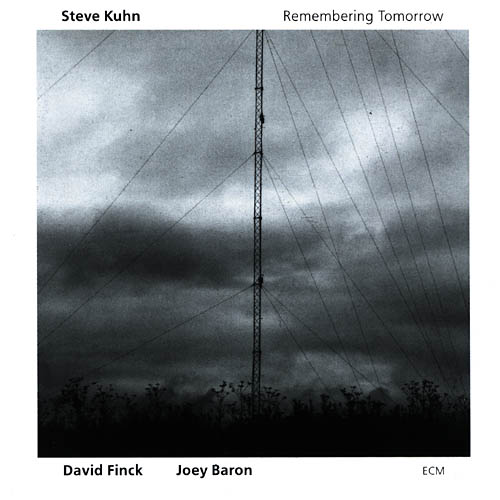
Steve Kuhn: Remembering Tomorrow (ECM 1573)

Steve Kuhn
Remembering Tomorrow

Steve Kuhn piano
David Finck double-bass
Joey Baron drums
Recorded March 1995 at Rainbow Studio, Oslo
Engineer: Jan Erik Kongshaug
Produced by Manfred Eicher

Fans of Steve Kuhn are sure to recognize many of the tunes on Remembering Tomorrow, but don’t let that fool you into thinking this intimate date with bassist David Finck and drummer Joey Baron is a mere retread of the past, for in the present trio setting the music shines afresh, fertile as fields after summer rain. And despite what the somber cover photograph would have you believe, the results are dynamic, intense, and uplifting. Sure, we get the lustrous, dreamy wash of “The Rain Forest” and “Lullaby,” kisses on the forehead to sooth our agitation. And there is the rather sober version of “Trance,” morphed from its optimistic progressions into Baron’s splashes through murky waters. Another tender reconsideration: “Life’s Backward Glance,” which blossoms with the full crystalline breadth of the assembled forces. But then there are groovier excursions like “Oceans In The Sky” and “All The Rest Is The Same.” Baron, in his second ECM appearance, tickles these and more with astute wit. Finck, for his part, remains happy to spin the fuselage to which Kuhn attaches his wings. The title track does indeed throb with the power of recollection, casting nets into a complicated past and pulling from them one spiritual thread that sings. Kuhn’s exchanges with Finck in “The Feeling Within” are the hallmark of this set’s most touching moments, while “Bittersweet Passages” finds the pianist uniting with Baron in a delicate crucible. The product is an eye of “Silver” that closes under the sands of sleep.

Kuhn’s magic is his touch, his feeling for stories warm as breath. He inhales with the lungpower of a choir, exhales with the veiled subtlety of an orchestra hanging on a pianissimo chord. Let these dandelion seeds fly and follow wherever they lead.

<< Dave Holland Quartet: Dream Of The Elders (ECM 1572)
>> Gateway: In The Moment (ECM 1574)

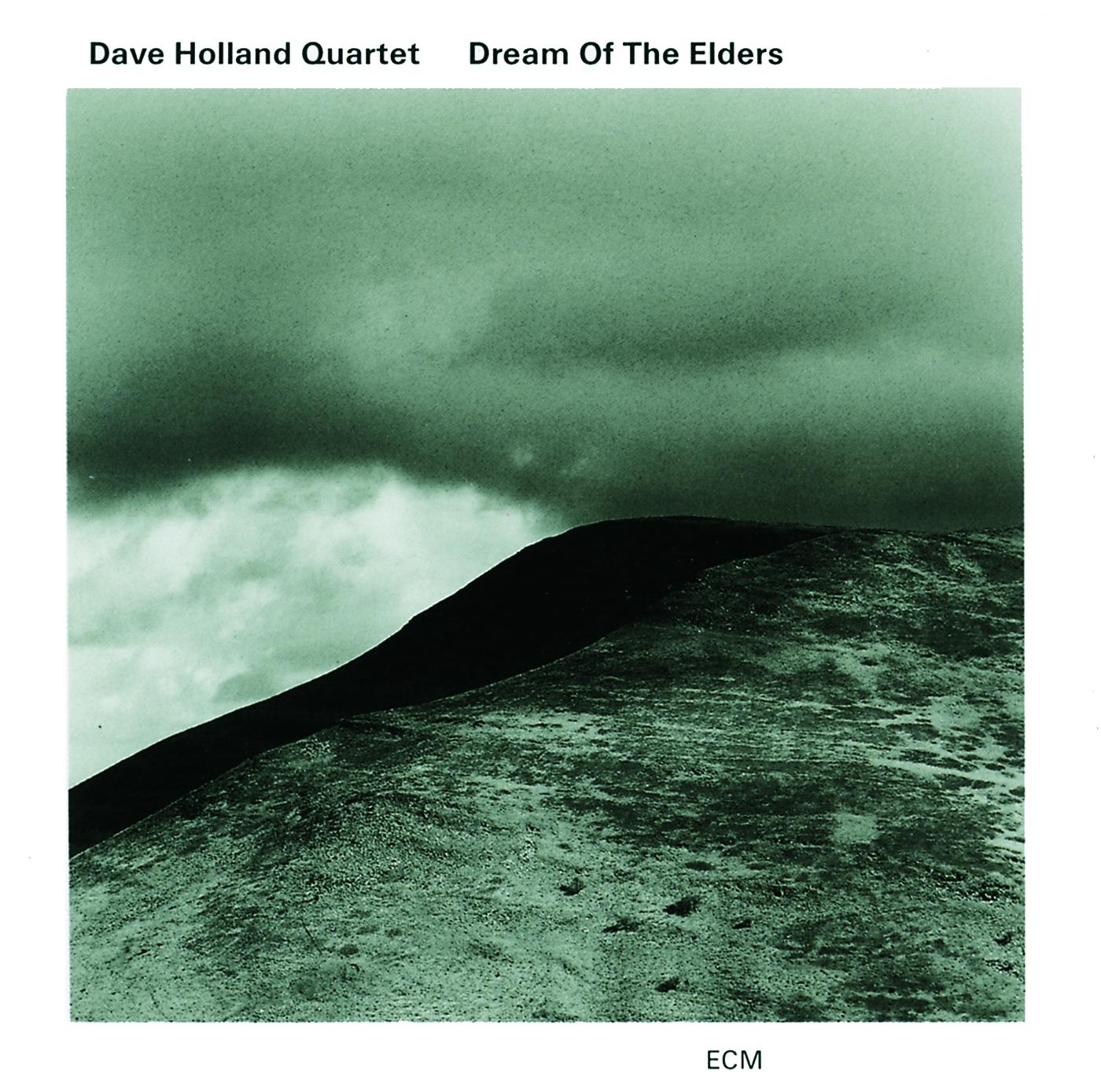
Dave Holland Quartet: Dream Of The Elders (ECM 1572)

Dave Holland Quartet
Dream of the Elders

Dave Holland double-bass
Steve Nelson vibraphone, marimba
Eric Person alto, soprano saxophones
Gene Jackson drums
Cassandra Wilson vocal
Recorded March 1995, Power Station, New York
Engineer: James Farber
Produced by Manfred Eicher

This incarnation of the Dave Holland Quartet finds the double bassist in the excellent company of mallet man Steve Nelson, saxophonist Eric Person, and drummer Gene Jackson. The combination is a fortuitous one and glistens under the ECM heat lamp. A characteristic bass line sets us on “The Winding Way,” the theme of which Person’s soprano rides like sunlight on the fin of a dolphin, followed not far behind by a string of underwater acrobatics from vibes. So begins a set of eight immodest Holland originals, averaging over nine minutes apiece. The length is never for its own sake, due only to the sheer amount of stories these musicians have to convey. Take “Lazy Snake,” for example, which begins with a gritty bass solo before swaying, dressed to the nines, like a debutante onto an empty dance floor. A marvelous joint that truly showcases the interlocking imaginations of these fearless four. At the marimba, Nelson moves from solo to vamp as the sky from dusk to midnight, dimming a meditative alto to finish. After a few sprightly turns in “Claressence,” vocalist Cassandra Wilson makes a guest appearance on “Equality.” Said attribute defines not only this tune but also the band as a whole. Hers is a voice that yearns for freedom, sliding lovers like beads off a string until the hummingbird of her resolve is left hovering. “Ebb & Flow” does much more of the latter than the former, proving once again why Nelson is the star on this date, further enlivening the spidery altoism of the title track and setting off a spate of cathartic drumming. Of the rhythm section we must also take note in “Second Thoughts.” Its blink-of-an-eye precision invigorates fabulous solos from vibes and alto for a telltale journey of the heart, ending with an instrumental reprise of “Equality,” sultry and debonair.

Dream Of The Elders lives up to its title. Just listen to Person soloing on “Ebb & Flow” and you’ll understand the lengths to which these souls will travel to translate the language of their genealogies into a vernacular we can all feel and understand. Easy as pie, sans sugar crash.

<< Thomas Demenga: J. S. Bach/B. A. Zimmermann (ECM 1571 NS)
>> Steve Kuhn: Remembering Tomorrow (ECM 1573)

Terje Rypdal: Double Concerto / 5th Symphony (ECM 1567)

Terje Rypdal
Double Concerto / 5th Symphony

Terje Rypdal guitar
Ronni Le Tekro guitar
Riga Festival Orchestra
Normunds Šnē
 conductor
Recorded June 1998, Riga, and August 1998, Nyhagen
Engineers: Audun Strype and Dag Stokke
Produced by Manfred Eicher

Ever the slippery idiomatic eel, Terje Rypdal holds his own as composer in two massive works, the Double Concerto for two electric guitars and symphony orchestra and the 5th Symphony, totaling eight movements of classical brilliance. While the influences are as maverick as he, the overall consistency of texture is refreshing and clean. Rypdal and fellow guitarist Ronni Le Tekro build on a mutual appreciation as soloists for the opus 58 Concerto. Erkki-Sven Tüür fans will find much to admire here in the adroit incorporation of percussion and brass against a Baroque-flavored counterpoint in the leading motives of the first movement. After these pyrotechnic swoops, the meditations of the second movement are a welcome reprieve. Yet the torch still burns all the way to the fourth, braving a storm of Glenn Branca proportion toward cinematic resolution.

If the concerto is about closure, then Rypdal’s opus 50 is about openness. The 5th Symphony reveals a detailed aesthetic that builds with molecules of descriptive energy, as what at one moment may evoke the sway of windblown trees may trade places the next with a waterfall’s shimmering veil. From this cascade emerges a faunal English horn, poking its head through the foliage like a curious deer whose need for caution pales in the light of the comfort that surrounds it. From a dissonant rumbling from below, a wayfaring piano anoints us with slumber, pulling threads of pathos to harp-gilded crests and falls. A thorough and pervasive atmosphere wins out, hurling us into oblivion.

Rypdal swings from innocence to fortitude at the flick of a pick (or pen, as the case might be). Like the oceans of Solaris, his music is ethereal even as it feeds on our darkest fears.

<< Mozart: Piano Concertos, etc. (ECM 1565/66 NS)
>> Giya Kancheli: Caris Mere (ECM 1568 NS)

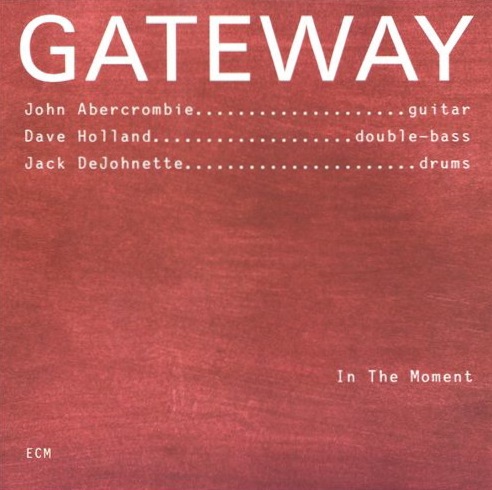
Gateway: Homecoming (ECM 1562) / In The Moment (ECM 1574)

Guitarist John Abercrombie, bassist Dave Holland, and drummer Jack DeJohnette made history with the release of Gateway in 1975. The name stuck, as did the accolades, which followed them to a 1978 sequel that bolstered their sound to new heights. Only after a 17-year hiatus, during which time each member played with the other (but never as a trio) in varying forms, did they push their already stuffed envelope with a reunion at New York’s Power Station studio, by then a familiar launch pad for DeJohnette and his work with the Keith Jarrett Trio. The session spawned two albums, though only one was planned, starting with:

Homecoming (ECM 1562)
Recorded December 1994, Power Station, New York
Engineer: Jan Erik Kongshaug
Produced by Manfred Eicher

The title track reunited more than one of the finest groups of the seventies, bringing together also the many emotional souvenirs each performer had gathered along the way. The joy in every lick and tumble is in full evidence. DeJohnette is aflame, Abercrombie following his trail of embers with laser precision and shaving off an twist of lime for his solo, while Holland (who penned this and three other of the album’s nine tunes) is at his buoyant best. His montuno-flavored “Modern Times” and “How’s Never” throw open the doors for both of his bandmates, but especially for DeJohnette in the latter. Abercrombie counters with three gems of his own, of which “Calypso Falto” is noteworthy for its conjuration of faraway islands and intimate shores. Not be left out, DeJohnette rounds out the set with a diptych, swapping sticks for ivory on “Oneness” and presaging his album of the same name by two years.

<< Anouar Brahem: Khomsa (ECM 1561)
>> Ralph Towner: Lost And Found (ECM 1563)

If only we could get a taste of this alchemy in our drink, we might all live beyond our time. Invigorating and fine, Homecoming is a joy to explore time and again. Which is, I imagine, exactly what was on ECM producer Manfred Eicher’s mind when he asked the trio to keep playing:

In The Moment (ECM 1574)
Recorded December 1994, Power Station, New York
Engineer: Jan Erik Kongshaug
Produced by Manfred Eicher

Thus, In The Moment, a 46-minute set of group improvisations that simply must be heard in conjunction. DeJohnette chants through a Turkish frame drum for the start, Abercrombie working his microtonal magic with an ess-curved twang. This formula persists because it works, finding new purpose in “Cinuçen.” Pregnant like a Saharan sky, it lets down its golden hair and lumbers through “The Enchanted Forest” to catch up to its own jangling caravan. The interaction between bass and drums make tracks like “Shrubberies” the beautiful things that they are. As far a cry as possible from the Monty Python images its title may evoke, this is an honest excursion that lowers us like a sleeping child into “Soft.” For this, Holland draws his bow like the Loch Ness monster beneath Abercrombie’s wavering reflections as a pianistic fog assures the sighting will never be captured. Magic and pure to the last, this one is.

Both Homecoming and In The Moment are of a piece, each the shadow of the other in the light of our listening. We may, and with good reason, marvel at three-dimensionality of their mesh…but in the end it’s all about letting go and taking the music for what it is: a language we all can translate.

<< Steve Kuhn: Remembering Tomorrow (ECM 1573)
>> Keith Jarrett Trio: At The Blue Note – The Complete Recordings (ECM 1575-80)

Anouar Brahem: Khomsa (ECM 1561)

Anouar Brahem
Khomsa

Anouar Brahem oud
Richard Galliano accordion
François Couturier piano, synthesizer
Jean-Marc Larché soprano saxophone
Béchir Selmi violin
Palle Danielsson double-bass
Jon Christensen drums
Recorded September 1994 at Rainbow Studio, Oslo
Engineer: Jan Erik Kongshaug
Produced by Manfred Eicher

Anouar Brahem’s third leader date for ECM explores the oud player’s incidental music for Tunisian film and theatre as interpreted by a shifting nexus of musicians, new and old alike. His compositional side takes precedence this time around, for it is accordionist Richard Galliano who lights the foreground with “Comme un depart” and hardly recedes until “Des rayons et des ombres,” the latter a superbly jazzy romp with Palle Danielsson and Jon Christensen. Bassist and drummer, respectively, add buoyancy to “E la nave va” and “Aïn ghazel,” culminating in the shadow of Jean-Marc Larché’s soprano for the title track. Galliano continues to somersault through the airspace of “Souffle un vent de sable.” Only here does the oud awaken, as if from long hibernation, its lips dry and puckered for the quench of a distant rain. Brahem deepens the sincerity of his instrument in “L’infini jour” with a twang that aches from the power of re-creation. He and Galliano flirt with the same watery surface in “Sur l’infini bleu,” the first of a handful of duets that also includes the animated “Claquent les voiles” (Brahem/Danielsson). “Vague” and its “Nouvelle” counterpart blossom with a piano that recalls the opening section of Philip Glass’s Glassworks, carrying over into the ensemble-oriented folktale of “Seule.” Larché questions the night in “Un sentier d’alliance,” where he is answered by the sparkling reflections of François Couturier’s pianism, only to be picked up by violin in “Comme une absence” before sliding into blissful self-awareness.

Khomsa is an inspired meeting, each musician highlighting a different curl of Brahem’s calligraphic art. This may not be his most consistent effort, but I discourage you from passing it up.

<< Nils Petter Molvær: Khmer (ECM 1560)
>> Gateway: Homecoming (ECM 1562)

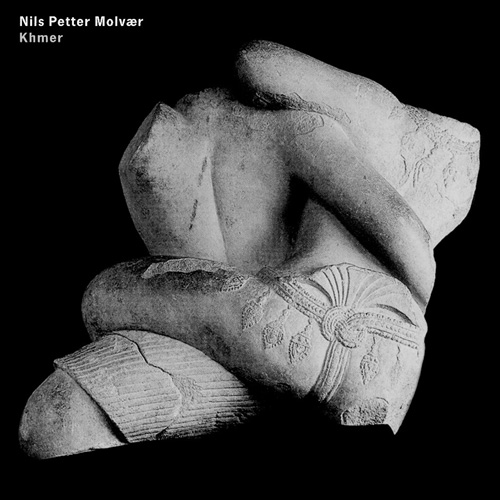
Nils Petter Molvær: Khmer (ECM 1560)

2000 X

Nils Petter Molvær
Khmer

Nils Petter Molvær trumpet, electric guitar, bass guitar, percussion, samples
Eivind Aarset electric guitar, effects, ambient treatments
Ulf W. Ø. Holand samples
Morten Mølster electric guitar
Roger Ludvigsen acoustic guitar, percussion, dulcimer
Rune Arnesen drums
Reidar Skår samples, keyboards
Recorded 1996/97 at Lydlab A/S, Oslo
Engineer: Ulf W. Ø. Holand
Produced by Manfred Eicher and Ulf W. Ø. Holand

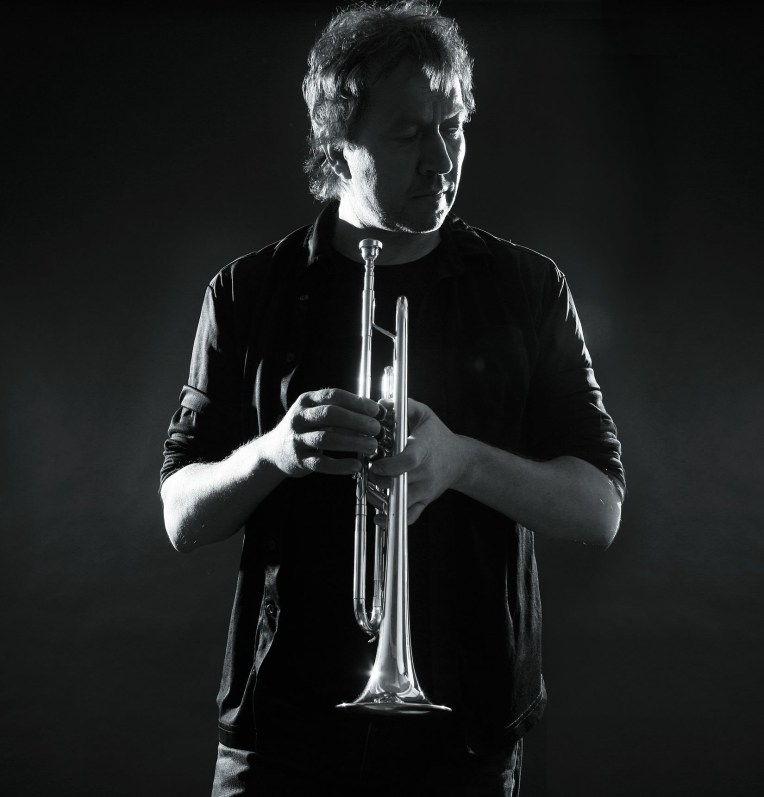
Khmer marks a monumental occasion: namely, the debut leader date of Nils Petter Molvær. Fresh off the boat of Small Labyrinths, the Norwegian trumpet player came out of left field with one of those rare albums that becomes second nature after only one listen. NPM, as he is also known, epitomizes ECM’s transcendental spirit with a collage of unbridled passion and integrity. Combining influences as diverse, if not also as intimately connected, as rock, ambient, dub, techno, and jazz, he deploys his mercurial fleet in a sea of samples, breakbeats, and smooth dives. Also carrying over from the Small Labyrinths session is hard rocker Eivind Aarset, who bookends the album with his e-bow guitar treatments and foils the delicate additions of free improviser Morten Mølster along the way. Mari Boine band regular Roger Ludvigsen adds six strings and more, playing prepared guitar and dulcimer, and along with drummer Rune Arnesen fleshes out the band’s acoustic signature. Yet it is keyboardist Reidar Skår and co-producer Ulf W. Ø. Holand who give the music just the kick it needs to hit the ground running. Holand, whose Lydlab is two floors above Oslo’s hallowed Rainbow Studio, provided samples and enough studio time to help shape the album into what it has become, while Skår brought his magic touch to said samples and others, manipulating them into an organic whole. The result is a classic that fits snugly alongside ECM’s all-time best.
Despite what from the above may seem like a grandiose experiment, the flow of Khmer is built around cells of rhythmic and melodic delicacy. It is only through the skill of the musicians, producers, and engineer that over a modest 43 minutes these cells build into fully fledged organisms. We hear this in the berimbau taps and snaking guitar lines that open the title track, giving plenty of net for Molvær’s distinct lobs. This feeling of pulse, sere and crystalline, burgeons in “Tløn,” which gives our first taste of the album’s electronic spread. A descending trumpet line hooks on to one of the catchiest samples you’ll ever hear (courtesy of Coldcut’s cult dance sampler, Kleptomania!). The mounting drums and talk-boxed vocals send this brew into active fermentation. NPM’s presence is intermittent, offering the occasional fluid monologue (enhanced to an electric guitar’s sheen), thereby allowing the group’s emergence to swing forth. Shawm-like cries throw up their hands to the rhythm of windblown leaves, ending on that same solo line, recycled and returned. The sediment-rich waterway of “Access” chains us to the digital ablution of “Song Of Sand I.” Funk reigns supreme, meshing with orchestral swells suggestive of Cypher 7’s “Message Important,” while also bearing Manfred Eicher’s stamp of focused communication. “On Stream” allows NPM to stretch his muscles more humbly. We hear the preparatory rhythms of his breathing against a subliminal caravan beat. “Platonic Years” continues down this percussive road. If the Bill Laswell influences were already felt in the low-end execution, here they blossom in a sample from his classic Axiom double album, Lost In The Translation, melding with breath and drum. “Phum” gives us a bubble of air to suck on in the rising waters before “Song Of Sand II” unleashes the selfsame track’s grittier side. Thus do we “Exit,” shifting, dreaming of doing it all over again.

Khmer was, for its time, a culmination of everything ECM had striven for in bridging styles, times, and places. An album with a sound, if there ever was one…


Khmer: The Remixes (ECM 1560/M)

…but the journey didn’t end there, for Eicher and company went a step farther when the following year they released ECM’s first remix albums, allowing for even greater expansion into fresh idiomatic territories. The Remixes offers up three re-interpretations, starting with The Herbaliser’s DJ Fjørd Mix of “Platonic Years,” which against heavy beats and filtered pizzicato touches stretches its trip-hop legs. Another twist of the prism gives us Mental Overdrive’s Dance Mix of “Tløn.” What seems like a meditative introduction washes into half the remix before the promised dance begins, rendered all the more cathartic for coming out of such a viscous carriage. “Song Of Sand” also goes under the knife, appearing in a “Single Edit” but finding greater traction in Rockers Hi-Fi’s Coastal Warning Mix. All of this makes for some head-nodding goodness.


Ligotage (ECM 1560/L)

Ligotage is a single in the truest sense, its cloudy title track straight off NPM’s follow-up, Solid Ether. This thought-provoking track is couched by an unedited version of “On Stream” and Mother Nature’s Cloud & Shower Show Mix of “Song Of Sand,” which sounds like Boards of Canada doing funk (this cut also appeared on a special promo remix edition, ECM 1560/S).

When I first bought this album in college, I played it for anyone who would listen. I brought it with me wherever I went and fed it into every stereo I encountered. On one such occasion, a friend smiled when I asked what he thought and said, “Groovy.”

Right on.

<< Marilyn Mazur’s Future Song: Small Labyrinths (ECM 1559)
>> Anouar Brahem: Khomsa (ECM 1561)

Marilyn Mazur’s Future Song: Small Labyrinths (ECM 1559)

Marilyn Mazur
Small Labyrinths

Aina Kemanis voice
Hans Ulrik saxophones
Nils Petter Molvær trumpet
Eivind Aarset guitar
Elvira Plenar piano, keyboards
Klavs Hovman basses
Audun Kleive drums
Marilyn Mazur percussion
Recorded August 1994 at Sun Studio, Copenhagen
Engineer: Bjarne Hansen
Produced by Manfred Eicher

Percussionist Marilyn Mazur, best known for keeping the beat with the Jan Garbarek Group, came into her own with Small Labyrinths, her first for ECM as frontwoman—in this case, of the Future Song project. With characteristic wit and commitment to seeing every gesture through, Mazur leads us on a trek of visions and fantasies. True to the dynamic nature of her art, she begins softly in “A World Of Gates,” caressing the periphery of her assembly and working her way to center with diligence. She blends into “Drum Tunnel,” clicking the tongues of her inner fire on the one hand, on the other adding a touch of icy whimsy via sleigh bells. In “The Electric Cave” a talk box hangs stalactites in code, while in the web of “The Dreamcatcher” we encounter the soothing voice of Aina Kemanis (in a different mode from her experiments with Barre Phillips), who gives fuzzy warmth to “Visions In The Wood” and prays for rain and thunder in “Castle Of Air.” Trumpeter Nils Petter Molvær adds backbone wherever he travels, shrouding the already supernal gamelan drone of “Back To Dreamfog Mountain” with a breath from below. After an interlude of “Creature Talk,” we stumble through the anthemic strains of “See There” into a “Valley Of Fragments.” This explosive aside casts us into an “Enchanted Place,” shattering windows into grains of sand, and those further into molecules, each indeed a small labyrinth harboring the promise of music. “The Holey” is where we end, lost in a book of cries and whispers, out of reach and out of time.

Small Labyrinths is no self-enclosed ritual, but rather a diary of open and spirited play. It seeks us out, asks us to stay, and hopes we may join in.

<< Jack DeJohnette: Dancing With Nature Spirits (ECM 1558)
>> Nils Petter Molvær: Khmer (ECM 1560)

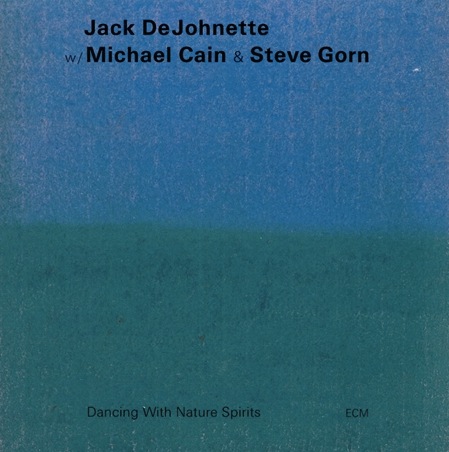
Jack DeJohnette: Dancing With Nature Spirits (ECM 1558)

Jack DeJohnette
Dancing With Nature Spirits

Jack DeJohnette drums, percussion
Michael Cain piano, keyboards
Steve Gorn bansuri flute, soprano saxophone, clarinet
Recorded May 1995 at Dreamland Studios, West Hurley, New York
Engineer: Tom Mark
Produced by Manfred Eicher

It’s astonishing to think—given the intensity of his collaboration with Keith Jarrett, Gary Peacock, and others for whom his talents were in demand as he rode a wave of worldwide prominence in the 1990s—that drummer Jack DeJohnette still found the time on shore to free such thoughtful beauty as that on Dancing With Nature Spirits. Pianist Michael Cain, in his ECM debut, makes noteworthy contributions to a deeply felt studio session, given three dimensions by Steve Gorn, here playing a variety of winds. The latter’s bansuri flute and kestrel soprano finger-paint rich undercoats to Cain’s sparkling pianism in the title track, all the while playing off tender bubbling from toms and cymbals. This low-grade fever pales into the mournful incantations of “Anatolia.” So the desert lures us, moths to candle, smudging us into the ashen backdrop. Breath becomes virtue incarnate, a doll Gorn fashions from dried reeds and lullabies. Tracings from piano and tabla push from the earth like kangaroos in slow motion, hovering above the ground for a split second before the lights are cut. “Healing Song For Mother Earth” stamps those feet back down, like hands to drum, from a wellspring of light. In those delicate freefalls we feel the vestiges of time wafting through us with all the comfort of a breeze through mosquito netting. DeJohnette scours the villages for cloth with which to dry the tears of elders who’ve relinquished hope, reaching blood-worthy sacrament in “Emanations.” The secrets of this garden stream are to be found in the waterfall that bore it unto the land like a vein in a field of muscle, where only “Time Warps” touch those reflections with silver in ecstatic storytelling.

A profound album to be savored for its simplicity, heart, and message.

<< Charles Lloyd: All My Relations (ECM 1557)
>> Marilyn Mazur’s Future Song: Small Labyrinths (ECM 1559)

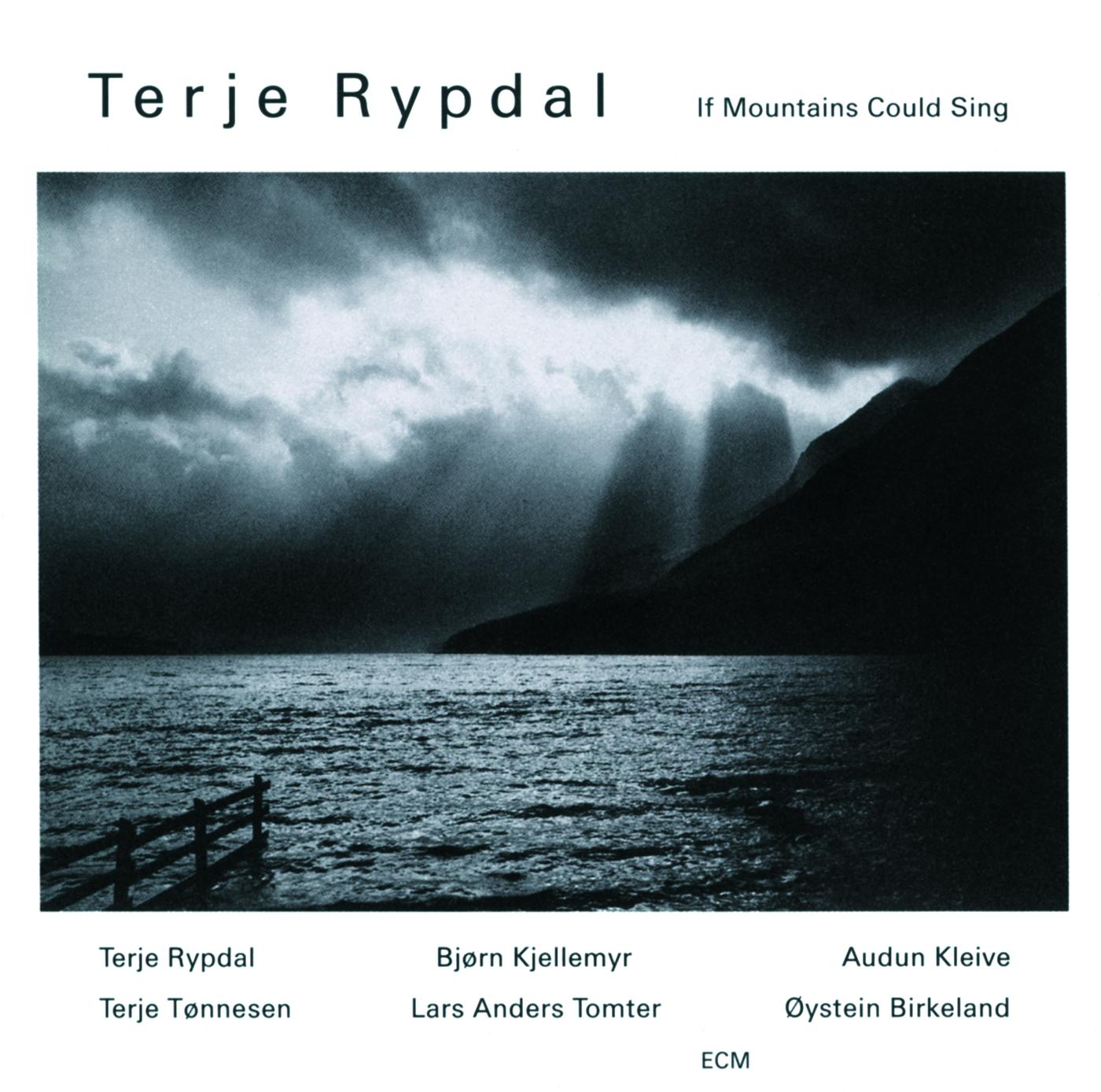
Terje Rypdal: If Mountains Could Sing (ECM 1554)

Terje Rypdal
If Mountains Could Sing

Terje Rypdal electric guitars
Bjørn Kjellemyr basses
Audun Kleive drums
Terje Tønnesen violin
Lars Anders Tomter viola
Øystein Birkeland cello
Christian Eggen conductor
Recorded January and June 1994 at Rainbow Studio, Oslo
Engineer: Jan Erik Kongshaug
Produced by Manfred Eicher

I start this review where I might end it, by marking If Mountains Could Sing as one of Terje Rypdal’s finest achievements. Marrying the Norwegian guitarist’s penchant for magnesium fire with his comparable passion for classical textures, this record gives us the clearest intersection of his split idiomatic personality since Descendre. “The Return Of Per Ulv” kicks off a journey that is modest in length—just shy of 48 minutes—yet anything but in scope and palette. Despite the odd title (“Per Ulv” being the Norwegian moniker for Wile E. Coyote), the smoothness of its melodic line, downright edible phrasing, and fluid bass playing (courtesy of Bjørn Kjellemyr) at once evoke snow and thaw, a landscape of discovery stretching beneath steel gray skies. If ECM were to make a single Best Of album for the label as a whole, omitting this one would be tantamount to crime. Running a close second is “Dancing Without Reindeers,” which after a pizzicato burst walks the violin off the plank into an ocean schooled by drummer Audun Kleive, who chronological ECM followers would have last heard with Jon Balke on Further. Kleive, in fact, shows incredible dynamic sensitivity throughout, supplying whispers of cymbal and snare in “It’s In The Air” and “Foran Peisen” as Rypdal awakens like some giant dragon from hibernation, splashing through the puddles of “But On The Other Hand” after a cosmic storm, and anchoring “Private Eye” with depth of experience. As for the composer behind all this, he breeds lifetimes of haze against tidal strings in the arresting title track and conjures up the object of Per Ulv’s ever-unrequited chase in “One For The Roadrunner” to gut-wrenching effect. The rhythm section gets its last gasp in “Genie” before he signs this love letter on a note of “Lonesome Guitar.”

Here we have a pinpoint of dawn stretched into a canvas large enough to fit any and all listeners. We can walk and admire, lounge or run as we please through its many moods, always knowing that the music is here for us and us alone. Open this door and don’t listen back.

<< Surman/Krog/Rypdal/Storaas: Nordic Quartet (ECM 1553)
>> Sándor Veress: Passacaglia Concertante, etc. (ECM 1555 NS)