Quercus: s/t (ECM 2276)

2276 X

Quercus

June Tabor voice
Huw Warren piano
Iain Ballamy saxophones
Recorded live March 2006 by Paul Sparrow
Edited by Mike Mower
Mixed at Rainbow Studio, Oslo by Jan Erik Kongshaug and Manfred Eicher
Produced by Manfred Eicher, Iain Ballamy, and Huw Warren

Quercus names both the debut album and trio composed of folksinger June Tabor, pianist Huw Warren, and saxophonist Iain Ballamy. The word is Latin for “oak,” but the image implies more than rootedness, embodying the full arboreal essence of this somber collection. Indeed, Tabor’s voice is the very wood of the forest, and invites the instrumentalists along its democratic path of music making.

Quercus Photo

All that I have endured
Lassie my dearie
Here in thine arms is cured
Lassie lie near me

These words, by Scotland’s national poet Robert Burns, ease us into a running theme: love as a salve for all ills. From the last line comes the title of the song, which Tabor sings with little affectation, save the emotional veracity of her diction, while Ballamy harmonizes, doubles, and cradles her by turns. He and Warren carry on the melody, unraveling finer implications behind the text with understated precision. This formula proves effective hereafter and works especially well in the iambic pentameter of Shakespeare’s “Twelfth Night,” from which is excerpted the lyrics of “Come Away Death,” in Ballamy’s own arrangement, and for which Tabor digs into her chest voice to tease out the Bard of Avon’s gravelly truths. It is a quality she employs selectively, as in her unaccompanied version of “Brigg Fair,” turning a normally airy song into ash. Ballamy further provides music for “Near But Far Away,” in which he seems to channel jazz legend Charles Lloyd in this melodious, if cautionary, tale that is one of the album’s finest. “As I Roved Out” completes the selection of traditional songs. Like a fantasy made actual and turned back into fantasy, its scrim bears the scars of transformation:

And at night when I go to my bed of slumber
The thoughts of my true love run in my mind
When I turn around to embrace my darling
Instead of gold sure it’s brass I find

“The Lads In Their Hundreds” couches the WWI poem by A. E. Housman in music of English composer George Butterworth. With the austerity of a Ken Loach film, it draws black where only green once thrived. The musicianship brings an eerie sense of calm and offsets morose imagery of young soldiers going off to war, only to die as anonymous placeholders of unwritten glory. To this elegy Warren responds with “Teares.” The John Dowland-inspired piano solo blends pointillism and sustain, for all a windswept pasture. Subsequent vignettes evoke faraway deserts (“Who Wants The Evening Rose”), the naïveté of love’s first kiss (“This Is Always”) and, in “A Tale From History (The Shooting),” the drama of remembrance. The latter, a true song of songs, features words and music by Irish singer-songwriter David Ballantine. Tales from history line our breath, goes the rhyme. Start with passion, end in death. The promise of retribution lingering in these mor(t)al variations finds fulfillment in the closing “All I Ask Of You,” by American spiritual leader and hymnist Gregory Norbet. Here Ballamy’s introductory soliloquy strikes a balance of prosody and poetry, and holds on to its melody as one in prayer might grasp a rosary. The flowing changes in instrumental color unexpectedly come together with Tabor in the final moments, oneness above all.

Like the three Robin Williamson discs before it, Quercus expands ECM’s unique interpretive folk niche. Although recorded live at The Anvil in Basingstoke in conclusion of a 2006 UK tour, it wasn’t released until 2013. The seven-year lag seems appropriate, for the trio had been together seven years before turning the microphones on. It’s as if the songs were doubly aged so that they might reach our ears at peak flavor and consistency, pushing us along the way into the darkest crannies of the human experience even as they lift us from those depths in want of light. Each is the shadow within the shadow, a space where dreams and realities intermingle until one cannot be pulled apart from the other.

(See this article as it originally appeared in RootsWorld online magazine, where you may also hear a sample track.)

Quercus review in RootsWorld

Another new review for RootsWorld online magazine. This one details the self-titled ECM debut of Quercus, a trio consisting of folksinger June Tabor, pianist Huw Warren, and saxophonist Iain Ballamy. Click the cover to read the article and hear a sample track.

2276 X

Trygve Seim and Frode Haltli: Yeraz (ECM 2044)

Yeraz

Yeraz

Trygve Seim soprano and tenor saxophones
Frode Haltli accordion
Recorded June 2007 at Rainbow Studio, Oslo
Engineer: Jan Erik Kongshaug
Produced by Manfred Eicher

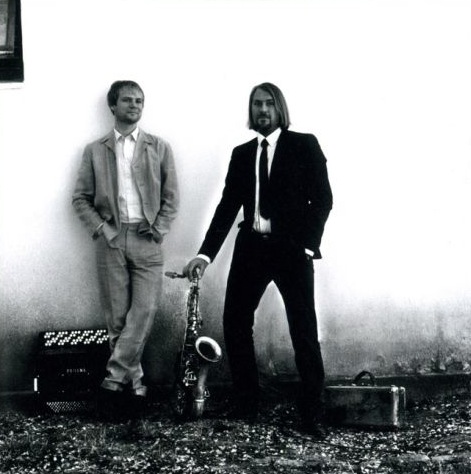
Saxophonist Trygve Seim and accordionist Frode Haltli, both children of the Norwegian jazz scene and frequent collaborators who have grown into some of that scene’s most genre-defying proponents, pair up for an intimate songbook of frequencies that wraps the duo’s minds around an erudite program of mostly Seim-composed pieces. Exceptions include the haunting and windswept Armenian traditional song, from which the album gets its name, and the seemingly bipartite “MmBall,” penned by Seim’s go-to drummer, Per Oddvar Johansen. Seim and Haltli further explore two melodies—“Bayaty” and “Duduki”—by spiritual guru G. I. Gurdjieff (1866-1949), who, since Keith Jarrett’s 1980 Sacred Hymns, has been a ghostly presence on a handful of ECM projects.

Seim Haltli
(Photo credit: Morten Krogvold)

Compared to past recordings, Haltli treads more carefully across the accordion’s polar ice caps, his touch as pliant as ever. With the slightest pitch bend or intervallic quaver, the accordion’s inner heart speaks with utmost profundity, especially in the lower range, which despite a seemingly tenuous hold on notes lays foundations of its own. Seim proves an ideal partner, not only sonically—both are reedmen of sorts—but also in musicality. Nowhere more so than in their interpretation of Bob Marley’s “Redemption Song,” for which the instruments blend so well they sound like extensions of one another, regressions and evolutions linking toward plush, resolute skies. In the Gurdjieff pieces, too, the duo feels like a splitting of the same consciousness. Seim’s duduk-like sound reveals tonal mastery, painting a cathedral from the steeple down to Haltli’s throaty bedrock.

As for Seim’s pieces, each is possessed of its own physical property. From the slow-moving liquid of “Airamero” to the cinematic grain of the Tom Waits-inspired “Waits for Waltz,” his writing engenders a joyous but never boisterous sense of play and understated virtuosity. Other Seim notables: the less inhibited brushwork of “Fast Jazz” and the accordion solo “Bhavana,” for which Haltli’s transcendent highs evoke the Russian bayan or, perhaps, the Japanese shō.

Holding the disc together are the freely improvised “Praeludium” and “Postludium,” each a beginning and an end in and of itself, waiting to redraw the circle. Thankfully, the PLAY button allows us to do just that.

Frode Haltli: Passing Images (ECM 1913)

Passing Images

Frode Haltli
Passing Images

Frode Haltli accordion
Arve Henriksen trumpet
Garth Knox viola
Maja Solveig Kjelstrup Ratkje voice
Recorded December 2004 at Rainbow Studio, Oslo
Engineer: Jan Erik Kongshaug
Produced by Manfred Eicher

Accordionist Frode Haltli mesmerized with his first contemporary program, Looking on Darkness, for ECM. Now, he furthers the journey with a chamber album of folk music from his native Norway. Although classically trained, Haltli has subsisted on roots since his formative years at the bellows, and over time has breathed new life into every tune.Accordingly, if not accordionly, the album’s centerpiece is a waltz from his home village of Våler i Solør in southeastern Norway. Here it takes three forms. The first two—“Per” and “Lyrisk vals” (Lyrical Waltz)—are games of tag between Haltli and violist Garth Knox, each a shade of the same ghost. Singer-composer Maja Solveig Kjelstrup Ratkje, whose Gagaku Variations formed the most memorable portion of Looking on Darkness, joins the duo for the final incarnation: the title piece. If the music until his point has been drawn in charcoal, here the medium is pen and ink. Its starker lines profess Haltli’s understanding of breath—not simply because his instrument is itself an artificial lung, but because it shares the body of its performer, expanding beyond human ken into warbling bird soul.

Dovetailing these musicians is trumpeter Arve Henriksen, whose poetry whispers gold into the alchemy of “Psalm.” The album’s gateway plants a dream within a dream, and from it a fragrance of hope wafts to the four corners of the compass. Both this track and “Vandring” make tasteful use of the accordion’s pitch-bending capabilities, thereby undercutting sharpened highs with lilting accents and intimations of children’s games.

Remarkable about Passing Images is the vastness evoked by its modest congregation. From histrionic wanderings (“Inter,” “Lude”) to less hallucinatory swaths of stagecraft (“The Letter,” “Vals”), the musicians travel between inner and outer worlds with ease, melting gestures down drains of progression. As of the folk song “Jag haver ingen kärare,” every melody is first unspooled and second re-spun, by which time the light has only moments to learn its dance before shining into your ear.

Savina Yannatou & Primavera en Salonico: Sumiglia (ECM 1903)

Sumiglia

Savina Yannatou
Primavera en Salonico
Sumiglia

Savina Yannatou voice
Primavera en Salonico
Kostas Vomvolos accordion, qanun, kalimba
Yannis Alexandris tamboura, oud, guitar
Michalis Siganidis double-bass
Kyriakos Gouventas violin, viola
Harris Lambrakis ney
Kostas Theodorou percussion
Recorded May 2004 at Rainbow Studio, Oslo
Engineer: Jan Erik Kongshaug
Produced by Manfred Eicher

Two years after the release of her ECM leader debut (although really a preexisting live recording repackaged as such), Savina Yannatou returns with her first album recorded under the label’s auspices at Rainbow Studio in Oslo. Sumiglia is at once a departure from and a deepening of the Greek singer’s extraordinary gifts, bound by nothing save her own imagination. Flanked as always by Primavera en Salonico, a band of dynamic expressive power, Yannatou graces another characteristically eclectic program of folk songs. Her voice is like a head of hair: thicker in some places, thinner in others, containing a wealth of reflections and colors, but always rooted and growing. Her wisdom is thus animated, blowing in winds from a thousand isles.

In spite of the studio comforts, one experiences Sumiglia as if a live recording, pulsing as it does with only thinly mitigated vibrancy. Like its predecessor, this album begins with a violin solo—a modest introduction that betrays nothing of the ensuing profusions. “Evga mana mou” thus opens with a nod to Yannatou’s homeland, a bridal song of farewell to family and friends. Adopting a tone that is delicate as a butterfly yet sharp as the bird that hunts it, the singing navigates a droning landscape with free surety. Other Greek songs include the tender, spring-like “Yanno Yannovitse” and the beautifully arranged “Ela ipne ke pare to,” which walks with a light kalimba step and a slight Arabic curl, further proving that sometimes the most bone-humming singing is that which is on the verge of fadeout. Within this frame, listeners are whisked away on a carefully sequenced journey. From the droning of Spain (“Muineira”) through the forests of Ukraine (“Ta chervona ta kalinonka”) to the twists of Albania (“Smarte moj”), there’s something for nearly everyone to grasp along the way.

Regardless of the roles she adopts, Yannatou remains painterly and self-aware. In the Moldavian song “Porondos viz partjan,” for one, she takes on the voice of an orphaned child, her evening wanderings matched step for step in arco starlight. In the Sicilian “Terra ca nun senti,” for another, she darts through mazes of war-weary angst. Other flybys of the Mediterranean yield the gravelly, fairytale affectations of “Orrio tto fengo” and the whimsical romanticism of “Sta kala lu serenu,” both from Italy. A stopover in Corsica in the album’s title track draws Yannatou’s voice like a thick rope through darkness, heaving histories and mysteries in equal measure. We feel that depth of mourning for times past.

The album’s delights take us inland and beyond. “Sedi Yanna,” a well-known Bulgarian folk song, receives an invigorating treatment, with just the exact amount of lilt and forward motion. It is also a perfect representation of the band’s clarity, which despite the density of its execution remains crystal clear. The lyrical fire of “Ganchum em yar ari,” from Armenia, warms us to “Tulbah.” This last is a Palestinian song that shows the Primavera at its chameleonic best. Whether riding the wave or swaying to the rhythm of calmer currents, the band adapts.

In addition to its many other virtues, Sumiglia is yet another feather in the cap of engineer Jan Erik Kongshaug. Known, of course, for his spacious treatments of various jazz configurations, here he brings an immediacy that serves the music as much as it serves us. A bravura showing from every angle.

Savina Yannatou & Primavera en Salonico: Terra Nostra (ECM 1856)

Terra Nostra

Savina Yannatou
Primavera en Salonico
Terra Nostra

Savina Yannatou voice
Lamia Bedioui voice
Primavera en Salonico
Lefteris Ahgouridakis percussion
Yannis Alexandris oud, guitar, tamboura
Kostas Vomvolos kanoun, accordion, caliba, tamboura
Kyriakos Gouventas violin
Harris Lambrakis nay
Michalis Siganidis double-bass
Antonis Maratos percussion
Tassos Misyrlis cello
Recorded live in Athens, November 2001
Sound engineer: Vangelis Kalaras
Remixing and sound processing: Yannis Paxevanis, Studio “N,” Athens
Editing: Yannis Christodoulatos
Mastering: Chris Hatzistamou and Yannis Christodoulatos, Athens Mastering

Savina Yannatou is a wonder. As well versed in classical and jazz as in traditional and folk repertoires, the Greek singer turns every melody she handles into an alloy entirely her own. By the time this album was committed to digital in 2001, she had twenty years of acclaimed recordings, performances, and collaborations behind her—five with Primavera en Salonico. From the brilliance of what’s captured on this, her ECM debut (repackaged from its original appearance on Lyra), here’s hoping there will be twenty more.

Savina

To describe Yannatou’s relationship with Primavera is to describe the spark of flint and fire. The result is a conflagration that dances with innumerable colors. Some of those colors are easily identifiable as cultural, spanning as they do a variety of locative sources. Others are not so amenable to labeling, for they arise out of Yannatou’s effortless code switching and extended vocal techniques. Among those techniques, we are treated to everything from unadorned lullabies (as in “Adieu Paure Carnavas,” which comes from Provence) and swirling enchantments (“I’ve told you and I say again,” a Greek traditional from Asia Minor) to trance states of speech-song (the Caribbean traditional “Ah Mon Dié”) and cathartic ululations (“El Barquero,” by way of the seaside Spanish village of Asturia). In this vein we have also “Ballo sardo,” a Central Sardinian tune with whimsical touches glinting off an already compelling surface. In it, Yannatou sings, “Be careful, barons, to moderate your tyranny / otherwise I swear to you that you will lose your power,” effectively flagging the shattering power that one sweep of the lips can possess. The pen may be mightier than the sword, she seems to say, but the mouth outdoes them both.

The topography of Terra Nostra is thus varied as the cultures that populate it. The mournful violin that introduces “With the Moon I’m Walking,” a Greek traditional from Kalymnos Island and the concert’s prologue, shifts tectonically beneath Yannatou’s crosscurrents. It’s an appropriate starting point, a place of questioning and cosmos that sets up much of what will soon be answered. Highlights to follow include “Ivan Nadõnka Dúmashe” (Ivan Said to Donka), a song from the Bulgarian province of Eastern Rumelia. The region’s Turkish and Greek minorities can be heard in the kanoun, a Middle Eastern zither that shines starlight across a bed of lyrical regret. Nay virtuoso Harris Lambrakis—of an ensemble rich with instrumental talent—is a noteworthy facet of Primavera’s vibrant sound. His contributions to “A Fairy’s Love Song” (traditional from the Hebrides) and others draw threads of longing throughout.

Since the beginning of the Yannatou/Primavera collaboration, Sephardic music has been a vital part of the group’s programming, and in this performance we are treated to four examples. The upbeat and full sound of such refreshing, if also surreally realized, songs as “Jaco” and “Los Bilbilicos” lends uplift, while the strong percussive drive of “Tres Hermanicas Eran” looses a dream from slumber, made reality by the tactile force of the performance. In these songs we feel Yannatou at the center of crowded streets, where her immediate surroundings curl into a ball at her feet and purr to the tune of her descriptive powers.

Five songs feature co-vocalist Lamia Bedioui, who was born in Tunisia but has been based in Greece for nearly two decades. She brings a likeminded cross-culturalism to the group, beguiling in a handful of Arabic songs, such as the Meredith Monk-esque “Yiallah Tnem Rima” (Let Rim Sleep), a lullaby from Lebanon that carves brief passage through caves and sand with its largely vocal palette, and a rubato version of the undying “Wa Habibi.” She also heads the jangling fragmentations of the Italian Renaissance tune “Madonna de la Grazia” (Italian Renaissance) with equal parts tact and abandon.

What makes this record blossom is the interactive prowess of its musicians. Primavera stays true to its name, gathering all the power of the eponymous season to resurrect these songs from the depths of a long winter. Through clever instrumental pairings (of, for example, oud darting through jazzy bass lines) and juxtapositions of sacred and secular, Yannatou and her band prove that, once everything sprouts, it all becomes one homogeneous field, across which we are bid to run for love of living.

Alternate Terra
Alternate cover

Claudio Puntin/Gerður Gunnarsdóttir: Ýlir (ECM 1749)

Ýlir

Ýlir

Claudio Puntin clarinet, bass clarinet
Gerður Gunnarsdóttir violin, vocal
Recorded 1997-99 at Radio Bremen, Sensesaal
Engineers: Dietram Köster and Christine Potschkat
Recording producer: Peter Schulze
Co-production ECM Records/Radio Bremen

Claudio Puntin and Gerður Gunnarsdóttir make their ECM debut with Ýlir, a musical portrait of Iceland utilizing a mixture of techniques, realities, and understandings of that fabled volcanic jewel. Gunnarsdóttir, a violinist and vocalist of eclectic professional associations, calls Iceland home, while clarinetist Puntin hails from Switzerland. The latter also possesses a wide-ranging talent across idioms, and has continued his association with ECM as a regular member of the Wolfert Brederode Quartet. As a duo, these partners operate under the moniker Essence of North, folding seamless improvisations into a batter of original and traditional material, but always with an ancestral taste on the tongue. The culmination of all this is a unique chamber recital of magical dimensions.

Puntin and Gunnarsdóttir seem most in their element when there are stories to be told. In particular, “Huldufólk”—literally “hidden people” but translated more colloquially as “fairies”—speaks to a world within a world, a world from which the duo draws its breath and feeds an interpretive grace back into the hollows. The piece takes shape in three divided parts. “Draumur” (Temptation) and “Tæling” (Seduction) each open a blank diary and inscribe it with mythological phonemes, a siren’s song in points and lines. Here, as elsewhere throughout, the clarinet embodies an unsuspecting Alice. The violin, meanwhile, slithers Cheshire-like across an outstretched branch, leaving a trail of streaking teeth and fur. “Hringekja” (Whirligig) finishes with a dance on a miniature scale, leaping up fungus steps and swinging from dripping leaves.

Evocative highlights include “Hvert örstutt spor” (Each Little Step), for which Gunnarsdóttir sings words by Icelandic writer Halldór Laxness, winner of the 1955 Nobel Prize for literature, as adapted by Darmstadt disciple Jón Nordal. This forlorn song for voice and bass clarinet closes our eyes in anticipation of “Sofðu unga ástin min” (Lullaby For An Abandoned Baby), a thrumming folk tune. “Kvæðið um fuglana” (Fantasy About Birds) is another visceral episode. This piece by Atli Heimir Sveinsson, a composer whose interest in folk music bears ripe fruit, positively glows in Puntin’s arrangement.

Whether the ebony drones of “Einbúinn” (The Ermite) and “Enginn láì öðrum frekt” (Contemplation), the Lena Willemark-esque excitations of “Peysireið” (Gallop), or the blend of near and far that is “L’ultimo abbraccio” (Last Embrace), there is much to explore in these vignettes. In the title track a pliant violin draws footpaths in snow (“Ýlir” means “winter”), joined by a clarinet that sings with memories of autumn. Like a bird caught in a blizzard, it ululates in the throes of indecision, thus giving melodious name to isolation. The yang to this yin comes with “Leysing” (Melting, Thaw), which sounds as if someone had placed a microphone inside a spring landscape and recorded its renewal. Through scrapings and lilting phrases, the musicians find a treasure trove of messages lurking below, just waiting to see the sky above and reach for it while they still can. In “Vorþankar” (Reflections On Spring), too, the harshness of winter is softened, glistening off icicles as if they were instruments, each a note with its own song to sing. Resonant and glassine, they waver at the edge of waking, like the lonesome goodnight of the “Epilogue,” a kiss forever locked on the lips of the moon.

All in all, this storybook journey peeks through the trees even as it uproots them, one microscopic tendril at a time, and with them strings a loom of thick emotions. Worth seeking out, if it hasn’t already sought you.

Iva Bittová: s/t (ECM 2275)

Iva Bittová

Iva Bittová

Iva Bittová voilin, voice, kalimba
Recorded February 2012, Auditorio Radiotelevisione svizzera, Lugano
Engineer: Stefano Amerio
Produced by Manfred Eicher

Characterizing the music of Iva Bittová as resistant to definition both describes it perfectly and does it a disservice. The former, because her minimal tools of violin and voice elicit a museum’s worth of colors, moods, and brushstrokes. The latter, because every listener will emerge from that museum with a unique image in mind that is anything but indefinable. Despite her many creative personalities—which encompass acting, performing, and composing—she has achieved notoriety by no small feats of expression. Still, don’t be mistaken: this is no “avant-garde” artist. She’s not upsetting paradigms, but deepening their self-awareness.

“The violin accompanies me all the time,” says Bittová of an instrument that has centered her musical life since the early 1980s. “It is a mirror reflecting my dreams and imagination.” Yet she is, above all, a singer. Whether through vocal folds, bow, or physical gesture, her voice strikes flint to stone and blows a tangle of weed until it glows. So potent is said voice that it inspired fellow Czech composer Vladimír Godár’s Mater (documented most recently in a 2007 release for ECM New Series), a multilayered cantata on women-centered texts of which Bittová is both sun and satellite.

Iva

This self-titled solo album finds Bittová in her element in a series of 12 numbered “Fragments,” and because fragments imply a whole, it makes sense to speak of the album as such. Like a work of masterful anamorphosis, its image emerges only by submitting oneself to its perspective. Twelve is, of course, a mystical number. It defines the modern clock, marks the end of childhood, numbers the Bibical apostles, and zodiacally divides the heavens. Here it is a riddle that harbors many more.

The album begins and ends with her voice slaloming through the delicate signposts of a kalimba. Here and throughout there is harmony and tension, starlight and soil. At one moment, her voice and bow may unify. At another, her feet go their separate ways, divorced from body and destination. Pizzicato gestures seem to pluck hairs from the scalp of the night, while arco gestures get lost in mazes even as Bittová draws them. Sometimes: her voice alone, spoken and then sung, so that incantation becomes chant becomes lullaby in one fluid swing. Sometimes: the violin alone, crossing every bridge without ever touching feet to plank. Sometimes: a river’s flow through black forest, hints of love and travel.

To be sure, ghosts of a Slovakian heritage breach the fabric of time that veils her, but the freshness of her storytelling makes it all feel uncharted. For while she does adapt the music of Joaquín Rodrigo in Fragment VI and sings texts by Gertrude Stein and, notably, Chris Cutler in others (III and VII, respectively), she renders these sources personal and organic through her crafting. Words like “gypsy,” “folk,” and “tradition,” then, might as well be gusts of air, so intangible are they in her sound-world. That being said, her art is certainly rooted in a worldly sense of time and plays with that notion as would a hummingbird flirt with a backyard feeder. Her sound is resilient to climatic damage, for it has already absorbed so much of the oxidation that gives it character, and her tone is never brittle, even at its thinnest. In fact, the album’s strongest moments are to be found in her unaccompanied singing. From gentle cuckoo to shaman’s possession, her voice cycles through many (after)lives and makes this world of social details begin to feel other-cultural.

Here is an artist whose sense of architecture is wholly translucent, whose persona is her crucible, and whose music is an embodied practice, a mimesis personified to the point of healing.

(To hear samples of Iva Bittová, click here. See this review as it originally appeared in RootsWorld magazine.)