Gudmundson/Möller/Willemark: Frifot (ECM 1690)

Frifot

Frifot

Per Gudmundson fiddle, octave fiddle, Swedish bagpipes, vocal
Ale Möller mandola, natural flutes, hammered dulcimer, folk harp, shawm, vocal
Lena Willemark vocal, fiddle, octave fiddle, wooden flute
Recorded September 1998 at Rainbow Studio, Oslo
Engineer: Jan Erik Kongshaug
Produced by Manfred Eicher

When I smile my face shines like
Sunlight glittering on the water’s surface,
But when I cry my face is like
A dark pine forest under a cloudy sky.

Frifot are Per Gudmundson, Ale Möller, and Lena Willemark, the holy trinity of Swedish folk revivalism. The name means “footloose,” a word that locates their effortless playing in a realm of dance. Much of that spirit comes through in the handful of diptychs scattered throughout this epic self-titled program. These embody layered juxtapositions of sonority and exposition, of comet and tail, rushing through eons at the touch of plectrum and bow. Of them, the intimate pairing of “I hela naturen / Mjukfoten” (In All Nature / Light-foot) is an album highlight, its Robin Williamsonian waves flowing into the mandola’s rich speech acts. “Silder” (Still Waters), an ode from Willemark’s pen, glitters by kindred harp light and reaches out through the lighter “Bingsjö stora långdans.” From the uplifting polskas of fiddle-hunter Sjungar Lars to the brooding shores of “Om stenen” (The Stone), one feels a tireless will at work. The latter’s text by Swedish poet Bengt Berg paints it true: “Listen to the sound of the sun sinking into the lake.”

Surrounding all this merrymaking is deeply considered soil that takes first nourishment in the a cappella “Abba fader” (Abba Father), a song once preserved only in the memory of Baltic islanders whose Swedish ancestors emigrated to the Estonian coast during the Middle Ages. One hears earthen harmonies in the musicians’ voices, the gravel and scrape of time as it leaves its scars. A hammered dulcimer and rustic fiddle cradle “Stjärnan” (The Star), which evokes the miracle in Bethlehem, holding ancient vigil for those with a willing ear. “Tjugmyren” is composed of herding calls. The nasal, almost Bulgarian-sounding singing shows Willemark’s range of height and density. Calling through windswept grain, she plants her feet in the soil and grows where she stands. “Kolarpolskan” (The Charcoal-burner’s Polska) is another herding tune, this one more uplifting and with a bit of a Sephardic twist.

The listener hardly needs names to feel the stories. This is especially true in “Hemvändaren” (The Homecomer), which from hopeful beginnings spins a tale of bittersweet reunion and attempts to answer how one carries the hardships in the context of the resolution toward which they are endured. Another example of the album’s programmatic acuity is the agitated brushwork of “Fåfänglighet” (Vanity), while Gudmundson’s “Drömsken” (The Dreamer) evokes softer crosscurrents of instrumental expression. Yet another is “Skur Leja.” Written by Möller, it tells of a magically virtuous maiden whose purity puts not so virtuous men in their place and through its telling achieves a tense drama of flesh and intrigue. Other evocative standouts include “Metaren” (The Lazy Fisherman) and “Roligs Per-låtar,” a play on motives of itinerant fiddler and entertainer Roligs Per Persson.

As always, Willemark’s voice rings dependably through this cosmos with a palette like the very planet from which it springs: a swirl of blues, greens, and whites. The accompaniment is so much more than that, flapping as it does with all the conviction of a bird of prey even as it nestles, gentle as a lamb, in pasture. Notable also is the attention paid to selection and song order. Its flow runs deeper than a river in the thirstiest of land.

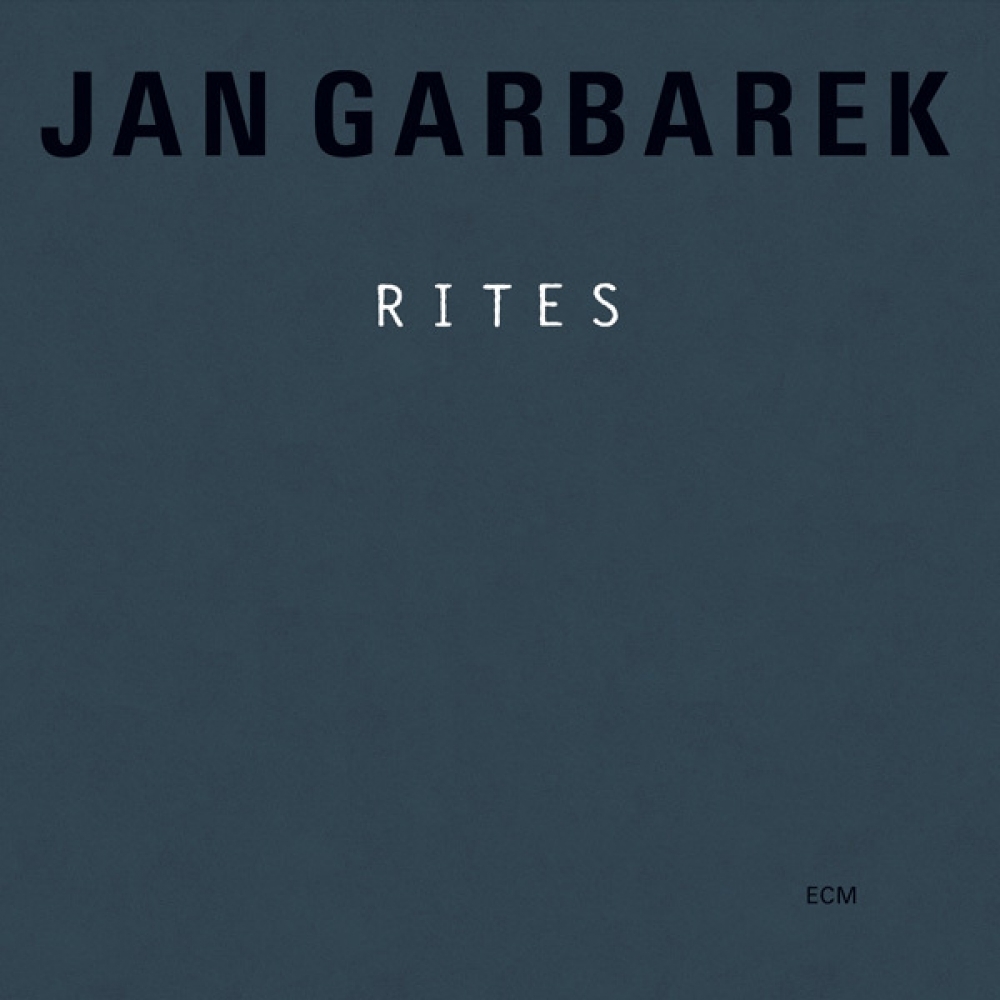
Jan Garbarek: RITES (ECM 1685/86)

RITES

Jan Garbarek
RITES

Jan Garbarek soprano and tenor saxophones, synthesizers, samplers and percussion
Rainer Brüninghaus piano, keyboard
Eberhard Weber bass
Marilyn Mazur drums, percussion
Jansug Kakhidze singer and conductor
Tbilisi Symphony Orchestra
Bugge Wesseltoft additional synthesizer and electronic effects, accordion
Recorded March 1998
Engineer: Jan Erik Kongshaug
Produced by Manfred Eicher

Our light is a voice.
We cut a road for the soul,
for its journey through death.

RITES is without question Jan Garbarek’s magnum opus. If not for the simple fact that it spans one and a half hours over two discs, it mines the deepest ores in the saxophonist-composer’s already vast oeuvre and polishes them just enough to let their colors speak. Every melody is a new stratum, a vein in the rock with a story to tell. The initiation begins with the cinematic title track. Accented by a light dusting of field recordings (taken during Garbarek’s travels in India), it follows a deep bass pulse and warm synths along an aerial view of mountainous terrain…barren, misty, and free. An eagle traverses these plains, the one who has seen it all: from ocean through volcanic eruption to solidification, from inhabitation through migration to desertion. Garbarek’s soprano peals like the lone survivor calling out to that eagle. The call goes unheeded. The eagle carries on, carrying nothing. In desperation, the survivor resigns himself to what must be and what never can. “Where the rivers meet” unspools his wayfaring in reverse, the last hopeful stage of a trek that brought him into the clearing. Like salmon leaping from the water, motives catch a glint of sun before they splash back into river’s flow. In that turgid reflection struggles the natural scope of “Vast plain, clouds,” where bassist Eberhard Weber leaves only the shadows of seedlings by way of drooping, willowed lines.

Garbarek flips back through the pages to his past with a haunting rendition of his quintessential “It’s OK to listen to the gray voice.” Its brushed cymbals and bubbling pianism invite us to look at our own lives anew. Keyboardist Rainer Brüninghaus provides epic touches to “So mild the wind, so meek the water” and “Her wild ways,” both of which give insight into the survivor’s maturation, while “It’s high time” brings us into the night of revelry that embraced his conception, further to the seat of his ancestry. The youthful candor of his discoveries, the newness of his faith, surprises one whose soles still bleed from the long journeys. And so, he bids, “Song, tread lightly,” cradling his own birth in a night vision.

The second disc thus replaces the survivor with a diary of things intangible. Here we come to know the profundity of joy. The memorable balance of “One Ying for every Yang” posits Garbarek and Weber against a shifting synth backdrop of liquid texture, while “Pan” and “Evenly they danced” enable likeminded playfulness. “Malinye” (written by, and offered in memory of, Don Cherry) is a distant carnival, an atmosphere emphasized in “The white clown,” which works its twisted spell in service of a childhood dream.

Two notable cameos come to us in the form of “We are the stars,” featuring the Norwegian youth choir Sølvguttene in a setting of a Passamaquoddy (Native American) poem, and another setting of Galaktion Tabidze’s “The moon over Mtatsminda” by Georgian composer Jansug Kakhidze. A tireless advocate of Giya Kancheli’s music, Kakhidze offers voice and baton in kind, conducting the Tblisi Symphony Orchestra in a heartrending song that hangs on a silver thread. This song is a rite unto itself, a window into cultural understandings that weave themselves into tapestries of experience until one day a tug sets off their colors just so. In light of this, “Last rite” rings prophetically. Though essentially a reprisal of the opening track, it elides the reed. With the survivor’s call now gone, we are left with a choice: implore the passing eagles in our lives for assistance or move on until we find what awaits us.

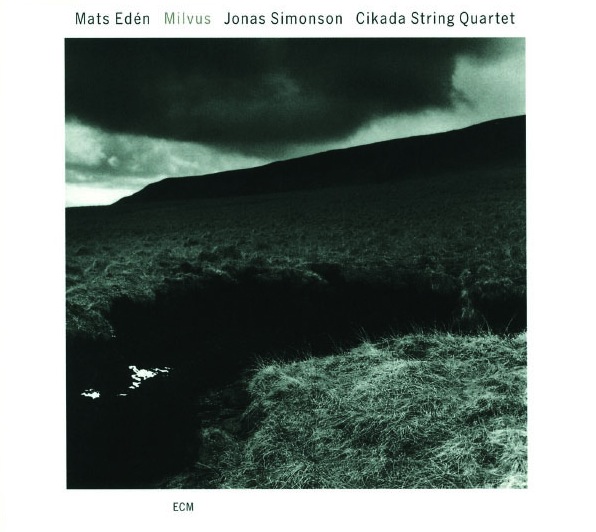
Mats Edén: Milvus (ECM 1660)

Milvus

Mats Edén
Milvus

Mats Edén drone-fiddle, violin, viola
Jonas Simonson flute, alto flute
Cikada String Quartet
Recorded September 1997 at Rainbow Studio, Oslo
Engineer: Jan Erik Kongshaug
Produced by Manfred Eicher

After making vital contributions to the ECM collaborations of Lena Willemark and Ale Möller, Swedish multi-instrumentalist and composer Mats Edén brings his folk revival sensibilities to this leader date from 1999. He joins longtime musical partner Jonas Simonson in paying homage to many great fiddlers, including Ärtbergs Kalle Karlström and Lejsme Per Larsson, and old-time masters Torleiv Björgum and Anders Rosén. The latter revived the use resonating strings, which Edén took on himself in developing a custom instrument called the bordunfiol, or drone-fiddle, featured prominently in Milvus.

Edén

Of that drone we get plenty in “Haväng,” an original tune dedicated to Indian violinist K. Shivakumar. Simonson’s flute is the photographic image that develops in Edén’s solution. This frothy combination of sublime harmonies and cohesive adaptation permeates especially the vibrant polskas that speckle the program. The contrast between airy riffs and tethered harmonics, between flowing lines and jagged accompaniment, between fragrant soil and dry winds makes for an altogether inviting atmosphere.

Having grown up in Värmland, which borders Norway, Edén takes inspiration from the region in “Norafjälls,” which he plays to earthen perfection. Likewise the dirge-like lows of “Vardag.” He also offers two improvised solo “Variations,” which bring with them a darker cast. Their strained quality and wrenching, emotional grit reveals a highly ingrained mind at work.

Simonson brings spiritual centeredness against distant fiddle accompaniment in “Den lyckliga (Beate Virgine),” a devout, reverberant jewel in the album’s rusted crown, and brings reflection and depth to his solo “Spillet,” a brief but profound segue.

As if this weren’t enough, the Cikada String Quartet concludes with Edén’s three-part String Quartet No. 1, of which the first movement feels like an unpacking of all the traditions that came before. As such, it is a distillation, a crystal fragmented and made whole again (the “jigginess” here is far more subtle, internal). The second movement is a quiet agitation of rubber-banded ideas, a spiral into the final Lento, engaged by folk themes amid careful attention to surroundings.

The album’s title refers to the kite bird. Not surprisingly, the music created in its name embodies the cut of those wings, angular and sure against the sky. Such contrasts would seem to be of vital importance to Edén, a musician who understands that the spaces in between the strings are just as important as the strings themselves.

Black Kite
(Photo by Laurent Breillat)

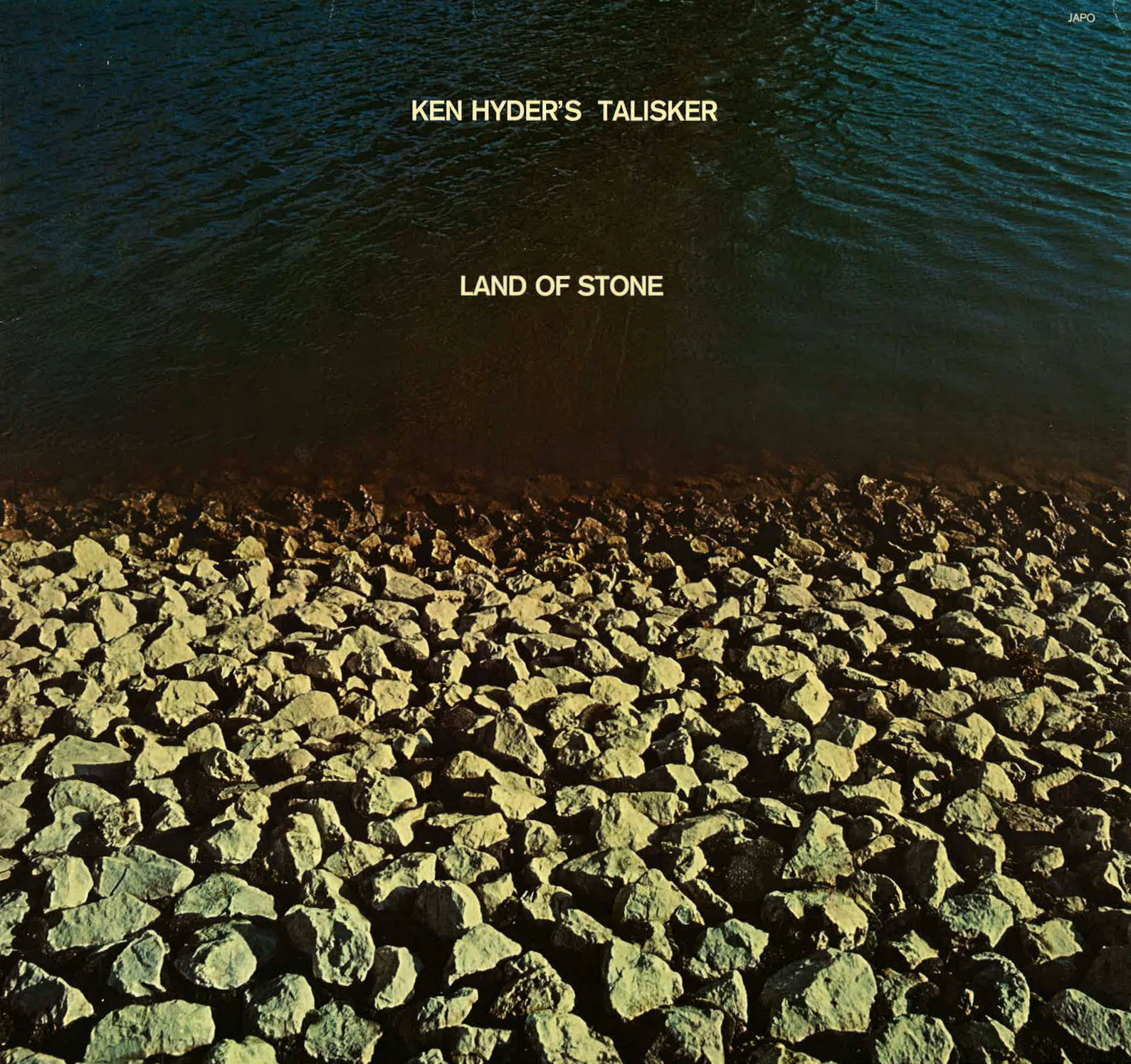
Ken Hyder’s Talisker: Land Of Stone (JAPO 60018)

Land Of Stone

Ken Hyder’s Talisker
Land Of Stone

Ken Hyder drums
John Lawrence bass
Marcio Mattos bass
Davie Webster alto saxophone
John Rangecroft tenor saxophone, clarinet
Ricardo Mattos soprano and tenor saxophones, flute
Brian Eley vocals
Frankie Armstrong vocals
Phil Minton vocals
Maggie Nichols vocals
Recorded April 1977 in London
Engineer Martin Wieland
Produced by Thomas Stöwsand

Over a career spanning more than four decades, Scottish percussionist and vocalist Ken Hyder has developed a strong body of work, though perhaps none so robust as his Talisker outfit. Combining Celtic and jazz influences, Talisker debuted in 1975 with Dreaming Of Glenisla on Virgin Records. Yet as Hyder’s musical interests began to expand to traditional Irish music and further to Asian monasticism, his sound opened itself to a world of possibilities. Enter album the second, Land Of Stone, which found a home on the JAPO label two years later.

“The Strathspey King,” a strangely swinging ode to Scottish master fiddler James Scott Skinner (1843-1927), sets a homegrown tone. Clarinetist John Rangecroft proves to be a vital presence in this increasingly enigmatic session, adding swagger aplenty. Like a young hopeful decked out in fresh threads and money in the pocket, he tricks the heart into thinking that harm is a while away. Hyder’s militaristic drum solo intercepts street-side, as if offering free samples of reality before a chorus of bidders drops into view with its haunting brand of Hebridean choral music in “The Men Of Barra Know How To Drink, But The Women Know How To Sing.” A boisterous and colorful chain, its syllables become actions, teetering like drunken instruments into “Close The Window And Keep It Down.” This likeminded island song is an onomatopoetic excursion into the inner lives of house wares and propriety. The latter quickly disintegrates as bonds loosen their friction and slide from grasp in screeching ululations, courtesy of ECM margin-bearer Maggie Nichols. The color wheel darkens further in “See You At The Mission, Eh, If It’s No’ Full,” in which a brood of instruments strains unison phrasings through an upturned colander. Bass and drums form a knot of support, eyes in a flowing wood grain. In the wake of these dirt-caked fingernails, “Derek Was Only A Bairn” rides into the dawn, a smooth caravan lead by Ricardo Mattos on flute and horse’s trot.

Hyder insists that improvisation was a vital component of Scottish bagpipe playing, and in a tripartite pibroch he explores the crossover from the Highlands to the fringes of American free jazz, dedicating parts respectively to the MacCrimmons (a notable family of pipers), John Coltrane, and Albert Ayler. After a microscopic dialogue between bassists John Lawrence and Marcio Mattos, soprano saxophone masquerades as bagpipe in piercing shepherd’s call. Hints of a jig rise and fall from deeper drones, a sky behind mountain silhouettes. Over the click of cymbal, dense voices weave in and out of earshot, taking solid presence in the loam of memory, to slumber and to molt. The banshees return with gentle persuasions, their ashen hair and earthward grins blistered by the rub of their limbo. Yet with the coming of rhythm they achieve communication somewhere on the other side of fear, ecstatic totems each passing through sea and grain until the wind puts fingers to lips and blows.

Cleaning off the dust of age, Talisker shakes out tunes old and new, and with the chaff pieces together charcoal fields as would a cobbler hammer a sole. Or is it soul? There’s plenty to be had in this land of stone.

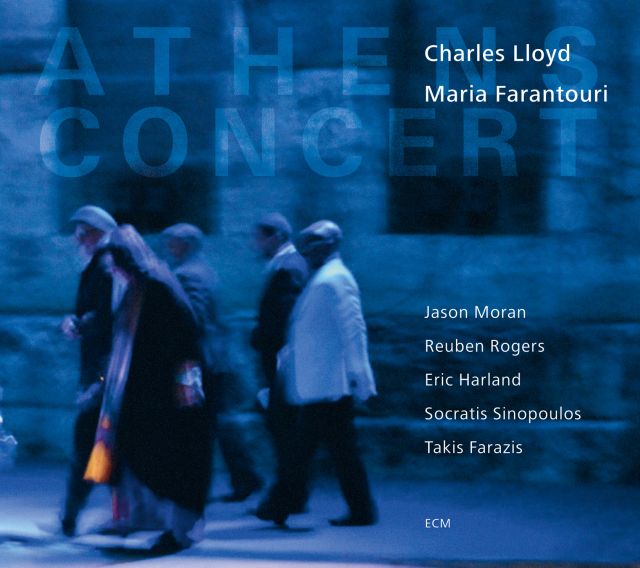
Charles Lloyd/Maria Farantouri: Athens Concert (ECM 2205/06)

Athens Concert

Charles Lloyd
Maria Farantouri
Athens Concert

Charles Lloyd tenor saxophone, flute, tárogató
Maria Farantouri voice
Jason Moran piano
Reuben Rogers double-bass
Eric Harland drums
Socratis Sinopoulos lyra
Takis Farazis piano
Recorded in concert June 2010 at Herod Atticus Odeon, Athens
Recording engineer: Nikos Espialidis
Assistant engineer: Kostas Kyriakidis
Equipment by Logothetis Music
Mixed by Manfred Eicher and Jan Erik Kongshaug at Rainbow Studio, Oslo
Produced by Manfred Eicher and Dorothy Darr

Where are we
that the wind won’t blow?

“The human voice can capture the heart more swiftly and directly than any other instrument,” writes Charles Lloyd in the liner notes for Athens Concert, an historic live event given the permanence it more than deserves through this landmark recording. Lloyd goes on to relate how, as a child growing up in Memphis, he would fall asleep to the sound of Billy Holiday’s voice from the radio under his pillow, and how years later that same magic revealed itself in contralto Maria Farantouri (Greece’s Edith Piaf, if you will), who he later befriended and who introduced him to the songs of Mikis Theodorakis after he’d invited her to sing one of his own. Farantouri’s heart is ancient, and her desire to introduce Lloyd to her culture is manifest in the depth of his playing. She characterizes the tenor master as “a shaman of jazz who dominates the stage with the power of the mystic and the innocence of a child. The sound of his music can have the weight of a stone or the lightness of the air. With his improvisations he weaves an imaginary but so familiar world, a mirage constantly disintegrating and reforming.” We might say, then, that Lloyd is a singer, channeling his breath through a weathered metallic throat and bidding the very stars to dance. The bridging of these two worlds spawns a third, one where voices of time sing like parents to a child.

And what is “Kratissa ti zoi mou” (I Kept Hold of My Life), which opens the program, if not a voice churning in the tide of darkness from which we all are born? George Seferis’s words (from the poem, “Epiphany, 1937”) blossom from an unmistakable tenor branch, smooth yet weighted as if by the buckshot of self-awareness and sliding like honey down an enviable backdrop: Jason Moran on piano, Reuben Rogers on bass, and Eric Harland on drums. Curtains part to reveal Farantouri’s husky swirls. Moran elicits sweet noise, mixing Ketil Bjørnstad-like textures with idiosyncratic spectral twists. An emblematic introduction into this forested sound-world, it is the concert’s Rosetta Stone. Lloyd’s classic “Dream Weaver” continues in the same flowing vein, his remarkably sunlit reed gathering enough thread to make even the most sedentary marionette nod in a groovy and somehow freer turn. Harland is also notable here, buoying a rich solo from Moran, who maintains epic contrast between the left and right hands throughout. Lloyd brings a classic edge to the denouement, further picked up by Rogers with intimacy. Our bandleader continues to regale us with his storytelling in “Blow Wind.” The original song finds Farantouri channeling Sheila Jordan, the lyrical star to an instrumental sky. Her voice indeed blows off into the distance, leaving Lloyd to shape those tendrils of dust left in her wake before she returns to stir them anew. Lloyd also pens “Prayer,” which features still more wonders from Moran. Farantouri’s full-throated, wordless song emerges from the bass, reedy like the muse that calls to her. A click away finds Lloyd setting words by politicist Agathi Dimitrouka in “Requiem.” A surprisingly buttery song that finds groove in the tragic, in it Farantouri’s tenderness clears the way for Moran’s more diffuse considerations, as microscopic as pollen and just as fragrant. The music of ECM mainstay Eleni Karaindrou also makes an appearance with “Taxidi sta Kythera” (Voyage to Cythera), which against a low and sultry swing allows gorgeous exchanges between the two bill headers, their voices filling the same crucible with variations of the same alloy.

LM 1

Pianist Takis Farazis joins for the performance’s remainder: the three-part Greek Suite, which he also arranged. Part I is the most ancient, shifting the sands with “Hymnos stin Ayia Triada,” an early Byzantine hymn to the Holy Trinity. Interweaving Lloyd’s flute and Farantouri’s flutedness, its song is its vow. “Epano sto xero homa” (In the Dry Soil) and “Messa Stous paradissious kipous” (In the Pradise Gardens) come from The Sun and Time by Theodorakis and as such unearth the greatest strengths of Farantouri’s gifts. Yet it is only when the strains of the lyra, played by Karaindrou regular Socratis Sinopoulos, touch the sky in Part II that the clouds weep rain. Amid its assortment of traditional tunes, “Thalassaki Mou” (My Little Sea) stands out to me. Although quite different from the version I grew up on the timeless Songs of the Earth by The Pennywhistlers, it nevertheless brings its own enchantment and stirs the musicians to invigorating levels. Part III boasts tunes from the Epirus region. Among the more moving are “Epirotiko Meroloi,” a lament of war and death told from a mother’s point of view, so well evoked by Lloyd’s uncanny intro and by the jangling folkways that ensue, and the intuitive digressions of lovesick souls in “Mori kontoula lemonia” (Little Lemon Tree). Harland grabs his fair share of the spotlight in “Alismono kae haeromae” (I Forget and I Am Glad), as does Sinopoulos in “Tou hel’ to kastron” (The Castle of the Sun), a traditional song from the Black Sea that is the band at its most attuned.

The encore also comes from a mother’s lips, as love pours through “Yanni Mou” (My Yanni) with more permanence than the bravery it mourns. The stichomythia between Farantouri and Lloyd discloses an oceanic world where the rhythms of fins and tails are the only music that remains. And if its mournful cast seems a somber note on which to end, it is only because the invigorations leading up to it linger like a childhood that refuses to let go. Such is the power of this music: it is memory incarnate.

(To hear samples of Athens Concert, click here or watch the video below.)

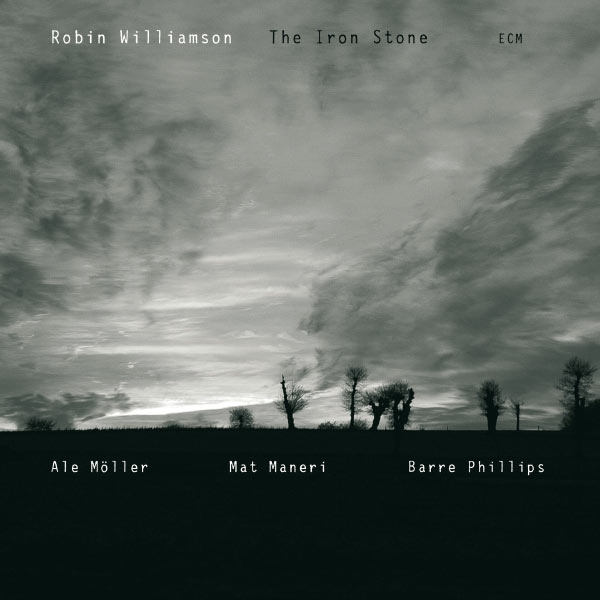
Robin Williamson: The Iron Stone (ECM 1969)

The Iron Stone

Robin Williamson
The Iron Stone

Robin Williamson vocals, Celtic harp, Mohan vina, Chinese flute, whistles, tabwrdd drum
Mat Maneri viola, Hardanger fiddle
Barre Phillips double-bass
Ale Möller mandola, accordion, clarino, shawm, natural flutes, drone flutes, whistles, jaw harps
Recorded September 2005, Mill House, Abergavenny
Engineer: Steve Lowe
Assistant: Dylan Fowler
Produced by Steve Lake

“Is it not strange that sheep’s guts could hail souls out of men’s bodies?”
–William Shakespeare, Much Ado About Nothing

From, but not to: this is the direction Robin Williamson travels by. For his third ECM outing, the man who puts the “true” in troubadour rejoins viola player Mat Maneri and fellow multi-instrumentalist Ale Möller, and plays for the first time alongside bassist Barre Phillips in tapping a trove of words by Sirs Walter Raleigh and Thomas Wyatt, Ralph Waldo Emerson, John Clare, and of course Williamson himself. “The Climber” offers a transportive introduction to this album’s relatively distant considerations, carrying us up through the clouds and into the moist particles of their origins. Improvised around the bard’s words, the music crawls and stretches, working its gnarled trunk around such shadows as “There Is A Music”—an ode to becoming that is played, as he sings, on the harp-haired gods by the fingers of tomorrow—and Emerson’s “Bacchus.” The last is the most heart-wrenching song of the set, a tale of forlorn tendrils and other fermentations caught in a butterfly’s wingspan.

There is an aged quality to the medieval Scots ballad “Sir Patrick Spens,” which through the arrangement here concedes to the palettes of coarser skies. It is not by mere virtue of Williamson’s years but fundamentally by perseverance of the tune itself that cuts the strings of time and marks wherever it may land. The fragility of Williamson’s telling gives impenetrable strength to the verses. Despite coming early in the program, this song drips with finality, drinking its vagaries through the scratching of bows and wistful sighs. The jaw harp trembles like the hearts of its characters, their lives tossed about the waves like discarded and shattered casks.

Williamson
(Photo by Jerry Young)

It is a stony and tender grave that harbors the melody of “Even Such Is Time,” which comes from “Lament For His Sister” by Rory Dall Morison—who, Williamson informs us in his liner notes, was one of the last traditional highland harpers—and replaces those words with Raleigh’s unconditional roundness. “Loftus Jones,” with music by Turlough O’Carolan, gets a vocal facelift. At Phillips’s suggestion, the group takes a “floating” approach to its wordless narrative. It calls to a different plane of our psyche, treading with carefully weighted soles on the sands of our adoration. Yet even these delicacies cannot help but dislodge a broken feeling or two from their interment, their bones having given up the ghost long ago for cloudy tragedies.

Also remarkable are this album’s evocations of animal life. A winding flute introduces us to “The Yellow Snake,” a somber tale of use and replenishment in a never-ending cycle of the elements of which the human body is composed and by which that same body does its deeds. “The Praises of the Mountain Hare” unearths a soothsayer’s gift, serrated like the mountain shawm that dances down its eastern slope, while in “The Badger” (Clare) Phillips’s scuttling phrasing mimes its eponym. A haunting instrumental epilogue draws us into “Political Lies,” among the more inescapable melodies of the Williamson songbook. In this tale of rearing recollections and broken realities, the history of mystery falls into its own rhyme and reason. The jangly slide guitar and thin-lipped poetry of the title track highlights a darkened wit about these follicles. “To God In God’s Absence” returns from its solo incarnation in The seed-at-zero in a fuller yet somehow more delicate version. No less intense for its adornments, it is Williamson at his finest. And there is, too, his stunning harp accompaniment to “Wyatt’s Song of Reproach,” a kiss to a visage half lit. “Verses at Ellesmere” is a flower of similar make. A ballad for his wife, Bina, if not also for love of balladry, it touches the ever green-ness of things and marks it with an insignia of most idiosyncratic design. These musings can only end with the open-ended “Henceforth,” which drops as a stone into a reflected sky, plying the reaches of dreams and bringing Williamson’s footprints full circle to the many copses and paths that hatch in his art.

The emphasis on spoken word and freer improvisatory elements on this record may polarize listeners. Nevertheless, let them not be a warning but an invitation. For in the grand scheme of sonic things, the truth of delivery reigns. The diction says it all: I am mortal, that I may sing of immortal things.

Robin Williamson: Skirting The River Road (ECM 1785)

Robin Williamson
Skirting The River Road

Robin Williamson vocals, harp, guitar, whistles
Mat Maneri viola, violin
Paul Dunmall tenor and soprano saxophones, clarinet, border pipes, ocarina, moxeño
Ale Möller mandola, lute, hammered dulcimer, shawm, clarino, drone flutes, natural flutes, bamboo flutes, vibraphone
Mick Hutton double-bass
Recorded March/April 2001 at Gateway Studios, Kingston-Upon-Thames
Engineer: Steve Lowe
Mixed at Albany Productions Ltd, Cardiff
Engineer: Lawson Dando
Produced by Steve Lake

No bird soars too high if he soars with his own wings.
–William Blake

These words have it: despite the mystic winds he rides, Robin Williamson flies close to the ground. He keeps us in sight. He wanders as he speaks, voice rising like the morning’s rooster even as it plunges a laborer’s tools into wet concrete. It is a storm in a teacup, the laugh inside a tear. For his sophomore ECM date, the Scottish singer/songwriter joins musicians whose participation is as unlikely as it is inevitable. With multi-instrumentalists Paul Dunmall and Ale Möller, viol(in)ist Mat Maneri, and bassist Mick Hutton at his side, he trudges his peerless way into fifteen territories under the banner “Songs and Settings of Whitman, Blake and Vaughan.” It is Blake whose legacy weighs heaviest on the scale, reaching the value of an ingot in “The Four Points Are Thus Beheld.” On the surface a lesson in cardinal perception, it is more deeply a catacomb riddled with improvisatory petroglyphs. Dunmall on tenor paints the most dynamic of these while strains of hammered dulcimer pluck the invisible strings that loom the stars with acoustic force. This opens into rich and sharply defined border pipes and peaks in meteorites of sustenance. Like the compass therein, Skirting The River Road has four hearts, for one must add Williamson himself to the subtitle’s list of three. The album carries the lantern of its main title from his “Dalliance Of Eagles.” Resting on a fulcrum of bass and framed by a wordless circle, his verse swivels from past to future and back again at a single breath. “The Journey” unravels its eponym in a pathway of hard-won disregard that recognizes the privilege of its vantage point. Further, “The Map With No North” crochets from every utterance a life bound by the dried skins of wayfarers, casting its far twisted spells for our naked scrutiny. A masterpiece.

Another original, “West From California’s Shores,” adds a drop of dawn to this dusky crucible that delights me. Not only because I am only now discovering the varietal delights of Williamson’s craft, but also because the title takes me back to Fairfax, the small town in northern California where I spent the first twelve years of my life. His animated travelogue drapes smiles like garlands along the neck of experience and underscores the travels that have since taken me far from home. One of Fairfax’s most unforgettable fixtures was The Sleeping Lady, a café and music venue where my mother could be found singing from time to time, and where my father saw Williamson perform with his Merry Band in the early 1980s. Sadly, I was with a babysitter during the show. Aside from the colorful instrumentation, which included the haunting mandocello at the bard’s fingertips, my father recalls harpist Sylvia Woods shooting rubber-tipped arrows from her strings (much to the audience’s chagrin) while the band engaged in bawdy banter in between songs. Above all, he remembers a comment that Williamson made: “The band members and I feel that the best kind of joke is something you can barely laugh at.” We can hear something of that wryness in this tune, so distinct from its gorgeously dour surroundings.

Yet let us not ignore the awakening of “The Morning Watch/A Song Of Joys.” This Whitman/Vaughan diptych opens the program by splashing a ray of golden light across pasture, thereby setting the blend of Williamson’s fullness at the helm and the ornamentation of his crew. A buttery soprano lends notably warm hues to the spectrum on deck, while Maneri’s viola flicks his hairs with programmatic brilliance in “Here To Burn.” Another Blake setting, it sits like its protagonist at a box of masks and destroys them one by one, making note of each parched expression before it fades. “Abstinence Sows Sand” is yet another. It takes some of the Indian influence that imbued much of the earlier Incredible String Band experiments and spins it afresh in dyed reeds. And then, there is “Infant Joy,” with which, as a new father ten weeks into a lifelong journey, I cannot help but hum in sympathetic resonance. Its articulation opens the gift of new life and finds within it infinitely more.

“The Terrible Doubt/The Price Of Experience” is a dire prologue that casts shadows over idyllic life and brings light to the wick of death to which we all must touch a flame. Infirmity looms outside the door of every private joy. This is linked by a lively “Shepherd’s Tune” on pipe into the web of “The Spider,” which along with “The Fly” fills a grave with filamented ale. Whitman makes a late reappearance in “Crossing Brooklyn Ferry.” His strong shadow claps a palm on our backs and guides us through the waters of its epic passage. Upon arrival, “The World Of Light” welcomes us: our immigrant soul turned inside out and signed by the promise of another livelihood.

Williamson doesn’t so much draw out notes as knead them into thumb-printed strands, so that by the end one remembers not the music so much as the histories it activates. Vibrato lies dead by the wayside, caught among the bramble of virtuosos who look on from their perches of fatigue. In its place, the rawness of forgotten things. Skirting The River Road is therefore more than an album. It is an interaction of the deepest kind. Every song is its own entity standing beside Time’s crystal, which with every turn catches the light ever so differently as children awaken to replace others in forever-sleep.

Robin Williamson: The seed-at-zero (ECM 1732)

Robin Williamson
The seed-at-zero

Robin Williamson vocals, guitar, harp, mandolin
Recorded March 2000 at Albany Productions Ltd, Cardiff
Engineer: Lawson Dando
Produced by Steve Lake

Let us paint library on the library…

“Salt of the earth” comes nowhere close to describing Scottish singer/songwriter Robin Williamson. He is, rather, earth of the salt: when caught in his bardic gaze, we cannot help but take a step beyond the minerals that make up our world and see in them an entirely new one. On his ECM debut, Williamson brings three strands together for a thick and brindled braid. First is the poetry of Dylan Thomas, which he sets to appropriate effect at lips and fingers as if it were hemp with which to weave a basket. Second are the related Welsh strands of Henry Vaughan, Llywarch Hen, and Idris Davies, which are the capture spiral of the ensuing web. Third is the songbook of Williamson himself, who had by this time shaped four decades of craft into a solo art. Armed with only a guitar, a harp, and his own throaty blade, he goes trundling through the undergrowth of joys and wars.

Having once improvised to Thomas’s words for a theater production based on the poet’s life (Geoff Moore’s Prospect of the Sea, 1984/85), Williamson draws on that internal puddle and fashions from it a dark and choppy sea. He sets his boat adrift yet remains on shore, introducing us to broken shells with words from Vaughan in “The World.” Here the voice builds a starfish pore by pore. The title track paints less jaggedly, in ochre and ash. Williamson’s register reveals itself as a different species, and we as mere children who gather round starry-eyed and hungry for tales of yore and the yet to be. In this metaphorical seascape, heroes blend into the living and the dead alike.

This leads us into a most enchanting triptych. First is “Skull And Nettlework.” One of Williamson’s own, it emotes like the artistry of Patrick Ball steeped in a brew of ancestral grievances. In its images are many scales. Of neither fish nor dragon, they gleam of their own accord, beyond the narrative strokes trying to whittle them into something recognizable. The balance between the two registers—string and throat—is inescapably harmonious. It is a ribcage sheltering flames that flicker at the expulsion of Thomas’s “Holy Spring” before opening the cap of a scrimshawed horn in “To God In God’s Absence.” Here is Williamson’s soul on stoneware, alive and impervious to prod of fork and interpretation.

Thomas bleeds in multiple directions throughout the program, at times inscribing verses across the backsides of our hides (“In My Craft Or Sullen Art”), at others dancing to the clink of emotional coinage (“On No Work Of Words”), at still others galloping along the stringed hills with the touch of knowing fingertips, as in “Hold Hard, These Ancient Minutes In The Cuckoo’s Month.” Just as the latter is a catalogue of calendrical time, so is “Poem On His Birthday” a charting of avian life and watery graves. And though melodies launch themselves in the occasional skyward arc, they always settle in the spoken word, where the quaking peace of breath trickles down the throat of a premature end.

Half-spoken, half-sung, if not both at once, “Lament Of The Old Man” is an ode to small things that, without care, bring us pleasure in spite of the heartless land, crooked like a stick bent under the weight of an aging shepherd. Memories of sprightly pasture abound in “Verses At Balwearie Tower.” They dance around the spring of human joy where bathe our transgressions, naked and mute. “Can y Gwynt” is a riddle of creation that fills our cupped hands with the waters of the Weary Well. Under its watchful eyes, wishful romance blossoms away from ours: a memory that tickles the scalp at night and quivers in the reflection of an ale glass by day. Keystones interlock in “The Bells Of Rhymney.” Set to Pete Seeger’s tune, it trips along a trail of ifs on the way to an unborn then and glows like light pollution in low cloud cover—pink yet tinged by the gray of a passing storm. With the decayed smile of a tree-lined horizon, “The Barley” welcomes us to settlement. Williamson drags his feet through the mud in “Cold Days Of February,” clear now in the hierarchy that one censored this old protest song. In its present restored form, it speaks with the power of Ken Loach’s The Wind that Shakes the Barley, a song from the lips of veterans and those too conscionable to fight. It lumbers through foggy paths and obscured vistas of blood-soaked battleground, leaving us paging through “For Mr Thomas” as an epilogue, if not an epitaph, to the album’s inscrutable muse.

Where others have explored Dylan Thomas and his roots, Robin Williamson has tapped them and siphoned the visceral bite of their learning. Their taste may challenge our complacent buds, but never for want of sincerity. Even if we’ve never heard them before, we can be sure these odes to the unlit dark and the snuffed flame have heard us. They know us that well. And if this smirking scholar has anything meaningful to offer in return, let it ultimately be my admiration—the only poetry I can muster.

If purity is a throwaway concept, it has been reborn here.

Elina Duni Quartet: Matanë Malit (ECM 2277)

Elina Duni Quartet
Matanë Malit

Elina Duni voice
Colin Vallon piano
Patrice Moret double bass
Norbert Pfammatter drums
Recorded February 2012, Studios La Buissonne, Pernes-les-Fontaines
Engineers: Gérard de Haro, Nicolas Baillard
Produced by Manfred Eicher

“This album is the echo of my childhood, my exile and my reconciliation with the two worlds that have shaped me—the Albania of my roots and the Switzerland of my life today.”

Matanë Malit. Beyond the mountain. The title of Elina Duni’s ECM debut. Yet something more. A call to the spirit in whose hands rests the diary her quartet inscribes with accounts of a tormented past. With one eye longing for her childhood in Albania, another taking in the classical, blues, and jazz traditions into which she has since grown, Duni treats every word that crosses her lips as if it were the first. By paying homage to the land of her birth, she forges a land in and of itself, each song a tectonic plate beneath the soil of the group’s atmospheric arrangements.

It was pianist Colin Vallon, with whom Duni studied at Berne’s Hochschule der Künste, who encouraged the developing singer to mine the past for inspiration. Her duo work with Vallon formed the seed of the current project, fleshed further by drummer Norbert Pfammatter and Vallon’s trio bassist, Patrice Moret.

In assembling this program, the quartet had to clean out the dust of political distortion that had gathered in its crevices, for many of the songs therein found themselves lyrically changed to suit the propaganda machine of a fervent communist regime. The titular shepherdesses of “Çobankat” long once more for self-sufficiency in the face of an inflexible marriage tradition, their voices wafting over the hills through Duni’s earthen diction with determination, beauty, and wit. Such individualism surely ruffled the feathers of agitprop pundits, who recast these once “progressive” women as “brave” allies bringing provisions and darning socks for anti-fascist partisans in the mountains. Such history further informs “Mine Peza,” a verse often sung by Duni’s maternal grandfather, who fought alongside those very partisans at the mere age of 12. Written under Mussolini’s shadow, it tells the tragic story of its eponymous hero, ending the album on its most solemn note:

Let’s cast off the chains
of this cruel occupation
cries the mother.
But the gun in the hand
of the treacherous soldier
shoots the mother dead.

Along the way, however, we do find moments of joy in a place where even the longest political arms cannot reach: the human heart. The secret love made manifest in “Ka një mot” (For a year) begins the album with youthful optimism, and is emblematic of the group’s democratic energy. Duni’s presence is close as a whisper, even as it seems to sing from a distance. Moret, Pfammatter, and lastly Vallon buffs every rock of this landscape until it speaks. There is also the invigoration of “U rrit vasha” (The girl has grown up), a wedding song from Kosovo that finds a living smile in every change of terrain.

The girl has grown up
in our mountains.
Her body is tall like a cypress
and the birds sing.

“Erë pranverore” (Spring breeze), a once-forbidden song from 1962, rises from the ashes here a beautiful organism. Every muted sentiment rejoices anew at the wonders of a life without borders. Vallon’s muted strings provide a percussive and melodic backbone as Duni follows roads to lovers in full bloom. True to the history being told, however, she looks also at the destitute. We stand with the “Vajzë e valëve” (Girl of the waves) as she yearns for her husband who may never return, invisible as he is among the waves of his vocation. Her love remains potent against the attacks of violent waters, but for how long?

Beautiful birds
my only hope lies in you.

And many of us will relate to the shattered protagonist of “Unë ty moj” (Me and you), whose love proclaims itself far too late, only to find the idol of its affections in the arms of another.

Burn my soul,
burn.

There are, too, the hero songs, which place emphasis on Albania’s vast diaspora. “Kjani trima” (Cry brave ones), for one, pits us against the mighty Ottoman Empire and searches futilely for those lost in the aftermath. Like the evocative “Ra kambana” (The bells are ringing), this is a song of the Alvanitas, Albanians living in northern Greece. “Çelo Mezani,” for another, tells of a local southern Albanian hero whose tragic death by bullets leaves a despondent mother behind. Heartrending even without knowledge of its content, the music embraces his fallen body and inters it with palpable care. Each note is a quiet cry, a reflection upon waters long disturbed but still as glass in memory.

Duni pens the most effective song of the set. Setting verse by the great Ismail Kadare, her “Kristal” fits seamlessly into the rest. A dance of death and forgetting, it lets us fall until we are at peace with what has transpired. “Poetry,” writes Duni in her liner notes, “is what guides and fascinates me,” and this is precisely what we feel coursing through the music even when she absents herself from it. Her silences and wordless flights lift us into a world preserved beyond not only the mountains but also the clouds, giving space for her band mates to expand upon what is painted before us. Their palette is the Albanian language itself, and by extension its heritages; their canvas, the mirror of ignorance that still surrounds this neglected republic. In paying due respect to the past, they have created an anthem for the future.

And when you remember the old house,
the friends we’ve lost
and those who are gone.
You will remember me too
like a stranger.
Like a statue whose arm you broke
in a wild embrace!

(To hear samples of Matanë Malit, click here. See this review in its original form at RootsWorld here.)