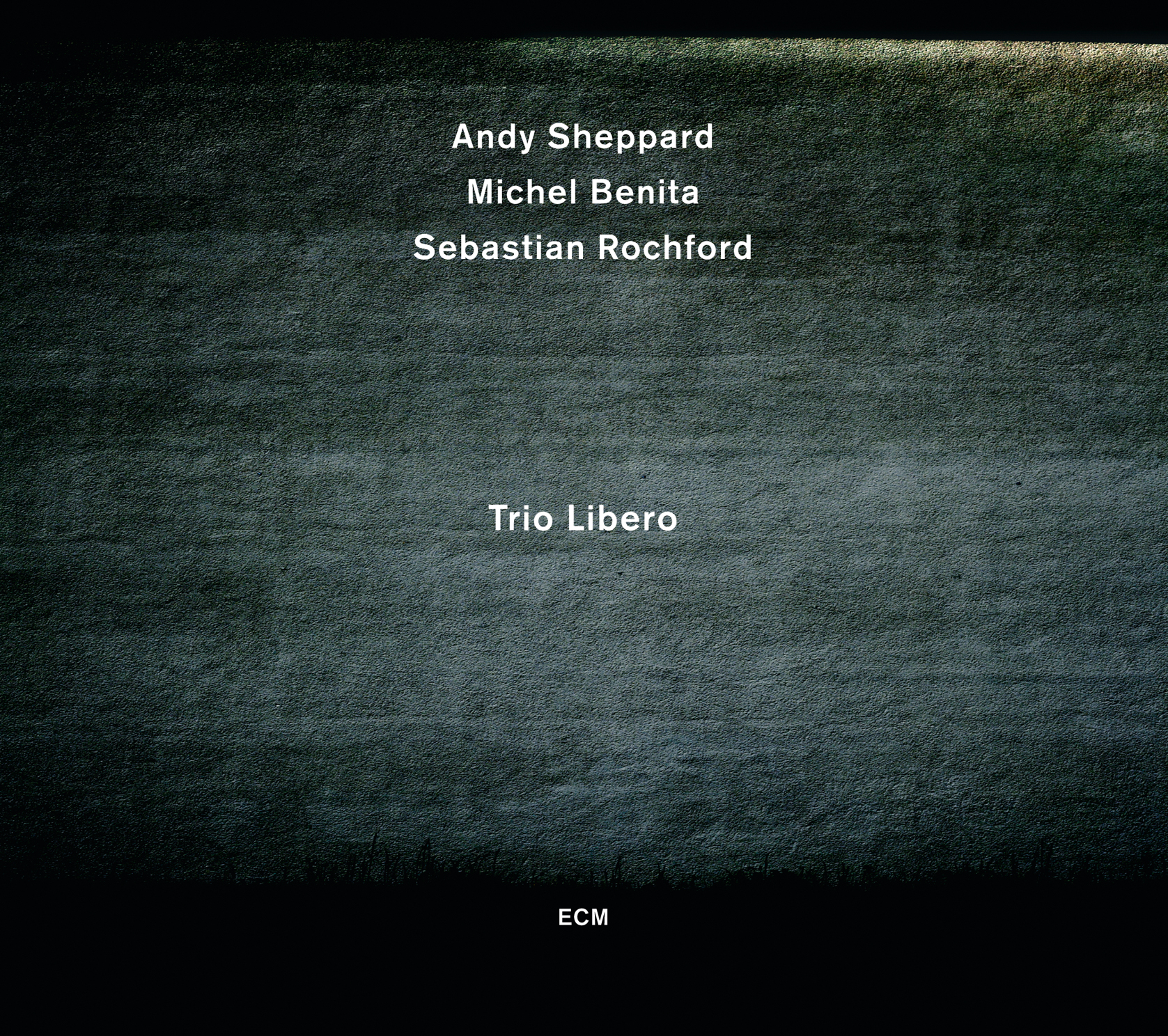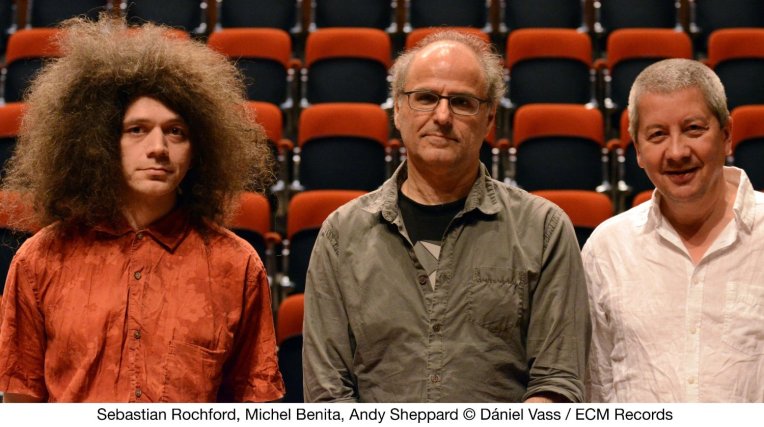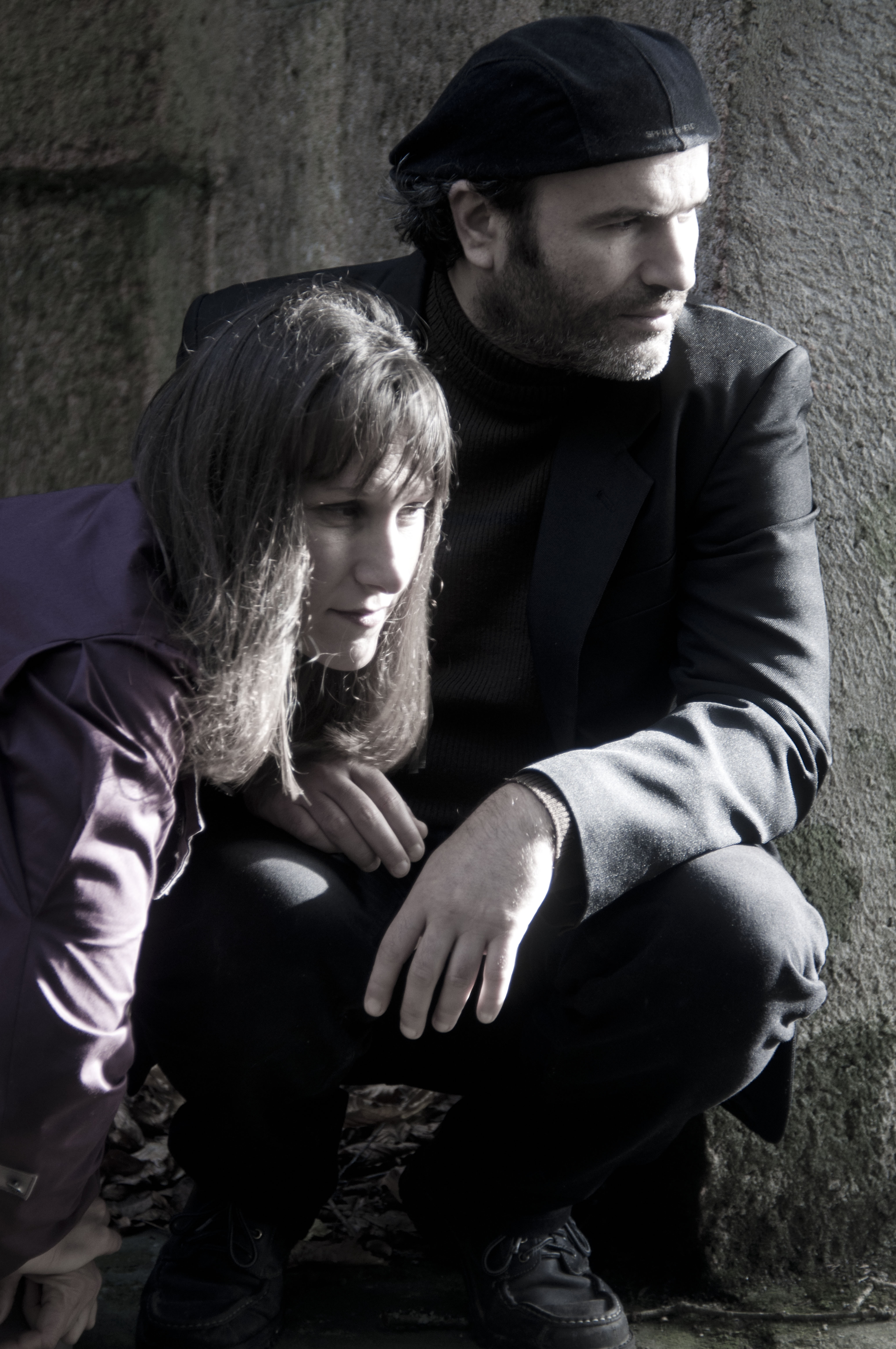
Sheppard/Benita/Rochford: Trio Libero (ECM 2252)

Trio Libero

Trio Libero

Andy Sheppard tenor and soprano saxophones
Michel Benita double-bass
Sebastian Rochford drums
Recorded July 2011, Auditorio Radiotelevisione svizerra, Lugano
Engineer: Stefano Amerio
Produced by Manfred Eicher

Putting on Trio Libero’s self-titled debut is like putting on a cashmere robe: it feels that good.

The level of comfort shared by saxophonist Andy Sheppard, bassist Michel Benita, and drummer Sebastian Rochford bears out from the first moments of opener “Libertino” with a looseness that never loses sight or hold of things. The themes are forthcoming but never insistent. An early solo from Benita trades off with some beautiful blowing from Sheppard, who unwinds a kite string toward cloudless sky. “Slip Duty” fronts Rochford’s limber bodywork as it traverses the landscape of his kit. To this percolating core Benita and Sheppard contribute structurally thematic elements in a variety of densities. “I’m Always Chasing Rainbows” features Sheppard on soprano. Despite the whimsical title, it describes a world of honest reflection. The two-part “Spacewalk” indeed balances gravity and buoyancy, an alterity of pathos that breathes melody and ends with a nebular cry for solidarity. “Dia da Liberdade” opens with an almost mournful bass solo, a lullaby for the fallen that trips the pulse of Sheppard’s wood-planed entrance. At times one can hear Paul Motian speaking through the drumming (he would pass away only four months after this album was recorded), only with a moth’s added murmuring. “Land of Nod” features more astuteness from Rochford in step with bass and piano. Don’t let the title fool you. It is one of the album’s livelier tracks and ripples beautifully at Sheppard’s fingertips as might a pond’s surface at the touch of a leaf. “The Unconditional Secret” is by far the most beautiful statement of the album. Its diurnal collage unites dreams and realities in a collage of transparencies. “Ishidatami” begins with another lovely bass intro, now with a sopranism as lithe as a tightrope walker bounding from anchor to anchor. The title, it bears noting, is a Japanese term for paving stones used to maintain navigable pathways in erosion-prone mountain passages, and serves well as a metaphor for the band’s unity. “Skin / Kaa” sustains a rubato flow into the modal tributary of “Whereveryougoigotoo,” the latter distinguished by its masterfully legato tenoring. “Lots of Stairs” is a weary but never wearying traversal. Under guise of balladry, “When We Live On The Stars…” concludes with a promise that the people and pleasures we adore will still be waiting for us when we wake.

Nowhere within these relatively brief tunes will you find demonstrative solos or waving of virtuosic flags. That said, it requires a special kind of virtuosity to carry off such music so humbly, and with a spirit that is as naked as the day all of us were born. This is the art of the trio, liberated.

(To hear samples of Trio Libero, click the image below.)

Trio Libero Photo

Text

Mediavolo: Purveyors of Secret Sounds

Mediavolo 1

There’s a reason why Pandora starter songs are called “seeds”: each has potential to grow into something magnificent. My first time using said online radio service, I’d created a Cocteau Twins station to maintain my sanity during some rote task or another, and periodically heard a mysterious song for which I was compelled to stop what I was doing and pay attention every time it came on. That song was “Misunderstanding” by Mediavolo, and my life as a listener was never the same. The music of Mediavolo has touched me like that of no other band. In an age where so many songs and their creators ephemerally surface before drowning in an unfathomable data stream, such life preservers are few and far between.

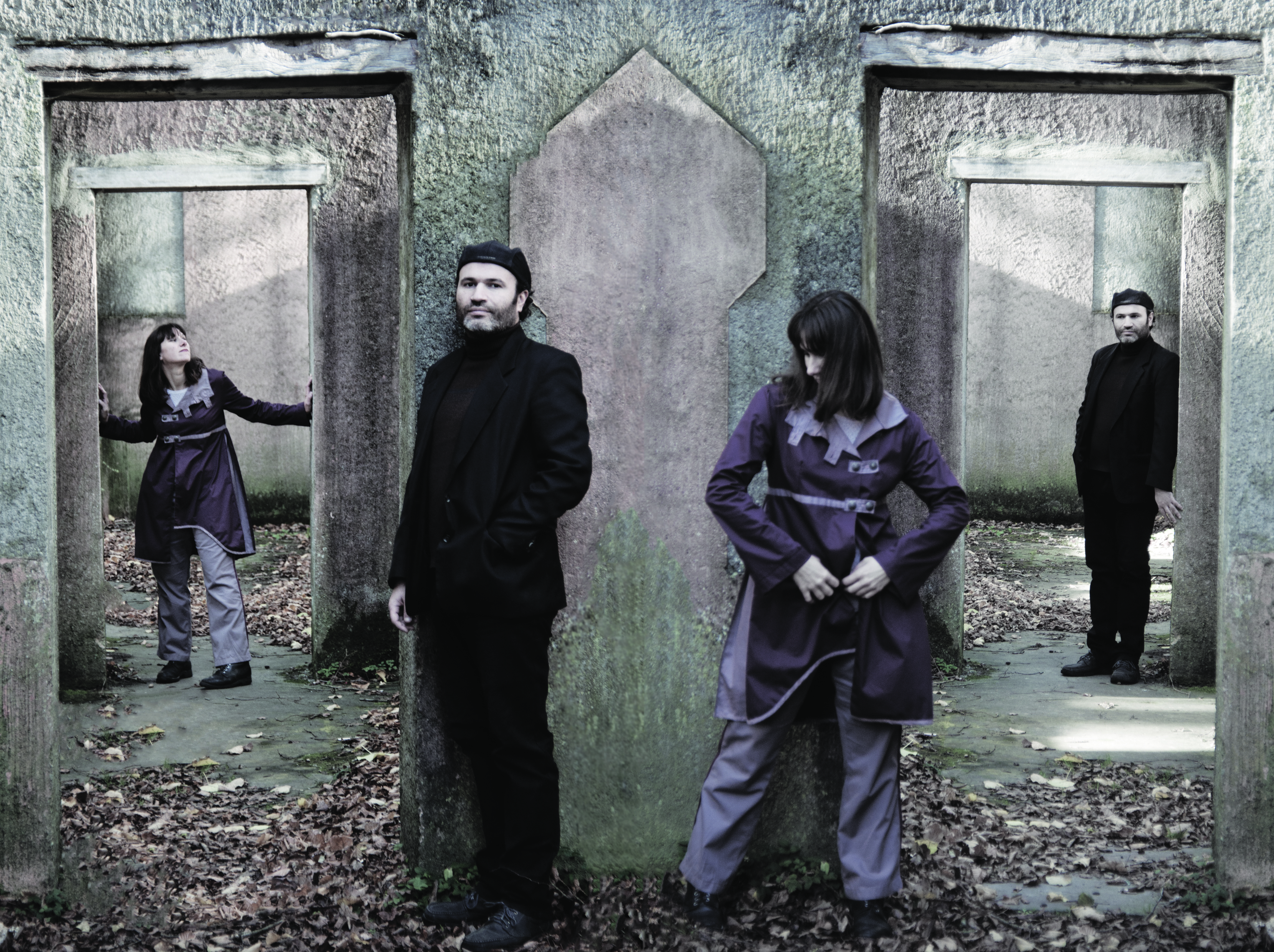
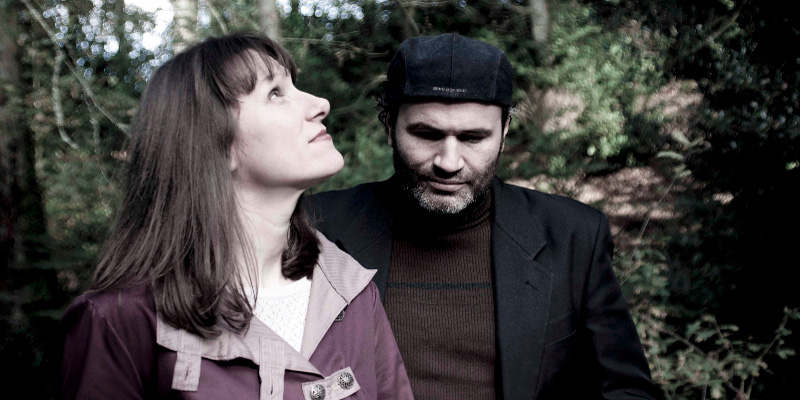
Mediavolo hails from the port town of Brest, in northwestern France. The band has shuffled its cards a few times over the years but, since 2000, Géraldine Le Cocq (who sings and writes all lyrics) and Jacques Henry (who handles all music, instruments, and production) have been its constant aces. Known affectionately as Gé and Jac, they took over officially as a duo in 2004, a binary star pulling other galactic talents into their sessions’ orbits but always shining brightest at the center of them all. Music had always been a vital force in their lives, prompting Jac to pick up a guitar at age six, and Gé the harp at seven. “We met thanks to common musical connections,” Gé recalls. “I joined the band Jac had with his brother and other friends, as it needed a new lead singer, which led to a name change: that’s how Mediavolo was born.” To that name, there is no meaning, save for whatever one brings to it. Naked and clothed alike, it embraces us as we are and slides around the brain until it becomes a single bead of dew on a blade of tomorrow.

Mediavolo 3

Listening to any Mediavolo album is an exercise in pareidolia—that psychological phenomenon by which we see familiar shapes in clouds, stars, and the occasional potato chip. In this manner we may read core influences into the band’s multifaceted sound, including Cocteau Twins, Kate Bush, Blonde Redhead, David Bowie, and various new-wave synth acts of the 70s and 80s. For me, Cocteau Twins looms largest of these (for those keeping score, check out “Resolve,” “To the Eye,” “Fanciest Scheme,” “Up Ahead,” and “Wh”). Are these a conscious homage to the band, or does the affinity come about organically? Jac: “I discovered Cocteau Twins very late, when the band had just imploded. What struck me most, the first time I heard one of their songs, is that I felt at home. I think it’s a bit of both: I’ve an organic link to their music, no doubt, and somehow, I set out to carry on with their music in my own way.” Jac, it bears noting, grew up on a steady diet of Beach Boys and Beatles, neither of which bear out on his compositional world, but whom he credits nonetheless for making him the musician he is today. Whatever the persuasion, Mediavolo is a universe unto itself, where popular footholds are white dwarves at best. As in a kaleidoscope, such elements are fragmented beyond recognition, so that from them a new mosaic emerges.

About my beloved “Misunderstanding” there was much to learn, and proper tutelage came in the form of A Secret Sound.

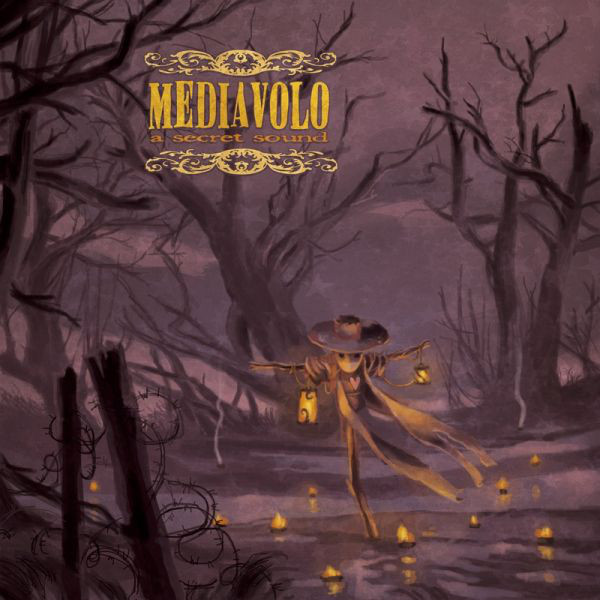
A Secret Sound

Released in 2006, it securely holds the throne of Mediavolo’s sonic kingdom, taking sustenance from the purple gold dripping down its castle of crossed destinies. Opening gambit “How Does It End?” is as splendid as they come, an anthem of shadows that crosses that clearing in the forest into which we all day must take leave. “Is it fear that sustained us?” Gé sings, balancing each word on the tip of her tongue before it drops into the abyss like the rabbit before Alice. Thus set, the stage of Mediavolo’s masterful songcraft opens its curtains. Resonating through its chemical admixture of sparkle and gloom is a phenomenal distillation, one that functions as something of a meta-statement for the band by way of its evergreen philosophical question.

“Humane & Live” finds an answer. With clear and present vocals (a harbinger of things to come on the latest record, Modern Cause), Gé floats the question “Am I afraid to die?” on post-storm streams, following it down sewage drains where, unwavering as the darkness there, she proclaims, “I’m not afraid to die.” The narrative voice finds further resolve in the track of the same name, which ends wordlessly—each utterance a torch without bearer whose wanderings are masked by the click of hammered leather on cobblestone.

The songs of Mediavolo often assume short story form, but on A Secret Sound the band takes especial care to evoke a poetic mise-en-scène. Gé elaborates: “It is the result of the systematic working method Jac and I had at the time: he wished the lyrics to be linked to the movies in his mind. These he would recount for me to develop an interpretation. It’s actually a storytelling-based process.” An example is the Dickensian nightmare that is “Death & the City.” This visceral nightscape follows Jack the Ripper through the less-than-pretty alleys east of Charing Cross. His is a resolve of a different order, flapping at his shoulders like a cape: a crude farewell to the corpses he leaves behind. His footfalls trail from nefarious transactions behind closed doors, through which bodies pass like so many ghostly matters into the annals of history. The streets of London bleed to the rhythm of Gé’s breathing (heard throughout the song in the right channel), and rebuild themselves in the enchanting synthesizer, which floats away in a nocturnal fog stretching out every final gasp to an unsuspecting dawn. “Hunted” revisits these autopsies and grants asylum, through sheer power of will, to blasts of light intent on clearing away the badness. This is the most hopeful song on the album, an affirmation on stilts.

“Hoary Man” is a true standout and another that feels tugged from some ancient past. As geometric arpeggios from bass drop anchor into ocean of mineral, a vision unfolds of another place where a golem-like figure embraces the narrator as a Venus flytrap closes around its meal. Fungible, smelling of rotting leaves and loam, yet caught in the eyelash flutter of a Frosted Elfin’s wing, the music here describes memory so powerful—of achieving one day fleeting confluence with the cosmos before gasping anew on the shores of reality—where swims the very figure who gave her life.


(“Hoary Man,” directed by Nicolas Hervoches)

Not all stories are pulled from dusty tomes. Touched off by echoing guitar, “Mass Anaesthesia” flanges into a traffic jam as timely as the technology used to record it. Gé floats above it, playing the part of the postmodern angel, dangling the ennui of our age on a string just out of reach. “Such a sight just fills my heart with awe,” she admits of these processions of anonymity. Cars become people and people become wishes, each desire fulfilled at the press of a button, the swing of a door, the click of a heel on hospital linoleum. Likewise the piano-driven “Dripping Mind,” which holds true to itself even as the barometric pressure drops for a spell, Gé’s voice oozing through the mist amid a flurry of banshees pushing its way beyond the pale of a covered moon.

My heart abounds
With suns and stars

So avers Gé in “Secret Sound,” emblematic not only for yielding the album’s title but also for so carefully walking the line between sleeping and waking. Its aftereffects oscillate into “Misunderstanding,” bringing us back to where we started. Through its motions the band peels back layers of cloud to expose the invisible heart within. A second voice—the first of a handful—makes itself known, an alter ego singing of need and brokenness.


(“Misunderstanding,” directed by Nicolas Hervoches)

Lest we dwell too long in the shadows, “Hollow Of You” plows a decidedly romantic field. It is a rainbow drained of its color and cinched so tight that it goads the diaphragm into self-expression. Nominally ending things is “Chimera,” which is notable for at one time being the album’s opener and for whimsically including Jac’s voice in the studio just before he lays down the drum track. I ask Jac about this moment, which adds a human touch and reminds us that someone created all that we hear: “If you listen, closely with headphones, to ‘A Day in the Life’ off Sgt. Pepper, a person counting down to the famous violin crescendo can be heard. That’s an accident. It was never meant to be perceptible. At the time, no tool existed to isolate and erase a sound from tape. But it is the type of ‘secret’ a listener loves to discover. In studios today, there’s no such thing as ‘accidents’…merely the will to make a reference to mythical recordings…or let the listener in on the behind-the-scenes process. The latter was my intention.” This train-tracked journey flows through the enigma of silence into a hidden track called “Trapped.” Originally penned by Jac for a play, Gé contributed new lyrics, thereby enabling a grungier, less pulpy hue to the tip of the dragon’s tail.

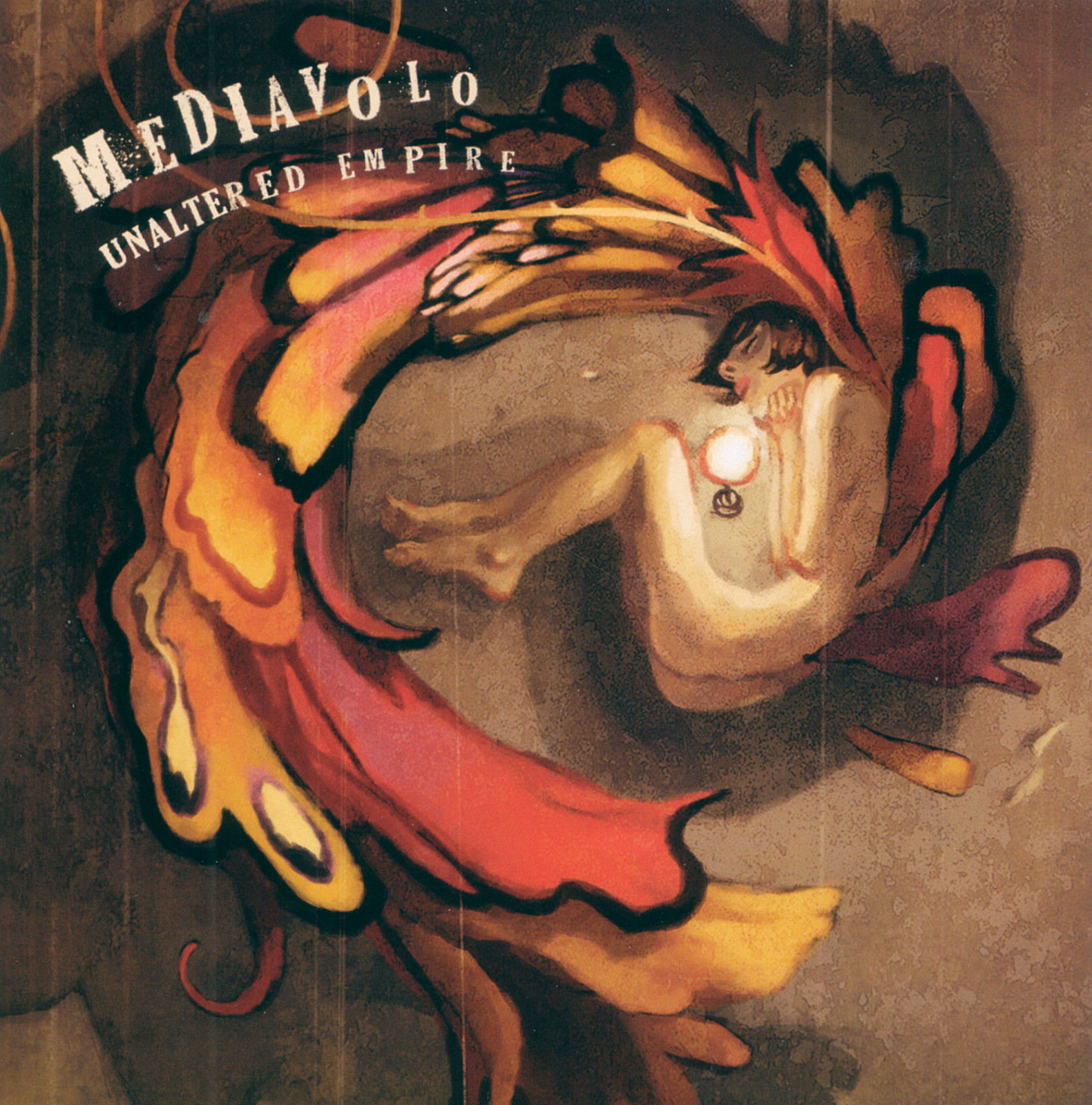
Unaltered Empire

With Unaltered Empire (2008), Mediavolo carried its ethos over into even more visual territory. Its striking cover implies a private room, an almost David Lynchian spiral into a ceiling fixture where inner and outer spaces become one. This leads me to ask: Does the music start with imagery, or vice versa? Jac’s reply: “I remember very clearly traveling through unknown worlds, my head filled with images, while I listened or composed music as a boy. That’s why ‘concept albums’ have exerted a strong appeal for me: Sgt. Pepper, Tubular Bells, Never for Ever—albums developing their own worlds. I’ve always wanted to write albums as such. So it is true that before music or lyrics, come images.” Gé adds, “And Jac took the habit of sharing his images with me. But it is impossible to convey, with lyrics, as many meanings as with images. That’s why the cover art is so important.”

Unaltered Empire takes its inspiration from Kafka’s “The Metamorphosis,” telling instead the story of a young woman’s transformation into a butterfly. Accordingly, it plumbs the depths of our biological minds and pushes Mediavolo into its most cosmic directions yet. Many of the songs play off the storybook nature of Secret, but do so with a biographical lens focused on childhoods. Consider “Treasure Box,” which crosshatches the snow blind of birth with the charcoal of development. Crafting words as photographs, it rewrites a death in the family, throwing light across the blank page by way of the guitar’s golden sunrise. Consider also the denser palette of “Dry and Brave,” in which last night’s dreams are stretched to breaking and repaired as if by watchmaker’s tools. A purging, this is.

The title track, too, is touched by familial magic, adopting a maternal tone that whispers lullabies and wisdoms. It springs before us, a fantasy novel come to life, wielding tongues against the great Silence. Dissolution of allegiances, a cutting of blood ties in favor of the new veins: the songs will outlive us all. Only now do we discover that the titular empire is entirely on the inside. It is carried in the heart, in the hands, in our labyrinthine brains, filling the skull with a vintage that can never be brought to lips.

In some uncanny way, listening to these songs lends exactly the same feeling as a scene in the film Amelie in which the title character, upon finding a trinket box that once belonged to a boy now grown, returns it to him anonymously but watches unnoticed as he cradles the all-but-forgotten storehouse in his hands for the first time in decades. We are thus privileged to know the connectivity of “Black Roses,” to peek inside the time capsule of “Selling Birds,” and to taste the flightless habitus of “The Backroom of My Mind.” And further, the dulcet axis of “Fanciest Scheme,” which splits consciousness into dots and dashes, each signal received on a scratching record that trails a ligament of stardust.

As singer, Gé soars and mires in equal measure. Harboring little interest in adornment, she brings her beauties on this album to three blinding jewels. The first of these is “Cavalry Drum,” a song of conflict rolled until rice paper thin. Jac’s guitar captivates with its radiance, threading a bass line between predator and prey with a nervous excitement. Throughout the song’s interweaving of speech and conscience, Gé patterns mysteries with due clarity. “This song,” she tells me, “is about feeling strongly about simple things. Our world draws us away from nature, from contemplation. We surround ourselves with technology, and feel ‘happy,’ ‘excited,’ ‘contented.’ Can it ever make us feel ‘alive’ as the sun does when it touches our skin?”


(“Cavalry Drum”)

“Dr Quayle” occupies the center of this masterful song trio. Its exacting compositional science heightens the laboratorial feel of the lyrics. A guitar solo sweeps across the night like a patient’s cry, as do Gé’s powerful highs in the final stretch. With such noir-ish granules working their way down the Mediavolo hourglass, it might be tempting to file the band under Gothic or Darkwave. Such designations, however, ring reductively, deferring instead to something more inclusive. “Restraining myself to a channeled kind of music is very difficult,” Jac admits. “I have so many different musical urges that Mediavolo ends up with multiple identities. Labeling our music has always been a problem. That’s why I’d rather it came under ‘indie pop.’ It’s a large enough tag to encompass all of what we do.”

Either way, the good doctor’s tinkering yields the most sublime creation in the Mediavolo archive: “To the Eye.” As the pinnacle of the band’s craft, it heralds a great beyond when music will one day live of its own accord and resound for its sake alone. Which is why the guitar is forthright but also suffused with a child’s wonder, as expressed in Gé’s lyrics:

they say that a star that we get to see
has long blown away and died
but how can this feel true, that is,
to the eye?

An insightful observation, to be sure, of the body’s generative power, but also of its penchant for immediacy. Gé stirs her hands in the overlapping tide of guitar, bass, and drums. From this she plucks her words, fixing each to a constellatory joint and breathing perfect animation with harmony. According to Jac, “To the Eye” takes its cue from The Sugarcubes and The Sundays (another heavenly band that should be of interest if anything herein strikes your fancy), but its winds blow decidedly off planet.

Before moving on to Modern Cause (2011), it bears us well to look at the foundations on which A Secret Sound stands: namely, the two French-language albums that preceded the band’s switch to English.

Soleil sans retour

Soleil sans retour (2003) is a self-styled “collection of short stories on the difficulty of living in today’s world.” By way of introduction, the title song orchestrates our inclusion in a sound-world dappled with shadow and the promise of skin-to-skin contact. With its tasteful keyboard accents, this compact drama evokes old discoveries and new nostalgias. As with much of what follows, there is antiqueness at play, a chain of vignettes swimming in increasingly potent fire. “Cryogénie” is a strangely tender crawl inward and spins Gé’s reverbed voice atop a crunchier peak. Touches of mandolin speak of sconce-lit catacombs, while above ground lovers wander, ignorant, through catacombs of their own.


(“Cryogénie,” directed by Nicolas Hervoches)

“Dernière fantaisie” (Last Fantasy) feathers the album’s swan, working its contortions through the instrumental simmer of “Final” and on to the smooth echo chamber of “Wh.” Between their frame lies a treasure trove of faded photographs. From the slices of 70s rock that clasp then release us through the chronological reckoning of “Ma redemption” and “Ballon rouge” to the ever-after wayfaring of “Le Gouffre aux chimères,” we sense reams of trauma with every lyric sweep, but also the marginalia of difference between them (note, for instance, the watery play of harpsichord and vibraphone in “Antichambre”). What distinguishes Soleil is its malleability: just when you’ve pegged a song’s psychological shape, it contorts into something new yet clearly underwritten by the same genetic signature. Furthermore, with “La Fille de Ryan” (Ryan’s Daughter)—a nod to the David Lean film of the same name—it foreshadows Effets Personnels, which takes listeners on a soldier’s “philosophical and surrealist journey” through the First World War.

Effets Personnels

Effets waltzes its way across fallen soldiers and makes of their last wishes a symphony of flesh hurled toward the horizon in endless catapult. Looking at the sky as if from the bottom of a well, the albumoffers hope in small, unreachable circles—closest perhaps in “C’est écrit dans la glace” (It is Written in Ice). References to war abound. “Mogador,” for one, names a class of French naval destroyer, cutting surf toward the anthemic “Safari” with a heart of darkness in mind. Even the promise of “Le Phare” (The Lighthouse), in spite of its enchantments, is tainted by amnesia. The effect is such that evocative titles like “Un Papillon sur l’épaule” (A Butterfly on the Shoulder) and “L’echo dans la vallée” (The Echo in the Valley) feel all the more claustrophobic for the meticulousness of their arrangements. Memories of open sky and pasture are only that, drawn away as they are in the saddles of emotional horses who recede into afterlife with every clop of hooves, over lullabies and goddess trails before seeking the shelter of “Necropolis,” where materialize and dissolve the echoes of gatherings and family affairs, of victors’ nightmares and victims’ dreams, leaving only the title track to show for their passing. Here is the wonder of birth expressed in sound, pulling the fatal transition of life as a razor across stubble, its wake as bare as our first moments in this unwritten world.

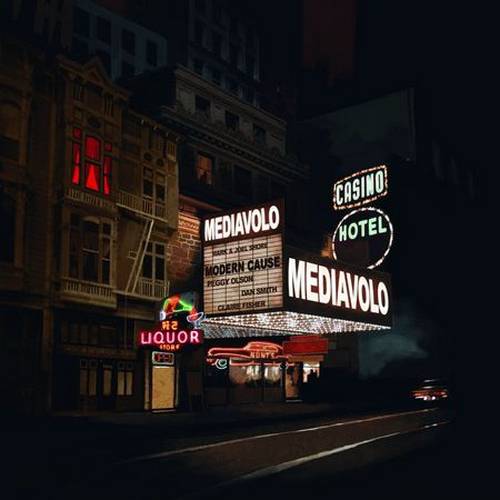
Modern Cause

And so, we arrive at Modern Cause, a record that is, in Jac’s words, “a patchwork of moments in life, with no link existing between them.” Its prologue comes in the form of “Dan,” which reiterates some of the backward glances of Empire but with a new age of emotional becoming. I ask Gé if this is a personal song: “It is indeed personal,” she says, “but it does not root itself in reality; it is a projection. That siblings love each other is taken for granted. Family is not immune to implosion, however: small things, slight differences of perception add up, until the wrongs of life reveal them. I drew my inspiration from some of my own family’s words and moves, and tried to imagine what they could lead to in a distant, cold, and love-free environment.” In both this song and “Up Ahead,” she fully embodies the protagonist, as if she has dug up some corroded jewel and polished it as if it were her own creation. Is not singing, then, a form of acting, or is it something deeper? Gé: “I regard singing as acting, definitely. In that respect, I’ve always agreed to embody the male characters of Jac’s brother’s lyrics [on the older albums], and I’ve never attempted to feminize the stories that came to me involving one. It so happened that the emotions of some of them started resonating with my own. ‘Keepin’ out’ is one of those occurrences.”

Indeed, in the indie rock vibe of “Keepin’ Out” Gé converses as if with herself, pulling teeth from the gums of the ego with pliers coated, in her turn of phrase, with “non-secretive scorn.” These machinations charge through an increasingly dense vocal flock until they find neither resolution nor peace, but rather the reality of moving on.


(“Keepin’ Out,” directed by David Carquet)

An exception to this rule is “We Danced Today,” which closes the album’s intimate economy with Jac’s singing: “I was convinced the song fitted Gé’s voice. But when we started recording, we realized quickly something was wrong. The demo vocals I had recorded kept sounding better. We finally understood the musical pitch was that of a male voice. Gé convinced me to take the lead.” His voice lends a historical charge to the song’s lavish—if sparsely populated—ballroom scene. Faces disappear with every twirl and contact, until fadeout draws its curtain near.

From this song alone, one may note the distinct production values of Cause, the result of Jac’s desire to go for a Phil Spector “Wall of Sound” effect, affording less scrutiny of the mix in the interest of overall atmosphere. In this regard, “Latent” is the album’s centerpiece. The anthemic loop thereof trades anticipation for acceptance, ending in a protracted instrumental outro that lures us deeper with every reset. Such structures, Gé notes, informed the lyrics: “There is a clear division in the middle of the song. The first half is tense and anxiety-provoking; the second is luminous and full of hope. To me it evoked those moments when we are confronted with difficulties and the feeling of release when we step out of them. The second part did not need lyrics, the music alone conveys the feeling.” This is especially obvious in the nakedness of the acoustic version:


(“Latent” Acoustic Attack Session)

Although Cause is less specific at the mixing board, it fully discloses its ghosts. Its crucible aesthetic boils down past and future impulses into a here and now of raw vitality. As a result, a heavy nostalgia pervades that was very much a part of the recording process. Says Jac, “When you get older, you sometimes wish to go back to what you once knew. As a matter of fact, the studio in which we work looks very much like the room I had as a boy. Some of my old toys sit on the shelves…” One of the album’s many affordances, however, is that it leaves plenty of room on those shelves for listeners to place their own mementos, be they a set of keys alongside the teenage thrill of“You Wish Mark Steered,” moth-eaten pajamas curled around “It’s Begun,” or glass marbles bending light into “Peggy ’60,” each object follows us like the eyes of a banknote. Their regard anoints us i search for plainspoken undertakers.

The music of Mediavolo may draw its waters from many wells, but nothing tastes quite like it. It does not regard itself in the mirror, but instead acts as a mirror itself, one fit to contain any face that dares approach it with an open ear.

Mediavolo 2

Exploding the Sandbox: A Moment with TOTEM>

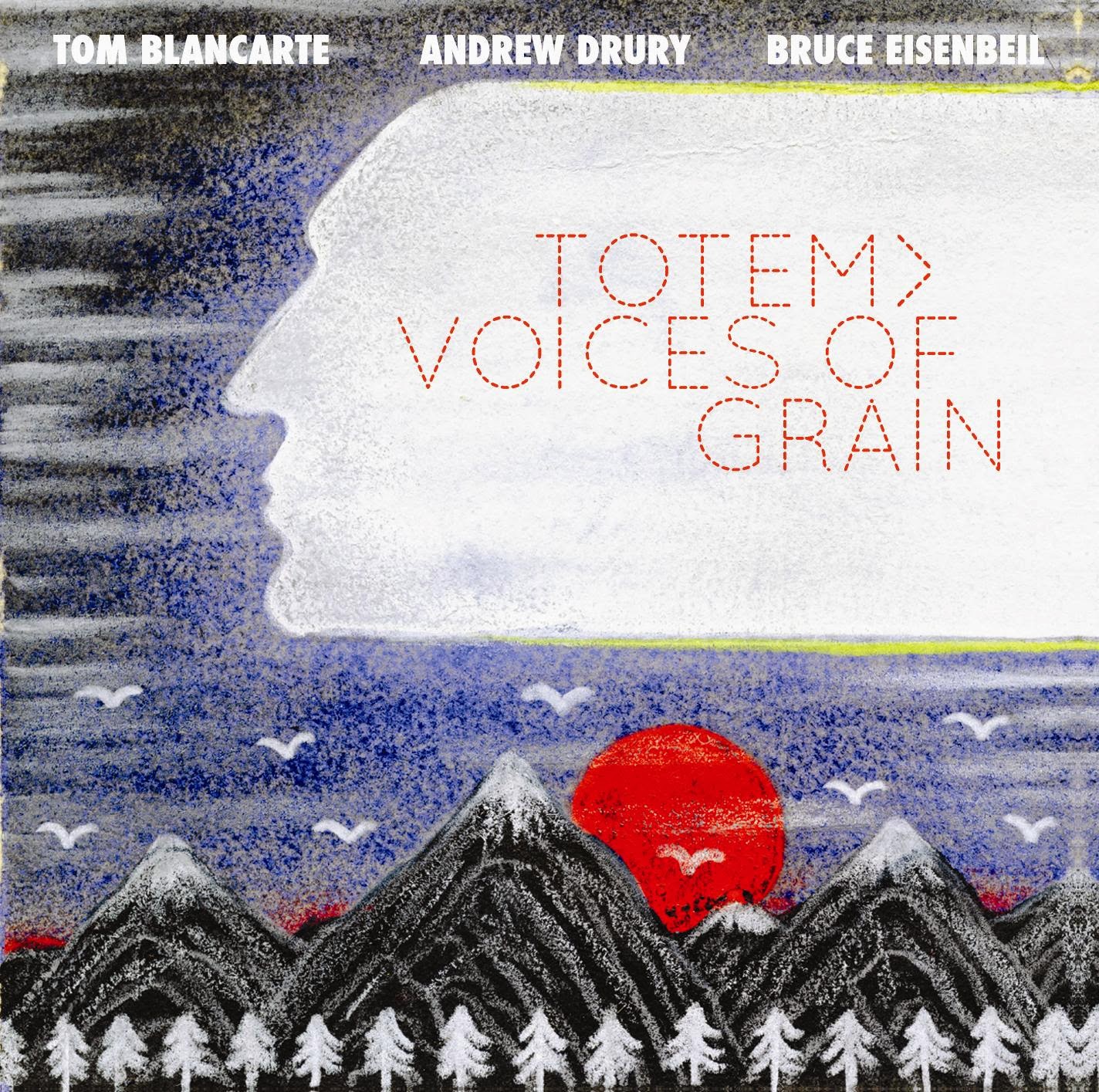
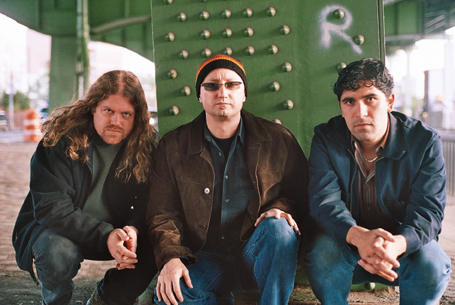
Voices of Grain In his seminal essay “The Grain of the Voice,” French philosopher Roland Barthes asserts the failure of language to interpret music for the precise reason that language and music are one in the same. Needing no self-projection to justify its existence, music is a signifier without identity that expresses its materiality by what he calls the “grain.” During a recent interview with between sound and space, guitarist Bruce Eisenbeil, who alongside bassist Tom Blancarte and drummer Andrew Drury is part of the free improvisation triangle known as TOTEM>, explains the importance of the grain in a mode of sonic production that may seem far afield of its roots but which in fact burrows past them: “The history of what I’ve been involved with, which is jazz-based, brought me to these sounds. When I look at the music of, for instance, of Cecil Taylor, John Coltrane, and Albert Ayler, and how each had his own musical influence—for Taylor it was classical; for Coltrane, world music; and for Ayler, folk—as a springboard for improvisation, I see those same influences in my own evolution. All of this and more, including contemporary classical music from the second half of the twentieth century (Xenakis, Reich, Lachenmann, etc.), has made me realize that playing guitar is in large part about imitating my own environment. It’s not unlike a child who acquires language just by being around family members and learning to communicate. For me, it’s as simple as that. I take everything I’ve ever heard or experienced and pass it through my filter, using my guitar as an instrument for the exploration of that sound by way of communication. So concepts of music, noise, or sound—really, all of these things are part of the same thing.” We may easily connect this way of thinking to Barthes, who avers that music, “by natural bent, is that which receives an adjective,” an assertion that renders moot any question of genre. Subjecting music to the violence of nominalization precludes the lived experience of its descriptive realities. In less uncertain terms: adjectives are active, while nouns are dead matter. The creation and absorption of sound functions as an act of translation, a way to experience the afterlife of sonic production through another form, be it in words or in reverberations.

TOTEM

To be sure, the matter-makers of TOTEM> know a thing or two about adjectives. Voices of Grain, which comes five years after their 2008 debut Solar Forge, brims with them. Although thoroughly established on the lunatic fringe of New York’s jazz scene, their presence is mappable by no coordinates, save the curtain behind which an ancestral Oz beats his drum. The virtuosity of each member is formidable, but when standing in the center of their galactic fury we needn’t understand any means of execution. We are more likely to find strange comfort in the mystery behind every utterance. Despite the frenzy, there is hardly a trace of urgency to the sounds, which come to us through noose-outlined ovals of sky, each a window into another, ad infinitum. And where does all of this leave the hapless writer, who struggles with words as if severed from the music they entail? Eisenbeil has an answer for that, too: “A vast majority of sound is created in the world and how that sound is used in situations is predicated on people being engaged in one form or another. Writings by those who sit removed just expecting to be fed say more about the writer’s environment than about the music’s. Musicians will tell you that the more the audience is involved, the better the experience is. It turns into something larger than everyone and everything involved. It’s an ancient process.” As indeed the free qualities of “Genosong” take shape, and in my own attempts to participate in the conversation, I initially struggle for reference points. To wit, possibilities include the Laswell/Haino/Ali joint Decided … Already The Motionless Heart Of Tranquility, Tangling The Prayer Called “I” (1999, Tzadik) and the pioneering work of Derek Bailey. Yet the confluence of signatures that is TOTEM> discloses another genealogy entirely, one quoted above yet also expressed by spontaneous architectures. The result is a hulking vessel that becomes indistinguishable from the waters it plows. Between the breakers of Drury’s drumming, Blancarte’s thick knot-work, and the guitar’s ever-fractal song, the trio trades shine for brine in a pirated helix of comportment. One can almost feel the mitochondria warming up. There’s a sense here of tentacles grasping on to something, of suction and underbellies barnacled by nocturnal passage. What seems a maritime nightmare is in fact a jazz dream, each strand of braid taking a solo while the others lock into supporting grooves. Such moments are brief, although periodic enough to prove TOTEM>’s three-dimensional locution. From oceans eternal to motions internal, from ship to submarine, creaks and water pressures abound in the claustrophobic symphony of “Written in the Body.” What appears to be a dive inward marks its clip by friction of strings and osmosis of skins. Chronology, then, becomes not an ordering of events but an event of orderings, each strand one possible pathway through the mind’s eye, a constant breaking and reconnecting of bare life. Further tensions ravel in “Toward Jouissance,” which stretches and rubs a balloon to the brink of rupture, and in “Counter Memory,” which draws a whirlpool of collective becoming. The latter is more explicitly layered as guitar elicits a frantic cartography across insectile spectrums. “Message Without a Code” not only names the next track, but might as well be the band’s slogan: despite the seemingly cryptic methods (extended techniques, and so on) of execution, the sounds produced are stark naked. Acceptance of that nakedness, molecular it may be, are the listener’s only entrance fee to a full experience of these goings on. More than that, it’s an awareness of one’s physical universe and the planetary alignments of performance. No mere analogy, this image reaches back to Eisenbeil’s genealogy of forms, which taps into a decidedly Foucauldian sense of biopower, that elusive yet pervasive technology of physical management: “Noise is the grain of the voice, and with the grain expresses power,” the guitarist goes on to say. “The idea is that all of the leading exponents of jazz have always had this kind of noise in their sound. Whether it was Ornette Coleman or Charlie Parker, or Evan Parker, or William Parker…many of these musicians were criticized early on for this grain that comes through their sound, which people initially perceived as noise because their emotional filter didn’t allow it to penetrate their being. Yet now that noise is accepted. It must be heard.” Perhaps this is the message of “Post-Repeating,” the album’s most outward statement by far. It cuts a vast horizontal plane, a frozen ocean cracking in the sun with meditative cause, and paves our way toward the final “Silence On Its Road.” In the end, there is only the beginning, a gesture that resounds with every possibility at its fingertips. All explosions look like implosions with enough mirrors around. “Music,” says Eisenbeil, “is best when formed when people have an open heart.” It need be nothing more or less. Like the arrowhead that ends the band’s name, it points forward, no more knowing of the future than the rest of us. And so, while the album does proceed in an extremely physical manner, it orbits us at such a rate that the distinction between the body and its environment collapses in endless porosity. Eisenbeil agrees: “I love playing with Tom and Andrew. It’s a fantastic experience for being completely natural. Every single time we get together, whether in public performance or in the studio, it’s a transcendental experience that is much bigger than the three of us. The sound is an entity in and of itself, a universal life force that the three of us are part of.” To that life force will be added the curious who, with open ears and hearts, find themselves drowning in the sandbox of TOTEM>’s sound-world, swallowing every last grain until it screams.

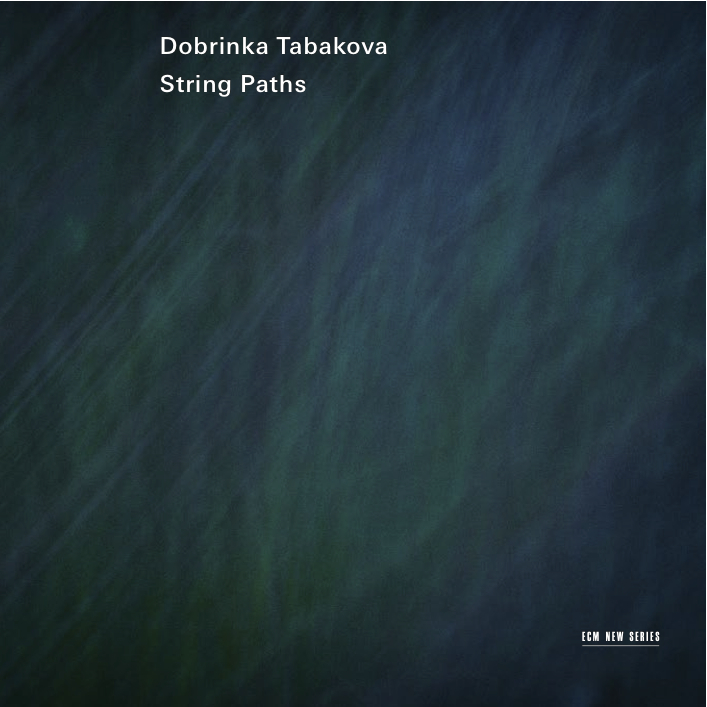
Dobrinka Tabakova: String Paths (ECM New Series 2239)

String Paths

Dobrinka Tabakova
String Paths

Kristina Blaumane violoncello
Maxim Rysanov viola, conductor
Janine Jansen violin
Roman Mints violin
Julia-Maria Kretz violin
Amihai Grosz viola
Torleif Thedéen violoncello
Boris Andrianov violoncello
Raimondas Sviackevičius accordion
Vaiva Eidukaitytė-Storastienė harpsichord
Stacey Watton double bass
Donatas Bagurskas double bass
Lithuanian Chamber Orchestra
Recorded March/April 2011 at National Philharmonic Hall, Vilnius by Laura Jurgelionyté and Valdemaras Kiršys, Studija Aurea in Vilnius
Such different paths recorded June 2011 at Jesus-Christus-Kirche Dahlem, Berlin by Markus Heiland
Mixed and mastered at Rainbow Studio in Oslo by Jan Erik Kongshaug, Manfred Eicher and Dobrinka Tabakova
Produced by Manfred Eicher

When art promises to be revelatory, it may become something to fear. Such is the case of String Paths, the first conspectus of music by Dobrinka Tabakova. Fear, in this sense, is close to awe, for before hearing a single note one knows its details will seep into places to which few others have traveled. Fear, because the trust and intimacy required of such an act is what the composer’s life is all about: she fills staves with glyphs so that anyone with an open heart might encounter their fleeting interpretations and become part of their accretion. Indeed, many factors go into the creation of a single instrumental line, incalculably magnified by its interaction with others. Fear, then, is closer still to love.

Born in 1980, Tabakova moved at age 11 from her Bulgarian hometown of Plovdiv to London, where she went on to study at the Guildhall School of Music and Drama. Her career began in earnest after winning an international competition at 14, since which time she has developed a voice that is refreshingly full and melodious. Such a biographical sketch, despite its prodigious overtones, does little to set Tabakova apart from her contemporaries. Recognition is one thing; experience is another. The coloring of imagination sustained in this timely album’s program, the whole of its corporeal sensibilities, can only come across when its water fills a listener’s cup.

Ukrainian violist-conductor Maxim Rysanov, notable proponent of Kancheli and other composers of our time, has become one of Tabakova’s strongest advocates. It was, in fact, his performance of the Suite in Old Style (written 2006 for solo viola, harpsichord and strings) at the prestigious Lockenhaus Festival that first caught ECM producer Manfred Eicher’s ear and led him to propose the present disc. As the album’s seed, it shelters refugees of the surrounding works. In amending a practice established by such visionaries as Górecki, Schnittke, Eller, and others who have mined elder idioms as a means of looking forward, Tabakova might be placed squarely in an ongoing tradition. She, however, prefers to trace the piece’s genealogy back to Rameau by way of Respighi. Given its descriptive edge, we might link it further to the great Baroque mimeticists—Farina, Biber, Muffat, Schmelzer, and Vivaldi—who were less interested in imitating each other (although some intertextuality was to be expected) than they were in describing nature and circumstance. In this respect, Tabakova’s triptych interfaces a variety of signatures, from which her own stands boldest.

The first movement is a triptych unto itself. Beginning with a Prelude marked “Fanfare from the balconies,” proceeding to “Back from hunting,” and on to “Through mirrored corridors,” already one can note Tabakova’s special affinity for space and place. A rich and delightful piece of prosody, its syncopations feel like ballet, a joyous dance of fit bodies. The viola leaps while the harpsichord adds tactile diacritics to Rysanov’s slippery alphabet. The transcendent centerpiece, entitled “The rose garden by moonlight,” is a shiver down the spine in slow motion, a season at once born and dying. The harpsichord elicits brief exaltations, pushing its wordless song into snowdrift, even as intimations of spring exchange glances with those of autumn. The quasi-Italian filigree of “Riddle of the barrel-organ player” and the Postlude (“Hunting and Finale”) fosters a nostalgic air of antique tracings, bearing yin and yang with plenty of drama to spare.

Insight (2002) for string trio opens the program with exactly that. Played by its dedicatees (Rysanov, Russian violinist Roman Mints, and Latvian-born Kristina Blaumane, principal cellist of the London Philharmonic), it unfolds in dense streams. For Tabakova the trio breathes as one, as might the moving parts of some singing, bellowed engine. The trio thus becomes something else entirely (a phenomenon achieved via the same configuration perhaps only by Górecki in his Genesis I). Moments of shining vibrato add pulse and skin. Glissandi also play an important role in establishing a smooth, coherent fable. The violin’s harmonics are glassine, somehow vulnerable. Indications of dances hold hands with jagged flames. Hints of a free spirit shine through the cracks. A decorated return to the theme looses a bird from an open palm, watching it fly until its song grows too faint to hear.

The 2008 Concerto for Cello and Strings, written for and featuring Blaumane as soloist, moves in three phases, the names of which recall the designations of John Adams. The music, too, may remind one of the American humanist, singing as it does with a likeminded breadth of inflection. The first movement (“Turbulent, tense”) unfolds in pulsing energy. Like a spirit coursing through the sky, it searches the heavens, lantern in hand, for earthly connection. The spirit casts a longing gaze across the oceans, leaping from continent to continent, harming not a single blade of grass by her step. The cello thus takes up the opening theme like a haul from the deep, letting all creatures slip through its fingers to hold the one treasure it seeks by their tips. In that box: a beating heart, one that seeks its own undoing by virtue of its discovery. It is a story revived in countless historical tragedies. The orchestra flowers around the soloist, carrying equilibrium as might a parent cradle a sickly child, laying her down on the altar where the opening motif may reach. The slow movement, marked “Longing,” thus revives that body, spinning from the treasure’s contents a trail she might follow back toward breath. With her resurrection come also the fears that killed her: the conflicts of a warring state, the ideals of a corrupt ruler, the confusion of a hopeless citizenry. The kingdom no longer smiles beneath the sun but weeps by moonlight. Chromatic lilts keep those tears in check, holding them true to form: as vast internal calligraphies whose tails find purchase only on composition paper. Echoes appear and remain. Blaumane’s rich, singing tone conveys all of this and more, never letting go of its full-bodied emotion. The softness of the final stretch turns charcoal into pastel, cloud into dusk, star into supernova. It is therefore tempting to read resolution into the final movement (“Radiant”). From its icy opening harmonics, it seems to beg for the cello’s appearance, which in spite of its jaggedness never bleeds into forceful suggestion. For whenever it verges on puncture, it reconnects to the surrounding orchestral flow, from which it was born and to which it always returns for recharge. Its blasting high sends a message: I am fallen that I might rise again.

Frozen River Flows (2005) is scored for violin, accordion and double bass. Intended to evoke water beneath ice, it expresses two states of the same substance yet so much more. It encompasses the snowy banks, the laden trees, the footprints left beneath them. It imparts glimpses of those who wandered through here not long ago, whose warmth still lingers like a puff of exhaled breath. The violin takes on a vocal lilt, the accordion a windy rasp, the double bass a gestural vocabulary—all of which ends as if beginning.

Such different paths (2008) for string septet ends the program. Dedicated to Dutch violinist Janine Jansen, it ushers in a full, chromatic sound. There is a feeling of constant movement here that is duly organic: in one sense as flow, in another as melodic variety. There is, again, a rocking quality, as if the music always rests on some sort of fulcrum. A quiet passage that deals with the barbs lifted to our eyes. It ends in transcendent wash, a bleed of dye in cloth.

The performances on this finely produced disc are as gorgeous as they come, even more so under the purview of such attentive engineering. This is not music we simply listen to, but music that also listens to us.

It is in precisely this spirit of mutual listening that I participated in an e-mail interview with Ms. Tabakova, who kindly answered the following questions from this enamored soul…

Dobrinka Tabakova

Tyran Grillo: In the String Paths CD booklet, your mention of a powerful first encounter with Keith Jarrett’s Köln Concert makes me recall my own. I felt as if that music had always existed beyond time, but that somehow Jarrett’s performance gave us the means to hear it at mortal speed. Because improvisation is, of course, vital to the compositional act, do you feel this way about your own music (i.e., that you funnel it from the ether), or do you see it emerging entirely from within, by your own design?

Dobrinka Tabakova: Longfellow said that “music is the universal language of mankind,” and I think this is what happens when you “meet” a work of music for the first time and it speaks in a way that you understand and/or it resonates with you. The time-old abstract dilemma of where music comes from, in this case, could be discussed under the larger topic of “how do we communicate.” Of course there is inspiration, and I hope the process of how that sparks the beginning of a new work will remain the wonderful mystery that it is. But that spark gets refracted through the artist’s own prism, made up of the experiences around, exposure to different musics, aesthetic preference… With composition we have the added layer of not working in real time and being able to work at the form and structure of a piece of music far longer than it will take to listen to it. Mendeleev imagined the periodic table in a dream, and the same is sometimes said of compositions, but that dream can only be the beginning, I think. It is a responsibility to capture it in the best possible way, and make it speak.

TG: As a listener who has been moved by your music, I see it as a gift. What has your music given you?

DT: The ability to express something through music has been the main focus of my life, and to have connected with someone is a privilege. That feeling is beyond words.

TG: I’ve always felt that music and literature are much alike: both are “written,” both “tell stories,” one has “movements” instead of “chapters,” etc. How do you envisage the relationship between the two?

DT: I am engrossed by literature, well-told stories, captivating multi-layered characters and, like you say, there are similarities with music in terms of form. But, at least for me, words and music occupy two very different worlds, and I am distracted to think too “literally” when composing. I don’t mean writing music to words—there is a relationship there, and this is when words become music.

TG: There is a seesawing quality to the opening and closing pieces of the program (Insight and Such different paths), as if they rest atop an unvoiced fulcrum and spin a melodic and chromatic equilibrium throughout. How do you visualize the structural nature of those two compositions?

DT: I am glad that you felt it this way and asked about this, because the structure of the album was an important part of the concept of the whole project. Although each of the pieces has its own structure, the feeling of an overarching symmetry to the structure of the album was important. The opening to Insight is almost deliberately aiming to make your ear search. The gradual development of the sounds from there, I feel, leads quite naturally and logically to the effect of the closing of Such different paths: having walked aurally through the album, reaching a kind of settled, calm sonic space.

TG: It’s easy to see your Suite in Old Style as continuing a trend among composers such as Górecki, Schnittke, Eller, and others who have leaned toward the past as a means of looking forward. Yet I wonder if what you have done in this marvelous piece is not more like the great Baroque mimetic composers—Farina, Biber, Muffat, Schmelzer, and Vivaldi—who seemed more interested in describing nature and action than in imitating each other.

DT: I think ultimately, I didn’t wish to try and sound like a composer from a certain time. The Suite is a bow to the music which inspired me and that I grew up hearing. Trying to capture that inspiration and present it through modern eyes/ears was at the heart of the concept of this work.

TG: Speaking of the same piece, your subsection titles have a very dramaturgical sheen to them.

DT: Yes, it helped me imagine being in this other time and also to emphasize the daily distance between then and now, but fundamentally hoping that the music would bridge the time gap.

TG: Insight is an appropriate way to open the program of String Paths. I particularly enjoy its horizontal energies, its balance of density and openness. Compared to the pieces that follow, it feels like a stream of consciousness that has undergone relatively little revision. Can you talk about its inception and unfolding throughout the process of composing it?

DT: I am glad you had that reaction—that it sounds like a stream of consciousness. I think at the start of most pieces, I have a general shape which I would like to achieve with a composition, so I am happy if it is perceived as a flowing unfolding. There are always edits and re-thinks, but I try to stick to the original shape. Also, having challenging parts for each voice makes the work dramatic which propels the motion of the piece.

TG: I am so fond of the little chromatic descending motifs in the second movement of your Concerto for Cello and Strings. They catch my attention every time like the teeth of a zipper locking together. How did this detail come to be in the piece?

DT:  The almost glissando motif came together with the melody—the two have always been inseparable. As I was imagining this to be the “human” section of the concerto (see my next answer), there is a desire to be particularly expressive and almost transform the cello to a singer.

TG: In relation to my earlier question regarding literature, I find the concerto to be especially vivid in its storytelling. What kinds of images does it bring to your mind?

DT: The overall shape of the concerto is an upward one—an ascent. As a student, my main thesis was about Music and Science, and while researching that I discovered the writing of Boethius, a 4th-century Roman philosopher who categorized music in three levels: musica instrumentalis, musica humana, and musica mundana. The first movement can be seen as an expression of musica instrumentalis—the “taming” of the instrument, challenging and stretching the performer and the instrument. Musica humana—believed to be the music of the soul, and everything that affects us as humans—is expressed in the second movement, while musica mundane—also known as music of the spheres—is our impression and hope for what may lie beyond our planet, which finds an expression in the final movement. I didn’t have a particular story in mind, more a shape, perhaps.

TG: Frozen River Flows, more than by virtue of its title, is a remarkably organic piece. The combination of instruments is intriguing. Did your decisions in this regard arise out of wanting to write for particular musicians or was there something about their admixture that spoke to you?

DT: Frozen River Flows was originally written for two conservatoire colleagues of mine, who formed an oboe-and-percussion duo called newnoise. Soon after I completed it, Roman Mints, who I also studied with at Guildhall, asked me if I could contribute a piece to a concert he was programming with violin, accordion, and double bass. This is how the unusual instrumentation came about.

TG: Such different paths is a piece of many layers. Where do you situate yourself among them?

DT: Perhaps, being the composer, I might situate myself at the foundation. But, in all seriousness, it is true, the septet is very layered and polyphonic/contrapuntal. This for me is the great pleasure in writing chamber music: one can have all these lines and give equal weight to each. The inter-relationships between parts can be very complex. Setting myself to this challenge—to have complexity within a clear structure and sound—was one of the first steps in the compositional process.

TG: Such different paths feels like an emblematic piece. What personal importance does it hold for you?

DT: I feel that way about all the pieces on the CD, to be honest. In each there are elements which build from previous ideas or thoughts, and since both the Cello Concerto and Such different paths are the latest compositions on the disk, I guess I’ve had more time to accumulate further thoughts when writing.

TG: Much of your music seems cyclical. Is this conscious?

DT: It really depends on the piece, I wouldn’t say that, for example, Such different paths is cyclical. But sometimes there is a satisfaction in hearing material in two contexts—without having a reference and after a certain development.

TG: Manfred Eicher has been a blessing to so many composers since beginning his New Series in the mid-80s. What does it mean for you to have worked with him and to see your music represented by an influential and prestigious venue?

DT: Manfred Eicher is inspirational, and it has been an unparalleled privilege to work with him and his team! It’s more than a dream to be part of such a catalogue of creativity. As a composer, it is a really great feeling to be able to feel that your music is understood and that those responsible for its delivery on record are concerned, above all, with the integrity and true nature of the music.

TG: On a related note, can you describe your involvement in the recording/mixing process and any insights Mr. Eicher imparted along the way?

DT: Well, my ability to navigate around a mixing desk would perhaps equal my ability to ice-skate, so I couldn’t have a detailed and technical conversation, as much as I may have liked. The process was very natural and dependent on what we were hearing, and at least my main point of reference was the feeling of being in the hall and experiencing the music as if it were played live.

TG: What currently excites you about being a composer? What currently excites you as a listener?

DT: I have a ton of research to get through for some upcoming projects, including one for the Shakespeare anniversary in 2016, and this is providing me with a well of inspiration and excitement. Being a Londoner excites me as a listener—with access to so many fantastic concerts and events as well as sounds.

TG: Generally speaking, how do you compose? Do you have a preferred space, environment, or atmosphere in which to do so?

DT: As long as I can have some quiet, a piano, and my notepad, I’m happy.

(See this article as it originally appeared in Sequenza 21. To hear samples of String Paths, please click here.)

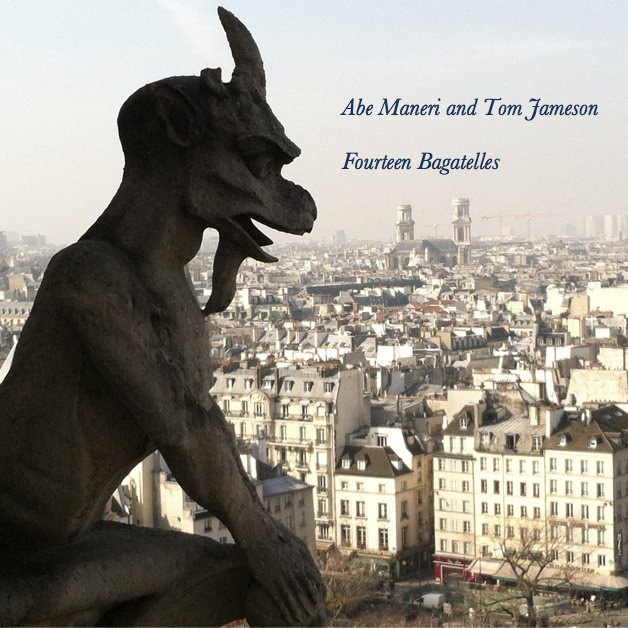
Abe Maneri and Tom Jameson: Fourteen Bagatelles

Adventurous ECM listeners will undoubtedly be familiar with Joe and Mat Maneri. The father and son team were known for offering their uncompromising microtonal adventures without fear, expectation, or agenda. The music sang with a voice within a voice. Although Joe has sadly passed from this realm, his relentless passion and pursuit of knowledge live on in his recorded work and in the endeavors of his multi-talented sons. Among that progeny stands Abe Maneri, a musically unquenchable soul who has been quietly making independent recordings for years on his own quest for sonic truth.

Music has followed Abe, as Abe has followed music, his entire life. An instrumental renaissance man, he plays violin, cello, piano, recorders, guitar, percussion, clarinet, and also sings. Collaborations have placed him alongside likeminded sound-seekers, including Jessica Jones, Sabir Mateen, Assif Tsahar, and John Medeski, not to mention Joe and Mat themselves. On his latest, Fourteen Bagatelles, Abe is joined by longtime friend and guitarist Tom Jameson. Recorded in Abe’s home studio, the project develops a profound direction in an artist of already broad-ranging interests.

Fourteen Bagatelles

The bagatelle is a short musical selection, typically for piano, with an etudinal, airy feel. It doesn’t reach out and grab so much as caress the listener with intimations of larger mythologies. The form began with Beethoven and its suitcase has received stickers from such other composers as Smetana and Bartók along the way. Abe would be the last to place his efforts among them, but there’s no reason why we shouldn’t accept Fourteen Bagatelles as a worthy contribution to the ever-growing canon of the genre. The album is, regardless of its ancestry, one of deep listening that builds a discursive blend of jazz and classical elements out of “semi-improvised forms.”

Although Abe’s hats are as varicolored as the talent with whom he has performed, consistent in his work ethic is a staunch commitment to bringing out the human element of music making. This is especially true of the new album. Abe tells me as much during a recent phone interview:

“As a musician, in general—and perhaps this comes from my father’s tradition—one of the most important parts of constructing music is honesty of expression. There was a pervasive emotion Tom and I were trying to express, something a little bleak but not entirely hopeless. Often lost in the contemporary dialogue is the human component, and so we consciously set out with no other agenda than to make the best music we could make.”

Indeed, Tom’s soft anchorage in “Melodica and Guitar #1” (all tracks are so named for their combinations, with Abe playing the first listed instrument, Tom the second) is the firmament against which Abe dips his ladle into the horizon. So begins an experience of great beauty and tact, an evocation of places where one can feel caught, certain of some emotional sediment just below the waterline of form. Given its melancholic tinge, these bagatelles more readily recall Valentin Silvestrov’s, which have a mournful undercurrent yet remain true to the essence of their space. It’s a soft reminder that “airy” doesn’t necessarily mean emotionally vapid. “There’s a lot of control that goes into making something seem light,” Abe agrees, “and I think that’s the characteristic. I’m thinking about Haydn and Mozart, both of whom wrote an enormous amount of music which seemed ‘light’ yet in which there is incredible tension, sustained beauty, and control. It’s powerful because you can experience it as background music or as something more complex, depending on how you listen.”

Abe’s words make me think about my recent foray into yoga, a practice which requires unseen control in order to maintain its economy of movement. Mind and body resist the holds, storms brewing in every muscle, but eventually you learn to overcome it (or, rather, become it) and enter into a new self-awareness.

“I can relate to that,” Abe responds. “I think of the melodica tracks in particular, so different from the music I normally do, in which I am freely releasing energy into the air. Playing with Tom takes a certain level of restraint and actually there’s more energy happening within my center that’s not being released in the same kind of push, but it’s being released nonetheless. There’s a unique tension in playing with him. I find myself holding all the ideas in before letting them out. It’s more strategic.”

In light of this, “Melodica and Keyboard” Nos. 1 & 2 sound like fairytales, touched by wind and water and played as if recited. The first is a winding stair into an attic where a single window affords the intermittent blink of a lighthouse. Every sweep leaves a trail along the floor, marking the development of a solitary thought. This heavenly track is the apotheosis of the project. Keyboards creep into a few others, notably twice with guitar in gestures interludinal (“Keyboard and Guitar #2”) and of quieter luminescence (“Keyboard and Guitar #1”). The latter ends a mostly bronzed program with hints of silver. I ask Abe about sequencing.

“It was really constructed and labored. The first track was one of the first things we recorded. There were a few like that which were just obvious in terms of placement, and they worked better the more we sat with them. The last track was always going to be the last track. And from there, it was about logically getting from Track 4 to Track 14, thus forming an organic 45-minute piece.”

Taking this album at the surface level, one might say that Tom is only an accompanist, but with each listen his melodic contributions, his equal level of communication, becomes obvious. Tom is, in a way, the tree to Abe’s cherry blossoms, falling in sheets of pink. Abe elaborates:

“In some ways with Tom there’s a lot of push and pull. For the most part, each of our methods of improvisation and playing do stem from very different mentalities. Tom reasons out complicated passages before coming to the table—at least with guitar, which is not his first instrument. It’s more like orchestration than accompaniment, and my job is to find the best tension within it. We have been playing one way or another for nine or ten years. After a while, it didn’t matter which instruments we played; it was clear we were the same people.”

The lion’s share of the album is realized through combinations of various recorders and guitar. Those with soprano, despite their higher pitches, are actually the most earthly, each a cavern of wingbeats. There is also an elasticity to these tunes that gives them great endurance. The alto foregrounds relatively distorted reflections, which nevertheless retain their shape and open our ears to lessons of pattern recognition. In them are distant, pastoral memories. Tenor and bass recorders make one appearance apiece, moving from elliptical arpeggios and Renaissance accents to a grammar that is almost gloomy in its parsing.

The greatest comfort of Fourteen Bagatelles is that, by the end of its mesmerizing, lyrical dream, listeners can take comfort in the fact they were awake all along. This album is a flashlight in the dark, a means to an end, which is but another beginning. It is for this reason that, pressing PLAY for another go, I find my thoughts wandering to Abe’s father. I distinctly remember the first time I heard Angles of Repose and the new language it was espousing—a language that, although one I’ll never speak, I can at least attempt to translate. I can’t help but conclude with a question about what Joe passed on to him.

“It affects everything. In terms of how I play music, it would be crippling to do anything in relationship to someone that good. It was hard in many ways and took me years to even have the guts to call myself a musician. It took adulthood and separation in order to find my unique voice underneath but I’m also afraid of where I come from and what I learned. Anytime I’m playing, I’m cognizant of the joy of learning music early, of being exposed to radical concepts of improvisation, but he was also an extremely knowledgeable human. His level of knowledge was just so advanced. On the other hand, he was extremely kind and listened very intently, never pushing anyone from what they loved to do. Anytime I’m playing, there are always different voices of Joe that permeate my sensibilities. For one, there is the teacher of harmony. Then there was the Joe Marneri Quartet Joe. Then there was the religious Joe, who had a whole other way of talking. And then there was Joe my dad. The teacher, the radical, the man of God, and dad. Each of these encourage and discourage in different ways. A lot of my determination comes from not thinking about that too much and in being proud of who I am, making music just plain different from that legacy but also coming from it.”

And has he changed as a musician since becoming a father himself?

“It’s had the most positive effect. Almost everything I do is done within that great irony of parenthood: having one twentieth of the free time but making the most of that time, which becomes more focused. Nothing has played more of a role in my creative life, funnily enough, than having no time. It gives you a sense of purpose and direction, imparts an energy, a freshness of purpose.”

It is a purpose we can feel in every note. The cycle continues.

(To order Fourteen Bagatelles and more, check out Abe Maneri online here.)

Skimming the Lake: A Conversation with ECM’s Undercover Producer

Put on an Evan Parker record. Now, put on a Hilliard Ensemble record. The difference is huge. Or is it? Such a question is both arbitrary and fascinating to consider. On the one hand, our fetishistic relationship with genre already precludes the possibility of approaching such disparate streams as anything else, while on the other we may just as easily ignore the perlocutionary category as a means of liberating ourselves into some universal sonic experience. The truth is far simpler than this quandary would suggest: The impulse that moves them is one and the same.

Such philosophy should feel like old hat to the veteran ECM listener, a listener who presumably understands the value of softening boundaries, if not sidestepping them altogether—surely a characterization befitting of a label that has forever changed the modern soundscape with its seriousness, integrity, and artfulness. At the same time, through the heart of it all has run an electric, vivacious, and at times whimsical thread. In the latter vein we have musicians like the late Hal Russell, whose latter-day documents are particularly enjoyable flings with a life-affirming timelessness. It is for these and more that we can thank Steve Lake. Having been a public voice of ECM for decades, the prolific wordsmith and former journalist has also moonlighted as a producer of striking vision and taste. Would we know the Maneris or the Russells of this world without him? I dare say some of us would not. From the Trevor Watts/Moiré Music Drum Orchestra collaboration A Wider Embrace to, most recently, Judith Berkson’s Oylam, the depth of his interests can be matched only by the label on which his productions have found a stable home.

My first encounter with Lake the producer was by way of the Joe Maneri Quartet’s In Full Cry. A perplexing yet mesmerizing experience, and one that took some years of investigative listening to worthily parse. Yet once I had learned to diagram the peerless language it was espousing, there was no turning back: by then I was caught in its web. It is in this vein of shared appreciation for hermetic talent that I began a conversation with Mr. Lake as a means of unfolding the hidden contributions he has over the years so selflessly brought to light.

Tyran Grillo: How would you describe artists such as Hal Russell, Joe/Mat Maneri, and the Bley/Parker/Phillips trio (personal favorites among those you’ve produced) to those who have never heard them?

Steve Lake: Independent spirits. Mad inventors. Geniuses.

What were your gut reactions when you first encountered these visionaries?

I have to go back a very long way to try and recall. The Bley/Parker/Phillips trio was formed in the studio to record Time Will Tell in 1994, but I’d known the three participants much longer. I’ve been listening to Evan Parker’s music, for instance, for 45 years, and bought his first recording, Karyobin with the Spontaneous Music Ensemble, while still a school kid. I was hungry for the strangest stuff available and luckily there was no shortage of it in the late 1960s. This meant, however, that I heard a lot of free jazz before listening closely to the unfree variety, which I found harder to follow at first. To naive and inexperienced ears, bebop could seem more cryptic than the collective sound-and-texture explorations of the free players.

I can sympathize with this. I also entered jazz through the back door, so to speak: starting out with John Zorn, Anthony Braxton, and Peter Brötzmann, not to mention the wealth of European artists introduced to me via ECM—Barre Phillips comes to mind—before ever stepping foot into a Duke Ellington joint. By no means a regression, of course, but certainly a new direction for me with its own learning curve.

Barre Phillips’s solo bass album Unaccompanied Barre on the Music Man label amazed me with its inventiveness…I used to listen to it on my little Dansette LP player until practically hypnotized by it. I loved Barre also in The Trio with John Surman and Stu Martin, one of the greatest groups of the late 60s/early 70s. Their double-disc white album was better than the Beatles’.

Evan Parker I checked out every chance I could. I’ve heard him play so often that I’m no longer sure what the first occasion was—I think probably in duo with John Stevens, around 1968. When I lived in London I’d see him play several times each month in contexts from the joyfully leaping African jazz of Chris McGregor’s Brotherhood of Breath to the confrontationally experimental duo with Paul Lytton—like two dervishes whirling in a junkyard—to a casual ad hoc gig in a pub somewhere, usually with John Stevens involved. Evan made artistic decisions to focus on specific sound areas in his own work, but he can play anything.

Paul Bley I first heard on his most uncharacteristic recordings, the ones where he’s doing battle with early analog synthesizers while Annette Peacock purrs suggestively through a ring modulator. Who wouldn’t appreciate that? John Stevens insisted I listen to specific Bley trio albums, and bought me a secondhand copy of Footloose with Steve Swallow and Pete La Rocca at the Record & Tape Exchange shop in Notting Hill. And Evan made me aware of the Jimmy Giuffre Trio with Bley and Swallow. I remember listening to Free Fall for the first time in his house in Twickenham in the early 70s. This gentler end of the free spectrum which the Bley and Giuffre trios represented was scarcely talked about in the music press at that time, but Footloose and Free Fall were key records for a number of London musicians. Big influences on Manfred Eicher and ECM, also, as I later found out.

When the Jimmy Giuffre Trio was revived and played some gigs in Germany in 1992, I went to a few of them, and spent some time talking to Paul Bley. Or the other way around—Paul is the master talker, a man of few notes and many words. Turn on your tape recorder and Paul can effortlessly talk you a book (several such available already on Amazon). In the course of his soliloquies he said several times that the only genuinely new music he’d heard in decades was being made in Boston by an elderly sax-playing professor whose son accompanied him on electric violin. Of course this made me curious. Did they have any records out? “No.” After some months I was able to get a tape from Radio Canada of a Bley concert in Montreal where Joe and Mat Maneri had joined Paul for a set. It was a very odd performance and obviously polarized the audience. Boos amongst the cheers on the tape, always a sign that something lively is happening. But it took me a while to make up my mind about it. The Bley/Maneri team-up wasn’t entirely compatible musically and the Maneris were so unlike anything else in improvisation it was as if they’d beamed themselves down from the moon. I breathed the air of another planet, and was puzzled.

The Three Men Walking trio was born out of email exchanges with guitarist Joe Morris. Morris and Mat Maneri had been playing together and father Joe jammed occasionally. I said make it a band and maybe it could be an ECM album. Morris sent some really promising rehearsal tapes which completely convinced me and helped persuade Albert Mangelsdorff to bring the trio to the Berlin Jazz Festival, where they made their debut. That was a fantastic break, and gave us the opportunity to take the group into the studio while they were in Europe. Live, Joe Maneri’s personal charisma overrode the superficial “difficulties” of the music: he sort of charmed and loved the audience into submission, irrespective of their views on microtonal improvising. A beaming Buddha with a saxophone.

Hal Russell caught me by surprise. I didn’t know him or the NRG Ensemble until their Moers Festival appearance in 1990, where they played before Einstürzende Neubauten. My first thought, looking at Hal in his business suit and Mars Williams in his psychedelic cowboy regalia, was: “This can’t possibly be a band,” but they were terrific. I hadn’t encountered a comparable combination of anarchy and humour and tightness and typhoon-strength free blowing since the heyday of the Willem Breuker Kollektief.

What do we lose sight of by shelving them under “avant-garde” or some such category?

I don’t know. What do you think? My favourite musicians don’t always fit too neatly into the genres yet we need I suppose some kind of approximate shorthand terminology to be able to talk about the stuff at all.

Yes, practicality typically wins out over idealism. As I see it, the term “avant-garde” is a double-edged sword. It pigeonholes its referent as being on the outside, and therefore “abnormal.” As such, it becomes at worst an annoyance, better a guilty pleasure, and at best a way of life. “Experimental” doesn’t seem to do the trick, either. Both terms fall flat for their inability to magnify the physical process of, in this case, fringe music. An avant-garde art is an embodied art, and at its best one can feel that presence as if the listener (or viewer, reader, etc.) were a network of sympathetic strings. In any case, how has such music pushed and/or enhanced ECM’s evolution as a label?

I haven’t given it much thought. In my first period of work at ECM, 1978-1980, Manfred Eicher encouraged me to do some production for JAPO, ECM’s sister label. So I did, inviting artists including Howard Riley/Trevor Watts/Barry Guy/John Stevens, Takashi Kako, Elton Dean, Eddie Prévost/Keith Rowe, etc., and at that time I was concerned that ECM’s beginnings in free improvising should have a continuation. Early ECM records like the Music Improvisation Company album, Marion Brown’s Afternoon of a Georgia Faun, and Circle’s Paris Concert were important to me as a young listener. And I liked the idea of careful recordings of improvisation rather than rough and ready recordings which were and are the norm elsewhere. Somewhere along the line, though, I stopped worrying about it. ECM has always maintained an experimental component as part of the whole picture, with or without my particular efforts.

How would you characterize your role as a producer?

Mostly it’s been about helping a project towards a result, helping a musician get heard. It feels to me like a natural extension of my job as journalist. A step forward from writing “you have to listen to this artist” by doing something concrete to make his or her work available. But writing/producing/promoting all seems part of the same impetus—an expression of enthusiasm. I hope that the character of the musicians comes through on the albums; I’m interested in them as individuals, as well in their ideas about music-making—the two things are interwoven. I don’t have any overriding sound ideal. And although I have learned also by watching Manfred Eicher in action, I wouldn’t presume to try and imitate his work. As you know, he’s perpetually producing recordings. I can cheerfully go for years without any studio work. But then I’ll hear something special or unique and think, Oh this should really be documented. And off we go again.

When do you get involved, and when do you step back?

It differs. Generally, I get involved early, and step back late. Some projects have felt like campaigning for a cause. The Hal Russell and Joe Maneri projects, the Evan Parker Electro-Acoustic projects, and also the Robin Williamson projects all had this flavour for me. In the 1990s I had a little tour-booking agency with my then-wife Caroline Mähl, and we found gigs around Europe for Hal and NRG, the Maneris, Trevor Watts, Krakatau and others, just trying to put the word out there—this also was an extension of “production,” at least in my mind. For sure, the work doesn’t stop when the studio door closes.

In terms of involvement in the individual projects there’s been no pattern. There might be no preparation for a given session, while sometimes a production begins a year before we get to the recording. Or there might be a mixture of preparation and risk-taking. I think for instance of Robin Williamson’s Skirting The River Road, which is a particular favourite of mine. We’d already made the solo album based on Dylan Thomas texts (The Seed-at-Zero) and were looking towards another poetry-related project. Over a period of many months Robin was developing the idea of “poetry of visions” as a theme and we were both researching this. I was mailing big packages to Cardiff of poetry which I thought he might like to sing. Then it was narrowed down to three poets—William Blake, Walt Whitman and Henry Vaughan—inspiring and enjoyable reading, of course, and we made a pre-selection of text material. I assembled the band for the project—with Mat Maneri, Paul Dunmall, Mick Hutton and Ale Möller. Robin knew none of the musicians previously, and they didn’t know each other, and we all went to the Gateway Studio in Kingston in England, with Steve Lowe as engineer, and improvised. Everything fell into place. The whole process unfolded like a dream. There was instant rapport between the players, and top-flight creativity from the first moment.

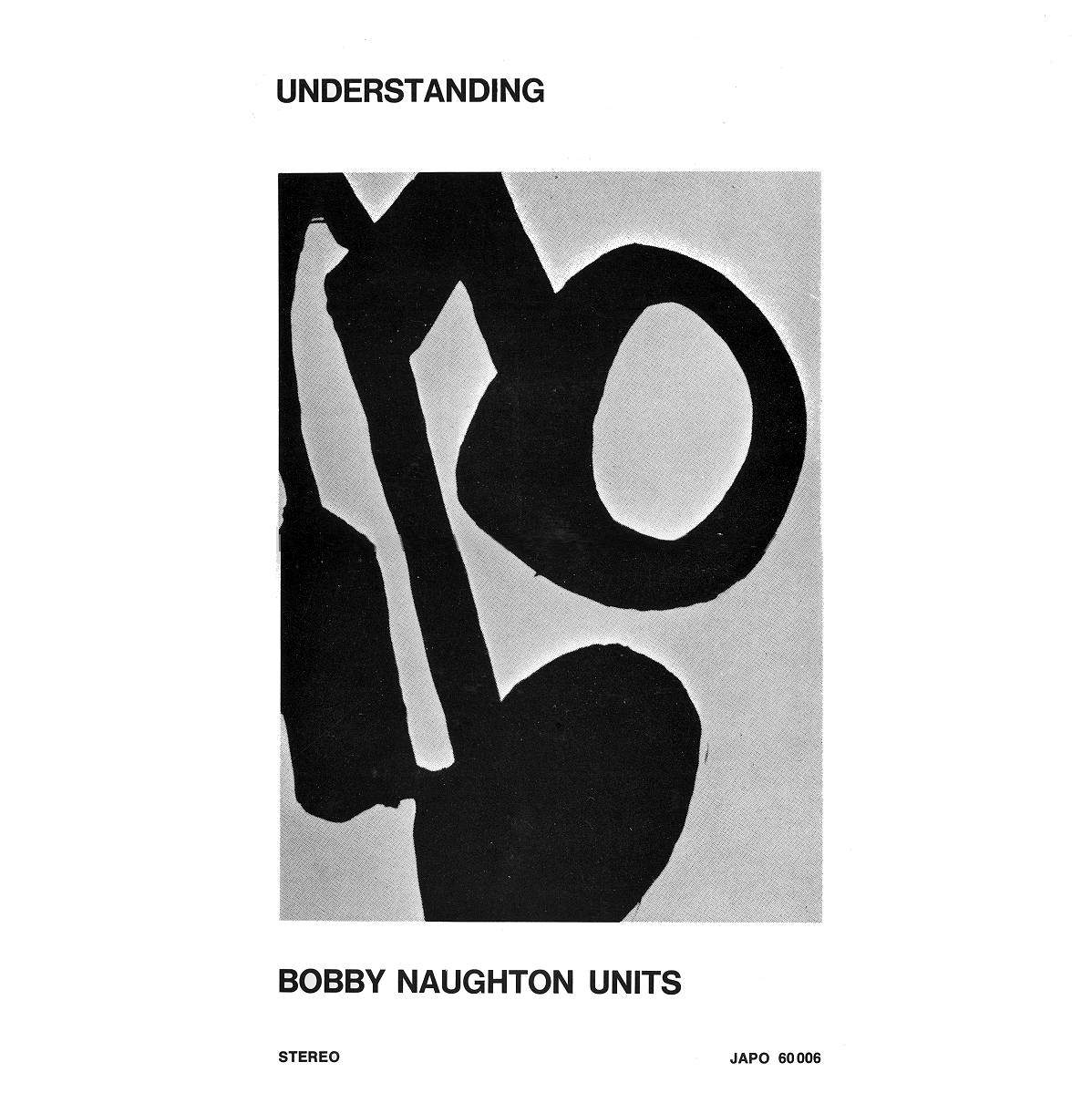
Bobby Naughton Units: Understanding (JAPO 60006)

Understanding

Bobby Naughton Units
Understanding

Perry Robinson clarinet
Mark Whitecage flute, basset born
Richard Yongstein or Mario Pavone bass
Randy Kaye or Laurence Cook percussion
Bobby Naughton vibraphone, piano, clavinet
Recorded October 30, 1971 in concert at Yale University and at Blue Rock Studio, New York
Engineer Eddie Korvin
Originally produced in USA by Otic Records, a musicians’ cooperative

Self-taught composer-performer Bobby Naughton has been playing the vibraphone professionally since 1966. From silent film scoring to a stint with the Jazz Composer’s Orchestra, not to mention a regular spot alongside Leo Smith (see 1979’s Divine Love), Naughton has since developed his craft by way of a unique, eclectic career. In 1971, Naughton and a handful of trusted musicians took a dip into the JAPO pool with Understanding. Recorded both in studio and in concert (with a slight change in roster between each), it documents a singular shuffle of original tunes and those of Carla Bley.

Bley and Naughton’s styles could hardly be more different, making their combination on this album all the more appropriate. Comparing the former’s title track with the latter’s follow-up, “Austin Who,” one finds a shift from the charcoal strokes of drummer Randy Kaye and Naughton’s own balance of melody and affect to a haunting look inward to places of delicate unrest. It is a fascinating diptych. Of the remaining Bley selections, the popular “Ictus” gets a gargling treatment, finding chaos and color in the tactile playing of clarinetist Perry Robinson. In it one can taste sunset and the excitement of evening’s promise. “Gloria” is the glistening heart of the set, a tender and questioning act of impression which, much like the opener, brushes its way into the ear, catching hair cells unawares with its jaggedness, pausing as if inhaling.

Naughton’s compositions unfurl a uniquely uplifting spread of descriptive moods. Sleigh bells, for instance, let us know that “Snow” is on the way. What ensues is not a song of winter’s dread, however, but of its thaw, each touch of percussion another clump rattling from the branches. Laurence Cook’s beautiful cymbal work in “V.A.” sparks an unusual conversation of wind and water, while for “Nital Rock” Naughton breaks out the clavinet for some electric throwback. Mark Whitecage does phenomenal things with the basset horn here, running a hundred errands at once.

This is a pot of water ever on the verge of boiling.

… . …

In an effort to better understand the context in which this album took shape, I interviewed Mr. Naughton, who kindly offered his succinct wisdom. Below is what transpired.

Tyran Grillo: Can you tell me a little about how you came to the vibraphone? Or did it come to you?
Bobby Naughton: I had been playing a lot of funky and out-of-tune pianos. The clarity of the vibraphone was appealing. And the keyboard was familiar. I went for it.

TG: As a self-taught musician, do you find that you approach performance in any way different from those with strictly formal training?
BN: I have no idea. As a child I had years of piano lessons, but am self-taught on the vibraphone. My formal education is in the liberal arts. My approach to performance? Prepare to lay it all on the line. Every time.

TG: How did Understanding come to fruition?
BN: I don’t know. Not by plan. It evolved.

TG: What was behind your decision to focus on the music of Carla Bley? Was she involved in the project in any way?
BN: No decision. Investigations led me to Carla’s compositions. Incredibly meaty and detailed stuff. No, Carla had no involvement.

TG: Looking back at your recorded output, how does Understanding fit into the sounds you have forged in, say, The Haunt or Zoar? What does the album mean for you?
BN: Each album covers quite a different area. Understanding is broader in scope and personnel. For example, the title composition is a tone row, a twelve tone piece, and “V.A.” is a graphic score.

TG: What were the circumstances that led you to work with Leo Smith?
BN: In the early 70s a JAPO employee wrote to me that Leo lived a few towns away in Connecticut. I called him and we met.

TG: Can you sketch me a picture of how the Divine Love recording session went down?
BN: A happening at the highest level.

TG: How would you describe your own compositions to those who haven’t heard them?
BN: Melodic and suggestive. Structures for improvisation.

TG: What would you say has been the most fulfilling aspect of your career thus far?
BN: Survival. It’s been musically rewarding but tempered by resources. You have to love it to do it.

Admir Shkurtaj Trio: Gestures and Zoom

Gestures and Zoom

Admir Shkurtaj Trio
Gestures and Zoom

Admir Shkurtaj accordion, piano
Giorgio Distante trumpet
Redi Hasa cello
Released 2012 by SLAM Productions

One of the benefits of my sideline as a music writer is that I receive review copies of albums by artists I might not otherwise have discovered. Through my ongoing contributions to RootsWorld online magazine especially, I have encountered a wealth of fascinating music from all walks of life. One of the most intriguing of these so far is Admir Shkurtaj, an Albanian multi-instrumentalist and composer who first came to my attention when I was asked to review his solo piano effort, Mesimér, for the selfsame magazine. Where that album might be seen as a distillation of his diverse interests, ranging from folk to the avant-garde, this from the same year attests further to his ability to interact, listen, and guide. The dynamic of Gestures and Zoom—for which Shkurtaj is joined by trumpeter Giorgio Distante and cellist Redi Hasa—is markedly different, not only for the flexibility of its means but also for its distinct methodology.

Shkurtaj elaborates on the title concept: “Gestures and Zoom is constructed from a plurality of musical gestures proposed by each of the instruments, in chaotic order. A musical ‘gesture’ means a cell or musical object. In theatrical terms, we would say that a musical gesture is a character within the scene. Each one has/is its own character, fleeting as it is. After several exposures, the ‘zoom’ factor fixes the target of a single gesture to view it more clearly, or, in more musical terms, to develop it in order to enhance its characteristics.” From this dance of physicality and visualization, Shkurtaj and his trio spin a wild photometry indeed.

Despite the delicate madness that follows it, the album’s introductory piece is duly exploratory. Shkurtaj’s tinkering pianism seems to deconstruct as much as it builds. The insightful processes therein foil the slalom course of “Disegni” and “Olmi,” which respectively showcase the tremendously expressive abilities of Distante and Hasa. “Improntrio” is another spiraling ride—the DNA helix as roller coaster—and reaches some dizzying heights of pitch, a ghostly conversation in fast-forward. Moments of deep familiarity do, however, come to the fore, most notably via Albania’s popular traditions as they materialize in “Danza” and “Victoria.” These nodes of locality stand out for their precision. Shkurtaj and Hasa, both of Albanian extraction, carry out the most delicate surgery, while Distante, who hails from Italy’s Apulia region, introduces their stark themes and from them spits out a full speech.

Gestures and Zoom balances improvisation and composition with great skill. Shkurtaj makes it obvious where one begins and the other ends, and so on until the resulting blend finds solidity in an emerging narrative. “The themes of the compositions,” he clarifies, “are structurally similar to jazz standards but have a chamber music character (I am writing for chamber ensembles in a contemporary classical environment). Improvisation is free and based on complex rhythmical frames, such as derivatives of the rhythmical cell 3 + 2/8 (Olmi – Victoria), and sometimes on particular musical gestures decided right from the start (Gestures and Zoom – Disegni).” Whether or not the listener has such vocabulary to make sense of the designs, the blend of their spinning remains clear.

What is challenging yet also enjoyable about this record is the detail of its fire. Nowhere is this clearer than in the title track. In bubbling voices and instrumental scrimshaw, an explicit liberation begins to take shape, making such programmatic gems as “Shi” all the more effective for their simplicity. Shkurtaj: “‘Shi’ in Albanian means rain. I have always listened in silence to the sound of rain. When it falls on metal surfaces it becomes even more interesting. I tried to imitate this through rhythmic counterpoint on the prepared piano.”

Shkurtaj’s is biological music that treats its motives as Petri dishes in which to culture a balance of attunement and free wandering. Between the intriguing little “Duetto” and the culminating “Conduction” the listener may feel a switch flipped at the mitochondrial level. Of this microscopic aesthetic, Shkurtaj says, “For the most part, with the possible exception here of ‘Improntrio,’ the music I write is mono-gestural. The songs are built on a single element or musical idea. This lends itself to feelings of narrow space.”

That said, there’s plenty of room to run around.