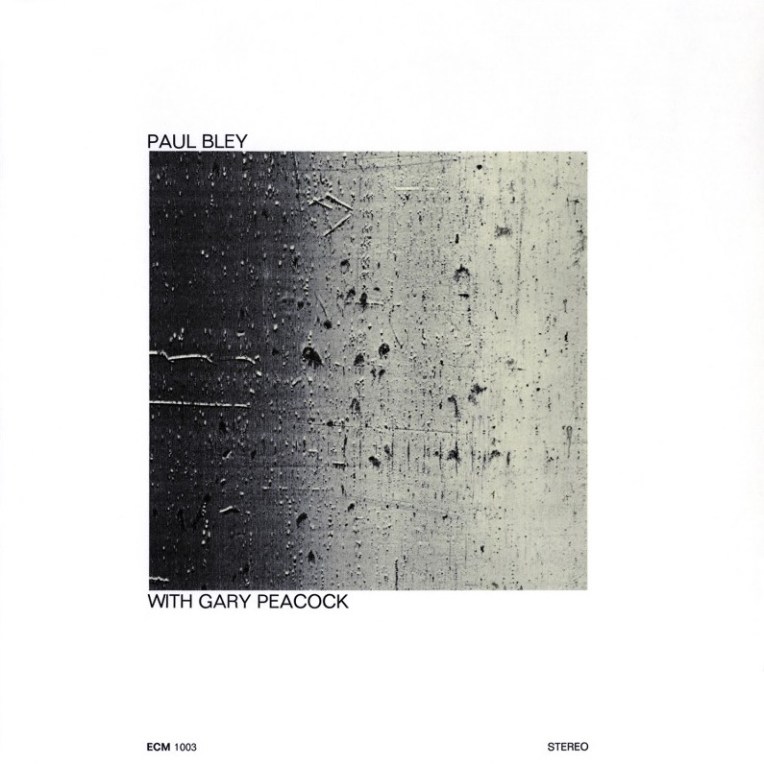
Paul Bley with Gary Peacock (ECM 1003)

1003

Paul Bley Trio
Paul Bley with Gary Peacock

Paul Bley piano
Gary Peacock bass
Paul Motian drums
Billy Elgart drums
Recorded 1964 and 1968 in New York
Produced by “ECM”
Release date: December 1, 1970

From the moment “Blues” lights the fuse, we’re rocketing through this magnificently swinging album. Pianist Paul Bley proves his comfort in Ornette Coleman territory, easing his way through a series of dexterous detours. His original “Getting Started” follows up with a ballad, its brushed drums giving off a grainy feel, desolate yet comforting. Peacock’s soloing is eager and ever so slightly askew. “When Will The Blues Leave” (Coleman) is a more syncopated affair. Brushes defer to drumsticks, adding delicate punch to the overall sound. Even Bley cannot restrain joyful cries as the mood intensifies. “Long Ago And Far Away” (Jerome Kern) moves forward with locomotive purpose and finds Peacock in an exuberant mood. “Moor” exhibits his soloing and composing, as refreshing as they are restless. “Gary” (Annette Peacock) is a lonely catharsis forged in bass and piano. The bassing here is somber, as if contemplating a jump from a high precipice. When the piano returns, it’s not to pull the bass downward but keep it from falling over. Bley’s own “Big Foot” is a rip-roaring good time. One can feel the lovingness of its creation. Finally, “Albert’s Love Theme” (Annette Peacock) presents us with a new direction as the trio goes its separate ways.

Bley is on point, Peacock hopping with vivacious confidence, as drummer Paul Motian brushes and rat-a-tat-tats his way through five of the eight cuts (the remaining three feature Billy Elgart in his place). The recording, made in 1963 (Motian session) and 1969 (Elgart session), has a classic trebly overlay yet is highly detailed. It’s a listening experience that suggests new focus every time. For this review, it’s Peacock who captures my attention. His fondness for higher registers punches holes in the music and allows the wind to flow through. Considering the time and place this album was cut, and the jigsaw of its talents, it practically recommends itself.

<< Just Music: s/t (ECM 1002)
>> Marion Brown: Afternoon Of A Georgia Faun (ECM 1004)

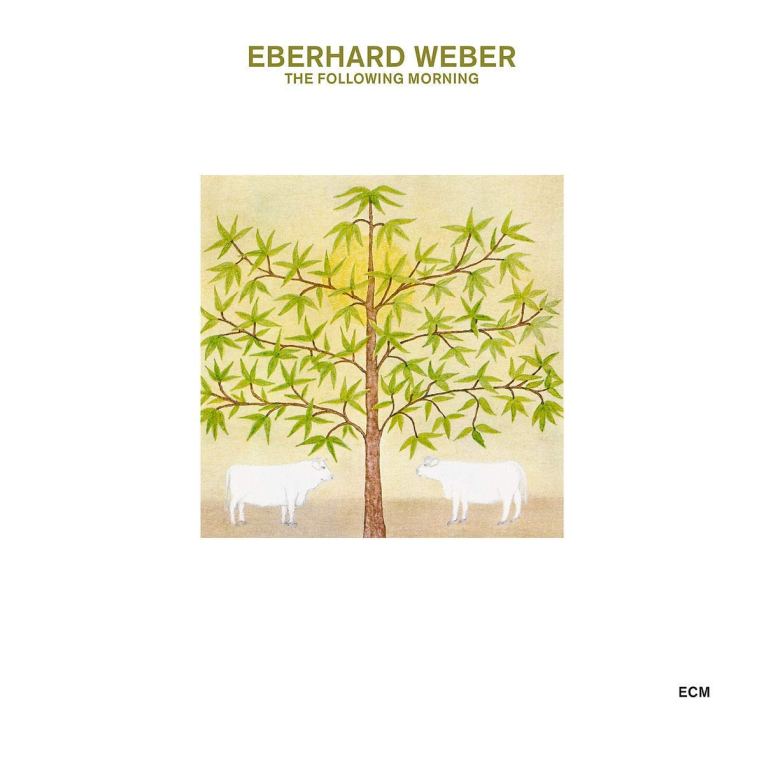
Eberhard Weber: The Following Morning (ECM 1084)

ECM 1084

Eberhard Weber
The Following Morning

Eberhard Weber bass
Rainer Brüninghaus piano
Members of Oslo Philharmonic Orchestra celli, French horns, oboe
Recorded August 1976 at Talent Studio, Oslo
Engineer: Jan Erik Kongshaug
Produced by Manfred Eicher

The title of Eberhard Weber’s classic 1977 album is as evocative as they come. At once cryptic and expository, the image calls up a host of associations, plays of light and shadow.

“T. On A White Horse” establishes the album’s solemn mood as Weber’s distinctive electrobass springs to life against an aquatic electric piano. A small orchestral section weaves its way in, painting chromatic oboe lines onto a droning canvas of cellos. As the strings intensify, bass and woodwinds share a plaintive synchronicity. The bass holds its breath, cupping its hands around Brüninghaus’s delicate flame. Oboes carry their lilting harmony across the oceans, fading into the bell-like call of sunrise.

“Moana I” feels less like a journey with a goal and more like a testing ground for confluence. The orchestra sprouts like a forest through which Weber must limp on his way toward dawn. The piano’s melodic charge, however, helps to cut this tension. Once the French horns offer their own desultory commentary, morning light pours in. The electric piano buffs the music to a crystalline sheen while horns and winds work their way back into rest. They find their beds and sleep, having reached the summit of their dreams.

The title track begins with indistinct ambient noises: people rustling in a resonant space, musicians shifting in their seats. This impressionistic cloud splits with a piano chord in reverse, loosing an electronic squall. Strings talk among themselves in the background as bowed harmonics trickle like rain down a window. The piano speaks of midnight to the bass, which emerges with a chorused effect. Weber’s keening tone touches the landscape, scratching glyphs into its fertile surface. The scene shifts and grinds, a hurdy-gurdy whispering in slow motion. The appearance of an acoustic bass in this track creates a dazzling effect, as if rising from some bygone era where the immediacy of live performance was a given and not a luxury, and where the communal experience of music thrived in the ears of every listener. The world unravels like a lullaby, revealing just enough of its heart to give us vast internal comfort. With this rupture mended the electrobass returns, laying out its motif over the pieces left behind. The acoustic bass chants the same note as a French horn plays us out.

“Moana II” puts us into an echoing flock of horns that seems to scorn the earth below. This segues into a brief passage of quiet abstractions before blossoming into a conversation between piano and bass, at which point the horns have flown away. Although the acoustic arrangements are wonderful, in this instance the heavily contrived bass feels just slightly out of place and, I think, clashes with the more organic backdrop. Thankfully, Weber reacclimatizes as he goes along, meshing beautifully with the synth effects at the album’s end.

Weber’s sound is instantly recognizable in its solitary function, marking its mission in stillness. With a liquid technique Weber wrings out as much melodic juice from his instrument as he possibly can. Not to be outdone, the epic piano stylings of Brüninghaus are the perfect foil for Weber’s decidedly intimate approach. Every time his fingers touch the keys, we begin to see where this music can really take us. Weber’s compositions constitute a vast sonic kaleidoscope in which one finds a range of moods all strung by the same nostalgic threads. Every detail is a new feather, stitched into the wings on either side of the space-bound fuselage that is his ever-expanding oeuvre. To listen to his music is to feel the state of things change from light to dark and back to light again.

<< Terje Rypdal: After The Rain (ECM 1083)
>> Keith Jarrett: The Survivors’ Suite (ECM 1085)

Fraying the Thread: Dave Holland Quintet Live Report

Dave Holland Quintet

April 18, 2010
Buckley Recital Hall @ Amherst College

Dave Holland bass
Robin Eubanks trombone
Steve Nelson vibraphone, marimba
Chris Potter alto and soprano saxophones
Nate Smith drums

As a graduate student with limited time and financial resources (a redundant statement, if ever there was one), I find that going to live shows has become all too rare a luxury. Lack of a car further constrains my options, and so I am deeply appreciative of the musical opportunities that a college community brings to the hermetic academic. Where else could I have experienced the wonders of Zakir Hussain, stumble upon a free performance of Dvořák’s New World Symphony, and bask in the sounds of the Dave Holland Quintet for less than the price of a good dinner, all within a three-week period?

The venue for the latter was a packed Buckley Recital Hall at Amherst College. And while the space didn’t seem at first particularly suited for a quintet of such explosive caliber, a few knob-turnings from the sound technician worked out the kinks soon enough. After a brief introduction, Holland and his crew took the stage. The man himself offered a quip or two to an eager audience before jumping right in.

“The Balance”
The opening bass line was pure Holland: a mixture of delicate highs and thrumming lows that set the tone with unmistakable immediacy. Through this freshly strung loom, vibes, soprano sax, and trombone strung their own vivid threads. The group began by scaling up the improvisatory ladder with practiced precision, holding fast to a tight core of unity while venturing just close enough to the edge to gauge a drop to certain doom. A trio of drums, vibes, and bass provided solid ground for the horns, with ample room to roam. This led into an artfully performed passage of more staid harmonies before Eubanks broke free, jumping nimbly through invisible hoops as he dyed this mosaic with a guttural ferocity that was as viscous as it was effervescent. Just as the tension rose, Smith brought his drumming to a halt, stopping and starting playfully, paring down the music to a variant trio. With full support from bass and drums, Nelson loosed a barrage of half notes that shimmered like a hailstorm in sunlight. The horns returned on the heels of a violent drum kick, which soon relaxed into a head-nodding interplay of rim shots and hi-hat, bringing the ensemble down for a slow and easy landing.

Next up was a tune from the latest Octet CD, Pathways. An extended and soulful bass solo lulled the crowed into an intimate silence. Holland’s fingers made the lows sing, milking the amp for all it was worth, while his highs fluttered like wings. Just then, our rapt attention was broken by a cell phone, which Holland simply smiled away as Eubanks placed a hand on his chest and mouthed, “It’s not me.” Before long, Smith picked up the beat, ushering the others into more distinctly composed material as alto sax and trombone leaped across rim shots and cymbal rides. Potter’s first major solo of the evening began tentatively, as if he were putting out his feelers before releasing a modest joy. Bass and drums kept pace like a fast-moving train. Suddenly, the mood changed, and I felt like I was in a dingy nightclub rather than an immaculately kept concert hall. Smoke billowed in the darkness with every turn of phrase. Potter let out the occasional impassioned screech, each strategically placed amid clusters of glistening notes, then moved into a series of sustained tones over a spate of superb drumming. This paved the way for a ferocious solo from Smith, who elicited nothing short of gunshots from his snare. Yet Smith also proved his finesse with a delicate splash of cymbals, to which Holland added a few lobbing glissandi, before locking into a full-fledged groove. Holland eased his way in, ushering the theme’s return, which was then picked up by Potter. The group ended with a staccato burst in triplicate.

“Souls Harbor”
Holland broke out his bow for the opening lines of this Potter number before Nelson and Eubanks began hanging a series of triads from the composer’s smooth lead. Vibes asserted themselves with a bass-like steadiness. Holland swapped bow for fingertips and plucked his way out of a fluid intro. Potter and Eubanks laid out the main theme in perfect unison. After splitting into two-part harmonies, they rejoined as a single voice against Nelson’s ostinato. Eubanks’s emergent solo was one of the evening’s most idiosyncratic, sounding like a foghorn yearning to sing its woes across the waters. As the music gathered speed and energy, laced with incredibly dexterous runs, vibes crept along the cove with their slow return. Potter’s reappearance made for some subtle harmonization before Smith cracked open a livelier beat. At this point, Potter and Holland wandered off into an abstract, but strangely lyrical duet. To this question, Smith and Nelson had an expansive answer, fraying the thread of their overall sound into its determinate strands. Potter’s sax screamed, making its voice known above the din even as it parsed itself. And before we knew it, everyone was back into thematic material, closing in solid agreement.

“Walking the Walk”
This newer composition began in a solid triangle of bass, drums, and vibes. With the entrance of the horns, we were treated to a mélange of moods before settling into an arid sound, opened even wider by Nelson’s gorgeous four-mallet stylings. This was the vibraphonist’s time to shine. With the barest shades of the opening proclamation, he tread confidently in familiar territory and receded as Holland took the cue. The shuddering high notes, resplendent vibrato, and rumbling lows of Holland’s solo filled the space with the instrument’s deepest possibilities. All the while, Smith relegated his playing to the rims. Sax and trombone once again took center stage and ended in a paroxysm of beauty.

Holland’s quiet count kicked off “Secret Garden.” Hot off Critical Mass, this tune continued the dune-laden dynamics. It was at this point that Nelson finally turned to the massive marimba at stage left, lending a certain organic flair to the overall sound. With the theme dispensed, Holland and Smith rode easy to let the light of Eubanks break from behind the clouds. Eubanks stretched his breath to its limits, occasionally singing into the trombone for a chorused effect. Smith, meanwhile, tore a page from the Joey Baron handbook and drummed with his hands. Soon, it was just Smith and Holland for the latter’s brief solo turn, singing upward as the horns and vibes reinstated the path upon which they first led us in this taxing yet scenic journey. A flickering strand of bass and marimba brought us to our destination.

Last on the menu was “Step Tunes,” another new piece that showcased the quintet at its most blistering. After a brief blast from the horns, Nelson took over with some incendiary support from Holland and Smith. The brass returned, and presaged the most stellar solo of the evening from Potter, which brought thunderous applause from the crowd. Nelson was left to pick through the aftermath and find still more to salvage. His notes ran up and down with the abandon of a child at play, letting the occasional sustained note ring through the body. The return of Eubanks and Potter was almost anticlimactic after such inspired displays of joy. After a concise drum solo, the musicians converged and, with a glance from Holland, fell back into the center.

The audience wasn’t about to leave it at that, and cheered for more. Thankfully, dessert came in the form of “Easy Did It,” a short but sweet encore dedicated to the city of New Orleans. And indeed, it was like mashing five jazz clubs from The Big Easy into one delectably harmonious confection. The quintet blossomed with a soulful theme, punctuated by a couple of low blasts from Eubanks and painted with broad strokes from Potter, whose penultimate cries on soprano signaled the winding down of the evening’s song.

In its current incarnation, the Dave Holland Quintet is an unstoppable force. Seeing them live deepened my understanding of their relationship and their process. Holland’s bass lines are like supremely fashioned entities whose entire physical makeup is as taut as the strings that tell their life stories. He smiles, eyes slightly squinted, and leans into his bass with the lilt of a conductor’s baton. Eubanks plays with closed eyes, his entire body rocking into the balance of every piece. Smith is constantly looking up, as if to let his drum kit whisper and shout of its own accord. Nelson dances left and right, navigating the broad terrain of his instrument with the deftness of a boxer. Potter’s approach is rather different, as nonchalant as it is utterly embodied. It’s as if he refuses to lock himself into any motif for too long, more interested as he is in finding out what awaits just around the corner. He is always turning and weaving through the crowd of his musical ideas, pickpocketing whatever interesting tidbits he can along the way and exhibiting them with minimal mitigation. I also enjoyed seeing how the musicians performed as a group, sometimes leaving the stage or standing off to the side when they weren’t needed, coming back at just the right moment to an unspoken signal. Their synergy was complex without being complicated.

The quintet’s compositional astuteness was also clearly evident. These were far from the concise ditties that characterize so much of what constitutes jazz in the mainstream. Rather, they were (with the sole exception of the encore) 10- to 15-minute epics of form, freedom, and style. Theirs is beautiful, heart-wrenching music that stands firmly in tradition even as it thinks over the horizon. Their sound is rich, evolved, and never content to type itself. Although Holland has, with the founding of Dare2 Records, deviated from his 34-year stint with ECM, he nevertheless carries with him that same communal spirit instilled in him through his seminal work with the label. He is always about dialogue, even when playing alone, for jazz is nothing without response.


Gateway (ECM 1061)

ECM 1061

Gateway

John Abercrombie guitar
Dave Holland bass
Jack DeJohnette drums
Recorded March 1975 at Tonstudio Bauer, Ludwigsburg
Engineer: Martin Wieland
Produced by Manfred Eicher

With this record, John Abercrombie both repaved and detoured from his staid path. He could hardly have been in finer company, and the combination seems to have fanned all sorts of flames within him. DeJohnette and Holland string an array of tightropes across which Abercrombie balances his way into previously uncharted territory.

“Back-Woods Song” evokes a mood that would come to define some of the later work of Bill Frisell. To be sure, the sound lives up to its name here as it awakens like an alligator poking its head above some swampy surface. Holland solos wonderfully here, after what some have rightly remarked to be a rather “creepy” turn from Abercrombie, ricocheting delightfully off the cymbals. This is very muddy jazz: viscous, opaque, and teeming with unseen life. “Waiting” is essentially a slow trek for bass that ushers us into “May Dance,” in which Abercrombie’s fingers frolic across the fretboard. Thus he brings a clear sense of continuity and of dynamic energy, scraping away at the surface of possibility and peering into its inner depths without fear of censure. The ensuing frenzy of activity resolves into a delicate bass solo, during which Abercrombie takes a much-needed breather. Holland cleverly mimics Abercrombie’s style, underscoring that same cluster concept of note value and melodic ascendency. “Unshielded Desire” is exactly what it claims to be. It starts with a percussive bang like the finale of a fireworks display and Abercrombie runs with all his might to capture every dying spark as it trails in the sky. The music goes around in spirals, flirting with a center it can never reach no matter how far down it goes, until it is like a compass gone haywire in the Bermuda Triangle. Next is “Jamala,” the most downtempo cut on the album. This is a moody masterpiece and a fine lead-in to the magical, epic, and incendiary “Sorcery I,” which rounds out the set.

I actually fell asleep the first three times I tried listening to this record. For whatever reason, its quirky energy seems to have had a soothing effect on me. Odd, seeing as I cannot imagine a more invigorating guitar trio. Abercrombie has such a distinctive sound and it has to do not only with the amplification and choice of instrument (or pairing thereof), but more importantly with the fragmented aesthetic he brings to his playing. Abercrombie is a “sensual” musician—that is, a musician of the senses. He seems to rattle his own bones, bringing to his improvisation a sense of detached wonder. Those looking for the laid-back Abercrombie may find this an unexpected outing. I do think it’s worth taking a chance on, however, as the freer moments herein might very well surprise and inspire. Despite a seemingly haphazard approach, Abercrombie remains tightly knit to the music’s immediacy. His is an electric sound that stays close to its acoustic roots, while Holland’s solos rise and fall, never straying from the core beat, as if strung to DeJohnette’s limbs.

It’s difficult to explain this kind of jazz to someone who has never heard it, and almost as difficult to describe it as someone hearing it for the first time. It is chameleonic music of the highest order. The wealth of possibility represented here in the art of improvisation expands the ear, the mind, and the heart of the listener, cracking the window of one’s worldview open just that much more to reveal the joys of lived experience. And maybe that’s what jazz is all about: experiencing the human spirit and the infinite ways in which it contorts itself to the tune of some intangible creativity.

<< Ralph Towner: Solstice (ECM 1060)
>> Collin Walcott: Cloud Dance (ECM 1062)

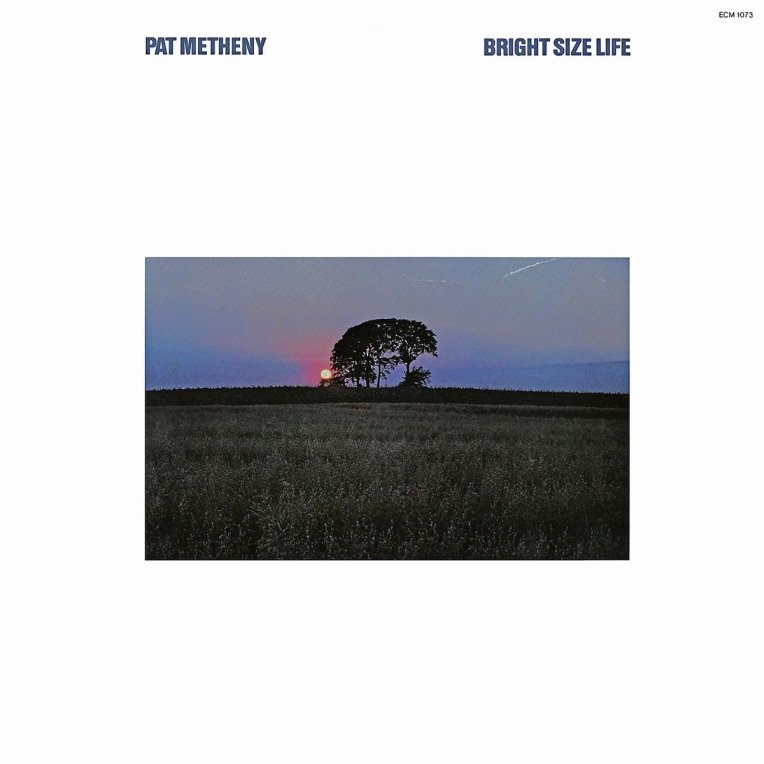
Pat Metheny: Bright Size Life (ECM 1073)

ECM 1073

Pat Metheny
Bright Size Life

Pat Metheny guitars
Jaco Pastorius bass
Bob Moses drums
Recorded December 1975, Tonstudio Bauer, Ludwigsburg
Engineer: Martin Wieland
Produced by Manfred Eicher

The tunes on Bright Size Life, Pat Metheny’s first studio album as frontman, tell a story that begins at the outskirts of Jim Hall, traverses the vast plains of the American Midwest, and ends smack dab in the middle of Ornette Coleman. From the moment fingers hit strings, we are launched into the luscious warmth that would come to characterize an ECM era. Flanked by the late Jaco Pastorius on bass and a cymbal-happy Bob Moses on drums, Metheny carries the brunt of the record’s melodic thrust. Positively overflowing with gorgeous circuitousness, organic inversions, and unwavering execution, Metheny and his sidemen make it sound as if it were harder not to produce such flawless synergy. With the obvious exception of his solo efforts, this is Metheny at his barest. And while his larger group projects tend to stray into more fusion-oriented territory, here we get a trio of musicians whose sensibilities, no less intertwined, arrange themselves into a more consistent rural flavor. There is something unmistakably outdoorsy about Bright Size Life. One can’t help but want to pop this music in the stereo during a long drive or cross-country trip, and maybe even have it in one’s ears during a hike (assuming that such digital trappings aren’t antithetical to the activity). An utter delicacy of phrasing and controlled abandon is what makes Metheny such a joy to listen to as he weaves his monochromatic web. Even during those moments in “Missouri Uncompromised” and “Omaha Celebration,” which swell into ecstatic fervor, Metheny exercises stylish restraint, as if pushing too far might break an already fine thread of articulation. Slower numbers like “Midwestern Night Dream” put Metheny in a more supportive mood, spinning a web of chords in equity with his fellow musicians. The bass adopts a more chorused presence, hopping over Metheny like a frog on lily pads. “Unquity Road,” along with the title track, foregrounds a composed doorway into an improvisatory wonderland, looking back regularly to its origins, as a child would its mother. Metheny closes out the set with “Round Trip/Broadway Blues,” an Ornette Coleman medley that seems to write its script as it goes along, until the vanishing point swallows and spits us out whole.

Bright Size Life is suitably recorded, with drums given the widest berth beneath the evenly spaced leads. Pastorius has plenty of opportunities to strut his stuff on center stage, and it is astounding to hear how he manages to thread every needle that Metheny fashions from the ether. At times, guitar and bass walk hand-in-hand, while at others one trails the other. Listening to this album is like tracing a map in sound. As followers, we may not know the next phase of our journey and can only trust that our guides will come through in the end. Metheny and company deliver above and beyond in this respect, with plenty of unexplored terrain left over to do it all over again.

Many consider the 1970s to be jazz’s deadest era. With records like this, ECM sufficiently laid that myth to rest. Listen and find out why.

<< Gary Burton Quintet: Dreams So Real (ECM 1072)
>> Jack DeJohnette’s Directions: Untitled (ECM 1074)

Keith Jarrett: Arbour Zena (ECM 1070)

1070 XKeith Jarrett
Arbour Zena

Keith Jarrett piano
Jan Garbarek soprano and tenor saxophones
Charlie Haden bass
Mladen Gutesha conductor
Recorded October 1975, Tonstudio Bauer, Ludwigsburg
Engineer: Martin Wieland
Produced by Manfred Eicher

The moment I lie in bed and begin listening to this album in my dorm room for the purposes of this review, my suitemate launches into a volatile argument with his girlfriend. As their loud verbal match breaches the gap under my door, I trace its implications across the geography of Arbour Zena. I think about the fallibility of relationships, about the trials and rewards of a musical life, and about the often contrived ways in which we attempt to validate our own experiences through the art of others.

Against a backdrop of accusations of infidelity, “Runes” blooms to quiet life with a slow orchestral tremolo. Jarrett disturbs the crystalline stillness with shafts of light and the bass falls like thick droplets as the orchestra turns to the morning sun, treading lightly upon the water so as not to disrupt its surface tension. The piano fades, leaving Haden to amble along the banks, skirting the limits of our visible world. Jarrett returns as if back from a foraging expedition, peering carefully into the scene laid before us as he unfurls a background of epic dimensions. He then pulls the orchestra in a new direction, leaving the bass to contemplate the fate of its own path. At first, we aren’t sure if the two are even connected. Perhaps they will join again, we wonder. Jarrett’s intimate piano improvisations dip their toes into waters familiar to fans of his solo work. Yet for all the music’s scope, we don’t so much travel as burrow deeper into the recesses of indecision until Garbarek’s entrance wakes us. In its own strange way, the music does resolve itself as these disparate voices achieve harmony over time. Where Luminessence was a conversation, “Runes” feels more like a narrative that jumps from one character’s head to another. It is also very difficult to picture the music, for Jarrett works in emotions here rather than in images. These aren’t simply the antagonistic ramblings of a polemicist, but rather the careful scripts of one whose relationship to determinacy is as complex as life itself, fragile as the flutter of breath over reed that ends the piece.

“Solara March” draws its plaintive curtains back to reveal an orchestra and bass. This is but the preamble to some stunning passages in which the piano touches off a lush tripping of orchestral sound while the bass seems only to meander, as if content to face an oncoming storm. As Jarrett plays a linear melody on the keyboard’s higher register, the bass continues to murmur in the background, as if unaware of its own critical potential. Garbarek injects some liveliness halfway through the “March.” With a characteristic buoyancy, Jarrett nudges us toward an opulent climax. The music finds its stride and renders worthwhile our disjointed path to getting there.

The third and final piece, entitled “Mirrors,” reflects a keening orchestral introduction, segueing into an extended meditation for piano and strings. As improviser over his own orchestral writing, Jarrett draws from the same threads and with the same colors, whereas his other improvisers mix their hues on an entirely different palette, if on the same canvas. With Jarrett leading the way, Garbarek has a much easier time fitting into the constantly shifting puzzle of the former’s evocative presence: the din of a distant flock of birds conveyed by the wind from an unseen field, or perhaps the sound of waves flitting in and out of our audible range. The lack of bass here is somehow comforting, leaving Jarrett and Garbarek to glide ever more assuredly across the album’s opaque surface. During this movement my suitemate’s girlfriend shouts, “That’s it! We’re through,” leaving behind not only a silent partner, but also emptiness in what would otherwise be a Saturday evening filled with laughter and sounds of lovemaking bleeding through these hollow walls.

This album is strangely recorded. The orchestra is given very little breathing room while Haden stands aloof, sounding as if he were recorded in a separate room and eased in later at the mixing board. In many ways, the bass is our mediator, our interpreter between languages and worlds, operating as it does a subliminal space. The music on Arbour Zena is diffuse, composed of blurry snatches of memory. There is nothing incredibly arresting about it. It doesn’t invite the listener and only barely acknowledges that it is being heard, playing not even for itself. It is like a dance missing a few steps, a garden with a trampled flowerbed and only a few unblemished specimens holding fast to their roots. It is the liberation of desire from the trappings of its own desire to be desired. Jarrett’s fellow musicians are rather well suited to this project, for to provide such continual commentary must be a challenge to even the most skilled.

Since writing this review, I am happy to report that my suitemate and his girlfriend have gotten back together, and I have taken to listening to Arbour Zena anew as an expression of hope—a musical talisman of emotional harmony in an unsympathetic world.

<< Kenny Wheeler: Gnu High (ECM 1069)
>> Tomasz Stanko: Balladyna (ECM 1071)

John Abercrombie: Timeless (ECM 1047)

Timeless

John Abercrombie
Timeless

John Abercrombie guitar
Jan Hammer organ, synthesizer, piano
Jack DeJohnette drums
Recorded June 11 & 12, 1974, Generation Sound Studios, New York
Engineers: Tony May and Jan Erik Kongshaug
Produced by Manfred Eicher

On Timeless, guitarist John Abercrombie spearheads a session with keyboardist Jan Hammer and drummer Jack DeJohnette for a melding of minds in the first degree.

The trio kicks things off in high gear with “Lungs,” a heaping pile of kindling set ablaze by Hammer’s high-octane staccato, DeJohnette’s explosive hi-hat, and Abercrombie’s unusually frenetic fretwork. A sublime energy is maintained throughout and the payoff is supremely satisfying—all the more so for its brevity, as the music suddenly changes avenues just a few minutes in. Hammer relays between organ and synth, keeping the pace (and the funk) through trailing guitar solos that send notes like cosmic fingers flicking galaxies into outer space. The organ smolders quietly in the background before clinching a new groove, which Abercrombie laces with lines flanged just right for the mix. It all ends in a game of musical jump rope, with Abercrombie skipping over the alternation of drums and organ. “Love Song” is true to its name and is the first of two exquisite conversations between piano and acoustic guitar. Just as the organ trailed long rows in the soil of our attention, the piano comes as a welcome rain for our crop and the guitar like the sun that infuses it. This brings us to “Ralph’s Piano Waltz,” a highlight of these six fine offerings. Like the album as a whole, this track is a superlative balancing act. It’s a construct so seamless that if you don’t find your foot tapping during this one, you might want to make sure it’s still attached. The electric leads speak in their respective languages, but also mimic each other along the way. “Red And Orange” is what might result if Bach had survived into the 1970s as a closeted jazz musician, and is another standout in a set of many. “Remembering” is an alluring chain of tableux and the second of the two duets. Abercrombie sustains details the piano seems content to ignore, loosening those threads from their weave. We end with the title track, which builds slowly from a synth drone peppered with guitar musings to a full-on embrace of space.

This evergreen stands tall in the ECM forest. There is no sense of competition, only mutual reveling in a distinctly nuclear sound. One could easily call it fusion, but if anything it is fused with itself, for it has created every element it seeks to combine. Timeless indeed.

<< Dave Liebman: Drum Ode (ECM 1046)
>> Paul Motian: Tribute (ECM 1048)

Keith Jarrett: Luminessence (ECM 1049)

ECM 1049 CD

Keith Jarrett
Luminessence

Jan Garbarek tenor and soprano saxophones
Strings of Radio Symphony Orchestra Stuttgart
Mladen Gutesha conductor
Recorded April 29 and 30, 1974 at Tonstudio Bauer, Ludwigsburg
Engineers: Kurt Rapp and Martin Wieland
Produced by Manfred Eicher

Having come to know Keith Jarrett primarily through his astounding improvisatory skills and classical interpretations, this recording marks my first time encountering him as composer proper. On the one hand, I feel as if setting Jarrett down on paper somehow limits his potential (note, for instance, his understandably longtime reluctance to publish a score version of the lauded Köln concert). On the other, Jan Garbarek is given such free reign of the icy territory into which he is deployed on this recording that he is able to channel Jarrett’s essence to its fullest. It’s difficult to imagine Jarrett’s music being any other way.

Any work for soloist and orchestra may be likened to a conversation in which the former introduces topics for the latter to work through “verbally.” At some point this dialectical relationship begins to take on a life of its own in the recording process. Yet in listening to Jarrett’s compositions one gets not conversation but conversion, a real-time transfiguration through which music implodes rather than expands. Garbarek doesn’t engage with the orchestra so much as traverse it, lifting and dropping his weighted feet across its rosin-dusted expanse. If there is dialogue to be found here, it’s entirely internal.

“Numinor” eases its way into the listener’s field of vision, across which Garbarek uses mournful reedwork to draw a series of jagged constellations. The orchestra sometimes bleeds, as if it were a cloth sheared by the edge of these gritty ruminations. Garbarek shouts with his instrument, treating it more as an extension of his voice by which the placement of his fingers articulates syllables in lieu of notes. Although we might not recognize the language, something intelligible comes through. In spite of some inspired solo passages, the music remains decidedly horizontal: every step forward is countered by one step sideways. There is, however, an incredibly moving scene in the final passage of “Windsong” where the saxophone blends into its surroundings, sharing an intimate moment of continuity made all the sweeter for its unexpected cessation. The title track, which closes the disc, is playful and romantic, slaloming its way through triadic signposts. The mood is contradictory, Garbarek engaged in two entirely different dialogues in a semblance of one.

Overall, I find Luminessence to be a challenging listen. Not because the music is particularly modernist, but because Jarrett makes so visible the often hidden dynamics of authorship we come to take for granted. As one who is continually enlarging the notion of musicality in everything he touches, Jarrett provides us here with an unabashed document of the compositional process. It is the audible equivalent of looking at the master’s sketchbook. I also find this album to be quite dark in spite of its glowing title, like a hidden shadow beneath the unturned page. It is an album that erases as many words as it inscribes, a memoir of images rather than prose. All of this makes for an effective, if threadbare, project. There are very few motives to speak of, which is liberating, as one is never subjected to the often-dominant reprise, nor to the subservience of secondary themes. Notes are sustained in ways they couldn’t have been sustained before, ending as abruptly as they began. This process is illustrative of the title’s clever play on words, a symbiosis of color and opaque desire.

<< Paul Motian: Tribute (ECM 1048)
>> Keith Jarrett: Belonging (ECM 1050)

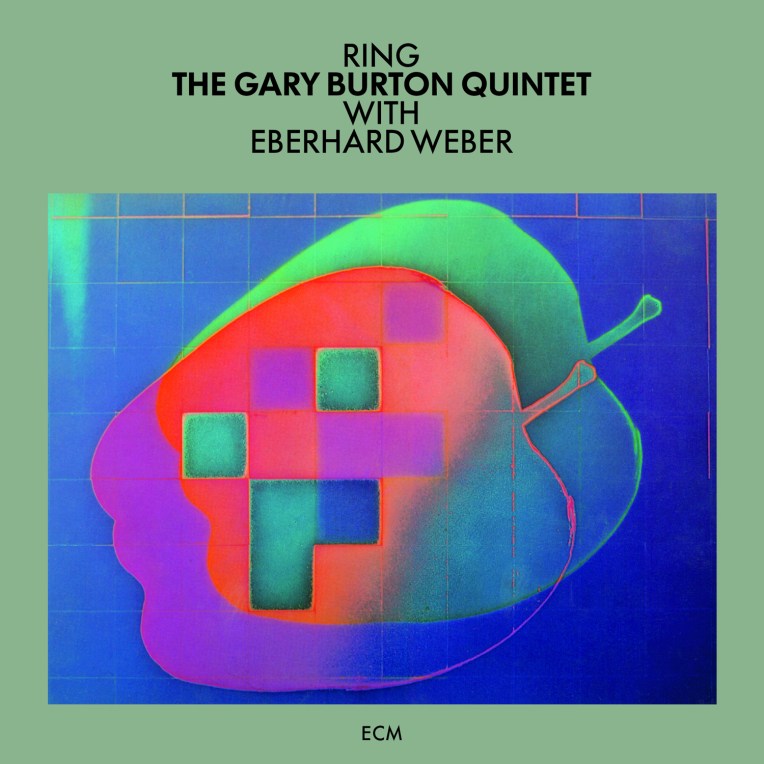
The Gary Burton Quintet with Eberhard Weber: Ring (ECM 1051)

1051 X

Gary Burton Quintet
with Eberhard Weber
Ring

Gary Burton vibraharp
Mick Goodrick guitar
Pat Metheny guitars
Steve Swallow bass guitar
Bob Moses percussion
Eberhard Weber bass
Recorded July 23 and 24, 1974 at Tonstudio Bauer, Ludwigsburg
Engineer: Martin Wieland
Produced by Manfred Eicher

Before I get into this review, I’d like to take a moment to share my process:

As a busy grad student, listening to music for pleasure has become an increasingly difficult luxury to sustain with any regularity. In addition to my undying adoration for ECM, one major part of my motivation for starting this blog was a desire to reinvigorate my listening life. To that end, I have taken to giving one album per night my undivided attention as I go to sleep. I keep a digital voice recorder by my bed and speak whatever impressions come to mind. I then transcribe these comments the following morning and pare them down to something coherent. Any of my regular readers will notice that my review production has slowed down as of late. This is due to the fact that I have been preparing for my M.A. thesis defense and am heavily sleep-deprived as a result. Even so, I have attempted to listen when I can and continue with my audio review logs. Due to the aforementioned sleep deprivation, however, fatigue has begun to take its toll on my cognizance. This became especially apparent as I was recording my review for Ring. It began benignly enough with my usual laudatory ramblings, but as I sat down the following morning to transcribe, I realized that I had almost no recollection of the second half of what I had said, having uttered it in a stupor of half-sleep. I have since removed the odder bits, but would like to share a few verbatim examples for your (and my) amusement:

One almost feels or gets the sense of joy, for in that concept of joy there are also children…. There are clouds and unwashed apples and trees floating in the sky…. Next year it will be different, somehow pleased by the authorities while people such as I will be behind bars…

Whether or not these comments impart any deep insight into the music at hand might very well be arbitrary. Still, I cannot imagine having said such things without some sort of provocation. This experience makes me question what kind of background noise I must be filtering out before coming up with anything at all intelligible. Thank you for indulging this tangent and, for what it’s worth, here’s my highly filtered version:

Gary Burton is in a class all his own. On the vibraharp he is pliant yet unbreakable with a certain flair for the understatedly powerful. Among the present company, he is perfectly at ease. No one tries to overpower him, and despite his melodic dominance he never looms for too long, receding into as many shadows as he casts. There’s not a single pretentious note to be heard; the flow between and within tracks barters its way across smooth waters. This is a nocturnal album all the way.

In the opening “Mevlevia,” flanged guitar provides a yielding current of sound upon which Burton and Weber are able to lie back and drift. “Unfinished Sympathy” is more than just a clever play on words, but is also a gorgeous vehicle for Goodrick’s rolling solos. Its structure is built around a recurring guitar motif, which indeed feels unfinished as it circles around a flower it can never pollinate. It is a short and sweet diversion into a vaguely grasped thought. “Tunnel Of Love” is a languid journey toward something that is apprently fated but which is actually uncertain. A warm bass solo arises from the murky surface that surrounds us, threading our path with its own braided thread. A lilting guitar in the background plucks steady notes from the air, balancing them atop slowly rolling spheres. “Intrude” begins with a drum solo that flitters like a dragonfly skirting the edge of its known domain. A certain jouissance works its way from the outside in before petering out into the last few drops of cymbal, at which point the ensemble kicks in with a six-stringed groove tugged along by bass and the now recumbent drums. The delicacy from before is implicitly maintained, even as the static builds in charge, at last defused by a premature spark. “Silent Spring” feels like the most composed piece in this set, and in that sense it refuses to take its own simple pleasures for granted. The bass flickers its way into recognition like a blown-out candle in reverse, telling what it knows to be untrue, a musical fabrication in disguise. “The Colors of Chloë” produces another superb bass solo in the midst of a first-rate groove, which seems to climb up and down stairs before settling on the black and the white of its own private chessboard.

In short: listen to this album and love it.

<< Keith Jarrett: Belonging (ECM 1050)
>> Steve Kuhn: Trance (ECM 1052)