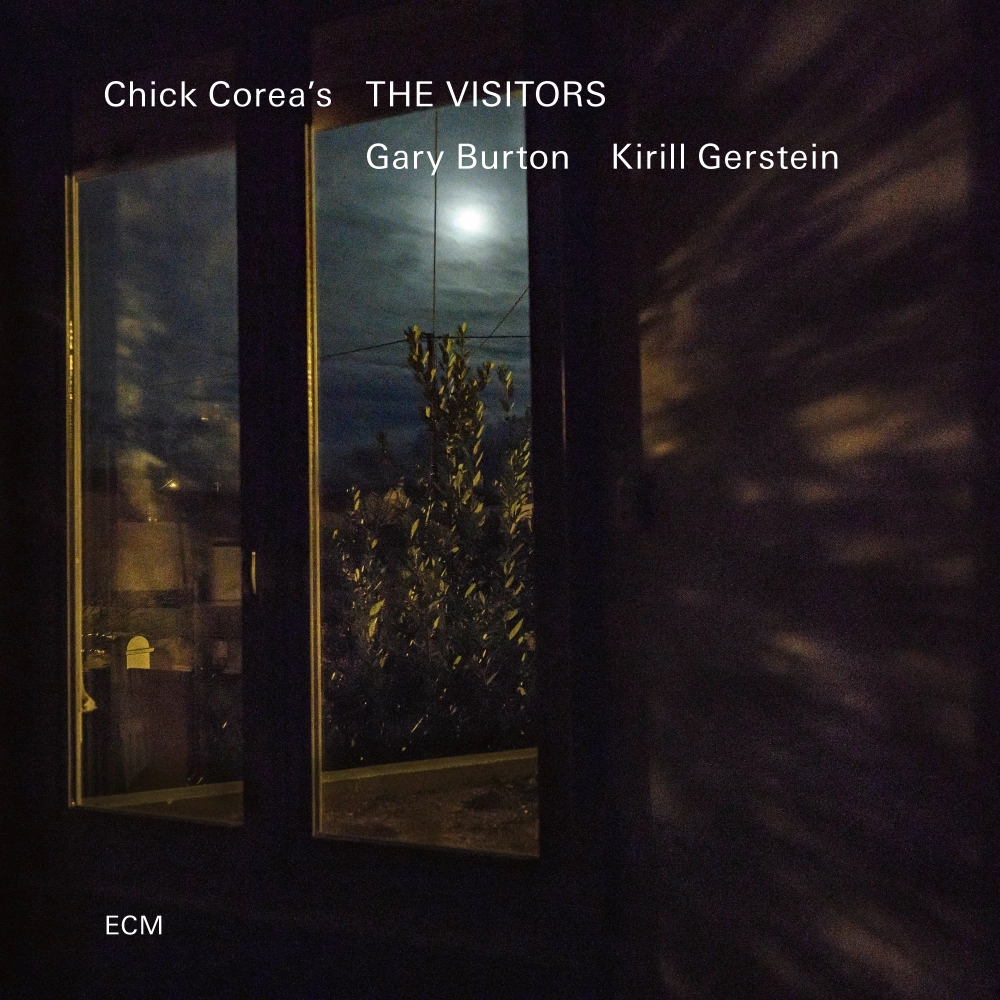
Gary Burton/Kirill Gerstein: The Visitors (ECM 2853)

Gary Burton
Kirill Gerstein
The Visitors

Kirill Gerstein piano
Gary Burton vibraphone
Recorded May 2012 at Chenery Auditorium, Kalamazoo
Release date: June 12, 2025

Vibraphonist Gary Burton first met pianist Kirill Gerstein in Saint Petersburg, Russia, in the early 1990s and almost immediately recognized his talent. So began a logistical saga that culminated two years later in brokering passage for Gerstein and his mother to come to America, where the young prodigy enrolled as a 14-year-old at Berklee College of Music under Burton’s mentorship. Although Gerstein has since pursued a career in his first love of classical music, he has worked increasingly with improvisers such as Brad Mehldau and, in the present recording, none other than Burton himself. After winning the prestigious Gilmore Artist Award in 2010, Gerstein used his prize money to commission a series of pieces and immediately thought of Chick Corea. Gerstein proposed that Corea write a piece for him and Burton that combined both through-composed and partially improvised sections. The result was “The Visitors,” a 12-minute masterpiece that premiered at the 2012 Gilmore International Piano Festival. This recording was their second live performance of it and had only been made known to the musicians recently. Now, we have it released via ECM as a digital-only single.

Grounded in a Latin ostinato in 7/4 with a “looping groove” as Gerstein calls it, it gives organic flight to the musicians’ most uplifting impulses. As Burton makes his entrance, the duo aligns in staccato gestures before giving way to fluid diversions. The transition between what’s on and off the page is seamless, giving way to a beautiful modalism that transcends genre and time. Hearing Burton, now retired, in a relatively new recording is a joy in itself, and one can feel his history with Gerstein in their dialogue. The pianist’s solo turns are as playful as they are on point, never wavering from the dream of what the instrument can achieve when cut from the ties of expectation. His abilities are more than apparent and lend themselves to ecstatic interpretations. Burton’s occasional stretches of pedal mesh with Gerstein’s stippled approach perfectly, allowing the breath of life to animate their music making. The pianist’s rare acuity in both classical and jazz gives him the credibility to channel Corea, whose own history with Burton is also palpably evident. What a gift to behold in these times of darkness, a lighthouse for our wayward seafaring souls.

The Visitors is available for streaming and download here.

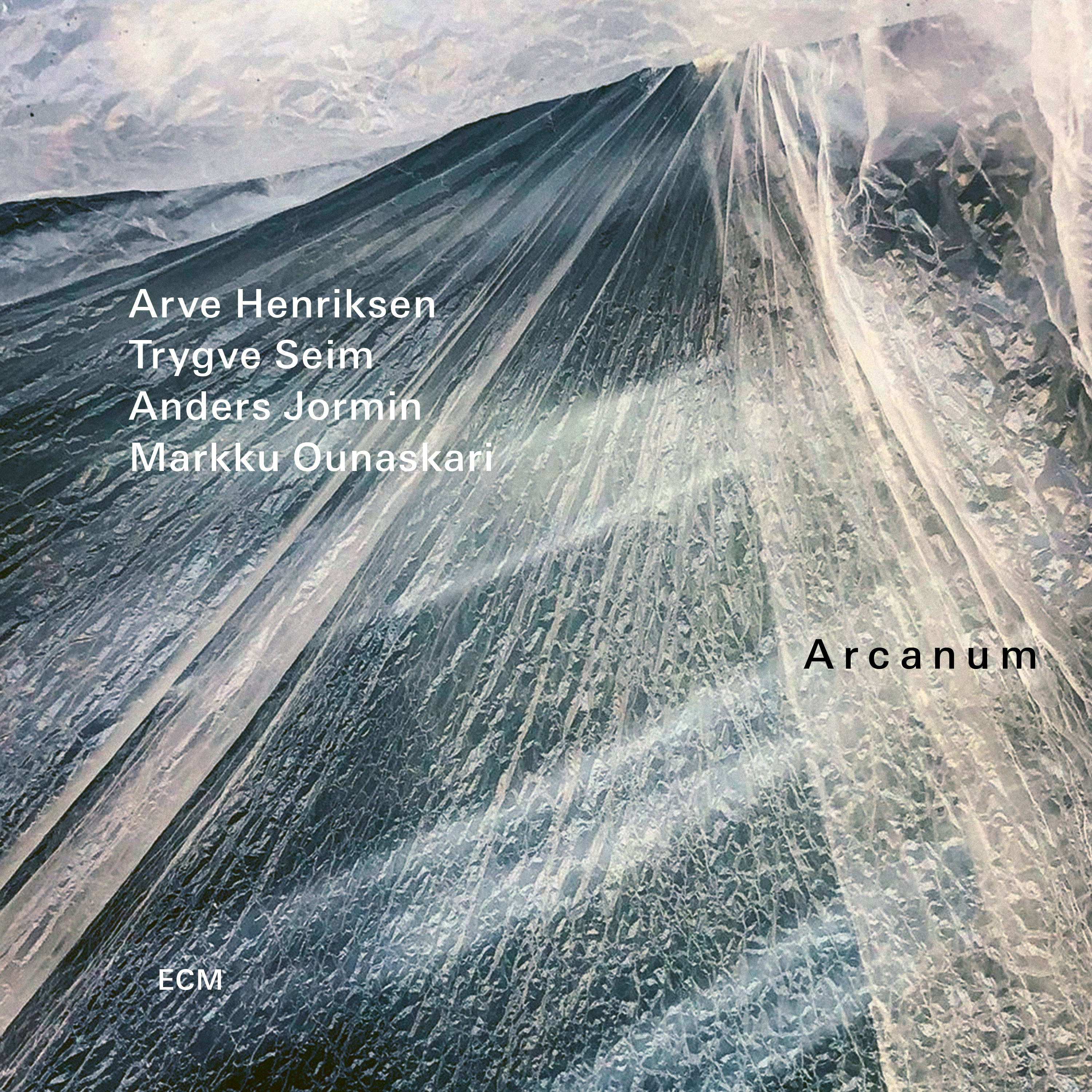
Henriksen/Seim/Jormin/Ounaskari: Arcanum (ECM 2795)

Arve Henriksen
Trygve Seim
Anders Jormin
Markku Ounaskari
Arcanum

Arve Henriksen trumpet, electronics
Trygve Seim soprano and tenor saxophones
Anders Jormin double bass
Markku Ounaskari drums, percussion
Recorded March 2023 at The Village Recording, Copenhagen
Engineer: Thomas Vang
Recording supervision: Guido Gorna
Mixed January 2025 by Manfred Eicher and Michael Hinreiner (engineer) at Bavaria Studios, Munich
Cover photo: Hubert Klotzek
Produced by Manfred Eicher
Release date: May 2, 2025

Arcanum brings together trumpeter Arve Henriksen, saxophonist Trygve Seim, bassist Anders Jormin, and drummer Markku Ounaskari. It is the first album for these longtime associates and ECM luminaries as a standalone quartet, following their previous collaborations with folk singer and kantele virtuoso Sinikka Langeland on StarflowersThe Land That Is Not, and The Magical Forest. In their element here, they look through a prism of shared influences toward something greater than their sum.

Seim’s opening tune, “Nokitpyrt,” is a nod to the greats of Scandinavian jazz (the title is Triptykon backwards, referencing Jan Garbarek’s 1972 watershed recording). It staggers its way forward, but never in doubt of where its feet will land. The horns converse soulfully, as they also do in “Trofast,” Seim’s other contribution to the set. Jormin offers two of his own in the form of “Koto,” a familiar gem that takes on new light through the glorious expanse of Seim’s tenor, and “Elegy,” written with these bandmates in mind on the first day of the war in Ukraine. That the musicians manage to elicit such a wealth of energy in such quietude is nothing short of astonishing. Jormin’s loving arrangement of the Ornette Coleman classic “What Reason Could I Give” and a take on the Kven/Finnish traditional “Armon Lapset” complete the predetermined material. The latter’s bipolar approach, by turns subdued and unbound, allows the band to free-wheel its way into uncharted waters.

And in fact, the lion’s share of the session consists entirely of spontaneous music making. First among these is “Blib A,” a brief yet evocative palate cleanser for the ears that comes second in the set list and once again proves the brilliance of Manfred Eicher in his placement and ordering of tracks into a narrative we can feel. Many of these pieces, such as the softly sunlit “Morning Meditation” and the memory-laden “Shadow Tail,” are almost as brief. Yet what truly impresses in these freely improvised wonders is their subtle and tasteful incorporation of electronics, courtesy of Henriksen. The musicians leverage this extra color to great effect as a bed for soulful sopranism and kindred trumpet (“Lost in Vanløse”), temperance for cymbal scraping (“Polvere Uno”), and tidal pull for distance tenoring (“Fata Morgana”). At any given moment, they are a source of deep comfort and hope.

Ironically, “Folkesong,” despite being ad-libbed, comes across as the most structured and traditional tune by comparison. Ounaskari’s tender brushes add a subtle undercarriage for this train ride, while Seim’s lilting sopranism gives way to Henriksen’s electronically enhanced calls. But even the most flowing tracks, like “Old Dreams” (another ECM reference, perhaps?) and “Pharao” (a highlight for its mind-melded horns), articulate with eye-through-the-needle precision. And in “La Fontaine,” with its late-night streets and evocations of urban solitude, we find ourselves at last coming home, different from when we first stepped out the door.

Arcanum is an experience of new directions born to longstanding impulses that says only what it needs to say—nothing more, nothing less.

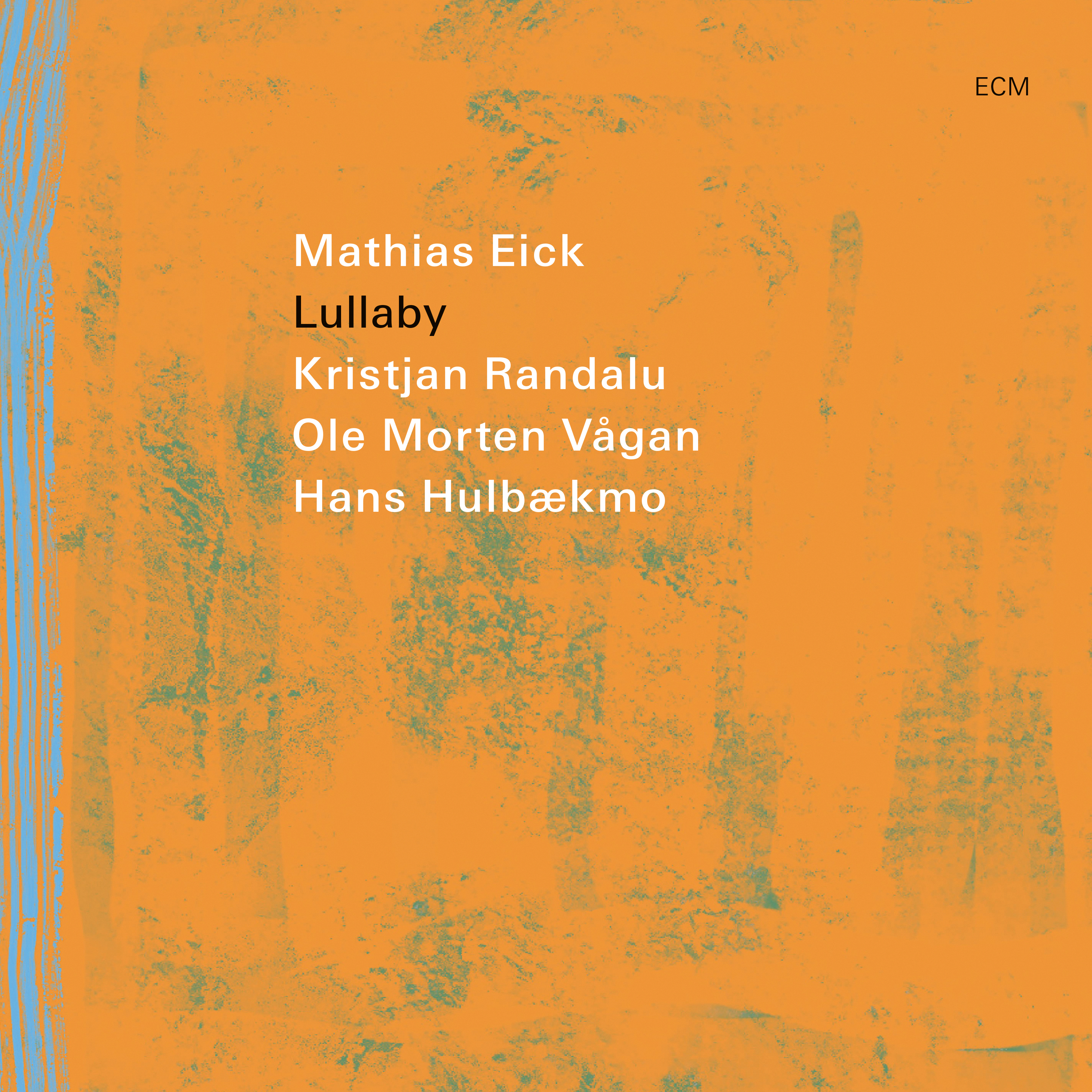
Mathias Eick: Lullaby (ECM 2825)

Mathias Eick
Lullaby

Mathias Eick trumpet, voice, keyboard
Kristjan Randalu piano
Ole Morten Vågan double bass
Hans Hulbækmo drums
Recorded January 2024 at Rainbow Studio, Oslo
Engineer: Martin Abrahamsen
Cover: Fidel Sclavo
Executive producer: Manfred Eicher
Release date: February 14, 2025

On Lullaby, Mathias Eick returns to ECM with a fresh quartet exploring eight originals. In addition to broadening his wingspan, the album marks a culmination of his creative evolution (if not also his evolutionary creativity). The trumpeter intensifies his aesthetic even as he opens it to new possibilities of freedom and expression. I can only analogize his relationship to his compositions to that of a father and his children, watching them grow and come into their own, even while knowing a part of him will always reside in their DNA.

Among his bandmates this time around, ECM listeners will be familiar with pianist Kristjan Randalu and bassist Ole Morten Vågan, while drummer Hans Hulbækmo is a newcomer to the label. It is, in fact, the latter whose presence is most deeply felt from the album’s first moments. His delicate establishment of “September” lays an open-bordered groove before Morten Vågan and Randalu make their introductions, pouring out grace from evocative pitchers of thought. Eick’s trumpet joins waveringly yet surely, never doubting its message and trusting in a higher power to give him a voice within and without his primary instrument.

The title track is the most inward-looking of the set. It serves as an especially suitable vehicle for Randalu, who builds on a tragic theme with selfless contemplation, giving Eick more than enough room to cushion the traumas of global politics (having been written in response to the violence in Israel and Gaza). Next is “Partisan,” a mid-tempo wonder grounded in Morten Vågan’s bassing, which shapes every turn of phrase as if it were the first. There is something vividly sunlit about the band’s sound, as emphasized by Eick’s falsetto vocals, which add such warmth of character (as they also do on “Free”). “My Love” is dedicated to the trumpeter’s wife, swelling from a pianistic intro into an overwhelmingly joyful ride. Randalu unpacks every vow as a memory in the making. Eick’s own soloing lends depth and breadth, examining the self and bowing in humility to having known such happiness in a world filled with suffering.

“May” offers one of the strongest melodies of the album, jumping into the swimming pool of the heart and doing a full breast stroke for nearly five minutes. Randalu’s harmonizations are affectionately articulated and give the tune just the uplift it needs to separate from its shadow. Meanwhile, the underlying pulse from Hulbækmo is bold yet never overbearing. “Hope” is another star turn for Randalu, who genuinely feels like he has always been a part of the Eick orbit despite being a new collaborator. A quiet tenderness gives the pianist a wide canvas on which to paint, while Hulbækmo adds light and shadow only where needed.

The gravelly beginning of “Vejle” opens into some darker strains, even as dawn beckons. A bright groove ensues, sending Randalu on a sojourner’s mission in which the sacred and the profane align. Eick’s soloing is at its freest here and shows just how unbound he has become in his playing.

While all the qualities that listeners have come to expect from the bandleader—the unabashed cinematic qualities and flowing atmospheres—are all present, it’s as if the camera has zoomed in a bit more on Lullaby. We get more close-ups than panning shots. At first blush, it almost sounds like a Manu Katché record, and likely gives itself nakedly to the blush of our interpretation. But as the distinctive qualities of its interplay become clear, we bear witness to a collective voice unlike any other. The result is a watershed moment for all concerned.

This, along with Dino Saluzzi’s El Viejo Caminante, is an easy contender for the top release of 2025.

Joe Lovano: Homage (ECM 2845)

Joe Lovano
Homage

Joe Lovano tenor saxophone, tarogato, gongs
Marcin Wasilewski piano
Slawomir Kurkiewicz double bass
Michal Miskiewicz drums
Recorded November 2023
Van Gelder Studio, New Jersey
Engineers: Maureen Sickler and Don Sickler (assistant)
Mixed by Manfred Eicher and Michael Hinreiner (engineer)
Bavaria Musikstudios, Munich, October 2024
Cover: Fidel Sclavo
Album produced by Manfred Eicher
Release date: April 25, 2025

Saxophonist Joe Lovano’s collaboration with pianist Marcin Wasilewski, bassist Slawomir Kurkiewicz, and drummer Michal Miskiewicz has evolved remarkably since the release of Arctic Riff and En attendant. While the quartet was knee-deep in its Village Vanguard residency during the fall of 2023, they stepped into New Jersey’s Van Gelder Studio to record this album, riding the wave of their live performances. Those who may have questioned the quartet’s intentions the first two times around may just find themselves now humbled. The third time is indeed the charm and proof positive that self-examination is a vital part of what makes this such a human endeavor.

“Paying Homage, Giving Thanks, Projections and Reflections is a way of life for me,” writes Lovano in his liner note, and, perhaps more than ever, we can feel the visceral charge behind that philosophy, which guides his horn throughout six substantial tunes. Of those, only the opener, “Love In The Garden” by Zbigniew Seifert, bears the name of another composer. Not only is it a beautiful welcome, with pitch-perfect trio work and Lovano’s plasticity, but it also proves that where there’s smoke, there need not necessarily be fire. Lovano’s “Golden Horn” follows with 10 minutes of quasi-spiritual sound paths. In addition to tenor, he dialogues on percussion with Miskiewicz and later switches to the tarogato as the rhythms intensify. Such costume changes are playful and thoroughly enjoyable to encounter.

The title track pays tribute where it is due: “The piece is dedicated to Manfred and the label’s history,” Lovano says. “I grew up listening to ECM recordings, because those were the cats that I wanted to play with, and it turned out to be the music that gave me a lot of direction.” It’s also a testament to the label’s progression from free jazz to modern cool and everything in between, never wavering from a certain underlying ethos.

“This Side – Catville” is a veritable sound collage. Like a train running instead of rolling, it forgoes the tracks laid before it in favor of pushing its way through trees, over rivers, and around mountains in search of its own mode of being. Lovano is unbound, as is Wasilewski, who takes inspiration from the wake and stirs it into a fresh concoction over Kurkiewicz’s distinct bedrock. This 12-minute juggernaut is hugged by two brief improvisations from Lovano that are exploratory and never forced, showing that he is always in deference to the unknown.

I know not everyone has been keen on this project, but if anything, Homage proves that the worth of jazz isn’t always determined by its creature comforts. Rather, it depends on whether the listener feels acknowledged. And in that respect, we are invited with open arms and open hearts to sit, stay awhile, and nourish ourselves on music that fills more than the ears—it fills the belly as well.

Fred Hersch: The Surrounding Green (ECM 2836)

Fred Hersch
The Surrounding Green

Fred Hersch piano
Drew Gress double bass
Joey Baron drums
Recorded May 2024
Auditorio Stelio Molo RSI, Lugano
Engineer: Stefano Amerio
Cover: Andreas Kocks
Produced by Manfred Eicher
Release date: June 27, 2025

Pianist Fred Hersch’s ECM journey, brief as it has been so far, already feels like a lifetime in its emotional scope. Beginning in duet with legendary trumpeter Enrico Rava, followed by a solo album, he now returns to Lugano’s Auditorio Stelio Molo RSI for a trio session with bassist Drew Gress and drummer Joey Baron. Despite having played with either musician in various contexts for decades, this is their first studio album as a trio, and the result has all the makings of a classic—not by mere virtue of its talented assembly (which is reason enough to rejoice) but also for the easy confidence of its touch.

Hersch contributes three tunes to the proceedings, of which “Plainsong” is our port of entry. Its introductory lines are so nostalgic, you’d be forgiven for thinking you grew up with them. As the variegated spectrum of autumn gives way to winter, Hersch rides a slow-motion wave in search of warmer shelter, which he finds in the title track. The breadth of Hersch’s melodic sensibilities is breathtaking here, hinting at faraway places while remaining intimate. And in the Latin-tinged beauty of “Anticipation,” the piano dances in midair without a worry to weigh it down.

That Hersch’s writing holds its own alongside “Law Years” is a wonder in and of itself. Ornette Coleman’s untanglings contrast with the measured melancholy of the bandleader with an even freer charge. In addition to the geometrically astute interplay from Gress and Baron, what impresses is the amount of space Hersch folds into his soloing, which, despite being a mighty stream of consciousness, allows for plenty of pauses, breaths, and exploratory surprises.

“First Song” by Charlie Haden feels like an inevitable choice. It opens with a solo from Gress, melting into Hersch’s lines like butter before Baron’s brushes baste that flavor in one stroke at a time. Egberto Gismonti’s “Palhaço” is another, and one that ECM aficionados will recognize from the Magico trio sessions and a smattering of Carmo recordings. Its childlike whimsy speaks through rainlike washes of chords from the keys. But it is in the Gershwin brothers’ “Embraceable You” that the band finds the biggest depths to plumb. With a light touch but deep roots, Hersch unlocks a powerful energy that one must fight to escape.

One thing that distinguishes Hersch in the world of jazz piano is his way with endings. Having the destination written in his heart, he is that rare magician who, even after telling us how the trick is done, still leaves us astonished.

Jon Balke: Skrifum (ECM 2839)

Jon Balke
Skrifum

Jon Balke piano, Spektrafon
Recorded November 2023
The Village Recording, Copenhagen
Engineer: Thomas Vang
Mixed by Sven Andréen and Job Balke
at Klokkereint Studios in Gjøvik
Cover: Jan Groth, Sign I (1973-74)
Produced by Manfred Eicher and Jon Balke
Release date: February 28, 2025

Although billed as the latest solo recording from pianist Jon Balke, the instrument here doubles as its own accompanist by virtue of the “Spektrafon.” Created by Balke in collaboration with music technology professor Anders Tveit at the Norwegian Academy of Music, this new tool captures ambient sounds in real time as the performer draws out chords of harmonic material via a tablet interface. “In a way,” Balke notes, “the player enters into a dialogue with a live active reverberation to the piano sound – a dialogue with oneself.” The result is his most meditative offering to date.

On Skrifum (“handwriting” in Icelandic), what we encounter is a series of mostly monophonic miniatures that frees his other hand to manipulate the effect of his keystrokes accordingly. Thus, Balke writes the music into being with that most ancient of gestural impulses to leave a record of one’s existence, only instead of cave walls and pyramids, he chooses the multiverse as his canvas. Pulling on the thread of Warp (2016) and Discourses (2020), both electro-acoustic explorations of the keyboard, he continues to unravel new metaphysical possibilities from wood, felt, and string.

“Calligraphic” and “Tegaki” (another word for handwriting, this from the Japanese) reiterate the theme as much in name as in execution, tapping the shadows cast by the primitive utterances we make. But it is in “Traces” where we are welcomed into the inner sanctum of the Spektrafon, which speaks as if it were only being spoken to. It is not an echo chamber but echo incarnate, self-sustaining and sentient. As the ink moves into “Lines” and “Streaks,” origins reveal themselves more clearly, emerging as afterglows of implied chords. If the piano is the soil, these are the crops it yields in digital harvest. All of which reminds us that contemplative gestures always leave their remnants, each with a life of its own. Such are the often-unrendered impulses of performance.

“Sparks” and “Strand” communicate in sporadic bursts, breaching realms out of which we are normally locked. From the finger-dampened strings of “Rifts” and the unsettled foundations of the title track to the almost-forbidden secrets of “Stripes,” there are more than enough articulations to spin a narrative that feels like our own. When Balke plays with two hands (as in “Ductus” and “Kitabat”), memories we never experienced start to become normal.

We often talk about improvisation coming from the ether. Skrifum makes that notion duly real. The pianism itself is of the past, as if played by the most conscientious children in an attic with no audience but themselves. Their explorations give way to unbridled dreams that manifest in the waking world, extending their tendrils to whoever will grab them.

Yuval Cohen Quartet: Winter Poems (ECM 2818)

Yuval Cohen Quartet
Winter Poems

Yuval Cohen soprano saxophone, melodica
Tom Oren piano
Alon Near double bass
Alon Benjamini drums
Recorded September 2023
Studios La Buissonne
Engineer: Gérard de Haro
Mixed April 2024
by Manfred Eicher and Gérard de Haro
Cover: Fidel Sclavo
Produced by Manfred Eicher
Release date: February 14, 2025

Yuval Cohen, brother of ECM veteran Avishai Cohen, makes his debut for the label with Winter Poems. Over the course of eight originals, he elicits a flowing and unsettled realm with pianist Tom Oren, bassist Alon Near, and drummer Alon Benjamini. As the opening “First Meditation” indicates, the quartet’s interplay is one of loosely sewn borders, of bonds just strong enough to offer a sense of cohesion while allowing for expressive individuality in the afterglow of stated themes.

The soprano saxophonist attributes his clean tone and sense of attunement to his classical training. In tracks like “The Dance of the Nightingale” and “Avia,” each the emotional opposite of the other, he showcases the breadth of his technical precision in creating blossoming narratives with minimal means. But where the former tune’s smoky balladry and the latter’s childlike exuberance seem worlds apart on paper, in execution, they share that special form of veracity that only freedom within constraints allows.

The title track is anchored by a river’s current of an arpeggio in the piano. At the same time, the bass and cymbals provide an all-encompassing mesh through which the air of Cohen’s reed can pass without obstruction to fuel a gorgeous collectivity that tugs at the heart. Speaking of heart, “Song for Lo Am” takes its influence from the playing of Charles Lloyd, whose unadulterated songcraft comes through. At Cohen’s fingertips, the saxophone communicates without fear, letting its bluesy shades speak for themselves across the night. “For Charlie” references Chaplin. It examines the film icon’s inner charm, the tender way about him that viewers can’t help but connect with on an empathetic level. Oren’s pianism is golden, and Near’s bassing lumbers in that same endearing way, all enhanced by Cohen’s nostalgic turns on the melodica.

“The Unfolding Nature of Iris” is another affectionate scene, this one perhaps more rooted in the present, as if being written in real time. Near’s solo is pure poetry and a highlight of the session, while the delicacy of Benjamini’s brushed drums adds detail only where needed. Lastly, “Helech Ruach” draws inspiration from Sasha Argov’s “Hu Lo Yada Et Shma,” adopting an open approach as the band sways telepathically into a joyful rest.

Dino Saluzzi/Jacob Young/José Maria Saluzzi: El Viejo Caminante (ECM 2802)

Dino Saluzzi
José Saluzzi
Jacob Young
El Viejo Caminante

Dino Saluzzi bandoneón
Jacob Young acoustic steel-string guitar, electric guitar
José Maria Saluzzi classical guitar
Recorded April 2023
at Saluzzi Music Studio, Buenos Aires
Recording engineers: Néstor Diaz and Lobo Zepol
Mixed February 2025 by Néstor Diaz
at La Montaña Studio, Madrid
Cover photo: Woong Chul An
Executive producer: Manfred Eicher
Release date: July 11, 2025

I can think of few souls who exude such innate musicality as Dino Saluzzi. At his fingertips, the bandoneón turns photographs into cinema, working its way into corners of the heart one never knew existed—or, more accurately, those we’ve long forgotten but only now recall. That he still has so much to say at age 90 is a testament not only to his endurance but also to the infinite power of music to link the lives of performers and listeners in an unbroken chain. The appropriately titled El Viejo Caminante (The Old Wanderer) finds him in the company of his son, José Maria Saluzzi (on classical guitar), and Jacob Young (on acoustic steel-string and electric guitars).

The project was seeded in 2022 when Young came to Argentina to perform a series of concerts with José. After hearing them on stage in Buenos Aires, Dino invited the Norwegian guitarist to come back the following year, resulting in the present record. But if the opening strains of “La Ciudad De Los Aires Buenos” are any indication, their sound is far deeper in the making than a chance encounter would have us believe. Father Saluzzi primes this canvas with a yielding gesso before the guitarists render their scenery in real time, never missing a single stroke in their duetting. The color contrasts between steel and nylon are a sunflower and its shadow swaying in unison with the wind. As the bellows return, the clouds cast their veil against the sun so that we can till the land just a little longer. 

From this inward reflection, we expand into outward travels in “Northern Sun.” Without a hint of coercion, the guitars glide and tumble as if they were made for the terrain of this Karin Krog classic. At the whim of a creative gravity, they move in concert with every change. Like the standard “My One And Only Love” that closes out the set, the tune lays down its cards with a twinkle of the eye.

Dino contributes a broad selection of pieces, including the nostalgia-laden “Buenos Aires 1950” and the title track. The fullness of the latter’s inner dialogue is made possible only by the space its composer allows. Even more heartfelt moments are to be found in “Mi Hijo Y Yo,” a duet with José that speaks in a language born of shared triumphs and tribulations. The son’s muted touch lends an air of reverence for the father. Their tenderness continues in “Someday My Prince Will Come,” turning this standard into a mellifluous anthem. Between them is “Tiempos De Ausencias,” which adopts a slightly abstract form of hindsight. As Young joins in, what began as a private conversation turns into the delicate banter of old friends. More of the same flows into “Y Amo A Su Hermano,” in which every line plays an equal role. With the utmost empathy, it ebbs and flows with the tide.

Young adds his own touch to the proceedings with three originals. In “Quiet March,” his electric adds nocturnal depth. “Dino Is Here” was written for the occasion and provides ample room for the musicians to coalesce into a dynamic tango. Meanwhile, “Old House” epitomizes the art of listening, each player given time to say exactly what they need to say.

As freely flowing as this music is, it is by no means carefree. Indeed, great attention to detail has gone into every turn of phrase, and not a single note feels wasted. Such economy of expression is what elevates the session as a wonder. Through the lens of personal experience, it brings forth truth, knowing that when we look back on things, certain details inevitably cut into frame. Though painful at the time, they become a necessary part of the landscape of our lives, songs waiting to be sung when we are old enough to handle them without fear.

Louis Sclavis/Benjamin Moussay: Unfolding (ECM 2831)

Louis Sclavis
Benjamin Moussay
Unfolding

Louis Sclavis clarinet, bass clarinet
Benjamin Moussay piano
Recorded March 2024 at Studios La Buissonne, Pernes-les-Fontaines
Engineer: Gérard de Haro
Mastering: Nicolas Baillard
Cover photo: Péter Nádas
Produced by Manfred Eicher
Release date: September 13, 2024

The pairing of clarinetist Louis Sclavis and pianist Benjamin Moussay, born of larger group collaborations on past work for ECM (including 2019’s Characters on a Wall), yields a program of fresh material penned by both musicians. Moussay’s writing, which comprises the lion’s share, comes into its own with smooth confidence from the start in the title track. Its invocational sound lends an air of providence to all that follows, which is indeed an unfolding of creative impulses into a grander narrative that takes shape one track at a time.

Extending the pianist’s signature is “Loma del Tanto.” A whispering keyboard introduces itself before the clarinet writes the names of faded others across a foggy window, breathing warm air to obscure them. This process repeats, each time a little bit differently, in a cycle of self-reflection. “None” has a more free-flowing quality. It seeks to spread anxieties until they are transparent enough to walk through. The slightly abstract and dissonant touches always return to harmonic resolutions, and the theme’s restatement assures us that all is well in the end. Other highlights from Moussay include the mysterious distortions of “L’heure du loup” and “Snow,” the latter an empathetic benediction that touches the past as if it were a physical substance.

If Sclavis’s voice, especially as spoken through the bass clarinet, is a multifaceted presence in these pieces, then so much more as a composer. Whether in the extradimensional fantasies of “L’étendue” or the phenomenally reactive improvising of “Somebody Leaves,” he is a master at delineating expressive space. In this and other respects, the album’s pinnacle is “A Garden in Ispahan.” Its piano arpeggios trace a wall of protection around the clarinet, whose lucid dreaming gives rise to an organic state flow. Like the set as a whole, it is a viewfinder into itself, ad infinitum.