Takashi Kako piano Kent Carter bass Oliver Johnson drums
Recorded June 1979 at Tonstudio Bauer, Ludwigsburg
Engineer: Martin Wieland
Produced by Steve Lake
That Japanese pianist Takashi Kako has spent much of his career as an accomplished classical pianist should come as no surprise to anyone who listens to this album, which documents a time in his life when he was heavily involved in the French free jazz movement at its zenith. It was during this period that, in 1979, he formed TOK, an acronym of its members, of whom drummer Oliver Johnson and bassist Kent Carter completed the trio. All of its pieces are by Kako, save for the last, the fantastic “Wobbly Walk Parade,” by Carter. This carnival dream expands the trio’s standard palette, adding cello to its composer’s toolkit; celesta to Kako’s; toy piano, tambourine, and vocals to Johnson’s; and featuring an unexpected appearance by producer Steve Lake on harpsichord (!). Leading up to this whimsical flourish is a program of striking originality, which is all the more intensified by Kako’s undeniable acuity at the keyboard. Certainly his time in Paris has worn off here, as riffs resembling those of the great 20th-century French composers—including his teacher, Olivier Messiaen—are recognizable throughout.
The OK to Kako’s T are finely supportive, responding to every dip and spiral of the pianist’s flights over delectable comping. Each listens to the other before deciding on a single note. Whether riding the groove of “Dodéc” or painting with shadow in “A Lua De Portugal,” the trio shares equal duties in the evocation department. Between Carter’s elasticity, Johnson’s adaptive timekeeping, and and Kako’s denser ligaments, the resulting music hides in a crawl space somewhere between classical and jazz.
But Paradox throws its brightest spotlight on Kako, whose piano piece “Night Music” shows the beginnings of what has since grown into a lauded career as solo performer. Another return to roots is “Sekitei” (the title means “rock garden” in Japanese), which is the album’s masterwork. This painterly piece takes chamber jazz to a high level of abstraction that is almost linguistic, diagnostic. Every new element in its unfolding becomes integral to the whole and, although in seeming contrast to the title, rather accurately captures the blossoming order of chaos in this often-misunderstood art form.
Peter Warren bass, cello John Purcell saxophones John Scofield guitar Jack DeJohnette drums Ray Anderson trombone
Recorded May 1981 at Grog Kill Studio, New York
Engineer: Tom Mark
Produced by Jack DeJohnette
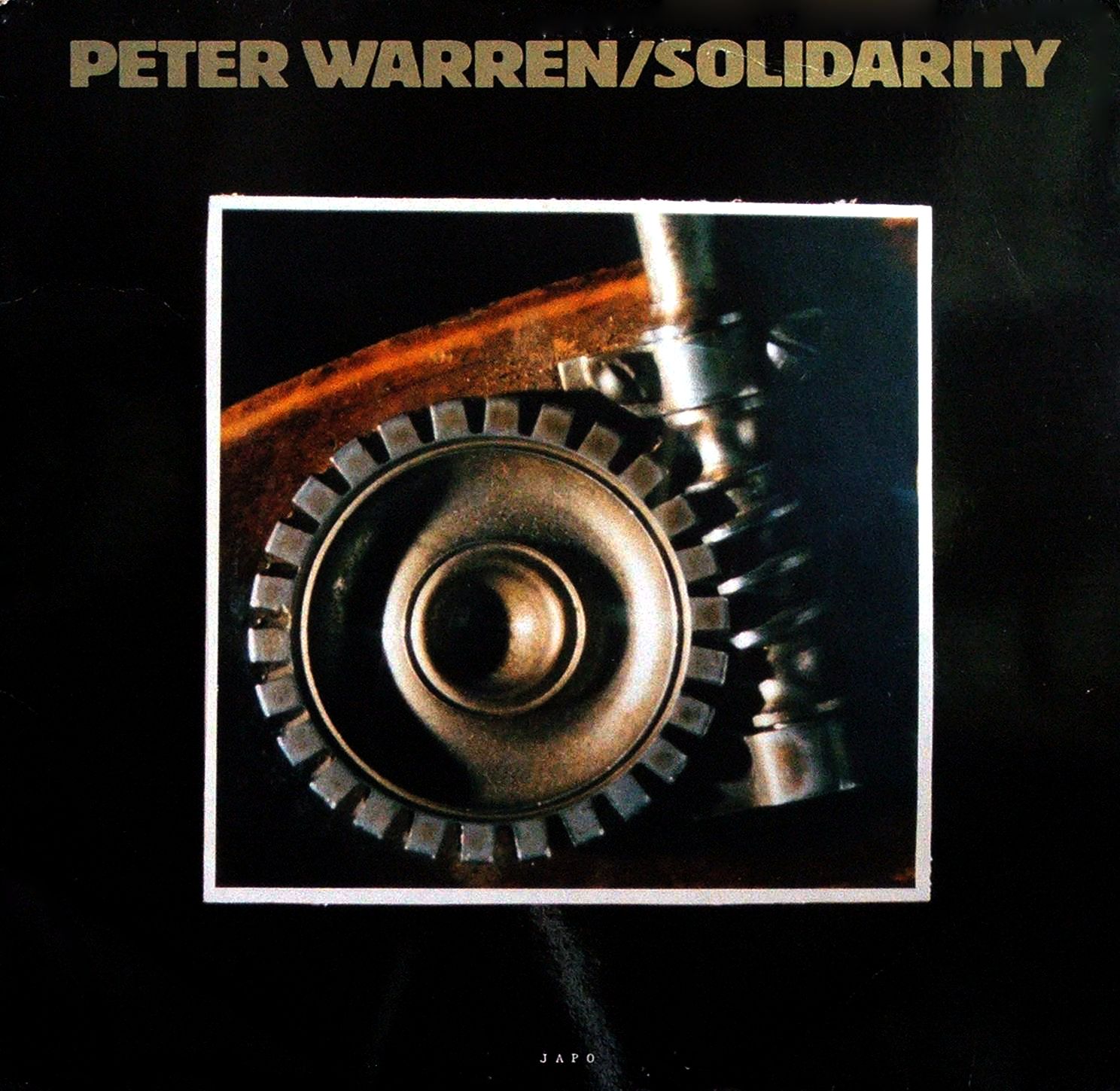
Bassist Peter Warren quite simply put out one of the finest albums in the JAPO catalogue: the long out-of-print Solidarity. Warren is one of a cadre of American jazz musicians who made a career for themselves in Europe, where his idiosyncratic approach was enriched and encouraged by the likes of Edward Vesala, Rolf Kühn, and Albert Mangelsdorff. In 1974, he returned to New York City, where he joined forces with Jack DeJohnette’s Special Edition, appearing on the classic ECM sessions Special Edition and Tin Can Alley. It was in that context where he also met reedman John Purcell, who along with the drummer was carried over into this phenomenal one-off band, rounded out by guitarist John Scofield and, for the set’s first half, trombonist Ray Anderson.
Anderson dominates the starter, “Riff-Raff,” which emphasizes his fiery tone against a groovy backdrop. His energy proves infectious, taking root in Warren and DeJohnette’s spirited contributions to the playing field. Scofield responds with a well-constructed solo of his own, minimal by comparison but no less robust for its underbite, while Purcell’s alto croons and cries. The overall effect here, as in the title track that follows, is one of meticulous abandon, whereby the latter tune’s circular bass intro betrays nothing of the tension about to unfurl.
The album’s remainder subtracts the trombone, shifting register into a darker quartet. Purcell’s soprano fogs the window of “Mlle. Jolie,” making for an attractive ballad further deepened by DeJohnette’s rarely-heard-but-always-artful pianism. Warren focuses on the infrared portion of his emotional spectrum, while Scofield dances on air. “Lisa’s Tilt” finds Purcell darker still on alto in a track that swings more than any other on the album. DeJohnette is noticeably foregrounded, holding every seam together, even as the band finishes in a swanky free for all. As a postscript, Warren offers “I Remember Stu,” on which he plays bass and cello in a piece written in memory of Stu Martin, whom he thanks in his acknowledgments “for his love and musical inspiration.”
Solidarity is characterized, among other aspects, by its ebb and flow, which at one moment may cast a spell and the next push through it like water through a broken dam. And with DeJohnette producing, the listener is left with an elusive but unquestionable winner.
Toshinori Kondo trumpet Kenny Wheeler trumpet Günter Christmann trombone George Lewis trombone, effects Albert Mangelsdorff trombone Bob Stewart tuba Gerd Dudek flute, soprano saxophone, tenor saxophone Evan Parker soprano saxophone, tenor saxophone Ernst-Ludwig Petrowsky flute, alto saxophone, baritone saxophone Alexander von Schlippenbach piano Alan Silva bass Paul Lovens drums
Recorded June 4, 1982 at Studio 105, Radio France/Paris.
Recording engineer: Jean Deloron
Mixing engineer: Martin Wieland
Produced by Thomas Stöwsand
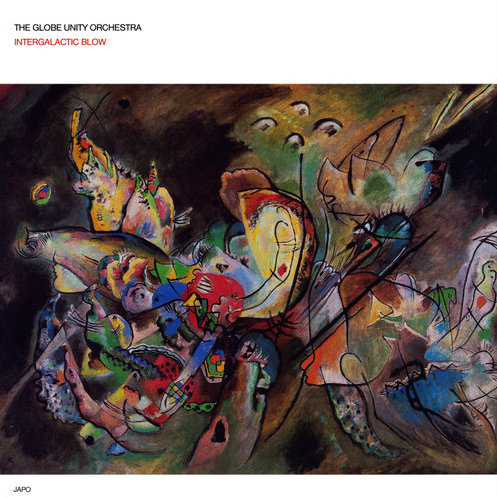
Beginning in 1966, the Globe Unity Orchestra sparked a four decades-long run that intersected with the JAPO label on three counts. For this, the group’s second for ECM’s sister label, founder Alexander von Schlippenbach hand-selected a set of free improvisations emitted in a Paris studio in June of 1982.
Even more noticeable this time around are the contributions of its brass players, especially trumpeters Kenny Wheeler and Toshinori Kondo (who takes the place of Manfred Schoof from the last record). Their methods of integration on the opening track, “Quasar,” set a tone that is dashed as quickly as it is established. From the farthest reaches of inner space, the musicians work their way to the front altar of the mind, where Ernst-Ludwig Petrowsky’s baritone files its utterances in living order. Tuba (Bob Stewart) and piano (von Schlippenbach) speak out of time—one from the future, the other for the past. Such is the ethos of the hour.
Even at its densest, Globe Unity makes sure to leave a door open for even the most transient listener, so that “Phase A” and “Phase B” feel no more connected by name than they are by process. It is their very incongruity that partners them in the album’s grander scheme, interpretable only after the fact. Their gestures are more jagged, turned from shining to brilliant by Evan Parker’s unmistakable soprano. Like the group as a whole, he takes rising levels of intensity as opportunities for sane reflection, thus allowing himself the strongest benefit of performance: being heard.
Drummer Paul Lovens is another master in this pool of many, adding to the 19-minute “Mond Im Skorpion” a scripture’s worth of microscopy. Amid this bramble of riffs and utterances, he treats every melodic branch as a fuse to be lit, and every lit fuse as a pathway toward new understanding of the improviser’s craft. Von Schlippenbach is again noteworthy for attuning to that same inner habitus, an environmental assemblage where one has to know where one has been in order to move toward the unknown. For even as reeds and brass elbow the horizon with the force of sunset, they hold the following morning in their chests. A snake-charming soprano seems to mock the wayward Orientalist who sees travel solely as a means of sticking another postcard in the scrapbook. Indeed, you will find no tourists here—only the artisans selling their wares on the outskirts of town, far from the crowded bazaar, where a cacophonous ending sings, proclaims, and teases every tether of dusk so that it might pull out another day from under our feet.
Globe Unity keeps everything clear and, thanks further to Thomas Stöwsand’s flawless production, ensures that every shout is also a whisper, and vice versa.
Evert Brettschneider acoustic and electric guitars Aloys Kott bass Michael Jüllich percussion, marimba, vibes
Recorded January 1978 at Tonstudio Bauer, Ludwigsburg
Engineer: Martin Wieland
Produced by Thomas Stöwsand
Along with Musik, the Contact Trio’s New Marks is another standout for ECM’s sister label, JAPO. Sharing with that later release frontmen Evert Brettschneider (acoustic and electric guitars) and Aloys Kott (fretless bass) but differing in the presence of Michael Jüllich (percussion, marimba, and vibes), this incarnation of the band charts vaster, even more palpable territory with a crystalline signature sound, for which we may also thank the late, great producer Thomas Stöwsand.
Brettschneider and Kott share composer credit. The former’s pen yields the album’s opener, “Happy,” which welcomes the listener appropriately with a smile. At first, Kott takes a page from the Eberhard Weber playbook—and, later, evokes the more experimental Bill Laswell—before ironing out his own distinct fabric. Jüllich, for his part, starches the outer layer with glowing cymbals. Guitarist and bassist trade harmonic arpeggios, foresting a temperate climate around Jüllich’s detail-oriented drumming. Kott’s “Circle” unfurls a likeminded mesh of marimba and vibes in support of Kott’s melodic overlay. This watery backdrop adds an ambient touch to the piece’s growth from conversation to prayer. Brettschneider’s electric shares starry crosstalk with Kott, then fades like a comet’s tail into a flanged midsection. This atmospheric shift wanders into what jazz might sound like if Steve Reich were to play it, mallet percussion and bass opening a window into the electric guitar’s virtuosic crunch.
“The Quick Brown Fox Jumps Over The Lazy Dog” begins the album’s second half of three tunes, each co-written by Brettschneider and Kott. It’s a frantic jazz crawl that reveals Jüllich at his finest, painting the night with a deluge of stars in his solo. “Stoned Tunes,” an album highlight, is a wintry duet of 12-string acoustic and bass, which segues into the title track’s freer language, a primer of both the band’s process and its imagistic leanings.
Dollar Brand piano, flute
Recorded live June 1972, Jazzhus Montmartre, Copenhagen
Engineer: Lars Vester Petersen
Sound: Mantra Sound, Copenhagen
South African pianist Abdullah Ibrahim, known in a bygone era as Dollar Brand, is a soothsayer at the keyboard, and on this out-of-print JAPO release from 1974 he divines from the ebony and the ivory a lifetime’s worth of bones. Like its label predecessor, African Piano, this album was recorded live at the Jazzhus Montmartre in Copenhagen, but adds nearly three years of additional life experience to show for its mesmerizing rewards.
The original vinyl is a gorgeous thing in and of itself. Sleeved in a photograph of flaking, painted wood, it reads like a structure worn by time but which is also stronger for it. The performance consists of a long piano medley of original tunes plus an encore on flute. The bulk of the set opens, as did African Piano, with an extended take on “Bra Joe From Kilimanjaro,” a quintessential tune in Ibrahim’s personal archive. Its deep-set, rocking ostinato provides all the rachises he needs to strut with plumage burning bright. If not already obvious, Ibrahim is a brother of a different feather, one whose gifts are every bit as intuitive as those of Keith Jarrett, whose likeminded penchant for gospel-infused anthemism makes an early reveal before lighting a rocket into the jubilation of “Mamma.” Ibrahim’s lush comping fleshes out the atmosphere to its fullest, smoothing with bravado into the calmer “Tokai.” A joyful spread of chords flings us into the train ride of “Ilanga” with such traction that no tracks are required. As with so much of Ibrahim’s output, an underlying propulsion lends sanctity to the overarching message.
“Cherry” is a buoyant morsel of lyricism that sets us up for the heat of “African Sun,” which fades out of Side 1 and into Side 2. Both this and the following tune, “Tintinyana,” show an artist who understands the blues like few other contemporary pianists can. His take on the form is as nostalgic as a childhood tree, which continues to grow in mind even when its physical form succumbs to the axe of time. The roots of his left hand are so thick that every burst of foliage is like salt in the wounds of evil, for it knows that the divine await the righteous with open arms. In light of this, the romping swing of “Xaba” comes across as a purifying dance, an invitation to commune with exclusively musical worlds. The prayers of those worlds are to be found in “Peace – Salaam,” which ladders its way into the clouds as if they were puffs ejected from the pipe of history. Here we are invited to relax, unwind, and let our cares consume themselves into nothingness. A swell of applause brings us back to reality, and to the final “Air,” for which the keys are rested and the flute leaves the final word. And final it most certainly is, for it begins melancholy and finishes in a hunter’s dash, swift and sure.
Karen Mantler vocals, harmonica, piano Doug Wieselman guitar, bass clarinet Kato Hideki bass
Basic tracks recorded by Kato Hideki and Peter Karl at Peter Karl Studios, Brooklyn, NY, October 2012
Overdubs recorded by Kato Hideki at Dog Day Studio, Brooklyn, NY, November 2012
Mixed and mastered by Kato Hideki at Dog Day Studio, July-September 2013
Produced by Karen Mantler and Kato Hideki
Release date: June 13, 2014
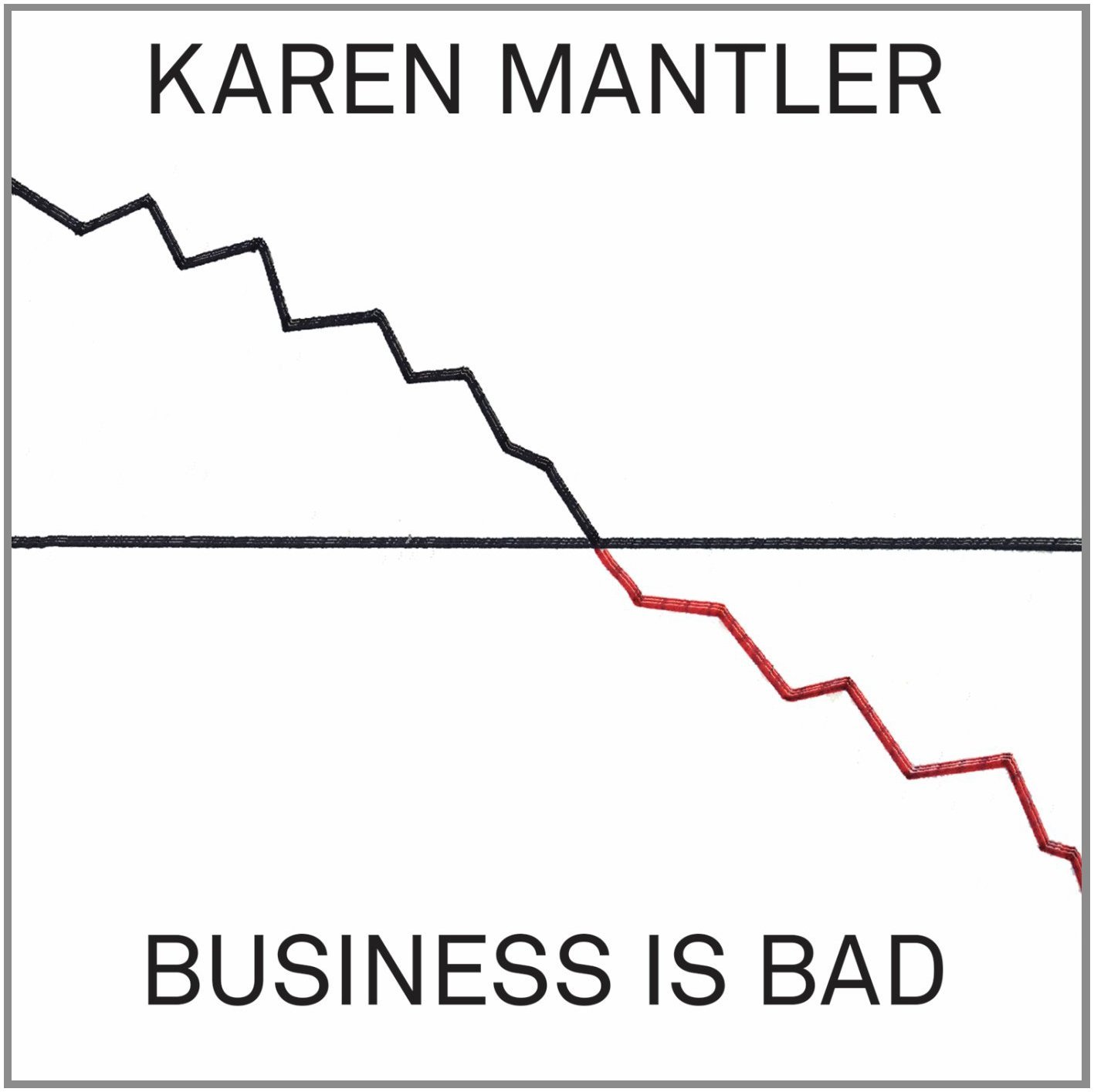
Karen Mantler is more than the sum of her genetic parts. As the daughter of Michael Mantler and Carla Bley, one might expect her to be any number of things, but ultimately she has come into her own as a singer-songwriter of understated brilliance. It’s difficult to capture the profound simplicity, it not the simple profundity, of her lyrics, much less so the skeletal arrangements in which she couches them in trio with bassist Kato Hideki and Doug Wieselman on guitar and bass clarinet. There is an innocence and charm about these songs, but also a maturity that only comes with the ups and downs of life experience. Mantler focuses decidedly on the latter throughout Business Is Bad, which paints the portrait of an artist starving through deprivations at once social, linguistic, climatic, emotional, legal, artistic, and geographic. Practically dripping with self-awareness, each is a vignette of insight into the working mind of a mind at work.
(Photo by Carol Lipnik)
Whether taking on the plight of the homeless in “Catch As Catch Can” or lamenting airport closures caused by “That Damn Volcano” (which, one can only assume, refers to the eruption of Iceland’s Eyjafjallajökull in 2010), Mantler’s slack-jawed lyricism discloses a tongue in universal cheek that wags almost like a child’s, filtering out none of life’s pessimistic moments. With deadpan humor and the meticulous support of her bandmates, she comes across like bold print on the page, a DNA helix gone rogue.
Despite the album’s gloomy pall, there’s much whimsy to be savored, and much of it self-deprecating. The bossa nova skin of “My Magic Pencil (Wrote This Melody)” does little to conceal Mantler’s delightful frustrations over the wanderlust of her most ubiquitous compositional tool. “Speak French” conveys the disadvantages of being monolingual, seesawing English and French like a language instruction tape. On a subterranean level, however, it is a song about the musician’s desire to be heard—all the more ironic, because music is one of the very few languages that transcends such arbitrary barriers. Even when she sings of dead ends, lost causes, and a faithless system in “I Can’t Afford My Lawyer,” she makes as astute observation on the nature of art, which becomes little more than a profit machine built around people’s misfortunes. And in the nervous “My Solo,” in which she expresses a lack of confidence in playing exactly that, she nonetheless produces a songful harmonica solo in the album’s longest, and prettiest, instrumental section.
Between jazzier, diaristic observations (see “Wintertime” and the title track’s funkier blues) and the requisite breakup song (“Surviving You”), Mantler jumps from the quotidian to the philosophical in a single keystroke. If this is your first Mantler album, these extremes may either repel or enchant, but one thing is for sure: her songs are a gust of fresh air in a musical landscape gone dry.
AMM III
It Had Been An Ordinary Enough Day In Pueblo, Colorado
Keith Rowe guitar, prepared guitar, transistor radio Eddie Prévost drums
Recorded December 1979 at Tonstudio Bauer, Ludwigsburg
Engineer: Martin Wieland
Produced by Steve Lake and AM III
By the time this obscure JAPO album was released in 1980, AMM was 15 years old. The British free improvisation outfit, credited here as “AMM III,” was already an underground legend, and thankfully has stayed that way, even now preserving its integrity as an exploratory unit. For this brief incarnation, founding members Keith Rowe and Eddie Prévost set out as a duo, respectively combining guitar and percussion in a real-time evolution that fans of Evan Parker are sure to appreciate. Like Parker, Rowe and Prévost spend as much of their time listening as playing, soaking in the feeling of the surrounding soil before enriching it with just the right minerals.
“Radio Activity” is both mantra and anti-mantra. Rowe’s use of a transistor radio underscores the title as a method of operation, leaving behind its descriptive properties to shrivel in the sun of another day. The metallic details put forth by the two musicians, at once percussive and speech-oriented, seem to fold themselves like sheets of self-aware origami paper. The sounds of broadcasts moving through a flanged portal are complemented by an amorphous electric guitar, its ochre pigment drawing a halo without an angel. In this amphibious dronescape, valleys eventually turn into peaks as Rowe and Prévost lock into powerful, staccato interplay before compressing into a jam between molecules.
After the massive parentage of this first track, the ones that follow feel like its offspring. “Convergence” is the youngest sibling, a frail yet expertly tuned entity whose potential for strength is unlimited. The elasticity of “Kline” pegs it as the eldest child. Its swansong is written on parchment, a brittle medical document that is beyond the need for prescription. Frenzy ensues, throughout which Rowe treats the air like a pin cushion while Prévost shines a light through every eye like a star.
The two middle children are intersectional beings. “Spittlefields’ Slide” is exactly what one might expect it to be: a stuttering and warped chain of expectorations. It’s also a fine exercise in restraint that grows even as it flounders into dust. “For A” sounds as if the musicians dismantled a pay phone and made music with all the loose change gutted from within, faithfully documenting every snap of communication in a game of resuscitated conversations.
Your guess is as good as mine as to what any of the above to do with the album’s title, but I like to think that somewhere in Pueblo, Colorado there exists an echo of these soundings, ghostly yet content in its geographical prison.
Steve Swallow bass Chris Cheek tenor saxophone Steve Cardenas guitar Carla Bley organ Jorge Rossy drums
Recorded November 15/16, 2011 and mixed and mastered at Studios La Buissonne, Pernes-les-Fontaines
Engineers: Gérard De Haro and Nicolas Baillard
Produced by Steve Swallow
Release date: June 14, 2013
Over a career spanning more than half a century, Steve Swallow has consistently redefined the electric bass as a jazz instrument. More importantly, he has taken any and every opportunity along the way to deepen his craft as a composer. His self-discipline in this regard has made every album seem at once a culmination and a stepping stone into greater futures. Into The Woodwork is no exception.
For this latest incarnation of his quintet, Swallow has chosen a lineup worthy of the subtlety on which these 12 original tunes nourish themselves. The tenor of reedman Chris Cheek, who made a noticeable ECM appearance as part of the Paul Motian Band on Garden of Eden, brings the smoke before the fire in “From Whom It May Concern,” a ballad that tilts its own thematic mirror toward artful reflection. Cheek also plays beautifully in “Unnatural Causes,” from the paint-by-number simplicity of which he unpacks the robustness of an unexpected spectrum. This tune is further notable for the contributions of guitarist and fellow Motian associate Steve Cardenas, whose unforced geometries settle us into the album’s intimacies by way of “Sad Old Candle.” Cardenas, in fact, proves to be the quintet’s greatest converser, whether exchanging remarkable banter with Cheek (“The Butler Did It”) or playing in duet with Swallow (“Suitable For Framing”). His lyricism pairs well, too, with the organ of Carla Bley, whose own omnipresence reveals another defining mastery in tunes like “Never Know,” “Still There,” and “Grisly Business.” The latter’s gentle carnivalesque is ideally suited to her touch at the keys.
Drummer Jorge Rossy is a constant thread to which the band looks for guidance, but especially in the more energetic turns such as “Back In Action” and “Exit Stage Left.” His understated groove actualizes Swallow’s ethos of less as more, and demonstrates that self-assured music need never be arrogant. And then there’s Swallow himself, whose first true solo doesn’t come until the album’s ninth track, “Small Comfort” fans the embers. The edge of his new custom bass sounds already finely aged over this bed of organ and cymbals, exposing a little more of his inner workings as brushed snare and tenor pull back the curtain to clarity.
In contrast to the steadied pacing of Swallow’s ECM outings, many tunes on Into The Woodwork flow into the next without break, thus keeping his atmospheric integrity in constant check. Like the title track itself, the album as a whole finds balance between the grounded and the free, always keeping one arm around the listener’s shoulder. The fact that this music doesn’t overtly challenge is a challenge in and of itself to experience its strengths as givens. Like an old friend, it may not often surprise, but its comforts are exactly where they need to be.
Cymin Samawatie vocals Benedikt Jahnel piano Ralf Schwarz double bass Ketan Bhatti drums, percussion Martin Stegner viola Recorded March 2014 at Rainbow Studio, Oslo Engineer: Jan Erik Kongshaug Produced by Manfred Eicher
Release date: 20 February 2015 (Europe only)
My melodies are reaching your heart, how come? My words are easing your pain, how come? Everything that I do, I don’t do it myself, how come? I live for the ones, who love me Why not for myself?
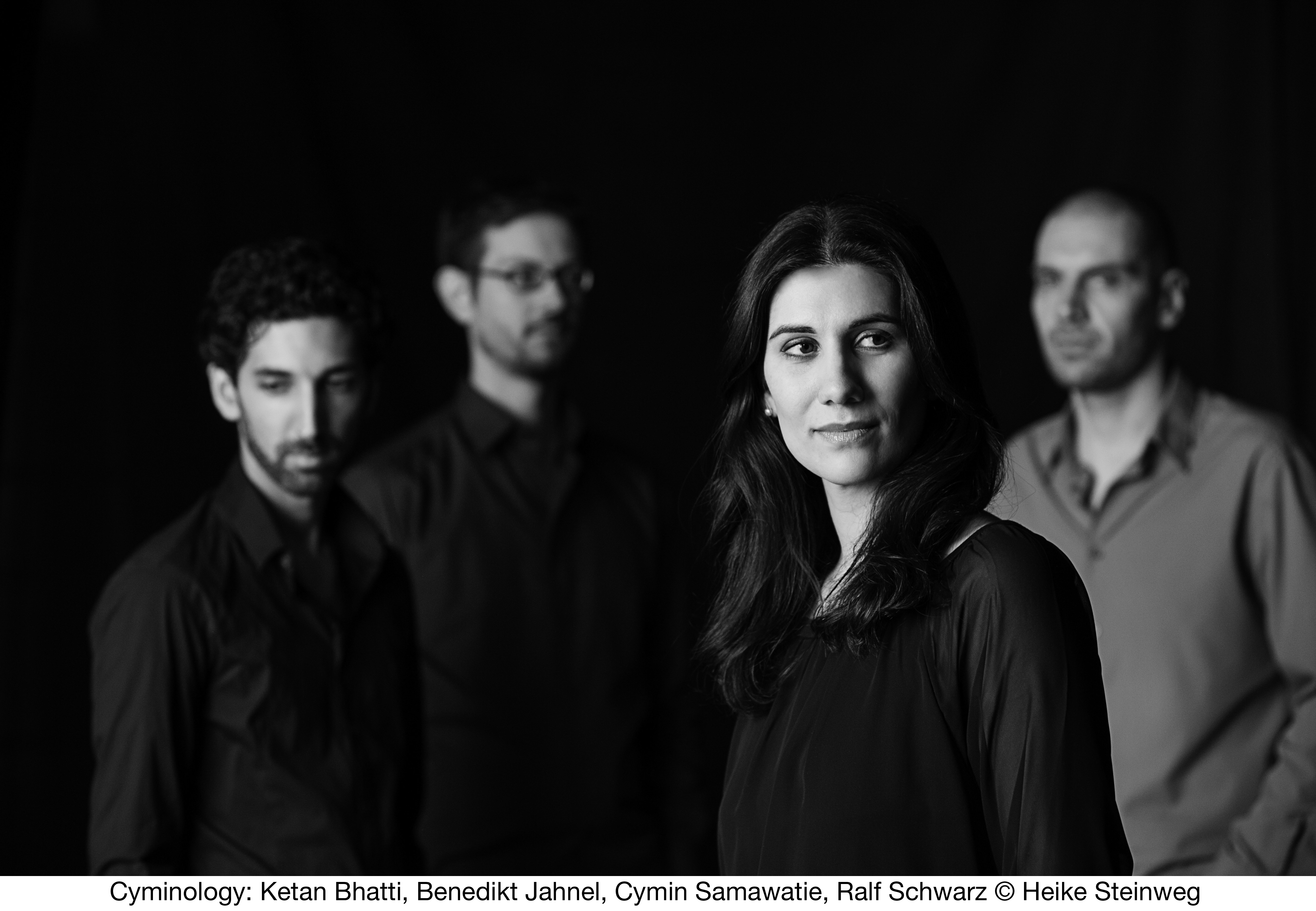
Cymin Samawatie, whose band Cyminology has swum twice in ECM waters (cf. 2009’s As Ney and 2011’s Saburi), is a crosser of barriers at once ethnic, linguistic, and musical. Such a characterization risks painting the German-Iranian singer as an enigma, when in fact she gives voice to her gifts through love of sentiment, empathy for politics, and humility of creation in a way so grounded, it feels as if she is singing as much for you alone as for the world. Samawatie’s backing trio of pianist Benedikt Jahnel, bassist Ralf Schwarz, and drummer Ketan Bhatti now welcomes violist Martin Stegner, whose presence is as defining as it is dressed in shadow. The voices of his bow constitute nominal additions, but their presence removes a few more layers of perception to reveal the naked truth of every note they touch.
The appropriately titled Phoenix revisits Iranian poet Forough Farrokhzaad (1935-1967), from whose own premature ashes emerged the winged verses explored therein. Farrokhzaad paints a veritable world around her body, which in “Aaftaab” and “Gozaraan” binds the narrator hand and food with ribbons of love’s many unspoken hues. The latter song’s improvisatory colors slip into a black hole as quickly as they emerge from one, feeling through the dark as if by every word, a fingertip. This is much in contrast with the former song, which unfolds, fractal-like, inlaying repeated patterns and meshing viola and voice interchangeably. Likewise, Farrokhzaad’s shapes tend toward a yin and yang relationship, whereby every pool of light contains one fish of dark, and vice versa. Like the stars she collects in “Harire Buse,” which accompanies Samawatie by bass alone, they shine only because of the unknowable pitch in which they swim.
Yet nowhere does Farrokhzaad—and Samawatie, by extension—speak so inwardly as in the closing “Baraaye To.” Here drums and bass shed their rigid constructions to better comprehend Cymin’s realisms as she sings:
I am writing this poem for you In the sunset, in the thirsty summer On a half gone, fatal way In the old grave of my endless pain
Let my eyes overflow again with dewdrops
The day will come when your yearning sight Will fall on this painful tune Searching within my words You will say: “This was my mother”
Throughout this incremental, emotional implosion, the band’s melodic blush yields more than the sum of its parts and proves that life can be written only on the palimpsest of memory.
The distinction of Cyminology as a vocally-centered group is that its instrumentalists also emit a poetry of their own, every bit as verbal as their bandleader’s. This is nowhere truer than throughout Samawatie’s own songs, wherein members of the rhythm section, into which the piano grows to be an interlocking part, punctuate each other’s sentences until they are spherical—global, if you will. Her texts may be far more concise, but their impact is anything but. In the pulsing infrastructure of “Che Gune Ast,” she activates a fierce individuality. From the pulsing pianism, which gives a sun for drums to compass their solar system, to the viola’s innocence, which feels almost blood-related to the breath-drawn bass, Samawatie’s singing tracks every change of mood as if it were a diary in real time. “Talaash Makon” is another duet, this time pairing her with Jahnel, whose defining pianism sets up one patch of earth per footstep. The band saves its deepest poetry for “Baraaye Ranj,” which, although effectively wordless, nevertheless alters its own DNA as if by language alone.
From Nimā Yushij (1896-1960), so-called father of Persian poetry, comes the album’s title poem. Over the course of its two parts, Samawatie embodies the fabled bird’s tragic cycle, which in this context becomes an exercise in self-reflection. The viola reveals itself as a descriptive force, soaring with arpeggios before landing on the mountain from which Yushij unspools its sorrowful cry. In Part II, the instrumentalists are Erdnase-shuffled into Samawatie’s muscular legato, by which new details emerge from every listen.
A canonical Sufi poem by Hāfez (c. 1325-1390) completes the mosaic. The mournful “Dishab” is the album in miniature, blending clearly defined voices into an even more clearly defined whole, while holding on to one elemental mantra: there can be no water without land. And indeed, as a whole these melodies reach out their talons and pull until sky and earth become one horizon, opening an internal eye that interlocks with the external knowing of being gazed upon. By this dynamic, the listener turns into participant and allows the music to be reborn through the act of knowing it.
(To hear samples of Phoenix, you may watch the EPK above or click here.)







 Between Sound and Space: ECM Records and Beyond