Thomas Strønen: Relations (ECM 2771)

Thomas Strønen
Relations

Thomas Strønen drums, percussion
Craig Taborn piano
Chris Potter
 soprano and tenor saxophones
Sinikka Langeland kantele, voice
Jorge Rossy piano
This album was recorded and assembled between 2018 and 2022, with Thomas Strønen, the project’s initiator, inviting the featured musicians to join him from different locations across Europe and the US.
Thomas Strønen, Lugano
Craig Taborn, New York
Chris Potter, New York
Sinikka Langeland, Oslo
Jorge Rossy, Basel
Engineers: Lara Persia, Martin Abrahamsen, and Patrik Zosso
Mixed February 2023 by Manfred Eicher, Thomas Strønen, and Michael Hinreiner (engineer)
at Bavaria Musikstudios, Munich
Photo: Dániel Vass
Album produced by Manfred Eicher
Release date: November 29, 2024

Four years in the making, Thomas Strønen’s Relations locates the drummer in virtual duets with Craig Taborn and Jorge Rossy on piano, Chris Potter on soprano and tenor saxophones, and Sinikka Langeland on kantele and voice. After recording Bayou, producer Manfred Eicher invited Strønen to play solo percussion for the remaining studio time. Taking a decidedly classical approach (one might easily recognize shades of Edgard Varèse in here), and already being in the Lugano space where the Orchestra della Svizzera italiana is based, he was able to expand his usual drum kit with a variety of instruments—the only stipulation being that he could not have worked with them before. In response to the pandemic, he sent tracks to other musicians for long-distance collaboration. After a final mix, the result was an album of striking intimacy, timely messaging, and understated humanity.

We open with “Confronting Silence,” one of two tracks featuring Strønen alone (the other being the more sparkling “Arc For Drums”). The initiatory gong sounds nothing like the kickstart of commerce, the welcoming of royalty, or even the peace of meditation. It sings for no other reason than to be a vibration for all creation. Meanwhile, the gran casa rumbles within the soul of things.

Following this is “The Axiom Of Equality,” for which he is virtually joined by Taborn (as also in the diurnal “Pentagonal Garden”). The cellular metamorphosis between them is astonishing for being rendered from opposite sides of the pond, each motif a love letter to the ether.

Because Strønen often leaves moments of pause, letting others dialogue with him and populate the gaps with complementary grammar feels effortless. This is especially true of the tracks with Potter, whose tenor is a voice in the night in “Weaving Loom,” while in “Ephemeral,” he expresses himself internally despite the extroverted and free-wheeling playing, diving with humility into every moment for all it’s worth.

The more we immerse ourselves in the unique sound of this record, the more we settle into the illusion that every duo configuration is in the same room. Strønen’s three dances with Langeland are especially vivid in this regard. In “Koyasan,” the kantele is somehow not an extension of the percussion but the other way around, while in “Beginners Guide To Simplicity,” Langeland’s voice is a call to heart. And in “Nemesis,” brushed drums added an earthy texture that perfectly matches the aural surroundings.

Rossy also joins for three outings, examining linguistic morphologies in “Nonduality” and dropping stones into the waters of “Ishi.” Last is “KMJ,” the most melodic of the set. Every gesture between them is as clear as one’s reflection in a newly polished mirror, and Strønen’s heightened awareness leaves palpable traces behind for us to cross-hatch with the instrument of our listening.

Nicolas Masson: Renaissance (ECM 2846)

Nicolas Masson
Renaissance

Nicolas Masson soprano and tenor saxophones
Colin Vallon piano
Patrice Moret double bass
Lionel Friedli drums
Recorded November 2023 at Studios La Buissonne
Engineer: Gérard de Haro
Mastering: Nicolas Baillard
Cover photo: Nicolas Masson
An ECM Production
Release date: March 14, 2025

A quiet sparkle, a pebble thrown into the water, and a band that regards every ripple with their art—so begins “Tremolo,” the first of 10 new tunes from saxophonist Nicolas Masson. With partners Colin Vallon on piano, Patrice Moret on double bass, and Lionel Friedli on drums, he crafts melodic prose poetry that opens its borders to the freedom of in-the-moment interpretation. His tenor has the quality of a dream struggling to maintain its form in the face of impending wakefulness. The tension between the two is where so much of this music lives: at once allied with the night while yearning for daybreak. Stretching its neck from the opposite direction is the title track. Speaking as much in the idiomatic language of feet that walk as in that of hands that create, it conveys its autobiography in linked verse. All the more appropriate that his previous album with these fine musicians should be called Travelers, for they all contribute their own stamps to this passport.

What makes the group’s interplay so endearing is the grace of their seeking spirit. In “Anemona,” for instance, they give themselves to the flow of Masson’s organic writing selflessly and not without a significant quotient of charm that lets childlike impulses come to the fore. In “Tumbleweeds,” the free improvisational bonus that follows, we encounter the deepest expression of their atmospheric capabilities. Like the equally brief “Moving On,” which finds Masson and Moret duetting in the half-light, it embraces uncertainty. That said, even in the more artful punctuations of “Subversive Dreamers” (a highlight for its under-the-skin them), we are never coerced into experiencing something outside the realm of lived experience. Such comforts are harder to come by in a world caged by division. And how can one not feel like a messenger bird with a broken wing, mended and set free by the soprano saxophone-driven “Forever Gone”? Tied to our foot is the message ciphered in “Practicing The Unknown,” where hope reigns. At the risk of belaboring the analogy, I wonder whether “Basel” isn’t the terminus of our flight. Its percussive tracery, soaring piano, and unforced sopranism show us the quartet’s heart.

If all the above is the body, then “Spirits” is the blood working its way through the veins. But despite the intimations of kinetic energy that it whispers, it all points to the conclusion in “Langsam,” which challenges the listener to find a better word to describe the mood of what we’ve just experienced.

When listening to Renaissance, it becomes obvious why songs on an album are called “tracks.” It’s because each leaves something physical that we can touch and follow, knowing the journey will be its own reward.

Billy Hart Quartet: Just (ECM 2748)

Billy Hart Quartet
Just

Mark Turner tenor saxophone
Ethan Iverson piano
Ben Street double bass
Billy Hart drums
Recorded December 2021
Sound On Sound Studios, NY
Engineer: Roy Hendrickson
Mixing: Gérard de Haro
Supervision: Thomas Herr
Cover photo: Thomas Wunsch
An ECM Production
Release date: February 28, 2025

Saxophonist Mark Turner, pianist Ethan Iverson, and bassist Ben Street join forces with drummer Billy Hart for a flight of 10 in-house originals. These experienced souls, each distinct in their own way, mesh without losing their sense of individuality. If anything, they strengthen it by allowing voices to be heard, listening to be spoken, and legacies to be honored.

Iverson contributes four tunes, including “Showdown,” which opens the set with a somber kiss. If this album is a city, here are its outskirts, where a certain lucidity immediately distinguishes the quartet’s unforced hands. Turner’s soloing is fluid, embracing the affections that compel it to survive adversity. The chord changes get under the skin, letting us go only when it is safe to land. And speaking of landing, “Aviation” throws its paper airplane high and far. Basking in fresh flavors with a swinging aftertaste, Turner digs deep into his roots to pull out some robust bulbs of inspiration. “Chamber Music” establishes a darker, more intimate sound, beautifully cross-pollinated by piano and bass. “South Hampton” is another evocative gem with nothing to hide. Delicate yet raunchy, it finds Hart matching Iverson tit for tat.

The classic “Layla Joy” is the first of three from the bandleader, loosely rendered. The composer’s malleted drums chart a tender undercurrent while his allies fold one cellular piece of origami after another until an abstract whole is revealed. Iverson’s scratching of the piano strings and Street’s downward spiral give plenty of ink for Turner’s pen. The title track is a nostalgic tune that lays down its royal flush one well-worn card at a time. Like a burnished handle on the outer door of an old walkup, it bears the traces of decades of contact and human stories. “Naaj” is another nod to the Hart songbook. The drumming is as detailed as the reedwork is raw.

The saxophonist himself offers three tunes of his own. “Billy’s Waltz” glides on ice and is a highlight for its flexibility, seamless construction, and organic development. Iverson’s solo is pure gold. “Bo Brussels” is the freest tune, giving way to improvisational splendor. Rounding out the session is “Top of the Middle.” Turner weaves between the traffic of this urban groove without batting an eyelash. The sheer naturalness of the band’s collective sound is a splash of cold water in the face on a hot summer day.

Each musician is a star in a sky of ancient constellations. Turner carries much of the melodic weight. Meanwhile, Iverson casts the widest net. Despite not contributing any tunes, Street is an equal composer in the sound. And Hart is ever the chameleon, roaming wide while always keeping home within sight.

Lucian Ban/Mat Maneri: Transylvanian Dance (ECM 2824)

Lucian Ban
Mat Maneri
Transylvanian Dance

Mat Maneri viola
Lucian Ban piano
Recorded live at CJT Hall in Timișoara, October 29, 2022
Recording engineer: Utu Pascu
Mixing: Steve Lake and Michael Hinreiner (engineer)
at Bavaria Musikstudios, Munich
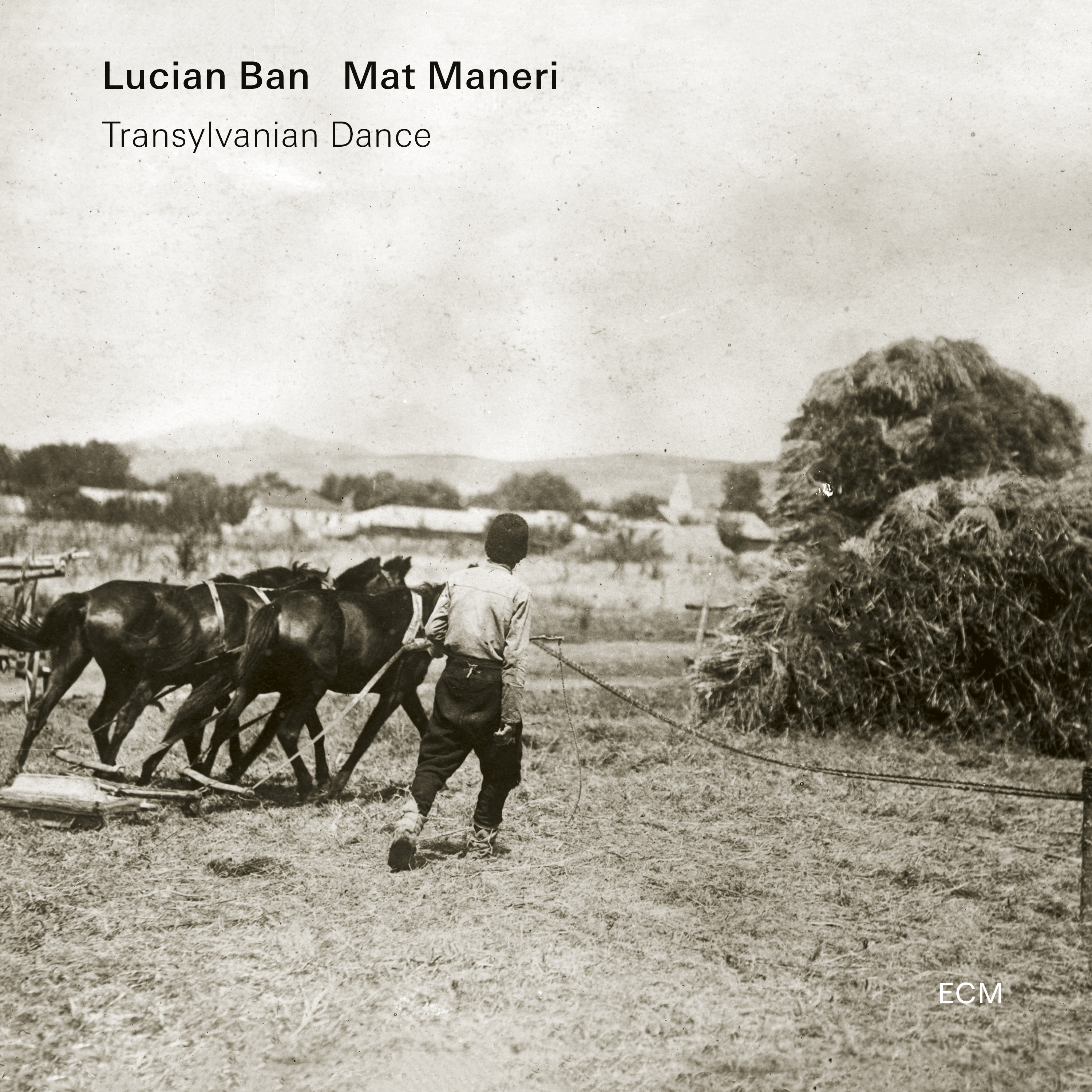
Cover photo: Romania farm scene, 1919 (courtesy Library of Congress, Washington)
Album produced by Steve Lake
Release date: August 30, 2024

Transylvanian Dance is the long-awaited follow-up to 2013’s Transylvanian Concert. The latter ECM debut of pianist Lucian Ban and violist Mat Maneri’s collaboration was a landmark showcasing the duo’s ability to immerse and blend in a partnership written in the stars. The present program, recorded live in October 2022 in the context of the Retracing Bartók project in Timișoara, is based entirely on songs and dances collected by Béla Bartók in Transylvania. And yet, the recapitulation of this music is more than a gesture of preservation; it’s an act of solidarity. If Ban and Maneri are archaeologists, they regard every artifact on its own terms. Rather than dust off the caked sediment, they appreciate it as a part of what the object has become.

In his liner notes for the album, Steve Lake invokes the “treasure-house,” a term used by Bartók and fellow composer Zoltán Kodáldy to describe the folksongs that may have gone lost without their efforts and one that feels duly appropriate to label the container built by these four hands. Drawing from his own experience growing up in Transylvania, Ban stains the wood with an ancestral quality, while Maneri carves adornments patterned after the imprints of far-reaching histories from within.

Open the door and take any interpretation stored a few steps beyond it, and you’re sure to find something to connect to. That being said, “Poor Is My Heart” is about as sparkling an introduction as one could hope for into this archive of still photographs come to life. To be welcomed into this space so freely is more than a privilege; it speaks to the human right of free expression against tyrannies of silence. Appropriately, the pianism is lithe yet strong, while the viola is a pliant voice that speaks of reeds and winds from bygone eras, its harmonics turning shafts of recollection into particles of real-time action. Like the title track later in the program, it keeps no secrets from us. However near or far the musicians feel, their balance of extroversion and introversion is superbly rendered. If Ban is the earth, then Maneri is the tiller of its collective memories. “Romanian Folk Dance” is another ripe harvest. Through disjointed yet natural movements, it breathes with an unsettled (but never unsettling) quality. The instruments circle each other, closing but never tightening the knot past the point of loosening.

What might seem to be a discerning focus on revelry is the oxygen for the darker flames of “Lover Mine Of Long Ago,” which treats its garments as layers of skin to be shed at will. Ban’s exploration of the piano’s inner strings, whether by plucking or muting, polishes a dowry of coins and other trinkets to be left behind with it. Meanwhile, “The Enchanted Stag” is a keening hymn in which bluesy accents bend to the will of the compass’s needle. Both “Harvest Moon Ballad” and “The Boyar’s Doina” turn the concept of the soul into a playing style. Wavering yet never faltering, each is a house creaking in the night, reminding us of the fragility of what we call home. Settling ever deeper into the ground, their candlelit windows beacons for wandering dreamers, they create a breezeway for the final song, “Make Me, Lord, Slim And Tall.” Not a single note feels wasted: percolating, germinating, and fragrant as a forest floor after the rain. With so much fertility, we can only wonder at the gifts it will yield with repeat listens.

Dine Doneff: Suite Yedi (neRED/4)

James Wylie alto saxophone
Maria Dafka bayan
Dine Doneff electric guitar, stomp box, double bass, drums
Recorded live September 3, 2023
Festival of Jazz, World & Contemporary Music
Teatar Jordan H.K. Dzinot – Veles, North Macedonia
Recording engineer: Ivica Jankulovski
Remix: Dine Doneff – Domagk Cell 27, Munich
Mastering: Christoph Stickel
Cover artwork & design: Fotimi Potamia
Produced by neRED music

Just as death is eternal
So the struggle goes forever.

–Kocho Racin

Composer and multi-instrumentalist Dine Doneff calls Suite Yedi, the fourth installment of his ECM-distributed label neRED, a “sound sketch of narratives about resistance.” And so, before a single musical utterance, we are implicitly asked to consider what resistance entails. Most, I imagine, would view it as a method of opposition, whether at the individual or collective level, to some malevolent force wreaking havoc on the world on any scale. But when the bayan of Maria Dafka—one of three musicians who make up the band recorded live here under the auspices of the 2023 Festival of Jazz, World & Contemporary Music in Macedonia—unfolds in the darkness of its own regard, a deeper meaning is revealed. For while the accordion-like instrument is solitary, it comprises the voices of its ancestors and the many who share them. It is a chorus in one body sustained by multiple vectors of identity. The effect is such that when alto saxophonist James Wylie and Doneff himself on electric guitar render for us the y and axes of this opening tune (appropriately called “Of the Memory”), we realize that resistance is ultimately not about opposition to but unity with. Just as one can be silenced by many, so can many be given hope by one.
 
Doneff’s guitar is an extension of his writing, which is the program’s backbone. Between the flowing traffic of “Yaros” and the offroading spirit of “Howl,” he merges onto and off our lane as if time were a highway to be traveled along at will. The latter’s country twang offers freer energy as Wylie stretches out his arms toward the horizon with a running start—and yet, beneath it all, the need to scream—paring down to Doneff on bass in a prayerful mode. This anchor carries over into “Naked Life,” where chords and melodies change places in stenciled light.
 
Between these milestones, we encounter the birthing pains of “Risserete,” wherein the bayan and alto meld as one while the guitar emerges aboveground, holding a scripture of its past in the hopes that a future might be possible. Dafka’s solo is a constellation shining through a smoke-tinged sky before resolving into Wylie’s monologue. Thus, each soul speaks for itself—another model for finding purpose. Doneff adds drums to make good on the promise of proximity and holds that pattern in “Minoria Grande,” allowing the theme to coalesce in a reunion that not even violence may hinder.
 
The performance closes with a contrasting diptych. Whereas “Another Chance” takes a forlorn look at things, the alto a picture of frustration resolving into fate but pulling away just before the grip of shadow becomes too ironclad to shake off, “Boombar” shines a light with its groovier bass line, a nod to how things used to be and how they might one day be again. Thus, we are reminded that, sometimes, catharsis does not happen all at once but gradually over time. In such an age as ours, where uncertainty has become the new normal (or has it always been this way?), the promise of comforts one can rely on becomes a treasure to be unearthed one footprint at a time.

Avishai Cohen: Ashes to Gold (ECM 2822)

Avishai Cohen
Ashes to Gold

Avishai Cohen trumpet, flugelhorn, flute
Yonathan Avishai piano
Barak Mori double bass
Ziv Ravitz drums
Recorded November 2022 at Studios La Buissonne, Pernes-les-Fontaines
Engineer: Gérard de Haro
Mastering: Nicolas Baillard
Production coordination: Thomas Herr
Cover: Avishai Cohen
Executive producer: Manfred Eicher
Release date: October 11, 2024

Since sewing his ECM leader debut with 2016’s Into The Silence, Avishai Cohen has reaped a unique voice as a trumpeter and composer. But in “Ashes to Gold,” the five-part suite from which his latest gets its name, we are introduced to the sound of his flute, which speaks of more harmonious times than these. Like the opening credits to a war film, it offers the dramatis personae—including pianist Yonathan Avishai, bassist Barak Mori, and drummer Ziv Ratiz—before throwing us into a battle scene from the start. In that vein, the trumpeting jolts us with its raw emotional reportage straight from the trenches.

By no stretch of metaphor, the music’s genesis took place in the aftermath of October 7, 2023, during which the chaos of war at once starved and fed Cohen’s inspiration. One week of intense writing later, the suite was born. While adding to and refining it on tour, he crafted the theme that would become the introspective Part III. Part II before it is its meditative ancestor, featuring a droning arco bass, keening brass, chanting pianism, and a heartbeat giving hope of survival beneath the debris. In the wake of Part IV, an interlude for flute and piano that turns light into shadow, the flowing conclusion finds Cohen soaring as a messenger bird with the sole remaining fragment of truth in its talons. 

Following this is the Adagio assai from Maurice Ravel’s Piano Concerto in G major, a staple in the band’s live repertoire. In this context, it serves as a lost hymn, fusing fragments of the past with the utmost attention to form. “The Seventh” (by Cohen’s daughter Amalia) provides the epilogue. Every flower that sprouts from its dying soil releases spores in the hopes that, at the very least, it might find richer land even as cities and their inhabitants fall.

It’s worth noting that the title Ashes to Gold refers to the kintsugi, the Japanese aesthetic practice of filling cracks in pottery with gold. Thus, he seals the traumatic ruptures of our humanity with music. And is that not what music does in times of unrest? It is a salve of retribution, physically applied to wounded fists closing around life itself.

Jordina Millà/Barry Guy: Live in Munich (ECM 2827)

Jordina Millà
Barry Guy
Live in Munich

Jordina Millà piano
Barry Guy double bass
Recorded live February 2022, Schwere Reiter, Munich
Engineer: Zoro Babel
Mixing: Ferran Conangla at FCM Studio, Barcelona
Mastering: Christoph Stickel
Cover photo: Thomas Wunsch
An ECM Production
Release date: July 5, 2024

Catalan pianist Jordina Millà and British bassist Barry Guy merge creative lanes for this live 2022 performance at the Schwere Reiter hall in Munich. The two first met as participants in Barcelona’s Mixtur Festival in 2017, where Guy was tasked as composer-in-residence to put together an ensemble piece, in which Millà’s participation stood out. Although a new partnership was born, one would never think of it as such from the telepathy they so intuitively inhabit.

This successor to String Fables, their first duo album (released on the Polish label Fundacja Słuchaj in 2021), offers an even deeper sense of lucidity and nursing of detail, enhanced but never overshadowed by the engineering of their sonic kaleidoscope. Their relationship is broken into—if not unified by—six freely improvised parts. Even without familiar melodies and rhythms, the sounds are holistically accessible for their spiritedness and emotional honesty.

One thing that becomes immediate is how each musician unearths elements hidden in the other. Whereas Millà fish-hooks the percussiveness of the double bass into the foreground, Guy inspires a pizzicato sensibility in the piano. The latter’s harp-like articulations in Part I are no mere decorations but a necessarily physical language. Even in the gentlest moments, there is a feeling of total revelation. Extended techniques lend comfort to an otherwise fitful dream. The effect is such that when Millà’s fingers land on keys, they cry out with the urgency of newborns.

Part II refashions much of that restlessness into conviction. Jazzy phrases bleed through postmodern lyricism and touches of prayer, their shadow growing to glorify the sun. Part III is even more melodic and communicates like a Janáček piece for children turned inside out to reveal its darkest fables. The prepared piano of Part IV is magical realism at its finest. With Guy’s skin tracings, it forms a complete organism that steps from thought into form with all the stop-motion haunting of a Brothers Quay film. Part V is the most tense yet also the most powerful in its release, working into a droning brilliance that calms the mind. Part VI is the final exposition, bowing and plucking its way into a humble sort of mastery.

What marks this recording is its sheer presence. Nothing feels hidden or obscured; rather, it is stripped of its protections for naked scrutiny. It speaks in the stirrings of souls, if not in the breathing room between them, until life becomes a mantra unto itself.

Jarrett/Peacock/Motian: The Old Country (ECM 2828)

Keith Jarrett/Gary Peacock/Paul Motian
The Old Country

Keith Jarrett piano
Gary Peacock double bass
Paul Motian drums
Recorded September 16, 1992
at the Deer Head Inn
Engineer: Kent Heckman
Design: Sascha Kleis
Produced by Bill Goodwin
An ECM Production
Release date: November 8, 2024

On September 16, 1992, pianist Keith Jarrett, bassist Gary Peacock, and drummer Paul Motian graced the humble setting of the Deer Head Inn, yielding an eponymous recording that stands as a beacon in the ECM catalog writ large. Nestled in the Pocono Mountains, the venue is one of the oldest for jazz in the US, having served as a stage for live music for over seven decades. As the story goes, Jarrett gave his first performance as trio leader there in 1961 at the age of 16 and returned for this performance to commemorate the ownership’s love for genuine music making. But this was another first, as it was the only time this group was ever billed as such (although Motian had, of course, played in the pianist’s “American Quartet”). Looking back on this landmark achievement, Jarrett and producer Manfred Eicher decided to release the rest of the recording, thus giving us The Old Country.

The title track by Nat Adderley is as good a place as any to begin our walkthrough, though one could start from anywhere and feel immersed in the inimitable vibe of that special evening a third of a century ago. The band never misses a lick, Jarrett treating every improvisatory message as the seed of a new tree. The “Autumn Leaves”-esque chord progressions only underscore that metaphor. “Someday My Prince Will Come” is another head nodder. As the doyenne of sorts in his American Songbook repertoire, one from which he recedes in the present treatment sooner rather than later to give Peacock the floor, it takes on a spirit of revival.

Engaging as such turns are, it’s in the slower numbers, like the Gershwin gem “How Long Has This Been Going On” and the Jule Styne standard “I Fall In Love Too Easily,” where we get glimpses of a particular beauty that might never grace a stage again. (They are also where Motian’s colorations are most vivid.) The latter tune is a heated blanket for the soul and feels custom-built for the musicians. Just as profound as Jarrett’s unfolding of every origami motif are the pauses between them. In each, where he may or may not cry ecstatically, it’s as if he were inhaling the Milky Way before exhaling starlight for all whose paths have gone dark. Peacock’s solo is a silhouette staring through a curtain for a lover who will never appear.

Further delicacies await in Thelonious Monk’s “Straight No Chaser,” the joy of which is so effortless that it might as well be a language with its own dictionary. Jarrett’s vocalizing cuts to the quick of the melody, giving us insight into his precognitive abilities at the keyboard. The dissonant touches are superb, and the rhythm section swings a full 360 degrees from start to spirited finish. Speaking of spirited, the piano intro to Cole Porter’s “All Of You” blossoms with metaphysical detail. The resulting groove is tempered by restraint—likewise in Victor Young’s “Golden Earrings,” which is as delicate as a bubble but strong as iron. Motian carries the bulk of this atmosphere with his brushes, while Jarrett manages to be ever one step ahead yet locked into place.

None of this would feel quite so complete with the album’s opening, “Everything I Love.” This little piece of magic from Cole Porter gives us that familiar blush of establishment such as only Jarrett can render, a chord progression that reminds us of where we belong. The sentiment is as much alive today as it was then. Your heart has already heard it. Now, it’s time for your ears to catch up.

Arild Andersen Group: Affirmation (ECM 2763)

Arild Andersen Group
Affirmation

Marius Neset tenor saxophone
Helge Lien piano
Arild Andersen double bass
Håkon Mjåset Johansen drums
Recorded November 2021 at Rainbow Studio, Oslo
Engineer: Martin Abrahamsen
Cover photo: Thomas Wunsch
Executive producer: Manfred Eicher
Release date: October 28, 2022

At the height of the pandemic, bassist and longtime ECM veteran Arild Andersen convened a new quartet at Rainbow Studio in Oslo. Although he arrived to lay down a predetermined set list alongside tenor saxophonist Marius Neset, pianist Helge Lien, and drummer Håkon Mjåset Johansen, during the second day of recording, he suggested the idea of a group improvisation. The result is Affirmation, presented in its real-time unfolding. Despite being new territory, the feeling is downright familiar from note one, the title indicative of a mutual trust and the need for life during a time of death.

Part I stakes its claim in delicate genesis. Light cymbals resolve into glittering pianism and tender reedwork, Andersen’s quiet strength bounding through it all. In a space enhanced by reverb, otherwise fleeting gestures become entire biographical statements, each the trail of an elder gone to rest. Johansen calls ancestrally, while Neset evokes the ancient ways of Jan Garbarek. Such influences speak of a metaphysical kinship—splashes of color spinning into freer territory before hints of groove can make good on their promises. At the center of their circle is a melodic heart that beats for all.

Part II rows darker waters at first, casts Andersen in more of a listening mode, cradled in a weed-woven basket. A lively middle section finds Lien working up a frenzy, but only briefly, as tenor and bass dialogue for a spell. Everything culminates in a smooth balladic energy, lit just enough to see our way through the night. What we’re left with, then, is a benediction, a prayer, a call to quiet action for the lost and found.

At times, Andersen eerily recalls David Darling’s cello playing and Eberhard Weber’s fluid arpeggiations, but for the most part, he sounds like only he can. And so, it makes sense to finish the album with his “Short Story,” an affirmation all its own. After two hefty doses of freedom, it resonates as a hymn to the future, riding its wave of appreciation straight into the sun.