Front and Tenor: Redman/Mehldau Duo Live Report

Joshua Redman / Brad Mehldau Duo
Bailey Hall, Cornell University
October 16, 2011
8:00 pm

Two peas in a pod. Cut from the same cloth. Peanut butter and jelly. Use whatever fatigued cliché your heart desires, but none comes close to describing neither the synergy, nor the marked shades of difference, shared by saxophonist Joshua Redman and pianist Brad Mehldau. Born a year and a half apart on opposite sides of the country, these two prodigious musical lives first converged in New York City in the nineties, when they began testing their musical conductivity in Redman’s early quartet. As a son of the great Dewey Redman, Joshua doesn’t so much live in his father’s shadow as throw a light on it. Having been raised by his mother, he grew up a step removed from the legacy into which it is so tempting to place him. But Redman sees himself foremost as a listener, not a protégé, and it shows. Music has always been for him, quite simply, a release, the surest way to unmitigated expression.

Mehldau is in no greater need of introduction, having ploughed a fertile sonic path whose lush crops bear little resemblance to those of a world filled with wilting farmlands. Whereas his recent Birdland live joint for ECM with legends Lee Konitz, Charlie Haden, and Paul Motian showed a penchant for sparkling and open paths, tonight he detoured into far more secluded glens. His notable flipping—playing ostinatos in the right hand and providing “bottoms” with the left—worked its selective magic on a couple of tunes, but for the most part flitted comfortably through the back alleys of expectation.

In the long run, however, one wonders just how significant these biographical details are, for perhaps the best communication we can offer is the listening ear—one that hangs, suspended in the darkness of the concert space, and gives in return the voice of its appreciation, not speculation. Take Mehldau, for example, who has been much praised for his eclectic palette, which includes healthy daubs of jazz, pop, and classical alike. Yet these idioms, too, seem arbitrary when caught in the throes of the music into which they are blended. What matters is not where these paints come from, but that they share the same canvas.

It was in this vein that, from those first few notes at the piano, the expanse of Bailey Hall collapsed under Mehldau’s touch, his right hand at full sail from the mellifluous and living wind of Redman’s tenor—so that by the time they reached their second number, the continent was already far behind us. Here, it was as if Redman had ended their last by drawing in a lungful of the tenor’s fog and exhaling it through this ballad’s cool, shipwrecked soprano, while hints of dawn flowered in the lovely, reflective trades on keys. As the music’s architecture intensified, “mesmerizing” was hardly the word. The following tune opened with a tenor lick so slick, there was no point in trying to stand upright. Though somewhat more fractured this time around, Mehldau found traction in a left-handed lead as his right adroitly negotiated two independent lines. After the crystalline highs of the soprano’s final appearance, Redman floated his signature tenor on a wave of velvety arpeggios. These haunting swaths of gorgeousness left us little prepared for an equally enthralling Nirvana medley, which showed Redman at his most animated, Mehldau at his most expansive. Night fell once more in their final piece, the piano lines of which had every mind attuned, and where Redman’s solo filled the hall with smoky caramel. The duo encored with a chromatic knot, unraveled with the utmost sincerity. Mehldau’s Brazilian influences crept through his soloing before bringing us back to shore via an amusing yet moving exchange with his partner.

Titles were announced after the fact, but were unnecessary when in the presence of music that was nothing if not already sufficiently interpretable. Like air, their nourishment was invisible and ungraspable by the word, a sound-world in which multiplicity was the language of the moment. By the same token, one could hardly deny the conversational aspect of their playing, for at times details—an ascending motive here, a trill there—joined forces with downright clairvoyant synchronicity. And yet, whenever the two reconvened after their soloing, theirs was never a simple, obligatory recapitulation of the theme, but rather an evolved (and evolving) splitting of light into its hidden colors.

Rarely have I heard such affecting tenor playing. The plasticity of Redman’s notecraft was a vital component of his performance. He explored some of the instrument’s darkest corners, sweeping away the gravel at the bottom of its bell and exposing the burnished surface beneath. His lows were as selective and as artful as those of Mehldau, who positively clarified the already buttery house Steinway. Both were as into each other as we were, and their body language in this respect was a treat to witness.

As a self-proclaimed “apolitical artist,” Redman creates a safe sonic space and, with Mehldau and others, has contributed significantly to his generation’s playbook. His is an ongoing conversation without walls, without message, without agenda. His genius lies in his humility, and in his openness to working with visionaries like Mehldau. And sure, all of the above may be dismissed as shameless pandering by the starry-eyed young listener and newly aspiring jazz saxophonist that I am…that is, unless you were there.

(See this article in its original form at the Cornell Daily Sun.)


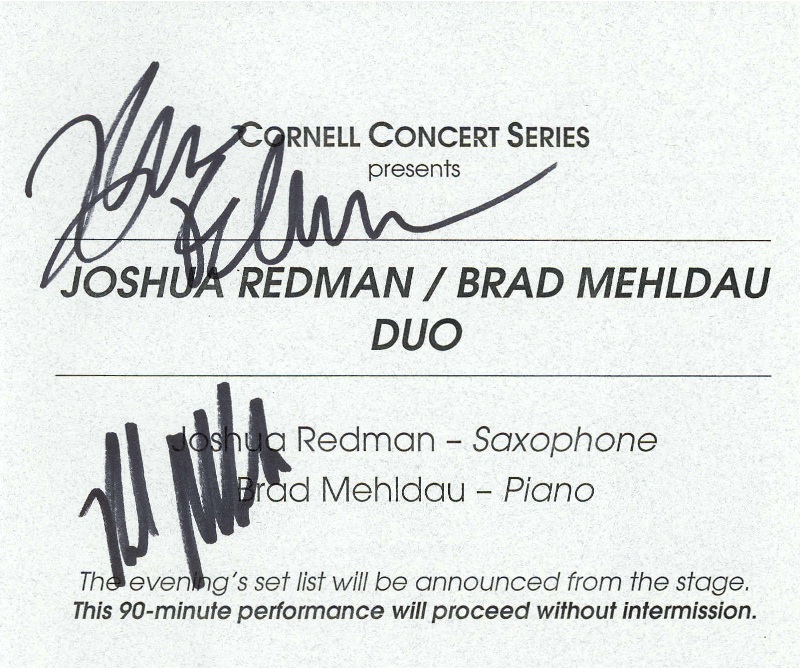
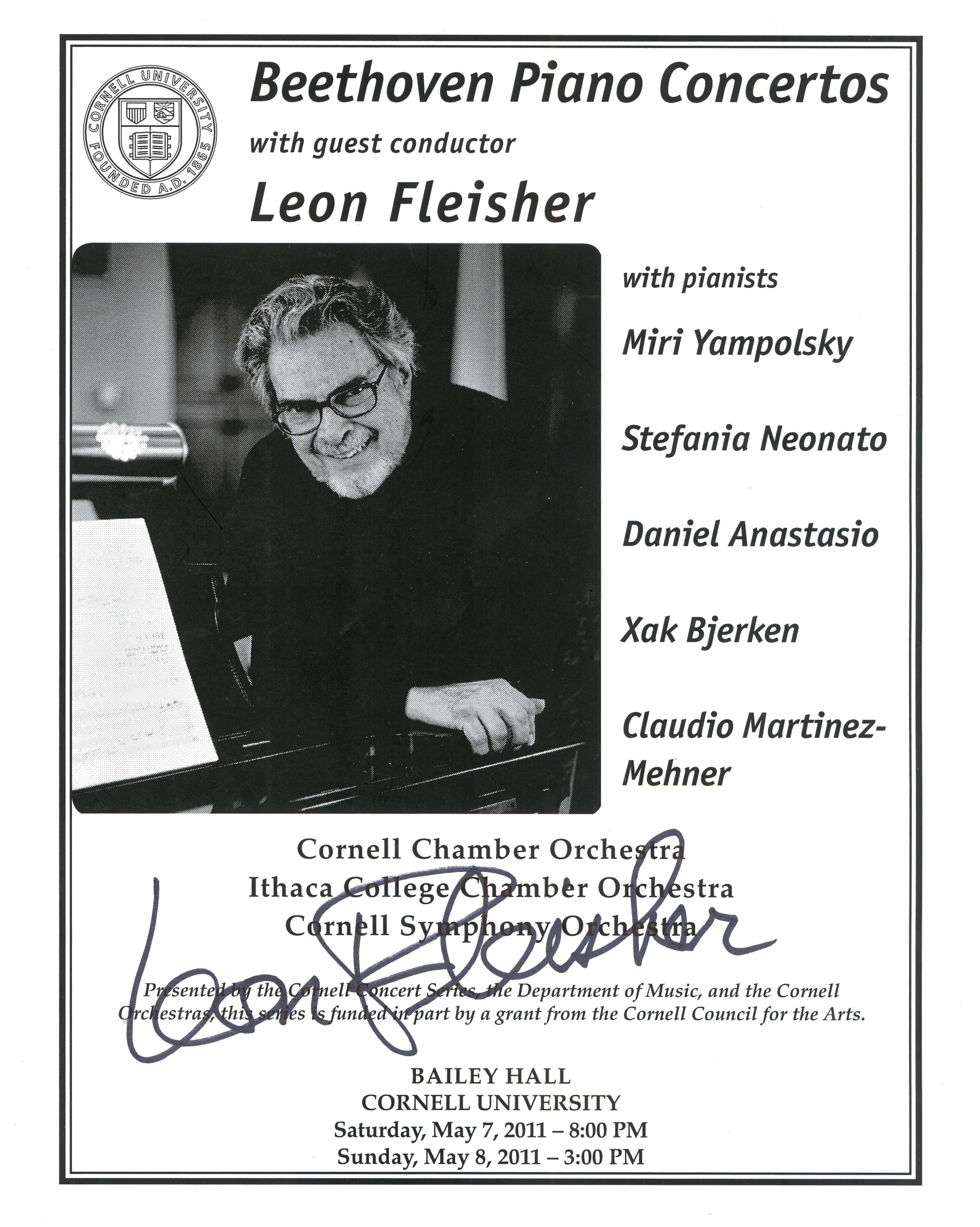
Signed program

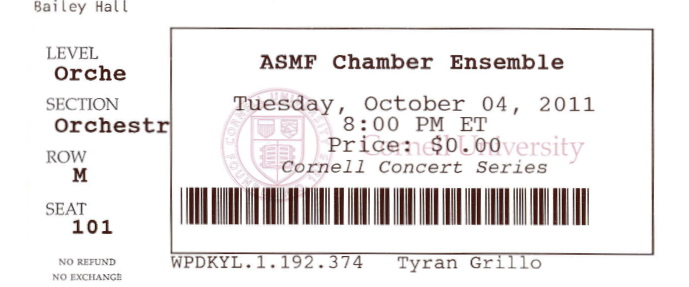
Lying in the Fields: An Evening with the ASMF Chamber Ensemble


Bailey Hall, Cornell University
October 4, 2011
8:00 pm

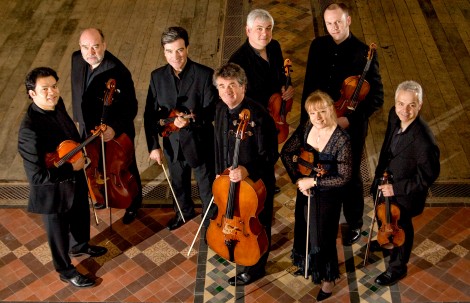
Since being founded in 1959 by Sir Neville Marriner, the Academy of St Martin in the Fields has flourished as one of the most renowned and most recognized orchestras in the world. The ASMF’s heritage traces back to its namesake church in London’s Trafalgar Square, where this conductorless collective was figuratively and literally instrumental in England’s renewed interest in Baroque music in the 1960s. Some 500 recordings later, the ASMF has now named violinist Joshua Bell as its new artistic director, thereby promising a fresh generation of adventurous programming and collaboration. On Tuesday night, Bailey Hall was presented with the ASMF in distilled form. Comprised of the orchestra’s principal players, the ASMF Chamber Ensemble continues to bring the legacy of its parent group to a broader international audience.

The results were a mixed bag of soaring catharses and unintended incidentals. These reputable musicians might have picked any number (or manner) of pieces for their performance. As it was, they played things relatively safely: two selections from the 19th century and one from the 20th made for an atmosphere that swung from quixotic to piquant at the draw of a bow. By fault of logistics, the program’s first half was flip-flopped at the last minute, thereby placing the Prelude and Scherzo of Shostakovich at the start, effectively bypassing the romanticism in which the rest of the concert would be steeped in favor of the neoclassical equivalent of a double espresso. While gorgeous in its own right—at the time of its composition (1925), Shostakovich declared the Scherzo the best thing he’d written—and filled with haunting moments, this diptych set an unsettling tone that I couldn’t quite shake.

Of the three composers represented, Brahms proved to be the most porous. His music breathes like a sponge. And yet, my heart still racing from the Shostakovich, I found difficulty in letting it soak up as much of my attention as I would have liked. Inked between 1864 and 1865, the String Sextet No. 2 is a farewell to a fiancée, Agathe von Siebold, from whom the composer had split. Traces from this emotional snap reverberate throughout the piece, which in its first movement obsessively spells Agathe’s name in hexachord. The addition of a second cello to the standard quintet seems to have opened Brahms’s sound to the symphonic possibilities of despondency, most especially in the Scherzo, which was the highlight of the performance. The Scherzo was so deeply realized, in fact, that I only found myself wondering why the rest of the piece seemed to waver on the surface of my interest. Thankfully, we had violist Robert Smissen, by far the brightest star of the evening, evoking a tremulous heartbeat, all the while underscoring the composer’s mid-range affinities and cutting some of the first violin’s incongruous glare.

Mendelssohn’s beloved Octet for Strings promised a costume change after the refreshing intermission. Composed in 1825 at the tender age of 16, it remains one of his most performed works and has been called “one of the miracles of nineteenth-century music.” That the ASMF has recorded this piece more than anyone showed in the delicacy with which the ensemble approached the dizzying Scherzo. And yet, like a Beethoven conductor who suspects that most in attendance are holding out for the Ode to Joy, the ensemble seemed to traverse the opening two movements as a courtesy toward getting there. The rousing finish did garner a standing ovation, however, so perhaps I was in the minority in feeling underwhelmed.

After thanking the audience and the many young faces populating it, Smissen lead the ensemble in a soulful rendition of Gershwin’s “Summertime,” which sounded like the Kronos Quartet, on a quiet day, in duplicate. I only wish such vibrancy had been on full display throughout.

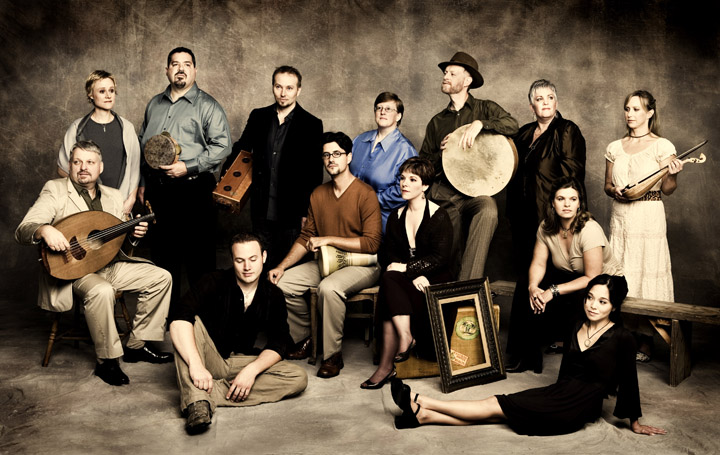
“For the fever of a song” – The Rose Ensemble Blossoms Before a Rapt Audience

(Ensemble photos by Michael Haug)

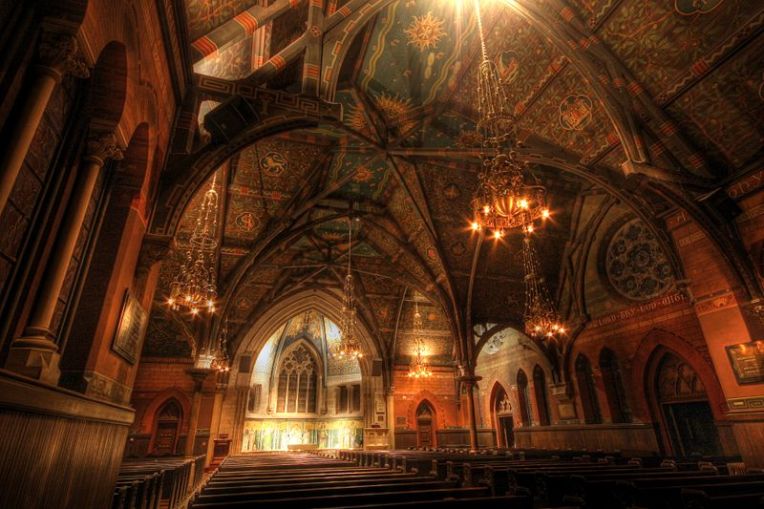
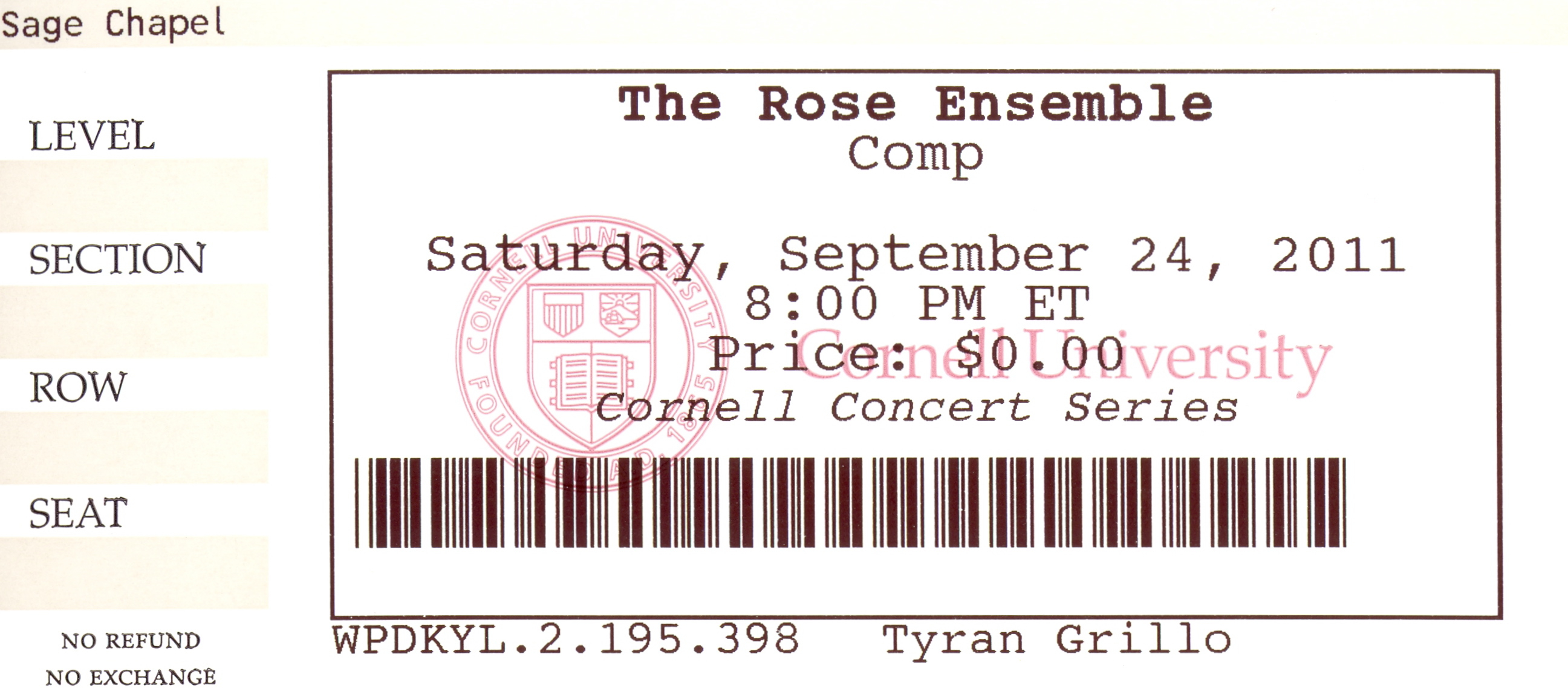
Sage Chapel, Cornell University
September 24, 2011
8:00 pm

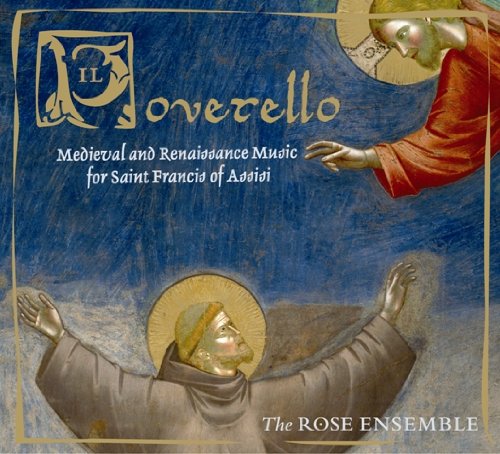
From its initial stirrings the human voice has sought to put the ineffable into words, to shape those words into melodies, and to pass those melodies on to posterity. Although the intrinsic value of this transmission has been irrevocably changed through the digitization of musical production, thankfully we still have groups like The Rose Ensemble willing to do things the old-fashioned way. And while of course their voices can also be found haunting the ever-refracting geographies of iTunes, in concert they plot an entirely different cartography, one that we wish to hold dear in that hermetic cave of memory where pores some nameless scribe who, by the candlelight of our awe, records that which moves us most. Now in its sixteenth year of activity, the Saint Paul, Minnesota-based collective of early music purveyors continues its mission of bringing vastly underrepresented repertoires from bygone eras to the ears of the living. To achieve this, members bring a wealth of scholarly legwork to every project. Over 1000 years and 25 languages infuse their nine recordings, the latest of which, Il Poverello, draws upon Italian Medieval and Renaissance sources in honor of Saint Francis of Assisi and which represents their performance at Cornell’s Sage Chapel on a still-humid Saturday night. If this opening concert was a sign of things to come, then the 2011-12 season promises to be an unforgettable one.

(Sage Chapel)

Before the concert even began, one couldn’t help but be impressed by the artfully crafted notes handed to us at the door. Numbering some 16 pages, they were exemplary in every respect and clearly manifested a steadfast dedication to craft, time, and care. Parallel texts, composer biographies, and a lovely essay that situated the program’s six-century purview in a vast web of miracles and politico-religious intrigue helped illuminate the life of a man so enigmatic that only through the ephemeral vagaries of music-making could such richness be revealed. In The Rose Ensemble’s meticulous tenure, Francis’s mysteries were distilled into a continuous circle of appreciation.

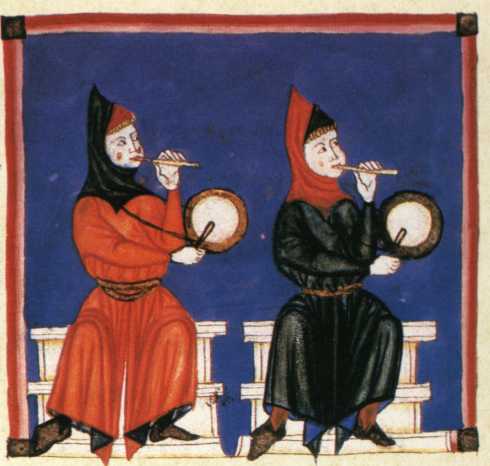
The music was as varied as its theme was unified. From enlivening dances and laude (non-liturgical spiritual songs) to no-less-stirring motets and plainchant, from composers well represented in early music circles (Johannes Ciconia) to those less familiar (Tomaso Graziani), this singular tribute was an unbroken string of hills and valleys. In addition to the seamless blend of voices, we were treated to a bevy of period instruments, including the paper-thin accents of the bowed vielle and rebec; the rounded edges of the recorder, shawm, double-flute; the shaded drones of bagpipes and hurdy-gurdy; and selected percussion, making for a collective sound that, not unlike the tongue of Francis himself, was “peaceable, fiery, and sharp.” These last brought an audible heartbeat to the instrumental interludes and inspired not a few feet to tap along on the chapel’s stone floor. Guest artist Isacco Colombo provided the evening’s most whimsical moments in Domenico da Piacenza’s 15th-century Ballo Anello, for which Colombo beat a tambor (slung drum) with his right hand while blowing a pipe (fife-like wind instrument with only three holes) in his left, looking like the one-man bands of yore.

(Pipe and taborers, as depicted in the 13th-century Cantigas de Santa Maria)

The narrative flow of the concert was further enhanced by readings at selected interstices. These ranged from firsthand accounts of Francis’s features and legendary stigmata to quieter theological reflections and even a recitation of Dante in Italian by Colombo evocative enough to elicit a smattering of applause upon its conclusion.

Among the tapestry of voices were many threads to tug at heart and mind, but in particular sopranos Kathy Lee and Kim Sueoka, whose filigreed loveliness soared above all in the motets’ more knotted passages and achieved a sonorous blend with the tenor lines and the notable anchorage of bass Mark Dietrich. Sueoka was especially arresting in her bird-like rendition of Radiante lumera, an anonymous 14th-century lauda that found her accompanied solely by Ginna Watson on harp. Yet the crowning jewel, if not the crown itself, of the concert was a sequential Stabat Mater sung in modal plainchant and also cradling the harp in its sonic breast. Its soul-piercing emotions leapt with the slow fire of Hildegard von Bingen at her most contemplative.

The blessing and the curse of early music is that we simply don’t know exactly how it sounded at the time of its creation. This sets before any aspiring interpreters the daunting task of reimagining atmospheres and places that exist for the most part on faded manuscripts and in forgotten alcoves. As a longtime listener, I have seen many such groups poke their head only briefly above the surface of obscurity, only to submerge back into it. Anyone who has heard The Rose Ensemble either live or on disc would surely flock to lift them from the waters should such an unlikely possibility ever present itself. Their deft blend of professionalism (there was not a single musical score in sight) and approachability (the musicians kindly offered demonstrations of their various instruments afterward) sets the bar beyond the reach of most. Not since the groundbreaking endeavors of Ensemble PAN or the Ferrara Ensemble have I been so profoundly affected.

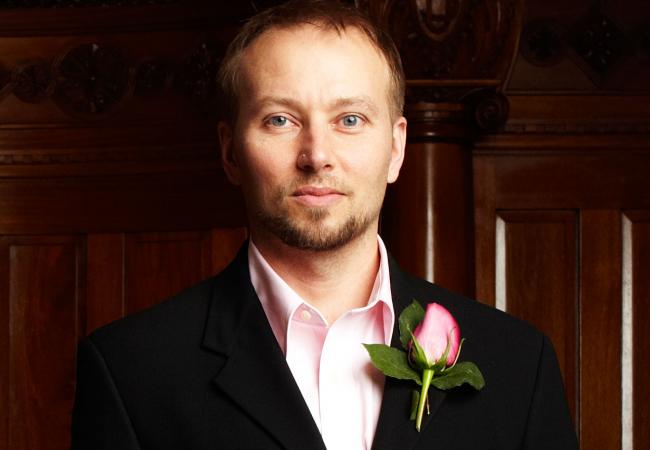
(Jordan Sramek)

Ensemble founder Jordan Sramek couldn’t help but pay humble deference to the beauties and acoustics of Sage during his thanks to staff and audience before an exultant finish, but these paled in comparison to the invocations that animated them. In charting the paths that led to The Rose Ensemble’s name, Sramek has described elsewhere its fragrant namesake as, among other things, a mystical symbol denoting “a portal into celestial worlds.” Nothing could be closer to the truth.

(See this article in its original form at the Cornell Daily Sun.)

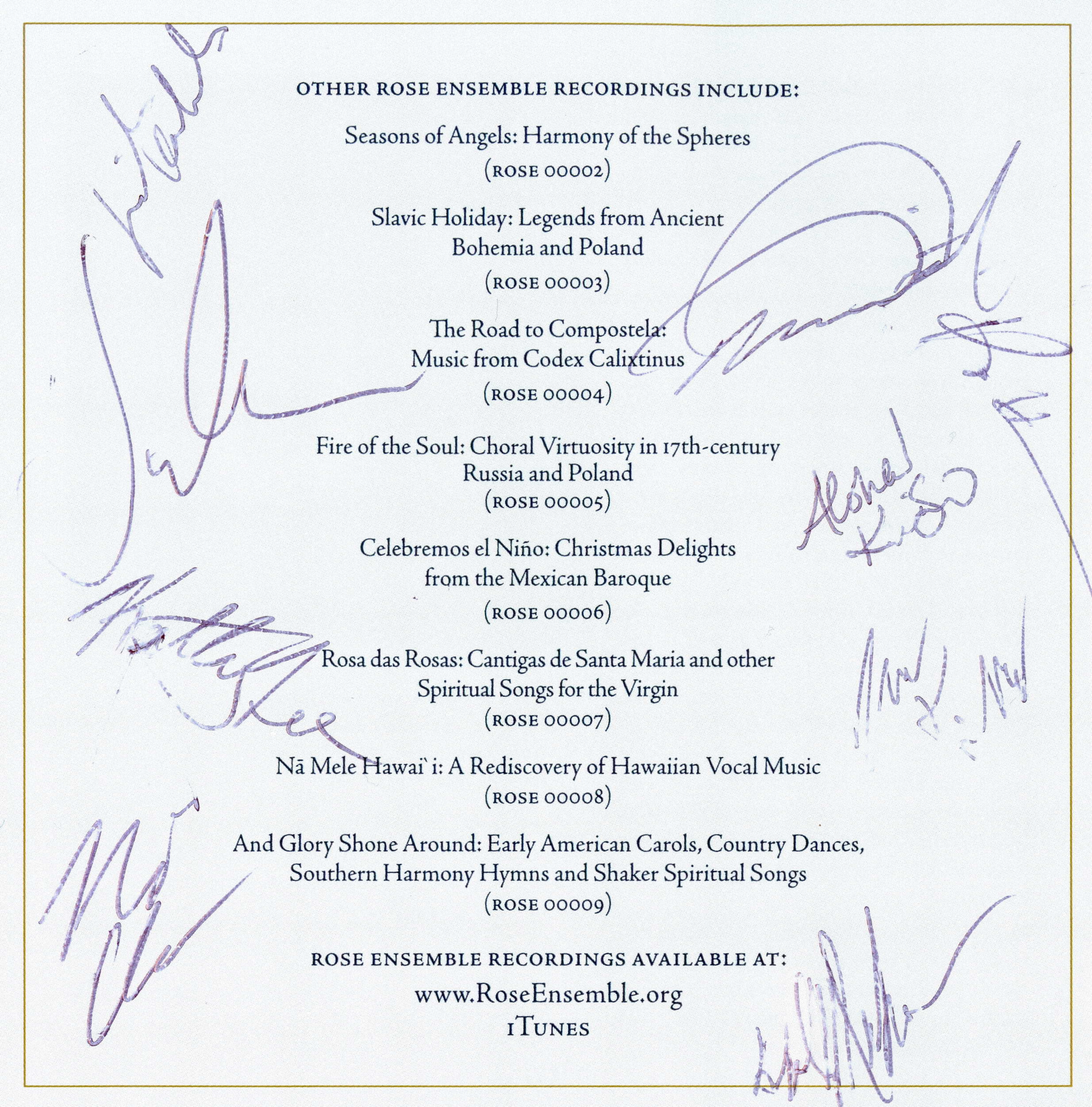
Signed CD Booklet

Turning Gold Into Life: A Live Report from Birdland

September 3, 2011
Birdland
8:30 pm

Gary Peacock bass
Marc Copland piano
Victor Lewis drums

Alchemy is defined as the process by which common substance is transmuted into something precious. This implies, however, that the base materials with which one starts are intrinsically of little or no value. On a humid Saturday night, enveloped in the singular space of New York City’s Birdland, a trio of uncompromising alchemists humbly turned this craft on its head, rendering the equivalent of sonic gold into something so immediate that we could sense only magic in what lies beneath our feet.

Although to the seasoned jazz enthusiast none in this trio configuration needed introduction, an introduction was exactly what this relative newcomer got the moment Copland laid his touch to the keyboard. Despite having played and recorded with a substantial handful of ECM greats over the years (including Ralph Towner, John Abercrombie, and Joe Lovano), his sounds had never before reached these ears. Lewis, of course, has intersected with Carla Bley’s unstoppable force on not a few occasions for Watt, but it wasn’t until I found myself in the closed quarters of tonight’s unforgettable set that his own alchemies became clear to me.

In any other company, Peacock might have seemed a tower among cabins, but with such graceful companions at his side his leaps of intuition were comfortably clothed. The trio’s loosely wound thread felt all the more consistent for having strung seven beads full circle. The lack of any announced set list showed that behind even the most burnished compositions there is only the lone heartbeat that animates them all, and it was in this circadian rhythm that we all shared. The aorta of that organ was Peacock’s bass, which thrummed, vast and sincere, in a phrase of welcoming. Like a bouquet of bronze-gilded morning glories, his notes unfolded and wilted at the slightest changes in light and air pressure. Copland’s unassuming presence and painterly asides added sheen to Lewis’s kit, as smooth as meringue. From the start, one could see just how much life experience Peacock compressed into every gesture.

The two tunes that followed were siphoned from the same font of wisdom, where Copland’s raw filigree and chromatic finger work sprouted wings and careered skyward. With a diving cymbal, we dripped into an even wider ocean. The cruise of Peacock’s bass emerged from the fog, morphing into a train as Lewis gained pace. Such were the seamless geographical transitions that made their interactions so special. With unpretentious sophistication, piano and bass laid out one carefully tied knot after another, each grafted by the occasional arresting snare hit.

The lone bass, dancing lithely between sky and earth, introduced a wintry mix of frozen truths and melting memories, all netted by unexpected classical flourishes from piano. Like Satie and Fauré walking hand-in-hand, these impressions found themselves conversing with an immeasurable peace. It was into this lull that we were all drawn before the darkness unleashed a dose of satori in a cathartic drum solo. Beginning at the periphery—rims, edges of cymbals, and the air around both—and working his way inward like a groundswell in reverse, Lewis mixed his ingredients with such precision that Peacock couldn’t help but smile. Copland, meanwhile, stood meditatively offstage, before both brought down a groove that, despite its light feet, left gravid remainders. With so much possibility before them, Copland’s defenestrations found all the kaleidoscopic thermals they needed to coast to solid ground.

For the penultimate number, as was true throughout, Peacock seemed to tell a story. Lewis, delicate as ever, caressed the drums with brushes or hands directly. Sliding easily from head-nodding goodness to somber turns, Copland swung from Peacock’s whimsical double-stops into his most inspired solo of the night.

Closing in the more familiar territory of Mile Davis’s “All Blues,” the set found narrative closure after rolling to the bottom of a most melodic flight of stairs. Lewis kicked the energy into the solar system with this one, and there we stayed.

As I write this I have the Peacock/Copland duo album Insight in the foreground. Seeming as accurate a distillation as any of the concoction brewed live (though I miss Lewis’s colorations), it reminds me that “insight” was indeed the operative word tonight. An insight aquatic, lush, and ecological; an insight circumscribed not by fences but by open doors; an insight as fleeting as its sharing, and all the more gorgeous for it.

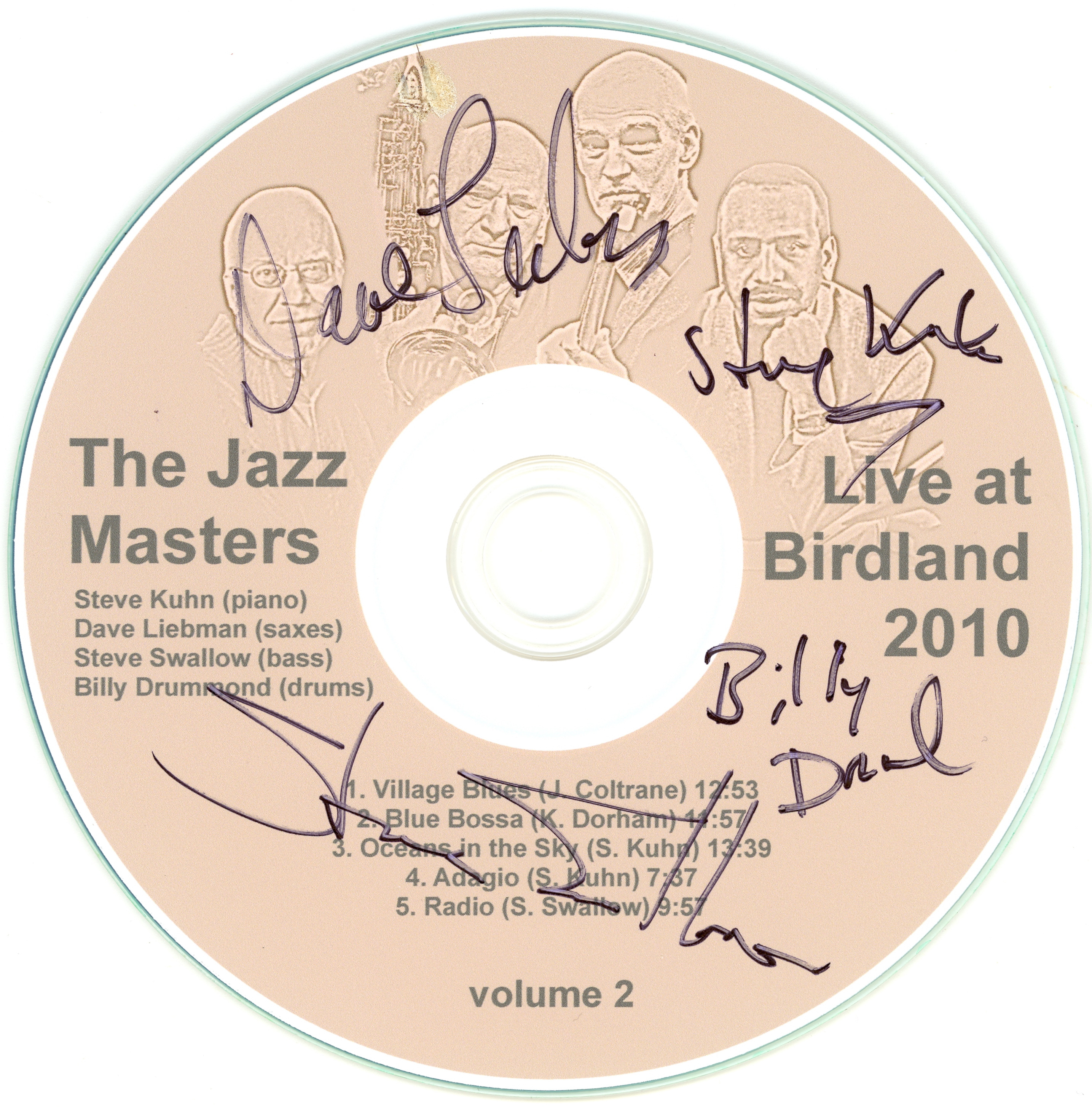
“Music We Order Our Lives To”: The Masters Quartet Live Report

August 20, 2011
Birdland
8:30 pm

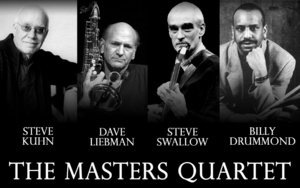
Steve Kuhn piano
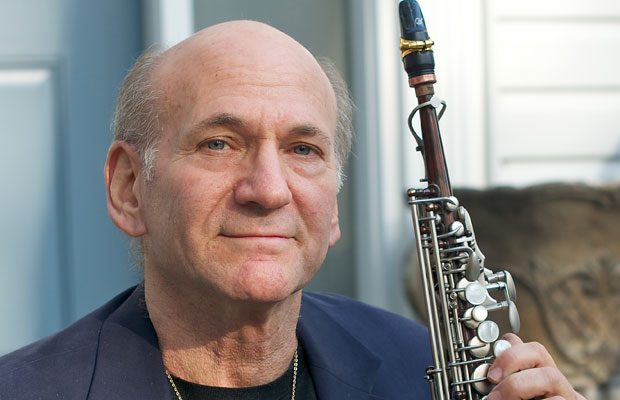
Dave Liebman saxes
Steve Swallow bass
Billy Drummond drums

A brief dictionary perusal of the word master yields variations on a theme of dominance: one who uses, controls, even disposes of that which is mastered. It’s with this hierarchical vision of mastery in mind that I entered the hallowed doors of Birdland for a late-summer performance by The Masters Quartet. None could earn such a title, of course, without verifiable skills and the countless hours necessary to hone them. As longtime collaborators, Kuhn and Swallow are strangers to neither, having made their first recorded appearance alongside Liebman on the bassist’s 1979 debut, Home, with over a decade’s worth of friendship and gigging already between them. Listening with eyes closed, one could hardly guess that Carla Bley band regular Drummond is a relatively new addition to this veteran nexus. Their blend was so seamless that by the time I stepped out into the humid streets, dominance was farthest from my mind.

To be in the presence of all four was already an honor, but the venue made it exponentially more so. This being my first Birdland experience, I finally understood why Charlie Parker dubbed it “The Jazz Corner of the World.” From its candlelit murmur, non-invasive wait staff, and intermittent tick of silverware to its top-flight roster, carefully considered sightlines, and one-on-one feel, the setting was ambiance incarnate. Though nothing remains of Birdland’s original digs, one can glimpse those glory days in the monochrome gallery of talents that adorns its walls. All the more reason, then, to bask in the present, where four incomparable musicians filled our ears with concoctions both pungent and smooth—not unlike the French martini at my fingertips—as they took to the stage and eased us into the evening’s intensities with a pair of trios.

A lush opening surge as only Kuhn can elicit swept this heart away in the standard, “There is No Greater Love.” With a sigh and a smile, he made us feel part of the band, creating music simply by bearing witness to its spontaneous unfolding. Through peaks and valleys, Kuhn navigated every turn of Swallow’s unshakable bass lines and the cymbal-happy squint of an ecstatic Drummond. The latter’s locomotive rolls opened a lyrical path for Swallow before kicking up a bit of dust as he exchanged jabs with Kuhn. His increasingly frenzied snare, along with Swallow’s leapfrogging bass, wound us into a state of high expectations. Thus did these gentle beginnings feed a dancing conflagration which, rather than brazenly overstepping those expectations, passed lithely through them like ghosts.

A milky intro stirred us into the coffee-like consistency of “Dark Glasses” (S. Swallow), resolving itself into a galactic swirl. With organic care, the music loosed ribbons of bass amid Drummond’s delicate knocking. Kuhn’s Möbius strip of a solo titillated (as a tongue, it would have rolled every “r”) and brought us ever closer to the filmic imagery lurking therein. Like its titular accessory, this joint at once clarified and obfuscated, cutting out the glare while hiding choice secrets.

“All the Things That…” (D. Liebman) marked its composer’s entrance to the stage. Inspired by the standard “All the Things You Are,” this smooth excursion was a prime vehicle for that oh-so-sweet soprano. With the magic of a mirage shimmering into shape, it showed us a level of tonal acuity that one can only dream of producing. Drummond provided sympathetic response, matching each of Liebman’s calls with joyful paroxysms of his own. Such were the beauties that awaited us also in “Adagio” (S. Kuhn). Here, Liebman’s slide into resplendence fogged our view with a long exhalation. Meanwhile, Kuhn tumbled in careful somersaults, marking the swaying rhythm that caught this listener from the get-go. Swallow traced a wide embrace with an engaging solo turn that seemed to welcome us all into its arc.


(photo by Manuel Cristaldi)

We were then treated to an unfailing rendition of “Village Blues” by John Coltrane, a “mentor to us all” as Kuhn so respectfully noted before its trio intro buttered our bread like nobody’s business. This proved a solid launching pad for a dramatic color shift as Liebman’s tenor awoke from its slumber. It, too, spoke in wooden riddles and guttural dreams, but those gritty squeals layered on the sonic paint—Van Gogh to his soprano’s Monet—and added a new dimension to surrender. His blows were softened only somewhat by Kuhn’s detasseling pianism, diving instead into an epic exchange with Drummond.

For the standard, “My Funny Valentine” (the “romantic highlight” of the show, as Kuhn artfully quipped), we were back to the smoky grain of soprano. Here the pianist’s poetry shone at its brightest, dissolving into lute-like strains of bass, as if in watercolor.


(photo by Robert Lewis)

Liebman’s robust tenor then inscribed “A Likely Story” (S. Kuhn) onto the pages of our attention. Against a grounded bass line and deep piano digs, he was lively and on point. Kuhn held a steady clip across his tightropes, tethers to an inspiring synergy with Drummond, who dotted the sky with sparks as this log was cast onto the evening’s kindling. I couldn’t help but note how “keyed in” Liebman was as his fingers mimed on the sax during a sit-out before he dove back in for the final splash.


(photo courtesy of the Montréal Gazette)

Mastery revealed itself in many guises throughout the show, but chiefly by the adroit ways in which the group always held fast to the tightly wound spring that thrummed at the heart of every tune they played. Their thematic cohesion was due in no small part to Swallow, who electrified with his unparalleled anchorage and fluid anticipations. Kuhn, ever the picture of concentration, threaded each of his needles with mindful improvising, those unmistakable octave splits crying with such epic grace that captivation was our only option. With every run of his fingers he seemed to travel miles’ worth of emotional distance. Against such broad pointillism, Liebman’s richness came across as filamented, teetering on edge, and all the more visceral for it. He was every bit the vocal performer, untangling seemingly impossible knots in a fraction of the time it took to tie them. As for Drummond, he seemed to squeeze every last drop of soul from the most delicate gestures, treating each as a gig in and of itself. He positively stole the show in its final gasps.


(photo by Albert Brooks)

In short, the quartet put the “band” back in “abandon” and proved yet again what for me is the blessing of jazz, an art form that makes the immediate effects of improvisation feel as if they have been growing inside us all along.

Furthermore, I discovered that true mastery bleeds from art into one’s countenance, one’s approachability as a human being, one’s humility offstage. In other words, it is nothing without the light of graciousness that permeated each of these four men, their loved ones, and the fans in attendance. In the end, their performance might very well have been but a flash in New York City’s overcrowded pan, but their afterimages are safe with me.


Autographed CD of last year’s gig, purchased at the club

Killing Pain, Not Time: Arild Andersen Trio Live Report

June 11, 2011
Xerox Rochester International Jazz Festival
Lutheran Church of the Reformation
7:30 pm

I find it difficult to begin any review about Arild Andersen without billing him simply as a “Norwegian bassist.” Succinct though the term may be, it hardly hints at the far reach of his fingertips, bow, and musical vision. A packed house felt some of that reach in the distance he’d so graciously traveled to bring his latest outfit to this year’s Rochester Jazz Fest as part of its “Nordic Jazz Now” series. While the cover of the Fest’s concert guide sported a collage of big names, headlined by Elvis Costello, Natalie Cole, k.d. lang and the like (ECM mainstay Bill Frisell could be found lurking among them), Andersen’s visage was nowhere to be found. Thankfully, this did nothing to deter an appreciative crowd from basking his warmth.

The trio is an intermittent format for Andersen, whose underrated early date with Bobo Stenson and Jon Christensen, 1971’s Underwear, gave listeners a foretaste of the propulsion that continues to strum the heartstrings of his playing. Thirty-two years later found him alongside Vassilis Tsabropoulos and John Marshall in The Triangle, a distinctly pianistic record of gentler pulses in slower motion. Though Andersen was the heart of these outliers, his compositional beauties were reserved for his influential quartet—and quintet, via Masqualero—outings throughout the seventies and eighties. Where the Tsabropoulos project was threefold, Andersen’s newest trio with saxophonist Tommy Smith and drummer Paolo Vinaccia is hexagonal, for each musician is doubled by a modest array of digital equipment. The latter, along with the glitter of Vinaccia’s golden Pearl kit, was the first to catch my eye as I settled into my pew at the lofty church where the concert was held. Andersen’s bass lay prone on the stage, its tiger-grained wood at once regal and humble. Stained glass icons seemed to fix their gazes upon it as they opened their arms, wept, and tended to the ailing—an emotional tableau not unlike the performance we were all about to experience.

On the morning of, I had awoken to the rather different tableau that is a pulled back muscle. Though it did little to squelch my anticipation for the day’s proceedings, it made getting there that much more uncomfortable. The muscle relaxants I took had rendered my body about as liquid as a phrase from Andersen’s bass. The effects had worn off by the time of his first evening set (sadly, financial constraints kept me from staying for the second), making sitting increasingly uncomfortable. It was in this state that I welcomed the sight of the trio ascending the stage.

Andersen offered a few words to start, openly lamenting the infrequency of European jazz acts in the U.S., before Smith launched into a rendition of a Gregorian chant. Fed through a microphone and expansively echoed, his Mark VI tenor blossomed with such gorgeous depth that, once Andersen joined with his arco strains, any pain I had felt was immediately blown to dust. Andersen and Vinaccia then shifted gears into an arid soundscape with Masada-like flavor, Andersen’s smile forming the perfect bridge into the beautifully realized Norwegian folk song that followed. Here, Vinaccia played with what appeared to be small wicker brooms without handles. Over this staccato backing, Smith plied his most soulful highs (which sounded like a soprano), going from sandy to cloudy and back again in a flash. Andersen’s echoed bass wavered like a receding mirage, leaving us to ponder a lone turn from Smith, an entire desert in his embouchure.

The cerebral groove of “Independency” (only Part 4 was played), written in 2005 for Norway’s centennial independence, unpeeled one of Andersen’s most captivating solos of the night and segued into his beloved “Hyperborean.” The title here refers to a mythical people with whom Apollo spent his winters in drunken revelry in a land without night—not unlike, Andersen quipped, Norwegians themselves. From the avian warbles of his bass to Vinaccia’s echoed brush-rolls, this piece sang of and through the heart. Smith’s exacting dynamic control was on full display, peaking in those soft, wooden highs. The band put us back on our feet with another folk song, “The Farm Girl,” even as it pulled the rug out from under them. Clouds of fire from each musician in turn delighted us before cooling with the vamp into fadeout. Last was “Dreamhorse,” a contemplative Andersen original with the watercolor bleed of a Kuára collaboration. The melodious exchanges thereof made for a fitting farewell.

The music of the Arild Andersen Trio is not about showing off. It is about mood, reflection, and living in the moment. The bass may be Andersen’s voice, but songcraft is his forte. The opening stretch of “Hyperborean” alone was enough to wipe clean anyone’s slate free of critique. Smith was the tail to his dove. His cleanness of tone paid clear homage to Jan Gabarek even as it forged into distinctly personal territories. Vinaccia’s drumming brought a sound as organic as the dried plants with which he elicited it and was also a joy to hear in close quarters.

With so many Fest events going on in succession, if not simultaneously, this evening show was a welcome respite from the day’s hurried atmosphere, and was a sonic gift of synergistic proportions.

Signed program

Savion Glover: Feet First, a live review (February 28, 2011)

In 1996, a career-defining stint in the Broadway hit Bring in ’da Noise, Bring in ’da Funk established Newark-born Savion Glover as the true heir apparent to Gregory Hines and the so-called “Hooferz” tradition of tap. Fast forward to last Monday night, when Glover electrified Cornell’s Bailey Hall with his unstoppable feet, and one sees just how far he has come. One is hard pressed to name another dancer, tap or otherwise, alive today who has generated as much inspiration and appreciation. Rooted as he is in the solid surface beneath him, he paints pictures with body parts that normally get us from Point A to Point B, but which in his creative web take on an entirely new form of communicative power. Key to his sound is his sharp attack (what he calls “hitting”), and this he brought in full measure to a packed house for his latest project, “SoLo in TiME,” which draws upon the rhythms and emotional acuity of flamenco.

As one who continually engages with histories and modes, Glover is no stranger to the importance of an evocative moment. Flamenco, therefore, feels like a logical next “step” for one of his caliber and drive. With the group Flamenkina providing a fine mesh of tried-and-true sentiment and modern sensibility, not to mention a star turn from BARE SOUNDZ member Marshall Davis Jr., Glover was, to be sure, in intuitively minded company. His setup reflected the exacting nature of the hoofer’s craft: A raised square stage miked from within was surrounded by four speakers and flanked by the musicians. Of the latter, guitarist Gabriel Hermida was first to join in at stage left. Starting at the margins and working their way to the center, the percussive sounds of Hermida’s instrument provided a likely foil to the various snaps, slides, clicks, and cries from those loosed taps. With such a “vocal” range as Glover possesses, he spoke to his audience at every turn.

Flamenkina

Rather than start with a bang, he restrained himself at the back of the stage, as if warming to the spotlight he outshone. I could not help but compare the dexterity of his feet to that of fingers on castanets, as reflected in the superb dynamic control of his instrument. Beneath him, the stage was a taut drum, replete with tuned sections and a wide range of tones. Once bassist Francesco Beccaro and Carmen Estevez—who played the cajón (a Peruvian box drum that seems to be popping up everywhere these days) and graced us with her mellifluous voice—took to the stage, the musical elements of the show began to soar. With a smile of life-affirming joy, Glover negotiated a complex landscape of creative signatures with infectious passion for the material at hand. Like the sweat from his brow, it was a veritable shower of kinesis.

Estevez and Glover shared some of the concert’s most intimate exchanges, those tapping feet the metronomic tide to her sandy shores. Although the band was sometimes lost in the sound mix, if only because the hoofer’s sound rang with such conviction, things balanced out once he and Estevez closed the circle. Still, at its best, the band enacted a glorious unity.

Glover had some fun with the audience during a solo rendition of Queen’s “Another One Bites the Dust.” Feeding off our rhythmic clapping, he took the interaction as far as it would go before abandoning it in favor of a more complex unraveling, whereupon he was joined by Davis, whose synchronicity and more compact style made for some enthralling interactions. Both hoofers practically leaped from the raised stage whenever they were finished, as if the call of that resonant surface was too much to ignore.

Glover’s musical approach is anything but programmatic. Here is an artist who paints in feelings and not images, who dances with palms open, as if in supplication to the gifts with which he has been graced. Seeing him live, one experiences tap at its most essential. No matter how fast he gets, his feet ring through with clarity and immediacy. In this regard, the show’s title might as well have been flipped to read: “TiME in SoLo,” for no matter how far he abandoned himself to the spirit of the moment, he harbored a seemingly infinite inner peace, so that by the end most of us were sitting transfixed. It was the kind of show during which we almost dared not tap our feet, for we could add nothing to something so lushly realized.

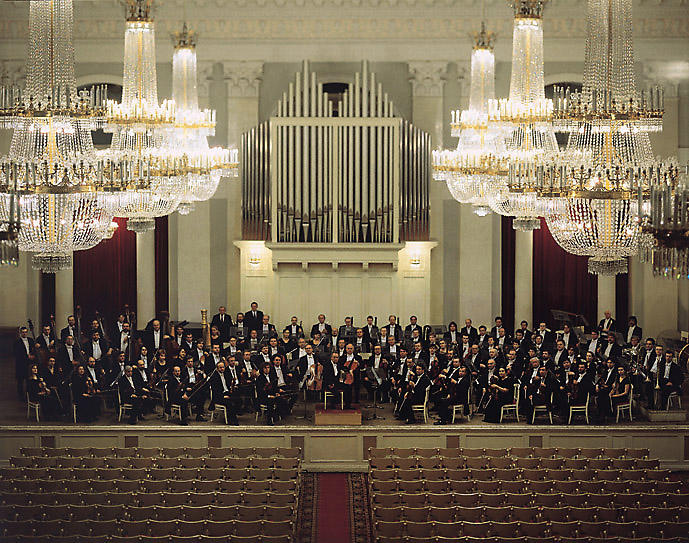
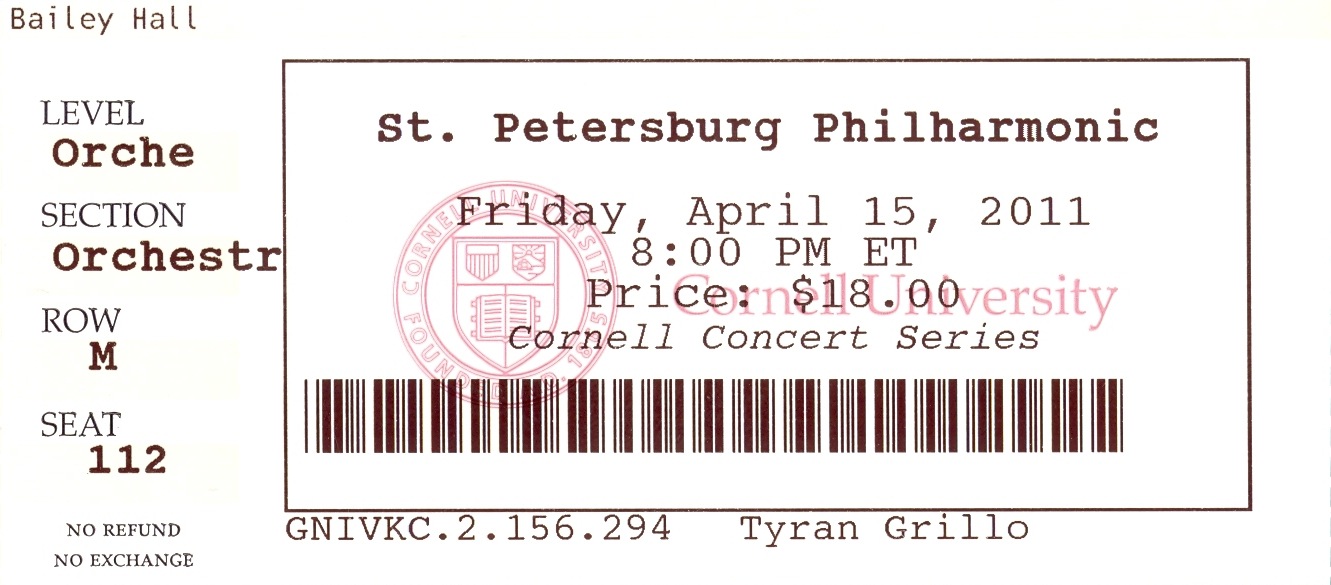
St. Petersburg Philharmonic live review (April 15, 2011)

St. Petersburg Philharmonic Shines at Bailey

Had gastronome Brillat-Savarin been a musician, he might have quipped, “Tell me what you play, I will tell you who you are,” which is to say that music is nothing without the instrument through which one expresses it. Therein lies the snag in Friday night’s performance by the St. Petersburg Philharmonic Orchestra, whose fabulous coruscations were tempered by a quiet shadow.

But first, the good. As Russia’s oldest symphonic ensemble, the SPPO exudes professionalism and the charisma to match. Before a sold-out Bailey Hall crowd, conductor Nikolai Alexeev led a hefty program comprising of two major works from his homeland.

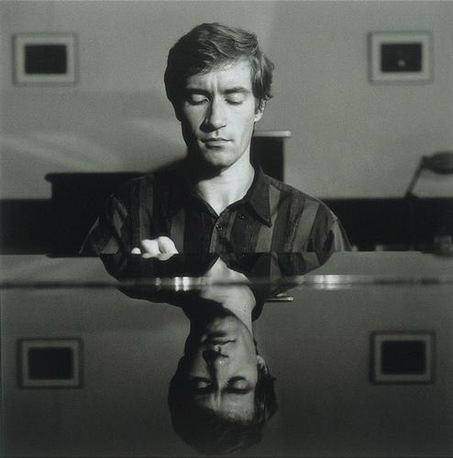
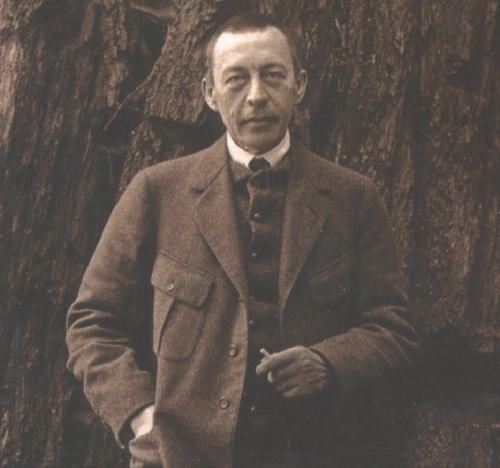
Composed at the dawn the twentieth century, the Piano Concerto No. 2, Op. 18 of Sergei Rachmaninoff (1873-1943) stands as one of the most enduring testaments to pianistic craft. It marked the end of a depression brought about by the derision with which the composer’s first symphony was met at its 1897 premier. Though among the more difficult concertos to master, at the hands of soloist Nikolai Lugansky the concerto’s complexities melted into a vibrant wash of sound. Lugansky’s poise was a joy to witness firsthand. Sadly, at least from where I was sitting, one was hard-pressed to say the same about the Steinway at his fingertips. A beautiful instrument in its own right, yet with such a watery middle range that it simply wasn’t up to the task of netting an entire orchestra, it seemed to get lost in itself. Similar issues marred the recent Leonidas Kavakos performance, which was otherwise technically first rate.

Lugansky

Rachmaninoff’s concerto is an epic, multilayered piece, but its vibrant colors seemed finger-painted in muddy passages with little separation. And while the piano’s lower and higher registers occasionally cut through the din with fortitude, for the most part Lugansky was lost in the orchestra’s massive sonic mazes. This was by no means the fault of the artists, who nevertheless wrenched out as visceral a performance as one could have hoped for. From the famous bell tolls that open the piece to the rapturous handsprings that close it, the music leapt from Lugansky’s hands almost as many times as he did from his seat when trying to wrench as much volume from the piano as he could. Along the way, he shared captivating little dialogues with winds, most clearly balanced in the second movement, where the quieter surroundings allowed the piano to breathe. As if from a deep slumber, its stepwise descent was awakened by the majestic runs of the final movement. The most heartfelt moments were to be found here, set off to captivating effect by Lugansky’s lithe trills and finger pedaling. And as the music’s Rhapsody in Blue-esque dramaturgy wound to a close, the crowd rose to its feet amid shouts of “Bravo!”

Rachmaninov

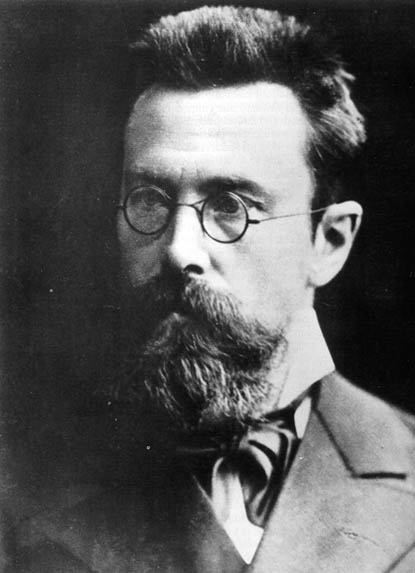
Nikolai Rimsky-Korsakov (1844-1908) composed his famed Scheherazade, Op. 35 in 1888. Based loosely on tales from The Arabian Nights, this symphonic suite depicts musically what the classic literary work does textually. The story, in the composer’s words: “The Sultan Schariar, convinced that all women are false and faithless, vowed to put to death each of his wives after the first nuptial night. But the Sultana Scheherazade saved her life by entertaining her lord with fascinating tales…for a thousand and one nights. The Sultan, consumed with curiosity, postponed from day to day the execution of his wife, and finally repudiated his bloody vow entirely.” And, surely, one can imagine the power of her storytelling in the music. Scheherazade herself makes frequent sonic cameos therein, represented by a leitmotif of violin and harp that runs like a golden thread. Thankfully, the piece has flourished beyond its Orientalist roots as a programmatic masterpiece that was a thrill to hear in such close quarters. Any acoustical issues were taken backstage with the piano, thereby allowing the SPPO to shine. Alexeev’s skillful direction was a pleasure and, at certain moments, brought the musicians to frenzied heights. Their strengths were found in what are often an orchestra’s most underappreciated sections: brass, winds and percussion. Like drummers or keyboardists in rock bands, their accents are the key to a seamless collective sound, and this they brought in full. Principal clarinetist Andrey Laukhin did a particularly fine job with his many rousing passages. Not to be outdone, however, were concertmaster Lev Klychkov and principal cellist Dmitry Khrychev, both of whom figured as leading voices. Klychkov’s bow made a few unintended noises, while Khrychev’s sound came off as flat at times, which perhaps explains the few boos they received during curtain call. Otherwise, they brought due passion and verve to the proceedings.

Rimsky-Korsakov

A humorous moment occurred when, as the audience was clapping after the first section, Alexeev took the opportunity to empty his nose into a handkerchief, encouraging further applause as he did so. This interaction was true to the free-spiritedness that pervaded the entire evening. These were performers who clearly enjoyed what they were doing and who invited us into that revelry at every turn, such that someone sitting in the audience sitting behind me couldn’t help but occasionally whistle along. The second standing ovation was met with a delectable finale in the form of the “Trepak,” or “Russian Dance,” from Tchaikovsky’s The Nutcracker — which, from the sound of it, they could have played in their sleep.

Quibbles aside, this was one of the finer of this season’s Bailey Concert Series performances here at Cornell, and left a satisfied house in its wake. The orchestra’s world-class reputation held its water, while Lugansky, who graciously signed CDs and programs after the show, brought a palpable inertia to the playing. All the more unfortunate, then, that the piano should have asserted an incongruent gravity of its own.

See this review in its original form here.

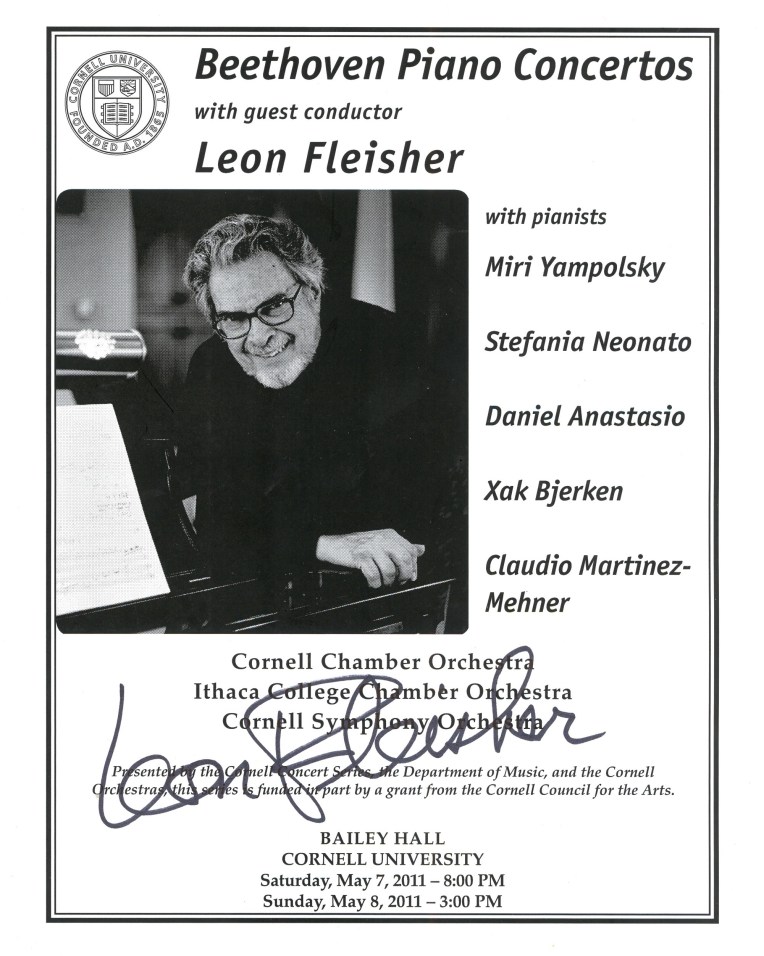
From Two Hands to Ten: A Review/Interview with Leon Fleisher

Below is my review of two recent concerts led by Leon Fleisher under the title of the “Beethoven Concerto Project” at Cornell University’s Bailey Hall, May 7/8, 2011. The full interview excerpted therein follows.

Leon Fleisher comes from a line of piano students extending directly back to Ludwig van Beethoven (1770-1827). Who better, then, than he to bring all five of the legendary composer’s piano concertos to the stage for a two-concert series? Fleisher is a legend in his own right, though one might never have suspected as much from the gracious humility with which he welcomed me to interview him last Thursday. In his speech I sensed a journey contoured with valleys and peaks in equal measure. At the highest of the latter, an illustrious career was suddenly halted when he was diagnosed with a neurological condition known as focal dystonia. This manifested itself in his right hand, two fingers of which curled under of their own accord. This might have undone him, were it not for an indomitable spirit and his prevailing love for the music that uplifted it.

Amid the storm of post-WWII pianists, many of whom were predisposed to strident showpieces, Fleisher had been quietly scrimshawing a more delicate niche into the yielding bones of the Austro-German canon. Very much a product of his teachers and their interests, as he will be the first to admit, Fleisher had settled into this repertoire without question, only to see it fade from his fingertips. One consolation: an altogether engaging body of work for the left hand paved the way for his reprisal on the classical stage. It was then that he began teaching, as well as conducting some of the world’s most prestigious orchestras. One unforeseen result of his activities at the podium was carpal tunnel syndrome, the corrective operation for which miraculously relieved his dystonic symptoms enough so that, with a measured combination of botox and Rolfing therapy, he has been able to play with two hands for the last fifteen years. Although he will never regain 100% functionality, his virtuosity and sensitivity have grown into something else entirely.

At a tender 82 years, Fleisher exudes a healthy balance of experience and resigned honesty. Refreshingly uninterested in the frills that so often creep into contemporary performance practice, he is more concerned with uncovering the music as it might have been, as it is now, as it may ever be. Not to be confused with an idealist, he is one who enjoys the proverbial moment, which remains the ultimate validation of all the practice and discipline that go into any performance. There is a peacefulness in Fleisher that one feels in his very presence, in his careful steps onto the stage, in the way he sits rather than stands, placing himself at a more familiar level with the orchestra before him, before us. His tempi are respectful, comforting, and never jarring, and his pianistic understanding of the music shines through with every swing of his hands.
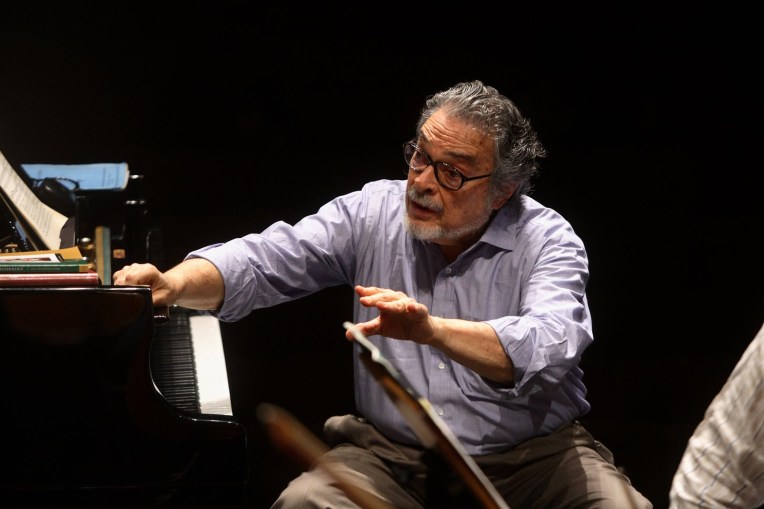
(Photo by Susana Neves)

During our conversation, I asked Fleisher to share his thoughts about Beethoven, a composer with unfathomable staying power. “The remarkable thing,” he told me, “about Beethoven, I think, is the rate at which he overcomes the detritus, the residue of…bad performances. His success rate is extremely high. In other words, you can really play Beethoven quite badly, and still something very powerful will come through.” With this in mind, it only made sense that each concerto be presented to us by a different soloist. Not only did this allow the audience to hear more clearly the distinctions between the concertos, but also those between the performers, each of whom brought an idiosyncratic flair to bear upon the material at hand.

Miri Yampolsky, Fleisher’s former student, offered the most well-rounded balance of stylistic grace and sense of musical grammar in her rendition of the Piano Concerto No. 1 in C major, her buoyancy in the right hand foiled tastefully by a weighty anchorage in the left. Xak Bjerken—another former student and Yampolsky’s husband—brought his own unique grace to the keyboard, which lent itself beautifully to the Piano Concerto No. 4 in G major. By far the most enigmatic of the set, this concerto, as Fleisher informed me, was once known among musicians as the “ladies’ concerto,” a tidbit of archival derision that has thankfully lost its currency. Fleisher himself prefers to see the Fourth as a middle-period dip for Beethoven into cosmological waters, a sonic foretaste of the metaphysicality that so pervades his final symphonies. Of all the players, Bjerken was most attentive to the baton, and one could feel his respect for the one holding it in every note he played. Italian-born Stefania Neonato had a fluid sense of timing of her own for the Piano Concerto No. 2 in B-flat major, heard most clearly in her trills and constantly running fingers. Not to be outdone was Spanish virtuoso Claudio Martinez-Mehner, yet another former student of Fleisher’s who filled the hall with palpable revelry in his rendition of the Piano Concerto No. 5 in E-flat. Also known as the “Emperor Concerto,” it more than lived up to this apocryphal nickname through the gallant expressivity that pervaded its realization at every turn. Yet by far the highlight to everyone’s ears, if the full-house standing ovation were any indication, was rising star Daniel Anastasio, a Cornell senior and student of Bjerken’s, who brought his finesse and prodigious talent to the stage for the Piano Concerto No. 3 in C minor. So propulsive was his enthusiasm that it spurred him on prematurely, so that his chordal punctuations in the first movement did not always sync with those of the orchestra. Rather than see this as a detriment, I felt it as a sign of his exuberance. Both he and Bjerken continued the Fleisher lineage with due poignancy.

Readers of my past reviews will be all too familiar with my love/hate relationship with the house Steinway at Bailey Hall, but I am glad to report that the modest settings proved to be a fine sonic fit this time around. Martinez-Mehner in particular elicited more volume than I have ever heard from the selfsame instrument, a kinesis we saw reflected in his unbridled body language. Sometimes the relationship between soloist and orchestra is likened to a conversation. Yet in these concertos, at least, the piano was a conversation in and of itself, and the surroundings overwhelmed not a single word. As far as the three (!) orchestras were concerned, the results were variable. The Cornell players, in both their Chamber- and Symphony-sized incarnations, as Fleisher wittily related in our interview, were under the stress of finals: “They were sitting there playing, looking as dour and depressed as I’ve seen in any group in my life. I was so struck by it that I stopped and I mentioned it to them. I mean, here are young people in their late teens and early twenties, looking like they were all ready for the couch! And then one bass player said one word that explained it all: Finals. Poor kids…that’s not really what I think even the most refined education is all about. There has to be some joy in life. They smiled a bit after that.” As students who must balance primary academic commitments alongside their musical double lives, our Cornellians performed admirably well. And let us not forget the lovely Canzonas by Giovanni Gabrieli (c. 1553/1556-1612), courtesy of the CSO Brass Choir, that bookended Sunday’s concert just outside the hall steps. That being said, the Ithaca College Chamber Orchestra was in a league all its own. Comprised of handpicked music students, it breathed like a single organism through superb tonal colors and communication. Regrettably, they lent their bows and breaths only to Anastasio’s performance, making it all the more electrifying.

“Like an EKG graph” was how my wife described the concerts. With her usual brilliance and fresh ears, she was able to cut through my verbose meanderings with a concise destination. For her, Beethoven is not about climax and resolution, but about the careful placement of clusters along an otherwise constant lifeline. I can only agree: Beethoven’s music doesn’t so much peak as plateau, navigating the nooks and crannies of a landscape that is bigger than all of us. This architecture was also reflected in the showings that preceded both concerts of Nathaniel Khan’s touching 2006 Oscar-nominated short film, Two Hands: The Leon Fleisher Story. In Fleisher’s testimony, we find something of a Beethovenian soul, one unwilling to let infirmity control the potency of its artistic license. As Fleisher so carefreely told me, when I asked about his being here, “It’s just a great adventure to go through with several of my former students. It’s a great delight to be able to come and explore the nature of this material with next generations. Plus, it’s fun, it’s what I do.” In the end, I could only bow to his candor, and by extension to the efforts of everyone who made this weekend possible.

(Photo by Joanne Savio)

Full interview with Mr. Fleisher, conducted by Tyran Grillo on May 5, 2011:

Having only just recently seen the documentary Two Hands for the first time, I am still struck by a comment you made regarding your connection to music itself—that it was perhaps the most important connection of all, something that had sustained you through hardships and ecstasies alike. And so, it is this connection that I would primarily like to discuss with you today. Before we get into that, however, I wish to ask one question in relation to your instrument: Have you come to hear the piano differently between the bench, the podium, and the classroom?

What an interesting question. I think I have to answer that “yes” and “no,” simply because, on the one hand—which would represent the “no,” I think—I hear in my head what I think is, for me, the ideal. In fact, that’s usually…well, I can explain the mechanism as I see it. On the other hand, as I actually listen to what’s being played, I think there is probably a difference between, let’s say, piano, orchestra, and students. I guess the main difference is whatever the medium is, whether it’s chamber music, solo piano, or orchestra. The idea of hearing—or listening, I should say—is an interesting one. The performer is, in fact, three people at the same time: Person A, Person B, and Person C. Person A, before he or she plays, must hear in the inner ear what it is that they’re going for, what their ideal is, so that they have a goal to strive for. If you put a key down without an intention behind it, it’s an accident, which means that the key that follows it is based upon an accident; everything that follows is based upon accident.

That reminds me of an art teacher who used to try to correct me from smudging as a method of shading. He used to say that a smudge is nothing more than a smudge the moment you run your finger across it. It just becomes an incidental mark without intention.

Oh, really? I can’t understand that. The smudge itself might be an intention…. So, that’s Person A. Person B is the one who actually does the playing, and has to be totally aware of how that playing is being manifested, so that if what Person C—who sits somewhat apart, who listens and judges—hears is not what Person A intended, Person C tells Person B, the doer, what to adjust to get closer to that ideal of Person A. And this is a process that goes on simultaneously and continually, all the time.

And, more broadly, do you feel that you changed over time as a listener?

Yeah, oh sure.

And do you think there is one change more than any other that has been deepest for you in your listening habits?

Well, I spent a good third of my life at the piano, which was essentially my instrument of choice, as it were, and most of the second third of my life, or a good part of it, dealing with orchestra, which is a beast of a totally different color. It’s really quite fascinating dealing with an orchestra. The response time on a piano is virtually instantaneous. In an orchestra, you have varying response times. I guess percussion is the most instantaneous, then strings. And you get varying responses out of winds and horns. Brass instruments respond later. And that’s just in terms of timing. Then you have timbre, instrumental differences. The one great advantage of the piano is that you can make it sound like an orchestra, and you can make it sound like the instruments of an orchestra. You can make it sound like a French horn or an oboe, cello…stuff like that. Yeah, it’s fascinating. Being a soloist is a very solitary affair, and therefore is full of what you might call the luxury of time. When you’re in your studio, however long you have to practice before you have to go about the rest of your life, that depends, but usually professional orchestras today rehearse for two and a half hours with a fifteen-minute break. That costs money, and you cannot go one second over time, because they’re paid in fifteen-minute segments. You go five seconds over and you have to pay them for fifteen minutes. So, dealing with an orchestra is, in a sense, more stressful, much more compact. It becomes very much a question, as with a doctor, of diagnosis and prescription. In other words, you have to be able to tell pretty much instantly what it is that’s not working, why this doesn’t sound the way you want it to sound. You have to diagnose the problem, and not with a certain infrequency do you find a conductor who from time to time misdiagnoses, who thinks the problem came from this or that player when in fact it comes from someplace else, and that’s usually when he loses the respect of the orchestra, because he can’t diagnose. And once you’ve made your diagnosis, you have to come up with the answer, with a prescription, to make it work. So, it’s a different kind of process. When you’re a soloist you have that luxury of time, you can try it this way and that way, you can ponder it, you have time.
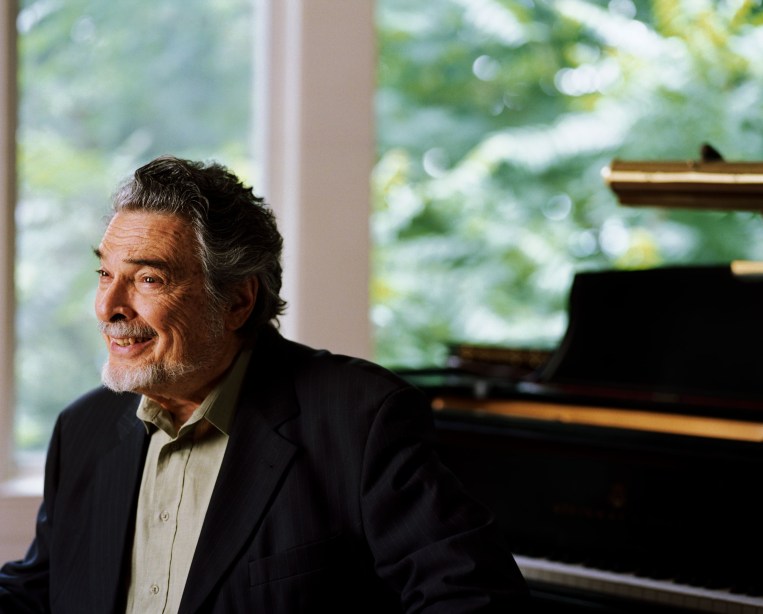
(Photo by Joanne Savio)

Moving on now to Beethoven, I would like to field your thoughts on the series you are presenting here at Cornell, which is, of course, the Beethoven Concerto Project. Could you share your thoughts on the appeal of the concerto form and how the piano fits into its long history?

Oh, I think it’s very basic, if not primitive. It’s that age-old story of one against the many, and who’s going to trial. The poor, singular soloist…which is often emphasized if the soloist is of the feminine persuasion, making it even more appealing as a dramatic story. And then, happily, in the end everybody triumphs.

Some would say—and here I am thinking specifically of András Schiff—that the music of Beethoven is prone to getting lost under the residue of time and interpretation, and that one must try to “refresh” it, so to speak, with each new performance.

And how? Does he say how? [laughs] Does he pick up a hose and hose it down?

He tries, I think, to look at the score as much on its own terms as possible.

Yeah, I think that’s valid for whatever composer you’re playing. The remarkable thing, though, about Beethoven, I think, is the rate at which he overcomes the detritus, the residue of those bad performances. His success rate is extremely high. In other words, you can really play Beethoven quite badly, and still something very powerful will come through. Most other composers, if you play them badly, just become flat. But Beethoven, for some reason, manages to supersede, to…what’s the word I’m looking for…

Transcend?

…transcend even bad performances. I certainly agree with András, though I think it can be done with every piece of music. A piece of music, in a way, is an interesting kind of process. Because, like most art, in relation to the norm most great art consists to one degree or another of, and I use a very powerful word here, distortion, especially when compared to the norm. In the dimension of time in music, the norm would be, say, a metronome, which is a machine. It has nothing to do with the music. It merely measures the rate of speed. Many people think they have to play with that same regularity. So, in relation to the metronome, often what one does is a distortion. I mean, look at Michelangelo. People don’t have arms like that, you know? Or Giacometti, El Greco. People are not that thin, but certain types look that thin. So, distortion becomes quite important. However, once we’ve made the small distortion, it’s quite probable that after a few weeks we’ve gotten so used to that distortion that the meaningfulness of it has disappeared. So, well, let’s distort just a little bit more. Well, that’s satisfying again. And that lasts for a few weeks until we get very used to that. And so on, and so on. But every now and then, like the fisherman, you have to bring the piece out again and wash it down of all its barnacles, and all its distortions, and start again from scratch.

Going back to the idea of regularity…I’ve often heard people characterize the music of Mozart, for example, as being very regular, and that, in contrast, Beethoven’s shies away from repetition in favor of more free-flowing thematic cells and unexpected returns. Yet clearly, these are far from mere abstractions. What gives traction for you in the concertos specifically? What is their heartbeat, and how might we listen for it?

I always hesitate to give anyone signposts in a piece of music, because invariably it winds up that they just wait for those signposts and miss everything else, and it turns out to be quite a loss, if not a total loss. I don’t particularly subscribe to that thesis of Beethoven and Mozart…

It is, unfortunately, a common one.

Unfortunate, yes, and shares the meaninglessness of most things common.

It seems almost obligatory to characterize Beethoven as a deeply “troubled” and “dramatic” figure. By extension, his music has taken on a mythology of its own. We have, for example, this enduring association between the Andante of the Piano Concerto No. 4 and Orpheus taming the Furies before Hades…

Well, everybody brings to the music what they want to bring to it. I see No. 4 less as Orpheus and its attendant connotations and more as the Prophet talking to the multitude in the desert.

So when you have these personal images attached to the music, do you ever keep them in mind while playing or conducting, or are they just afterthoughts?

They’re usually afterthoughts. They give color. I think people really have to use whatever best serves them and best serves the music as seen through their eyes and as heard through their ears. In other words, it’s really quite pragmatic: whatever works. You don’t necessarily have to talk about it. You know, everybody has their way of, I think the phrase today is, “getting in the zone.”

Do you find any humor in these concertos?

Oh, they’re filled with it!

And how does it make you feel to engage with that humor, and do you try to bring it out?

I must say, I’ve been now at two rehearsals with various groups here, two groups so far, and I am going to meet today yet a third group. I was so struck last night at my second rehearsal, and I realized it was the same thing that struck me at the first rehearsal. It seemed to me that these young people were totally devoid of any humor. They were sitting there playing, looking as dour and depressed as I’ve seen in any group in my life. I was so struck by it that I stopped and I mentioned it to them. I mean, here are young people in their late teens and early twenties, looking like they were all ready for the couch! And then one bass player said one word that explained it all: “Finals.” Poor kids…that’s not really what I think even the most refined education is all about. There has to be some joy in life. They smiled a bit after that. And I think maybe by Saturday finals are over, so I look forward to some lighter spirit. No, this stuff is full of humor, and Beethoven’s humor is sometimes more on the rude side than most composers, though Mozart certainly has his share. You know, he has those famous scatological canons. The things we prudes of today scoff at were, back in Mozart’s time, just part of the regular scene.

I wanted to talk to you a little more about how music is received and how the fame of a composer might come into play in audience response. Take, for example, the Adagio of No. 5, which has been divorced as one of the finest passages in the set, if not in all of classical music. How do you approach these heartrending turns, so often plucked as sonic emblems? Do you treat them any differently, or do you prefer to see them as part of a larger whole and simply deal with them as they come?

The only extracurricular meaning that the second movement of the Fifth Concerto holds for me is that it was chosen by Lenny [Bernstein], for, uh…

“Somewhere”?

Yeah. [sings] “There’s a place for us…” He thought it was such a good tune that he used it for West Side Story. Stravinsky said: good composers borrow, and great composers steal. One might remark upon it in passing, but it certainly has no contributory virtues.

Now, these concertos are, of course, riddled with difficulties: the cadenza in the No. 3 Allegro, the pedaling in the Largo of No. 3…

That pedaling shows up everywhere, in virtually all the concertos. And the important part of it is the extent to which Beethoven’s indication is misunderstood, because he writes for the piano using the same term that is used for stringed instruments. It’s a totally different mechanism as manifested on the piano, and the effect is quite different. He writes senza sordino and con sordino, which on a string instrument is the extra little bridge you put on top of a normal bridge, the sordine, which mutes it to a certain extent. But the sordine on the piano is the damper, that bit of the mechanism made of felt that rests on the string that prevents it from reverberating. So when he writes senza sordino for the piano, it means lift those dampers so that the string can vibrate, can resonate as a result of being hit by a hammer, and the only way you can raise those dampers is to put the right pedal down. People cannot conceive that in Beethoven’s time he would want the resultant mix of harmony, which really belongs to impressionist music, which comes much, much later. But they don’t realize that on these pianos today you get much more reverberation from using the right pedal than you did in Beethoven’s time, so if you want to approximate the sound that he seems to be asking for when he writes senza sordino, you can get it by just using a fraction of the pedal, not putting it down all the way but just barely depressing it so that the dampers lift just the wee bit off the string, and you get this kind of hazy recollection, remembrance of things past, in this sound that he was obviously going for.

Beyond the written score, do you feel there are any particular challenges that await the would-be Beethoven performer?

The concertos certainly do not span Beethoven’s life’s output the way that, say, the sonatas do. They stop at opus 73, and his works go up to something like 135. So the first two are really youthful. Actually, what we call the Second Concerto, the B-flat, is really the first. He wrote it before he wrote the C major. It was just published after the C major was published. The other three are middle period pieces of quite different characters. Yes, in a sense the Fourth, which was for a long time called the “ladies’ concerto” because it wasn’t as outgoing, as…what’s the opposite of introspective?

Extroverted?

Extroverted, thank you. The Fourth being more introspective, in a sense dealing with the transcendental, dealing with the sublime. Those are challenges that you find in all of Beethoven, that he likes to delve into the cosmos, which evokes the wrong picture. He likes to explore the universe. His music really becomes quite metaphysical. He is interested in those great questions of how we relate to the world around us, how are we like a brook, how are we like the leaf on a tree. French music is more concerned with the sensory, with the senses—with sense of smell, touch, taste, sight as seen through squinted eyes. Russian music is a much more subjective kind of breast-beating: look how I suffer…

More embodied, perhaps?

Yeah. But German music, as demonstrated by Beethoven, really is metaphysical. It raises those existential questions.

So, you mentioned that the Fourth was once known as the “ladies’ concerto,” which reminds me of the research I am conducting now on the differences in audience expectations toward female and male classical pianists, and I wonder what gender stereotypes you see still lingering on the stage in that regard.

I think we’re getting, thank God, over those to a great extent. I should even stop talking about the fact there was a period of history when the G major was known as the “ladies’ concerto.” It injects something that has no role, no place. Some of our female performers are just…someone like Martha Argerich is just a force of nature. It just blows everyone and everything away when she makes music.

And I’m sure that anyone just listening to her play on a recording would never think to question her gender. It’s not important.

Oh no, of course not, of course not.

Surely, I am not alone when I express my adoration for your Brahms concertos as reigning favorites in your repertoire. I feel your passion and connection to that music quite viscerally when I listen to or watch it, and I wonder if your relationship with Brahms is particularly different from that with other composers.

I had the incredibly great fortune of working with one of the great masters of the twentieth century, Artur Schnabel, and my love and appreciation for the music that most interested him, which was essentially German music…yeah, I come by that quite legitimately. My bloodlines are Russian, and one of my great early influences was French. I feel I’ve had the best of all worlds, musically.

Is there one mantra, word of wisdom, philosophy, or lesson from your teachers that you still carry with you?

No. I am, to an extraordinary extent, the result of my teachers, and they were filled with nuggets.

What does it mean for you personally to be here at this place, at this time, with these friends and colleagues, presenting this music?

It’s just a great adventure to go through with several of my former students. It’s a great delight to be able to come and explore the nature of this material with next generations. Plus, it’s fun, it’s what I do.

I think I speak for all of us when I express a deeply felt and genuine gratitude for your presence here this week and for bringing what I am sure will be wonderful performances.

Well, I don’t know about that [laughs]. We will have had, in a sense, only minimal rehearsal. It is a bad time of year for the students, being finals time, so I’m not sure if they’ll have their best concentration. But again I think Beethoven, as always. will somehow muddle through.

He will prevail?

[laughs] Yes, he does, he does prevail.