Dine Doneff: Suite Yedi (neRED/4)

James Wylie alto saxophone
Maria Dafka bayan
Dine Doneff electric guitar, stomp box, double bass, drums
Recorded live September 3, 2023
Festival of Jazz, World & Contemporary Music
Teatar Jordan H.K. Dzinot – Veles, North Macedonia
Recording engineer: Ivica Jankulovski
Remix: Dine Doneff – Domagk Cell 27, Munich
Mastering: Christoph Stickel
Cover artwork & design: Fotimi Potamia
Produced by neRED music

Just as death is eternal
So the struggle goes forever.

–Kocho Racin

Composer and multi-instrumentalist Dine Doneff calls Suite Yedi, the fourth installment of his ECM-distributed label neRED, a “sound sketch of narratives about resistance.” And so, before a single musical utterance, we are implicitly asked to consider what resistance entails. Most, I imagine, would view it as a method of opposition, whether at the individual or collective level, to some malevolent force wreaking havoc on the world on any scale. But when the bayan of Maria Dafka—one of three musicians who make up the band recorded live here under the auspices of the 2023 Festival of Jazz, World & Contemporary Music in Macedonia—unfolds in the darkness of its own regard, a deeper meaning is revealed. For while the accordion-like instrument is solitary, it comprises the voices of its ancestors and the many who share them. It is a chorus in one body sustained by multiple vectors of identity. The effect is such that when alto saxophonist James Wylie and Doneff himself on electric guitar render for us the y and axes of this opening tune (appropriately called “Of the Memory”), we realize that resistance is ultimately not about opposition to but unity with. Just as one can be silenced by many, so can many be given hope by one.
 
Doneff’s guitar is an extension of his writing, which is the program’s backbone. Between the flowing traffic of “Yaros” and the offroading spirit of “Howl,” he merges onto and off our lane as if time were a highway to be traveled along at will. The latter’s country twang offers freer energy as Wylie stretches out his arms toward the horizon with a running start—and yet, beneath it all, the need to scream—paring down to Doneff on bass in a prayerful mode. This anchor carries over into “Naked Life,” where chords and melodies change places in stenciled light.
 
Between these milestones, we encounter the birthing pains of “Risserete,” wherein the bayan and alto meld as one while the guitar emerges aboveground, holding a scripture of its past in the hopes that a future might be possible. Dafka’s solo is a constellation shining through a smoke-tinged sky before resolving into Wylie’s monologue. Thus, each soul speaks for itself—another model for finding purpose. Doneff adds drums to make good on the promise of proximity and holds that pattern in “Minoria Grande,” allowing the theme to coalesce in a reunion that not even violence may hinder.
 
The performance closes with a contrasting diptych. Whereas “Another Chance” takes a forlorn look at things, the alto a picture of frustration resolving into fate but pulling away just before the grip of shadow becomes too ironclad to shake off, “Boombar” shines a light with its groovier bass line, a nod to how things used to be and how they might one day be again. Thus, we are reminded that, sometimes, catharsis does not happen all at once but gradually over time. In such an age as ours, where uncertainty has become the new normal (or has it always been this way?), the promise of comforts one can rely on becomes a treasure to be unearthed one footprint at a time.

Dine Doneff: Lost Anthropology (neRED/3)

Dine Doneff
Lost Anthropology

Mathis Mayr cello
Antonis Anissegos piano, prepared piano
Stamatis Passopoulos bayan
Dine Doneff double bass, guitar, percussion
Recorded live July 2, 2015
Einstein Kultur Munich
Engineer: Hans R. Weiss
Remix: Pande Noushin
Mastering: Tome Rapovina
Cover artwork: Fotini Potamia

For the third full installment of his neRED label series, multi-instrumentalist Dine Doneff presents a live set of seven original pieces. Playing bass, guitar, and percussion, he leads a quartet completed by cellist Mathis Mayr, pianist Antonis Anissegos, and bayan player Stamatis Passopoulos. This combination yields a fascinating gallery of scenes painted in various mediums, often within the same track. The opening “Pripapindoll,” for example, introduces us to a faintly abstract sound, a pencil sketch for the paint yet to be applied. When the melody makes itself known, it leaves a trail of pigment in search of evergreen hills beyond. The range of sonorities these instruments achieve is as varied as the topography they describe, culminating in a folk-like flourish. “Endekapalmos” follows a parallel path of development from less ordered dreams to smooth awakening, opening its vista for the bayan’s welcome entrance, sunlit and free as the wind. Doneff’s bass is the anchor for “The Fallen,” in which a groovier aesthetic prevails, the cello adding a fluid overlay, riding a wave of emotional transference from one peak to another. Mayr and Doneff carry over their traction into “Meglen,” setting up an evocative vehicle for Passopoulos and Anissegos, who trade words and memories to climactic ends. After the bayan interlude of “Exile,” a cinematic nostalgia bleeds into “Rite of Passage,” the initial flow of which clots in the improvised plasma of a prepared piano. At last, we reach the turning point of “Prolet.” Building from guitar arpeggios, it shifts into higher gear through percussive color changes, driving toward the horizon without once looking back because the only thing that matters is catching the last glimpse of sun before it dies.

Dine Doneff and neRED: A New Frontier with an Ancient Heart

Dine Doneff, multi-instrumentalist and composer of Macedonian extraction, is a self-taught musician with an undeniably broad spectrum of signatures at play in his creative persona. Since 2001, he has been a part of Savina Yannatou’s traveling ensemble, Primavera en Salonico, appearing (under his Greek citizenship name, Kostas Theodorou) on three ECM productions: Sumiglia, Songs Of An Other, and Songs of Thessaloniki. After being encouraged by producer Manfred Eicher to start neRED in 2017. Though still in its nascent stages, the label has put out two fascinating yet distinct sonic experiences for the world-weary listener. I recently conducted an email interview Doneff, who graciously offered his time and insights into how this all came to be. I began by asking how he came to be a part of Yannatou’s circle of phenomenal talent:

“I first met Savina purely by accident back in 2000. While visiting a Greek island for a concert, she happened to be there with the band. The bass player, due to a less fortunate type of accident, suddenly couldn’t make it for the next few concerts, so she asked if I would replace him, which I did with pleasure. One year later, I joined Primavera en Salonico permanently as percussionist.”

As for how neRED came to be, Doneff offers the following anecdote:

“Back in 2003, while touring in Germany, I had the chance to meet with Manfred Eicher. Since then, events brought us often together. He always has open ears to listen to what you do, and got to know some of my recorded projects that had never been officially released. Later on he suggested the idea of creating a label under ECM’s auspices. Such advice, not only from a friend but also a master, was not something I could ignore.”

Before getting to neRED proper, however, we cannot gloss over a beautiful little recording called Izvor. Though not originally rendered with neRED in mind, it served as something of a “test” single—a glimpse into worlds to come. Doneff explains its genesis:

“During the 90s, using a portable tape recorder, I often made short recordings with my guitar with the wish—or better, the need—to capture the mood of the day just before I went to bed. Izvor, which means ‘source’ in Macedonian, was recorded back in 1999 and is my way of representing of this sonic diary in miniature.”

Izvor cover
Izvor

Dine Doneff classical guitar
Recorded November 1999
Release date: January 26, 2017

If labeling music as cinematic hasn’t lost its currency of description, then I must wholeheartedly apply its charge here. This is not to say that Izvor moves like actors on film, but rather that Doneff’s guitar suspends time (and disbelief) in the way a camera facilitates. As memory turns into a reverie of images, words, and sensations, we might just feel the touch of something archaeological, the contact of modern tools resuscitating forgotten relics to their former intimacy, held like an offering to the very air that allows their song to resonate.

From this brief statement (one track of two minutes and forty-five seconds in duration), it is impossible to understand the spectrum of Doneff’s style, much less his inspirations. Of the latter that have come to inform his music over the years, it’s no surprise, given that the bass is among his primary instruments, that he should point to a paragon of creative inspiration:

“I am lucky to have discovered since the late 70s the work of some great musicians. But, if I have to mention one, then I would say that the remarkable personality of Charlie Haden played a big role in my artistic and social development. Especially concerning his projects with the Liberation Music Orchestra.”

While Doneff is very much his own player, perhaps we can draw a connecting thread to Haden’s likeminded ability to evoke grand scenery with minimal gestures. Nowhere truer than in Rousilvo, his first properly cataloged neRED release.

Rousilvo cover
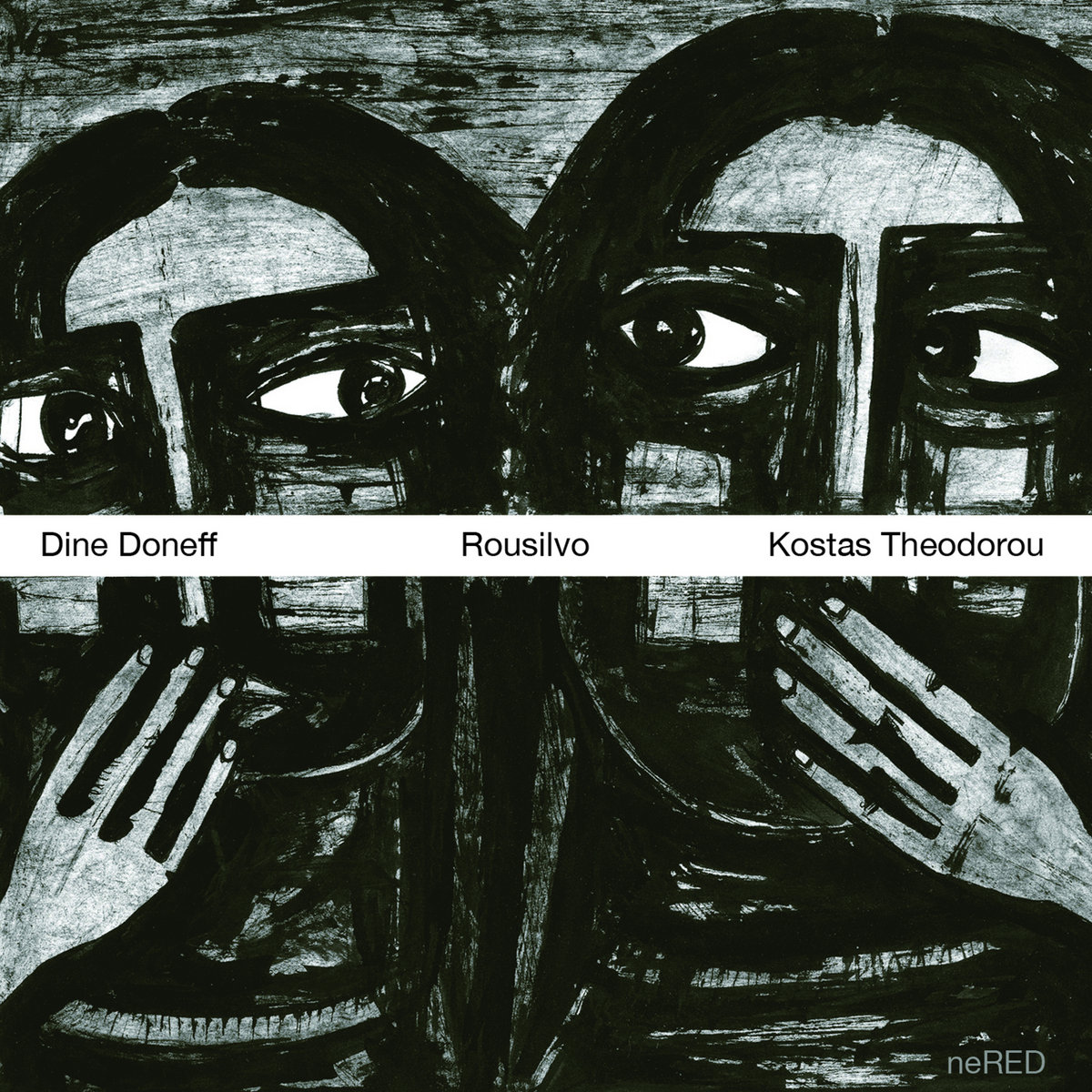
Rousilvo

Takis Farazis piano, accordion
Kyriakos Tapakis oud, mandola
Pantelis Stoikos trumpet
Dimos Dimitriadis alto saxophone, flute
Antonis Andreou trombone
Dine Doneff double bass, guitar, tabla, vocals
Kostas Anastasiadis drums
Slava Pop’va Evdoxia Georgiou voice
Lizeta Kalimeri voice
Martha Mavroidi voice
Lada Kandarjieva soprano
Elena Ginina soprano
Elitsa Dankova mezzo
Irina Gotcheva alto
Recorded April 15-19, 2004 at Agrotikon Studio, Thessaloniki
Additional vocal recordings and editing: Jorgos Pentzikis
Engineered, remixed, and mastered by Christos Megas at Magnanimous Studio, Thessaloniki
Release date: October 27, 2017

This self-styled “Balkan-Jazz Folk Opera” pulls a creative IV from his cultural roots, drawing through that lifeline a flow of minerals, ancestry, and echoes of time. Rousilvo names the village in northwestern Greece once known as Xanthogeia, where Macedonian residents fell victim to persecution and violence at the hands of Greek’s “Hellenization” until it eventually became abandoned. To preserve this marginal community, Doneff combines recordings of the women who survived with an instrumental ensemble and septet of singers. The title of its opening movement, “Narrative,” sets not only a musical but also a conceptual tone. Voice and piano lay down a mournful theme as if standing over a broken landscape and wishing it might all go away. Conversation and birdsong mingle with clear and present melodies, so that those who never got to speak may now be heard.

Doneff further explains the genesis of what he calls his “requiem for a poetry dissolved by political decisions”:

“From a very young age I have experienced social, cultural, and political oppression as a member of the unrecognized Macedonian minority in northern Greece. Even later, as a traveling artist, I came across this issue more times that I would’ve liked. It made me angry but also sad. As I gathered enough strength to talk about it, I built up a kind of operatic structure from those emotions. The libretto includes field recordings and fragments of hidden or ‘forgotten’ songs or stories by members of that same minority.”

Appropriately enough, much of the weight of Rousilvo is carried on the shoulders of its singers. In particular, soloist Slava Pop’va Evdoxia Georgiou’s salt-of-the-earth delivery in “Penelopes of Xanthogeia” moves the heart in a scene teeming with life. Is hers a longed-for past or a hoped-for future? The question remains open, as do we to the Macedonian textures and jazz infusions of “Mirka,” wherein Martha Mavroidi’s voice, wrapped in a cloud of tabla, oud, and drums, cries without border. There is also the unaccompanied singing of Lizeta Kalimeri in “Natsko,” which turns the dawn into a score sheet to be scrawled across by the pen of hardship.

The album is also a vibrant showcase for musicianship. Like theatrical scene changes, each instrumental track is a cleansing of what came before. Highlights include “Apatris” (featuring a gorgeous saxophone solo from Dimos Dimitriadis) and “Song of the unquietness” (a mournful duet between Doneff’s guitar and the trombone of Antonis Andreou). Whether swinging in cathartic improvisation or unraveling a lullaby for the dead, these pieces straddle the line between what cannot be denied and what may never resolve.

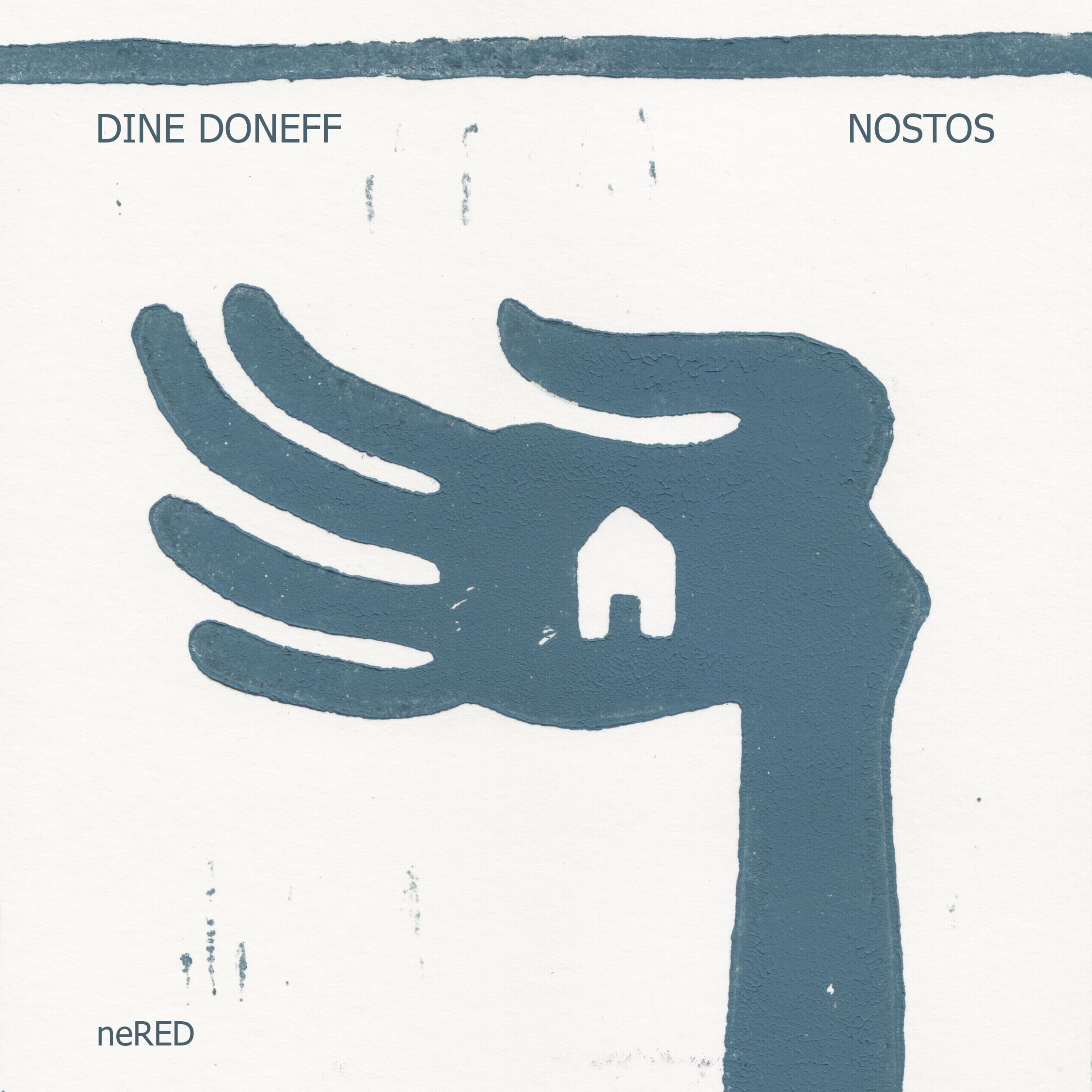
Rousilvo, it bears mentioning, is the second part of a trilogy, of which the first part is Nostos (released in 1999 on the independent LYRA label). Doneff speaks of the trilogy itself as “a rite of passage; the long process of the transformation from what we are to what we are coming to be through time.”

We might easily wrap that description around his second neRED release, IN/OUT.

IN:OUT cover
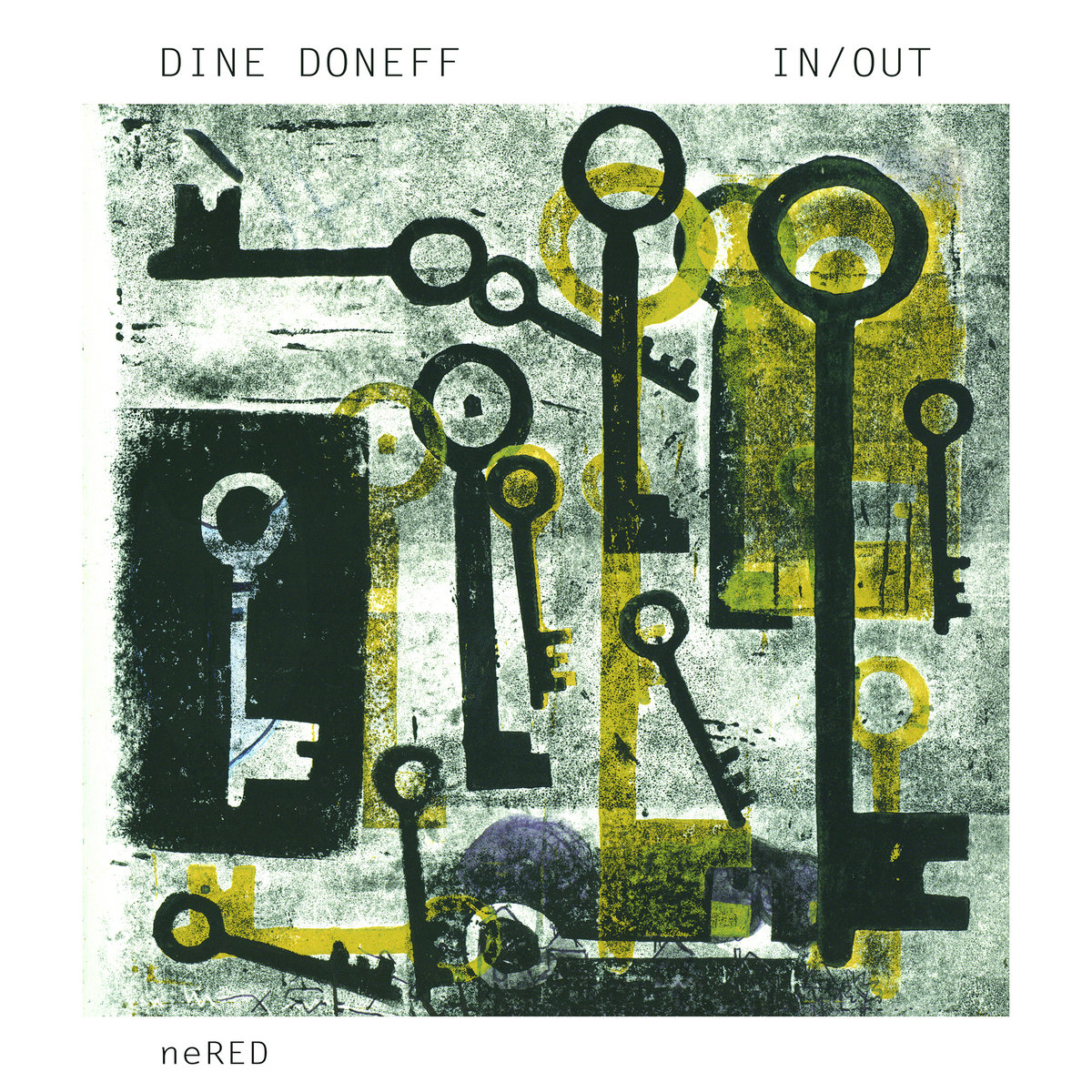
IN/OUT

Dine Doneff piano, Fender bass, electric guitar, drums, waterphone, bendir, bells, flutes, spinetto, keyboards, mouth harmonica, field recordings
Vocal quartet in “Disquiet”:
Lada Kandarjieva soprano
Elena Ginina soprano
Elitsa Dankova mezzo
Irina Gotcheva alto
Composed & performed live by Dine Doneff on July 1, 2016, Domagk Ateliers, Munich as a part of the vernissage for In Search of a Common Ground #2, a group exhibition by eleven contemporary Macedonian artists
Recorded and mixed by Pande Noushin
Mastered by Tome Rapovina
Release date: February 9, 2019

Recorded live on July 1, 2016 as part of the vernissage for In Search of a Common Ground #2, a contemporary Macedonian art exhibition,  this “Soundscape Theater for Double Bass and Tapes” is indeed a search for commonality between the material and immaterial worlds. In light of his maturation as an artist over the decades, it finds him at a point of being able to his fear of going deeper into intimate territories of body and mind.

And what does the album’s title signify to him?

“Mainly balance. Belonging to everything and at the same time to nothing. Both sides, or spaces, are equal in quantity of action and possibilities. In our life experience we are more often in the position of the slash standing between IN and OUT, and it is in our decision to use this ‘symbol of punctuation’ to move from one side to another, however skillfully.”

Over the course of seven parts, the plucked strings of a spinet mingle with bass, the sounds of toys at an open market in Istanbul, an electric guitar, crows in Timisoara, a harmonica, a PA announcement at Zurich Airport, and more. The sensation is that of moving via portals not only through space but also through time. The added magic of field recordings allows us to experience all of this at once. There is a sense that something deeply microscopic is happening here, as if flesh itself were being folded until its inner sanctum is revealed like a diorama at the most genetic level. This method of exploration places the self on a path into the self: the meeting of salt water and fresh water.

Given such subtitles as “Division within,” “Unbelonging,” and “Exile,” it’s difficult to read this as anything but a deeply personal album:

“Indeed. It is a collection of recordings, both composed and out in the field, captured during the past decade while touring in Europe, blended in a storyline, also as a sonic diary. Then, using the recording as theater music, I performed a live monologue on my double bass, interacting with the prerecorded material. A narratively staged debate with soloist as actor/improviser in a one-act play.”

In the context of such attunement, I find myself wondering about a core concept behind it all. Hence, the very name of his label:

“Nered is a southern Slavic word and, in my mother tongue of Macedonian, describes something that has no special order. There is a village in West Macedonia, close to where I come from, that’s called Nered for being chaotic/anarchistic but still beautiful. I felt that neRED applies well to multidimensional artistic projects which have no particular sequence, pattern, or method in relation to one another.”

All of which seeks to inform his art as a space of communication and life experience. Without either, it would just be a flame without a wick. Let his candle burn for decades more.