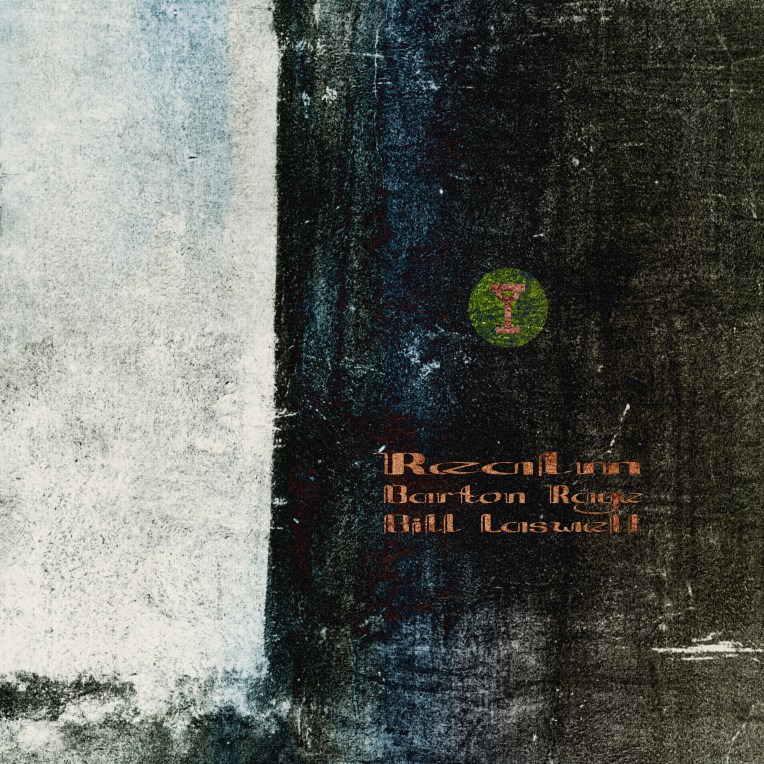
Barton Rage & Bill Laswell: Realm 1

Realm I

For this first installment of the “Realm” series of concept albums on the M.O.D. Technologies label, wherein artists are free walk their own paths even when those paths crumble from beneath their feet, Bill Laswell and Barton Rage combine heat sources to forge an ambient talisman that is sure to haunt you with its protections.

Hints of orchestras and long-playing melodies, each the ancestor of a solitary listener, learns the art of flotation right before us. Gloomy, perhaps, but only because darkness is sensed by the ears as light by the eyes. For in the darkness there is a sound which wilts at misinterpretation and blossoms when taken on its own terms. Barest hints of drumming flicker in and out of frame, while lower lines take shape as pure sonic reckoning, their compasses burrowing into skin unaware of their own mapping. A meditation made reality. This is “Mater.”

Clicking of cymbal and drum, an echo chamber that knows not the wrath of an open gate. Rather, it peers into the heart of things. The duo’s to-the-marrow methodology braids time signatures so tightly that the sun no longer reflects off them. A flash of song. An electronic insect attracted to pheromones emitted by throat and wrists. Laswell’s bass cannot help but lumber through the landscapes of its upbringing with sketchbook in hand. The confluence of machinery and sinews is the decoration, not the anchor, of this evolving tree, around which leaves dance in the wind like a child waiting for an embrace. This is “Waters of Mirage.”

Globular, uncertain arcs bow before a sacred dub altar, on which has been left offerings of star-bound digitalia. The signal is incomplete, its transmitter having broken eons ago in a moment of distress during some mission no one remembers. Synthesized trumpet breaths channel a chasm of death into automatic life, drinking in the scent of fortune to get away from the smoke. A pause before drum ‘n’ bass snakes shed their skins. A groovier test of faith through dance music for isolationists. This is “Triad Seer.”

A watery expanse larger than any ocean on Earth. A smooth undertow, amphibian and pliant. Funkier textures unfold wings of air, ephemeral yet alive. This is “Seraphim.”

A freer space ensues, prowling caves for want of ore. Weightless spaces intertwine with heavier drops of thought. This is “Beyond the Abyss.”

A melodic fractal, in the mode of guitarist Jeff Pearce, though with a murkier pulse. The finality here is heavy with cinema. This is “Nama.”

I haven’t been moved in this particular way since Mick Harris’s Somnific Flux, a 1995 collaboration with Laswell on Subharmonic. Such nostalgic threads also pull me back to Cypher 7’s Decoder (released the year before on Strata), bringing together past and future in a single, protracted blink. Let’s have more of this.

Two new reviews for All About Jazz

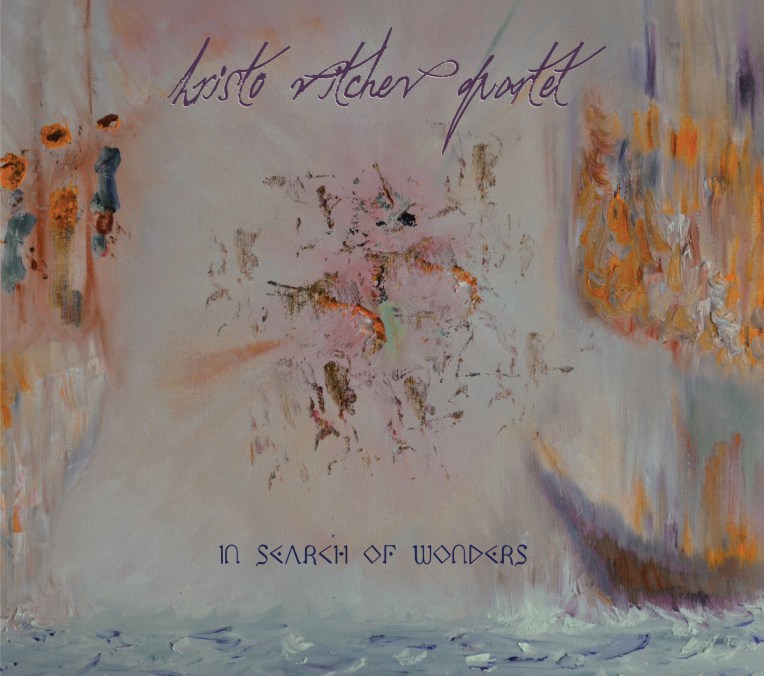
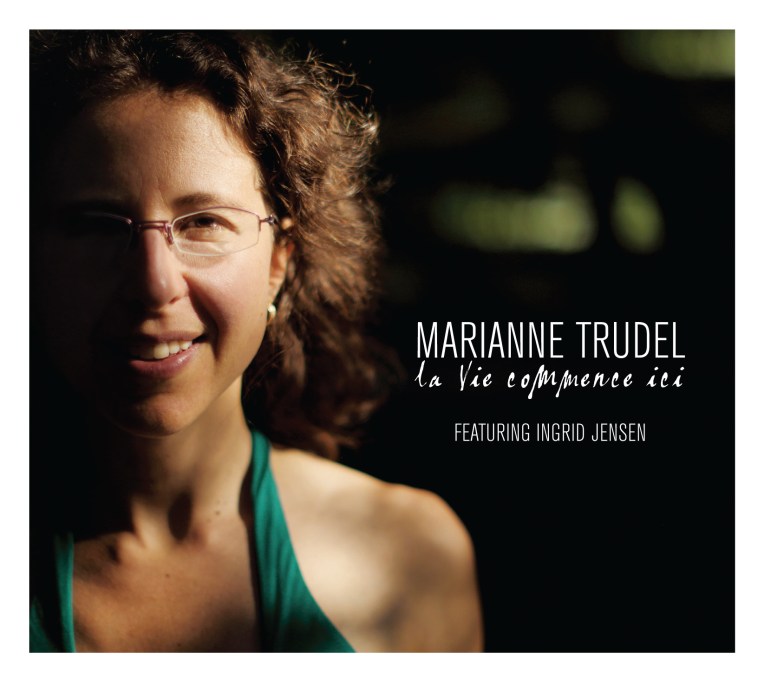
I have two new reviews up on All About Jazz: one of a recently issued live album of an older Sheila Jordan concert with Harvie S and Alan Broadbent, another of of Canadian pianist Marianne Trudel’s La vie commence ici, which should appeal to fans of ECM’s Nordic sounds. Click the covers to read on.

Better Than Anything

La vie commence ici

Wadada Leo Smith & Bill Laswell: Akashic Meditation

Akashic Meditation

Soul-seeking trumpeter Wadada Leo Smith and sought soul, bassist Bill Laswell, recorded live at New York City’s The Stone on April 22, 2014. A metropolis unto themselves, built by a masonry of interlocking musicality.

In this spontaneous set, listeners may open their eyes, only to find themselves behind another’s closed. Laswell slows the dance of time to near-stillness, so that every contraction of every muscle may be studied. Smith’s entry comes from within rather than from without, portioning flesh on scales counterweighted with virtue. Consciousness on either side denies the illusion of consensus reality and offers a purely sound-based alternative in its place. The psycho-sphere of these spiraling prevarications acts as glue for a jagged infrastructure.

Laswell has a leviathan’s heart for this stuff. His bass flashes and writhes with intrigue, far more than the sum of its plastic, wood, and strings. And because the machinations of that instrument rotate on linguistic axes, a sense of communication is vital to understanding his improvisational cartography. It is at one moment a bodhisattva of desert suns, the next a dying gamelan courting the moon. It listens to its own heartbeat and tracks the decimation of rhythms.

Smith, for his part, treats the skin as a palimpsest of discovery. His breath, the written word to Laswell’s speech, resonates through a brass menagerie of travel. As distant as he is present, he is a nomad in search of the next melodic attachment.

Distortions in both look back with forward eyes as regularity subsumes, is subsumed, and touches off a limpid and final spark after an elliptical net catches Smith’s reborn self.

The Akashic meditation is not a conversation but a conversion. A reverse alchemy that turns gold into lead. Here you will find no towering, canonical monuments, but only ruins of such raw power that every crumbling edifice yields the scripture of change.

(For more information, visit M.O.D. Technologies here.)

Milford Graves & Bill Laswell: Back In No Time

Back In No Time

Drummer Milford Graves and bassist Bill Laswell, live at The Stone in New York City. Two stalwarts of their respective instruments, passing in the night on April 22, 2014. Separately: wanderers of this musical world, toting satchels of invention for the sonically weary. Together: architects of flexible structures to house the enormity of their collective imagination.

Laswell fades into frame riding a harmonic for the ages, organic and initiatory. His is the vertical signature. Graves, meanwhile, drops to the floor and rolls around in his drums, for all the horizontal motivator. These are the stirrings beneath the floorboards of your childhood, the magic of beings you always knew were there but were sworn against discovering by parents who didn’t know any better. Now they have emerged, ready to perform.

The actions of this duo are kinetic and headstrong. Like muscles of the throat, they twitch in anticipation of speech. Only words never materialize. Graves is, nevertheless, quite vocal at peaks of expression. His hi-hat is the measure of a defibrillating heart, around which sticks converge like bones. The mounting corporeality of his playing underscores the circularity of this meeting. Laswell rides the wave, respectfully and patiently, before chorusing his approval through improvisation.

The bassist’s densities match those of Graves step for step before cutting out to leave the drummer running wildly across the savannah, of which every plant is an instrument waiting for contact of feet and hands. Laswell rejoins sagaciously, exploring the flanged interior of a fallen vessel, whose engine must be resuscitated by clean attention. He attends to broken wires and gears, giving life by electric injection.

Short blasts of data, each made knowable by the gift of vibration, project themselves across the inner ear. Motivations fall victim to their own causes. Despite having been designed for harm, the musicians are here to put an end to that cycle with their heavy light. The passion of experience wins.

(For more information, visit M.O.D. Technologies here.)

Jean Touitou: Samba de Merda

Samba de Merda

Jean Touitou, founder and designer of the A.P.C. clothing brand, wrote this song after the Paris attacks in January of 2015. It’s a curious, even tongue-in-cheek catharsis to a real tragedy that seeks desperate healing in a smile. With the involvement of H.D.R. (piano, synthesizer, drums, guitars, effects), Bill Laswell (bass, vibes), and Noam Levy (saxophone), Touitou sings the filling of a tripartite sandwich. Framed by the opening guitar riff of “Jingle Bell Rock” and an emblematic dub from Laswell, Touitou’s unstudied vocalizing might feel right at home on the runway, were it not for the motivations behind its realization.

It’s unsettling to hear Bobby Helms’s Christmas staple out of context, somehow flowing into its own bossa (super)nova as if there were no other words for grief. There is strangeness in these trees, through which the winds of aftermath flow like blood. Here is a dream that whispers to those who are still awake, a shadow behind the laughter. Only Laswell would find a dub lurking in this unremarkable specimen. His bass digs deeper with every scouring of surface, while ambient textures congregate around its roots. So is the linearity of time mocked and burned, its ashes spread across the lips of those who perpetrate destruction for its own sake. A repeating signal for a single bound in hyper-reflection.

This chain of seemingly unconnected events follows a cinematic realism of discomfort. If any message is to be taken from its flicker, it’s that the crust of observation is its own strongest defense against terrorism. It reveals the heart better than any surgery, for it must remain an idea. It must remain one’s own.

Praxis: In Times of Horror

In Times of Horror

Following in the footsteps of Sound Virus, Praxis returns for a single act of twisted faith. Featuring bassist and depth-bringer Bill Laswell, guitar alien Buckethead, and underground dot-connector John Zorn, this blast of hell heat overlays vocals from hip-hop artist extraordinaire and hero of the abyss, RAMM:ΣLL:ZΣΣ (1960-2010).

Less than two minutes in time, but infinite in effect, “In Times of Horror” takes a drill to the tooth of a deity in agony. Its spiraling guitar, newly struck lyrics, and whirring core-grist bring a more guttural treatment to this archival classic. It is a morsel of rock turned into steel, then hammered into a spaceship of moon-destroying virtue. The abuse is at once robotic and as organic as dusk. It turns on an axis like a stick making fire on a bed of dry grass, inhaling smoke until it passes out.

The shop of time reopens for no one once the sign says CLOSED.

(For a sample and ordering information, click here.)

Method of Defiance: Dub Arcanum Arcandrum

Dub Arcanum Arcandrum

Dub is smoke without mirrors, a realm in which a single beat, bass line, or keyboard riff might jettison you in the orbit of another planet. It is an axis of spirit and tactic, a philosophy shaped through strategic distribution of energies. In the context of Bill Laswell’s Method of Defiance, the parameters of dub take on new valences of initiation, and throughout this album, refashioned from the project’s first two appearances on its namesake label, their pressures equalize across a raw spectrum of possibility.

The Scientist, a remixer of exacting standards and enmeshed execution, conducts three laboratory experiments. At the outer rims are his “One World Dub” and “One World Disorder Dub,” each a head nodding across the mind’s eye, of which every bloodshot vein is a river. Rooted in groove, even as they groove into roots, their magickal patterns serve us a steaming bowl of get into it. If one is a body, the other is its soul. On the exhale, that same body basks in the smoke of “Herb 4” with enough justification to fill a book of harmony.

Sonic pedagogue extraordinaire Mad Professor gives us the first of two takes on “Elijah’s Lament.” While his is a mirrored consciousness that plays with time like Legos, the other, by MRC Riddims (a.k.a. Oktopus and MRC) is a love letter to Krooklyn that fills our legs like sun the Hudson. It is a world unto itself, one where phantom selves dance until they sweat themselves out of their minds and back into our own. Sub Code, who hails from Morocco, gives us a rarefied, immediate version of “Do or Die.” It is a breath given meaning through faith in the evergreen conflict of populations. These last two are among a handful of one-way communiques, the others being Perdurabo 6’s “One World First Claim Version” (a necklace strung with plaster footprints and hung around a lion’s neck) and “Encode Armour Feed” by the isosceles Prefuse 73, whose embrace of Laswell’s prime currents is a match made in outer space and brought to earth for an all-too-brief visitation.

Dr. Israel is a master oarsman in these waters, rowing as he does with entire trees in his hands. His plunges into “Taykeovah” and “No Salvation” remind us that exploration kills in the name of self. Where one is melodic glass shattered and re-glued for strength, the other is a spider’s web unchained and repurposed for flight.

At the topographic endpoint, meditating on a mountaintop, is Laswell’s binary star. “Quantum Echo Apparition” renders his bass an elliptical entity, by whose hands the heart of dub is massaged to tenderness, while an “Entombment Dub” of the same cut frames darkness as a stroke that gives life without need for validation but the listener’s undivided attention.

Reverberation is rebirth. Dig it.

(For ordering information, visit M.O.D. Technologies here.)

Method of Defiance: Jahbulon

ATOZMEDIA4paneldigipak.qxd

The first release from the namesake project of bassist Bill Laswell’s M.O.D. Technologies label, Jahbulon introduces a collective freed by evolving membership yet united by a common prayer: to move. In this incarnation, Laswell island-hops with fellow travelers Dr. Israel and (Garrison) Hawk on vocals, Bernie Worrell on keys, and Guy Licata on the percussive front line. Yet the beacon of this record is Hawk himself, who, true to name, soars above every soundscape with sharp vision and dives for the kill at the slightest hint of escape.

In this respect, “Patterns of War” speaks less of outward aggressions than inner protections. Its opening whistle, reminiscent of a bomb in freefall, sends up a shock of hip-hop particles, shot through with reggae afterburn. The latter bronzes the words, each a fist against oppression that turns mass destruction on its head until weapons fall out of its pockets in two equidistant piles. In the shadow of this difficult introduction, the little flame of “Salvation” flickers into a full-fledged conflagration of brotherhood. God is not only in the details, it seems to say, but also born from them. This is glory in Creation, a circulation of nature as father, mother, and child in one.

Singularity further prevails in “One World,” a central, affirmative palette. Its vocal fingerprints litter the canvas until portraits of a city, a borough, and its denizens take discernible form. In their hands, a book of knowledge reads: Whenever you are disillusioned by what happens down here, know that reality never ceases up there. Such is the message of “Do or Die,” the halting beats of which serve to emphasize its corporate surgery before retexturing into smoother down midway through.

Whether spiraling through the tightness of “Revolution” or sending listeners on missions of the heart in “No Justice,” splashing the inner ache of “Taykeovah” or looking beyond skin into the stealth groove of “Elijah’s Lament,” each song blasts its refusal to be held down, translating technology of the rich into aid for the destitute. A testing of faith by the genocide of global interests. A scriptural circle in which judgment is swift only for those unworthy to wield it.

Each of these urban zones acts as a reflection of the body and its genetic recitations—rituals forged in breath and semantics. Even the illustrative affirmations of “Herb is Burnin’” and “Diss Never” breed a certain invincibility of purpose. Worrell’s sparkle and shine are particularly salient at expressing the changes of tomorrows, even as they nibble on leftovers at the table of survival. No soul should have to fend for sustenance on a planet united against its own iniquities. But this is exactly what’s going on, and why we need to open our ears like the pages of a book. We must rise above the power of difference not between each other but within ourselves before we can recognize what we all share.

Blood, music, love.

(For ordering information, visit M.O.D. Technologies here.)