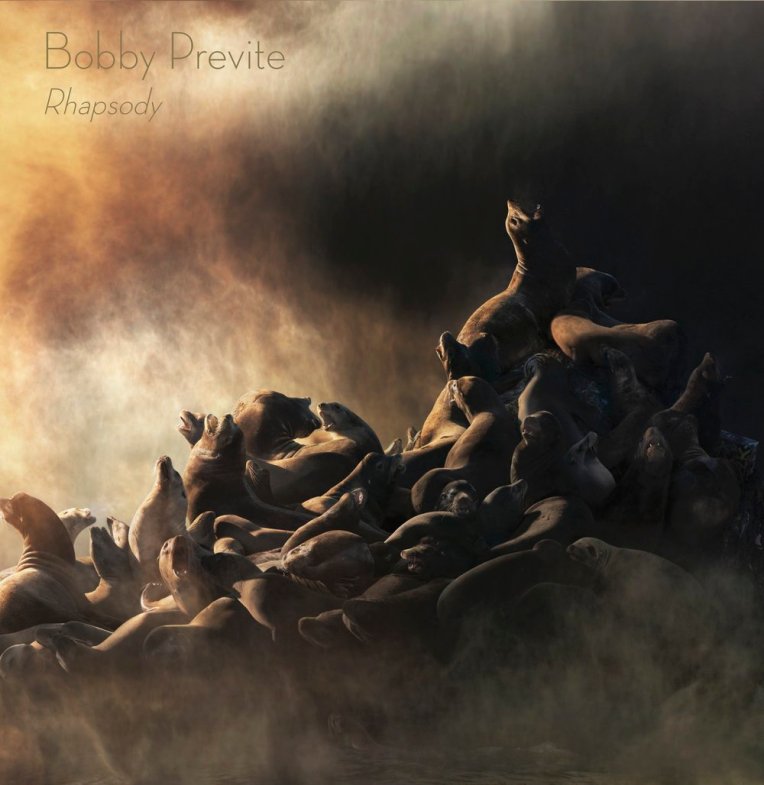
Bobby Previte: Rhapsody

Rhapsody

For the second installment of his Terminals trilogy, an ongoing ode to transit and migration, drummer Bobby Previte has convened a dream group. Although featuring musicians often found in electr(on)ic settings, Rhapsody unfolds a grand mise-en-scène by purely acoustic means. “Casting Off” and “I Arrive,” respectively, begin and end the album by threading the vocal delivery of Jen Shyu (whose erhu playing is another distinct color in this palette) through the netting of John Medeski’s piano and Fabian Rucker’s alto saxophone. As the center of the action, Shyu imbues Previte’s lyrics (a first for him) with theatrical punch, singing the role of an airplane traveler cycling through various stages of self-awareness until she reaches her unknown destination under cover of night.

That state of liminality—of hanging suspended between locations with only a thin layer of metal and composite between you and certain death—is beautifully rendered in Previte’s downright cinematic movements, each of which variously highlights the strengths of one or more of his bandmates. Medeski shines in “When I Land,” his precise syncopations seeming to chart every leg of the journey, and, in tandem with harpist Zeena Parkins, he renders the backdrop of tracks like “The Lost” and “The Timekeeper” while Ruckman carefully links his own chains of melody and abstraction. Hearing Parkins unplugged is an especial privilege; in this context, her crystalline beauty feels nearly all-consuming. Guitarist Nels Cline treads a parallel path and to highest effect in “All Hands,” in which his slide guitar sounds almost like a pipa. Previte himself completes the picture, playing an assortment of drums and percussion and, in “Last Stand/Final Approach,” autoharp and harmonica to boot. He treats himself no differently than his other musicians, letting his singular compositional voice ring over all, handing us a light to navigate the darkness in which he leaves us.

(This review originally appeared in the March 2018 issue of The New York City Jazz Record, a full PDF of which is available here.)

Turtle Island Quartet: Bird’s Eye View

Bird's Eye View

The Turtle Island Quartet presents a new program centered on the spirit of Charlie Parker. Although only one of his tunes is included, these four impeccable musicians share Bird’s penchant for expanding parameters and the results of their alchemy are just as golden. Like the other jazzy ingots herein—namely, “Subconscious-Lee” (Lee Konitz) and “Miles Ahead” (Miles Davis)—“Dewey Square” makes artful use of extended techniques. Violinist/founder David Balakrishnan employs scratch tones for a delightfully percussive effect while cellist Malcolm Parson (who, along with violinist Alex Hargreaves, is new to the group) plays the role of bassist via robust pizzicato. The in-house arrangements alone boast of interdisciplinary genius at play, allowing for plenty of improvisation to show the quartet’s combinatory properties.

The Modern Jazz Quartet’s “Django” gets a welcome spin and in its central section evokes the fluidity of Stéphane Grappelli, whom Balakrishnan calls a “patron saint” of the quartet. Yet Balakrishnan’s own compositions are the support beams of this soundly engineered structure. They sometimes reveal an underlying quirkiness, as in his “Rebirth of the Holy Fool,” which puns on Davis’s Birth of the Cool, and “Squawk,” taking its inspiration from a mysterious incident in 2011 when the town of Beebe, Arkansas awoke on New Year’s Day to find that 5,000 dead blackbirds had fallen from the sky. The composer navigates these images with delicate rigor. His “Aeroelasticity: Harmonies of Impermanence,” however, is the album’s centerpiece. A multivalent suite in four movements, it hums with the very propulsive energies that inspired it. Influences range from Indian classical music to mathematical properties (the piece is, after all, dedicated to his father, a UCLA professor of engineering), bringing solid returns on his emotional investments. There’s a backwater charm lurking within and a feeling of memory tying it all together. Violist Benjamin von Gutzeit’s “Propeller” is something of a sister piece, as it deals equally with mechanisms in motion, if on a more intimate scale. Its balance of curves and straights is emblematic of what this quartet is capable of at its finest.

(This review originally appeared in the March 2018 issue of The New York City Jazz Record, a full PDF of which is available here.)
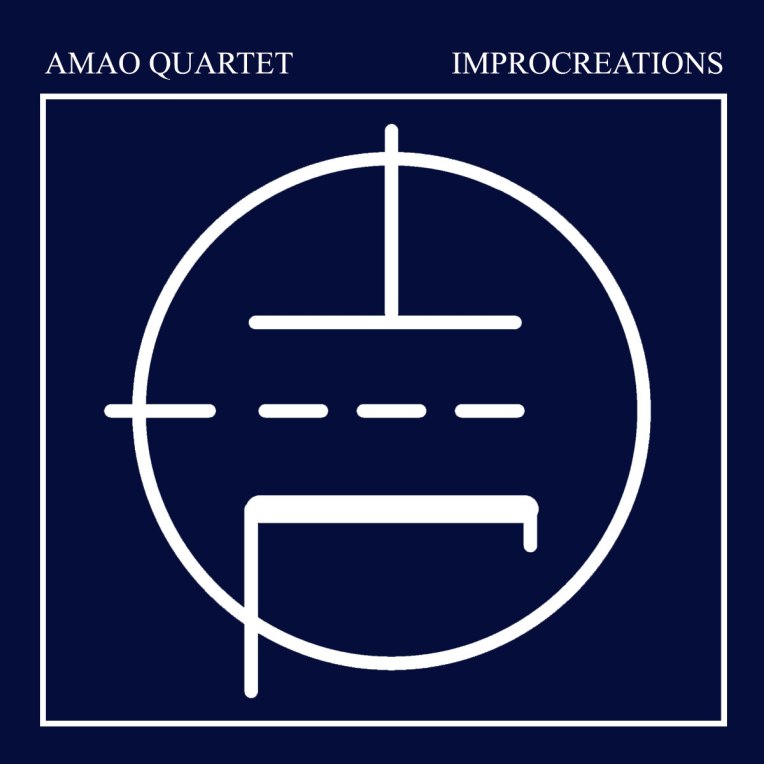
Amao Quartet review for All About Jazz

My latest CD review for All About Jazz is of the Amao Quartet’s self-produced Improcreations. A beautiful example of free improvisation (here featuring four Brazilian electric guitarists) that is neither overbearing nor confrontational. Click on the cover to discover!

improcreations_cover_art

Amine & Hamza review for RootsWorld

Amine & Hamza are an oud and kanun duo from Tunisia. Their album Fertile Paradoxes is the subject of my latest review for RootsWorld online magazine. Fans of Anouar Brahem: do not pass this one up. Brahem himself calls the new album “a spell-binding repertoire of new compositions full of emotions. We are taken on a delicious trip of intoxicating rhythms and subtle, yet powerful melodies. Far from being run-down clichés, we are struck by its strength of suggestion and the modernity of its arrangements. There is a strong sense of being on a voyage of surprising passages and undiscovered timbres. Fertile Paradoxes owns the evident and natural qualities which are the hallmarks of an authentically inspired work. A beautiful success!”

Click the cover below to read my full review and hear sample tracks.

Fertile Paradoxes

Miroslav Vitous: Ziljabu Nights

Ziljabu Nights

Ziljabu Nights is an emotional black box recovered from the wreckage of a bygone era and brought intact into ours. Recorded live in June of 2016 at Germany’s Theater Gütersloh, it features saxophonists Gary Campbell and Robert Bonisolo, keyboardist Aydin Esen and drummer Roberto Gatto. Leading them all in a program of mostly original compositions is legendary bassist Miroslav Vitous, whose experiential integrities shine among those of like-minded maestros.

The performance documented here is at once nostalgic and spontaneous. Vitous, who turns 70 this month, and his musicians inhabit their respective continents, yet on stage forge a veritable Pangea of sound. “Ziljabu” eases us into the album’s tender awakenings with a mélange of keyboards and flanged bassing. Its fusion-leaning tendencies recall certain landmark ECM albums from the 1980s, not least of all the bassist’s own for the label. A one-letter difference in the title of “Ziljabe” yields an equally subtle shift in tone. A subtle maturity percolates throughout the 17-minute “Morning Lake.” It unfolds with patient respect, under cover of which Bonisolo’s sopranism provides the aerial view to Campbell’s terrestrial excavations, while in “Miro Bop” the reeds play out a dancing exchange of tenors, both feet on the ground.

Vitous pays homage to late fellow bassist Scott LaFaro in an unaccompanied rendition of “Gloria’s Step Variations.” What seems relatively straightforward on the surface, however, reveals a depth-charge of interpretation, with equal parts muscularity and flexibility woven into its fuse. The same holds true of “Stella By Starlight Variations,” wherein the band sends love to the periphery as Esen takes solo flight at the center of it all.

The album finishes off with an interview, in which Vitous speaks a little to his history as an artist, his growth out of the initial iteration of fusion giants Weather Report and the blessedness of his musical life. “It’s not so much searching,” he says of his rapport with this band. “Basically, we hear it.” And it’s all we can do in return to appreciate that which has been heard.

(This article originally appeared in the December 2017 issue of The New York City Jazz Record, a full PDF of which is available here.)

John Zorn: There is No More Firmament

Firmamament

Throughout his career as musician, producer and collaborative lightning rod, John Zorn has never forgotten the importance of putting pen to paper. This all-chamber program of pieces spanning 2012-2016 speaks deeply to his indefatigable spirit and the obvious care with which he chooses his musicians.

Two brass fanfares, consonant and invigorating, are palate cleansers of a sort. “Antiphonal Fanfare for the Great Hall” commemorates Zorn’s historic 2013 day-in-residence at the Metropolitan Museum of Art. It moves harmonically and with a precision that fortifies its ancient roots. “Il n’y a Plus de Firmament” likewise breathes formidable life into the wind quintet genre. With attentions to texture, rhythm and color rarely heard outside Edgard Varèse, Zorn provokes each strand of motivic DNA to fullest unraveling.

“Freud” is an enchanting psychoanalytical detour. Violinist Chris Otto and cellists Jay Campbell and Mike Nicola are its breathtaking interpreters, negotiating neuroses and reveries with comparable aplomb. Its wilder moments recall Zorn’s seminal pieces for the Kronos Quartet, but also the chamber music of Henryk Górecki. “Divagations,” inspired by the poetry of Stephane Mallarmé, places a through-composed score at the hands of classical pianist Stephen Gosling, with the interpretive jazz rhythm section of bassist Christian McBride and drummer Tyshawn Sorey, who must make spontaneous decisions along the way.

This disc’s crown jewels are its solo pieces. Clarinetist Joshua Rubin performs “The Steppenwolf” on the rarely heard A clarinet, eliciting a dynamic and tonal range as only a master of the reed like Zorn could enable. “Merlin,” for solo trumpet, is even more compelling in the two versions presented here. Peter Evans fills the ears with wonder, his extended breathing providing the most thrilling moments of the program, while Marco Blaauw (on his custom-built double-bell trumpet in C) adds ghostly dimensions.

There is so much philosophy packed into this album, it feels like a living (auto)biography of which we are given a tantalizing synopsis.

(This review originally appeared in the November 2017 issue of The New York City Jazz Record, a full PDF of which is available here.)