Sam Rivers: Contrasts (ECM 1162)

1162 X

Sam Rivers
Contrasts

Sam Rivers soprano and tenor saxophones, flute
George Lewis trombone
Dave Holland bass
Thurman Barker drums, marimba
Recorded December 1979 at Tonstudio Bauer, Ludwigsburg
Engineer: Martin Wieland
Produced by Manfred Eicher

It’s a funny thing about getting lost: the more one tries to do it consciously, the more one discovers new pieces to fit into the jigsaw puzzle of familiar things. Jazz legend Sam Rivers, who made his only other ECM appearance on the classic Conference of the Birds, proved this sonically when he brought his patented “inside-out” technique to bear alongside Dave Holland, George Lewis, and Thurman Barker upon this free jazz date from 1979. Now in his 88th year, Rivers’s legacy continues to yield new nuggets of audio wisdom through such albums as Contrasts.

The album opens in “Circles” with some chewy improv. Thick horns and brittle drumming provide plenty of interplay to keep our wits on a tight leash. Lewis seems the most at home here, providing a bubbling cauldron of likeminded flights. It is the first in a smattering of freer tracks, the others being the slowly building “Solace” and perhaps the most abstract aside, “Images.” This leaves us with a hefty set of rhythm-driven powerhouses. “Zip” tightens the purse strings with an ever-moving tenor for some wholesome, head-nodding goodness. This joint also serves up a heaping drum solo on the side. Our frontman opts for flute in the swinging “Verve” with a renewed spring in his step. Convincing monologues from Holland and Lewis ease into a slow and timid end. “Lines” reprises that contagious soprano sax against an omniscient rhythm section before bowing out for some quality bass time. “Dazzle” brings exactly that, freeing our minds with a Braxton-esque tenor and tap-dancing bass work. Lewis is more than up to the task, scurrying in with Rivers in their joint commitment to going deeper.

As one of ECM’s bolder sessions, Contrasts deserves shelf space right next to George Adams’s Sound Suggestions. It is nothing if not about contrasts: the cohesive and the fractured, uprightness and vertigo. Colorful, straightforward, stirring.

<< David Darling: Journal October (ECM 1161)
>> Azimuth: Départ (ECM 1163)
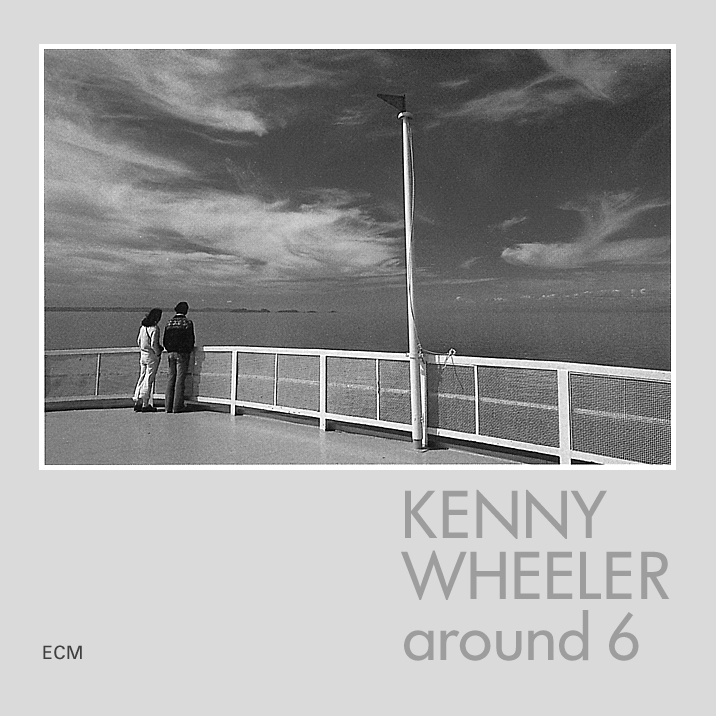
Kenny Wheeler: around 6 (ECM 1156)

ECM 1156

Kenny Wheeler
around 6

Kenny Wheeler trumpet, fluegelhorn
Evan Parker soprano and tenor saxophones
Eje Thelin trombone
Tom van der Geld vibraharp
Jean-François Jenny-Clark double-bass
Edward Vesala drums
Recorded August 1979 at Tonstudio Bauer, Ludwigsburg
Engineer: Martin Wieland
Produced by Manfred Eicher

For his third ECM outing as leader, Kenny Wheeler offers up this set of six originals among some of the finest support ECM had to offer at recording time. The reed-work of Evan Parker in particular proves to be a prophetic addition to Wheeler’s rounded edges.

Like the wordplay of first cut (“Mai We Go Round”) the album as a whole is twice removed: once from the immediate expectations born of past projects, and once more from the often earthly shapes of those projects. This time around, Wheeler is happy to tiptoe over the clouds, reaching for the sun that illuminates their cauliflower topsides. A pliant intro urges us down the rhythmic paths of Jean-François Jenny-Clark (bass) and Tom van der Geld (vibes), along which Wheeler crafts the tenderest of songs. At heart a lullaby, it is lively on the surface, so that we always remain half awake, our eyes glazed by an interest in the musical moment. All of this stretches a diffuse canvas across which Parker splashes the enchanting wisdom of an aurora borealis in fast forward. After this dip into limpid waters, Wheeler breaks out the gorgeous ”Solo One.” Floating on a studio echo with great care, his tone is tender yet immovable, and moves like a human body after an epic recovery. “May Ride” lays another solid foundation between bass and vibes and the subterranean patter of Edward Vesala on drums. Wheeler stays fairly centered, letting out the occasional squeal, and sets up a fantastic solo—one of the album’s best—from trombonist Eje Thelin. After a few doodles from the horns, “Follow Down” unfolds in a parabolic blade, thereby tilling a nutrient-rich soil for Parker’s brilliance. Vibes curl their reverberant fingers alluringly along the edge of our attention before horns and arco bass fall into line. A splash of water dispels our reveries in the propulsive “Riverrun.” Wheeler and Thelin swing from every branch with an unwavering sense of play, granting Vesala a few moments in the spotlight before ending tenderly, conservatively, with the ballad “Lost Woltz.”

A lush and consistent album, around 6 takes on a life of its own with every listen, and deserves a place in any self-respecting jazz collection.

<< Pat Metheny Group: American Garage (ECM 1155)
>> Jack DeJohnette New Directions: In Europe (ECM 1157)

Old And New Dreams: s/t (ECM 1154)

ECM 1154

Old And New Dreams

Don Cherry trumpet, piano
Dewey Redman tenor saxophone, musette
Charlie Haden bass
Ed Blackwell drums
Recorded August 1979 at Talent Studio, Oslo
Engineer: Jan Erik Kongshaug
Produced by Manfred Eicher

Hot on the heels of Old Friends, New Friends comes Old And New Dreams, an operation meant as a new flagship for Ornette Coleman, whose lack of enthusiasm for the project left a gap duly filled by Dewey Redman. The result is this delightful excursion into post-bop outlands that sounds as alive as ever. Two Coleman pieces comprise nearly half of its duration—which is saying much, for like many of ECM’s joints of the 70s, this one breezes by in under 50 minutes. The first Coleman piece, “Lonely Woman,” walks the tightrope stretched by Haden, who hugs the solo spotlight after a string of progressive fadeouts in this otherwise drum- and horn-heavy opener. Redman and Cherry elicit a peculiar distance in their playing, speaking in tongues from beyond a wall of silence. The second is the more upbeat “Open Or Close.” Its buoyant drumming and unhinged horn soloing do nothing to obscure Haden’s brilliance as he kick-starts his usual pensiveness into overdrive. Not to be outdone, Blackwell whips his snare into a froth before the group reconvenes.

With these territories covered, each band member completes the experience with one tune apiece. Blackwell’s “Togo” is a prime vehicle for Cherry, as is the latter’s own “Guinea.” The music here is reflective of the long journey that had led Cherry from the limelight into political protest and back into ECM’s fold. We hear this in his biting themes and pianistic wanderlust. Redman breaks out the musette (or suona, a Chinese shawm) for his “Orbit Of La-Ba,” a mystical detour into sere grooves. “Song For The Whales,” courtesy of Haden, is the last piece of the puzzle, and shows the bassist in a more experimental mode. Even as he glides along his harmonic slides like some large creaking vessel that is part cosmic ship and part bird, we are held firmly into place. Drums and horns tremble like the very gut of the earth letting its voice be known.

This is a superb album, and regardless of whether these dreams are old or new, they never seem to fade. What makes it so strong is its careful balance of sidewinding monologues and the sense of direction that a full band sound brings. One craves that sound throughout and the expectation it manifests, so that when it comes in such thick doses, it heightens our involvement in the listening. It acknowledges us.

<< Ralph Towner: Old Friends, New Friends (ECM 1153)
>> Pat Metheny Group: American Garage (ECM 1155)

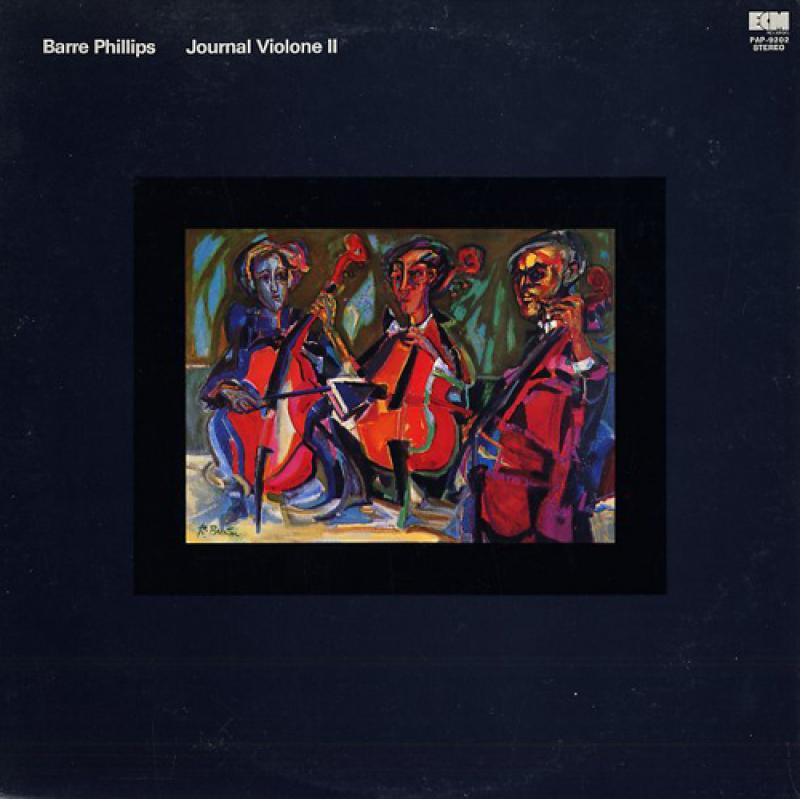
Barre Phillips: Journal Violone II (ECM 1149)

Barre Phillips
Journal Violone II

Barre Phillips bass
John Surman soprano and baritone saxophones, bass clarinet, synthesizer
Aina Kemanis voice
Recorded June 1979 at Tonstudio Bauer, Ludwigsburg
Engineer: Martin Wieland
Produced by Manfred Eicher

Barre Phillips’s music always seems to be more about the obscuring than about what is being obscured. Such a description, I hope, does not merely practice what it preaches, but instead gives insight into his modus operandi. For this suite of six parts, ranging from organic to synthetic and back again, Phillips is joined by frequent collaborator John Surman and vocalist Aina Kemanis. The combination proves to be a formidable one. Phillips brings a delicate intensity to every cell of musical information he divides, especially in the slow buildup of Part III, while Surman threads not a few needles with the bevy of reeds at his disposal. He magnifies our deepest love with an earthy bass clarinet in Part IV. Here, Kemanis’s lilting themes dance with his distanced soprano, painting less jagged lines than she does in Part I. The Brian Eno-esque synths of the latter inject the album with fragrant warmth that Kemanis sustains beautifully with every syllable she sings. Part II harbors the deepest shadows, through which Phillips works his way toward the first lit street he can find. Part V is dedicated to Aquirax Aida, a.k.a. Aida Akira (間章), a music critic and producer deeply committed to free jazz artists like Phillips, leading down a sibilant path toward the final Part VI. This backwater fantasy bounces with the twang of a jaw harp, anchored by Surman’s organic woodwinds and brought home by Kumanis in smooth gradations.

To call any Phillips project “unique” is to commit the commonest of platitudes. His ability to draw a cello’s breath from a bass’s body is nothing short of astonishing. Every inch of his instrument seems to offer up a melody. Were this journal ever to materialize on paper, we would see that it had been written in an erratic but always legible sonic calligraphy.

<< John Surman: Upon Reflection (ECM 1148)
>> Keith Jarrett: Eyes Of The Heart (ECM 1150)

John Surman: Upon Reflection (ECM 1148)

ECM 1148

John Surman
Upon Reflection

John Surman soprano and baritone saxophones, bass clarinet, synthesizers
Recorded May 1979 at Talent Studio, Oslo
Engineer: Jan Erik Kongshaug
Produced by Manfred Eicher

I imagine that John Surman’s first solo album for ECM was something of a revelation when first released. Having already provided his sequined elegance to a handful of productions, the English reedman shows us the breadth of his wingspan in this remorsefully out-of-print pool of limpid brilliance. The sequencer of “Edges of Illusion,” recalling the title cut off Azimuth’s debut album, immediately carries us into a uniquely melodic sound-world. Where some might exploit such a transcendent ostinato as mere atmospheric backdrop, Surman engages with it as an equal partner, experiential in dimension, existential in effect. He adds welcome traction via a gravelly baritone, even as he bores out a winding melodic core with soprano.

Other passages show Surman’s penchant for drawing with folk pigments. Of this, the jig “Caithness To Kerry” and the Nyman-esque geometry of “Prelude And Rustic Dance” and “Filigree” are the clearest examples. More somber moments abound in “Beyond A Shadow” and “The Lamplighter,” both of which feature synths and bass clarinet. Each pulls a distinct string of floss through cosmic teeth. At times delicate, at others cathartic, its sonic plaque streaks like shooting stars into silence. A brief aside of whimsy finds us in “Following Behind.” This lovely fling between baritone and echo chamber wipes the slate clean for the arpeggiated “Constellation” with which the album closes.

From soulful solos to one-man ensembles, Surman does it all with the signature intonation and robotic syncopations that make him one of the finest at the reed. One of the most elegant saxophonists represented on ECM, or on any other label for that matter, he brims with information to be pored through and deciphered with each renewal.

<< Nana Vasconcelos: Saudades (ECM 1147)
>> Barre Phillips: Journal Violone II (ECM 1149)

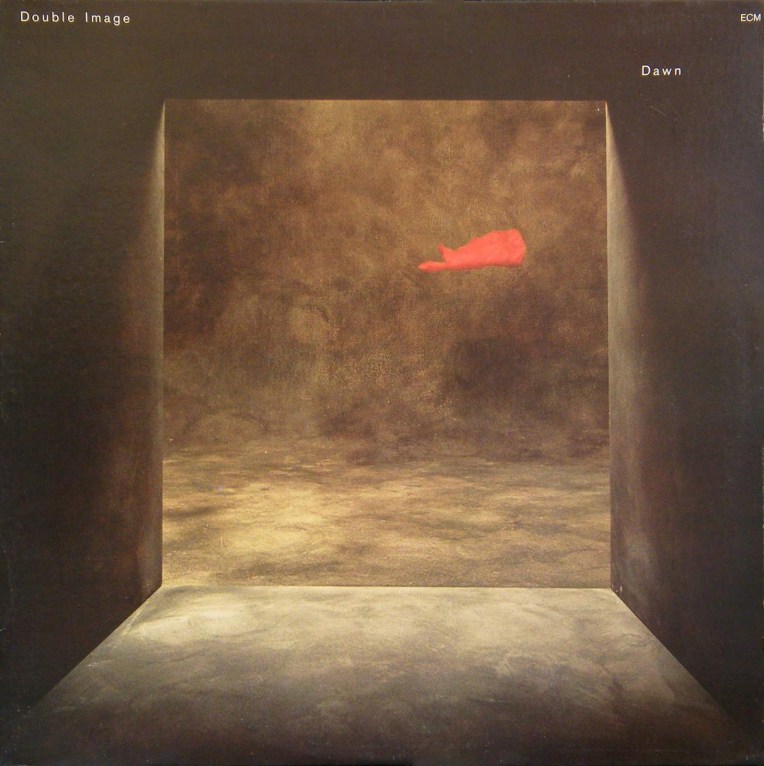
Double Image: Dawn (ECM 1146)

ECM 1146

Double Image
Dawn

David Samuels vibraharp, marimba
David Friedman vibraharp, marimba
Harvie Swartz bass
Michael DiPasqua drums, percussion
Recorded October 1978 at Talent Studio, Oslo
Engineer: Jan Erik Kongshaug
Produced by Manfred Eicher

Double Image was the intermittent project of Davids Friedman and Samuels, whose vibes and marimbas found likeminded company in session musicians Harvie Swartz and Michael DiPasqua on Dawn, the second of only three albums for the group and their only for ECM. Having two jazz percussionists in the same space was something of a rarity in the late seventies, when the album was recorded, and perhaps contributed to its being swept under the carpet over time. What we have, however, is a smooth and airy set of four extended pieces more than worthy of a reissue.

Every gesture therein is artfully considered, as demonstrated to delightful effect in the opening “Passage.” Swartz’s buttery soft bass adds girth to the Friedman/Samuels nexus, where light and darkness walk hand in hand. While DiPasqua baits a hook for every loop, vibe notes hang like keys from a chain, swinging in a steady hand with a pleasant jingle. For the final stretch, marimbas smoke from a flame of cymbals before vibes recap with a sublimely resolute chord. These plaintive measures continue in “The Next Event,” where the marimba broadens its wingspan into “Sunset Glow.” And as that honeyed bass trickles slowly back in, the shaded sound is fleshed out into a colorful fan of sunrays. Swartz beatifies the final “Crossing,” which, over a steadily popping snare, flows with calm virtuosity before breathing down the neck of finality.

This album makes a fine addition to any mallet enthusiast’s collection and proves that, even as its drowsiest, ECM quietly towers above the rest. A personal favorite among the label’s painted covers as well.

<< Miroslav Vitous: First Meeting (ECM 1145)
>> Nana Vasconcelos: Saudades (ECM 1147)

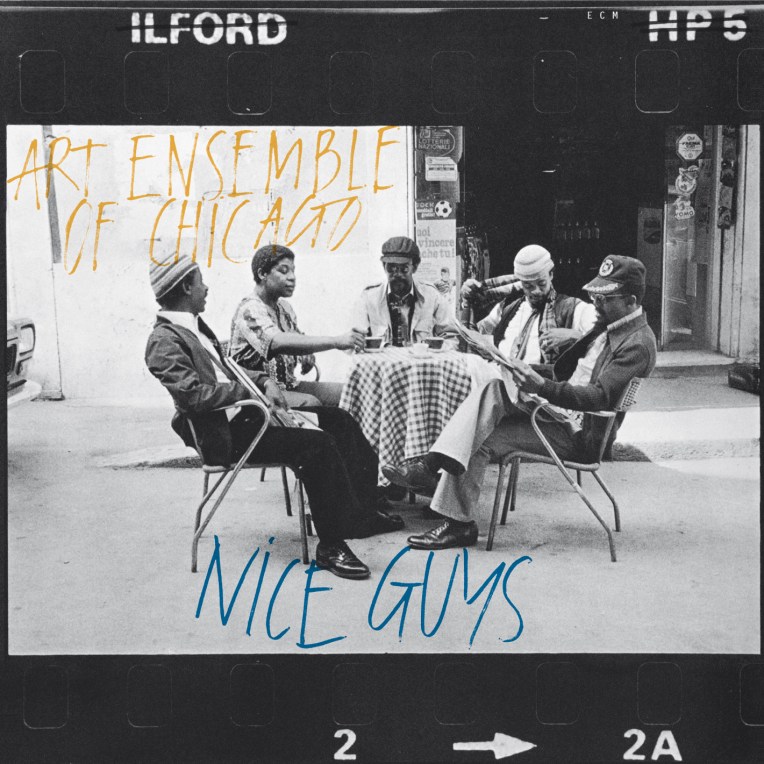
Art Ensemble of Chicago: Nice Guys (ECM 1126)

ECM 1126

Art Ensemble of Chicago
Nice Guys

Lester Bowie trumpet, celeste, bass drum
Joseph Jarman reeds, percussion, vocal
Roscoe Mitchell reeds, percussion
Malachi Favors Maghostus bass, percussion, melodica
Famoudou Don Moye drums, percussion, vocal
Recorded May 1978 at Tonstudio Bauer, Ludwigsburg
Engineer: Martin Wieland
Produced by Manfred Eicher

The legendary Art Ensemble of Chicago, currently in their fifth decade of activity, ended a five-year studio silence with Nice Guys, their debut for ECM at the pinnacle of the label’s output. As children of Chicago’s groundbreaking Association for the Advancement of Creative Musicians (AACM)—which also finds Jack DeJohnette, Anthony Braxton, and Wadada Leo Smith on its formidable roster—Ensemble members bring to every project a sound as eclectic as their technology. Theirs is simply positive music-making that is loads of fun and possesses much to admire. Free of dangerous philosophical trappings and illusions of space, it forges through the loose aesthetic of its performance a circle in which any and all listeners feel included.

The group’s noted fondness for “little instruments” adds color at every turn, as in the blown menagerie that is “Folkus,” the sole contribution from drummer Don Moye. Amid accents from parallel dimensions, winds and brass get locked in a cacophonous traffic jam—recalling the opening of Jean-Luc Godard’s Weekend—before falling into shadowy gestures and other cosmic accidents. Out of this, we awaken with Moye’s footsteps as a flock of shawms flies overhead into a tease. Such enigmatic caravans are emblematic of the AEC at their most visceral. Leader and reed-meister Roscoe Mitchell delights with the title track and with “Cyp,” both likeminded forays into breath and time. In the latter, we get the first (and perhaps last) bike horn “solo” in all of jazz, as well as some powerful wails from trumpeter Lester Bowie, who also lures us in with the album’s opener, “Ja.” Here, we start in freefall, finding solid ground beneath our sonic feet as the group slips into a Jamaican free-for-all. Joseph Jarman brings his saxophonic skills to the tripping rhythms of “597-59.” Bassist Malachi Favors, who provides not a few captivating moments, is the bounding foil thereof. Yet it is “Dreaming Of The Master,” Jarman’s nearly 12-minute love letter to Miles Davis, that brings the album to its most emphatic conclusions. With more specific execution, it shows the depth and breadth of the Ensemble at their best. Moye kicks things up a notch or two, paving the way for star turns from Mitchell, so that when the vampy horns return we hear them not as a memory but as an entirely new collective experience. And in the end, this is what the AEC is all about.

<< Rypdal/Vitous/DeJohnette: s/t (ECM 1125)
>> Arild Andersen Quartet: Green Shading Into Blue (ECM 1127)

Steve Kuhn: Non-Fiction (ECM 1124)

ECM 1124

Steve Kuhn
Non-Fiction

Steve Kuhn piano, percussion
Steve Slagle soprano and alto saxophones, flute, percussion
Harvie Swartz bass
Bob Moses drums
Recorded April 1978 at Tonstudio Bauer, Ludwigsburg
Produced by Manfred Eicher

Steve Kuhn is the all-purpose element: his presence heightens any musical concoction. Like no jazz pianist I know, he is aware of the negative spaces between his notes and shapes those spaces to suit the emotional needs of the tune. And what a set of tunes we have in Non-Fiction, a sorely out-of-print firecracker in dire need of a digital fuse. Speaking of conflagration, nothing singes our brow in any Kuhn project quite like “Firewalk,” which, despite its characteristically spacious feel, is clear and present (I bow to the uncredited engineer on this one). Kuhn accolades aside, it’s the sopranism of reedman Steve Slagle that really sets these coals to glowing and cradles every assured step in the liberation of play. Bob Moses and Harvie Swartz—an ideally suited rhythm section if there ever was one—lock the “Random Thoughts” that follow into lively traction. Slagle opts for flute and alto sax over a constantly shifting sonic palette. Whenever he isn’t breathing, he keeps his hands busy with additional percussion. (Unfortunately, the latter comes across as intrusive to my ears during headphone listening. External speakers will remedy this.) “A Dance With The Wind” and “The Fruit Fly” reverse the scales with a collective dose of whimsy and nostalgia. Swartz is simply fantastic here, weaving deftly through Kuhn’s canvas of vamps with distinct yet harmonious brushstrokes of its own. If anything has been missing so far, we find it all collected in “Alias Dash Grapey,” which has it all: a sweeping piano intro, replete with unrestrained cries from Kuhn, a spirited collage of solos (Moses ever palpable), and a deep sense of communication.

This is a tight album with plenty to unpack through repeated listening. Its energies fluctuate in volume, but always to the beat of Kuhn’s erudite dictation. As worth tracking down on vinyl as it is waiting for an appearance on CD.

<< Barre Phillips: Three Day Moon (ECM 1123)
>> Rypdal/Vitous/DeJohnette: s/t (ECM 1125)

Barre Phillips: Three Day Moon (ECM 1123)

ECM 1123

Barre Phillips
Three Day Moon

Barre Phillips bass
Terje Rypdal guitar, guitar synthesizer, organ
Dieter Feichtner synthesizer
Trilok Gurtu tabla, percussion
Recorded March 1978 at Talent Studio, Oslo
Engineer: Jan Erik Kongshaug
Produced by Manfred Eicher

I have said it before and I will say it again: Barre Phillips is one of ECM’s most underrecognized treasures. A maverick of the upright bass, his is a mind in which one revels getting lost. This follow-up to 1976’s Mountainscapes is the genesis to the latter’s messiah. From Dieter Feichtner’s opening synth in “A-i-a” and its attendant bass line, we are immediately engaged in a dialogue that is untranslatable except via the grace of its performance. Electric guitar accents from Terje Rypdal, who feels right at home here, billow backwards from the stratosphere into fissures of sonic earth. Rypdal swaps axe for organ in “Ms. P.,” unfurling a shimmering heat in which the breath of bass turns to steam. Even spacier touches await us in “La Folle” and “Ingulz-Buz.” Farther-reaching abstractions mesh into the neutral colors of electric guitar and bowed bass, respectively, throughout these intertidal interludes. “Brd” puts me in mind of Paul Schütze’s Stateless (especially the track “Cool Engines”): strung by a steady bass line and tabla, the latter courtesy of Trilok Gurtu, and Rypdal’s continued ploys, each bead reveals new insights with every listen. If Rypdal has been a key figure in the album’s narrative thus far, for the final “S. C. & W.” he morphs into a demigod. Backed by an insectile arpeggiator, alongside bombilations from bass, Rypdal gets tricky with the effects, at times lapsing into R2-D2-like articulations, but always with integrity. An emblematic closer.

Grandiose, cinematic, and meticulously constructed, Three Day Moon once more proves Phillips to be one of jazz’s best-kept secrets. The album also sports one of the most evocative ECM sleeves of the seventies, with sonic innards to match.

<< Enrico Rava Quartet: s/t (ECM 1122)
>> Steve Kuhn: Non-Fiction (ECM 1124)