Alice Zawadzki/Fred Thomas/Misha Mullov-Abbado: Za Górami (ECM 2810)

Alice Zawadzki
Fred Thomas
Misha Mullov-Abbado
Za Górami

Alice Zawadzki voice, violin
Fred Thomas piano, vielle, drums
Misha Mullov-Abbado double bass
Recorded June 2023 at Auditorio Stelio Molo RSI, Lugano
Engineer: Stefano Amerio
Cover painting: Emmanuel Barcilon
Produced by Manfred Eicher
Release date: September 13, 2024

Collected on our travels and taught to us by our friends, these are songs we have learnt and loved together. Gathered from Argentina, France, Venezuela, Poland, and the deep well of Sephardic culture, these folk tales speak to the moon, the mountains, the rain, the madness of humans, and the prophecies of birds.

The above is more than a collective artist statement from Alice Zawadzki (voice, violin), Fred Thomas (piano, vielle, drums), and Misha Mullov-Abbado (double bass). It’s also an example of how traditions, regardless of geographical distance, are organs of a larger body. Said body is literal, not metaphorical, insofar as it connects all of humanity at the internal level (the blood), even when the external (the voice) seems so disparate. The album’s title, Za Górami, says the same. Although it translates to “Behind the Mountains,” it is the Polish idiomatic equivalent of “Once upon a time…,” less a prompting of place than of possibility—not unlike the selections gathered here.

Within the trio’s curation of material, there is a liberal sprinkling of Sephardic songs. And yet, while some of the most well-worn treasures of the repertoire, including “Los Bilbilikos” (The Nightingales) and the lullaby, “Nani Nani,” are to be expected, the tact of each arrangement is remarkable. Even when the latter builds to an almost rapturous conclusion, it never loses sight of slumber’s healing effect. Such restraint is only made possible by a receding musicianship that lets the verses speak for themselves. This is increasingly rare to hear in Ladino programs, which can feel over-arranged as early music ensembles seek to outdo one another, favoring the interpreters over the interpreted. Not so in the hands of Zawadzki, who pours vocal plaster into “Dezile A Mi Amor” (Tell My Love) and “Arvoles Lloran Por Lluvias” (The Trees Weep For Rain) as if they were footprints in a landscape to be disturbed as little as possible. The tone and shape she brings to even wordless improvisations constitute natural delineations of their source material.

In Gustavo Santaolalla’s “Suéltate Las Cintas” (Untie The Ribbons), we find a most suitable modern companion. Steeped in the composer’s characteristically cinematic qualities, it lends itself to broader strokes in an instrumental economy. Thomas’s pianism is a warm evening breeze that equalizes the ambient air of its chamber and the lovers breathing it in. Its denouement alongside Mullov-Abbado’s heartbeat weaves a veil of privacy before Zawadzki renders their ecstasy a poetic afterimage. Another kindred spirit awaits in “Tonada De Luna Llena” (Song Of The Full Moon) by Venezuelan singer Simón Díaz, which yields some of the most evocative descriptions:

I saw a black heron
Fighting with the river
That’s how your heart
Falls in love with mine

The moon, even when not explicitly mentioned, is a constant presence in these songs, shining on the maiden in “Je Suis Trop Jeunette” (I’m Too Young, after Nicolas Gombert) who dreams of being swept away from her family. Her internal conflict is only heightened by the prepared piano in the upper registers, which carries over into the title song by Zawadzki, after the Polish traditional about a girl who defies her mother and ends up dancing her life away. “Gentle Lady,” Thomas’s setting of James Joyce, is a folk song in and of itself, stepping out of time to unravel its literary knot with grace.

ECM listeners familiar with the label projects of Savina Yannatou, Arianna Savall, and Amina Alaoui will feel swathed in comfort here, even as they are caught up in the unique flow that only this trio can bring forth from the hillsides of their wanderings. How fortunate we are that their paths have aligned on this side of the mountains.

Anouar Brahem: After The Last Sky (ECM 2838)

Anouar Brahem
After The Last Sky

Anouar Brahem oud
Anja Lechner violoncello
Django Bates piano
Dave Holland double bass
Recorded May 2024
Auditorio Stelio Molo RSI, Lugano
Engineer: Stefano Amerio
Cover: Emmanuel Barcilon
Produced by Manfred Eicher
Release date: March 28, 2025

Where should we go after the last frontiers?
Where should the birds fly after the last sky?

–Mahmoud Darwish

After The Last Sky marks the return of oud virtuoso and composer Anouar Brahem to ECM, eight years after Blue Maqams. That groundbreaking album also featured pianist Django Bates and bassist Dave Holland, both of whom are retained here, along with a new addition in cellist Anja Lechner. The result is a culmination of culminations, blending Brahem’s evolving integrations of jazz, European classical music, and, of course, the modal Arabic maqams at their core. Gaza was firmly on his mind leading up to and during the recording, and the titles reflect this awareness in a contemplative way. Despite the music’s delicacy (if not because of it), it offers prescient meditations on the horrors of violence that, sadly, seem to be the most inescapable leitmotif in the symphony of our species. That said, Brahem is not interested in proselytizing. “What may evoke sadness for one person may arouse nostalgia for another,” he says. “I invite listeners to project their own emotions, memories or imaginations, without trying to ‘direct’ them.” By the same token, notes Adam Shatz in his liner essay, “as with ‘Alabama,’ John Coltrane’s harrowing elegy for the four girls killed in the 1963 bombing of a Black Church by white supremacists, or ‘Quartet for the End of Time,’ composed by Olivier Messiaen in a German prisoner of war camp, your experience of Brahem’s album can only be enhanced by an awareness of the events that brought it into being.” Either way, After The Last Sky invites us into a conversation between ourselves and the political realities we would rather avoid.

And so, when wrapped in the tattered garment of “Remembering Hind” to start, we must remind ourselves that music, like life, is only what we can experience of it. If something never enters our sphere of awareness, it might as well not exist, which is precisely why we so often choose to ignore rather than engage. Here, we are given a space in which to reconcile those two attitudes, in full recognition that the sacred is forged from the ashes of the profane and that beauty is a fragile compromise for destruction. In some ways, this contradiction is inherent to Brahem’s instrument and its vulnerabilities, which he animates from within.

The more we encounter, the less we can deny our complicity in suffering. Whether in the post-colonial shades of “Edward Said’s Reverie” or the painful imagery of “Endless Wandering” and “Never Forget,” the weight of exile weighs on our shoulders. Meanwhile, the instruments take on distinct personas. Bates is the bringer of prayer, Holland is the bringer of faith, and Lechner is the bringer of community. Through it all, Brahem is the one who brings trust. Through his establishments, he reminds us that intangible actions have very physical consequences. By the thick threads he pulls through “In the Shade of Your Eyes,” we draw close for comfort in the afterglow of bombs.

Despite the sadness casting its pall over this journey, there are way stations where gravity has less of a hold on us and where, I daresay, hope becomes possible again. This is nowhere truer than in “The Eternal Olive Tree,” an improvisation between Brahem and Holland. As bittersweet as it is brief, it finds the oudist feeding on the bassist’s groove as if it were a ration to be savored, not knowing where sustenance might come from next. Other sparks of resignation are carefully breathed upon in “Dancing Under the Meteorites,” “The Sweet Oranges of Jaffa,” and “Awake.” In all of these, Lechner’s playing transports us to another level, inspiring Brahem to dramatic improvisational catharsis (yet always restrained enough to maintain his sanity). The album ends with “Vague.” Among his most timeless pieces, it is lovingly interpreted. Bates renders the underlying arpeggios with artful grace, while Holland and Lechner open the scene like a hymnal for all with ears to hear.

I close with another quote from Shatz, who writes: “Brahem’s album is not simply a chronicle of Gaza’s destruction; but its very existence, it offers an indictment of the ‘rules-based order’ that has allowed this barbarism to happen.” Thus, what we are left with is an indictment of indifference, as profound as it is melodic. What Brahem and his band have done here, then, is not to simply make an album of beautiful music (which it is) but rather to offer themselves as a living sacrifice to the altar of reckoning to which we all must bow if we are to make a difference that matters. When we are stripped of all we have, music is what remains.

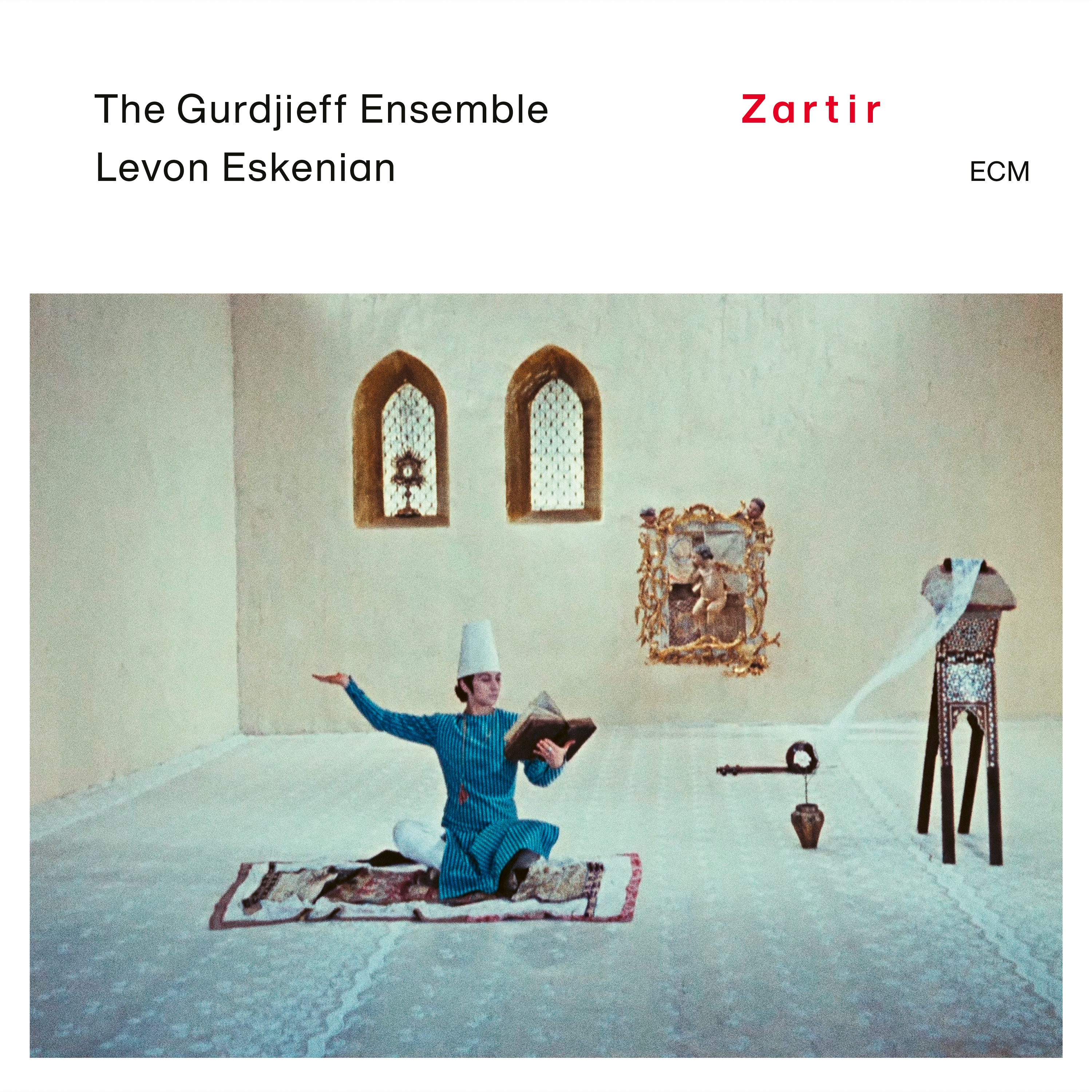
The Gurdjieff Ensemble: Zartir (ECM 2788)

The Gurdjieff Ensemble
Zartir

The Gurdjieff Ensemble
Levon Eskenian
 artistic director
Vladimir Papikyan voice, santur, burvar, tmbuk, singing bowls
Emmanuel Hovhannisyan duduk, pku
Meri Vardanyan kanon
Armen Ayvazyan kamancha, cymbal
Gagik Hakobyan duduk
Norayr Gapoyan duduk, bass duduk, pku
Avag Margaryan blul
Aram Nikoghosyan oud
Astghik Snetsunts kanon
Davit Avagyan tar
Mesrop Khalatyan dap, tmbuk, bells, triangle
Orestis Moustidis tombak
National Chamber Choir of Armenia
Robert Mlkeyan
 director
Recorded December 2021 at Radio Recording Studio, Yerevan
Engineer: Tigran Kuzikyan
Mixed November 2022
by Manfred Eicher, Levon Eskenian, Michael Hinreiner (engineer), and Tigran Kuzikyan (engineer)
at Bavaria Musikstudio, Munich
Cover photo: Still from Sergei Parajanov’s film The Color of Pomegranates
Album produced by Manfred Eicher
Release date: October 27, 2023

“Who can say that I will live from dawn till dusk? Man’s entry and man’s exit is simple work for the hand of God.”
–Sayat-Nova

Continuing the journey on which they first embarked for ECM in 2011, Levon Eskenian and The Gurdjieff Ensemble deepen their relationship with the enigmatic Georges I. Gurdjieff (c. 1877-1949). Given the mystery surrounding the Armenian-born teacher/philosopher, one can hardly say that the music on Zartir is a historically informed recreation. Rather, writes Steve Lake, “Eskenian’s ensemble resituates the music along the paths of its possible interpretations.” On said paths, one encounters travelers of Armenian, Assyrian, Greek, Caucasian, Kurdish, Persian, and Arabic persuasion, each a reflection of the other in the grander sense yet simultaneously individual enough to lend historico-cultural insight. Given that the bulk of Gurdjieff’s music is preserved in 250 pieces for piano (an instrument he saw as a compromise at best), Eskenian has once again brought new life (or is it old life?) to melodies that speak of their lineage more deeply than whatever we might glean from biographical speculations. Lake calls these “triple-distilled reverse transcriptions,” reflecting how they might have been intended to sound on the folk instruments that would surely have been a familiar soundtrack to Gurdjieff’s own itinerancy.

The album’s title, which means “Wake up!”, seems to evoke the Zen concept of satori, referring to a sudden enlightenment of mind, body, and spirit. However paltry that comparison might be, it nevertheless points to the undeniable alignment of this trifecta in the music arranged for us by Eskenian here. For example, in the twilit sagacity of “Pythia,” the first of many tears in the veil of obscurity, the mood is almost regal, as if welcoming some great royalty to step on a carpet woven just for the occasion, only to be torn to shreds and burned after so that no mere mortal feet dare taint it. At the same time, however, the palace and any tokens of grandeur it might contain are not on display. Rather, this is music that lives in the nooks and shadows of its architecture, so that we might know its inner secrets before sharing them with the world. Even in the briefest glimpses, including “Sayyid Chant and Dance No. 41” and “Oriental Dance,” we stand at the edge of a precipice with an eye seeking the unsettled territories as yet before us, ignoring the opulence at our backs. In “Introduction and Funeral Ceremony,” flight becomes possible so that we might leave the trappings of men in favor of the natural resources they all too often neglect. Whether in the sound of the duduk or the touch of percussion, the listener is rendered a spirit in search of a body, if only to feel the burden of gravity once again.

Beyond Gurdjieff himself, the program expands its reach to invoke the bards and troubadours of Aremania known as the ashughs, a tradition to which Eskenian’s father, Avedis (to whom this album is dedicated), was a vital link. This introduction of voices to the milieu adds another layer of fragile humanity. Ashugh Jivani (1846-1909) gives us

“Kankaravor Enker” (Friend of Talents), a poignant lament on the weaponization of humility in the land of the self-righteous. “Ee Nenjmanet Arkayakan Zartir” (From your royal slumber, awake) by Baghdasar Dbir (1683-1768) is a song of love from a distance (always from a distance). Nothing is ever touched, felt, or tasted; nothing more than an impression that must be concretized in music. And in the sound paintings of the legendary Sayat-Nova (1712-1795), namely “Dard Mi Ani (Do Not Fret)” and “Ashkharhes Me Panhjara e” (The World Is a Window), the mortality of love serves as a prayer against entropy.

Speaking of prayer, we end with Gurdjieff’s “The Great Prayer,” for which the National Chamber Choir of Armenia joins the ensemble. Eskenian calls this “one of the most profound and transformative pieces I have encountered in Gurdjieff’s work.” Indeed, it unfolds like a metastatement among metastatements. A culmination of life and death into a single neutral point, it is existence for its own sake, divine yet without doctrine, the lifeblood of our every waking hour.

Savina Yannatou: Watersong (ECM 2773)

Savina Yannatou
Watersong

Savina Yannatou voice
Lamia Bedioui voice
Primavera en Salonico
Kostas Vomvolos qanun, accordion
Harris Lambrakis nay
Kyriakos Gouventas violin
Yannis Alexandris oud
Michalis Siganidis double bass
Dine Doneff percussion, waterphone
Recorded March 2022 at Sierra Studios, Athens
Engineer: Yiorgos Kariotis
Mastering: Christoph Stickel
Cover photo: Woong Chul An
Album produced by Manfred Eicher
Release date: April 11, 2025

For her fifth ECM album, Greek singer Savina Yannatou returns with a collection of songs themed around water. Spanning the European continent and beyond, her sources draw from wells of uniquely situated cultures and traditions, where the elemental force that sustains us can be at once beatific and menacing. Along with her mainstay musicians, Primavera en Salonico, she is joined by Tunisian singer Lamia Bedioui, last heard alongside Yannatou on Terra Nostra, and whose Arabic inflections lend interlocking contrast to the Mediterranean flavors.

The soul of the set list is to be found in the Greek material, of which “The Song of Klidonas” brings that distinctive voice into frame, while violin and oud dot the sky with extra stars. Yannatou links these into a storyboard of constellations. Similar vibrations abound in “The Immortal Water,” which moves like a body in the throes of unrequited love, while “Kalanta of the Theophany” turns a solemn carol into a jazzy free-for-all. Yannatou and her band further skirt the edges of interpretation in “Perperouna,” which describes water as something prayed for to ensure a harvest for survival. A percussive backdrop lends uplift, violin and nay soaring as birds catching a tailwind.

While island hopping from Cyprus (“Ai Giorkis,” a hymn to Saint George) to Corsica (“O onda,” a paean to ocean waves and distant storms by G. P. Lanfranchi), we encounter a gallery of moods, times, and places, including “Sia maledetta l’acqua” (Cursed Be the Water), a playful 15th-century gem, plus two journeys farther north. In the Gaelic “An Ròn” (The Seal), the qanun plays the role of harp, filling the air with shades of green and blue. And in “Full Fathom Five,” Robert Johnson’s 17th-century setting of words from Shakespeare’s The Tempest, percussionist Dine Doneff plays the waterphone for a haunting evocation of entropy. But nowhere is the beauty so deep as in “A los baños del amor” (At the Baths of Love). This anonymous ballad from 16th-century Spain configures water as a sign of loneliness, a space to drown one’s sorrows. It is also something of a sister to “Con qué la lavaré?” (With What Shall I Wash It?) by El Cançoner del Duc de Calabria (1526-1554), another astonishingly lyrical melody, held in the most delicate of frames. It expresses that same sense of solitude, but with a hint of resignation to fate. 

Bedioui’s contributions are worlds unto themselves, especially because of the bridges they build. “Naanaa Algenina” (Garden Mint), an Egyptian traditional from Aswan, finds a suitable partner in “Ivana” from North Macedonia. Where one opens in duet as a moonflower, the other turns mystical in its freer geographies. “Mawal” (To the Mourning Dove, I Said) sets the poetry of Aby Firas al-Hamdani (10th century) to music by Iraqi singer-songwriter Nazem al-Ghazali, meshing Bedioui’s spoken word with Yannatou’s improvisational underlayment, hand drums marking the unprimed canvas with their ink. Finally, “Alla Musau” (God of Moses), a Nubian song about baptizing infants in the Nile, is interwoven with the African American spiritual “Wade in the Water.” The result is unexpected and wondrous.

As always, Primavera en Salonico’s chameleonic abilities are as free as they are precise. Playing both an anticipatory and reflective role, the band unpacks as many vocal implications as possible without the aid of words. Of the same mind, they walk in unison, even as their speech draws lines between increasingly disparate tongues.

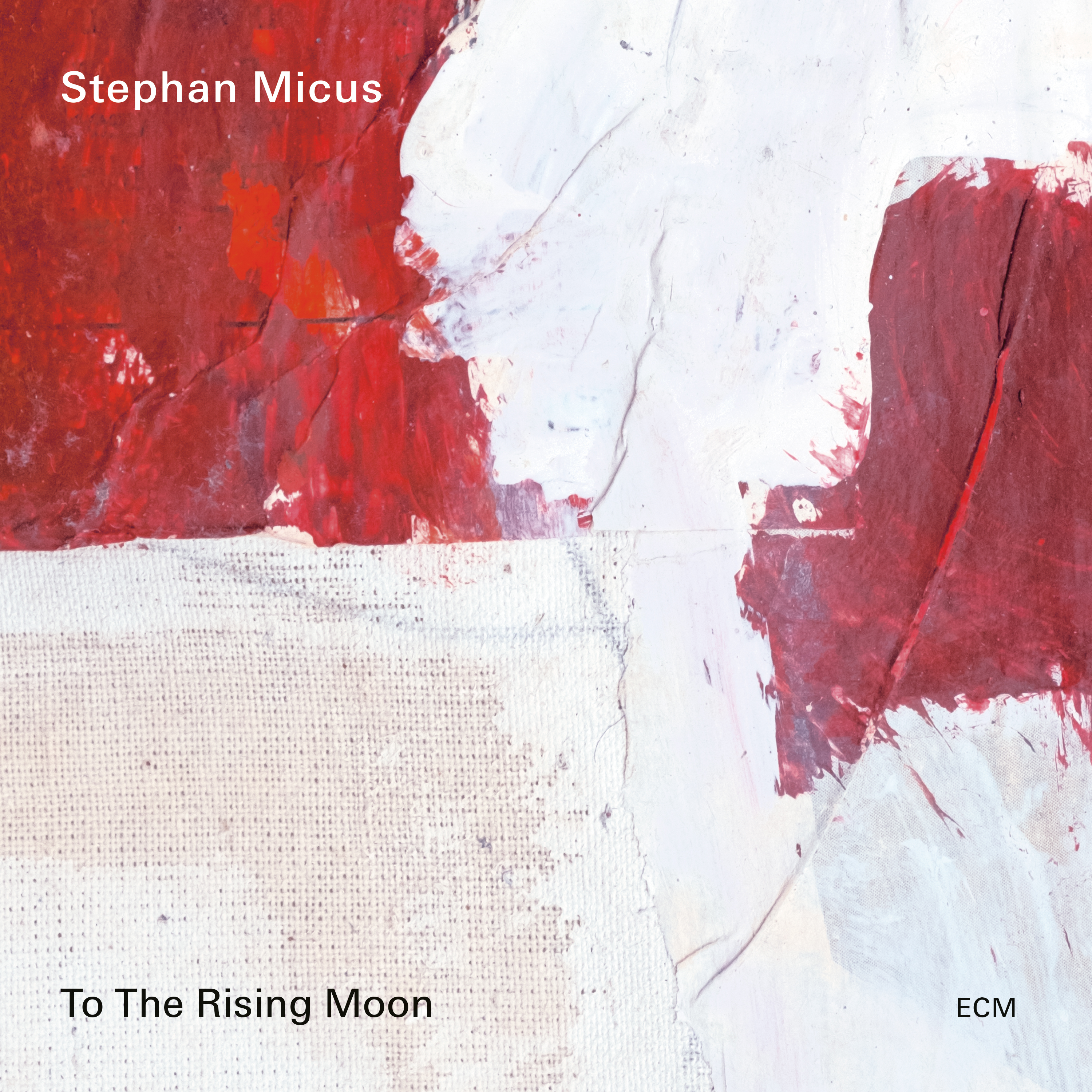
Stephan Micus: To The Rising Moon (ECM 2834)

Stephan Micus
To The Rising Moon

Stephan Micus tiple, dilruba, sattar, chord zither, tableharp, nay, sapeh
All music and voices composed and performed by Stephan Micus
Recorded 2021-2023 at MCM Studios
Cover art: Eduard Micus (1925-2000)
An ECM Production
Release date: November 15, 2024

my house burned down
now I have a better view
of the rising moon
–Masahide Mizuta (1657-1723)

To step into a new Stephan Micus recording is to approach a koan from the inside out. For while every world he creates feels immediately familiar, there’s also something about it that distances us from ourselves. In To The Rising Moon, his 26th solo album for ECM, he unravels an out-of-body experience through characteristically novel combinations, transcending cultural and historical borders in search of a collective humanity.

His narratives always seem to have a central protagonist; this time, it is the tiple. Sounding like a charango but with a looser feel, it is the national instrument of Colombia, but in the present context, it steps out of space and time into its own. “To The Rising Sun” features two of them: one to establish a percussive jangle, the other to sing through its contours. Building a monument one stone at a time, even as Micus scales it, he comes prepared with the finishing capstone, so that we can fully admire the valley of which it affords a sacred view. This format is later replicated in “Unexpected Joy,” which has all the internal tension of a young warrior walking through the forest on his first solo hunt, and in “To The Lilies In The Fields,” where gemstones rounded by the river’s current are ignored in favor of the greater value of leaving them as they are. “In Your Eyes” increases the count to three and adds a lone voice. Its juxtaposition of steel strings and Micus’s rounded singing gives us room to explore. At the heart of all this is “The Silver Fan,” a tiple solo through which light and shadow merge with a kiss.

On the topic of voices, another prominent one is the dilruba, an Indian bowed instrument with sympathetic strings. Six of these band together for “Dream Within Dream,” painting a realm where the physical world recedes into the farthest corners of consciousness. The sound is thin and incisive. Like wisdom offered by a sage on his deathbed, its truth can never be forgotten. The dilruba finds a long-lost brother in “Embracing Mysteries,” where the sapeh, a four-stringed lute from Borneo (normally plucked but modified to be played with a bow), evokes nature and nurture in equal measure. Meanwhile, Micus’s voice cuts the figure of a traveler with a rucksack filled with hymns, which he drops in place of crumbs.

Yet another member of this ad hoc family is the sattar, a long-necked bowed instrument of the Uigur people. In triplicate, it elicits one of Micus’s most spiritual creations: “The Veil.” He runs his hands gently across, feeling every pleat and fold as if it were an era of history to be navigated. In that sense, there is also mourning for the past and a hope that all the destruction we’ve brought has not ultimately been in vain. Despite taking part in the album’s largest ensemble in “Waiting For The Nightingale” (which brings together two dilruba with five sattar, five voices, three Cambodian flutes, and two chord zithers), the result feels open, a spider’s web touched with dew that has withstood an entire day’s worth of climatic change. Micus’s chorusing is a call to the wilderness within. The sattar also binds three tableharps (which combine elements of bowed psaltery, zither, and harp) in “The Flame,” leaving blurred traces of its past like paintings on stone. Finally, in the title track (alongside two tiples and two nay), it is a birthing ground of fluidity and purpose. Having nowhere else to go but inward, it bows its head in offering to silence, a prayer without words to get in the way of meaning.

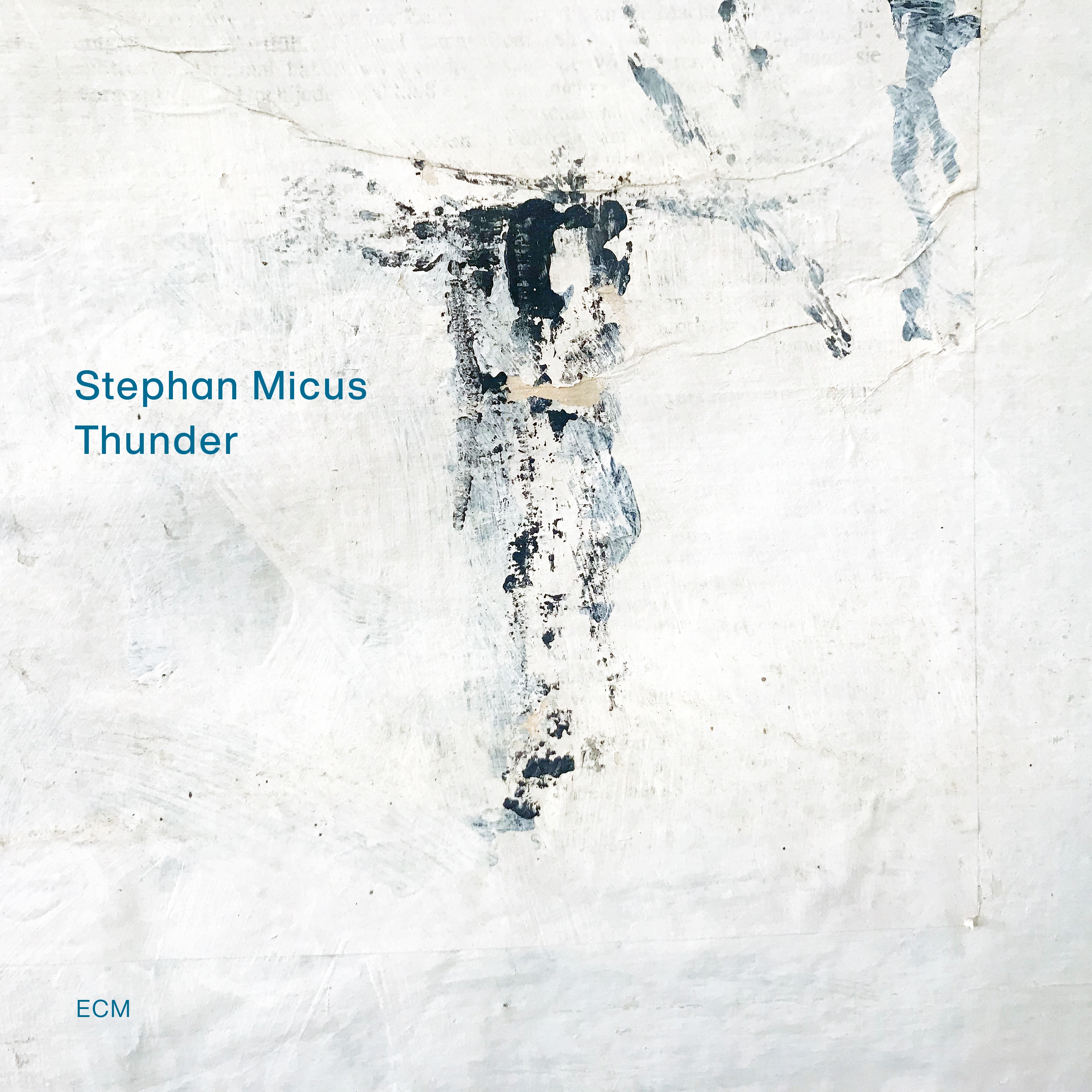
Stephan Micus: Thunder (ECM 2757)

Stephan Micus
Thunder

Stephan Micus frame drum, storm drum, dung chen, Burmese temple bells, Himalayan horse bells, ki un ki, bass zither, bowed dinding, kyeezee, shakuhachi, sarangi, nyckelharpa, kaukas, sapeh, voice, nohkan
Recorded 2020-2022 at MCM Studios
Cover art: Eduard Micus (1925-2000)
An ECM Production
Release date: January 20, 2023

Multi-instrumentalist Stephan Micus goes bigger than he ever has before on Thunder, his 25th solo album for ECM. Inspired by the dung chen, a four-meter-long trumpet heard booming from monasteries during his travels to Tibet, he long dreamed of incorporating it into a series of compositions. After immersing himself in its depths (only in Kathmandu did he find someone willing to teach him how to play this instrument normally reserved for monks), he settled on the ki un ki (a cane stalk common among the Udegey people of Siberia played by inhaling) and the nohkan (a transverse bamboo flute from the Japanese Noh theatre). From this trinity arose a series of nine compositions, each dedicated to a different god of thunder from different world traditions.

Despite the album’s concept, however, and the decidedly spiritual overtones, there is something undeniably elemental about the music itself. For while there are certainly far-reaching moments of great drama and development, others are intimate spirals of reflection that are just as content in staying where they are. Of the former persuasion are pieces like “A Song For Thor,” “A Song For Vajrapani,” and “A Song For Perun.” All three make use of dung chen, frame drums, Burmese temple bells, Himalayan horse bells, bass zither, and either the ki un ki or nohkan. The drums are the heartfelt griots of this primal tale, evoking the sound of footsteps on dirt and stone. The ki un ki moves with an eagle’s precision, so determined that every clod seems to get out of its way as it barrels through with a human soul firmly in its sights. As it traverses the landscape, passing through every dead object as if it were made of air, it finds its way to life itself. Through this transformation, it lingers on the edge of speech. Meanwhile, the dung chen move like elephants across the plains, each carrying a virtue known only by its ancestors.

So much of what we encounter here, however, is as reflective as a pond in moonlight. For example, “A Song For Raijin” and “A Song For Leigong” feature the storm drum, which, despite its name, betrays only the slightest hint of a climatic disturbance on the horizon. Both tracks also feature bowed sinding (a West African harp), kyeezee (bronze chimes from the Buddhist temples of Burma), and shakuhachi. With so much tenderness between them, each wrapped in the arms of a subcutaneous drone, the Japanese bamboo flute can only plant its prayers in whispers. It is a frail warrior that would be torn in the next violent rainfall, the possibility of which haunts every dream.

Of those dreams, we get two glimpses through the lenses of “A Song For Armazi” and “A Song For Zeus.” These share the same scoring (3 sarangi, 2 bass zithers, and nyckelharpa), opening spaces of translucent incantation. Speaking of which, Micus’s voice enters magnified in “A Song For Shango” and “A Song For Ishkur.” Accompanied by the sapeh (a lute from Borneo) and kaukas (a five-string lyre of the San people in Southern Africa), he traces the aftermath of nature’s fury. We can feel the humidity in the air, the sweet musk of precipitation in the nostrils, and the tang of love on the tongue. The sapeh shimmers, while the singing rolls across the mountains, flattening everything it touches with quiet power—not a ritual but a revelation that manifests itself as a footnote on the page of time.

Steve Tibbetts: Hellbound Train (ECM 2656/57)

Steve Tibbetts
Hellbound Train

DISC I
Steve Tibbetts guitars, kalimba, percussion
Marc Anderson congas, percussion, gongs
Jim Anton bass (1, 2, 3, 4, 6, 9)
Eric Anderson bass (1, 8, 9)
Bob Hughes bass (10, 11)
Mike Olson synthesizer (7)
Marcus Wise tabla (8, 10)
Claudia Schmidt voice (1, 9)
Rhea Valentine voice (1)
DISC II
Steve Tibbetts guitars, dobro, piano, kalimba
Marc Anderson congas, percussion, steel drum, gongs, handpan
Michelle Kinney cello, drones (9, 10, 11, 16)
Bob Hughes bass (15)
Tim Weinhold vase, bongos (15)
Marcus Wise tabla (3)
Recorded 1981-2017
Mastered by Greg Reierson
at Rare Form Mastering, Minneapolis
Cover photo: Lucas Foglia
Album produced by Manfred Eicher
Release date: July 1, 2022

“The Best Steve Could Do” is how Steve Tibbetts describes Hellbound Train, a sweeping anthology of works drawn from his decades-long trek across internal and external terrains. The Minnesota-based guitarist and composer selected tracks for this double-disc effort in terms of how well their beginnings and endings suggested connections in an emerging (if malleable) whole. Holding it all together is the trust he shares with his musicians, including percussionists Marc Anderson and Tim Weinhold, tabla player Marcus Wise, bassists Jim Anton, Eric Anderson, and Bob Huges, and cellist Michelle Kinney, among others. In sampling his ECM traversal through Northern Song (1982), Safe Journey (1984), Exploded View (1986), Big Map Idea(1989), The Fall Of Us All (1994), A Man About A Horse (2002), Natural Causes (2010), and Life Of (2018), we are privy to an artist whose instruments are as fleshy as his flesh is instrumental.

Disc I begins with light, as such experiences often do: the glow of an ember, the first twinkle at dusk, the glint in a child’s eye. In search of roadside rest, the itinerant Tibbetts coaxes an all-out percussive mantra from the thickets flanking his path. This is the setting of “Full Moon Dogs,” one of four vital organs transplanted from The Fall Of Us All. An electric guitar courses over this landscape with the charge of a meteor shower. As in “Nyemma” (a lunar spotlight on the voice of Claudia Schmidt) and “Roam And Spy,” he makes his choice—and a fire—to settle in for the night. What follows is not a peaceful slumber, though tranquility is never far away, sharing one image after another until a story takes shape.

Five signposts from A Man About A Horse rise like telephone poles against the Milky Way, strung with trajectories of communication to take upon waking. Whether through the clopping rhythms of “Chandoha” or the sputtering lantern light of “Lochana,” a sense of unease builds to the dyad of “Black Temple” and “Burning Temple,” wherein smoke rules the day. In the aftermath of “Glass Everywhere,” hints of violence dissolve into a brief exchange of voices and laughter.

Despite its destructive qualities, fire is a constant companion, fueled at every turn by the gristle of truth. Tibbetts survives by flinging his 12-string bola at the agile game embodied by hands on drums. The sunlight grows stronger in the elastic nostalgia of “Your Cat” (our sole dip into Exploded View), intersecting the ecliptic of “Vision.” The latter encounter foreshadows the standout selections from Safe Journey on Disc II, including the sacred congregation of kalimba, steel drum, and reverberant picking that is “Climbing” and the masterful “Night Again” and “My Last Chance.” With so much scintillation to chew on, it’s a wonder we don’t turn into comets in the process of listening to them. Big Map Idea compels five entries in this sonic diary, including a nod to Jimmy Page (“Black Mountain Side”) and an excerpt from “Mile 234,” an excursion marking time more than distance.

Grander biomes await us in two tracks from Northern Song. Whereas “The Big Wind” is a winged groove, “Aerial View” feels somehow connected to the earth—so much so that their titles could be reversed and still feel accurate. Life Of sends out four of its offspring, reared in the shadows of Natural Causes, of which “Chandogra” is the epitome of renewal. As if first setting out, our feet no longer have callouses, our muscles are strong, and our packs are heavy. We look upon the open road not as a burden but as an invitation. The only answer to our call resounds in the final “Threnody,” a guitar without a need beyond the hymn it holds against the sun as a compass for all who might come after.

An ethereal souvenir from places we will never visit, Hellbound Train struggles against the current of any vocabulary. This is the best can do to tell its story. A must-have for Tibbetts fans and an ideal place to start for those fortunate to hear any of this music for the first time.

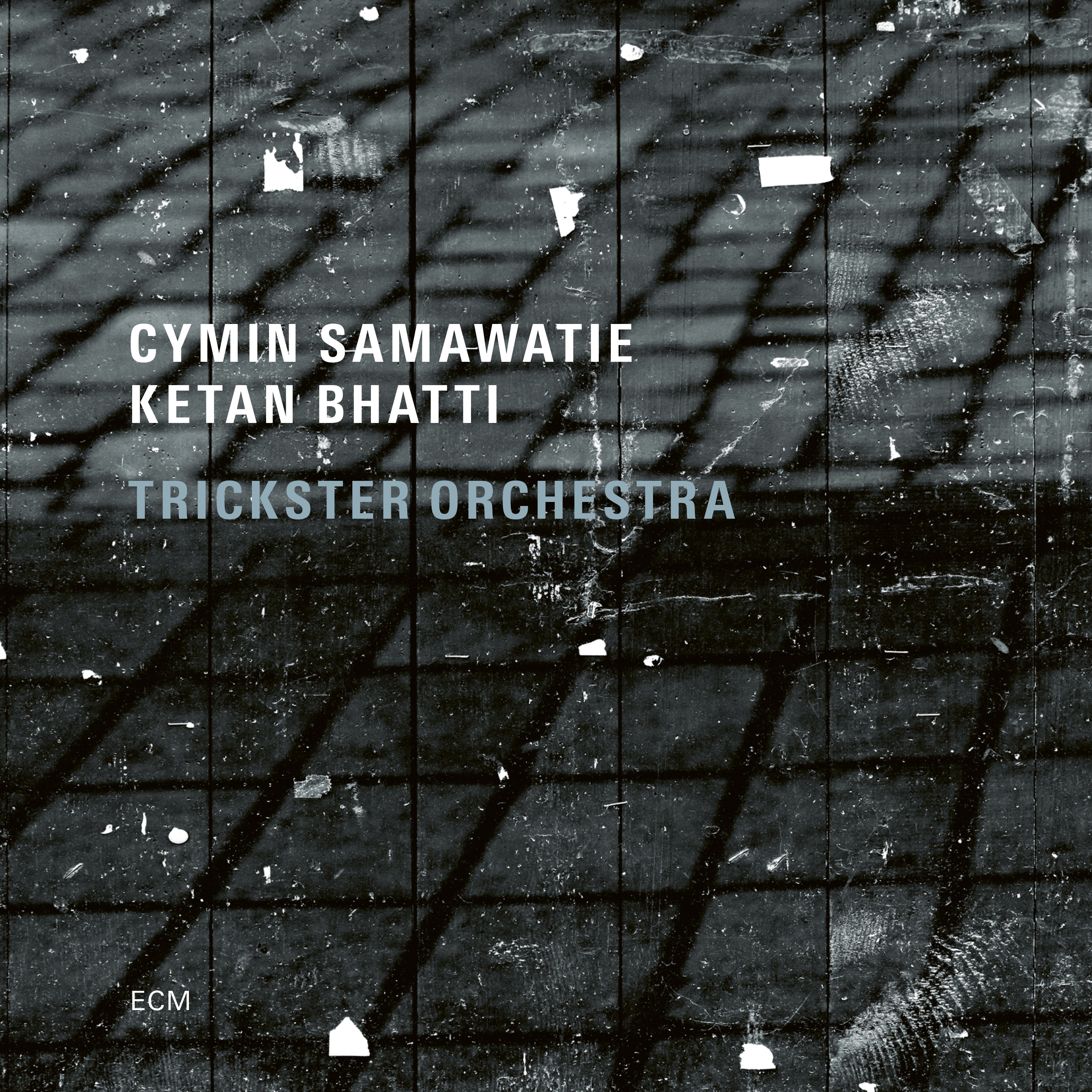
Cymin Samawatie/Ketan Bhatti: Trickster Orchestra (ECM 2696)

Cymin Samawatie
Ketan Bhatti
Trickster Orchestra

Cymin Samawatie vocals
Ketan Bhatti drums
Trickster Orchestra
Recorded January 2019, Meistersaal, Berlin
Engineer: Martin Ruch
Assistant engineer: Philip Krause
Mastering: Christoph Stickel
Cover photo: Fotini Potamia
An ECM Production
Release date: April 23, 2021

I wait for the LORD, my soul doth wait, and in his word do I hope. My soul waiteth for the Lord more than they that watch for the morning: I say, more than they that watch for the morning.
–Psalm 130:5-6

Since gracing ECM’s catalog with three facets of its musical wisdom, Cyminology reconfigures itself on a larger scale. This time, the group’s leader, singer Cymin Samawatie, and mainstay percussionist Ketan Bhatti drop their stones into the pond of the Trickster Orchestra, forming a 23-piece supergroup poised to interpret a wide repertoire that includes Old Testament scripture and Sufi poetry, connected by linguistic threads spun in Hebrew, Arabic, Turkish, and Farsi. Instruments span an even wider gamut, from the koto of Naoko Kikuchi, the kanun of Bassem Alkhouri, and the sheng of Wu Wei to the clarinet of Mona Matbou Riahi, the recorders of Susanne Fröhlich, and the viola of Martin Stegner. Among the resulting music’s many excitements is the feeling that, despite finding themselves in unfamiliar territory, the musicians paint with an exploratory quality that makes every blade of grass their own.

“Shir hamaalot” is one of two songs cowritten by Samawatie and Bhatti. This stark setting of Psalm 130 evokes the inner turmoil born of self-awareness that prompted David to praise God with such fervency, while “Keşke” (“If Only”) melodizes a poem by Efe Duyan. This playful exploration of morbid topics, from trauma and self-harm to disaster and desire of the flesh, presents the human voice as a fluid presence given afterlife through electronic manipulations in what is arguably the album’s expressive apex.

On their own, each composer emotes with a genuinely distinctive quality. Samawatie’s sound-world is designated by its careful attention to syntax, its validation of textual histories, and its uplifting of the human experience. In “Gebete,” the tangible words of Rumi blend into Psalm 23, the former’s resignations easing into the latter’s divine comforts through tribulation before the sun’s radiance shines crosswise through the mesh of Sura 91. Like the verses themselves, the music blurs the line between inner and outer. Samawatie’s voice is joined by those of Rabih Lahoud and Sveta Kundish, who string their incredible harmonies from far and wide. In “Modara” and “Por se ssedaa,” we encounter freer singing and groovy undercurrents, respectively. Both look beyond the veil of religion to a place where reverence can flourish without constriction.

Bhatti’s atmospheres are more overtly about contrast. From the whispered imaginings of “Tounsibuurg,” which constitutes the album’s solar plexus, to the urgency of “Hast Hussle II,” he examines a mélange of influences, cultural touchpoints, and philosophical inquiries. Even the emerging chaos of “Kords Kontinuum” feels narratively structured, especially when the bass clarinet of Milian Vogel peeks above a rim of cloud while the viola works clockwise through its string games.

These songs are sirens of tomorrow gracing the here and now, each strand of their hair fanning out to reveal a possible trajectory across arid land, through murky waters, and over snow-dusted mountains. Still images are so frequent and congruent that, before long, they begin to take on the illusion of movement one would expect to find in the flipbooks of childhood.

This unusually thorough (and thoroughly unusual) experience is an ode to those who feel most at home in liminal spaces.

Stephan Micus: Winter’s End (ECM 2698)

Stephan Micus
Winter’s End

Stephan Micus chikulo, nohkan, 12-string guitar, tongue drums, voice, kalimba, sinding, charango, nay, sattar, Tibetan cymbals, suling
Recorded 2018-2020 at MCM Studios
Cover art: Eduard Micus (1925-2000)
An ECM Production
Release date: June 11, 2021

although there is the road
the child walks
in the snow

–Murakami Kijo (1865-1938)

Tempting as it is to characterize the music of Stephan Micus as the soundtrack of a solitary traveler, given the staggering amount of instruments he uses to articulate those songs, one can hardly say he is alone. With so much companionship through his interaction with, study of, and reactions to humanity’s need for music, his albums are consistently open-ended, each inhaling in anticipation of the next’s exhalation. Every project, too, has its focal instrument, and in this case, it is the chikulo, a bass xylophone from Mozambique with a distinct buzzing quality (though for many tracks, Micus removes the plastic membrane responsible for that quality). It is heard most distinctly in the “Autumn Hymn,” which convenes three of those instruments with the nohkan, a Japanese bamboo flute used in Noh theatre. Though often used for its dissonant effects (which add to the drama of Noh’s out-of-time sensibilities), here it is as clear as a mountain stream, quietly wandering its way through barren trees in search of nothing but its fulfillment of a natural order. In “The Longing Of The Migrant Birds” (3 tongue drums, 2 chikulo, 14 voices), the buzzing is left aside for percussive melodies to clear a path for tongue drums (wooden boxes with “tongues” of various sizes cut into the top surface) and a chorus of magnified voices, cradling sacred things to leave a profane world behind. This same combination is called upon in the less nomadic “Sun Dance.” In “Baobab Dance,” a single chikulo holds counsel with 4 kalimba and one sinding, a West African harp fitted with five cotton strings. In the absence of fleshly voices, fashioned ones are bid to share their narratives of experience. “Black Mother” also uses one chikulo as its anchor, while sinding arpeggios and 11 voices carve their glyphs into the tablet of their becoming. The ultimate dive into this instrument’s heart, however, is “Oh Chikulo,” in which a quartet of these wooden wonders opens a drum-like heart.

Sprinkled throughout these scenes are interludes that bend the light more intimately. The harmonics of “Walking In Snow” (12-string guitar solo) dance off Micus’s fingertips like clumps of snow shaken from heavy boughs. Micus detunes and alters his instrument so that it jangles with glorious details, turning what might normally be seen as a travelogue into something far more profound: an elegy. Paying homage not to lives that have come and gone but to those who never get the chance to materialize, it offers those unrequited journeys a place for souls to converse, play, and love. Its companion piece, “Walking In Sand,” is the hymnal counterpart.

In “Southern Stars,” four charangos (small guitars of the Andes) convene with five suling (recorder-like flutes associated with Balinese gamelan orchestras), one sinding, and two nay (Egyptian hollow reed flutes). Shades of these cultures mingle without conflict, birthing new associations of light to dispel the dark arts of reductionism. This is where the most light can be found—not in terms of brightness but of distance and symbolic charge. Here are the album’s most ancient sounds brought forth as if they never died.

“A New Light” is a standout in the sequence, not only for its instrumentation (using three sattar, long-necked bowed instrument played by the Uighurs of Western China) but also for its subliminal potency. Another is “Companions” for two charangos, whose resonant strings indeed feel like hands joined in friendship to weather the implications of faraway storms. “Winter Hymn” adds to the opening combination, the nohkan and buzzing chikulo now tempered by Tibetan cymbals, whose voices articulate what we, perhaps, have all been feeling this past year: fatigued and in need of a loving embrace.

Migration is the language of life, but all too often borders get in the way of our understanding of it. Here we can rest in the full knowledge that beauty is not a choice but a given.