Then Comes The White Tiger (ECM 1499)

Red Sun
SamulNori
Then Comes The White Tiger

Red Sun
Wolfgang Puschnig alto saxophone, alto flute
Linda Sharrock voice
Rick Iannacone electric guitar
Jamaaladeen Tacuma bass guitar
SamulNori
Kim Duk Soo changgo, piri, hojok, ching
Lee Kwang Soo k’kwaenwari, vocals, ching
Kang Min Seok buk, ching
Kim Woon Tae buk, ching, bara
Kim Sung Woon komungo, kayagum
Recorded May 1993 at Garak Studio, Seoul
Engineer: Jan Erik Kongshaug
Produced by Wolfgang Puschnig

Look at the sky and pluck a star
Look at the earth and farm the land…
Moon, moon, bright moon, as bright as day
In the darkness this light is our illumination

Like many people I am sure, my first exposure to the world of samul nori was through the 1984 Nonesuch Explorer Series recording Samul-nori: Drums and Voices of Korea.
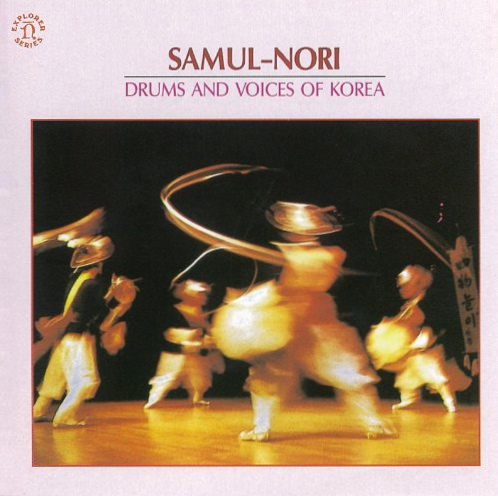
The group SamulNori, which takes its name from the selfsame style of Korean folk music and was founded in 1978 by Kim Duk Soo as a means of expanding the music’s compass of awareness, combines its namesake’s balance of ritual and humble beginnings with contemporary leanings. Samul nori is at heart a percussive genre. Its four instruments are the jing (large gong), the kkwaenghwari (small gong), the janggu (hour-glass drum), and the buk (barrel drum). Each is its own element—wind, thunder, rain, and clouds, respectively—and brings a fertile sound to bear upon a range of ecologically minded texts, both recited and sung. SamulNori members have worked with, among others, Bill Laswell (a true maverick whose seamless productions were the soundtrack to my late teens) and Kodo, but perhaps most notably with Red Sun, a jazz outfit that was the brainchild of saxophonist and flutist Wolfgang Puschnig and with whom SamulNori had its first meeting eight years prior to this influential record.

The ritual drums and horns of “NanJang (The Meeting Place)” are the ideal start, giving way as they do to Lee Kwang Soo’s recitation of the “Pinari,” a Korean origin myth in verse form. Splashing gongs seem to swirl at our feet, and from them arises the voice of Linda Sharrock (wife of another maverick, Sonny), who explores a panorama of nature and living bounty. Guitarist Rick Iannacone draws a cosmic thread through these rawer beads (not to say that one is purer than the other, for they are all made from the same breath that gives all life to matter, and all matter to life), and steers us into the beauties of “Peaceful Question.” Though it is but an amorphous congregation of gongs and bells nesting a voice born from nature who blurs the lines between human and animal (and in fact shows them to be one and the same), words fail to evoke its splendor. It sounds familiar to us all the same, so that “Kil-Kun-Ak” becomes the percussive sinew connecting that voice to the void from which it has taken shape. It leaps like a fire, finds its stillness of mind in the sharing.

Like a playground swing moving of its own accord, Jamaaladeen Tacuma’s crab-walking bass line in “Hear Them Say” traces a counter arc while Sharrock’s notes tremble amid Puschnig’s starlit branches, singing of self-empowerment in a spider’s web of radial guitar lines. “Piri” changes gears dramatically and takes its name from the double-reed bamboo pipe played here by Kim Duk Soo, who soars on a crane’s back through a flowering rendition of the folk song “Han O-Paek Nyn” (The Sorrows of Five Hundred Years). “Soo Yang Kol (The Valley Of Weeping Willows)” is an equally inspired construction that celebrates the place where the musicians had their first Korean pre-production meeting. It also boasts most arresting sax solo on album. Quieter pastures await us in the electric gyrations of “Flute Sanjo” and in “Komungo,” a wavering solo from guest artist Kum Sung Woon on the zither of the same name. This is followed by the two-part “Full House.” Composed by Tacuma, it brings some groove into the mix and represents the session’s deftest idiomatic blends. Its message of joy, peace, and thanksgiving leads us into “Ariang,” which comes to us as if from a distance, an ancestral song woven anew into the lighted corridor of all life.

I have to admit that, as one who had only heard samul nori outside of any fusion context, it took me a while to understand the sound-world of this project. Yet what at first seems an incongruous meeting of “East” and “West” ends up a genuinely wholehearted attempt to undermine those very arbitrary categories. And in the end, perhaps jazz and samul nori aren’t all that different in what they are trying to achieve, in the language they speak and in the ways they speak it. Its voices enact that same need for dialogue and communication that is at the heart of jazz, and expresses said need through evolution and improvisation. All of this is wrapped up in those voices, and in the saxophonic punctuation that reorders their grammar. This music speaks to us because it tells us a story we already know. It is a story from which we were born, one into which we will be written when we die. A space-time continuum to which profundity need not apply, for it is too lowly to express that from which it hangs.

<< Hal Russell/NRG Ensemble: The Hal Russell Story (ECM 1498)
>> Jan Garbarek Group: Twelve Moons (ECM 1500)

Stephan Micus: Bold As Light (ECM 2173)


Stephan Micus
Bold As Light

Stephan Micus raj nplaim, bass zither, chord zither, bavarian zither, nohkan, sho, voice, kalimba, shakuhachi, sinding
Recorded 2007-10 at MCM Studios

All these ideas, striving towards one goal, thronged whirling through his head, blinding him with their light.
–Leo Tolstoy

Here it is, the dead of winter, and I am listening to Bold As Light, the nineteenth ECM release from renaissance man Stephan Micus. After a few days of heavy snow, the temperatures have risen and let slip a warmer precipitation. Ice melts in the downpour, and I find solace in this music, which works in similar intra-seasonal contrasts. Two transverse bamboo instruments form the audible crux of the sanctuaries therein: the Laotian raj naplaim and the Japanese nohkan. When multiplied, the former coalesces into a proto-harmonium of twirling skies, while the latter skates its wingtips along the clouds.

Like much of Micus’s later work, titles to individual pieces have again crept from the creative woodwork. Yet the music is so rich that one might just as well forego these sentimental tags and experience what they have to offer firsthand. And so, while the opening “Rain” might be a harbinger for the “Spring Dance” that follows, it is only through Micus’s profound playing that our spirits come into focus. “Flying Swans,” for instance, has not a feather in sight. Rather, Micus sings a different style of flight, the forest looming as high around us as the lake is deep, shielding a copse where voices gather to pay their respects to the wind. “Wide River” is barely distinguishable from what has come before, flutes winding themselves around a droning core like fibers to a tether that attaches every listener to a star. The clearest shadows come in the form of “Autumn Dance,” a beautiful and lilting shakuhachi solo falling like a leaf from the “Golden Ginkgo Tree” that follows. Dedicated to master teacher and maker Kono Gyokusui (1930-2008), that latter is easily one of the most enchanting improvisations Micus has ever recorded, and all the more so for being accompanied by the percussive rattle of a sinding (African harp).

Wood and flesh come together in “The Shrine.” Animated by a solemn congregation, it is a prayer unto itself. “Winter Dance” highlights the negative spaces in every snowflake, gaping like a mouth in a plant of infinite soliloquies, of which this is but one leaf. “The Child” would seem to be the recipient of every preceding color shift. Another awe-inspiring track, this one comes across as especially personal. We end in a bed of “Seven Roses,” blooming as if in the forgotten summer, and rocking on a seesaw of meditation and soaring dreams.

You can read more about the fascinating background to and instrumentation of Bold As Light here, but ultimately such explanations are, like the words you’ve just been reading, empty in the face of a music so full of life.

Dino Saluzzi: Andina (ECM 1375)

Dino Saluzzi
Andina

Dino Saluzzi bandoneón, flute
Recorded May 1988 at Rainbow Studio, Oslo
Engineer: Jan Erik Kongshaug
Produced by Manfred Eicher

Each title on Andina, Dino Saluzzi’s second solo album for ECM, describes a different facet of the bandoneón prodigy’s creative process. He is the forlorn sonic architect, using melody to construct a world of indelible impressions, and perhaps nowhere more so than in “Memories,” which in both concept and execution seems the culmination of his notecraft and the spirit on which it thrives. Saluzzi makes an organ of his instrument, suspending a new ornament from every echoed moment, each a forgiving step into a shaded past. And in that past we encounter a life in miniature. A lively “Dance” introduces us to the music’s silver screen, on which rich insights flicker like a trailer for all that follows. “Winter” leaves a chain of cautious footsteps imprinted on the blanketed landscape. The promise of a warm hearth quivers in a single lit window, a beacon in the snowdrift. We feel this domestic comfort in every key change, in every “Transmutation” that balances agitation with resignation. The overwhelming solitude then splits into the eerie “Tango Of Oblivion,” moving with light footwork across heavy sentiments into “Choral.” This slow hymn-like progression is the one of the album’s most endearing, sounding like an organ touched by the fingers of a lone Kapellmeister, whose only muse is the absence of light. In contrast, the chording of “Waltz For Verena” twirls joyfully like a gymnast’s ribbon. And if by the time the title piece unleashes its emotional reserves you aren’t fully immersed, then you may want to get an EKG.

Another quiet stunner from Saluzzi, Andina is lovingly recorded, allowing perfect separation between both sides of the bellows. His leading lines in the right hand move like ice skaters across the blackened surfaces of the left. And while an unaccompanied squeezebox recital may not sound like everyone’s idea of a good time, Saluzzi holds rapt attention through a constantly metamorphosing array of moods, melodies, and atmospheres. Nothing short of magical.

<< Eberhard Weber: Orchestra (ECM 1374)
>> Werner Bärtschi: Mozart/Scelsi/Pärt/Busoni/Bärtschi (ECM 1377 NS)

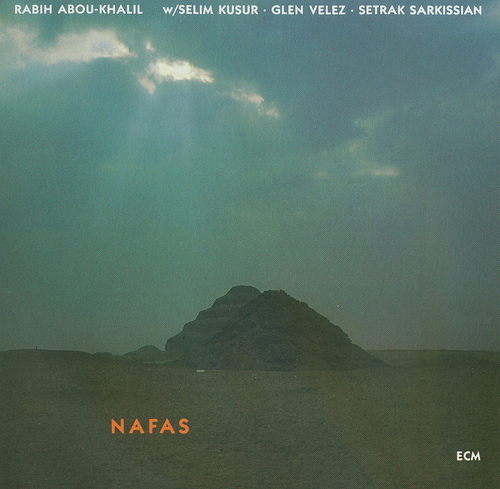
Rabih Abou-Khalil: Nafas (ECM 1359)

Rabih Abou-Khalil
Nafas

Rabih Abou-Khalil oud
Selim Kusur nay, voice
Glen Velez frame drums
Setrak Sarkissian darabukka
Recorded February 1988 at Rainbow Studio, Oslo
Engineer: Jan Erik Kongshaug
Produced by Manfred Eicher

Nafas is Lebanese oud master and composer Rabih Abou-Khalil’s only ECM album, and it is a thing of beauty. Blending Arabic elements with flowing execution, its musicians are not so much in dialogue as they are in communion, sharing the same path to light and immediacy.

Nafas reads like life itself, beginning and ending with Glen Velez on frame drums. Between “Awakening” and “Nadi,” he carves an arousing circle of worldly desires rendered transparent through reflection. It is he who draws us upright into the morning sun, in which Selim Kusur’s gentle nay shines upon our faces through “Window.” Outside, we see that the two have joined forces, a pair of journeyers walking together, planting a tree with every step, so that when the oud blossoms into the present, it cannot help but paint leaves on every curling branch of the past.

This music never flaunts the virtuosity required to produce it, but rather sheds it like a skin to reveal a deeper understanding of its own craft. Take, for instance, “Gaval Dance,” which moves like a cycle within a cycle—from birth into death and back into birth. The nay revives itself in “The Return I.” Wavering, windblown, and forever flying, it is like the first fray of an unraveling, pulling us into the secondary orbit of “The Return II,” where the sounds of nature are the truest pedagogy. Setrak Sarkissian enchants here on the darabukka (clay drum). After Kusur’s sepia-tinted vocals bring the title of “Incantation” into fruition, we get some of the liveliest sounds on the record, which is all the more transportive for its swirling energies. In “Waiting,” we find ourselves drenched in yearning. The oud traces fears and confidences, working like an awl to let in the golden love of “Amal Hayati.” This hope brings us higher on the wings of the title composition, a brief passage into a cloudy embrace.

Albums like this should not be seen as mere token nods in the ECM canon, but rather as selfless parts of a larger flowing whole. Nafas is simply gorgeous music-making that is as intimate as it is all-encompassing, opening like a sky into the heart of something divine.

<< Stephan Micus: Twilight Fields (ECM 1358)
>> Keith Jarrett Trio: Still Live (ECM 1360/61)

Zakir Hussain: Making Music (ECM 1349)

Zakir Hussain
Making Music

Zakir Hussain tabla, percussion, voice
Hariprasad Chaurasia flutes
John McLaughlin acoustic guitar
Jan Garbarek tenor and soprano saxophones
Recorded December 1986 at Rainbow Studio, Oslo
Engineer: Jan Erik Kongshaug
Produced by Manfred Eicher

In March of 2010, I had the great honor of seeing Zakir Hussain and the Masters of Percussion give an unforgettable performance. I had always been a great admirer of him, but to experience that blissful power firsthand was beyond special. This liveness can hardly be replicated on disc, though we can still feel the passion that imbues his every action in the studio and beyond.

The key to Making Music lies in its title. This is not about a fusion of East and West. This is about creation for its own sake. The selfsame track opens our ears to the flute of Hariprasad Chaurasia, who turns breath into gold. Guitarist and Mahavishnu Orchestra guru John McLaughlin is another welcome addition to a quartet rounded out by saxophonist Jan Garbarek. As lines curve their way through subtle changes in temperature, we can feel the rhythm being formed, piece by ephemeral piece, even before Hussain lays hands to drum. Garbarek works some of that same magic that enlivened his earlier recordings with Shankar, while McLaughlin showcases his mastery of classical forms (the duet with Hussain on “You And Me” is one of many highlights), matching the tabla master’s deftness with ease.

Yet Chaurasia is the jewel of this session. His dialogues with McLaughlin (“Zakir” and “Sabah”) in particular reveal a purity of tone all his own. Sometimes, he lowers the threads from which the music hangs, pulling us along with them into a verdant sky. Others, he bends like an outstretched leaf hit by the first raindrop of spring (“Toni”). The album’s remainder is filled with rainbows. The most verdant of these is “Water Girl,” a mosaic spread with saffron and rosewater, willed into life by that generative flute. Garbarek makes his voice clearest in “Anisa,” which first pairs him with McLaughlin in an exchange at once forlorn and sweet before Hussain regales with such grace that one has to wonder if his fingers aren’t pure energy. After this saga of tribulation and triumph, Garbarek’s skyward incantation in “Sunjog”—incidentally, another standout for McLaughlin, who shares a winged exchange with everyone in turn—proves well suited to this musical nexus, for he, like the others, plays not in unison but in tandem, and in so doing binds the overall unity toward which they strive together. And so, when they do join in the occasional doubling, the sound becomes gentler, each voice restraining itself so as not to overpower.

Hussain is a carpenter who delicately hammers the edges of every project he touches into perfect alignment. Yet after listening to Making Music, one has the feeling this project had only just begun.

<< Gidon Kremer: Edition Lockenhaus Vols. 4 & 5 (ECM 1347/48 NS)
>> The Bill Frisell Band: Lookout For Hope (ECM 1350)

Steve Tibbetts: Exploded View (ECM 1335)


Steve Tibbetts
Exploded View

Steve Tibbetts guitars, tapes, kalimba
Marc Anderson percussion
Bob Hughes bass
Marcus Wise tabla
Claudia Schmidt voice
Bruce Henry voice
Jan Reimer voice
Recorded 1985-86 in St. Paul, Minnesota
Engineer: Steve Tibbetts
Produced by Manfred Eicher

Two chipmunks of the oak at last found a way into the tree house, and would run cheerfully over us, breathing our heated breath; they slept in Blink’s lap for three days of blind violent storms that sheathed the forest in ice, which seemed to make music in the fine blue morning that followed, music too blinding to look at.
John Crowley, Engine Summer

Bless the day Manfred Eicher decided to give Steve Tibbetts his own country in the ECM continent, where he has produced some of the label’s most transportive folkways. On Exploded View, we get a few licks of the fire that would utterly consume us in The Fall Of Us All (if not the other way around). This sits somewhere between that later masterpiece and the quieter heart of Northern Song. “Name Everything” bursts like a freshly lit match onto a geyser-pocked landscape, each beat from percussionist Marc Anderson an eruption of steam that proclaims the earth’s inner desires. “Another Year” is anchored by a glistening acoustic and gilded by that incendiary electric as spiraling internal avenues come to a head in an expansive choral palette. “A Clear Day And No Memories” carries on those vocal menageries with the prominent cries of Claudia Schmidt, who trails her song across an oceanic sky. These quiet into an acoustic aside, alive with rhythmic whispers. The pliant guitar of “Your Cat” is a wonder to behold in the full efficacy of its power, and evidences Tibbetts’s programmatic flair: the music is indeed feline in the way it arches its back, wiggles and pounces, purrs and dreams of the savannah, plays and loves. “Drawing Down The Moon” locks us into the subtlest of grooves, linked by the forward-looking tabla at its core, while “The X Festival” throbs with the voice of history. This superb blend of local and far-reaching mysteries cracks open the dawn, spilling its sunny yolk across the floodplains. The album’s most rhythmically intense moments can be found in “Metal Summer,” which again thrums at the core of something ineffable yet so visceral it can never be denied. Forgoing speech, its finds its voice in the elemental language of grinding flame that is Tibbetts’s modus operandi. Last is “Assembly Field,” another biting trek that ripples across the sands with the slow-motion whip of a sidewinder in search of an oasis it already carries inside, finding solace at last behind the closing eyes of a shimmering acoustic reflection.

Tibbetts chooses his grooves and comings together with tact and with grace, so that we never forget the vivacity of their placement. He shines his light through a necklace of motifs and cellular sound paintings. Take, for instance, the short but unforgettable “Forget,” which has all the makings of a universal anthem. It bristles with a fast head nod and electrical break in the production, keying us in to the malleable style of its surroundings. Like the guitarist at its center, it pulls the strings of time rather than plucking them for trite effect. In doing so, it unleashes an entire culture’s worth of footsteps.

<< Keith Jarrett: Spirits (ECM 1333/34)
>> Meredith Monk: Do You Be (ECM 1336 NS)

Keith Jarrett: Spirits (ECM 1333/34)

Keith Jarrett
Spirits

Keith Jarrett piano, flutes, soprano saxophone, guitar, percussion
Recorded May through July 1985 at Cavelight Studios, New Jersey
Engineer: Martin Wieland
Produced by Keith Jarrett and Manfred Eicher

Spirits is more than a jewel in the rough. It is the rough of a jewel. By this, I mean to say that through its hard-won journey Keith Jarrett has peered into the heart of darkness that is life and compressed it into a diamond so honest that no amount of polishing will wear away its blemishes. Recorded at his home studio, then post-processed by ECM engineer Martin Wieland, this is a most personal album of boundless expression. Then again, so is every Jarrett album. The difference is in the instrumentation: an unusual array of flutes, keys, and percussion, overdubbed in various combinations and densities (Jarrett even picks up a guitar, which he treats more like a sitar). Jarrett also sings, wails as if in and of the earth, finding in Nature a single feather plucked from nowhere. Bird-less, it has no recourse to flight, and can only call to a sky it will never know.

Though splashed over two discs in 26 parts, this heartrending session takes breath into the same pair of lungs throughout. Moods range from jubilation to a burrowing pensiveness, but always with an ear attuned to catharsis. The nearly two-hour purge turns repression into a path, beginning deep in the heart of ritual, where drums and flutes tread in place of feet and throats, and ending in the recesses of a Renaissance dream, where shepherds, troubadours, and shamans share their slumber. Jarrett’s occasional chants flirt with the exigencies of articulation, all the while forming steady yet somehow ungraspable touchstones along the way. The expected pianism is kept to a graceful minimum, giving way instead to wondrous ruminations on soprano saxophone and other suspended airs.

In so many other hands, such an album would come across as a trite exercise in tribalism, but in Jarrett’s it emotes with full transparency. By far his most colorful release, it marks a shift in method. Where before he charted every possible recess of the structure at hand, here he allows that structure to build itself around him in a shelter of the psyche. The result is a freestanding insight into the pathos of creation. Probably not the one you’ll want to start with, but by no means a prism to bar from the light of your curiosity.

<< Paul Hindemith: Viola Sonatas (ECM 1330-32 NS)
>> Steve Tibbetts: Exploded View (ECM 1335)

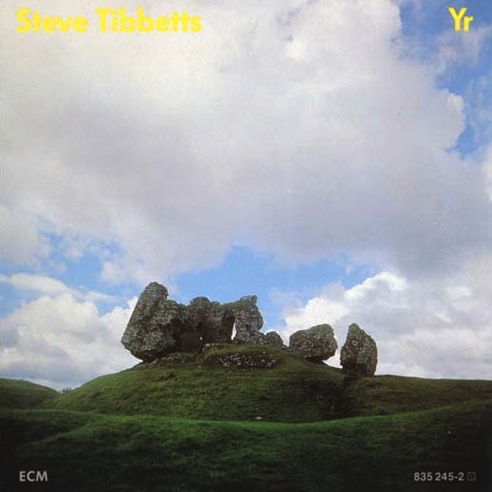
Steve Tibbetts: Yr (ECM 1355)


Steve Tibbetts
Yr

Steve Tibbetts guitars, kalimba, synthesizer
Marc Anderson congas, drums, percussion
Bob Hughes bass
Steve Cochrane tabla
Marcus Wise tabla
Tim Weinhold bongos, vase, bells
Recorded ca. 1980 at Atma-Sphere and Oxit Roxon, St. Paul
Engineer: Steve Tibbetts
Produced by Steve Tibbetts

Yr is yet another fascinating peek into the Steve Tibbetts sound-verse. The feeling of open plains that so characterized his previous efforts remains, only now the production is more immediate, such that the 12-string intimations unlocking the doors of “Ur” set us adrift in our own mysteries. Percussionist Marc Anderson soars, seeming to grow out of Tibbetts’s hollow-bodied heart before the heavy thrum of the latter’s electric curls itself into a ball and rolls down a hill of unrelenting melody. After an explosion of beats and guitars settles us into the soothing reverie of “Sphexes,” we find our expectations blotted by an interlude of kalimbas before Tibbetts spreads his buttery axe over this acoustic toast with sweetness in “Ten Years.” Fantastic. “One Day,” much like the opener, rises from the ashes of a campfire, but not without leaving an aftertaste of the prairie. “Three Primates” is a pocket of sunshine that shifts masterfully between tones and timbres. Now darkened by shadow, now blinded by noon, it dives headfirst to a tabla-infused conclusion. “You And It” is another shimmering slice of life. Backed by strings and icy sleigh bells, it breathes life into a new day. This opens the doors even wider, letting in the dawn’s early electric and unleashing a torrent of dreams made real. “The Alien Lounge” traipses through tall grasses, weaving past abandoned foxholes and memories of warm nights toward the starlight of “Ten Yr Dance,” spun like a home movie rewound to one’s first days on earth.

This is by far Tibbetts’s most uplifting date and one sure to win you over with its no-frills charm, emoting as it does with an artistry at which we can only shake our heads in wonder. It also shows just how deftly and appropriately he takes advantage of the studio, flipping prerecorded bits on end and adding just the right touch of electronics for depth. The spaces therein are constantly morphing, content to move on once they have achieved a certain kind of beauty while always looking forward to the next.

Timeless, as all Tibbetts releases are.

<< Oregon: Ecotopia (ECM 1354)
>> Pepl/Joos/Christensen: Cracked Mirrors (ECM 1356)

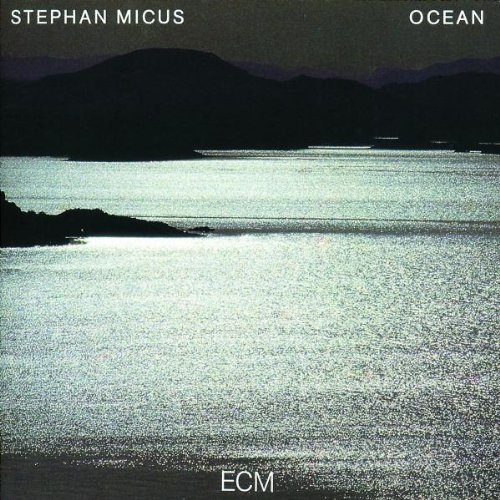
Stephan Micus: Ocean (ECM 1318)


Stephan Micus
Ocean

Stephan Micus voice, sho, nay, shakuhachi, Bavarian zither, hammered dulcimer
Recorded January 1986
Engineer: Martin Wieland

Stephan Micus is more than the sum of his parts. The German-born multi-instrumentalist has done that rare thing: absorbed rather than pilfered a wealth of musical traditions and means and molded from them an entity all its own. As one of his earlier recordings for ECM, Ocean is a tinted window into an artistry of full-blown brilliance. Part I opens with his unaffected, wordless incantation before opening into a flower of hammered dulcimers. As the mournful cries of the nay replace his voice, it is as if the bodily has become breath incarnate, airing out its gentle patchwork of sound in a breezy sky, while meditations rise like pedestals beneath souls. The shō (Japanese mouth organ) opens Part II, treading its feet upon cloud, every step forward an exhalation, every step backward an inhalation, such that one remains poised on the brink of falling. From this congregation of threads arises a shakuhachi, unspooling in reverse, its fatigued song but a dream on a wistful day. Zithers enter in with their skittering rhythms, fluttering like the wings of some vast diurnal insect whose wing covers are its feet, and for whom landing is but a memory of a past in which humans never spoke. In the opening dulcimer meditation of Part III, we feel the kinship into which Micus so profoundly invites us, a promise of stillness in its embrace. The shakuhachi whispers its secrets across the waters, ending in a delicate waterfall, a lifetime’s worth of tears compressed into a single fade and pooled in the cupped hands of silence. Part IV ends (or does it begin?) with a moving shō solo, which turns like a crystal spun from Philip Glass-like filaments and melted by body heat into a fluted garden, churning with the song of every earthworm below.

Micus lets unfold a territory so personal that it becomes selfless, somehow unmarked the human elements of its creation. In his playing, names, labels, and covers, even personages and politics, cease to matter. The only restriction is its very lack. Such music goes beyond the pathos of meditational action, looking into the soul of stillness, where only music can express that which all the languages of the world, lost and extant alike, never could. Their cage is not one that surrounds us but one we surround with the promise of creation, waiting with closed eyes and open hearts.

<< Keith Jarrett Trio: Standards Live (ECM 1317)
>> Masqualero: Bande À Part (ECM 1319)