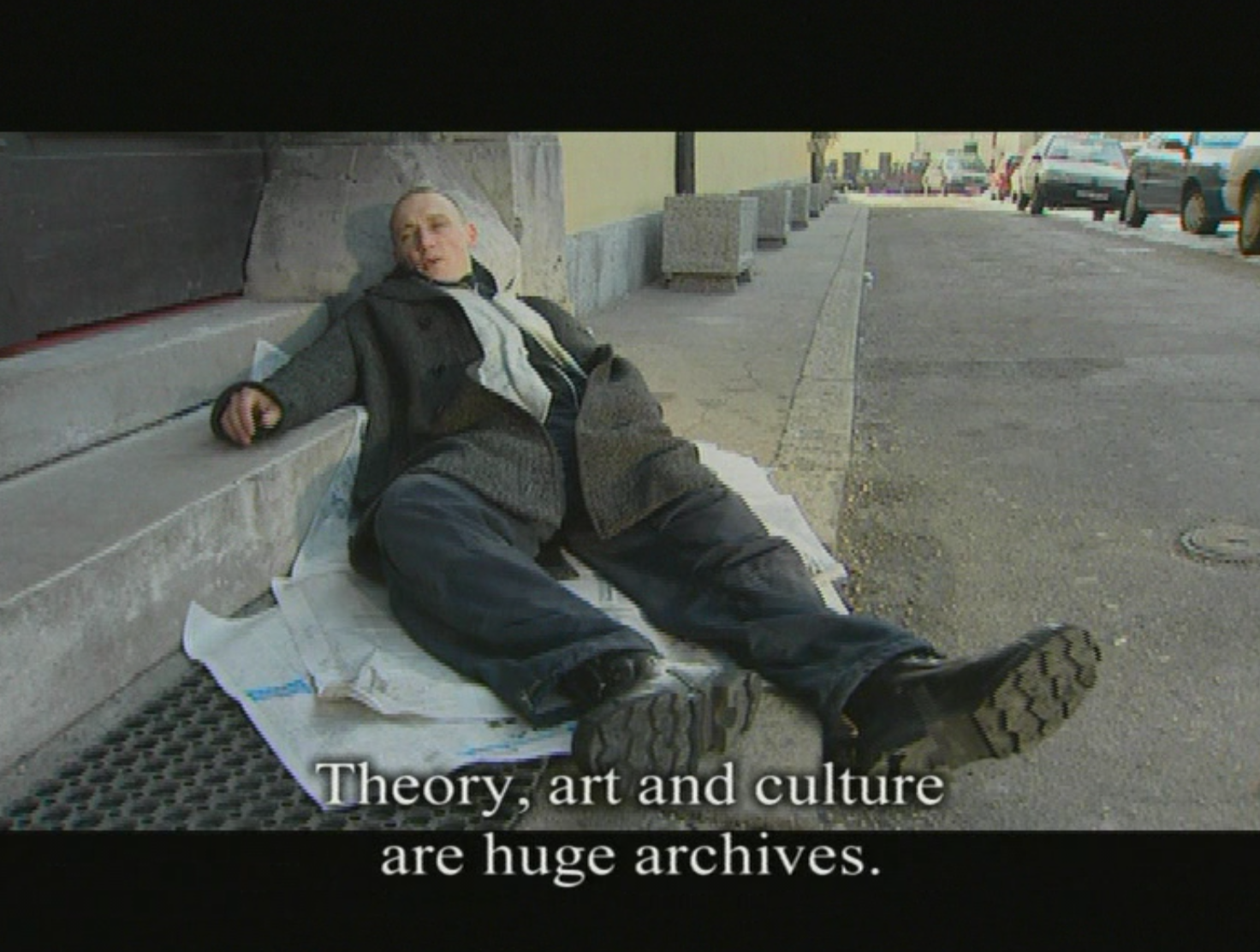
Twin ramparts of Slovenian video art rise to the proverbial occasion in the work of Marina Gržinić and Aina Šmid, whose decades-long collaboration has forged a visual language rooted in fracture and the unsettled terrain of post-socialist transition. Their films operate as dispatches from the former Yugoslav region, where ideology and memory never truly loosen their grip. The critique that emerges is both intimate and structural. They carve into the spectacle of authority, revealing how power survives by mutating, how it seeps into the body and then disguises itself as habit, nostalgia, or even desire. They scrape away the veneer of official history and rebuild it as a series of contested images. In this state of permanent transition, incrustation becomes their central strategy. One image embeds itself in another as a reminder that trauma never disappears. It simply resurfaces in new forms, as persistent as a scar and as volatile as a suppressed memory. Documentary footage becomes raw material that they melt and reshape into a spectral double, a reminder that truth always has a counterpart produced by the state, the market, or the collective need to forget.
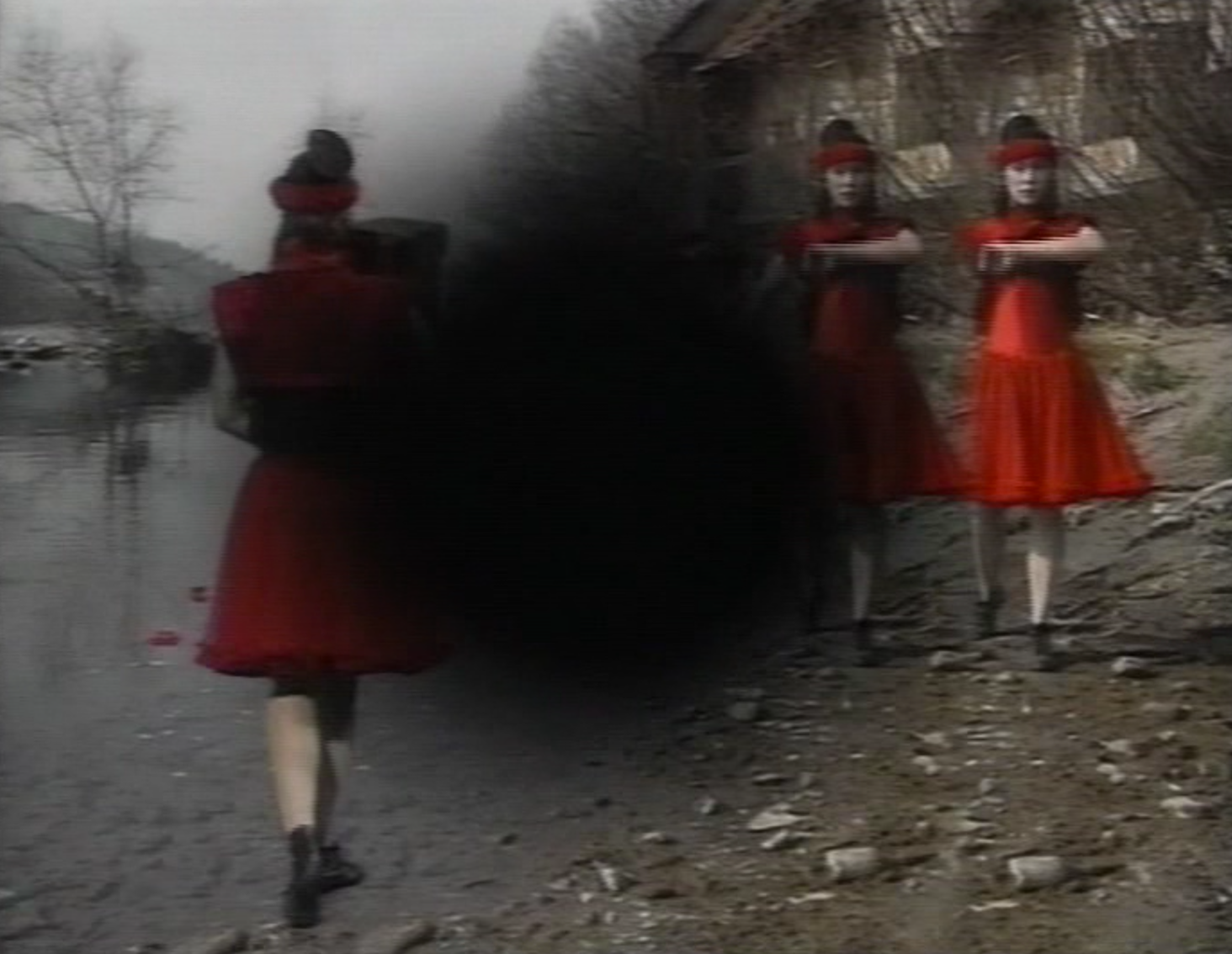
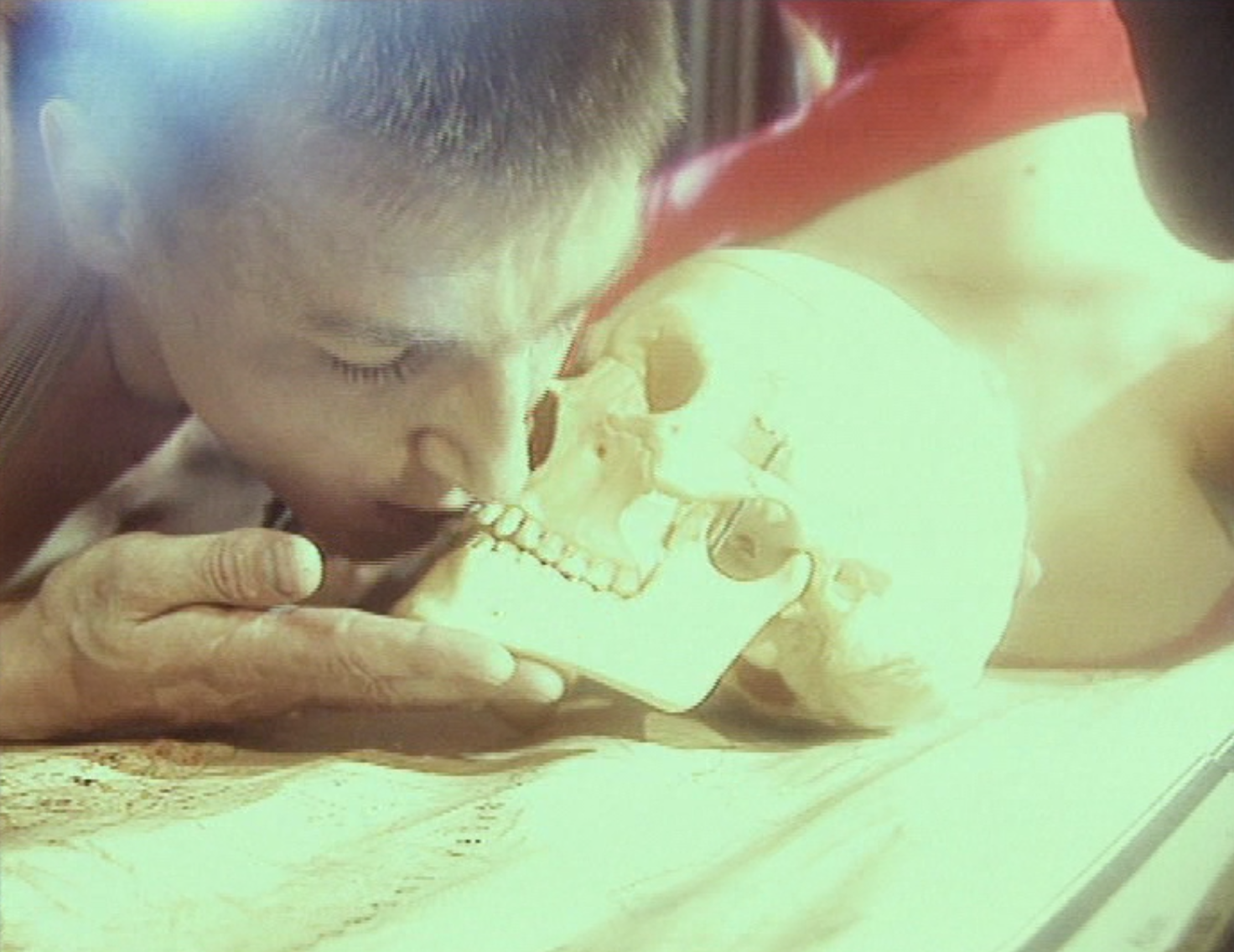
Their 1990 work Bilokacija (Bilocation) embodies this tension by staging a split between body and soul, as if the self has been forced to occupy contradictory geographies. This condition mirrors both the paradox of video and the experience of Kosovo during wartime, a place where identity was carved and recarved by border shifts and nationalist ambitions. Documentary and synthetic images intertwine while Barthes’ reflections on desire are folded into the wreckage of conflict. The result is a meditation on how war reorganizes the self. A black screen compresses itself into visibility as if to suggest that seeing requires force. Images pulsate with the ache of Europe’s unresolved past. A man’s grip on a woman’s arm becomes an aperture into videographic truth, a reminder that even personal gestures become charged when surveillance, ethnic tension, and state control shape the conditions of daily life. A drone of bees fills the soundscape while parades move through the frame. The socialist body appears sculpted by ideology yet undone by its own contradictions. A woman climbs a tower marked “Mengele,” insisting that fascism remains latent beneath the surface of Europe’s democratic self-image.
In Labirint (Labyrinth), also from 1990, the artists summon surrealism not as an aesthetic flourish but as a way to expose the irrational logic that emerges when the aftermath of upheaval becomes the norm. Bosnian refugee camps appear beside theatrical gestures, creating a portrait of a society trying to digest its own collapse. A doctor’s healing hands are powerless against the structural violence embedded in the region’s history. A dying woman’s body becomes an emblem of a ravaged homeland, a reminder that national projects too often run on human expendability. Men inspect a stripper while another peels a membrane from a woman’s body. These actions reveal how patriarchal power thrives in instability. Dancers tremble like historical residue that refuses to settle. The Actionist tremor erupting through their limbs becomes a critique of Europe’s claim to civility, a claim repeatedly contradicted by its own wars, camps, and exclusions.
With 1994’s Luna 10, the stakes widen. The artists draw from the Yugoslav neoavant-gardists yet refract their legacy through the violence of the Bosnian War and the accelerating forces of global technology. Video becomes a lens aimed at the fragmented self of the new world order. A woman lifts a telescope. Diagrams flicker. A shortwave crackles with narratives of conflict described as “radio war,” a term that recalls how states monopolize the airwaves and shape public perception through the management of signals. Domestic labor occurs alongside accounts of cross-border violence, revealing how private ritual becomes entangled with geopolitical strategy. Creativity itself appears as a tool of influence. It can inspire solidarity, but it also constructs hierarchies, invisibilities, and selective empathies. The millennial body is a fearful one because it must navigate a global landscape where production systems act as both oracle and executioner.
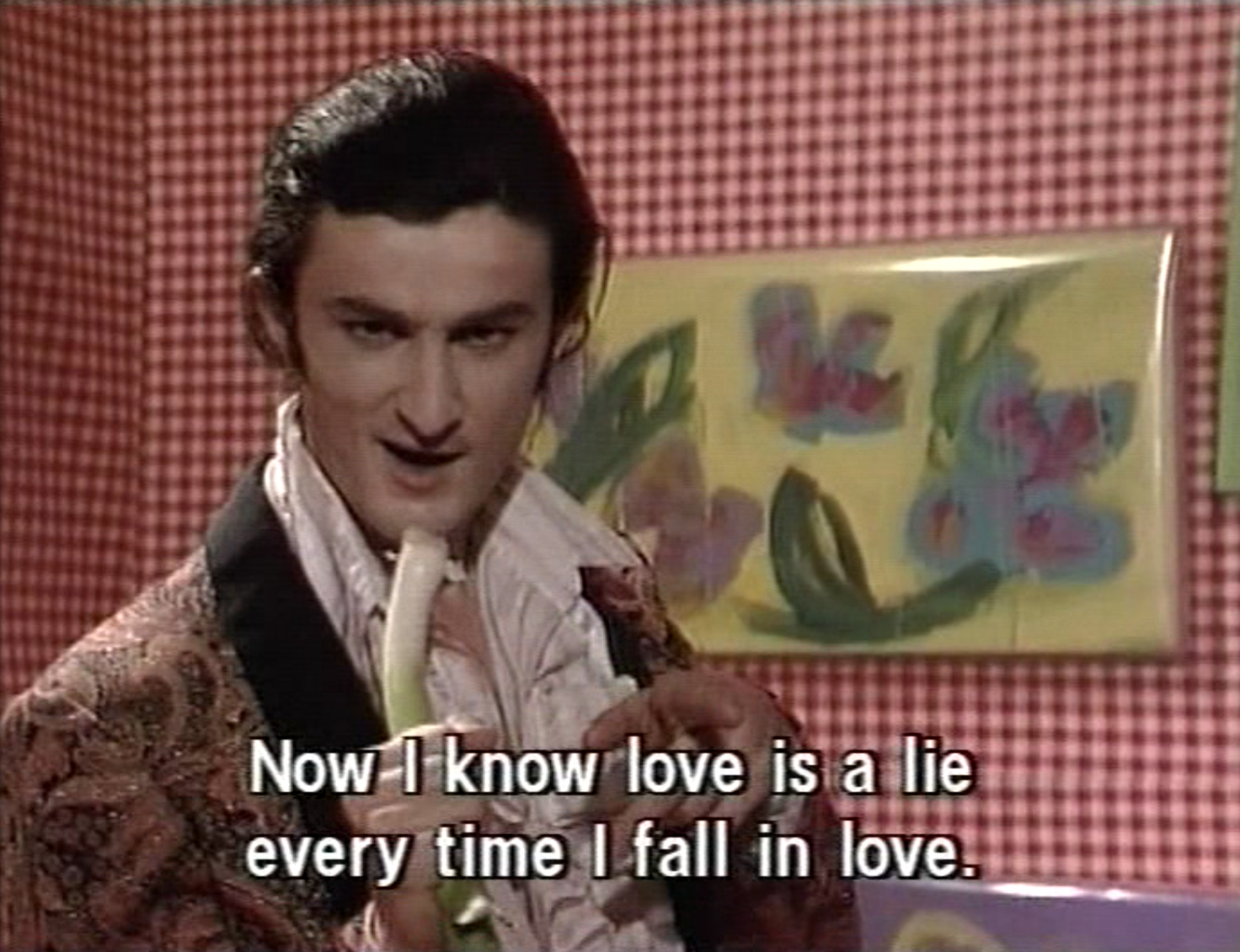
By 1995, the montage sharpens into satire. A3 – Apatija, Aids in Antarktika (Apathy, Aids and Antarctica) juxtaposes the wives of Ceaușescu and Milošević with scenes from The Private Life of Mirjane M., exposing how power reproduces itself through domestic performance and the spectacle of femininity under authoritarian rule. A skier moves through Communist iconography. A photographer labors in a darkroom. A body perforated by history attempts everyday chores. Milošević sings into a leek while demons wander through Styrofoam snow. The absurdity is not comedic. It is a critique of how regimes rely on myths, kitsch, and theatricality to mask structural cruelty. The “Ms” dancing in their kitchen, one with a werewolf face, reveal a deeper truth. Systems of authority mutate those who serve them. They turn the mundane into the monstrous and leave no private space untouched.
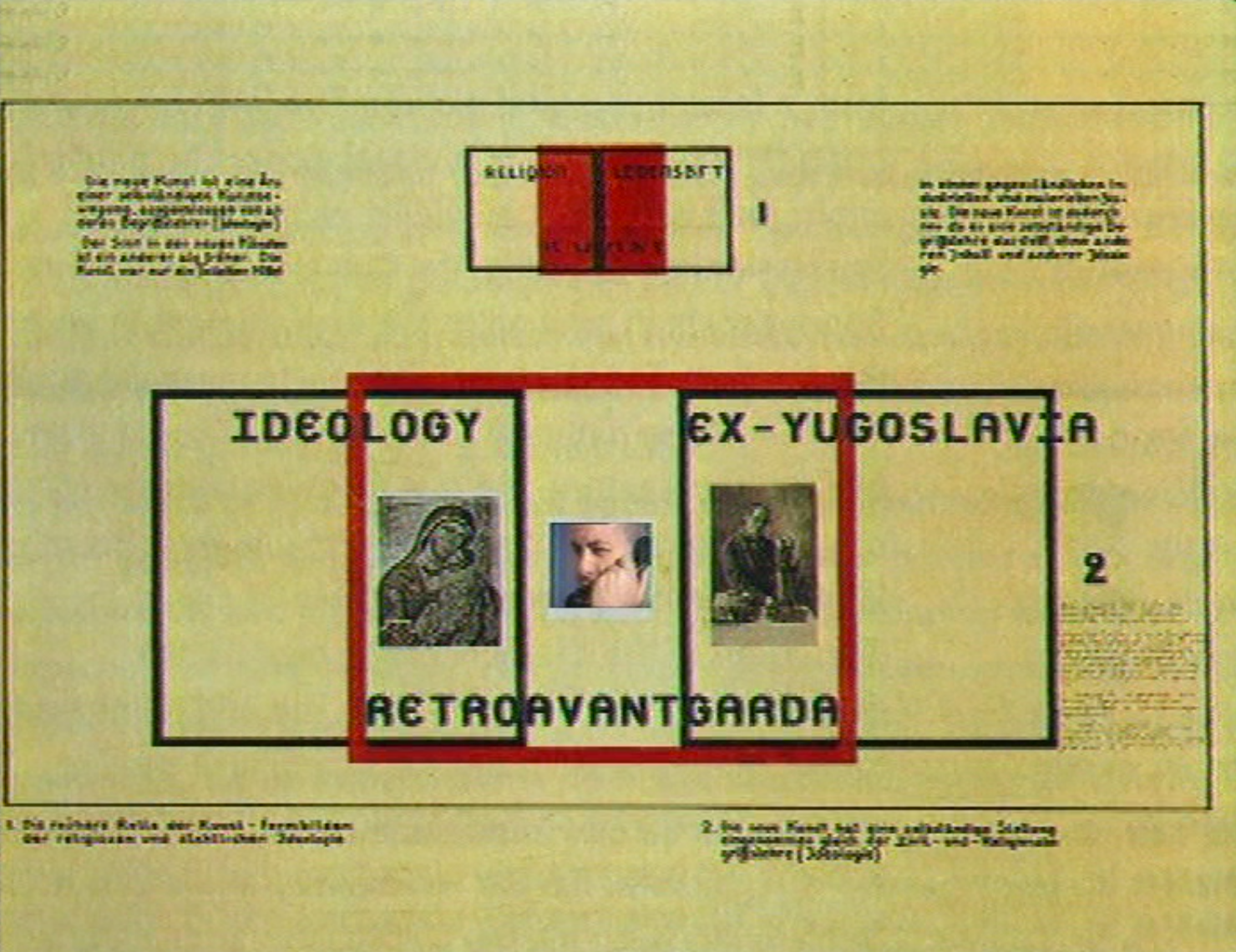
The 1997 project Postsocializem + Retroavantgardia + IRWIN (Post-socialism + Retro Avantgarde + IRWIN) turns critique into philosophical inquiry. Gržinić frames the discussion while Žižek and Weibel articulate the stakes of avant-garde resistance amid radical restructuring. Žižek argues that the avant-gardist seeks to preserve an ancient core more faithfully than the liberal desire for perpetual fragmentation. This is not a rejection of Enlightenment values but a defense against their appropriation by market forces that claim rationality while enforcing structural inequality. Retro-avant-gardism becomes an act in which reason and action invert themselves. Ideology enters the body only when the body has been damaged. Manifestos appear as shattered fragments because post-socialist reality leaves no space for unbroken narratives. Even Lévi-Strauss’s culinary triangle becomes an allegory in Žižek’s hands. The region’s toilets tell stories about national identity, hygiene, and cultural pride, transforming domestic infrastructure into a commentary on power.
As 1999 crests into frame, the artists widen their lens to all of Europe in O Muhah s Tržnice (On the Flies of the Market Place). The continent appears as a divided brain struggling to reconcile its imperial past with its neoliberal present. An empty swimming pool becomes a metaphor for ideological drainage, a sign that Europe is unsure whether it has shed its history or simply displaced it. Kant hovers as a ghost in the background while communism lingers as residue rather than memory.
Their 2003 work Vzhodna Hiša (The Eastern House) turns domestic space into a battleground of rehearsal. Cinema is reread through Antonioni, Coppola, Siegel, and Badiou while Gržinić’s philosophy threads its way through the narrative. A man sprays a woman with milk from a syringe. At dinner, he mutters slogans that dissolve into frustration. Directorial cues merge with diegesis as if to suggest that civic life itself is staged. Normality fractures while the body’s code is rewritten. A man wakes beside two women who whisper like conspirators. One declares that women and Eastern Europe must no longer be treated as symptoms or mute witnesses. The statement echoes across the film’s terrain of power. Sexuality becomes a site of ideological struggle. References to Alien and Blade Runner reveal a world where love is entangled with biopolitics and fear. Those unaware of their manufactured nature become the ones capable of loving freely because they have not yet internalized the hierarchies that govern them.
Technology appears again as a force that dictates which bodies receive care and which are forgotten. UNICEF enters the frame as a reminder of global humanitarian structures that simultaneously relieve suffering and reinforce social hierarchies. Human activity becomes archival. The cyber-feminist search for identity moves across surfaces where the real and the virtual collide. Gržinić and Šmid show that agency is now mediated by screens that claim objectivity yet reproduce bias at scale.
In the end, they do far more than document history. They anatomize it. They trace its scars, expose its contradictions, and return it to us as a living terrain populated by trembling bodies. Their work insists that understanding the former Yugoslav space demands a confrontation with ideology in its most intimate forms. Desire and power become inseparable. Bodies carry the aftermath of systems that promised liberation yet delivered surveillance, nationalism, and new forms of inequality. Gržinić and Šmid remind us that we live in bilocation. Our bodies remain here while our civic selves drift elsewhere, pulled between the past we inherited and the future we continue to build, often without realizing whose walls we reinforce in the process.
“Not two, not four, but three. A triangle: a full, beautiful form. There was something to be said for the square, too, but the triangle was the basis of all form. The dominant. The chord, do, mi, so. This perfect chord had grown too familiar to move her every time she heard it, yet its fullness had a tough resilience, more so than any other sound.” –Yūko Tsushima, Child of Fortune (trans. Geraldine Harcourt, Tokyo: Kodansha International, 1983)
VALIE EXPORT emerged from the kinetic crucible of Viennese Actionism, an artistic milieu defined by the rupturing of boundaries, bodily extremity, and an anti-ritualistic desire to shatter the illusions of polite culture. Yet even in those early years, she seemed oriented toward a fire of her own. From the start, she saw both technology and performance as weapons against the stillness of the unmoving picture, as tools capable of detonating the complacency embedded in images that merely represent rather than confront. Born Waltraud Lehner in 1940 in Linz, Austria, she earned a degree in textile design in Vienna in 1964, learning, through threads and weaves, the discipline of material, the meaning of tension, and the politics of surfaces. Her early work as a script girl, cutter, and film extra taught her something equally lasting but far more corrosive: that “at best women were tolerated in art as extras.”
Refusing this fate, she cast off her surname—its lineage, its patriarchal tether—and took on a new one, VALIE EXPORT, borrowed from a cigarette brand and transformed into a “logo and artistic concept,” as she called it, but also a rebirth: a declaration that identity, too, could be self-authored. EXPORT quickly recognized the potency of the filmic medium, a terrain far more permeable and insurgent than painting, which she saw as calcified beneath male dominance. Yet finding her footing in Vienna proved difficult. The Actionists still loomed large, remapping themselves in effluvia and spectacle. EXPORT sought something different: not merely to shock, but to reorganize perception itself.
It was in this environment that, in 1968, she detonated her breakthrough: Tapp und Tastkino—“Touch Cinema.” Strapped to her chest was a small box, a miniature theatre into which passersby were invited to insert their hands. Created with Peter Weibel, her frequent collaborator and fellow Cooperative member, the piece became what she called “the first real woman’s film,” and with good reason. Instead of projecting images of the female body for public consumption, she transformed her own into a site where cinematic illusion was not only confronted but dismantled. As EXPORT explained, tactile reception subverts the fraud of voyeurism; the public, conditioned to watch from the safety of darkness, is suddenly thrust into the vulnerable intimacy of physical contact. Since anyone could be the viewer-participant, taboos become implicated by default, the mythologies of state, family, and property exploding under the pressure of an unmediated encounter. As Robert von Dassanowsky observes in his book Austrian Cinema: A History, EXPORT made clear that a society content with a reproduced copy of sexual freedom would never know a revolution of the body.
The following year, in 1969, she stoked her politics into an even more searing gesture. In her guerrilla performance Action Pants: Genital Panic, she stormed a Munich porn cinema with wild hair, a machine gun, and crotchless trousers. Moving up and down the aisles, she confronted the male spectators directly, daring them to look away from the passive women on the screen and toward a “real” woman—one who stared back, unfiltered, unidealized, unwilling to be framed. Her approach was not merely provocation; it was a socio-critical intervention shaped by the late 1960s, by the student revolts, and by the rising insistence that the state’s machinery of repression needed to be broken from within. Thus, EXPORT sought to expose the structures and conditions of visual and emotional communication, to awaken a dormant sensitivity numbed by convention. Her body became the surface on which these ideas were inscribed, the material through which she delivered her creativity with raw immediacy.
In the early 1970s, EXPORT continued to push boundaries with Mann & Frau & Animal (Man & Woman & Animal), a film whose iconoclastic frankness provoked both scandal and revelation. What unfolds on screen—EXPORT pleasuring herself with a shower nozzle, followed by the sight of her menstruation juxtaposed against a man’s retching—is not meant to shock for its own sake but to articulate a distinctly female sexuality at a time when the male gaze had only just begun to be theorized and critiqued. EXPORT, ever unwilling to retreat from what is culturally forbidden, asserted that the sexual curiosity cultivated in men and suppressed in women needed to be dragged into the light. The film was a slap in the face of pornographic desire, which invests the erotic with power only through unilateral domination. EXPORT instead rooted her images in an authentic refusal to sanitize the female body.
Her work coalesced around the idea of an “Expanded Cinema,” a concept she defined as a stretching of the medium until its foundational assumptions crack. Expanded cinema dissolves the border between product and producer, making the audience a necessary component of the work. Film is liberated from its linguistic character, a site of formal reconfiguration. Celluloid need not remain the substrate. Its projection can be abandoned, manipulated, cut, or reimagined. The film strip itself becomes a location for expansion; the screen, once a receiver devoid of agency, becomes an active surface that can be torn open.
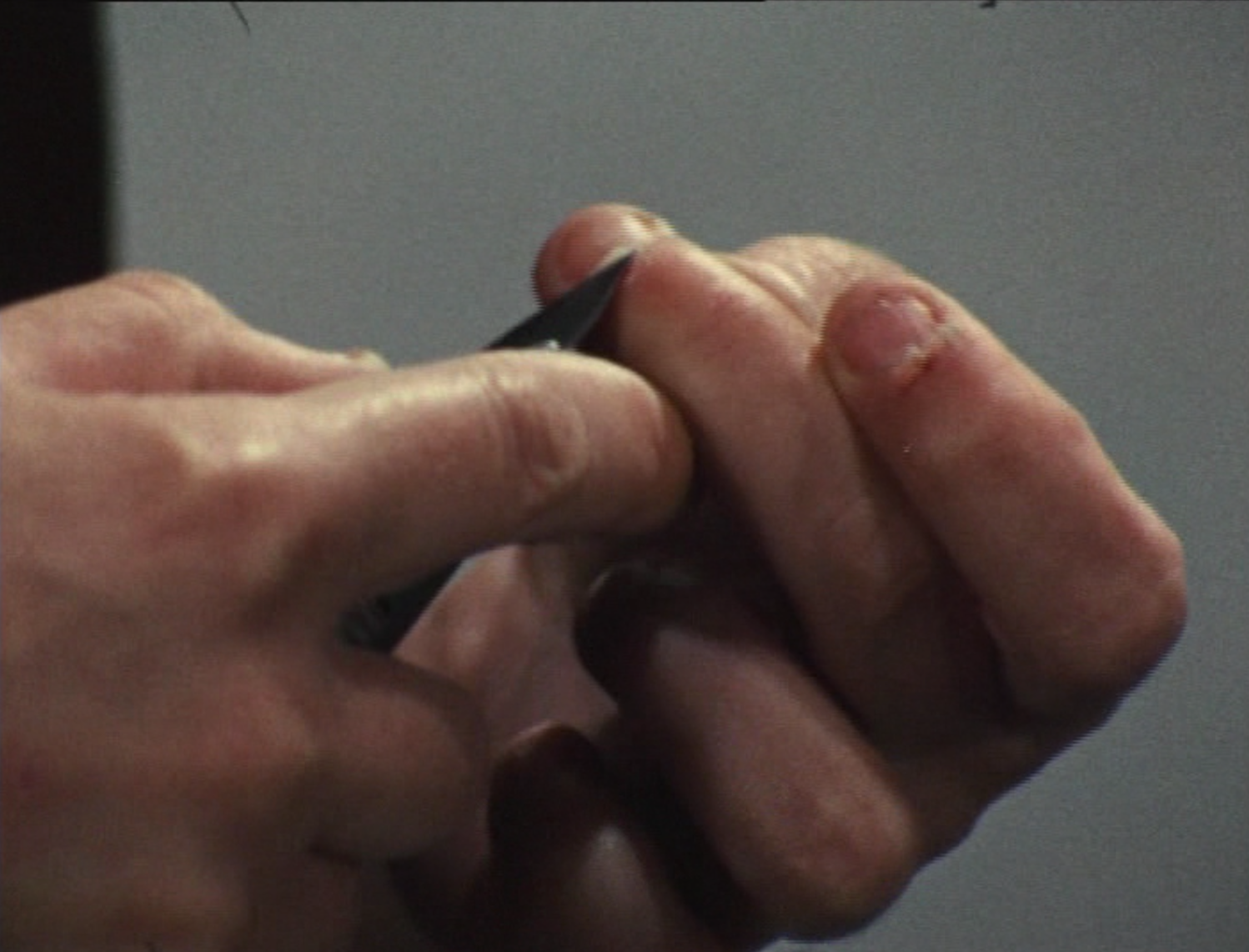
By 1973, EXPORT had entered a more introspective yet no less unsettling phase. Her short piece …Remote…Remote… stands as one of her most emblematic works. It is quietly devastating, almost unbearable to witness. As she sits before the camera, she peels away her cuticles with a boxcutter, allowing the blood to rise before submerging her fingers in a bowl of milk. The juxtaposition of pain and nurture, violence and purification, creates a ritual of self-inspection. Behind her hangs a family photograph, beckoning the viewer to consider wounds inherited across generations. When she finally leaves the frame, hands appear—linked, ghostlike—connecting past and present in an uneasy continuum. Here, norms themselves become the sites of self-harm, a theme she explores with feverish complexity in Invisible Adversaries (1976).
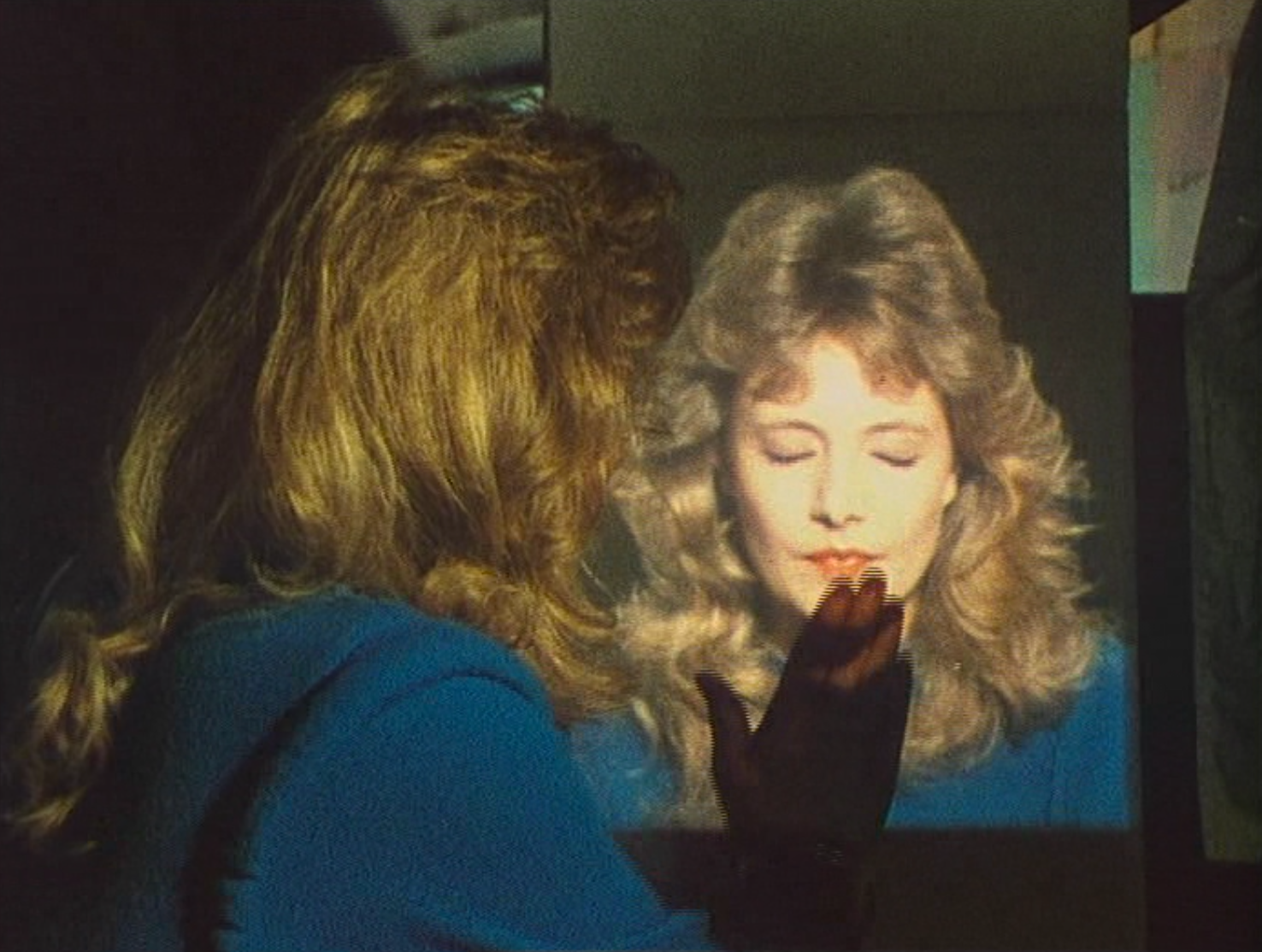
Renate Lippert notes how EXPORT’s unconventional self-grooming provokes defensive reactions, particularly among women who instinctively reject what cuts too deeply into the private realm of bodily experience. Such reactions, she argues, reflect the discomfort provoked when the damage hidden in the recesses of everyday existence is exposed for what it truly is. And as Valerie Manenti writes, EXPORT’s articulation of the body as a finite entity extends beyond standard feminist discourse. Her work demonstrates how “body language” can be pushed to extremes, conveying messages in ways words cannot. In Syntagma (1984), hands spell out the title in sign language before the film’s edges reveal themselves, exposing the strip’s materiality as those hands physically divide the cinematic space. The superimposition of flesh and image, layered with footage of transportation, illuminates the ill-fitting nature of human bodies within systems designed to contain and transport them. Narratives appear in fragments, flaring and dissolving until the act of self-advocacy becomes the only throughline.
EXPORT herself articulates the essential metaphor underlying her work: “From the outside the body is a projection surface, the skin encompasses its interior architecture; on the other hand, the cuts are openings to the inside, they open the picture, they are the tears in the projection surface.” This statement encapsulates her lifelong interrogation of embodiment as both medium and message. For her, the body is not simply represented; it is performed, ruptured, and rewritten. Her manipulations make the viewer acutely aware of the self as a contested space where meaning is constructed and dismantled. The “cuts” she references function not only as literal incisions or disruptions but also as conceptual apertures, revealing the internal structures (psychic, social, and political) that typically remain concealed beneath the veneer of human skin.
To witness her oeuvre with this insight is to understand that it does not merely push boundaries but allows them to bleed into one another. Such radical interventions insist on an expanded field of perception in which the viewer becomes implicated. The dissolution of boundaries in her work is not an abstract ideal but a visceral encounter, demanding that audiences confront the unstable terrain of identity, autonomy, and representation. In this way, her practice is an ongoing act of unmaking and remaking, a cinematic and corporeal poetics of rupture that continues to resonate across contemporary feminist and experimental art.
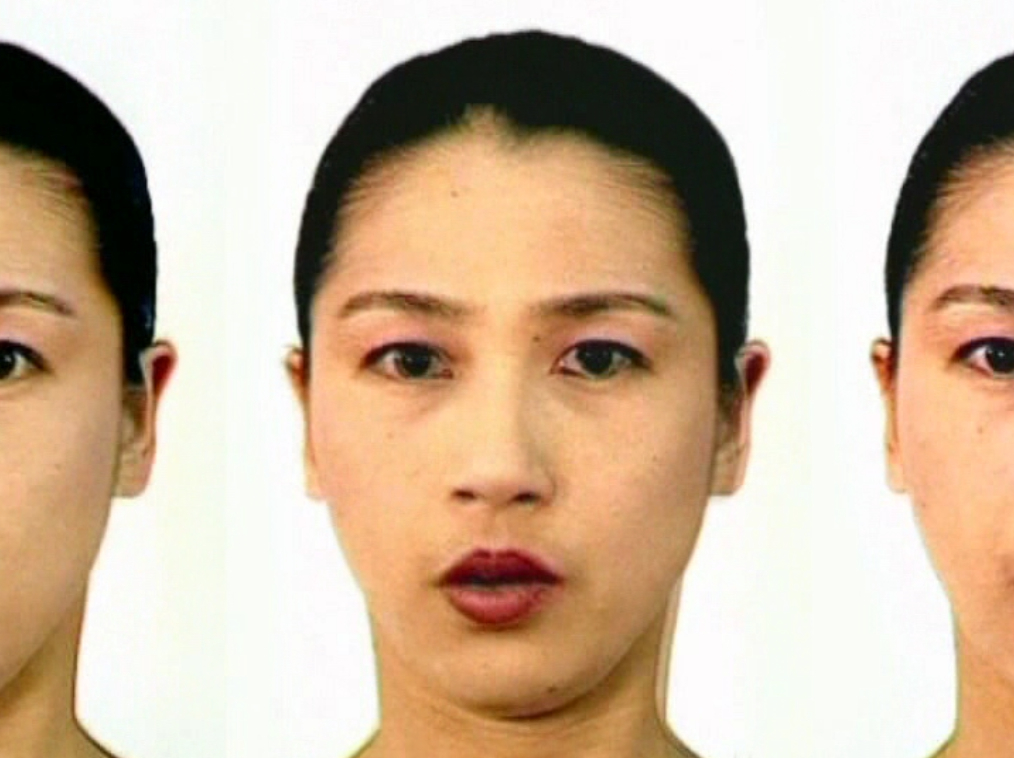
You walk into a large room. Dark, save for four glowing screens. The face on each is the same: singing, whispering, screaming in concert like some demonic slot machine. Moments are looped, locked in ephemeral chains by which inward structures blur into outward fruition. Bones and tendons cry for recognition, even as their pathos erodes with every false start. This process becomes more organic the more contrived it tries to be. At once algorithmic and unpredictable, it unfolds through the flesh of which it is made, shaping light into something audibly destructive. The light, in turn, molds images that are both alien and familiar. Sound unleashes shards of time in a torrent of disillusionment. The curtain falls, revealing a cavernous interior where resides the actor behind all our voices, that invisible artist of the soul whose only language is rupture.
This is what it feels like to experience Motion Control Modell 5 (1994-96), a digital video installation by Vienna-based artist duo Granular Synthesis. The face and voice in question belong to Japanese performance artist Akemi Takeya, whose passion for the project was integral to its becoming. By taking her otherwise continuous performance and splicing it into a rhythmic onslaught, melding the natural and the mechanical, Granular Synthesis—in both name and process—fragments the norms of synchronicity between sound and image. How does the body fit into, if not constitute, such an audiovisual world? What is its reality? Can sound and image exist in the absence of time, without bodies? In my attempts to address these questions, I take Modell 5 as a viewfinder to the complexities of flesh on screen, of one’s experience of that flesh, and of how both meet in the specific location of the gallery.
The museum installation blurs a contested boundary between image and sound. On the one hand, sound has, since the latter half of the twentieth century, become an increasingly prominent aspect of installations, imbuing them with an attraction to interactivity and multisensory engagement. One may also read indifference into the art form: the artist can set the space and run, leaving audiences to grapple with the results on their own terms. Whether or not such a situation can be considered musical would seem to hinge on its viability as a performance, on whether the piece conforms to basic expectations of gesture, sound production, and effect. Since the 1960s, artists have consistently emphasized, through the medium of video, our inability to determine where we begin or end. Their images configure the human body as a user of technology, as an extension of the technology being used, and even as a technology in and of itself—as in a musical performance, for which the body is figured not only “in” a sonic act but also “as” a sonic act. Its expressivity is self-transcendent.
The televisual body may be reconfigured in more ways than are possible by its inherent means. Technology enables artists to deconstruct the modal and figural language of moving images, thereby creating shadow plays of indeterminate originals and mimics of the quotidian from fresh and exciting perspectives. According to video artist Joan Truckenbrod (1992, 95), however, digital and computer technologies simply “offer artists the potential to convey the complexities of environmental, cultural and political issues by layering and choreographing images, text, voice and sound in a manner that parallels the fabric of contemporary life.” Taking this parallel to be true, what can we surmise about the continuity of contemporary life when its most topical representations are also the most fragmented? Does this mean that we, as children of deconstruction, are destined to eat off the cutting room floor? We seek confirmation of, if not refutation to, these concerns in arts of many stripes, only to discover that those same arts embrace both destruction and illusion of seamless existence. This is not a contradiction. Rather, it is the keystone in the arch of the creative spirit.
Mutability more than compatibility is of special significance in videographic life. It is what can be hidden or rejected in video rather than what can be visually mapped across reality proper that determines its effectiveness as an emotive art form. The screen overlooks more than it reveals, blurring the distinctions between inner and outer spaces through the interstitial bodies of its making. In light of this, Johannes Birringer (1999, 57) regards postmodern electronic media as “leaving no traces behind since they continuously simulate and reduplicate citations as such.” Yet, why should any medium, postmodern or not, leave no traces? Traces are, in fact, an inevitable result of bodily involvement. For whether or not artistic experience is hands- or eyes-on, one always finds within it the potential to speak and to be heard, to listen and to be felt. The body functions with a unified purpose as a means to achieve a desired result. In the context of performance, it is rudimentarily a productive, if not reproductive, entity insofar as it nourishes its audience, which may also consist of decidedly mechanical receptors (e.g., microphones).
We can, then, revise an assertion I have just made: The boundaries between inner and outer are not so much blurred in video as they are rendered coincidental. Any discomfort in that fact is due to an unwillingness to acknowledge the fundamental sonicity of our anatomies. Said boundaries are, as art historian Amelia Jones (2006, 136) might define them, “functions of videographic representation, as bodies produced through (apparently coextensive with) a screen, which thus takes on three-dimensionality as a kind of body.” And might not the body also become the screen? We are, after all, skin and veins, nerves and bone, brains and blood, all working to breathe rhythm into an audiovisually marked life. We fashion our instruments from the same molecular stuff—plucking, bowing, and striking them on the asymptotic path toward mastery of expression.
Following Jones, I should also like to ask: How do we experience our own flesh in relation to the flesh of sonic production? My answer: Musical flesh is self-sufficient and, when bound to videographic reality, its relationship to sound is already secured. As a representation of the real, it is its own reality, divorced from a corporeal original. Deleuze saw this already in his approach to the “virtual,” which for him always defined a reality at odds with its empirical counterpart (Hansen 2004, 43n), yet which, in so being reconfigured, empirical reality as an equally arbitrary state of defined existence. The very fact of a virtual reality’s existence configures it as a reality in and of itself, beyond the reductive grasp of teleological assumption. The excitement of video art stems from its propensity to combine “competing elements” in ways that draw attention to their discordance (Wood 2007, 142). And so, even as we take apart these images—these composites of illusion, loop, and glitch—piece by piece, they continue to cry, All at once!
Here I move away from the fatalistic assumption of video artist Vito Acconci, who describes his medium as “a rehearsal for the time when human beings no longer need to have bodies” (cited in Birringer 1999, 69). Can the scenario Acconci describes not also be an affirmation of the body? Can it not, by its very nature, celebrate the body in ways not sexually, racially, or classically demeaning? This is the promise offered in the soundness of video, which seeks the “radical transformation of art and society” (62), yet continues to operate within and of society. To be sure, the work of artists such as Bill Viola and Mara Matuschka has challenged bodily norms through the use of technological innovation. In this sense, “installation art can be seen as an evolving process, no longer a static object, but as a work that unfolds in relation to both the viewer and its location” (Wood 2007, 134). The process itself is clearly physiological—hence “body” of work—insofar as it evolves. By the same token, we might, then, wonder how this is any different from the reality of a “static” museum piece. Video art bears differentiating not through its separation from art but through a shared connection to art through sound. A sculpture may hum, but a video sings.
To see the image as material is not to objectify it, but rather to acknowledge its place in the world. Video is performance-oriented at heart, embodying musicality even in the seeming absence thereof. The influence of performance practices on the development of the televisual arts is incalculable. In acknowledging this influence, we come to see video as a means of intimacy, as it inherits an ongoing interest in its own materiality and real-time manipulation of images from key figures such as Nam June Paik and Steina Vasulka, both of whom come from musical backgrounds (Salter 2010, 116). Paik’s training in music composition and performance was especially vital to his development of video as a medium. Consequently, his brilliance came less from what he did to change the medium and more from what he did to foreground its vibrational constitution. Lest we incorrectly file Paik away in a drawer labeled “Essentialism,” let us look at an example.
In the 1963 installation piece Symphony for 20 Rooms, Paik filled his eponymous rooms with all manner of noisemaking objects, including prepared pianos and treated violins, as well as “a scattering of thirteen television sets that, as Paik later described, ‘suffered 13 sorts of technical variation’” (ibid., 117). Paik’s choice of the word “symphony” was far from arbitrary. While it did retain the metaphorical sense of comingling, it also implied a visually commanding performance space and musical event. In the latter vein, Paik’s room of distorted television sets was not unlike a prepared piano in exploded form. As “musical instruments subjected to the nondeterministic force of electronic signals,” the sets fit snugly in line with the John Cagean idea of preparation (ibid.). Paik was trying to show that video was itself an instrument to be played.
In the work of Austrian artist Kurt Hentschläger and German-born Ulf Langheinrich, who formed the collaborative project Granular Synthesis in 1991, I observe a homologous process at work. Their collaborations simultaneously exemplify and transcend postmodern currency, opting instead for something far more regressive and introspective. The Granular Synthesis moniker is purely descriptive, referencing the process by which large acoustic events are generated from myriad “sonic grains” (Roads 1988, 11), a process that unifies sound and image. It looks at itself in the mirror and revels in the possibilities. In this respect, Granular Synthesis makes no mistakes about its indebtedness to Paik.
The unity exemplified by Granular Synthesis sees more than what bodies appear to be. As vessels for prayers for the unbroken, televisual bodies take on what Maria Chatzichristodoulou (a.k.a. Maria X) and Rachel Zerihan call a “myriad aesthetic” (Chatzichristodoulou and Zerihan 2009, 1). This aesthetic presupposes an acceptance of creation under a matter cannot be destroyed principle. It also embraces a key binary. On the one hand, we are all composed of the same sounds, while on the other, we are so clearly different from one another, if not also from ourselves, that to subscribe to the romantic notion of a Universal Lyre is to tie a noose around philosophical resolve. Granular Synthesis portrays this most clearly in Modell 5. Using 4-channel video as its medium, the duo concretizes its synthetic approach to the human form on a fresh plane of vividness. For purposes of this discussion, I focus on two key aspects of Modell 5: first, its playful troubling of interactivity; second, its musicality.
Modell 5 renders us lulled, if sometimes confronted, over the course of its 45-minute becoming. Using video recordings of the head, face, and voice of Akemi Takeya, the duo designed a system whereby her expressive vocal improvisations were “severely stylized” by looping and rearranging snippets of time (i.e., “grains”) into mathematically determined sequences that defy the trappings of temporality. The result sounds like a skipping CD, synced with its visual equivalent. Any performance forges its own pathos, refracting temporal concerns along caesuras of self-discovery. In such “mediatized” performance, says Philip Auslander (2006, 9), “the crucial relationship is not the one between the document and the performance but the one between the document and its audience.” As such, “the authenticity of the performance document resides in its relationship to its beholder rather than an ostensibly originary event.” In short, “its authority is phenomenological rather than ontological.” Seeing the document itself as a performance, therefore, allows us to experience the synthesis of Modell 5 for (and within) ourselves. This distinction further pushes the line between liveness and the medium of musical transmission, whereby the very notions of integration and interaction are rendered synonymous (Jeffereis 2009, 199). I question, however, the special interactivity of the form, for according to Lev Manovich (2001, 56), new media art forms are no more interactive than classical forms. Both are live, if not living, by virtue of their phenomenological display. They are presences to be experienced.
Philosopher Laird Addis (2004, 175-176) posits five types of knowledge in relation to music: knowledge “for,” knowledge “from,” knowledge “that,” knowledge “how,” and knowledge “of.” Modell 5 activates all of these, and more: the “for” through Takeya’s interest in the project concept and its manifestations; the “from” through her collaboration with Granular Synthesis to make those manifestations a reality; the “that” through the installation space itself; the “how”through her improvisational prowess and Granular Synthesis’s technical acuity; and the “of”through the experience of live audiences. Although not quite on the level of a Gesamtkunstwerk, it nevertheless evokes the distributive power of an opera, with scenography and soloist locked beyond space. We may read into it recitatives, arias, mad scenes, and other catharses against a blank scrim, its stage never seen and its story undeniably aleatory: “In a double transformation, both in replacing the human form of the actor that occupied the space in front of the screen onto the screen itself and the human performing in front of the camera, the reassembled, projected body that reemerges in the performance reaches its machine-age apotheosis” (Salter 2010, 164). Yet again, the projected body always seems secondary, derivative, and interred in a sea of pixilated information where every continuity break laps a new wave along a resonant shore.
Through a deft phase drifting technique, the image converses with itself in a wash. At once prayerful and violent, it careens through the ether with the stealth of a radio wave, visualizing the body’s multiplicity in screen-centric performance. To achieve this effect, Granular Synthesis employed an Avid online system, by which Takeya underwent what Chris Salter calls “a real-time Francis Bacon” (ibid., 175), only where Bacon captures moments of rupture in the stasis of the painted image, here the rupture is multiple, flailing, and rhythmic. The facial close-up is not a “liberation of affect from the body” but an “interface between the domain of information (the digital) and embodied human experience” (Hansen 2004, 134). Not a severance but a humble, if not humbling, regard. As we find ourselves lost in Takeya’s singing visage, we are also lost in her agency, capable as it is of what we are not.
It is in this sense that Salter (2010, 175) further characterizes Modell 5 as “a step toward electronic possession, where image and sound, screen and flesh, matter and pixels were pushed to degree zero.” Just what is this “degree zero”? Is it death? Does life end where the image stops? Surely not. Video is a medium with an afterlife, for not only is the body possessed, but so too is sound, specifically in the form of the voice. In his essay, “The Grain of the Voice,” Barthes unravels this theoretical thread, asserting that language fails when it comes to interpreting music precisely because language is, in itself, a form of music. Yet, somehow music, as an act in and of itself, fails far less often when it comes to interpreting language. “Music, by natural bent,” he writes, “is that which at once receives an adjective” (Barthes 1977, 179). As such, it is a sign without an identity, a self-protecting subject whose very description acts as armor. For Barthes, in the context of vocal music—and here he is speaking of German and French art songs—the “grain” of the voice, the “materiality of the body speaking its mother tongue” (182), has a “dual posture, a dual production…of language and music” (181). By thus breaking the voice down to both its literal and theoretical grain, Granular Synthesis puts the music of Modell 5 through the wringer of communication.
Modell 5 is a pragmatic work, if only because its methods are far from hidden. Still, there is something beyond text and music, something undeniably somatic, in the singing. Just as deaths sung on the operatic stage are so often excessive, so too is the song of Modell 5 recessive. The excess is that which is lacking: namely, the ability to refract and displace the body on its own terms. I should therefore like to remove the quotation marks with which Barthes couches the word “grain” in favor of its literal significance as the materiality of the music. The grain is no mere metaphor, but a correct acknowledgment of the voice as a vibrational matrix of the tangible and the abstract.
Much in the same way that Timothy Murray (2000) argues for the materiality of interactive performance, even in the most digital of realms, so too does the voice of Modell 5 take shape in the molecules of the space it inhabits. Thus, it is a plastic, moldable form that allows the potential player to transcend those very concerns. The ontology of the voice is disparate from its source. It is a resurrected source in the light of its confirmation through repetition. In the words of Tom Sherman (1998), Modell 5 is a “perpetual moment machine.” By looking past the causal relationship, this characterization gets to the heart of the piece: perception as recapitulation. The screen, then, “is not simply a way into a story-world, document, game, or artwork, but an interface which…intercedes with the way in which a viewer gains access to the story-world, document, and so forth. The interface can be seen as being created by elements that work to organize a viewer’s attention” (Wood 2007, 5).
The screen is nothing more than itself, and when multiplied, becomes neither a window nor a mirror, but rather a node in a network (cf. Jones 2006, 134, citing Jean Baudrillard). In Modell 5, the interface is one step removed. More precisely, it complicates the dynamics of the interface by drawing attention to itself through the very act of being noticed. We experience in its grotesqueness something profoundly shared. Through the work’s relentless visual and sonic staccato, we see and hear the body for the first time. Where only linear articulation was possible before, now it is shattered in favor of overwhelming disclosure.
But how do we reckon the above impulses when devoid of human anchorage? Such is the question addressed by Reset, another video installation from Granular Synthesis that brings us into an even deeper communion with our relationship to the almighty screen. To enter it is to step sideways—out of linear time, out of the comfortable frameworks by which we ordinarily tame the visual, and into a pulsing interval where images behave less like representations and more like events. The work loops from two synchronized DVD players, each feeding its own projection onto opposite walls, creating a chamber of reciprocating light. Originally conceived for the Austrian Pavilion at the 2001 Venice Biennale, this installation becomes less a room and more a breathing organism, one whose inhalations and exhalations are made visible through shifting textures, oscillations, and the shimmer of self-authored algorithms.
Granular Synthesis built the piece using software of their own making—a decision that registers not merely as technical innovation but as a philosophical gesture. The artists refuse to let commercial tools mediate the birth of their imagery. Instead, they craft a digital womb, an autonomous system from which the piece can emerge with its own logic, its own metabolism. In doing so, they confront the viewer with a question: What happens when images are not captured, but generated? What becomes of vision when its source is no longer the camera’s lens, but a computational pulse?
Langheinrich describes the result as “an increasingly oscillating space of light, not abstract in the actual sense of the word but gradually emptying.” And indeed, as one watches, the space seems to hollow itself out. The projections thicken and thin like fog, sometimes palpable, sometimes fugitive, always sliding between presence and disappearance. The haptic effect—the sense that the image presses itself against the surface of your skin—is unmistakable. It is vision turned tactile, light turning into a kind of climate.
Standing in the installation, you are surrounded by a visual language that seems to have escaped the confines of its alphabet. The imagery resembles a minimalized sound visualizer, a cousin of those trembling frequency spectrums that have danced in the peripheries of clubs and laptop screens. Yet here the language is slowed, purified, withdrawn from spectacle. What remains is the rhythm of perception itself—a meditation on how the mind processes flicker, repetition, and the tiny fractures between frames.
Gaspar Noé would later appropriate a similar technique for his title sequences, draping his films in strobing introductions that hint at the chaos to come. But where Noé uses the method as a violent overture, Granular Synthesis brings it into a different register: quieter, more intimate, more attuned to the devastating beauty that arises when the retina is allowed to dream. The sensations here are haunting not because they threaten, but because they insist on a way of seeing that bypasses narrative entirely.
In many ways, Reset takes the conceptual DNA of Modell 5 and folds it inward. The latter, with its amplified gestures and explosive multiplicities, feels like an externalization of the digital psyche. Reset, by contrast, turns that psyche into a sanctuary. It is as if the raw materials of perception have retreated into themselves, seeking not to overwhelm. The result is a form of intimacy born from the proximity of light to surface, of sound to vibration, of the viewer’s presence to the room’s shifting architecture.
By the time the loop restarts—and it will restart, always—you realize the title is not merely descriptive. Reset becomes an instruction, a mantra, an invitation to clear the perceptual field and begin again. Each repetition is both return and renewal, an oscillation mirroring the work’s own play of fullness and emptiness. In this sense, the installation does not conclude; it continues. It continues long after you’ve stepped back into the known world, its flicker lingering like an afterimage on the inner eyelid, reminding you that seeing is never merely optical but is, in its most profound moments, an act of surrender.
With the advent of DVDJs, granulation has fully entered the concert space as an acceptable mode of performance. Through the styling of young practitioners like Mike Relm, who has gained a reputation for his live scratches of viral hits and remixes of popular film, the manipulation of synchronous image and sound has breathed old life into the new. Exciting about Relm’s work in particular is the audacity of its sampling, for in his work we have not only the familiar in sound spliced and reworked before our ears, but also the familiar in images redeployed before our eyes.
Common to the work of both Relm and Granular Synthesis is the edit, which, rather than manipulating audiovisual information, treats its elements as pure cells of connective mastery. But is there mastery in the Granular Synthesis approach? Perhaps the question is moot, for if “even the most ordinary images find their value, their substance, their impetus, in the agency and investments of our flesh” (cited in Jones 2006, xiii), then we cannot possibly shackle Takeya’s sheer vocal presence as anything less than a concerted act. What separates Modell 5 from the spectacle of its installation is precisely its camouflage of mastery. Somewhere in its denouement hangs the uncanny, trembling skeleton on which every act of reception is fleshed.
If such interventions appear violent, it is only because we recognize the possibility of violence in them. Although blatantly expressed via Takeya’s bleating cineseizures, division forces its way into even the most ponderous moments of the Modell 5 experience. In this vein, Addis (2004, 189) notes an ontological affinity between sound and consciousness whereby the question of time is freed from the obligation of change, and is instead tied biologically to affect (Varela 1999, 295-298). We cannot, then, collapse the Granular Synthesis gesture into a chronological narrative, nor can we promise the comfort of innovation despite the complexities described above. It is the programmability of media that makes it new (Manovich 2001, 27), not necessarily what is being programmed. The videographic experience cleanses residue left by the messiness of thought and action, leaving us to face the “transparent eternity of the unreal” (Blanchot 1989, 255). Imag(in)ing such anatomies gives credence to coincidence as a way of life. The anatomies of Modell 5 are not new. They are resoundingly infinite.
References
Addis, Laird. 2004. “Music and Knowledge.” In Truth, Rationality, Cognition, and Music: Proceedings of the Seventh International Colloquium on Cognitive Science, eds. K. Korta and J.M. Larrazabal, 175-190. Dordrecht, The Netherlands: Kluwer Academic Publishers.
Auslander, Philip. 2006. “The Performativity of Performance Documentation.” Performing Arts Journal 28 (3), 1-10.
Barthes, Roland. 1977. “The Grain of the Voice.” In Image-Music-Text, trans. Stephen Heath, 179-189. New York: Hill and Wang.
Birringer, J. 1991. “Video Art/Performance: A Border Theory.” Performing Arts Journal 13 (3), 54-84.
Blanchot, Maurice. 1989. The Space of Literature. Translated by Ann Smock. Lincoln, NE: University of Nebraska Press.
Chatzichristodoulou, Maria, and Rachel Zerihan. 2009. Introduction. In Interfaces of Performance, eds. M. Chatzichristodoulou, et al., 1-5. Farnham, UK and Burlington, VT: Ashgate.
Hansen, Mark B. N. 2004. New Philosophy for New Media. Cambridge, MA: The MIT Press.
Hentschläger, Kurt, and Ulf Langheinrich. 2010. Granular Synthesis: Remixes for Single Screen. DVD. Vienna: Arge Index.
Jefferies, Janis. 2009. “Conclusion.” In Interfaces of Performance, eds. M. Chatzichristodoulou, et al., 199-202. Farnham, UK and Burlington, VT: Ashgate.
Jones, Amelia. 2006. Self/Image: Technology, Representation, and the Contemporary Subject. London and New York: Routledge.
Manovich, Lev. 2001. The Language of New Media. Cambridge, MA: The MIT Press.
Murray, Timothy. 2000. “Digital Incompossibility: Cruising the Aesthetic Haze of the New Media.” Ctheory, http://www.ctheory.net/articles.aspx?id=121 (accessed 13 April 2012).
Roads, Curtis. 1988. “Introduction to Granular Synthesis.” Computer Music Journal 12 (2): 11-13.
Salter, Chris. 2010. Entangled: Technology and the Transformation of Performance. Cambridge, MA: The MIT Press.
Truckenbrod, Joan. 1992. “Integrated Creativity: Transcending the Boundaries of Visual Art, Music and Literature.” Leonardo Music Journal 2 (1): 89-95.
Varela, Francisco. 1999. “The Specious Present: A Neurophenomenology of Time Consciousness.” In Naturalizing Phenomenology: Issues in Contemporary Phenomenology and Cognitive Science, eds. J. Peitot, et al., 266-312. Stanford, CA: Stanford University Press.
Wood, Aylish. 2007. Digital Encounters. London and New York: Routledge.
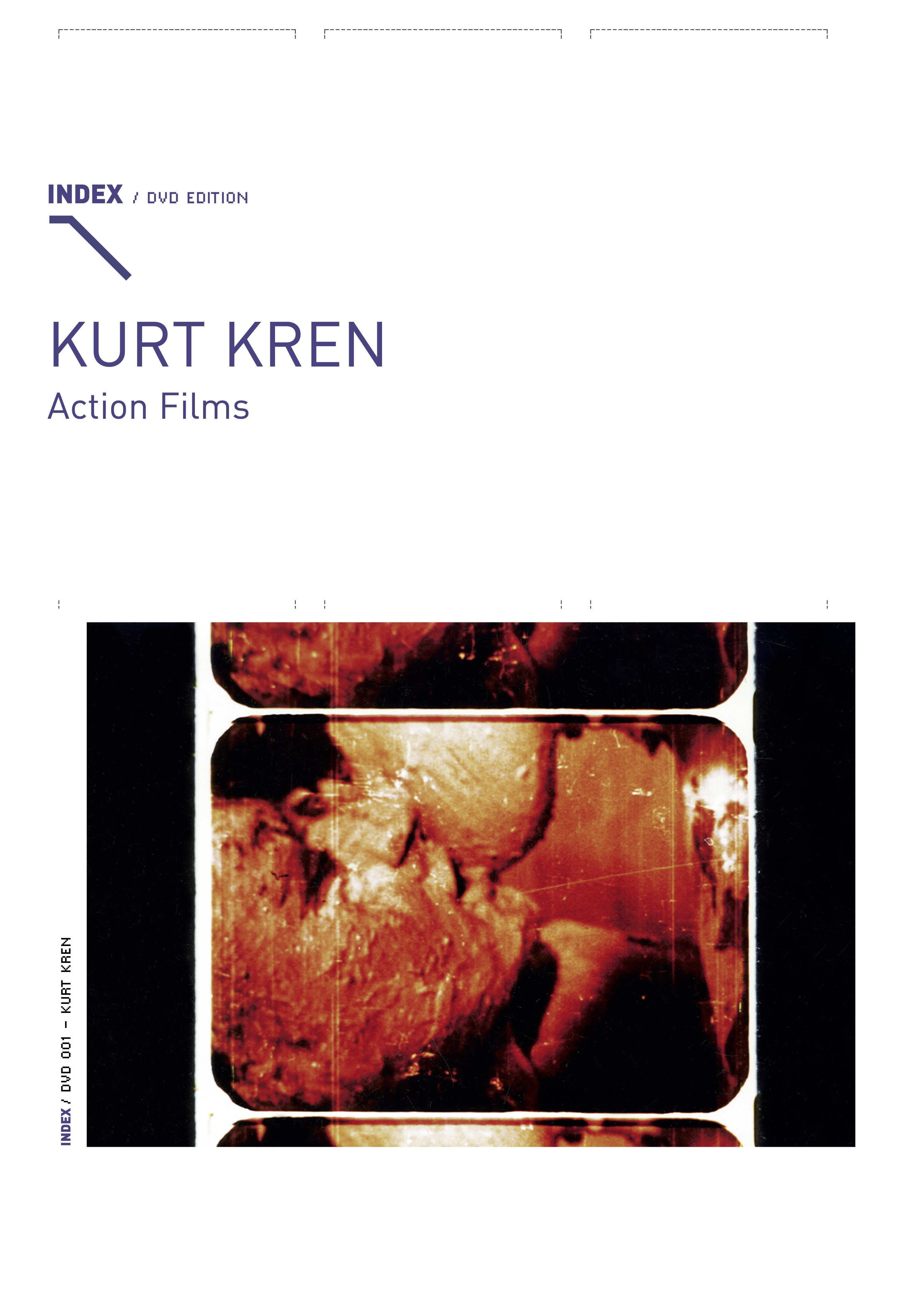
In this collection of 16mm structural films, we find ourselves ushered into a markedly different chamber of Kurt Kren’s creative house, one that feels dimmer, more ascetic, and more inwardly resonant than the rooms we inhabited in the previous DVD of his action films. If the earlier works thrummed with kinetic urgency, these unfold like meditations carved into celluloid. Filmmaker Peter Tscherkassky, ever attuned to the language of photochemical mysticism, praises these films as among the most important in the history of cinema. A bold claim, to be sure, but boldness feels appropriate here, considering the archival tenderness and curatorial reverence with which these inimitable pieces have been unearthed, handled, and presented, as if some delicate species of moth were being returned to its nocturnal habitat.
Fascinating about the chronology of Kren’s expressivity is the way it relinquishes the primacy of the image even before the image learns to walk. Rather than building from sight outward, he begins in the auditory shadows, as though cinema were a pulse, a vibration, a coded murmur etched below the threshold of visibility. His inaugural film, 1/57 Versuch mit synthetischem Ton (Test) [Experiment with Synthetic Sound (Test)], bears this ethos plainly: its “soundtrack” is scratched directly into the filmstrip, a raw trembling of impulses that barely gestures toward any physical context. It exists as a proto-world, a seed in place of trunk and branches.
Versuch mit synthetischem Ton (Test)
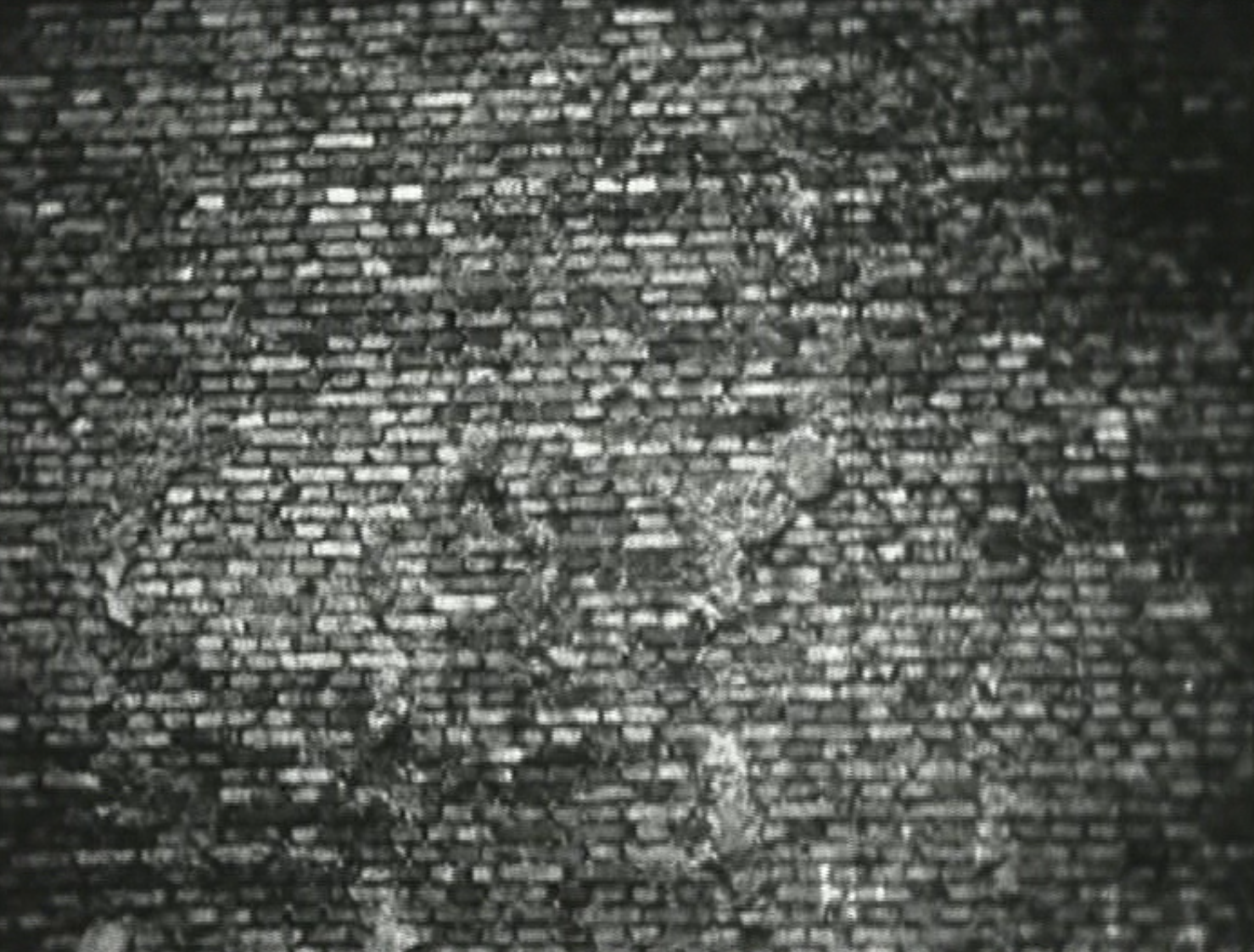
His next four films trace their trajectories in a procession of experiments, each one a footstep into deeper formal terrain. The most unforgettable among them, the groundbreaking 3/60 Bäume im Herbst (Trees in Autumn), moves with the grace and turbulence of a thought in the act of transforming. Here, Kren paints the soundtrack with ink, unspooling a choreography of leaves that distorts the mind’s eye. Everything is montage, but all of it is performed in-camera, as if the editing table were too coarse an instrument to contain such delicacy.
Bäume im Herbst
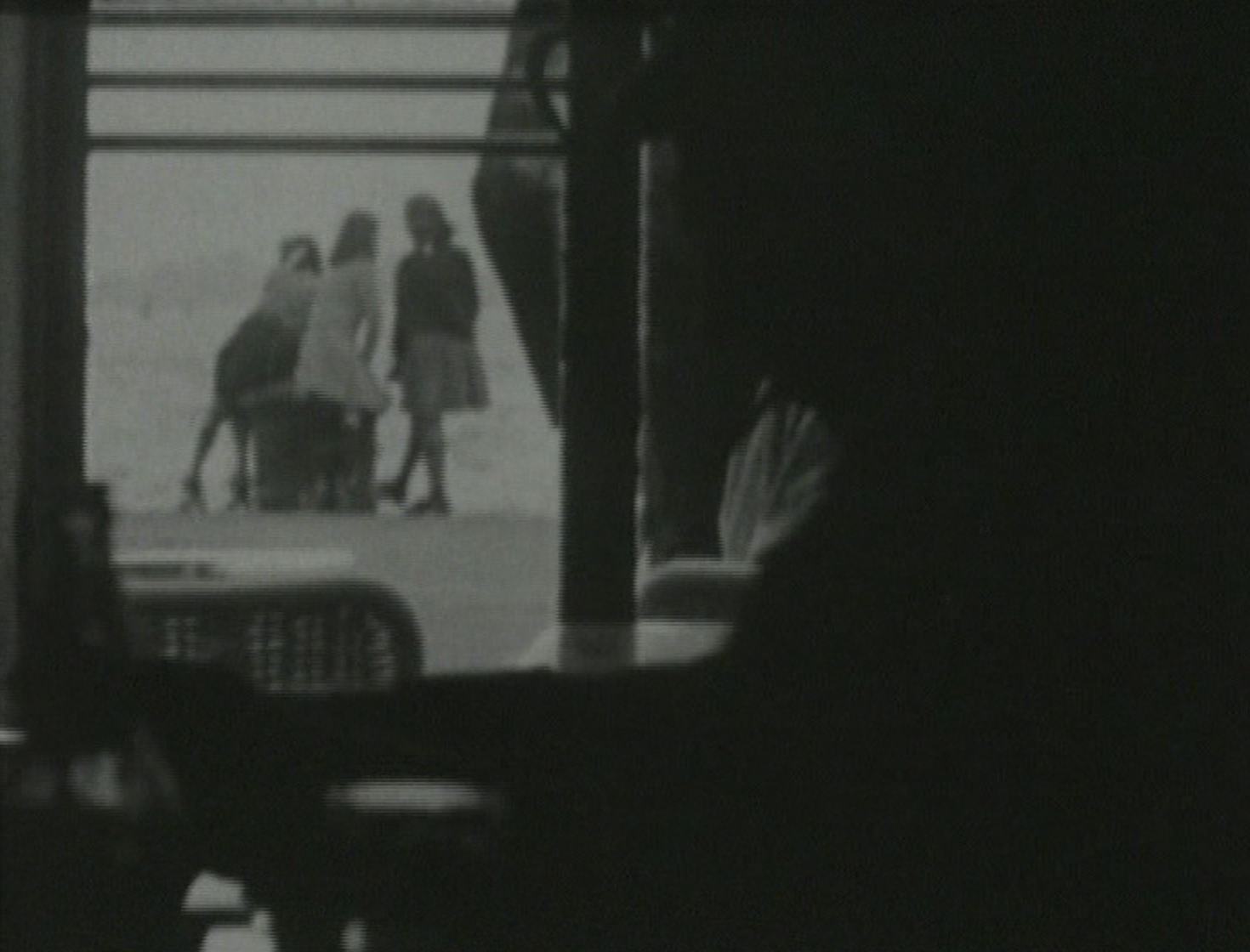
As Kren crosses the threshold into the sixties, his gaze pivots toward the everyday, lowering itself from abstraction into the realm of human gestures and urban happenstance. In 5/62 Fenstergucker, Abfall etc. (People Looking Out of the Window, Trash, etc.), quotidian fragments become luminous by the very fact of being noticed. In 15/67 TV, a Venetian harbor café becomes a stage for repetition and reassembly: five takes copied 21 times, shuffled like a deck of overheard moments. The era also coaxes out his political conscience, most starkly in 20/68 Schatzi, where a photograph of an SS officer at a concentration camp is revealed piece by piece. The image flickers in and out, a memory trying to recall itself, or perhaps a society trying to forget—and failing to do so.
TV
In her booklet essay, Gabriele Jutz describes Kren’s work of the 1970s as “a media-immanent ideology critique,” and indeed the films of this period seem to interrogate their own scaffolding. Kren travels from the take to the frame, peeling back the skin of the medium to expose its smallest nerves. Through this distillation, film becomes a tactile surface on which time leaves fingerprints. Out of this emerges what may be his most quietly beautiful creation: 31/75 Asyl (Asylum). Shot in Saarland near the French border, the film uses a mask with five holes—changed daily, for 21 days—as a kind of ritual viewing apparatus. Through those apertures, we witness the changing of seasons, but also time grieving its own passing. It is a soft and private composition, a chamber sonata of the natural world.
Asyl
Then comes 36/78 Rischart, Kren’s oblique self-portrait. But if the genre is traditionally an attempt to assert the self, this one dissipates it. He speaks, but we do not hear him. He appears, but we are denied his solidity, painted in fog.
Rischart
The collection also offers two films shot in the United States, including the hypermodern 37/78 Tree Again. In it, a Vermont tree—stoic, spectral, filmed on expired infrared stock over 50 days—seems to stand against nothing less than a nuclear reckoning. The specimen is both witness and survivor, a lone guardian in a field of unseen catastrophe.
Tree Again
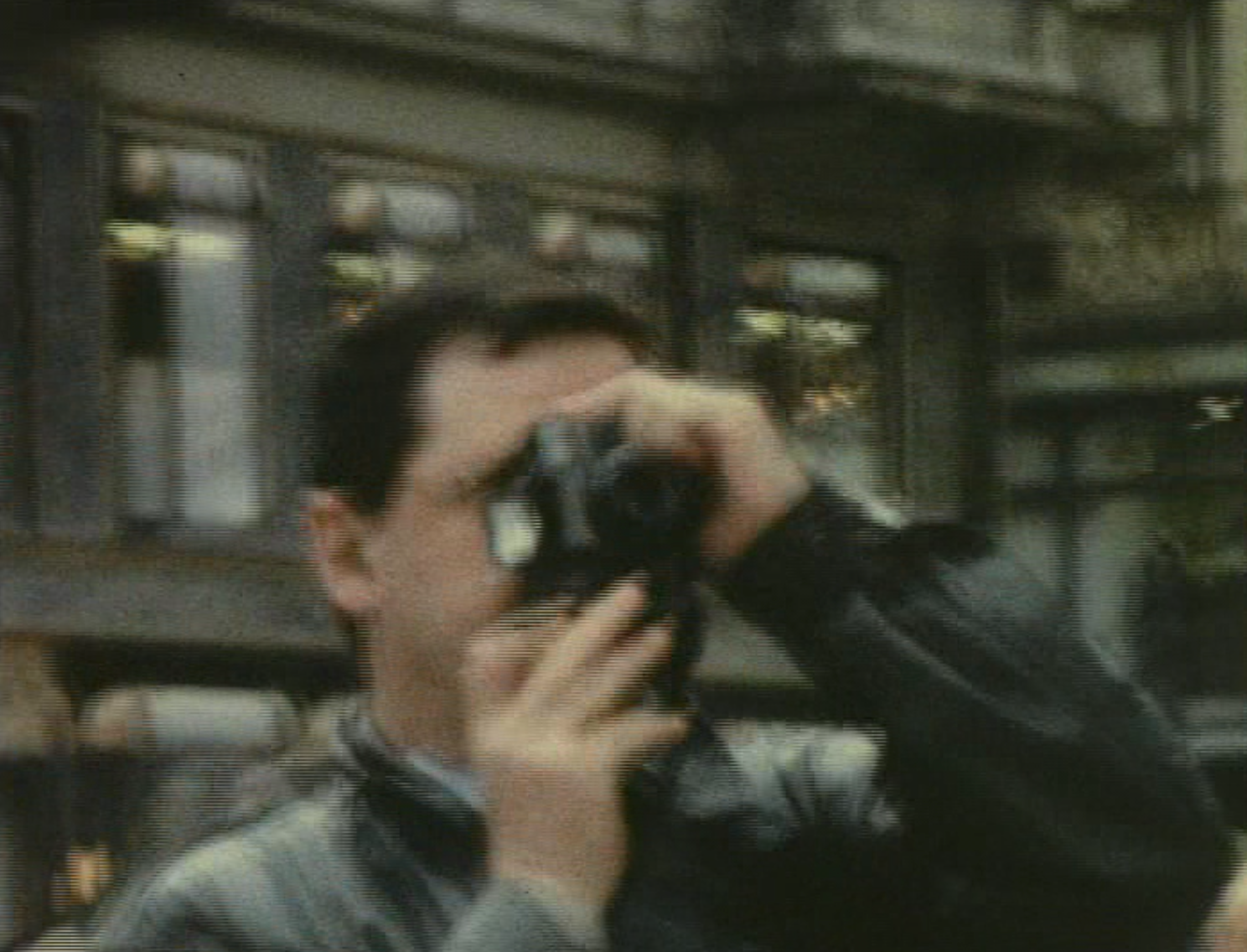
All of this culminates in 49/95 tausendjahrekino (thousandyearsofcinema), which feels like Kren’s Möbius strip farewell to the medium he spent a lifetime interrogating. Filmed over 30 days at Stockim-Eisen square in Vienna, it captures tourists taking photos and videos, no doubt believing themselves to be chroniclers of their own experience. Yet Kren folds their documentation back onto itself, creating a looped meditation on how we look and record ourselves looking. The sound, collaged from Peter Lorre’s film The Lost One, drifts through the piece as a ghost trying to remember the words to its haunting.
tausendjahrekino
Structural Films does not merely preserve a body of work; it preserves a way of seeing, a way of listening, a way of thinking with and through the spliced architecture of film itself. Watching these works, one senses that Kren was always less interested in representing the world than in revealing the mechanisms through which its physiognomy becomes visible. And so the collection closes not like a door but like a breath, leaving us to wonder what images and sounds might yet emerge from the language he left behind.
In May of 1955, Austria emerged from the purgatory of occupation and stepped tentatively back onto the world stage. With the Austrian State Treaty came the promise of political independence and the fragile sheen of sovereignty, a neutrality it hoped would steady it in the receding shadow of the Second World War. The so-called economic miracle that followed gave the young nation a chance to rebuild its identity, yet the 1960s brought with them an ideological tremor. Liberal politics rose like a heatwave from beneath the cultural pavement, ushering in a new radicalism that refused polite distance. And in this environment—half rebuilding, half rebellious—the Actionist movement materialized, confronting not only the remains of fascism but the very notion of aesthetics itself. While France and its neighbors cultivated New Waves gleaming with cinephilic verve, the Viennese Actionists were all but erased from Austria’s collective memory, swallowed by mass television, expanding leisure culture, and a lack of state support that rendered the nation’s cinema nearly comatose. Even what little commercial film did surface received scarcely more than a raised governmental eyebrow.
Yet the 1950s had already planted a seed. In Vienna’s “Art Club,” more than a hundred films were produced in its first decade, flickering beacons in an otherwise dim landscape. Though Europe witnessed various politico-artistic manifestos, including the pivotal Oberhausen Manifesto of West German filmmakers in 1962, Vienna’s underground artists found no single ideology sturdy enough to carry the weight of their visions. With no public venues willing to host their experiments, they forged their own path, cultivating Wiener Aktionismus, or Viennese Actionism, as a radical gesture of self-unmaking. These Actionists confronted audiences with the unvarnished human body—its fluids, its failings, its feral possibilities—not as spectacle, but as a state of being. Their performances were neither narratives nor manifestos. They were eruptions of immediacy, born of trauma and jouissance intertwined.
Censorship’s thumb bore down heavily, and some artists fled to West Germany in search of oxygen. Those who remained—including Kurt Kren, Peter Weibel, Hans Scheugl, and VALIE EXPORT—organized. Their efforts culminated in the founding of the Austrian Filmmakers Cooperative in 1968. From there, they cracked open the country’s cultural shell, finally allowing their films not only to circulate at home but to seep into the international bloodstream. At last, an audience began to coalesce.
Among these artists, none left a deeper mark on Actionist cinema than Kren (1929–1998). If Actionism was a flame, Kren was the accelerant. His death prompted renewed interest in his work, but his influence had been quietly fermenting since the late 1950s, when he first began experimenting with 16mm. A pioneer of what would later be called “structural film,” Kren approached the body—his own and that of his collaborators—as a pliable medium. Working alongside Otto Mühl, Günter Brus, and “Op” artist Helga Philipp, he filmed “happenings” neither as documents nor as artistic trophies but as participatory comings-together. Denying Brus and Mühl the control they so often demanded, he stripped the Actionist gesture of its authorship and returned it to the site where it originated. For Kren, the body was the raw material of cinema, a plane of performativity before the concept had academic caché. His films remain testimonies to the intensity of sensation before symbol.
This DVD, the first of a series published by INDEX, collects these early action films and situates them in their rightful historical and visceral context. In the accompanying booklet, Michael Palm observes that Kren’s cinema privileges moment over narrative, rupture over resolution. “In Kurt Kren’s body-cinema,” he writes, “the human is no longer the measure of all things.” One feels this as a kind of internal compass unmoored from its magnetic north.
6/64 Mama und Papa serves as our entry point into Kren’s world: brief, confrontational, and unforgettable. Here, quasi-Freudian studies of masculine and feminine imagery flicker across the screen in 82 rapid, deliberately fragmented shots. Their brevity sears them into memory, as though the mind must tattoo them instantly or risk losing their significance. Its companion piece, 7/64 Leda mit dem Schwan, reimagines myth through the recycled image of Mühl; its parabola of pouring, feathering, and smearing moves with an almost biological rhythm, as if bred rather than composed.
Leda mit dem Schwan
With 8/64 Ana, Kren’s first work with Günter Brus, the scarcity of film forced him into live montage. Bodies become objects, objects become bodies, and pain becomes calligraphy. The lineage this establishes runs straight to the later works of Peter Tscherkassky.
Ana
Kren expands this single-frame improvisation in 9/64 O Tannenbaum, where body parts, bursting balloons, and a flaming tree consume the holiday spirit in a frenzy of destruction. After such feverish play, 10/65 Selbstverstümmelung stuns by slowing down. Brus’s simulated self-harm becomes a ritual of preparation, much like Olivier de Sagazan’s Transfiguration, where the performance masquerades as violence but reveals only the harm of a cigarette.
Selbstverstümmelung
In 10B/65 Silber – Aktion Brus, Brus edits out his own visage in erasure, yielding a collage of gestures where only women’s faces emerge intact. This destabilization continues in 10C/65 Brus wünscht euch Seine Weihnachten, a home-movie-styled rupture of domestic space, filmed again in single frames and culminating in a frenzy of limbs without a trace of festivity beyond escape itself.
Silber
The erratic nature of Kren’s cinema becomes almost orderly once one accepts its internal logic; conversely, its familiar elements turn alien when stripped of context. Sexuality dissolves into abstraction in 12/66 Cosinus Alpha, while the face (the most primal signifier of identity) flickers in and out of recognition in 13/67 Sinus Beta, a film Kren himself struggled to define. Finally, 16/67 20. September redefines narrative altogether. By entwining images of urination, defecation, eating, and drinking, it reveals a stark truth: far less emerges from us than what we take in. The body becomes a ledger of exchanges, an organism of relentless consumption and automatic release.
20. September
Ultimately, Kren’s films resist closure. They are less documents than detonations. They remind us that the body—imperfect, ungovernable, infinitely expressive—remains cinema’s most volatile instrument. Through Kren’s eye, it confronts us not with what it means, but simply with the unavoidable fact that it is.
Thomas Strønen drums Ayumi Tanaka piano Håkon Aase violin Leo Svensson Sander violoncello Ole Morten Vågen double bass Recorded December 2021 at Rainbow Studio, Oslo Engineer: Peer Espen Ursfjord Mixed July 2024 by Manfred Eicher, Thomas Strønen, and Michael Hinreiner (engineer) at Bavaria Musikstudios, München Cover: Fidel Sclavo Album produced by Manfred Eicher Release date: December 5, 2025
Off Stillness begins not with sound but with a memory, one that Thomas Strønen carries like a stone kept in the pocket of his youth, made rounder and smoother with time. His recollection of slipping unnoticed through a café kitchen in Tønsberg to witness his first jazz concert at age 15 is more than nostalgia; it’s an origin story. There, engulfed in the sounds of Jon Balke’s Oslo 13, was a revelation. Rhythm, he discovered, was not a grid but a worldview, a way for the body to converse with the unseen.
From this quiet prelude, the latest iteration of his band Time Is A Blind Guide opens with “Memories of Paul,” a piece that feels like stepping into the half-light of Rainbow Studio, a space that does not merely record music but seems to cultivate it. Despite the title, this is not a tribute to Motian or Bley so much as a meditation on the tension between lineage and selfhood. Ayumi Tanaka’s piano breathes first, the faint stirring of a creature waking in its natural habitat. Håkon Aase’s violin is a drifting breeze, Leo Svensson Sander’s cello a subterranean hum, and Ole Morten Vågan’s bass a slow-moving tide beneath the surface. Strønen’s drumming is the pulse of the room itself, a presence woven so delicately into the others that extracting any single thread seems almost sacrilegious.
As the album moves inward, the climate changes with “Season.” Here, the strings take on an arid beauty, as if we’ve been transported into a landscape shaped by centuries of shifting winds. The piece proceeds like an archaeological dig through sand and sovereignty, yet from this dryness small harmonies bloom, each a tiny flower of possibility pushing through historical sediment. The music astonishes by how much it conveys with so little, conjuring a vastness that feels earned rather than imposed.
The ensemble’s paradoxical strength, its ability to move loosely while bound by deep listening, emerges even more fully in “Fall.” The piece sways like a great creature with an internal compass that needs no magnetic north. Its journey nourishes itself, leaving behind traces—melodic footprints, rhythmic indentations—for the listener to follow. Time is not measured but wandered through.
The mood softens with “Tuesday,” a piece stripped to its essentials, left bare so its poetic speech can resonate. Whether the musicians play in unison or diverge into their own small eddies, they inhale and exhale as a single lung. It is tenderness as a means of clarity.
A shift occurs in “Cubism,” where architecture abounds. The piece balances on a precarious structure of boards and cylinders, a slow-motion circus act in which each rotation differs subtly from the last. Strønen provides the chemical uplift, one reaction setting off the next. Tanaka’s piano becomes an alkaline counterpoint to the more acidic strings, and together they settle into an equilibrium that feels strangely, beautifully neutral. The music is precise without being rigid, playful without losing its center.
Abstract shapes drift into form with “Dismissed,” which begins like an experiment suspended in midair. Its irregular surfaces soon accumulate heat, expanding into outbursts of collective energy. Metallic tensions shimmer and collapse, highs and lows collide, and the piece finally dissolves into a sonic steam rising from a cooling forge.
Then comes “In Awe of Stillness,” which glistens with a self-generated glow, moving as if guided by impulses as old as they are unnameable. Just when it feels ready to drift away, it recoils slightly, a moment of satoric self-recognition. This pause resets the ensemble for the next step in its nomadic journey. Even as the piece thickens into louder phrases and hints of groove, it never sacrifices atmosphere. Nothing is ornamental; everything breathes.
By the end, one realizes that Off Stillness is as much a pilgrimage as an artistic statement. Its stories do not unfold in straight lines but in spirals, circling back to that teenage boy in Tønsberg who planted a seed that has now grown into a tree in its own right. The music invites repeated listening not to decipher it but to inhabit it, each return revealing new details, like light shifting across the same landscape at different hours.
For all these reasons, it may well be—both in craft and in spirit—the ECM album of the year. There is truly nothing else like it.
Red Hook Records began its journey with pianist Masabumi Kikuchi’s final studio recording, and now, for the label’s eighth release, we are given more of a revelation than a sequel. If that first album was a door half open, this one is the room beyond it: dimly lit, shadows stretching toward us with quiet familiarity. Drawn from the same December 2013 sessions, these seven tracks seem to have steeped longer in the vessels of memory and time. They arrive seasoned by the sort of emotional oxidation that turns recollection into something rarer and more useful. If saving the best for last were a novel, then this album would not simply be the final chapter; it would be the codex hidden in the spine, the annotation that changes the tone of everything preceding it.
The standards here were formative ones in Kikuchi’s student days, and he approaches them as an elder returning to the foundational texts of his own becoming. They are less songs than mirrors that have aged with him, warped by years of touching, of looking, and of looking away.
“Manhã de Carnaval,” for instance, unfolds as a dream freshly slipped from its cocoon. Kikuchi walks tenderly across its terrain, each step testing the integrity of a world that seems to be forming beneath him even as he treads it. There is the sense of waking from a coma, unsure of what has changed most: the world outside, or the one within. As he coaxes the theme into coherence, it resembles memory grafting itself onto the present. Notes reach upward as fingertips toward a moon that has watched over him for decades, asking silent questions about the knots forming in the threads of existence below.
This pathos is his signature, and it reveals itself early, already pulsing under the surface of “Alone Together,” in which confidence is not announced but revealed slowly, the way a photograph emerges through chemical baths. Kikuchi does not so much play the tune as breathe through it. By the time we arrive at “I Loves You, Porgy,” the emotional stakes have deepened. The opening chords blush across time as if receiving a first kiss from a future that will never fully arrive. He settles into its changes with a kind of practiced vulnerability, proving that tenderness need not be fragile. His quietude carries drama the way a lantern carries flame, not ostentatiously but with an understanding of its purpose.
“My Ship” drifts into view as if slowed by the gravitational pull of recollection. Time is not a river but a weight, and living requires the steady muscle of acceptance. The ship does not simply approach; it gathers the currents of decades, reminding us that history is not always something the world gives us but grows in the chambers of the heart.
Faro-shuffled into these standards are three improvisations, astonishing in their immediacy and yet strangely timeless. As Ben Ratliff so beautifully puts it in his liner notes, they “can sound like instant ballads from another planet,” and together they form a kind of secret autobiography, spoken in a language only the subconscious fully understands. The first of them, “Improvisation II,” opens the door with a dark playfulness, as though Kikuchi were tugging at the piano’s hidden wiring, testing where resistance might give way to confession. What at first sounds abstract begins to gather logic the longer one listens. In “Improvisation III,” the music flips itself inside out. Small fragments swell into whole lifetimes, while emotional atoms compress into diamonds of feeling that shimmer before being tossed into the river of time. “Improvisation IV” climbs stairways within stairways, each gesture reaching for a rung made of breath and hesitation. A rhythm struggles to be born, faltering yet fiercely sane, as though meaning rises from the very fractures that threaten to undo it.
What is ultimately astonishing about this album is that it never feels tired or cynical, never weighted by the knowledge that these would be among his final recorded breaths. Instead, it is a witness: someone channeling truth in the moment, as though the body knows something that words and plans and even melodies cannot fully grasp. This is not farewell music. It is presence music, created by a human being who understands that honesty requires discipline.
To listen to this album is to feel the pulse of time through someone else’s fingertips, understanding at last that the deepest truths are not contained in beginnings or endings, but in the trembling line that connects them. In these tender and fractured meditations, Kikuchi offers not closure but permeability. The circle remains open, as all living circles do, inviting us to step through and find ourselves changed on the other side. Artistic life begins where the tape stops.
Even as the world churns in its ceaseless kaleidoscope of beginnings and erasures, Amina Claudine Myers sits at her solitary piano like a witness to the secret continuity beneath all ruptures. Her inner flame neither wavers nor consumes. It hovers, steady as a lantern held by an ancestor who has patiently waited for us to open the door. In this solo offering, recorded at 81 years young, she extends a topography of intimacy where every listener may stake a claim not of ownership but of belonging. It is a home carved from the psychic sediment of music made in real time. “African Blues” rises first, a kind of invocation to the heart’s memory of itself. Its anthemic pulse thins the veils between the seen and the felt until the blood remembers how to sing. “Song for Mother E” unfurls in response, sculpted yet unbounded, a river reasoning with its own flow. It reminds us that every emotion is both a tributary and a delta of something older than the body that hosts it. Here, her church roots shimmer not as dogma but as archeology. Layers of hymnody and gospel slough their husks to reveal a holiness that needs no altar. It is a spirituality so egalitarian it could only have been shaped by hands that labored long to mend the broken lens of the world with the glue of lived experience. Her “Hymn for John Lee Hooker” becomes a wandering morality, touching the past like a finger trailing over photographs saved from a burning house. The American spiritual “Steal Away” drips from her like baptismal water that refuses to dry, anointing with the trembling newness of a spirit freshly called. Her original pieces, nearly all of them windows cut into the architecture of her being, span a spectrum of interior climates. In “Ode to My Ancestors,” her Hammond B3 hums like a memory engine as she speaks of the lineage that built her path, hand upon weathered hand. Each uttered reflection is a stepping-stone laid. In “Voices,” the piano speaks in tongues older than language, delivering messages only the flesh understands. “Sensuous” enlarges the ears into satellite dishes that capture transmissions from the universe’s unanswered questions. It draws us into rooms of shadow and recollection where love’s contradictions bloom like crushed orchids—messy, fragrant, impossible to arrange without getting the fragrance on your fingertips. This ambiguity stretches further into “Twilight,” where starshine blurs into meteor-ghosts. Time loosens its grip, and even certainty forgets its name. “Cairo” offers points of reference that feel like déjà vu wearing new garments. “Beneath the Sun” tilts the face of the self upward, eyes closed, receiving the warmth of our nearest star as if gratitude were a gravitational force. Its chords unspool dissonance the way wisdom exudes suffering, letting each tension reveal its lesson. And though Myers’s personal history could indeed fill countless pages, tracing constellations of influence and expression, none of that is required to feel as though she is already kin. The moment we press play, we are confronted not with her story but with a shared stream of remembrance, carried by waters that have been flowing toward us long before we knew how to swim.
With Breaking the Shell, the sixth release from the groundbreaking Red Hook label, producer Sun Chung has offered not merely a trio but a quietly seismic realignment of possibility. Electric guitar (Bill Frisell), pipe organ (Kit Downes), and drums (Andrew Cyrille) form a constellation that feels, paradoxically, at once unprecedented and long familiar, like discovering a new moon only to realize its gravity has pulled our tides all along. Chung, having cultivated relationships with all three musicians through previous ECM projects, sensed a convergence before any of the participants could name it. As Philip Watson writes in his liner notes, the trio exists “in a deep state of not-knowing,” a phrase that might just as easily describe the listener’s condition of being suspended between recognition and estrangement.
Recorded at St. Luke in the Fields in New York’s Greenwich Village, the music bears the acoustics of a space built for a resonance of spiritual persuasion. Here, sound doesn’t merely travel outward but returns, circling back like a question that grows more meaningful the farther it wanders. The trio treads honestly without ever falling over, even as it allows trips and stumbles to become part of its gait. There is no fear of imbalance. Instead, there is trust in the materials of the moment. And while one could easily linger on the rare combo or the grandeur of hearing the pipe organ in a chamber-like setting, once the album begins, such considerations dissolve. The instruments become porous vessels for a collective intuition.
The opening track, “May 4th,” emerges in a slow-rolling fog, the organ releasing a detuned drone that tilts gently against the ear. Higher notes graze the air with the soft certainty of fingertips tracing an old, half-forgotten symbol. Frisell and Cyrille enter as if waking from the same dream, their gestures swelling and receding in a space where time loops back on itself. The music feels exploratory—not in the sense of searching for what is missing but in allowing what is already present to unfold without resistance.
From there, the trio slips into “Untitled 23,” a meditation that cycles through scenes like a zoetrope, each revolution shifting character just enough to remind us of the fragile illusions we call continuity. The trio invites the imagination to wander alongside them, not as spectators, but as co-conspirators in the act of making sense of the flickering.
The journey then turns extraterrestrial with “Kasei Valles,” named for the vast valley system etched across the Martian surface. The music reaches outward with similar breadth: Downes’s organ stretches into horizonless zones while Frisell’s guitar, distorted into an adventurous rasp, scratches the underbelly of atmosphere. One can almost sense distance itself, not only as measurement but as emotional terrain.
On “El,” cellist Lucy Railton joins the ensemble, her tone a shaded river cutting through the organ’s cathedral-like glow. The track breathes with the warmth of a melody as an offered hand rather than a distant signal. Cyrille’s brushes sketch spontaneous star paths, while Frisell’s detailing elicits messages whispered from within.
The mood deepens further with “Southern Body,” perhaps the album’s most quietly radiant piece. It is an earth swell of potential energy, the sound of something enormous choosing rest over detonation. Downes releases ocarina-like tones from the organ’s upper registers that seem to summon the wildness nestled in even the most domesticated corners of ourselves.
The first of two traditionals, “Sjung Herte Sjung,” arrives as a turning point. Translating from the Norwegian as “Sing Heart Sing,” it mirrors the ethos animating the entire project: a willingness to let the voice rise unforced. Frisell’s modal wanderings feel like steps taken along an ancient footpath, one that continues to reshape itself beneath each traveler.
Between these landmarks lie hints of discovery, including the swirling interplay of “Two Twins,” whose energies braid together like strands of DNA before dissolving in a delicately percussive fade. “July 2nd” is a drifting lantern, its tender, fluttering textures slipping briefly into an electronic-sounding mirage, as if a synthesizer were dreaming of being an organ, or vice versa.
Cyrille’s own “Proximity” appears near the album’s end, its tender-footed steps guided by the composer’s trademark sensitivity. The brushes move not to clear a path but to reveal it. Finally, another traditional, “Este a Székelyeknél” (“Evening in Transylvania”), closes the circle. Its Hungarian melody (one that passed under Bartók’s orchestrating hand) dissolves into the trio’s shared air, a cultural imprint carried forward not by preservation but by transformation.
By the end of Breaking the Shell, the title reveals its shape. What breaks is not the world but the hard surface of clinging to familiar forms. Frisell, Downes, and Cyrille do not present answers, nor do they ask us to seek them. Instead, they remind us that unknowing can be a place of shelter, and that music—when allowed to move through its players rather than be moved by them—can form a thematic circle in which every beginning contains its end, and every ending nods softly back to the beginning.
Here, in this luminous setting, the shell breaks not with force, but with attention. And what slips out feels like truth.
























 Between Sound and Space: ECM Records and Beyond