Lutosławski/Bartók: Musique funèbre (ECM New Series 2169)

Musique funèbre

Witold Lutosławski
Béla Bartók
Musique funèbre

Hungarian Radio Children´s Choir
Stuttgarter Kammerorchester
Dennis Russell Davies conductor
Recorded May 2004 and February 2010, Liederhalle, Stuttgart
Engineer: Peter Laenger
Executive producer: Manfred Eicher

Conductor Dennis Russell Davies leads the Stuttgart Chamber Orchestra in a program of music by, and dedicated to, Béla Bartók. The disc opens in the latter vein with Witold Lutosławski’s Musique funèbre, composed between 1954 and 1958 for the 10th anniversary of Bartók’s death. The title, often erroneously translated as “Funeral music,” is better rendered as “Music of mourning,” and connotes homage to one of Lutosławski’s greatest inspirations, if not the greatest, for he never dedicated a work to another composer. Although the piece’s overarching development resembles Bartók’s Music for Strings, Percussion and Celesta, the opening cellos closely prefigure the robust, overlapping memorial of Henryk Górecki’s Symphony No. 3, even if they do chart a vastly different geography, from collective to individual landing. That initial feeling of density and weight gives way to a dark airiness. Motives bend and sway—at moments pliant, at others sharply angled. Darting violins bring us closer to a sense of inner turmoil and bold reckoning. The Bartókian flavor is clear yet faged, and falls back where it began: in the solemn cellos. Ashes to ashes.

As Wolfgang Sandner observes in this album’s liner notes, for Bartók the music of Hungary’s peasants “was the source of a radical new musical system, not material for reverting to a nostalgic transfiguration of the original sounds.” In light of this, we might reckon his Romanian Folk Dances of 1917 not as an archival storehouse but, more like Estonian composer Veljo Tormis’s choral arrangements, as an experiment made fresh by extant impulses. While for me the reference recording by Midori and Robert McDonald (1992, Sony Classical) gets to the core of the music in ways I’ve not since heard, the Stuttgarters’ soaring performance of this 1937 arrangement for string orchestra by Arthur Willner articulates the orbits of its moons with surprising precision. A delicate piece of nevertheless sweeping proportions, it moves by a hand unseen. The solo violin stands out like a red rose among a field of black, its changes organic, even a touch mournful, in the present setting. As the mosaic evolves, it gives light to the translucent cells of its becoming. The flute-like strings in the enlivening finale give us reason to rejoice in the shadows.

So, too, does the Divertimento. Composed 1939 in dedication to Paul Sacher (who commissioned the work) and the Basler Kammerorchester, it achieves novel balance of spiritedness and restraint under Davies’s direction. Its unmistakable beginning lures with its insistent rhythm but would just as soon fragment into multiple galaxies of melodic thought. There is a smoothness of execution in the tutti passages and a paper-thin delicacy to the solo strings. While one might expect that energy to be sustained, it waxes and wanes in a most natural, thought-out-loud sort of way that lends especial insight into Bartók’s compositional process. The second movement proceeds slowly at first, but then, with the coming of dawn, stretches its gravity. The lower and higher strings forge an implicit harmony, an acknowledgment of the invisible forces connecting them both. The contrast between double basses and violins is one not of tone but of purpose: the lowers an unstable fundament, the uppers a firmament in turmoil. This chaos they share as if it were blood. The final movement returns the promise of that dance with wit. There are, of course, intensely lyrical and slow-moving parts, with the violin carving surface relief, but always returning with that whirlwind of fire.

In the wake of this dynamism, selections from Bartók’s 27 Two- and Three-Part Choruses (1935-41) come as something of a breather. They are not adaptations of folksongs, but were composed in such a style at the behest of Zoltán Kodály. With evocative titles like “Wandering,” “Bread-baking,” and “Jeering,” each is a vignette of imagined life. A snare drum pops its way through the choral textures, by turns martial and lyrical, adding colors of interest throughout. And while these pieces hardly hold a candle to his a capella choruses (the orchestral writing feels at points superfluous), they provide welcome contrast to the veils that precede it with gift of vision.
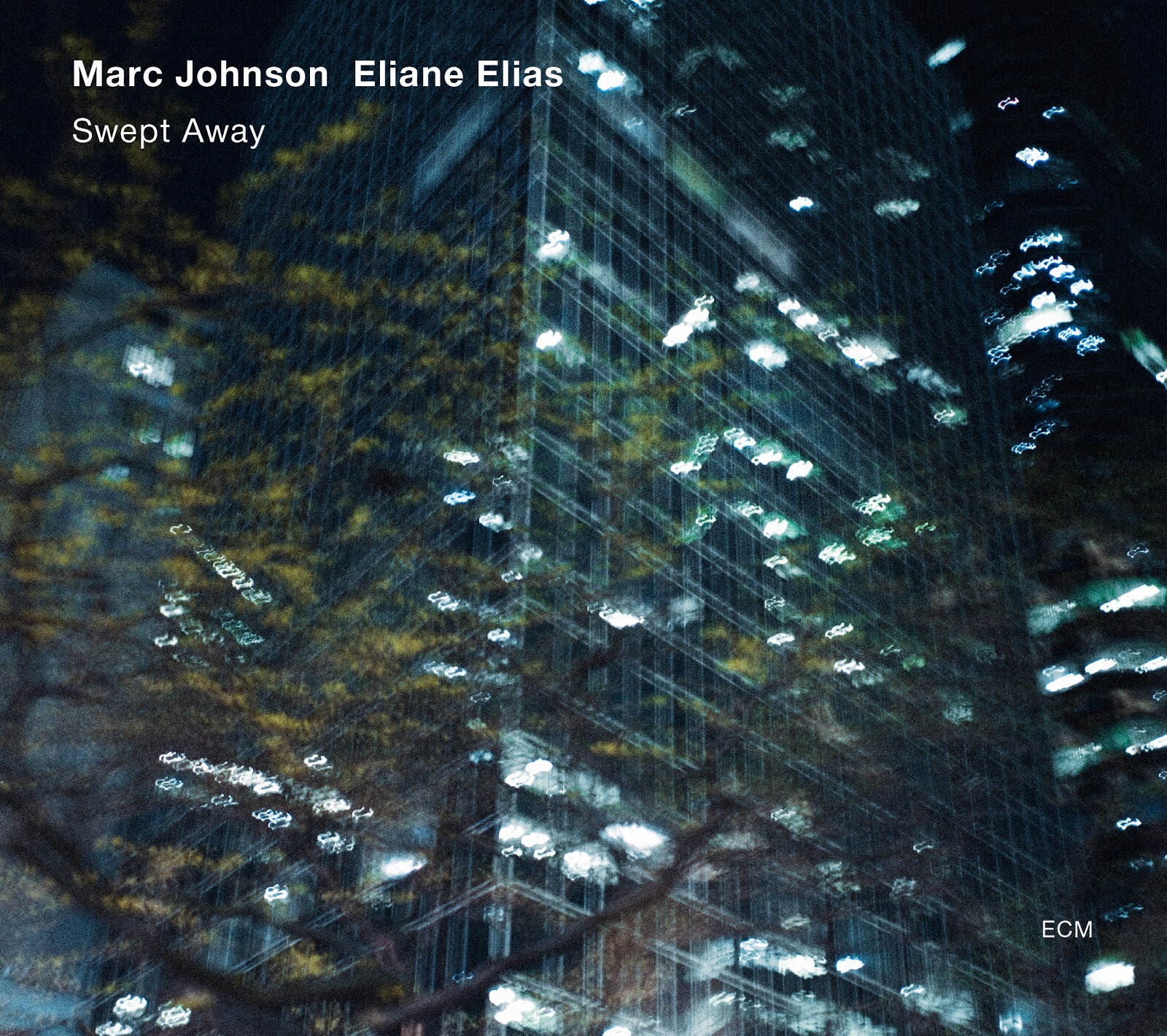
Marc Johnson/Eliane Elias: Swept Away (ECM 2168)

Swept Away

Marc Johnson
Eliane Elias
Swept Away

Eliane Elias piano
Marc Johnson double-bass
Joey Baron drums
Joe Lovano tenor saxophone
Recorded February 2010 at Avatar Studios, New York
Engineer: Joe Ferla
Produced by Eliane Elias and Marc Johnson

Although bassist Marc Johnson and pianist Eliane Elias are the heart of this distinctly melodic album (only their names appear on the cover), let us not ignore the atmospheric contributions of saxophonist Joe Lovano and drummer Joey Baron, whose completion of the quartet thus featured lends a sweeping quality to these mostly original tunes. With the latter contributions in full effect, Elias’s lush, classic sound and Johnson’s ever-thoughtful navigations ring that much more authentically.

The working trio of Johnson, Elias, and Baron produces five delectable tracks, of which “One Thousand And One Nights” and “B Is For Butterfly” are the most upbeat. Where one is engaging and modal, the other emits springtime warmth. Elias’s comping is dense but never invasive, lending context to her partner’s bass solos with a love shared both within and without the studio. One may read signs of this connection throughout the title track, in which Johnson’s prosody serves as yang to Elias’s poetic yin. These intimate settings prove fine vehicles for Elias, but none so nostalgic as “Inside Her Old Music Box” nor so impressionistic as “Foujita.”

With Lovano the band curves inward—more spaciously yet with lesser travel. This is no small feat, considering the powers of evocation possessed by each member. “It’s Time” introduces Lovano to the record’s sound-world and references Michael Brecker, in whose memory the tune was written, with richness. “When The Sun Comes Up” and “Sirens Of Titan” are jewels in their own right, contrasting hills of awakening with valleys of darker energies. Whether spurring the drums to lively enterprise or stretching intergalactic wormholes into sonorous infinity, Elias abounds. “Midnight Blue,” for difference, portraits a softer romance, the following “Moments” even more so, Lovano swaying like the night itself with the assurance of a touch shared by two.

Johnson’s solitary rendition of the American folksong “Shenandoah” closes out this well-rounded album with poise and purpose. In addition to being an autobiographical look back to the bassist’s Midwestern roots, it leads with equal footing into a future where one never need go far to find a song to sing.

Swept Away is a flawless reckoning of intuition and compositional integrity. The engineering, courtesy of a crack team at New York’s Avatar Studios, processes each cymbal hit as if it were the only thing sounding, while every channel around it remains clear and alive. Fresh yet familiar, sparkling yet serene, this is the kind of record you want to come home to.

(To hear samples of Swept Away, click here.)

Paul Bley: Solo in Mondsee (ECM 1786)

Solo in Mondsee

Paul Bley
Solo in Mondsee

Paul Bley piano
Recorded April 2001 at Schloss Mondsee, Austria
Engineer: Jan Erik Kongshaug
Produced by Manfred Eicher

The release of Solo in Mondsee in 2007 marked the 75th birthday of Paul Bley, and his first solo recording since 1972’s Open, To Love. Like the first, it owes its existence to producer Manfred Eicher, who on both occasions lured Bley onto solitary terrain. This time, the Montreal-born pianist sits at a massive Bösendorfer last heard under the fingers of András Schiff in a New Series program of Schubert’s C-major Fantasies. The instrument equally suits Bley’s preference for long sustains, as made lucid in the album’s opening statement: a resonant hit of the lowest strings. From this he summons ghosts of familiar songbooks, and bodies of those more distant, across ten so-called “Variations,” whose only theme is the absence of one.

Bley’s craft is an admixture of the ethereal and the gravid. He works from a palette so expansive that perhaps only Keith Jarrett has matched it in this unaccompanied format, and with tenderness so beguiling it tightens the ribcage to hear it. The freedom of his exponentially refreshing playing imbues the first numbered section with declamatory sparkle. Like Variation IV, it evokes warmth in winter by a peerless ballet of touch and tendon.

In contrast to these sweeping narratives, Bley gives props to whimsy on a handful of Variations. There are the dissonances and chromatic ladders of II, the centrally focused III, and the busier V and VIII, the eddying of which evokes the end of a waterfall. Variation VI is an especially brilliant turn for its fusion of the epic and the intimate. Its densities never occlude, but allow the light to sing over a flourishing undercurrent. The tenth and final Variation possesses an almost teasing quality, but leads toward a fragile, shape-shifting meditation.

Bley finger-walks on water and gifts solace in return, turning the world into a chamber, and the chamber into a universe.

<< Robin Williamson: Skirting The River Road (ECM 1785)
>> Yves Robert: In Touch (
ECM 1787)

Konitz/Mehldau/Haden/Motian: Live at Birdland (ECM 2162)

Live at Birdland

Konitz/Mehldau/Haden/Motian
Live at Birdland

Lee Konitz alto saxophone
Brad Mehldau piano
Charlie Haden double-bass
Paul Motian drums
Recorded live at Birdland, New York, December 2009
Engineers: James A. Farber, Paul Zinman, Nelson Wong, Sean Mair, SoundByte Productions Inc., NYC
Mixed at Avatar Studios by James A. Farber and Manfred Eicher
Assistant: Akihiro Nishimura
Produced by Manfred Eicher

On December 9 and 10, 2009, New York’s legendary Birdland jazz club hosted a quartet of three sages and one acolyte for a string of ad hoc performances. Altoist Lee Konitz, bassist Charlie Haden, and drummer Paul Motian, being of the older generation, brought lifetimes of experience to their respective instruments, but more importantly a willingness—if not a need—to share their wisdom with those of the up and coming. That said, pianist Brad Mehldau was already well established in the scene when he laid fingers to keys for this unusual gathering and proved himself a masterful chameleon within a jazz of patience that asks only the same in return from its listener.

With only six tunes to the album’s credit, there’s plenty of meat on the bone. Konitz’s signature sound swoons from the first in the ballad “Loverman,” his alto’s rounded tone sounding more like a soprano than its larger cousin. Haden and Motian make for a phenomenal rhythm section, sectioning rhythm as they do into base components. Motian’s brushes are the opposite end of Haden’s plunking color wheel. Meldau, for his part, goes wherever the winds may take him. At one point he inverts the standard solo, using the right hand to comp and the left for melody, and with a polish so radiant that the album might as well come with a pair of sunglasses. Haden’s reflection is likewise true to form, seeming to float beyond the stage by virtue of some slick postproduction.

George Shearing’s “Lullaby Of Birdland” comes as a subtle energy boost. Konit’z beauteous stream of consciousness over a cool back end scouts a prime location for Meldau, whose dense pockets give up handfuls of gold. His right hand has a mind of its own here, straying but always holding a tether line back to the fundament. Haden’s soliloquy is a remarkable stop of the journey. It’s a solo that keeps up the appearances of the tune while unraveling dreams of others in real time. This time the engineering is more forward, even as the musicians look back with angels of nostalgia on their shoulders.

Konitz introduces a spontaneous rendering of the Miles Davis classic “Solar.” The loose coalition that ensues works a collage-like magic very much like the album’s cover: mixing signatures that are familiar yet made novel by their overlap. Meldau’s complex and mind-altering denouements find balance in Haden’s contemplations, leaving Motian free to flail toward smooth finish.

“I Fall In Love Too Easily,” a ballad made famous by Frank Sinatra, turns down the lights but ups the tension. Konitz, soulful as ever, is the central candle of this altar in a vigil for a love that might have been, but wakes up bright and early for “You Stepped Out Of A Dream.” Here the band holds every detail in mind, as also in a glowing version of Sonny Rollins’s “Oleo.” Motian and Konitz set the stage in duet for the most endearing portion of the set list. Meldau thickens the stew, throwing his chords like spices and watching them mingle, as underneath Haden’s subdued funk culminates in a chiming brilliance.

It’s sobering to realize that, as of this review, half of the album’s roster is no longer with us. Haden and Motian may be gone, but their sounds will live on as long as there are ears to hear them.

(To hear samples of Live at Birdland, click here.)

Kremerata Baltica: Hymns and Prayers (ECM New Series 2161)

Hymns and Prayers

Kremerata Baltica
Hymns and Prayers

Gidon Kremer violin
The Kremerata Baltica
Roman Kofman conductor
Khatia Buniatishvili piano
Andrei Pushkarev vibraphone
Marija Nemanytė violin
Maxim Rysanov viola
Giedrė Dirvanauskaitė violoncello
Sofia Altunashvili voice on tape
Recorded July 2008, Pfarrkirche St. Nikolaus, Lockenhaus
Engineer: Peter Laenger
Produced by Gidon Kremer and Manfred Eicher

A recent album released of solo piano music by Stevan Kovacs Tickmayer bears the title Gaps, Absences, which best describes the music of the composer, pianist, and essayist who, born 1963 in former Yugoslavia, has since 1991 called France his home. His life as an improviser has brought him in collaboration with Fred Frith, Chris Cutler, and many others of the avant garde, while on the classical side he has enjoyed fruitful collaboration with violinist Gidon Kremer and the Kremerata Baltica, having served as composer in residence at the renowned Lockenhaus chamber music festival, where this album was recorded in 2008, and more recently at the Kremerata Baltica’s own festival in Latvia. His Eight Hymns (1986/2004), written in memory of Russian filmmaker Andrei Tarkovsky, begins a tripartite program of monumental works for various ensembles. Scored for violin, strings, vibraphone, and piano, each of Tickmayer’s hymns bears a title of calm strength. His atmospheres are deceptively minimal, at times spectral and at others hovering as mist over a lake at dawn. The instruments interlock in alternating tides and continental shelves. The piano paints evening skies as single notes break off into satellites of a deeper gravitation. The violin is a thin yet utterly present voice, an omniscient myth-keeper whose experiences of assumption, redemption, and remembrance all answer to the same voice. The vibraphone is a pinwheel moved by breath of slumber. Strings move in the draw of a paintbrush from behind a veil of ash and harmonic light. All of this ends in a flower, as fragile as it is trembling, leaving us indeed with gaps and absences of profound resonance.

Such soul-nourishing music finds like spirit by way of Giya Kancheli, who wrote his 2007 Silent Prayer in honor of Mstislav Rostropovich (for his 80th birthday) and Gidon Kremer (for his 60th). The familiar Kancheli themes crystallize in the prerecorded singing of one Sofia Altunashvili. Her pure-toned voice, carried like a feather on exhale, rings authentically for its vulnerability. It’s an unusual voice, an untrained voice, a voice unafraid of a misshapen psalm. As in the Tickmayer pieces, the violin feels thin and unchained, and puts into relief the spaciousness of strings dragging hands across water from methodical vessels. Their occasional interjects feel like proclamations from above, chances to restring the universal lyre. Still, there is a feeling of oppression to this piece, as if the sky had become weighted with death, so that the lively center almost blinds. Even more cinematic in feel than the Tickmayer, Kancheli’s hymnal cast turns wine into water in a single tracking shot.

Equally affecting, if by relatively compressed dynamic force, is César Franck’s Piano Quintet in f minor (1878/79), which occupies program center. A dramatic and chromatically ecstatic work that met with criticism at the time of its premiere, it also makes expert use of its formidable combination of instruments. What appears short and sweet by name becomes epic in performance as Kremer and his colleagues muscle their way through the first movement with heartfelt aplomb, chipping away at the music’s calcified soul as they proceed. Each drift into the major is a barrel over the waterfall of reality. The most genuine passages are the quietest. On that note, the second movement turns an elegiac frame into a window on fertile land. The legato phrasings of the final Allegro, then, are a bittersweet harvest, tempered by the promise of winter’s freeze. In anticipation of that cold, the piano holds a fire in its belly, changing from blue to orange to white as echoes return with nourished grief. For indeed, mourning is the final message of even the brightest day. The tinge of mortality knows no limits of sun.

Garth Knox: Saltarello (ECM New Series 2157)

Saltarello

Garth Knox
Saltarello

Garth Knox fiddle, viola, viola d’amore
Agnès Vesterman violoncello
Sylvain Lemêtre percussion
Recorded December 2009, Auditorio Radiotelevisione svizzera, Lugano
Engineer: Stephan Schellmann
Produced by Manfred Eicher

Garth Knox describes Saltarello, his second nominal disc for ECM’s New Series following 2008’s D’Amore, as “a mobile structure of musical ‘snapshots’ taken from nearly one thousand years of music.” As the former violist of the Arditti Quartet, Knox gained in-depth knowledge of music by living composers, all the while strengthening his relationship to the viola d’amore and folk-grounded fiddling, and compresses that knowledge into a roaming program. Knox has also developed his voice as a composer, as demonstrated by his Fuga libre for viola solo, which juxtaposes fiery arpeggios with moonlit pizzicato diffusions, glissandi, and harmonic overlays. This cellular approach is writ large across the album’s full breadth, which for the most part traverses centuries-old lineages. Joining Knox on his time travels are cellist Agnès Vesterman and percussionist Sylvian Lemêtre.

On the deepest end of the spectrum we encounter works of medieval masters Hildegard von Bingen and Guillaume de Machaut. The former’s lilting poetry, liturgical and solemn to its ashen core, comes out all the more authentically in the intimate setting, while the latter’s Tels rit au ma[t]in qui au soir pleure adds percussion in Sephardic spirit. Three dances from the 14th century speak further to an ancient aesthetic uncluttered by the discontents of modernity, resonating instead through the viola d’amore’s singing body. Here, too, the percussion balances luminescence opposite Knox’s originary tone. A handful of traditionals takes us into less definable territory, where Appalachian folk song and Irish fiddling meet in Black Brittany in limber arrangement with cello, and a trio of Irish tunes under the title of Pipe, harp and fiddle turns temerity into joy through a prism of bells and drums.

A dip into the font of the Baroque gives up the ghosts of Henry Purcell and Antonio Vivaldi. Where one feels steeped in downright cinematic tragedy, the other crucibles a concerto originally written for viola d’amore and orchestra down to its lead and bass lines, so that the striking geometries of each movement, from dancing to slumbering to dancing again, mold a beautiful sculpture of exuberance.

Bolstering all of this is contemporary Finnish composer Kaija Saariaho’s Vent nocturne for viola and electronics, which was written especially for Knox. The first of its two movements bears the title “Sombres miroirs” (Dark Mirrors), the second “Soupirs de l’obscur” (Breaths of the Obscure). The piece includes the composer’s own breathing, as well as the amplified sound of the bow drawn across a string, in a mood that best recalls Sofia Gubaidulina’s String Quartet No. 4. It’s a windblown reverie, opened and not merely enhanced by the technological overlay. It is sometimes restless and draws from a relatively stark palette, even as glass harmonica-like drones bleed into frame as if they were time itself. Splitting the two movements even as it binds them is John Dowland’s Flow My Tears, a song last heard under ECM auspices with words on In Darkness Let Me Dwell. It is, like the album as a unit, a prayer that looks itself in the mirror and neither smiles nor frowns, but takes in the entire face, scars and all, as something greater than the sum of its features.

Billy Hart: All Our Reasons (ECM 2248)

All Our Reasons

Billy Hart
All Our Reasons

Mark Turner tenor saxophone
Ben Street double bass
Ethan Iverson piano
Billy Hart drums
Recorded June 2011 at Avatar Studios, New York
Engineer: James A. Farber
Assistant: Fernando Lodeiro
Produced by Manfred Eicher

It’s no coincidence that Billy Hart’s surname is homophonous with “heart,” because this album is filled with it. From the simpatico yet open-ended musicianship to the flowing compositions, his quartet knows exactly where it’s at…and where it isn’t. In the latter vein, the bandleader-drummer emotes as much on the inhale as on the exhale, selectively deploying bursts of illustration. Pianist Ethan Iverson and bassist Ben Street make their first ECM appearances, while tenorist Mark Turner and Hart himself represent two very different intersections with the label: respectively, with the Fly Trio and the Charles Lloyd Quartet.

It’s Lloyd, in fact, whose influence is most apparent in “Ohnedaruth,” the first of three tracks penned by Iverson. Despite being based on John Coltrane’s “Giant Steps” (Ohnedaruth was Coltrane’s adopted spiritual name, a Sanskrit word meaning “compassion”), the balance of viewpoints between Hart and Turner is, both here and across the album’s full spectrum, so strong that I could easily imagine a duo flight in the vein of Lloyd and Billy Higgins’s Which Way Is East. Hart is staggered (and staggering), deciphering Iverson’s chromatic twists like a locksmith jiggling his way into Street’s fixed grooves. Turner’s studied approach spreads virtuosities as the icing of a delicately layered cake. Iverson is as bold as a composer as he is understated as a pianist. Even when given the spotlight, as in his Paul Bley-inspired “Nostalgia For The Impossible,” he opts for an inward quality that allows Hart’s brushes to sing. Iverson’s alchemy is naked and slow, and all the more impactful for it. His solo interlude, “Old Wood,” cuts the corner pieces of the larger puzzle.

Turner offers up two tunes of his own. “Nigeria” takes inspiration from Sonny Rollins’s “Airegin.” Its wing-beat opening fades from theme to solo, Hart taking a downright spiritual path of expression. As a drummer, Hart can be at once free and meticulous, but as a musician he combines molecule after molecule into the audible compound of this track’s flowering architecture, all while Turner and Iverson open every window to let in a flood of sunlight. Street, meanwhile, responds to gradations of the passing day. “Wasteland” opens with an acrobatic introduction from its composer and floats along its own ripples through the other instruments toward the opposite shore.

Hart shares his gifts on four originals. On the whole, they reap distinction from the incantational properties of his playing. One by one, they till the soil with a uniquely shaped implement every time. His most artisan spade breaks ground in “Song For Balkis,” which inspires his musicians in turn. Turner’s tone is bracing and wrought in spirit magic, working busily to transmit the messages his fingers receive into mortal recognition. Iverson tears up patches of earth and replaces them with sound. His pianism, restless and responsive, breaks every mold that clutches it. Hart, for his part, carves directly into the bedrock something beautiful. A rustic feel pervades the funkier blues that is “Tolli’s Dance,” which from modest foundations builds a tower to the sun—only this one isn’t made of brick, rivet, and lime, but of slick rhythm and rhyme. Hart’s “Duchess” and “Imke’s March” are by turns ecstatic and revelatory. The latter’s bee-wing delicacy wears such personal clothing that one can envision its colors with eyes closed and ears open.

All Our Reasons has plenty of reasons to discover, appreciate, and enjoy. But most important among them is the realization that mastery exists only when egos get left at the door. This is music for the soul, because only the soul knows how to detach itself from harmful desires that would get in the way of the experience.

(To hear samples of All Our Reasons, click here.)

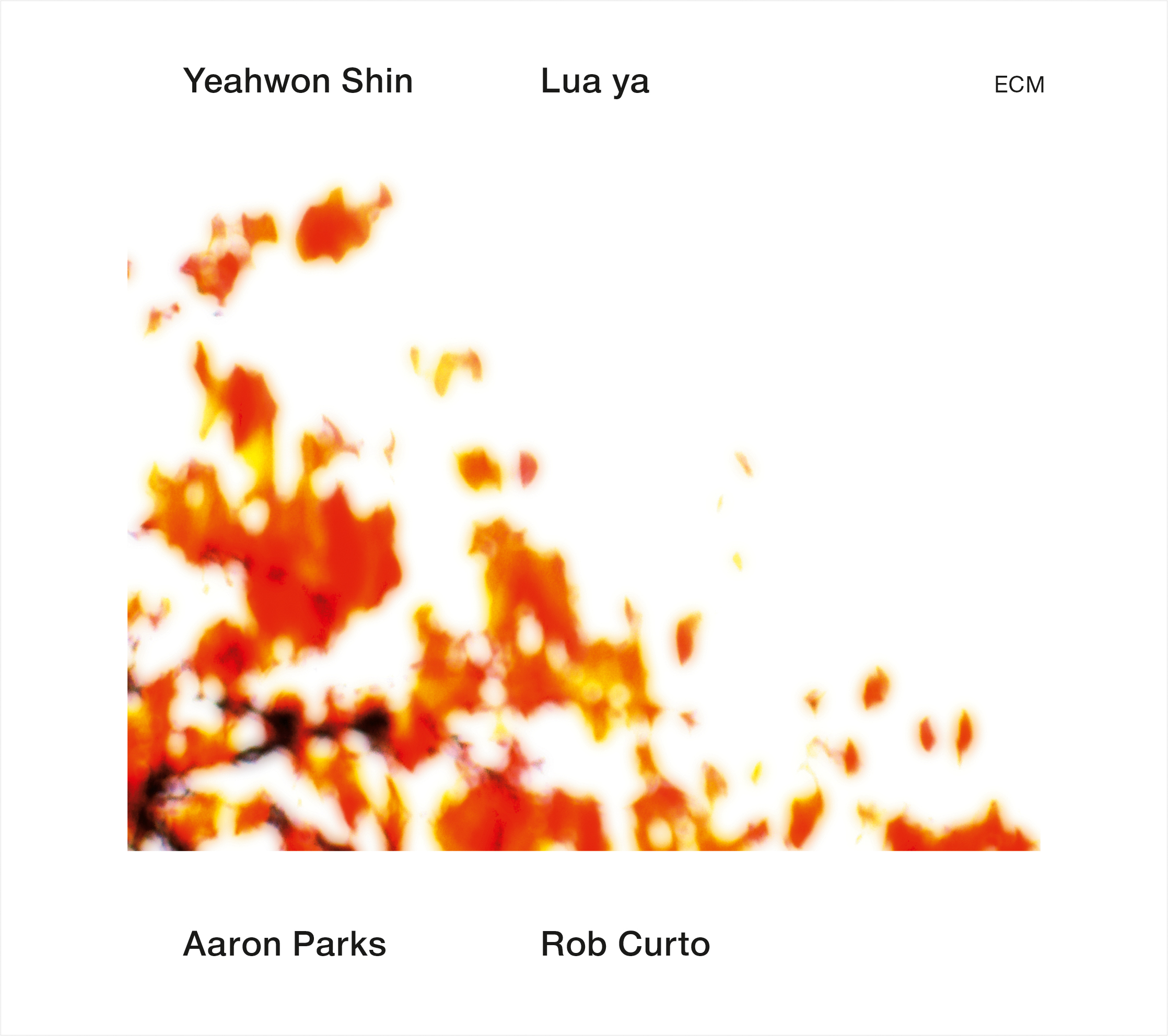
Yeahwon Shin: Lua ya (ECM 2337)

2337 X

Yeahwon Shin
Lua ya

Yeahwon Shin voice
Aaron Parks piano
Rob Curto accordion
Recorded May 2012 at Mechanics Hall, Worcester, MA
Engineer: Rick Kwan
Mixed at Rainbow Studio, Oslo by Jan Erik Kongshaug, Manfred Eicher, and Sun Chung
Produced by Sun Chung

If we can believe poet Federico García Lorca, who in a 1928 lecture entitled “On Lullabies” claimed that “Spain uses its saddest melodies and most melancholy texts to darken the first sleep of her children,” then we can also believe in a culture where lullabies nourish the growing soul. Of the latter persuasion are those offered by Yeahwon Shin on Lua ya. Shin’s selections give voice to transitions of darkness to light, spirit to flesh, dependence to independence, and all with a grace of expression that pretends nothing. Although best known as a Brazilian music specialist (her 2010 self-titled debut was nominated for a Latin Grammy), the singer rejoins accordionist Rob Curto and, for the first time, pianist Aaron Parks, in an enchanting survey of Korean children’s songs.

“The album’s theme is the remembrance of childhood,” Shin tells me in an e-mail interview. “I would like the listeners to have the freedom to imagine the story themselves.” In light of this invitation, we may still feel the need to tread lightly, for each song is of such fragile constitution that it would seem to crumble at the slightest mishandling. Then again, the music blossoms with such strength—a strength born of unconditional love—that it also feels impervious to misunderstanding. As in the opening improvisation, called simply “Lullaby,” it crafts a world of tracings and starlight. Parks’s pianism introduces the landscape across which Shin’s voice emerges as a maternal whisper, carrying with it the histories of countless mothers before, and the countless more to follow, in life’s eternal cycle.

Yeahwon Shin
(Photo credit: John Soares)

Shin grew up enchanted by the music of Egberto Gismonti, who along with the iconic Tom Jobim spun the tapestry of her appreciation for Brazilian music. She looks back even further to Chopin and Bach, composers who informed her first love—the piano—as fundamental inspirations in her development as an artist. “I like Korean traditional music, as well,” she says. “I am strongly bonded to Korea’s rhythmic patterns. I still want to discover more about this music.” Lua ya is a new step in precisely this direction. It is also a return to origins. For Shin, what seems most important in life is that which imparts it: “My parents are very important figures in my life. I respect my father’s wisdom, my mother’s unlimited love and spirit of self-sacrifice. They are not musicians, but the way they express themselves by singing shows a pure love for music. I have always wanted to feel that way in music.”

To be sure, Shin’s filial respect echoes in the songs passed down from her own mother, whose voice is forever preserved in memories of a family that was always singing. Of those songs directly passed down, “Island Child” is among the album’s most emblematic. Syllables roll off the tongue from both singer and instrumentalists until language ceases to matter. Indeed, Shin is at her most powerful when singing wordlessly (as she does here, and in “Moving Clouds”), as one needs not struggle against the elastic of linguistic barriers. “The Orchard Road” is another descendent of personal experience and shows the trio at its densest. Shin’s breathy storytelling develops over a rustic backdrop, as affecting as it is brief.

If Lua ya feels less like a cycle and more like one continuous song, it’s because it was, at the behest of producer (and Shin’s husband) Sun Chung, conceived and realized as a concert, played from start to finish with no edits. Chung acted as both audience and director when the performance was being recorded in Mechanics Hall in Worcester, Massachusetts. His presence is palpable in the album’s dynamic flow. Also present are Shin’s attentive accompanists, both of whom take her voice as a compass takes magnetism.

(Click here to see this article as it originally appeared in RootsWorld magazine, where you can also hear samples.)