Jimmy Giuffre 3, 1961 (ECM 1438/39)

Jimmy Giuffre 3, 1961

Jimmy Giuffre clarinet
Paul Bley piano
Steve Swallow double-bass
Fusion recorded March 3, 1961 in New York
Thesis recorded April 8, 1961 in New York
Originally produced by Creed Taylor for Verve
Engineer: Dick Olmstead
Remixed June 1990 at Rainbow Studio, Oslo by Jan Erik Kongshaug and Manfred Eicher
Reissue produced by Manfred Eicher and Jean-Phillipe Allard

A true arbiter the chamber jazz idiom before it even was one, clarinetist Jimmy Giuffre was brought back to vivid life in this much-needed ECM rescue. Engaging a then-acoustic Steve Swallow on bass and a gushing Paul Bley on piano in a twofold session of ruffled play for Verve (who showed no signs of reissuing these great works), Giuffre brought his signature silken tone to an ephemeral trio whose tuneful interactivity made for gobs of affirming music. In a wonderful encapsulating essay, Steve Lake tells us that the group had by this point reached a state of free jazz that dove past the blaring expectations of its current fashion and headed straight into the instincts beating quietly below.

We hear all of this and more from breath one in the album’s first half. While its title, Fusion, may sound tongue-in-cheek by today’s standards, Lake reminds us that the term had “nobler connotations” back then, bespeaking something tactile and ahead of its time. A couple of Carla Bley tunes stand out. Of the former, “Jesus Maria” would still the heart of a demon. With a clear and present lyricism, it traipses its way into the mind and redecorates our expectations of what a clarinet can sound like. The rest of Fusion comes from Giuffre, whose own compositions reveal a musician bent on practicing what he preaches. The lilting energy of “Cry, Want” fans its wonders like a deck in a magician’s hands, distracting us with its melody (the card we’ve been forced to pick) in lieu of a desired effect. Even more evocative is “Afternoon,” which imagines sunlit streets, walks hand in hand, and the carefree pleasures of a life given to the moment. “Brief Hesitation” is a slightly halting piece, with more enviable tone from Giuffre, who seems to grow with every breath. For all the reasons above, “Trudgin’” is, to borrow from an infamous Saturday Night Live sketch, positively scrumtrulescent and a personal favorite of the collection.

Honorable mention must also be given to Swallow, whose sheer percussiveness in tracks like “Scootin’ About” and “Venture” is so astute that, at times, one almost hears the cymbals of an absent drum kit.

The companion album, Thesis, again sports another pair of Carla Bley classics. The first, “Ictus,” sets a more freely flowing tone for this set’s second half. The fluid interplay between Bley and Giuffre is pure and subtle magic. From songs by Carla to one about, we arrive at “Carla,” penned by former husband Paul. From Giuffre’s delicate arpeggios to the confident bass support and attuned pianism, this one plunks us right into the spirit of things and is a perfect little thing. Other notables include “Whirrrr,” which puts one in mind the whirligigs of childhood, and the dynamic spread of “The Gamut.” Gordon Jenkins gets a treatment in “Goodbye,” which boasts some downright totemic interactions between Bley and Swallow and piercing overtones from Giuffre, while “That’s True, That’s True” brings dreamy groove back into style. “Me Too” feels like a lost cut from Fusion, and its sprightly energy contrasts whimsically with “Herb & Ictus,” a studio outtake that offers an endearing look at the camaraderie behind the scenes.

Giuffre’s vision spoke in shapes and colors. It was, in a word, painterly. This being my first Giuffre experience, it is one I will always treasure. Warmly recorded and remastered, it is a testament to the communicative skills and equity of the 1960s greats. The music on this essential set is sure to be relevant as long as there are ears to hear it.

<< Masqualero: Re-Enter (ECM 1437)
>> Keith Jarrett Trio: The Cure (ECM 1440)

Masqualero: Re-Enter (ECM 1437)

Masqualero
Re-Enter

Arild Andersen bass
Jon Christensen drums, percussion
Tore Brunborg tenor and soprano saxophones
Nils Petter Molvær trumpet
Recorded December 1990 at Rainbow Studio, Oslo
Engineer: Jan Erik Kongshaug
Produced by Manfred Eicher

Three years after leading Aero, Arild Andersen’s Masqualero outfit—by now a quartet with Jon Christensen on drums, Tore Brunborg on saxophones, and Nils Petter Molvær on trumpet—returned to ECM’s Rainbow Studio with a solid follow-up. On this outing the band seems most comfortable in its shoes, and uses that confidence to travel more abstract avenues of expression. The strident opening statement in the title cut is a case in point, for its conventions quickly slide down a banister of drums into a groovy bass line, mere preamble to some wild conversation between Molvær and Brunborg, who rock that fulcrum with unrelenting conviction. (Note also their smoldering handoff in “Gaia.”) The latter’s gorgeous soprano brings out more of the same in “Lill’ Lisa” over some touch-and-go drumming from Christensen and Andersen’s echoing draws. Even subtler acts of sonic pension like “Heiemo, Gardsjenta” and “Find Another Animal” pull at frayed seams in delightful ways. “Little Song” is, in scope, anything but, expanding as it does far into the horizon of its intimacies. And if John Zorn’s Masada is your bag, then you’re sure to be delighted by “There Is No Jungle In Baltimore.” Masqualero crosses the finish line with time to spare in “Stykkevis Og Delt,” ending with a concoction that is equal parts elegy and tribute, as monochromatic and cloudy as cover photograph.

I feel fortunate to have encountered most of Arild Andersen’s work in chronological order. Doing so has allowed me to witness with fair proximity the evolution of his craft. The sound of his amplified instrument here is thick and honest, at times unassuming yet more than willing to muscle its way to the top when needed. Due to its meandering nature, Re-Enter is as much about feeling as it is about the means of expressing it. It wants to emote rather than simply describe its stories, and this is what separates Andersen from the pack. A getaway for the heart, this one.

<< Doran/Studer/Burri/Magnenat: Musik für… (ECM 1436)
>> Jimmy Giuffre: Jimmy Giuffre 3, 1961 (ECM 1438/39)

Doran/Studer/Burri/Magnenat: Musik für zwei Kontrabässe, elektrische Gitarre und Schlagzeug (ECM 1436)


Musik für zwei Kontrabässe, elektrische Gitarre und Schlagzeug

Christy Doran guitar
Fredy Studer drums, percussion
Bobby Burri double-bass
Olivier Magnenat double-bass
Recorded May 1990 at Soundville Recording Studios, Lucerne
Engineer: René J. Zingg
Produced by Doran/Studer/Burri/Magnenat

After discovering the unique hand-wringing style of guitarist Christy Doran on Red Twist & Tuned Arrow, I was excited to check out this seemingly neglected record, for which he was again joined by drummer Fredy Studer, only this time, intriguingly enough, with two bassists: Bobby Burri and Olivier Magnenat. Burri is a familiar name in the ECM circuit, having shared stages with Pierre Favre, Manfred Schoof, and Tim Berne, and of course as a member of OM (also with Doran and Studer). Burri, it bears noting, began as a guitarist before switching to bass, and so his attentiveness to Doran’s insectile runs is not without forethought. Magnenat, on the other hand, started his training classically before he began teaching himself to improvise. He also brings previous collaborative experience to this playful little studio session.

I am tempted to compare the starting track, “Siren,” to Marc Johnson’s Bass Desires, sporting as it does a nice dose of fluid guitar and solid drumming. But there is something far different going on behind the light groove exterior. In this sonic sky there are more than just galaxies, but also dead stars whose forms have given up their hold on symmetry long ago. These playful details soon jump into longer stretches of collective energy. Doran’s penchant for long and twisted passages is on full display in “Chemistries I.” With every percussive percolation the colors change. Flavors comingle, finding in newfound combinations an unbridled joy amid spastic picking and hitting from Doran and Studer, (not always) respectively. The band has its day in “Collage,” an unsurprisingly eclectic work featuring lively interchange between basses. “Chemistries II” spreads a paper-thin veneer through which an arco light and sparkling drums shine, seeming to foreshadow the subtler considerations of “Ma Perché.” While this glittering window of interpretation best showcases the band’s improvisatory abilities, the somehow haunting “’Seen A Man About A Dog” offers a tender side—short lived as it is—before the resolute romp of “SCD,” which seems to turn the flames ever higher. Bringing us at last to “Ü 7,” which over a metronomic guitar weaves a mesh of knotted threads and plucking strings.

In spite of its clean production, this album maintains a garage band honesty that still rings refreshingly. Worth seeking out for the curious.

<< Arild Andersen: Sagn (ECM 1435)
>> Masqualero: Re-Enter (ECM 1437)

Arild Andersen: Sagn (ECM 1435)

Arild Andersen
Sagn

Arild Andersen bass
Kirsten Bråten Berg vocals
Bendik Hofseth tenor and soprano saxophones
Frode Alnæs guitar
Bugge Wesseltoft keyboards
Nana Vasconcelos percussion, vocals
Recorded August 1990 at Rainbow Studio, Oslo
Engineer: Jan Erik Kongshaug
Produced by Arild Andersen

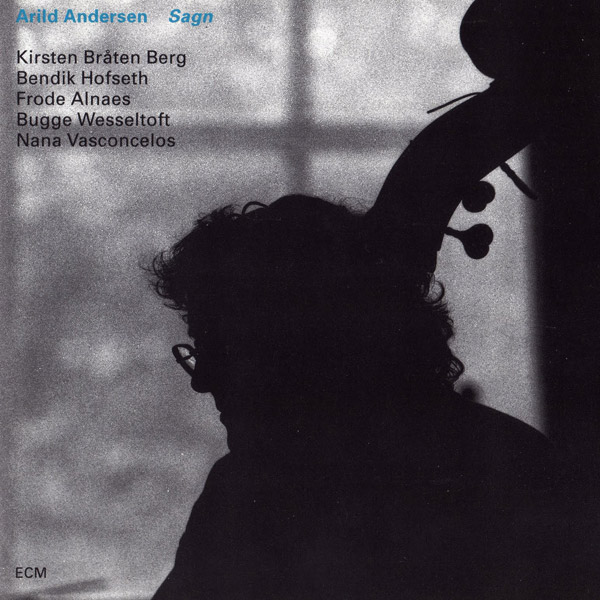
Sagn was the result of a commission for the 1990 Vossajazz festival that sealed the collaborative spirits of singer Kirsten Bråten Berg and bassist Arild Andersen. Blending folk songs from their native Norway, along with jazz and rock elements, the two shared the stage with percussionist Nana Vasconcelos, saxophonist Bendik Hofseth, pianist Bugge Wesseltoft, and guitarist Frode Alnæs. While we don’t have (so far as I’m aware) a live recording of what was surely an historic occasion, we do have this ECM studio rendition, buffed and polished to a mirror’s shine.

The album’s multilayered concept is perhaps best demonstrated in the title track, which opens with an ambient drone (something akin to the lull of train tracks) before awakening to the rhythm of Vasconcelos’s touches and Berg’s unmistakably equally earthy elements. Her voice binds this album together, even as it scatters its pages to the wind. Hofseth, bearing a proud stamp of influence from Jan Garbarek while being no mere epigon, traces lines in the sand with his tenor. These Andersen is happy to overstep in that gentle way he has.

From here we travel the length of an entire seasonal cycle, each point on the compass like a year divided. “Gardsjenta” continues this wintry mix, whitewashing us into the young dawn of “Eisemo,” in which Andersen’s lyrical swings first come into prominence amid Vasconcelos’s scrapings. The latter offers a deeper, worldly feel throughout “Toll,” for which Andersen offers a head nod to Eberhard Weber. ECM artist influences continue in “Draum,” in which Alnæs lends a Terje Rypdal brand of melancholy to the album’s first intimations of spring before opening into some powerful screaming from Hofseth (a cathartic moment). Wesseltoft cradles the past in the vocal territories of “Laurdagskveld,” while “Tjovane” (heard more recently on Trio Mediaeval’s Folk Songs) sends us forward into the band’s ecstatic synergies. “Sorgmild” is by far the album’s most breathtaking. Hofseth’s tenor sings like the wind and primes us for a tender solo from Andersen. After the diffusion of “Svarm” and “Gamlestev,” the syncopations of “Reven” bring us into a lively summer. It is also a mysterious summer, whose dreams are played out in a smattering of rounded tracks until the winds of “Belare” whip up a storm of leaves, bringing us full circle into the icy depths and ending this masterful album on a trailing brushstroke.

Sagn is a massive effort, one of ECM’s fullest on a single disc, and stands as Andersen’s most personal statement to date.

<< Bach: Das Wohltemperierte Klavier, Buch II – Jarrett (ECM 1433/34 NS)
>> Doran/Studer/Burri/Magnenat: Musik für… (ECM 1436)

Anouar Brahem: Barzakh (ECM 1432)

Anouar Brahem
Barzakh

Anouar Brahem oud
Béchir Selmi violin
Lassad Hosni percussion
Recorded September 1990 at Rainbow Studio, Oslo
Engineer: Jan Erik Kongshaug
Produced by Manfred Eicher

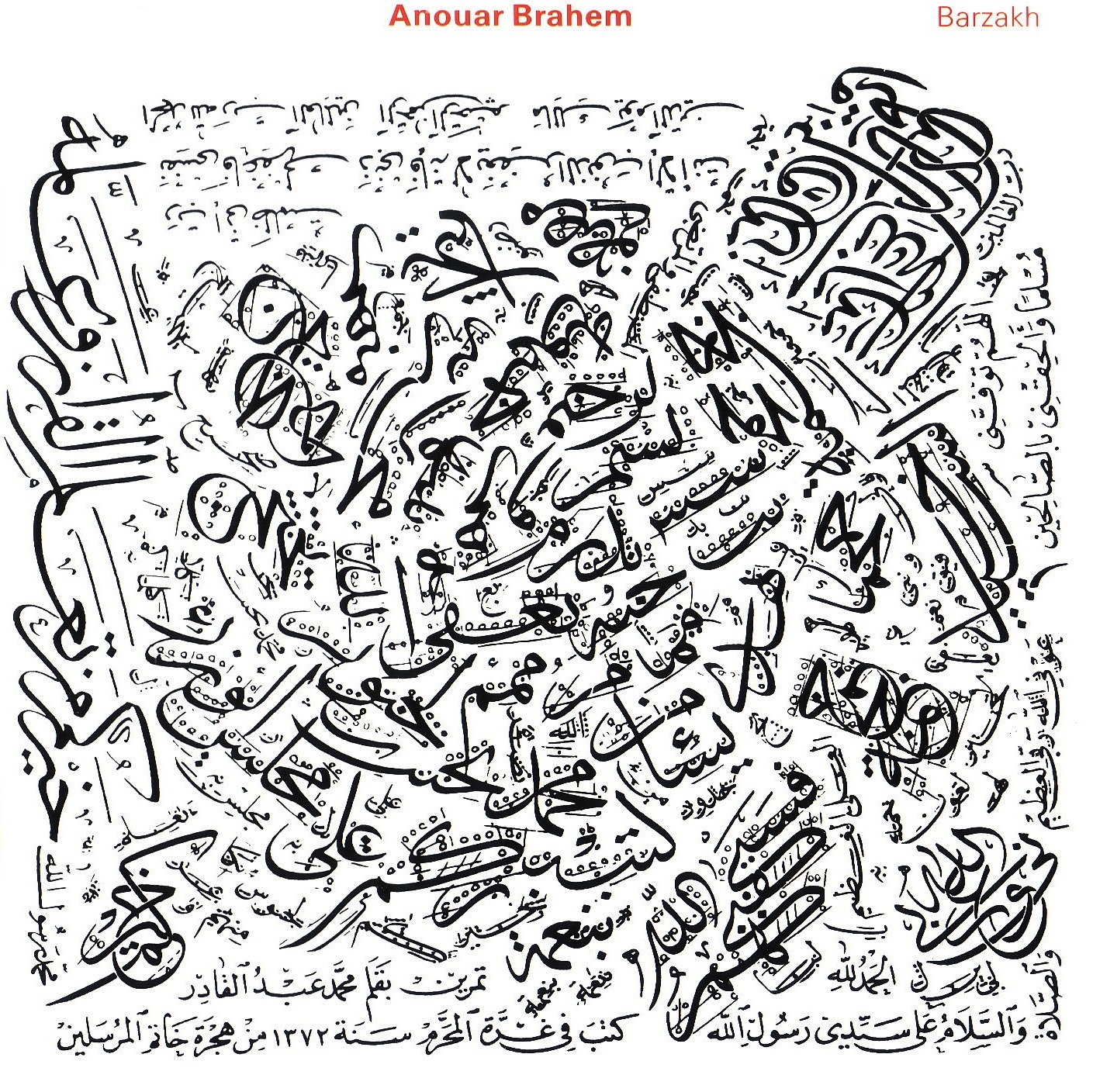
This album marks the beginning of an ongoing and fruitful relationship between Tunisian oud master/composer Anouar Brahem and the ECM label. From the exhilarating solo “Raf Raf,” we know we are in the presence of someone whose sense of touch, rhythm, melody, and atmosphere speaks straight to the heart from the mind of a visionary. This first track puts us into a time and place where only melody speaks, and the sands of time flow like blood in an infinitely chambered heart. The title track introduces the violin of Béchir Selmi, whose tender ribbons bind volumes. Brahem unfurls a ponderous firmament for which Selmi strings the clouds together in a necklace—a smile arcing across some divine collarbone. So begins a mournful, loving diatribe of sand and air. The synergy of this trio is honed to a golden edge in “Parfum De Gitane,” which exemplifies the album’s organic progression from soliloquy to chorus, and which is couched by two solo excursions from percussionist Lassad Hosni. These float us down the river of “Kerkenah,” which again spreads its warmth wide.

A tapestry of colors fills out the album, including the lullaby-like “Sadir” and “Hou,” as well as the fresh energies of “Ronda” and “Sarandib.” Brahem shines most, however, in the solo pieces, of which “La Nuit Des Yeux” is an incredibly programmatic example that works at the level of fantasy. And in “Le Belvédère Assiége” we find in the intimate confines of that hollow body a shelter for all of us, where the sustenance of “Qaf” is given on a sonic platter as ephemeral as the drink that nurtures us from its plane.

Barzakh balances itself on the fulcrum of tradition, in the process bidding us to follow the lessons of the every day.

<< Christopher Bowers-Broadbent: Trivium (ECM 1431 NS)
>> Bach: Das Wohltemperierte Klavier, Buch II – Jarrett (ECM 1433/34 NS)

Eleni Karaindrou: Music For Films (ECM 1429)


Eleni Karaindrou
Music For Films

Jan Garbarek tenor saxophone
Vangelis Christopoulos oboe
Eleni Karaindrou piano, vocal
Anthis Sokratis trumpet
Nikos Guinos clarinet
Tassos Diakoyiorgis santouri
Eleni Karaindrou director String Ensemble
Recorded August 1990, Polysound, Athens
Engineer: Yannis Symrneos
Produced by Manfred Eicher

Once we are aware that certain music has been written for film, it’s easy to wax poetic about said music’s visual associations. Yet I believe that one needn’t be aware of Greek composer Elenei Karaindrou’s filmic motivations in order to feel it in the same way, for hers imagines, recites, and sings the lament of a zeitgeist in decay.

Saxophonist Jan Garbarek is very much at home in the quiet throes of “Farewell Theme” and lends his focused energy to a nexus of strings and santouri that, in a short span, scales the heart’s deepest cliffs. This piece both begins and ends a disc comprised of Karaindrou’s best from the 1980s, and is also the longest. “Elegy For Rosa” and “The Journey” are among the briefer portals into the album’s blinding refractions, such as “The Scream” and “Return,” the latter something of an anthem in its present context. The chromatically inflected evocations of “Wandering In Alexandria” quiver with curiosities, as if lost in a land one has forgotten. The oboe of “Adagio” spins a rope of travel across the sky, sending down threads of hope into “Fairytale” and “Parade.” These recurring themes bow in deference to the cradle of “Rosa’s Song,” in which Karaindrou’s own voice rings like a slow-motion slingshot into the improvisation that follows. This collection pours its remaining jewels from a silken pouch, bringing us back through Alexandria and into the folds where we began.

Karaindrou’s themes are potent yet familiar, even (if not especially) to those who’ve never heard them before. Brimming with tragedy and triumph alike, this is music not only for the fictional, but also for real strangers crossing paths in a world of mist and shadows.

<< Egberto Gismonti Group: Infância (ECM 1428)
>> Arvo Pärt: Miserere (ECM 1430 NS)

Egberto Gismonti Group: Infância (ECM 1428)

Egberto Gismonti Group
Infância

Egberto Gismonti piano, guitars
Nando Carneiro synthesizers, guitar
Zeca Assumpção bass
Jacques Morelenbaum cello
Recorded November 1990 at Rainbow Studio, Oslo
Engineer: Jan Erik Kongshaug
Produced by Manfred Eicher

Egberto Gismonti cuts a fascinating figure, even among ECM’s already populous roster. The Brazilian multi-instrumentalist never fails to delight with his nostalgic mix of folk and personal melodic elements. In this sense, the opening “Ensaio de escola de samba (Dança dos Escravos)” is emblematic. Combining the Ralph Towner-like flurry of his guitar with bass and cello (the latter courtesy of Jacques Morelenbaum, of Morelenbaumfame) riding musical waves into an oncoming storm, we visualize a deep and colorful ocean. Gismonti’s pianism is even more inspiring. His sound—every bit as lush as Keith Jarrett’s—levels the playing field in the carnivalesque of “7 Anéis” and in the lushness of “A fala da paixão,” throughout which he pulls the past through the sky like a thread through a needle. He is joined by a cello’s comet and distant supernovas of bass for an ascent toward blissful stillness.

“Meninas” finds Gismonti in ghosted form, providing both the pianistic scenography and the raindrop guitar that populates its stage. Bass and cello continue stringing their pearls, moving in gusts and pauses like the wind. The title track floats a cello over a Steve Reichean ostinato. One finds also a Chick Corea exuberance at play here, both in the sparkling musicianship and in the writing. Some turns from synth add a darker side to this bright memory. “Recife & O amor que move o sol e outras estrelas” then offers a chance to hear Gismonti’s skills at the keyboard in fuller bloom. This track is yet another sparkling jewel, theatrical and full of contrast. We close with two dances for guitar and cello, invigorating and prickling the sunset like a silhouetted cactus, and joins its playful dissonances to the calls of children at play.

This album shows the maturity of Gismonti’s writing, his evolution as melody-maker and musician. This huge slice of life treads its past as might a youth through a jar of marbles, picking out only those clearest and most aesthetically pleasing to click among the rest.

<< Stephan Micus: Darkness And Light (ECM 1427)
>> Eleni Karaindrou: Music For Films (ECM 1429)

Stephan Micus: Darkness And Light (ECM 1427)

Stephan Micus
Darkness And Light

Stephan Micus dilruba, guitar, kortholt, suling, ki un ki, ballast-strings, tin whistle, balinese gong, sho
Recorded January/February 1990 at MCM Studios and Studio Giesing, München
Engineer: Tom Batoy

Listening to a Stephan Micus album is always like taking a journey through darkness and light, and so it is no wonder that his fourth album for ECM should bear that very title. The sarangi-like tones of the dilrubi of Part 1 open up a pathway that is indeed by turns bright and shaded. The path is circular, leading forever back to where it began, as if to say, “Birth and death issue from the same step.” From this mouth agape we get the insular sutras of guitar. Its chain of arpeggios carries in its arms a bouquet of memories and rests it in the crook of a tree, where it plays for the sake of Nature. From that whispered cove arises a mermaid holding a bow at the edge of a string. With every splitting of voice we are veiled in deeper solitude. Mournful songs shape a still heart, hanging on to certain threads longer than others. The guitar helps us to nourish ourselves with what remains in its chamber, stenciling the periphery with every pluck and unearthing in the afterlife all that is yet to come. Even in the absence of a bow, we feel our voices continuing to spin novel draws in the ether.

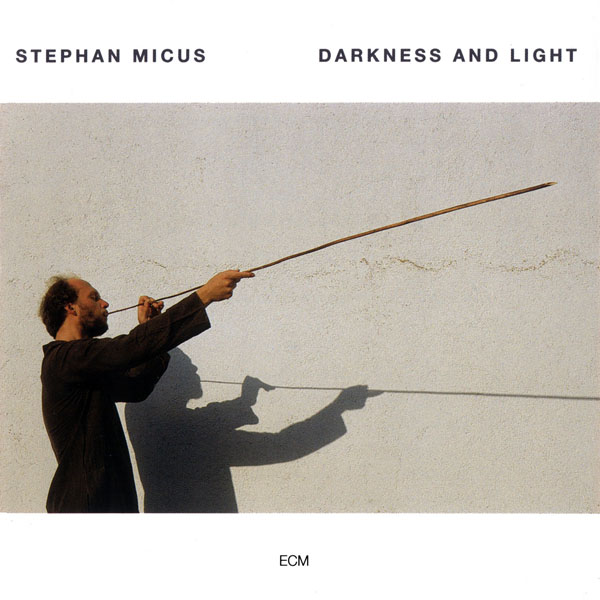
Part 2 takes a rawer approach to the dilrubi, giving rise to the call of the ki un ki, the Siberian cane trumpet pictured on the album’s cover. Played by inhaling, it sounds like a combination between a Theremin, a split and blown grass blade, and an elephant calling out to the cosmos. Part 3 scrapes the edge of darkness on its climb toward a trembling song. A flute cries as if in dialogue, two lovers parted on either side of the Milky Way unifying at last in a hopeful vein, tracing light back to the nebula that birthed them both.

Darkness And Light is as fleeting as its message, transparent as water and betraying its presence only through reflections. Still, its elemental forces sweep us away in the depth of Micus’s human touch, such that when they stop, one feels they might linger forever.

<< Paul Giger: Alpstein (ECM 1426)
>> Egberto Gismonti Group: Infância (ECM 1428)

Keith Jarrett Trio: Tribute (ECM 1420/21)


Keith Jarrett Trio
Tribute

Keith Jarrett piano
Gary Peacock bass
Jack DeJohnette drums
Recorded October 15, 1989, Philharmonie, Köln
Engineers: Jan Erik Kongshaug and O. Fries
Produced by Manfred Eicher

No one makes live records quite like the Keith Jarrett Trio, whose inimitable skills and synergy ensure us that every tune breathes with all the life it deserves. As one of the few groups that can draw in a crowd thousands of miles and years away into that indefinable moment of expression, it transcends the confines of the concert hall, of the jazz club, of the audience’s adoration. All of these recede the moment you put this music on and let it fill your own space and time with the love and passion what bore it. We hear this especially in the balladry, of which Jarrett proves an adept exponent in “Lover Man.” Dedicated (as all pieces on Tribute are to those who once performed them, hereafter in parentheses) to Lee Konitz, the piece expands such notions of genre to begin with, unraveling from characteristically somber piano intros a world of sentiment. Peacock is especially notable in his first solo of the night, tracing an outline that DeJohnette is more than happy to color in. Jarrett maintains enviable subtlety in his improvisations, working in a clever nod to “The Girl from Ipanema.” He dances on air, even as he plunges his hands into a watery keyboard and mixes the sediments until they shine. DeJohnette, meanwhile, works wonders with his snare, unfolding a ponderous yet somehow buoyant solo: a drop of melancholy in an otherwise joyful sea. All this in the opening number? Yes, it’s that good.

Such things are de rigueur in Jarrett Land. One could expound at great length, for example, on “I Hear A Rhapsody” (Jim Hall). From the fluid intro and swinging groove it dovetails to DeJohnette’s popcorn bursts, there’s so much to acknowledge for fear of doing the music injustice. DeJohnette and Peacock generally keep the flame low and steady as Jarrett turns all manner of somersaults, each a storm cloud waiting to burst, yet which instead couches rainbows. Down one of these Jarrett slides into a pot of golden applause. “Little Girl Blue” (Nancy Wilson) turns with the grace of a plumed bird bowing into the wind. Peacock again walks that fine line between heartbeat and fluster. The more up-tempo “Solar” (Bill Evans) finds Jarrett working his usual eddies into relief. One really notices the acoustics of the concert space, linking Jarrett’s submissions to the rhythm section’s stellar flip-flopping and moving us seamlessly into the exhilarating, sparkling piece of music-making that is “Sun Prayer.” A quintessential Jarrett tune if ever there was one, one feels in its shape a musical life lived to its fullest. DeJohnette flashes his powers as Jarrett weaves some of his densest pianism yet before baying into a translucent cove, where floats the detritus of a promise so enormous that it cannot help but embrace the world. “Just In Time” (Charlie Parker) delights with its odd timing, which sends Jarrett on a simply unstoppable journey as Peacock rides the DeJohnette train to Smoothville. The trio digs even deeper in quiet stunners like “Smoke Gets In Your Eyes” (Coleman Hawkins), “All Of You” (Miles Davis), “It’s Easy To Remember” (John Coltrane), and “Ballad Of The Sad Young Men” (Anita O’Day), the latter graced by DeJohnette’s steam-engine brushes. A highlight in the album’s second half.

From the buoyant piano intro, “All The Things You Are” (Sonny Rollins) puts one in mind first of Gary Burton at the vibes before unleashing a rhythm section aflame, making for one of the trio’s most exhilarating tracks anywhere. More pure Jarrett follows in “U Dance.” This joyous romp seems porous, but would withstand even the sharpest bullets of criticism. A spirited turn from DeJohnette bridges us into the tune’s closing half, where we find ourselves still dancing even as the music recedes into the distance from which it spoke.

I typically don’t read other reviews before writing mine, but in my gathering of information for this one I took a look at the comments on Amazon, only to be shocked at one customer who proceeds to tell us how, listening to “Ballad Of The Sad Young Men” while driving, he (?) became so fed up with DeJohnette’s drumming that he rolled down his window and threw the CD onto the highway. Everyone is, of course, entitled to personal opinion, and my reviews are never meant to be prescriptive, but I find it baffling that anyone could react against DeJohnette so strongly on the basis of such an exhilarating album. Chalk it up to my drumming ignorance, but I daresay that DeJohnette’s is some of the best around. Among other things, on this recording he seems to have upped his snare work to something special in the grammar of his kit. I underscore this point only to prevent potential listeners from missing out on a tremendous experience.

Gorgeous to the last drop.

<< Jan Garbarek: I Took Up The Runes (ECM 1419)
>> Gesualdo: Tenebrae (ECM 1422/23 NS)