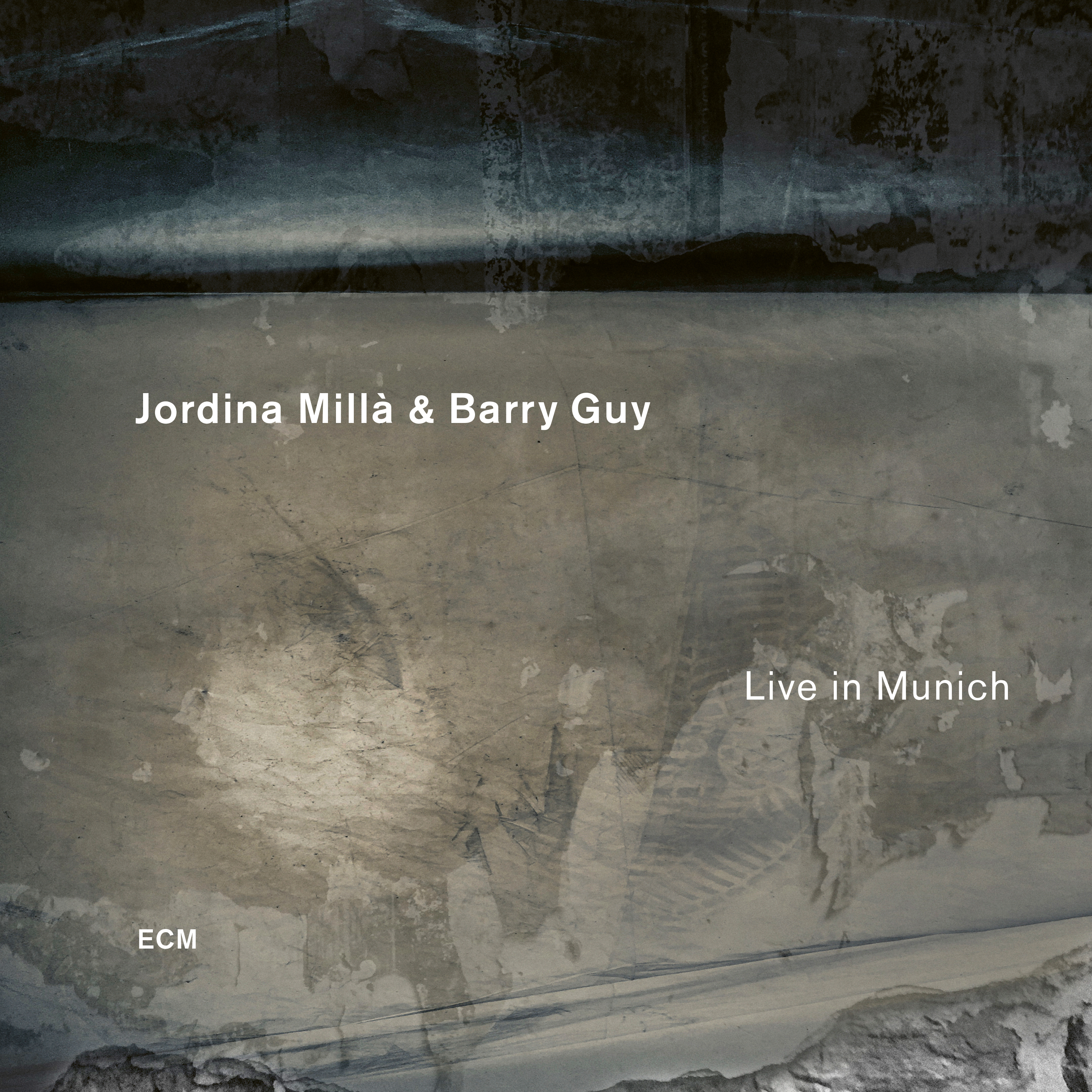
Jordina Millà piano Barry Guy double bass Recorded live February 2022, Schwere Reiter, Munich Engineer: Zoro Babel Mixing: Ferran Conangla at FCM Studio, Barcelona Mastering: Christoph Stickel Cover photo: Thomas Wunsch An ECM Production Release date: July 5, 2024
Catalan pianist Jordina Millà and British bassist Barry Guy merge creative lanes for this live 2022 performance at the Schwere Reiter hall in Munich. The two first met as participants in Barcelona’s Mixtur Festival in 2017, where Guy was tasked as composer-in-residence to put together an ensemble piece, in which Millà’s participation stood out. Although a new partnership was born, one would never think of it as such from the telepathy they so intuitively inhabit.
This successor to String Fables, their first duo album (released on the Polish label Fundacja Słuchaj in 2021), offers an even deeper sense of lucidity and nursing of detail, enhanced but never overshadowed by the engineering of their sonic kaleidoscope. Their relationship is broken into—if not unified by—six freely improvised parts. Even without familiar melodies and rhythms, the sounds are holistically accessible for their spiritedness and emotional honesty.
One thing that becomes immediate is how each musician unearths elements hidden in the other. Whereas Millà fish-hooks the percussiveness of the double bass into the foreground, Guy inspires a pizzicato sensibility in the piano. The latter’s harp-like articulations in Part I are no mere decorations but a necessarily physical language. Even in the gentlest moments, there is a feeling of total revelation. Extended techniques lend comfort to an otherwise fitful dream. The effect is such that when Millà’s fingers land on keys, they cry out with the urgency of newborns.
Part II refashions much of that restlessness into conviction. Jazzy phrases bleed through postmodern lyricism and touches of prayer, their shadow growing to glorify the sun. Part III is even more melodic and communicates like a Janáček piece for children turned inside out to reveal its darkest fables. The prepared piano of Part IV is magical realism at its finest. With Guy’s skin tracings, it forms a complete organism that steps from thought into form with all the stop-motion haunting of a Brothers Quay film. Part V is the most tense yet also the most powerful in its release, working into a droning brilliance that calms the mind. Part VI is the final exposition, bowing and plucking its way into a humble sort of mastery.
What marks this recording is its sheer presence. Nothing feels hidden or obscured; rather, it is stripped of its protections for naked scrutiny. It speaks in the stirrings of souls, if not in the breathing room between them, until life becomes a mantra unto itself.
Keith Jarrett piano Gary Peacock double bass Paul Motian drums Recorded September 16, 1992 at the Deer Head Inn Engineer: Kent Heckman Design: Sascha Kleis Produced by Bill Goodwin An ECM Production Release date: November 8, 2024
On September 16, 1992, pianist Keith Jarrett, bassist Gary Peacock, and drummer Paul Motian graced the humble setting of the Deer Head Inn, yielding an eponymous recording that stands as a beacon in the ECM catalog writ large. Nestled in the Pocono Mountains, the venue is one of the oldest for jazz in the US, having served as a stage for live music for over seven decades. As the story goes, Jarrett gave his first performance as trio leader there in 1961 at the age of 16 and returned for this performance to commemorate the ownership’s love for genuine music making. But this was another first, as it was the only time this group was ever billed as such (although Motian had, of course, played in the pianist’s “American Quartet”). Looking back on this landmark achievement, Jarrett and producer Manfred Eicher decided to release the rest of the recording, thus giving us The Old Country.
The title track by Nat Adderley is as good a place as any to begin our walkthrough, though one could start from anywhere and feel immersed in the inimitable vibe of that special evening a third of a century ago. The band never misses a lick, Jarrett treating every improvisatory message as the seed of a new tree. The “Autumn Leaves”-esque chord progressions only underscore that metaphor. “Someday My Prince Will Come” is another head nodder. As the doyenne of sorts in his American Songbook repertoire, one from which he recedes in the present treatment sooner rather than later to give Peacock the floor, it takes on a spirit of revival.
Engaging as such turns are, it’s in the slower numbers, like the Gershwin gem “How Long Has This Been Going On” and the Jule Styne standard “I Fall In Love Too Easily,” where we get glimpses of a particular beauty that might never grace a stage again. (They are also where Motian’s colorations are most vivid.) The latter tune is a heated blanket for the soul and feels custom-built for the musicians. Just as profound as Jarrett’s unfolding of every origami motif are the pauses between them. In each, where he may or may not cry ecstatically, it’s as if he were inhaling the Milky Way before exhaling starlight for all whose paths have gone dark. Peacock’s solo is a silhouette staring through a curtain for a lover who will never appear.
Further delicacies await in Thelonious Monk’s “Straight No Chaser,” the joy of which is so effortless that it might as well be a language with its own dictionary. Jarrett’s vocalizing cuts to the quick of the melody, giving us insight into his precognitive abilities at the keyboard. The dissonant touches are superb, and the rhythm section swings a full 360 degrees from start to spirited finish. Speaking of spirited, the piano intro to Cole Porter’s “All Of You” blossoms with metaphysical detail. The resulting groove is tempered by restraint—likewise in Victor Young’s “Golden Earrings,” which is as delicate as a bubble but strong as iron. Motian carries the bulk of this atmosphere with his brushes, while Jarrett manages to be ever one step ahead yet locked into place.
None of this would feel quite so complete with the album’s opening, “Everything I Love.” This little piece of magic from Cole Porter gives us that familiar blush of establishment such as only Jarrett can render, a chord progression that reminds us of where we belong. The sentiment is as much alive today as it was then. Your heart has already heard it. Now, it’s time for your ears to catch up.
Marius Neset tenor saxophone Helge Lien piano Arild Andersen double bass Håkon Mjåset Johansen drums Recorded November 2021 at Rainbow Studio, Oslo Engineer: Martin Abrahamsen Cover photo: Thomas Wunsch Executive producer: Manfred Eicher Release date: October 28, 2022
At the height of the pandemic, bassist and longtime ECM veteran Arild Andersen convened a new quartet at Rainbow Studio in Oslo. Although he arrived to lay down a predetermined set list alongside tenor saxophonist Marius Neset, pianist Helge Lien, and drummer Håkon Mjåset Johansen, during the second day of recording, he suggested the idea of a group improvisation. The result is Affirmation, presented in its real-time unfolding. Despite being new territory, the feeling is downright familiar from note one, the title indicative of a mutual trust and the need for life during a time of death.
Part I stakes its claim in delicate genesis. Light cymbals resolve into glittering pianism and tender reedwork, Andersen’s quiet strength bounding through it all. In a space enhanced by reverb, otherwise fleeting gestures become entire biographical statements, each the trail of an elder gone to rest. Johansen calls ancestrally, while Neset evokes the ancient ways of Jan Garbarek. Such influences speak of a metaphysical kinship—splashes of color spinning into freer territory before hints of groove can make good on their promises. At the center of their circle is a melodic heart that beats for all.
Part II rows darker waters at first, casts Andersen in more of a listening mode, cradled in a weed-woven basket. A lively middle section finds Lien working up a frenzy, but only briefly, as tenor and bass dialogue for a spell. Everything culminates in a smooth balladic energy, lit just enough to see our way through the night. What we’re left with, then, is a benediction, a prayer, a call to quiet action for the lost and found.
At times, Andersen eerily recalls David Darling’s cello playing and Eberhard Weber’s fluid arpeggiations, but for the most part, he sounds like only he can. And so, it makes sense to finish the album with his “Short Story,” an affirmation all its own. After two hefty doses of freedom, it resonates as a hymn to the future, riding its wave of appreciation straight into the sun.
Jacob Young guitar Mats Eilertsen double bass Audun Kleive drums Recorded May 2021 at Klokkereint Studio, Gjøvik Engineer: Sven Andréen Mixed by Audun Kleive and Sven Andréen Design: Sascha Kleis An ECM Production Release date: May 12, 2023
Eventually is the fourth leader date from Norwegian guitarist Jacob Young, but his first trio outing. Alongside bassist Mats Eilertsen and drummer Audun Kleive, he traverses a set of nine original tunes that are as varied in dynamic and scope as they are cohesive in temperament.
The title track opens with arpeggios and impressions, broadening into a shoreline of shifting sands. Even with this precedent in place, one honed by the individual band members’ century of musical cross-examinations between them, there is room for incisive melodizing and fresh runs across familiar terrain. A case in point is “I Told You In October,” which goes down warmly while awaiting whatever surprises the next sunrise has in store. Eilertsen flirts with blues in his solo while keeping things forthright and pure.
Continuing in that spirit, “Moon Over Meno” manages to simultaneously feel like family but also a new acquaintance. Young takes brief yet surprising turns, thinking out loud in an unpretentious display of honesty and vulnerability. Despite his trepidations with the trio format going into this project, he proves himself well-attuned to its challenges, ever buoyed by musicians anticipating his every move. With the gentlest of frictions, he brings forth small flames of beauty in his chord voicings. In that light are rendered shadow plays of quiet intensity (“One For Louis”), urban sprawl (“Schönstedtstraße,” a head-nodding standout for its spacy overdubs), and somber travels (“Northbound”).
“The Dog Ate My Homework” is a treat not only for its tongue-in-cheek title but also for the interlock of its development. Kleive keeps just enough fuel in the tank to get us where we need to go, while Eilertsen facilitates the combustion to let Young fly. After lovingly schooling us on “The Meaning Of Joy,” we end up “Inside,” where circling motifs knit scarves against the cold from the air so we might survive the winter without fear.
As the band hangs one masterful painting after another in this intimate gallery, the core strength of the proceedings lies in Young’s composing and the depth of expression giving them life. Like a lighthouse revolving in the night, his sound embodies a place to return to and a function to serve, bringing safety to those caught in the fog of dangerous waters.
Without knowing how or when I got here, I find myself walking through the trees at sunrise. Having no compass but the tingling sensations in my feet and a gentle tugging of the heart, I follow a call of the spirit to places unknown yet somehow familiar. Were I to cull enough energy from these surroundings to bottle the light peeking through the canopy, it might look (and smell) like Hacivat, a Chypre fragrance from the Turkish house of Nishane.
At first spritz, it slices thickly into top notes of bergamot, pineapple, and grapefruit. Although this embrace of citrus sweetness is juicy and sensual, it is far from hedonistic. Rather, it practices restraint to appreciate its surroundings without getting distracted by them—not blind romanticism but a blush of self-awareness and faith in boundaries. In this kiss, there is no hidden agenda. It is naked without being profane, vulnerable without being weak.
With a fuller spray and time to develop this newfound relationship, heart notes of jasmine, patchouli, and cedarwood emerge as woodland creatures from their dens. Here, the warmth comes through, poised as if on the brink of a newfound love. The colors shift in the manner of a shadow play, each figure expressing more than the sum of its parts in a parable of mischief. In the absence of water, it drinks in the promise of another day.
As the journey continues, base notes of clearwood, oakmoss, and dry timberwood remind me that no matter how far I may travel, home is never far away as long as I have my body. Even in the face of deterioration, it whispers of the future.
Nearly 12 hours later, despite finding those comforts where I’ve staked my life, traces linger in whiffs of timber, ancient and covert.
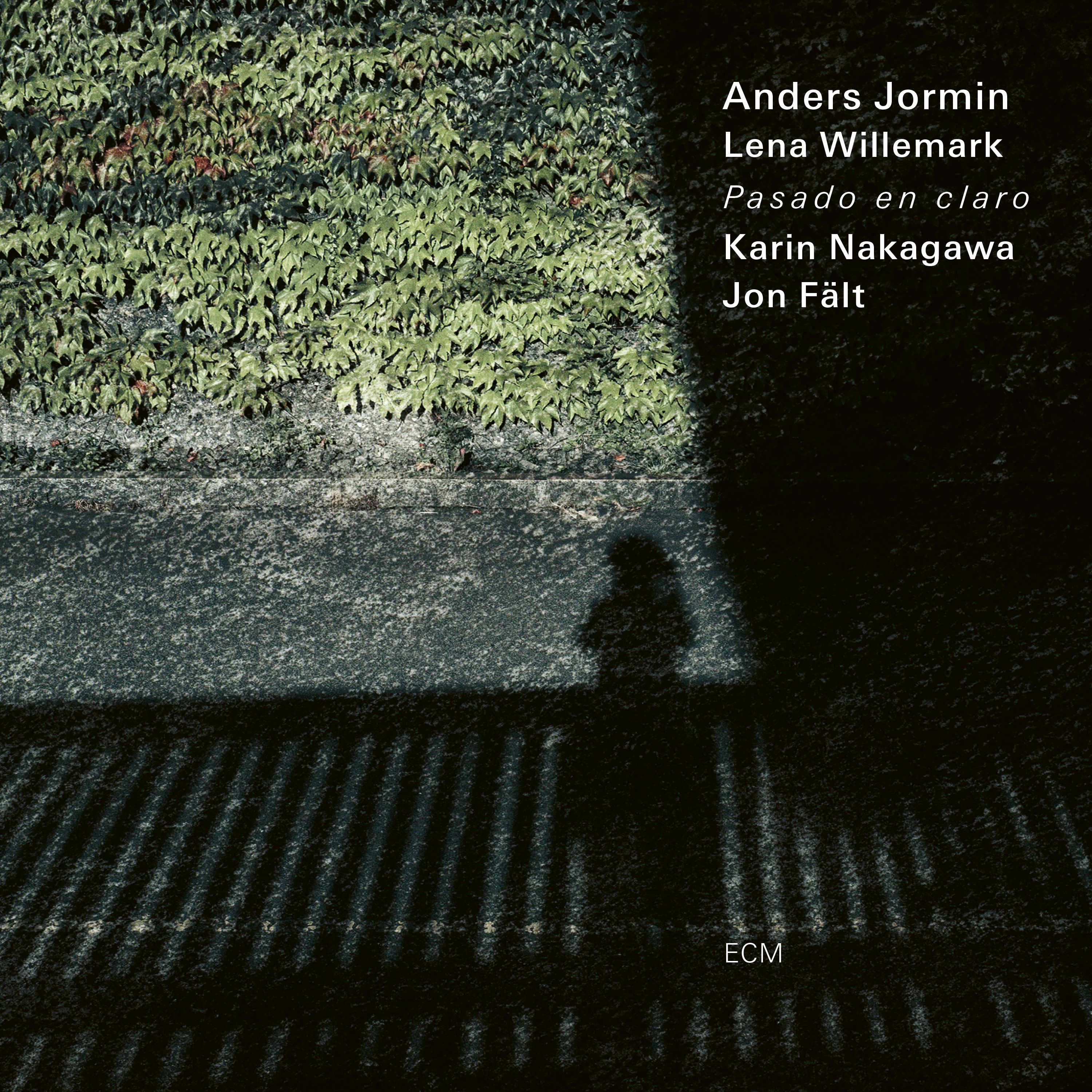
Anders Jormin double bass Lena Willemark vocals, violin, viola Karin Nakagawa 25-string koto Jon Fält drums, percussion Recorded December 2021 at Studio Epidemin, Gothenburg Engineer and coproducer: Johannes Lundberg Cover photo: Fotini Potamia Executive producer: Manfred Eicher Release date: January 20, 2023
Since breaking ground on 2004’s In Winds, In Light, bassist Anders Jormin and singer/violinist/violist Lena Willemark have charted old and new territories in an increasingly fertile partnership. Their collaboration reached the next stage of development when they welcomed Japanese koto player Karin Nakagawa into their midst on 2015’s Trees Of Light. To that milieu, they’ve added drummer Jon Fält, whose name will be familiar to Bobo Stenson Trio fans. Although Willemark’s roots in Swedish folk heritage and its preservation are at the core of what’s being articulated here, the improvisational packaging has been deepened. The settings touch down on the landing strips of many times and places, including poetry from ancient China and Japan, contemporary Scandinavia, Mexican luminary Octavio Paz (whose “Pasado en claro” gives us this album’s title), and Renaissance humanist Petrarch.
The latter’s Poem no. 164 from Canzoniere, the eponymous subject of “Petrarca,” flickers like a candle flame. It is one of many musical settings by Jormin, whose loose strata give his bandmates plenty of room to look for fossils and regard their shapes melodically. Long before that, “Mist of the River,” his take on Ouyang Xiu (1007-1072), opens with the gentlest shimmer of koto. The poem paints a picture of a fisherman whose cast is obscured by mist and storm, resolving into groovy textures. With the clarity of a statue, Willemark etches the scene one frame at a time until they mesh into a flowing whole. Brushed drums add jazzy touches: water and silver combined. “Glowworm” looks even further back to the 8th century. The tanka by Yamabe no Akahito, rendered here in an evocative Swedish translation, finds Willemark and Jormin’s instruments in a cloudy slumber while percussion and koto yield just enough light to see the contours of their dreams.
Most of Jormin’s tapestries are woven from more recent material. And yet, despite the brief appearance of artifice—as in Jörgen Lind’s “Blue Lamp,” which contrasts hospital buildings against a starkly natural scene—all the modern verses are steeped in an unbroken respect for the organic. This is especially true in “Kingdom of Coldness,” where the haikus of Tomas Tranströmer seep through liquid gongs and arco bass as Willemark’s voice draws maternal lines across Nakagawa’s constellations, and “Returning Wave,” where Anna Greta Wide’s words accumulate against the barrier of closed eyelids.
The remaining tracks consist of original songs by Willemark, who has her bow and throat on the pulse of something so genuinely folkloric that they seem as weathered by time as the rest. “The black sand bears your footprints / trampled by many, but seen by none,” she sings in “Ramona Elena,” forging a scene of heartache, loss, and sisterly love that demands motionless listening. “The Woman of the Long Ice” brings more of that briny sound through her fiddle as she laughs with joy at the power of music to run beneath even the most frozen waters. (This track is also a highlight for its freer playing.) Between the instrumental “Wedding Polska” and the leaping strains of “Angels,” the quartet never loses sight of its roots, which run deep and wide, sustaining forests older than us all.
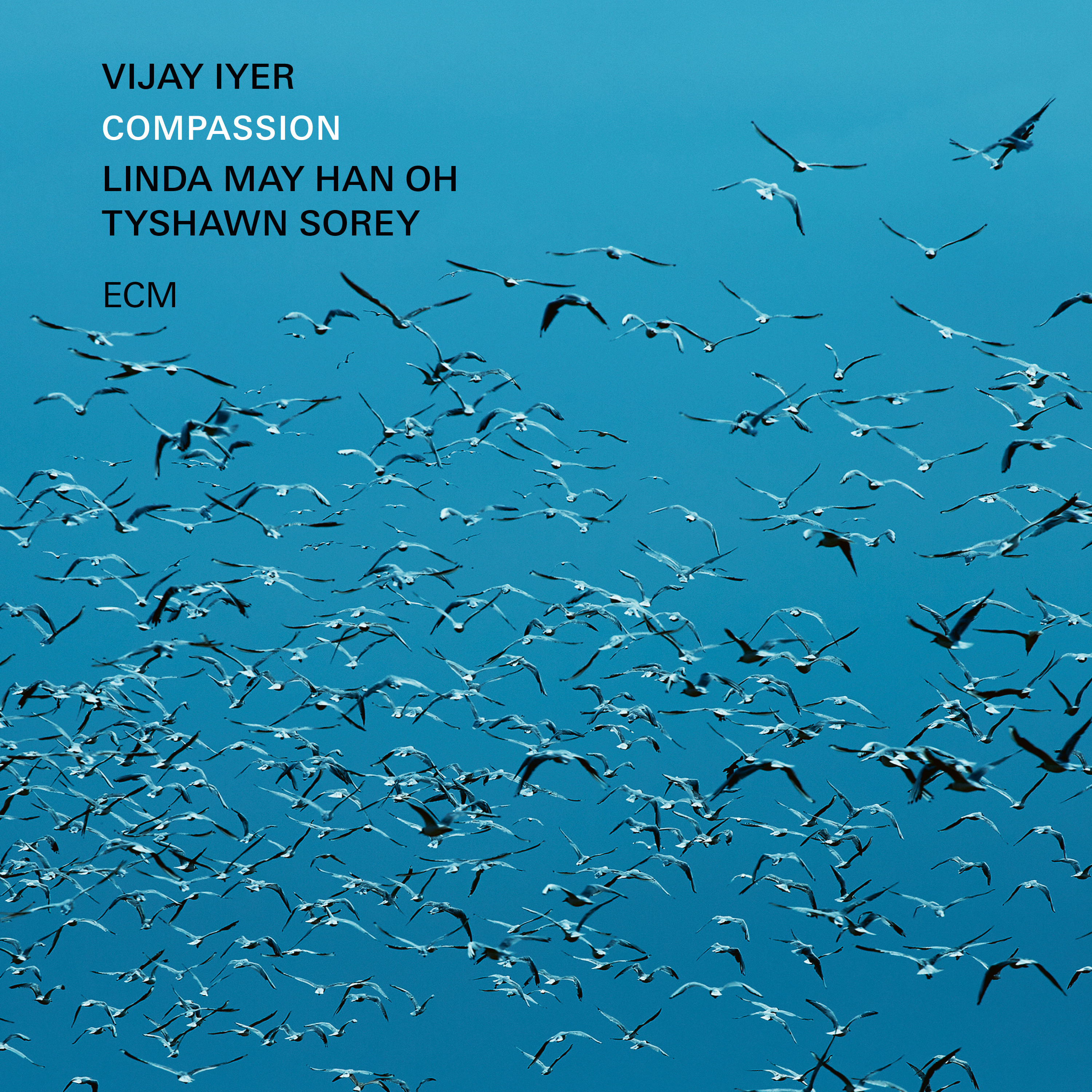
Vijay Iyer piano Linda May Han Oh double bass Tyshawn Sorey drums Recorded May 2022 at Oktaven Audio, Mount Vernon, NY Engineer: Ryan Streber Mixed July/August 2022 Cover photo: Jan Kricke Produced by Vijay Iyer and Manfred Eicher Release date: February 2, 2024
In this follow-up to 2021’s Uneasy, the debut of pianist-composer Vijay Iyer’s trio with bassist Linda May Han Oh and drummer Tyshawn Sorey, the humanity quotient has been exponentially magnified. The resulting session is a kaleidoscope of inspirations that constantly redefines itself without ever losing touch with the center. As Iyer puts it in his liner notes, “music is always about, animated by, and giving expression to the world around us: people, relations, circumstances, revelations.” We might add to this list its importance as a sacred gift of communication. In that respect, the title track looks through the world as if through eyes screened by eyelashes knitted together until now by coma. Light that once seemed quotidian and unremarkable feels so bright that it illuminates the soul. As the first in a chain of mostly originals, it speaks of the pianist’s willingness to seek revelation in his physical and spiritual travels. “Arch,” for example, references the Archbishop Desmond Tutu, a champion for abolishing apartheid in South Africa who also saw music as something we were made to enjoy. Oh’s bassing is a joy in and of itself, articulating shapes of reason in a world seemingly devoid of it. Rather than use the master’s tools, she draws her own from within. That same duality of spirit carries over into “Overjoyed” (Stevie Wonder), the choice of which was inspired by a piano loaned to Iyer that once belonged to the late Chick Corea, who had played the song as part of his final livestream before his death in 2021. The result is a meta-statement of the album’s M.O., in which the trio communes by intertwining personal histories into a collective truth. Iyer’s balance of staccato motifs in the left hand and abstract runs in the right, ever anchored by a sense of rhythm, embodies this worldview to the fullest. Oh’s solo suspends cuts an emotional snapshot into pieces and reassembles in the image of love. “Maelstrom,” “Tempest,” and “Panegyric” all come from Tempest, which is dedicated to victims of the pandemic. These pieces shower themselves in unity, catching the runoff so as not to waste even a single droplet. Nestled between them is “Prelude: Orison,” a nod to Iyer’s father that treats the expanse between stars not as an excuse to draw lines in mimicry of all that we see (or wish to see) but as an invitation to meditate. “Where I Am,” “Ghostrumental,” and “It Goes” hark to Ghosts Everywhere I Go, a 2022 ensemble project inspired by the writings of Chicago poet Eve L. Ewing. Smooth and rough textures abound in this triptych, from gliding figure-eights and groove-laden romps to the latter tune’s dawn-lit wonders. How fitting that this should have accompanied verses that saw Emmett Till as “an elder still among us, enjoying the ordinary life that should have been his.” Such is a life we should all be able to live in a world punched in the stomach daily by things even more indiscriminate than a virus. If anything, Roscoe Mitchell’s “Nonaah” (Roscoe Mitchell) is a maelstrom in which chaos breeds order. It is creation incarnate, a navigator in the swirling molecular business of survival. The double-header of “Free Spirits / Drummer’s Song” (John Stubblefield/Geri Allen) delineates a safe groove space. In it, we recognize that behind every smile is the tension of all who died to make it possible. And so, when Iyer claims, “I am no more qualified than anyone else to tell you anything new about compassion,” this is no statement of false humility but rather an honest realization that music tells us what is old about compassion, for without it, there would be no creation in which to set flame to its wick. Like the block paragraph of these words, it stands firm in the face of our temptation to parse it, resolved to be itself.
Ralph Towner classical guitar Recorded February 2022, Auditorio Stelio Molo RSI, Lugano Engineer: Stefano Amerio Cover photo: Caterina Di Perri Produced by Manfred Eicher Release date: March 31, 2023
Guitarist Ralph Towner may just be the longest-standing recording artist on ECM records. With a discography spanning over half a century, he has left indelible marks on the catalog with a sound that is as instantly recognizable as it is in a constant state of change. No matter his age (this album was recorded just shy of his 82nd birthday), he always seems to be searching for something, happy to stop and share a conversation with listeners at every bend of the road.
Making good on that characterization, “Flow” and “Strait” recapture some of his finest recordings, including 1980’s Solo Concert, with their stop-and-start cadences, underlying continuity, and Stravinsky-esque harmonies. Other nods to the past—both his own and of bygone eras—include the bright and upbeat “Guitarra Picante” (harking to his Oregon days) and show tunes by Hoagy Carmichael (“Little Old Lady”) and Jule Styne (“Make Someone Happy”). The latter was a favorite of one of Towner’s early influences, pianist Bill Evans, and finds itself geometrically rearranged in the guitarist’s signature style. With masterfully articulated exuberance, it pirouettes, sashays, and leaps without losing sight of home.
Whether passing us by in the evocative vignette of “Argentinian Nights” or languishing in the title track, Towner reacts instantly even when taking it slow. “Ubi Sunt” (a Latin “where-are” construction often used in poetry to express regret over something that has faded with time) is an especially brilliant piece in this regard. Like a basket woven in real time, it takes shape before our very ears, making full use of the classical guitar’s dynamic breadth and exploring much of its range. His interpretation of the traditional “Danny Boy” is another wonder. Just when you think this song has been unraveled and restitched more than it is worth, it reveals even deeper shades of meaning. “Fat Foot” is a kindred highlight for its airy chords and domestic charm.
The last piece is “Empty Stage,” which feels like it might have been the first recorded for this session. Yet, it is appropriately placed as a distillation of everything that precedes.
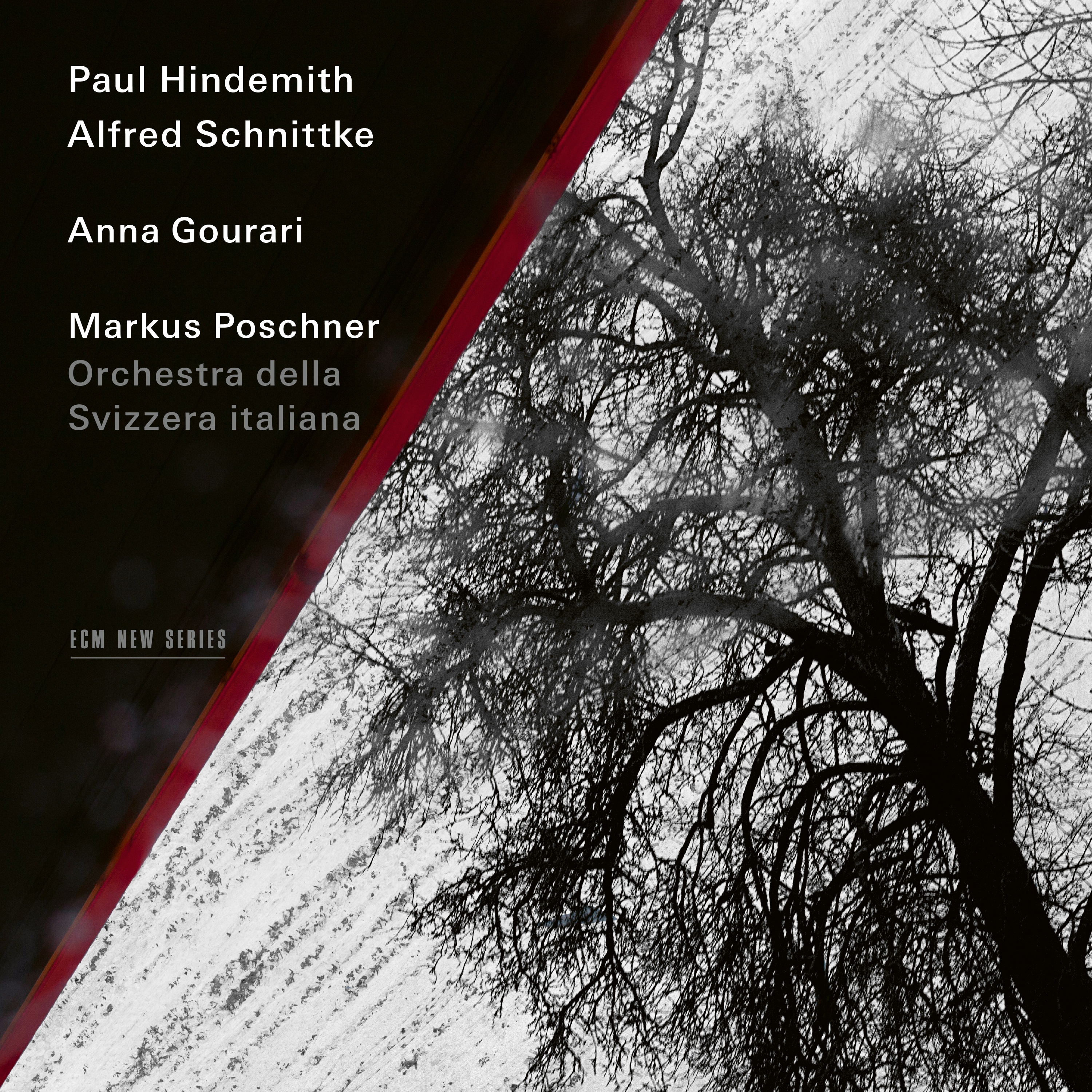
Anna Gourari piano Orchestra della Svizzera italiana Markus Poschner conductor Recorded December 2021, Auditorio Stelio Molo RSI, Lugano Engineer: Wolfgang Müller (RSI) Mixed January 2023 by Wolfgang Müller and Manfred Eicher Cover photo: Fotini Potamia Produced by Manfred Eicher Release date: June 14, 2024
Since making her ECM debut with Canto Oscuroin 2012, Tatarstan-born pianist Anna Gourari has tread a distinct path. On that and two subsequent solo recitals, the breadth of her vision as a musician is matched only by her choice of repertoire, spanning the gamut from Bach and Chopin to Medtner and Kancheli. For the present program, she gives deference to two beacons whose light has often shined at her fingertips.
The Composers
In this program notes, Roman Brotbeck describes Alfred Schnittke (1934-1998) as a listener above all. As “one of the most idiosyncratic and enigmatic composers of the 20th century,” he was a resolute soul who didn’t so much search for sounds that were new but rather expressive of a higher power. In addition to his symphonies, choral works, and various configurations for orchestras and soloists, he wrote prolifically for film, seesawing throughout his life between his German roots and Russian upbringing, all the while examining a deepening Orthodox faith. As well versed in idioms as he was in subverting them, he operated like a linguist parsing morphemes to explore how they might be connected across seemingly insurmountable barriers of genre, style, and historicity. From his early days at the Moscow Conservatory to his later years in Hamburg, Germany, he was as much a polyglot as a polystylist who organically defied categorization.
“The reactions music evokes are not feelings, but they are the images, memories of feelings.” So wrote Paul Hindemith (1895-1963) in his 1952 collection of lectures, A Composer’s World. Like Schnittke, music was a field where he planted two sacred ideas for every secular. He was also a concert violinist/violist, an author, and a committed teacher. His composing was as much a reflection of extroversion as his daily life was of privacy. After studying at the Hoch Conservatory in Frankfurt, he served in the Imperial German Army, diving headlong into composing upon his return to civilian life. Fleeing the scourge of Nazism, he founded the Ankara State Conservatory at the behest of the Turkish government, thereafter arriving in America in 1940, where he taught at Yale and Cornell, among other institutions of higher learning, before living out the rest of his life in Switzerland and his native Germany. Throughout his steadfast career, he explored the tonal landscape with fortitude and creative boldness. He also greatly influenced the young Schnittke, whose side of the Venn diagram overlaps Hindemith’s by 29 years.
The Music
Schnittke’s Concerto for Piano and Strings (1979) has a special place in my heart. As a teenager, I discovered his music through the BIS recording label. This piece was featured on my favorite of the series (CD-377), where it was paired with the Concerto Grosso I of 1977 and the Concerto for Oboe, Harp, and String Orchestra of 1971. It wasn’t long before I learned of his death via my local classical radio station.
The opening piano of this gargantuan piece is an exercise not in contrasts but in constructs; the gentle stirrings morphing into giant broken triads and the ethereal entrance of strings are as cohesive as they are episodic. Over 23 minutes, this mashup of, in the composer’s words, “surrealistic shreds of sunrise from orthodox church music” and “a false burst of Prokofievian energy and a blues nightmare” succeeds with an uncanny beauty. As the orchestra attempts to engulf the piano in an almost Purcell-like wave of drama, the struggle feels as real as rain. In the end, the B-A-C-H motif emerges like a blush of red across bare skin, a comet frozen in time, a scar where the light of God shows through.
During the second half of his composing career, Hindemith became firmly entrenched in robust harmonic structures that overshadowed the expressionism of his youth even as they drew from it. In response to Hitler’s growing shadow, he wrote his opera, Mathis der Maler, in which the titular protagonist, Renaissance painter Matthias Grünewald, sought refuge in his art from the German Peasants’ War of 1524-25. During that period, Grünewald painted the Isenheim Altarpiece in Colmar, and it was this Hindemith expressed in musical form in this symphonic distillation from 1934. First is the “Angel Concert,” which takes the medieval song “Es sungen drei Engel” (Three angels were singing”) as its central motif. Its tripartite structure is just one echo of the Trinity. Like Schnittke’s own angelic concert, the music is richly varied yet utterly cohesive, if more accessible to lay ears. Next is the “Grablegung” (Entombment), which depicts the mother Mary, Mary Magdalene, and the apostle John mourning the death of their Savior. But that darkness is short-lived as the glory of Christ’s resurrection crashes into the foreground. Lastly, the “Versuchung des heiligen Antonius” (Temptation of Saint Anthony) nestles the patron saint from Padua (and contemporary of St. Francis) in a gaggle of monstrous creatures. Dissonance makes itself known, rendering the marching valiance of its unfolding all the more powerful. Brotbeck notes the significance of this movement’s subtitle (“Where were you, good Jesus, where were you? Why were you not there to heal my wounds?”) as painted into Grünewald’s portrait of Antonius: “Hindemith’s reference to this exclamation shows the autobiographical aspect of the symphony, as Antonius, who withdraws from society and is exposed to satanic temptations as a desert hermit, also reflects Hindemith’s personal situation in Nazi Germany.” Said temptations play out with churning drama.
After fleeing to the US, Hindemith came to write his ballet score, The Four Temperaments, in 1940 for George Balanchine. However, this theme and variations for piano and string orchestra never received its intended premiere, as the sinking of the Hood of Britain by the Bismarck of Germany cast a pall over composers of the latter persuasion. Nevertheless, we find another space in which politics seems even farther away. Here, we encounter a more metaphysical realm. Whereas the first variation flirts with melancholy and the fourth with jagged relief, the constellations between them blend concerto-like impulses with sonata-esque spirit. Duos, trios, and other combinations abound, each reaching for something familiar.
The Performers
Gourari approaches Schnittke with incredible drive and reflection. In a particularly dramatic middle section, she digs into the piano’s most nutrient-rich dirt, finding equilibrium even amid the drunken sway of violins struggling to maintain their own. She treats the instrument as an extension of herself, ever searching for a means to speak through its many intermediary mechanisms. From jazzy slurs to neoclassical aphorisms, medieval chants to postmodern geographies, she navigates it all with a compass that adapts to every shift of current.
The Orchestra della Svizzera italiana and conductor Markus Poschner work through the fleshly struggles of Hindemith’s Mathis der Maler with appropriate tension. They take stock of flesh and spirit equally, treating them as substances to render the compositional impulse as clay in the potter’s hands. There is a sense of having been somewhere tragic, carrying fragments of some tattered book or relic on the way to a church down to its last candle.
The Four Temperaments combines all of the above. In the second movement (first variation), Robert Kowalski’s solo violin lends a sense of mournful whimsy. Gourari is deeply in character throughout. The orchestra doesn’t act as a massive unit for which the piano is a mere decoration or accompaniment. Rather, it serves as a wellspring of material inspirations from which every key may be gathered.





 Between Sound and Space: ECM Records and Beyond