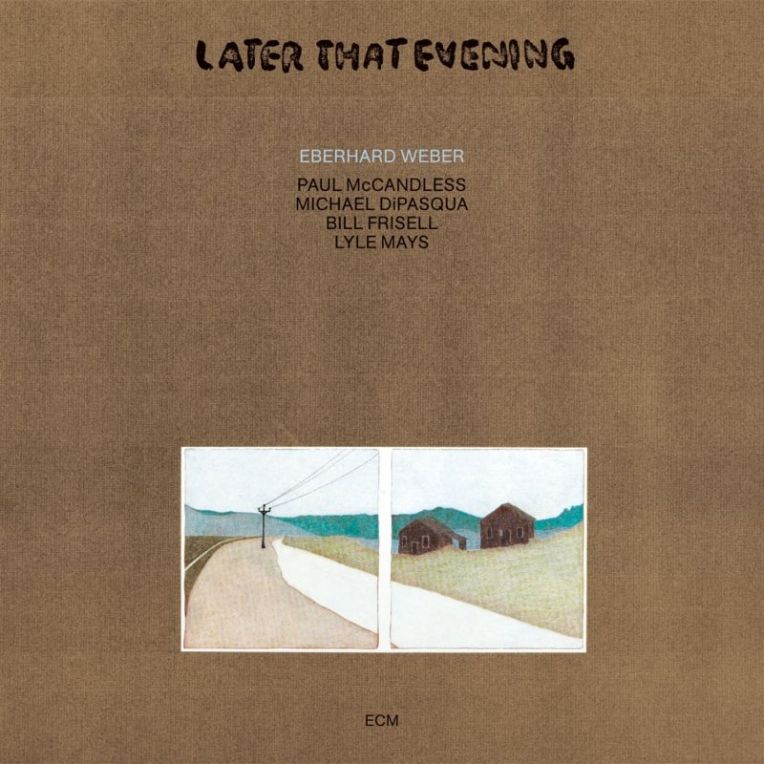
Eberhard Weber: Fluid Rustle (ECM 1137)

ECM 1137

Eberhard Weber
Fluid Rustle

Eberhard Weber bass, tarang
Bonnie Herman voice
Norma Winstone voice
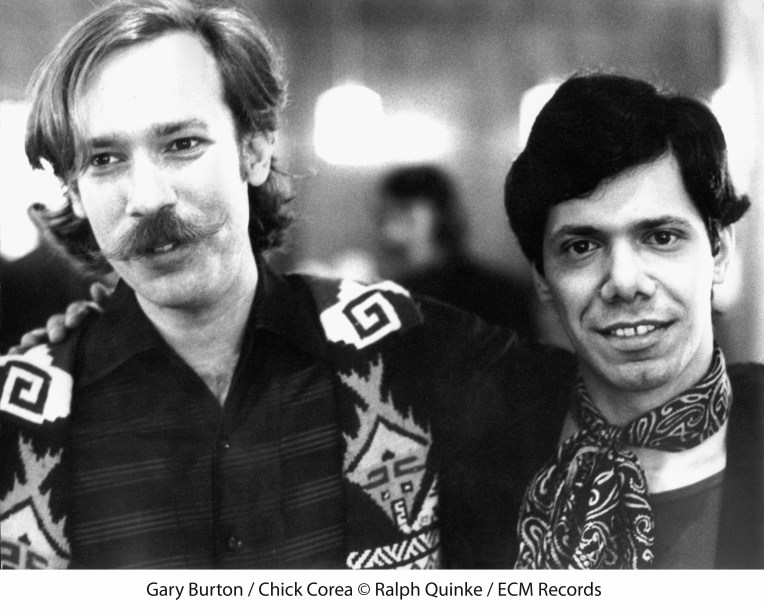
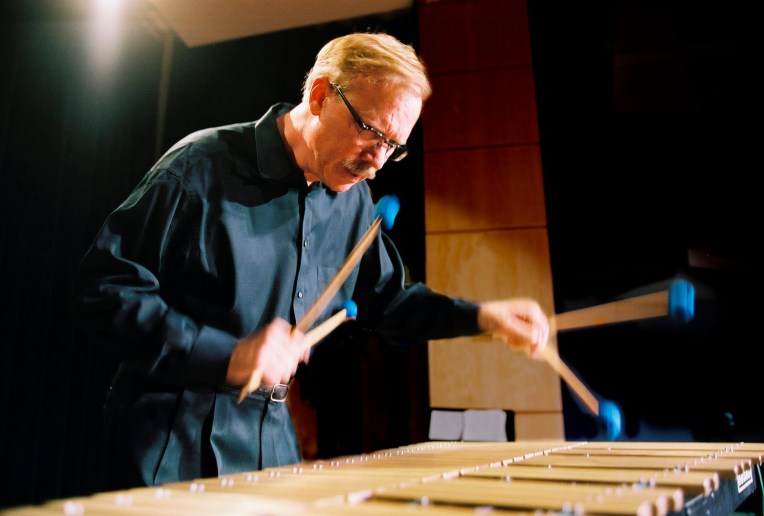
Gary Burton vibraharp, marimba
Bill Frisell guitar, balalaika
Recorded January 1979 at Tonstudio Bauer, Ludwigsburg
Engineer: Martin Wieland
Produced by Manfred Eicher

As the wind freshened from the south, the red and yellow beech leaves rasped together with a brittle sound, harsher than the fluid rustle of earlier days. It was a time of quiet departures, of the sifting away of all that was not staunch against winter.
–Richard Adams, Watership Down

Although with Fluid Rustle, Eberhard Weber continued to draw upon the Watership Down references that cast 1977’s Silent Feet into such lovely relief, I hesitate to call it program music. Neither are the titles mere frames; they are also the open windows within those frames. Like the rabbits in Adams’s novel, each instrument in “Quiet Departures” is its own vivid personality in a vast warren of possibilities. Such strong metaphorical ties are there to be unraveled, one fiber at a time, by every strike of Gary Burton’s vibes. The introduction of Norma Winstone (in her first non-Azimuth ECM appearance) and Bonnie Herman represents an exciting tectonic shift in Weber’s geology, urging us through an atmospheric tunnel. At its end: a brightly lit solo from Burton, swaying comfortably in Weber’s hammock. This piece beguiles like déjà vu over a buoyant electric guitar (courtesy of Bill Frisell), voices returning on the syllable “Na” for a Tehillim-like consistency. Further textural detail is provided by the twang of the tarang, an Indian banjo played by Weber himself. As Burton switches to marimba, we find ourselves between two electric guitars, throwing sonic confetti from either side, before Weber plunges us into the depths of the title track and its ecstatic dreaming. “A Pale Smile” is a hallucinatory wash of guitars and vibes that works its magic with a Laurie Anderson feel. Weber also has a quiet, heartfelt solo here. “Visible Thoughts” carries us out on a bowed bass laced with percussive breathing and whispers. Painting syncopations with a broader brush, the group fades in an ever-tightening braid of wordless breathing until we are left dry.

The album’s title would seem to characterize the sound and effect of Eberhard Weber’s music in one fell swoop. His presence is felt here more melodically than instrumentally, as he chooses just the right moments to foreground his unfettered sound. And while the absence of keyboardist Rainer Brüninghaus marks a noticeable change in density, it also allows voices that have always been there to emerge from the woodwork and shine.

<< Egberto Gismonti: Solo (ECM 1136)
>> Paul Motian Trio: Le Voyage (ECM 1138)

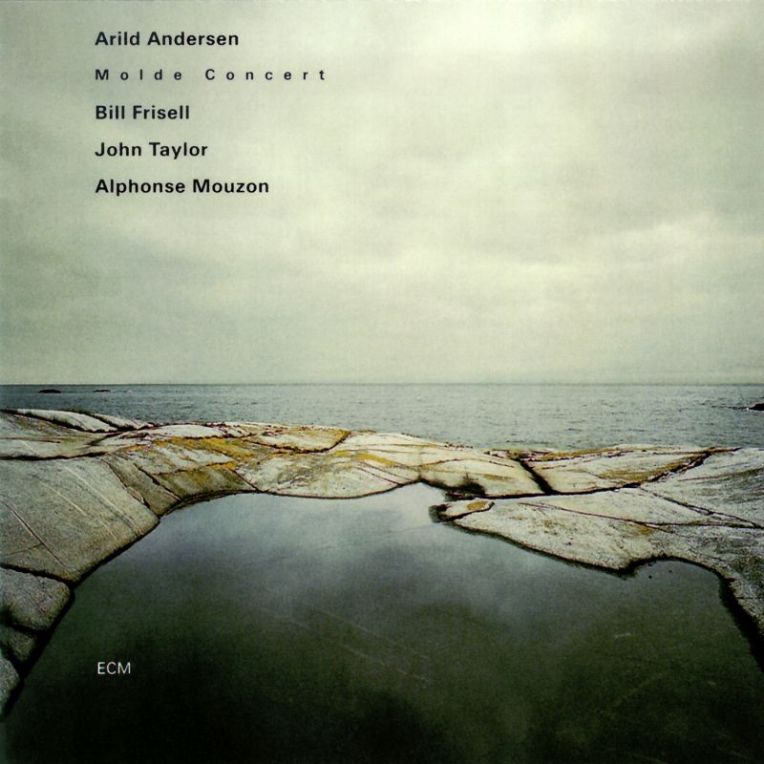
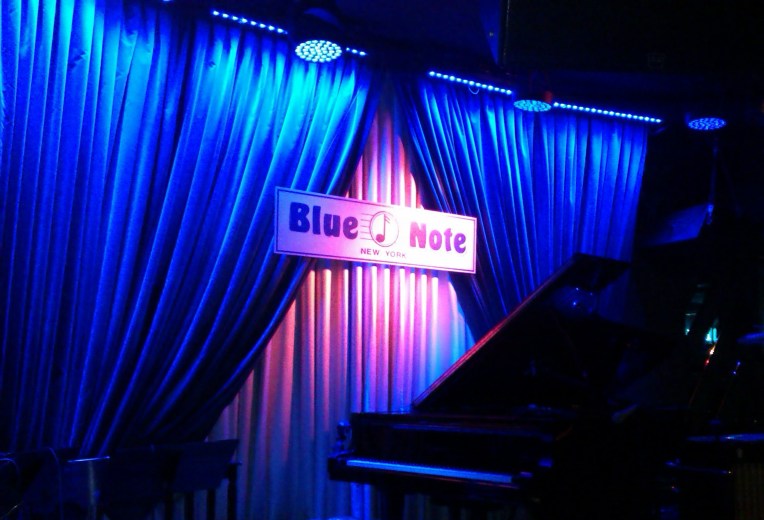
Killing Pain, Not Time: Arild Andersen Trio Live Report

June 11, 2011
Xerox Rochester International Jazz Festival
Lutheran Church of the Reformation
7:30 pm

I find it difficult to begin any review about Arild Andersen without billing him simply as a “Norwegian bassist.” Succinct though the term may be, it hardly hints at the far reach of his fingertips, bow, and musical vision. A packed house felt some of that reach in the distance he’d so graciously traveled to bring his latest outfit to this year’s Rochester Jazz Fest as part of its “Nordic Jazz Now” series. While the cover of the Fest’s concert guide sported a collage of big names, headlined by Elvis Costello, Natalie Cole, k.d. lang and the like (ECM mainstay Bill Frisell could be found lurking among them), Andersen’s visage was nowhere to be found. Thankfully, this did nothing to deter an appreciative crowd from basking his warmth.

The trio is an intermittent format for Andersen, whose underrated early date with Bobo Stenson and Jon Christensen, 1971’s Underwear, gave listeners a foretaste of the propulsion that continues to strum the heartstrings of his playing. Thirty-two years later found him alongside Vassilis Tsabropoulos and John Marshall in The Triangle, a distinctly pianistic record of gentler pulses in slower motion. Though Andersen was the heart of these outliers, his compositional beauties were reserved for his influential quartet—and quintet, via Masqualero—outings throughout the seventies and eighties. Where the Tsabropoulos project was threefold, Andersen’s newest trio with saxophonist Tommy Smith and drummer Paolo Vinaccia is hexagonal, for each musician is doubled by a modest array of digital equipment. The latter, along with the glitter of Vinaccia’s golden Pearl kit, was the first to catch my eye as I settled into my pew at the lofty church where the concert was held. Andersen’s bass lay prone on the stage, its tiger-grained wood at once regal and humble. Stained glass icons seemed to fix their gazes upon it as they opened their arms, wept, and tended to the ailing—an emotional tableau not unlike the performance we were all about to experience.

On the morning of, I had awoken to the rather different tableau that is a pulled back muscle. Though it did little to squelch my anticipation for the day’s proceedings, it made getting there that much more uncomfortable. The muscle relaxants I took had rendered my body about as liquid as a phrase from Andersen’s bass. The effects had worn off by the time of his first evening set (sadly, financial constraints kept me from staying for the second), making sitting increasingly uncomfortable. It was in this state that I welcomed the sight of the trio ascending the stage.

Andersen offered a few words to start, openly lamenting the infrequency of European jazz acts in the U.S., before Smith launched into a rendition of a Gregorian chant. Fed through a microphone and expansively echoed, his Mark VI tenor blossomed with such gorgeous depth that, once Andersen joined with his arco strains, any pain I had felt was immediately blown to dust. Andersen and Vinaccia then shifted gears into an arid soundscape with Masada-like flavor, Andersen’s smile forming the perfect bridge into the beautifully realized Norwegian folk song that followed. Here, Vinaccia played with what appeared to be small wicker brooms without handles. Over this staccato backing, Smith plied his most soulful highs (which sounded like a soprano), going from sandy to cloudy and back again in a flash. Andersen’s echoed bass wavered like a receding mirage, leaving us to ponder a lone turn from Smith, an entire desert in his embouchure.

The cerebral groove of “Independency” (only Part 4 was played), written in 2005 for Norway’s centennial independence, unpeeled one of Andersen’s most captivating solos of the night and segued into his beloved “Hyperborean.” The title here refers to a mythical people with whom Apollo spent his winters in drunken revelry in a land without night—not unlike, Andersen quipped, Norwegians themselves. From the avian warbles of his bass to Vinaccia’s echoed brush-rolls, this piece sang of and through the heart. Smith’s exacting dynamic control was on full display, peaking in those soft, wooden highs. The band put us back on our feet with another folk song, “The Farm Girl,” even as it pulled the rug out from under them. Clouds of fire from each musician in turn delighted us before cooling with the vamp into fadeout. Last was “Dreamhorse,” a contemplative Andersen original with the watercolor bleed of a Kuára collaboration. The melodious exchanges thereof made for a fitting farewell.

The music of the Arild Andersen Trio is not about showing off. It is about mood, reflection, and living in the moment. The bass may be Andersen’s voice, but songcraft is his forte. The opening stretch of “Hyperborean” alone was enough to wipe clean anyone’s slate free of critique. Smith was the tail to his dove. His cleanness of tone paid clear homage to Jan Gabarek even as it forged into distinctly personal territories. Vinaccia’s drumming brought a sound as organic as the dried plants with which he elicited it and was also a joy to hear in close quarters.

With so many Fest events going on in succession, if not simultaneously, this evening show was a welcome respite from the day’s hurried atmosphere, and was a sonic gift of synergistic proportions.

Signed program

Egberto Gismonti: Solo (ECM 1136)

ECM 1136

Egberto Gismonti
Solo

Egberto Gismonti guitars, surdo, piano, cooking bells, voice
Recorded November 1978 at Talent Studio, Oslo
Engineer: Jan Erik Kongshaug
Produced by Manfred Eicher

The prolific output of Brazilian multi-instrumentalist Egberto Gismonti is only partially represented on ECM. Thankfully, what we do have on the label is among his most captivating work, and perhaps none more so than this adroit solo set from the late seventies. By the time he recorded Solo Gismonti had already honed his distinctions to a fine polish in smaller group settings, in particular with his longstanding partner, percussionist Nana Vasconcelos. Drawing from a wealth of inspirations ranging from Maurice Ravel and Django Reinhardt, Gismonti’s is an ever-morphing tapestry of melody and often modest virtuosity.

The sun rises on Solo through the 20-minute “Selva Amazonica, Pau Rolou,” by which Gismonti plants us into his fertile imagination. From that imagination we eventually depart with only the merest glimpses, despite the protracted track times. The opening suite is replete with resonant 8-string guitar and the floating charm of his wordless singing. Touches such as the latter add hints of remembrance, sealing a child’s proverbial innocence with an adult’s creative stamp. Across this steel-stringed landscape Gismonti imprints the tread of the surdo (a bass drum of African origin), then settles into a pre-dawn hymn against a wavering backdrop of cooking bells. A later track, “Salvador,” focuses these same energies into a single guitar, also tailed by a song to the skies. Two piano pieces along the way—“Ano Zero” and “Frevo”—showcase Gismonti’s melodic fragility in even more humbling terms. Through these, he works his augury by less persistent memories. The results fall barely shy of Keith Jarrett at his spirited best. Sunset arrives with the parabolic “Ciranda Nordestina.” After an introductory half-dream in bells, a gentle piano stains us with grand swaths of color, each an emotion in smoke. With every gemstone reaped from the earth, we pursue the rays of light passing through them to their cosmic ends.

As high as his group projects climb, I always prefer the earthiness of Gismonti alone. Perhaps the best place to start any musical journey is with a single guide at your side, and this role he seems more than willing to fulfill.

<< Jan Garbarek Group: Photo With… (ECM 1135)
>> Eberhard Weber: Fluid Rustle (ECM 1137)

Savion Glover: Feet First, a live review (February 28, 2011)

In 1996, a career-defining stint in the Broadway hit Bring in ’da Noise, Bring in ’da Funk established Newark-born Savion Glover as the true heir apparent to Gregory Hines and the so-called “Hooferz” tradition of tap. Fast forward to last Monday night, when Glover electrified Cornell’s Bailey Hall with his unstoppable feet, and one sees just how far he has come. One is hard pressed to name another dancer, tap or otherwise, alive today who has generated as much inspiration and appreciation. Rooted as he is in the solid surface beneath him, he paints pictures with body parts that normally get us from Point A to Point B, but which in his creative web take on an entirely new form of communicative power. Key to his sound is his sharp attack (what he calls “hitting”), and this he brought in full measure to a packed house for his latest project, “SoLo in TiME,” which draws upon the rhythms and emotional acuity of flamenco.

As one who continually engages with histories and modes, Glover is no stranger to the importance of an evocative moment. Flamenco, therefore, feels like a logical next “step” for one of his caliber and drive. With the group Flamenkina providing a fine mesh of tried-and-true sentiment and modern sensibility, not to mention a star turn from BARE SOUNDZ member Marshall Davis Jr., Glover was, to be sure, in intuitively minded company. His setup reflected the exacting nature of the hoofer’s craft: A raised square stage miked from within was surrounded by four speakers and flanked by the musicians. Of the latter, guitarist Gabriel Hermida was first to join in at stage left. Starting at the margins and working their way to the center, the percussive sounds of Hermida’s instrument provided a likely foil to the various snaps, slides, clicks, and cries from those loosed taps. With such a “vocal” range as Glover possesses, he spoke to his audience at every turn.

Flamenkina

Rather than start with a bang, he restrained himself at the back of the stage, as if warming to the spotlight he outshone. I could not help but compare the dexterity of his feet to that of fingers on castanets, as reflected in the superb dynamic control of his instrument. Beneath him, the stage was a taut drum, replete with tuned sections and a wide range of tones. Once bassist Francesco Beccaro and Carmen Estevez—who played the cajón (a Peruvian box drum that seems to be popping up everywhere these days) and graced us with her mellifluous voice—took to the stage, the musical elements of the show began to soar. With a smile of life-affirming joy, Glover negotiated a complex landscape of creative signatures with infectious passion for the material at hand. Like the sweat from his brow, it was a veritable shower of kinesis.

Estevez and Glover shared some of the concert’s most intimate exchanges, those tapping feet the metronomic tide to her sandy shores. Although the band was sometimes lost in the sound mix, if only because the hoofer’s sound rang with such conviction, things balanced out once he and Estevez closed the circle. Still, at its best, the band enacted a glorious unity.

Glover had some fun with the audience during a solo rendition of Queen’s “Another One Bites the Dust.” Feeding off our rhythmic clapping, he took the interaction as far as it would go before abandoning it in favor of a more complex unraveling, whereupon he was joined by Davis, whose synchronicity and more compact style made for some enthralling interactions. Both hoofers practically leaped from the raised stage whenever they were finished, as if the call of that resonant surface was too much to ignore.

Glover’s musical approach is anything but programmatic. Here is an artist who paints in feelings and not images, who dances with palms open, as if in supplication to the gifts with which he has been graced. Seeing him live, one experiences tap at its most essential. No matter how fast he gets, his feet ring through with clarity and immediacy. In this regard, the show’s title might as well have been flipped to read: “TiME in SoLo,” for no matter how far he abandoned himself to the spirit of the moment, he harbored a seemingly infinite inner peace, so that by the end most of us were sitting transfixed. It was the kind of show during which we almost dared not tap our feet, for we could add nothing to something so lushly realized.

St. Petersburg Philharmonic live review (April 15, 2011)

St. Petersburg Philharmonic Shines at Bailey

Had gastronome Brillat-Savarin been a musician, he might have quipped, “Tell me what you play, I will tell you who you are,” which is to say that music is nothing without the instrument through which one expresses it. Therein lies the snag in Friday night’s performance by the St. Petersburg Philharmonic Orchestra, whose fabulous coruscations were tempered by a quiet shadow.

But first, the good. As Russia’s oldest symphonic ensemble, the SPPO exudes professionalism and the charisma to match. Before a sold-out Bailey Hall crowd, conductor Nikolai Alexeev led a hefty program comprising of two major works from his homeland.

Composed at the dawn the twentieth century, the Piano Concerto No. 2, Op. 18 of Sergei Rachmaninoff (1873-1943) stands as one of the most enduring testaments to pianistic craft. It marked the end of a depression brought about by the derision with which the composer’s first symphony was met at its 1897 premier. Though among the more difficult concertos to master, at the hands of soloist Nikolai Lugansky the concerto’s complexities melted into a vibrant wash of sound. Lugansky’s poise was a joy to witness firsthand. Sadly, at least from where I was sitting, one was hard-pressed to say the same about the Steinway at his fingertips. A beautiful instrument in its own right, yet with such a watery middle range that it simply wasn’t up to the task of netting an entire orchestra, it seemed to get lost in itself. Similar issues marred the recent Leonidas Kavakos performance, which was otherwise technically first rate.

Lugansky

Rachmaninoff’s concerto is an epic, multilayered piece, but its vibrant colors seemed finger-painted in muddy passages with little separation. And while the piano’s lower and higher registers occasionally cut through the din with fortitude, for the most part Lugansky was lost in the orchestra’s massive sonic mazes. This was by no means the fault of the artists, who nevertheless wrenched out as visceral a performance as one could have hoped for. From the famous bell tolls that open the piece to the rapturous handsprings that close it, the music leapt from Lugansky’s hands almost as many times as he did from his seat when trying to wrench as much volume from the piano as he could. Along the way, he shared captivating little dialogues with winds, most clearly balanced in the second movement, where the quieter surroundings allowed the piano to breathe. As if from a deep slumber, its stepwise descent was awakened by the majestic runs of the final movement. The most heartfelt moments were to be found here, set off to captivating effect by Lugansky’s lithe trills and finger pedaling. And as the music’s Rhapsody in Blue-esque dramaturgy wound to a close, the crowd rose to its feet amid shouts of “Bravo!”

Rachmaninov

Nikolai Rimsky-Korsakov (1844-1908) composed his famed Scheherazade, Op. 35 in 1888. Based loosely on tales from The Arabian Nights, this symphonic suite depicts musically what the classic literary work does textually. The story, in the composer’s words: “The Sultan Schariar, convinced that all women are false and faithless, vowed to put to death each of his wives after the first nuptial night. But the Sultana Scheherazade saved her life by entertaining her lord with fascinating tales…for a thousand and one nights. The Sultan, consumed with curiosity, postponed from day to day the execution of his wife, and finally repudiated his bloody vow entirely.” And, surely, one can imagine the power of her storytelling in the music. Scheherazade herself makes frequent sonic cameos therein, represented by a leitmotif of violin and harp that runs like a golden thread. Thankfully, the piece has flourished beyond its Orientalist roots as a programmatic masterpiece that was a thrill to hear in such close quarters. Any acoustical issues were taken backstage with the piano, thereby allowing the SPPO to shine. Alexeev’s skillful direction was a pleasure and, at certain moments, brought the musicians to frenzied heights. Their strengths were found in what are often an orchestra’s most underappreciated sections: brass, winds and percussion. Like drummers or keyboardists in rock bands, their accents are the key to a seamless collective sound, and this they brought in full. Principal clarinetist Andrey Laukhin did a particularly fine job with his many rousing passages. Not to be outdone, however, were concertmaster Lev Klychkov and principal cellist Dmitry Khrychev, both of whom figured as leading voices. Klychkov’s bow made a few unintended noises, while Khrychev’s sound came off as flat at times, which perhaps explains the few boos they received during curtain call. Otherwise, they brought due passion and verve to the proceedings.

Rimsky-Korsakov

A humorous moment occurred when, as the audience was clapping after the first section, Alexeev took the opportunity to empty his nose into a handkerchief, encouraging further applause as he did so. This interaction was true to the free-spiritedness that pervaded the entire evening. These were performers who clearly enjoyed what they were doing and who invited us into that revelry at every turn, such that someone sitting in the audience sitting behind me couldn’t help but occasionally whistle along. The second standing ovation was met with a delectable finale in the form of the “Trepak,” or “Russian Dance,” from Tchaikovsky’s The Nutcracker — which, from the sound of it, they could have played in their sleep.

Quibbles aside, this was one of the finer of this season’s Bailey Concert Series performances here at Cornell, and left a satisfied house in its wake. The orchestra’s world-class reputation held its water, while Lugansky, who graciously signed CDs and programs after the show, brought a palpable inertia to the playing. All the more unfortunate, then, that the piano should have asserted an incongruent gravity of its own.

See this review in its original form here.

Jan Garbarek Group: Photo With… (ECM 1135)

ECM 1135

Jan Garbarek Group
Photo With…

Jan Garbarek tenor and soprano saxophones
Bill Connors guitar
John Taylor piano
Eberhard Weber bass
Jon Christensen drums
Recorded December 1978 at Talent Studio, Oslo
Engineer: Jan Erik Kongshaug
Produced by Manfred Eicher

Now they are resting
in the fleckless light
separately in unison

like the sacks
of sifted stone stacked
regularly by twos

about the flat roof
ready after lunch
to be opened and strewn

–William Carlos Williams, “Fine Work with Pitch and Copper”

From the flowing introductory licks to the final exhalation that snaps this sonic locket shut, one look at the track listing of this debut nominal album from the Jan Garbarek Group can’t help but remind us of William Carlos Williams. The full title—Photo With Blue Sky, White Cloud, Wires, Windows And A Red Roof—is a Williams verse in itself, each element drawn from the cover photo into a sonic description thereof. Together they form a concept album in the deepest sense, the anatomy of which is known before the music even graces our ears. Garbarek is as incisive as the words, each the tooth of a widening grin.

Melody and circumstance cohabitate the sonorous waves that issue from every new turn that awaits us, and all in a language that is mellifluous, filled with open spaces, and drenched in Garbarek’s sunlit tone. The airy piano stylings of John Taylor and ever-moving bass of Eberhard Weber, not to mention outstanding contributions from guitarist Bill Connor and the omniscient Jon Christensen on drums, make for a most soluble palette. Even in such a pool of bases, Garbarek’s thematic bite loses none of its acidity. His is an ever-shifting kaleidoscope of worldly-wise meditations and humble commentary.

Each piece breaks a piece from the longer title and rolls it out into a photo in its own right. “White Cloud” works its way from the inside out, laying the tender kindling of a solo piano before being set aglow by Garbarek’s deep smolder. Slowly but surely, drums, bass, and electric guitar weave their way into this dreamlike fabric, cinched by soothing legato threads. We keep our eyes on the cover as its “Windows” are hung with lilting harmonies between Garbarek and Taylor. An acoustic guitar speculates through its translucent frame, enhancing Connors’s understated brilliance all the more. “Red Roof” finds Garbarek in a more pentatonic mode in his soaring reverberant passages, while “Wires” gives us a more animated, earthbound concept in which to contemplate the patterns of our psychic dentition. This track is composed not of melodies, but of wing beats tickling the edges of our brains with promises of light, and all the more soothing for its lack of vivid rhythmic separation. Every fragment falls into place in “The Picture,” which sprouts from the piano’s chromatic seeds into a small yet lush garden of life. Garbarek paints delicate images in the snatches of sky afforded to us while Weber’s bass navigates the soil below with the silent knowledge of an earthworm, closing in a gorgeous crepuscular fade.

Photo With… is far more than the “high-quality background music” it has been accused of being elsewhere. It was a finely polished stepping stone for the Norwegian saxophonist and composer, who with its ripples forged a distinct sonic shoreline that we continue to imprint every time we put our ears to its surface.

<< Tom van der Geld: Path (ECM 1134)
>> Egberto Gismonti: Solo (ECM 1136)

The CODONA Trilogy (ECM 2033-35)

ECM 2033-35The CODONA Trilogy

Don Cherry trumpet, doussn’gouni, flutes, organ, melodica, voice
Nana Vasconcelos berimbau, cuica, talking drum, percussion, voice
Collin Walcott sitar, tabla, hammered dulcimer, sanza, timpani, voice

When my mother had gone to Canton market to shop, her wallet had unfolded like wings…. She had hunted out the seed shops to taste their lichees, various as wines…. She had dug to the bottom of fabric piles and explored the shadows underneath awnings. She gave beggars rice and letter-writers coins so that they would talk-story (“Sometimes what I gave was all they had, and stories.”)
–Maxine Hong Kingston, The Woman Warrior

The music of CODONA, ECM’s most emblematic creation, invariably puts me in mind of the above passage from Kingston’s classic “memoir.” It describes the author’s mother as, having just received her diploma, she celebrates by spreading what little monetary resources she has. The word that always stands out for me, and which is a theme of the book as a whole, is “talk-story,” for it describes with no uncertain brevity exactly what CODONA enacted in the studio (and on the stage) throughout the four-year span represented on this Old & New Masters trilogy. CODONA’s name—a portmanteau derived from its members’ firsts: COllin Walcott, DOn Cherry, NAna Vasconcelos—melds minds and hearts in the deepest crucible of music making.

With their unique brand of pan-culturalism, CODONA developed an entire sonic landscape without needing to throw itself under the next promising classification to come along. These self-titled gems each plot a unique transition in ECM’s graphic and sonic development, reaching both beyond jazz and more deeply into it for hints of origins and possible futures. The improvisational spirit is very much alive at every turn, while also recognizing the pulse of its own maudlin journeys. There is always a sense that one has arrived at a truth, which through CODONA’s collective spirit(ualism) has transcended the misnomer of “universal” into a far more nuanced and selfless understanding of the relationship of sound to all creation.

Whenever we speak of “universal truths,” we delineate quite the opposite. Rather than tapping into a concept, an energy, or state of being that binds all life in however arbitrary a way, the only purpose of universalism is in fact to make us feel better about ourselves. It treats the human experience as primary target, the standard by which all else comes to be measured. The base concept of universalism implies, through its very anthropocentrism, self-obsession as the only path to connectivity. The music of CODONA remains an invaluable corrective to this assumptive attitude toward human experience. Rather than hide, it transcends its own sense of self into a disembodied sonority.

ECM 1132

CODONA (ECM 1132)

Recorded September 1978 at Tonstudio Bauer, Ludwigsburg
Engineer: Martin Wieland
Produced by Manfred Eicher

CODONA’s first album is particularly dear to my heart, for it is the only in the ECM catalog to have been recorded during the month and year of my birth. As such, it lends itself well to my imagination, where it plays as soundtrack to my emergence into this mortal coil. Careful arrangements, spontaneous though they may be, flavor our first taste of CODONA blood in “Like That Of Sky.” From the opening gong, this album enchants with its dramaturgy, in which time and space are one and the same. Against clicks and whistles, a subterranean sitar appears. In it, we hear the grumbling of voices. Cherry fills the vast emptiness with his sung trumpeting, so that the emptiness can only weep in return. Walcott’s sitar is respectfully articulated, ever so subtle in its reverberant twang, providing a gelatinous backbone, such as it is, for Cherry’s more immediate interpretations. From this, we get the tinny call of a clay drum and a flute hooked into every loophole, pulled to expose a more regular core. [This track reminds me very much of the work of the enigmatic duo known as Voice of Eye (especially their 1994 album Vespers), who achieve similarly evocative density from purely acoustic means.] Walcott’s tabla signals the phenomenological urgency with which divine creation takes form, as if finding amid the contact of fluttering fingers along pulled skin the key to unspeakable life. The second track takes the group’s name, and further slackens the threads that keep them bound to this mortal coil. Through an intriguing blend of wooden flute, hammered dulcimer, and some scattered percussive footsteps, the musicians manage to evoke a wide range of special effects from clear and present means. And as the rhythmic rope ladder unrolls itself step by step, we are enticed by its gentle sway into the enlightened space it has drawn for us of wood, metal, and touch. “Colemanwonder” deftly combines Ornette Coleman’s “Race Face” and “Sortie” with Stevie Wonder’s “Sir Duke” in an auditory hodgepodge that is as delightful as it is singular. Given Cherry’s formative history with Coleman back in the late 1950s, this is an important swath of light to note in the album’s otherwise stark shade, made all the more vivid by the grunts, barks, poundings, and knocks issuing from Vasconcelos’s Brazilian cuica drum. “Mumakata” (apparently a favorite of the group’s live shows) features Vasconcelos on berimbau, Walcott on sanza, and Cherry on doussn’gouni. Voices sing, as if evoking the past for past’s sake. Against this tapestry, Cherry breaks out his trumpet for some gorgeous legato phrasings. “New Light” begins with the tinkling of bells and an awakening sitar. We arise from a gentle coma even as we settle into another: from the beauty of awareness to the awareness of beauty. Cherry launches higher flights of virtuosity, underscoring all the more the humility that has led him to this point in the album. Shells hiss like the raspy leaves of a giant palm thrashing in the wind. The dulcimer returns with maraca as Cherry spreads thicker melodies with clarity of tone and posture. A track so nocturnal that it almost glows. Every telepathic moment sparkles before Cherry cracks open a box of blissful high notes and fluttering half-sung hymns, leading us out as dulcimer strings are brushed like a harp by breath without source.

<< Pat Metheny: New Chautauqua (ECM 1131)
>> John Abercrombie Quartet: Arcade (ECM 1133)

… . …

ECM 1177

CODONA 2 (ECM 1177)

Recorded May 1980 at Tonstudio Bauer, Ludwigsburg
Engineer: Martin Wieland
Produced by Manfred Eicher

CODONA 2 drops us immediately into a groovier pool with “Que Faser.” Over tabla and sitar, Vasconcelos exchanges tender thoughts with Cherry’s trumpet, traveling from the majestic to the falsettic in one fell swoop. This leads into “Godumaduma,” the briefest track of the collection, and also its most enchanting. What sounds like three overdubbed sitars in a gorgeous transitory interlude configure something akin to Steve Reich’s Electric Counterpoint had it been written for Walcott and not electric guitar. Switching colors from the sandy and windblown to the gravid and architectural, “Malinye” features Cherry on melodica and Walcott on timpani. As the latter tumble over a highly cinematic terrain, a ring of spirits whispers, cackles, and wails. This haunting piece ends in a sanza-led chorus that stretches far beyond the final vibration and into another state of mind. At the halfway point, we find ourselves feeling “Drip-Dry.” Sitar and voice creep around our circle of light, reaching with shadowy hands to grasp the trumpet’s song within. The buoyant “Walking On Eggs” that follows sounds, like all of CODONA’s work, simultaneously composed and improvised. A buoyant piece, it is also as tentative as its title suggests. “Again and Again, Again,” on which we end, might as well be our listening instructions for this most underrated album of the set. Sitar and trumpet provide some vivid runes, of which Vasconcelos makes a sonic rubbing with a string of sounds not unlike a tape in fast forward, if not a dreaming bird. Add to this the plurivocity of a melodica, and one begins to see subtle density and “vocal” qualities that make this one of the group’s most inward-looking statements.

<< John Clark: Faces (ECM 1176)
>> Barre Phillips: Music By… (ECM 1178)

… . …

ECM 1243

CODONA 3 (ECM 1243)

Recorded September 1982 at Tonstudio Bauer, Ludwigsburg
Engineer: Martin Wieland
Produced by Manfred Eicher

The traditional Japanese “Goshakabuchi” that begins the final leg of this triumvirate turns the mirror just so, flashing a glint into our eyes from a distance. Cherry’s brassy ether drips with sympathetic effect; hammered dulcimer hurls its delicate, insectile hiccups; untold lives tease us with their possibilities. This is perhaps the most haunting and coalescent track in the collection and shows the trio at the height of its signature synergy. Sanza and doussn’gouni back the chant-heavy “Hey Da Ba Boom,” which will adhere to your mind far more than any words I might use to describe it here. “Travel By Night” trailmarks its path with berimbau, sitar, and muted trumpet. Walcott’s arcing tones make for quiet narration. Hooded by the darkened firmament, it practically floats with the practiced steps of a modest caravan fleeing from its own histories. A trio of shorter rest stops follows, of which “Lullaby,” the only moment with Walcott alone, gives us a heartening glimpse into the mind of group’s creative nerve center. “Clicky Clacky” provides a dash of whimsy, a bluesy gem from the mind and mouth of Cherry, complete with train whistle. The final gasp comes from the “Inner Organs,” where the echoes of trumpet and, not surprisingly, organ move in concert like a jellyfish and its tendrils toward open closure.

The music world lost one of its most innovative figures when Collin Walcott perished in a car accident while on a European tour with Oregon in 1984, and the CODONA trilogy is but a flash of what this inimitable project might have further accomplished had he lived on. As rooted as the music is, the edge of time has severed its earthly ties. If jazz had developed from one mystical seed (and who’s to say it didn’t?), then certainly its originary tales would sound very much like the elder’s musings preserved here. Through their own brand of talk-story, these attuned sages brought forth truths of fragmentation, permeability of mind and body, and of the knowledge that nothing matters anymore once sound opens your ears.

Want to see ECM at one of its finest hours? Then set your clocks to CODONA time.

<< Miroslav Vitous: Journey’s End (ECM 1242)
>> Jack DeJohnette’s Special Edition: Inflation Blues (ECM 1244)

From Two Hands to Ten: A Review/Interview with Leon Fleisher

Below is my review of two recent concerts led by Leon Fleisher under the title of the “Beethoven Concerto Project” at Cornell University’s Bailey Hall, May 7/8, 2011. The full interview excerpted therein follows.

Leon Fleisher comes from a line of piano students extending directly back to Ludwig van Beethoven (1770-1827). Who better, then, than he to bring all five of the legendary composer’s piano concertos to the stage for a two-concert series? Fleisher is a legend in his own right, though one might never have suspected as much from the gracious humility with which he welcomed me to interview him last Thursday. In his speech I sensed a journey contoured with valleys and peaks in equal measure. At the highest of the latter, an illustrious career was suddenly halted when he was diagnosed with a neurological condition known as focal dystonia. This manifested itself in his right hand, two fingers of which curled under of their own accord. This might have undone him, were it not for an indomitable spirit and his prevailing love for the music that uplifted it.

Amid the storm of post-WWII pianists, many of whom were predisposed to strident showpieces, Fleisher had been quietly scrimshawing a more delicate niche into the yielding bones of the Austro-German canon. Very much a product of his teachers and their interests, as he will be the first to admit, Fleisher had settled into this repertoire without question, only to see it fade from his fingertips. One consolation: an altogether engaging body of work for the left hand paved the way for his reprisal on the classical stage. It was then that he began teaching, as well as conducting some of the world’s most prestigious orchestras. One unforeseen result of his activities at the podium was carpal tunnel syndrome, the corrective operation for which miraculously relieved his dystonic symptoms enough so that, with a measured combination of botox and Rolfing therapy, he has been able to play with two hands for the last fifteen years. Although he will never regain 100% functionality, his virtuosity and sensitivity have grown into something else entirely.

At a tender 82 years, Fleisher exudes a healthy balance of experience and resigned honesty. Refreshingly uninterested in the frills that so often creep into contemporary performance practice, he is more concerned with uncovering the music as it might have been, as it is now, as it may ever be. Not to be confused with an idealist, he is one who enjoys the proverbial moment, which remains the ultimate validation of all the practice and discipline that go into any performance. There is a peacefulness in Fleisher that one feels in his very presence, in his careful steps onto the stage, in the way he sits rather than stands, placing himself at a more familiar level with the orchestra before him, before us. His tempi are respectful, comforting, and never jarring, and his pianistic understanding of the music shines through with every swing of his hands.

(Photo by Susana Neves)

During our conversation, I asked Fleisher to share his thoughts about Beethoven, a composer with unfathomable staying power. “The remarkable thing,” he told me, “about Beethoven, I think, is the rate at which he overcomes the detritus, the residue of…bad performances. His success rate is extremely high. In other words, you can really play Beethoven quite badly, and still something very powerful will come through.” With this in mind, it only made sense that each concerto be presented to us by a different soloist. Not only did this allow the audience to hear more clearly the distinctions between the concertos, but also those between the performers, each of whom brought an idiosyncratic flair to bear upon the material at hand.

Miri Yampolsky, Fleisher’s former student, offered the most well-rounded balance of stylistic grace and sense of musical grammar in her rendition of the Piano Concerto No. 1 in C major, her buoyancy in the right hand foiled tastefully by a weighty anchorage in the left. Xak Bjerken—another former student and Yampolsky’s husband—brought his own unique grace to the keyboard, which lent itself beautifully to the Piano Concerto No. 4 in G major. By far the most enigmatic of the set, this concerto, as Fleisher informed me, was once known among musicians as the “ladies’ concerto,” a tidbit of archival derision that has thankfully lost its currency. Fleisher himself prefers to see the Fourth as a middle-period dip for Beethoven into cosmological waters, a sonic foretaste of the metaphysicality that so pervades his final symphonies. Of all the players, Bjerken was most attentive to the baton, and one could feel his respect for the one holding it in every note he played. Italian-born Stefania Neonato had a fluid sense of timing of her own for the Piano Concerto No. 2 in B-flat major, heard most clearly in her trills and constantly running fingers. Not to be outdone was Spanish virtuoso Claudio Martinez-Mehner, yet another former student of Fleisher’s who filled the hall with palpable revelry in his rendition of the Piano Concerto No. 5 in E-flat. Also known as the “Emperor Concerto,” it more than lived up to this apocryphal nickname through the gallant expressivity that pervaded its realization at every turn. Yet by far the highlight to everyone’s ears, if the full-house standing ovation were any indication, was rising star Daniel Anastasio, a Cornell senior and student of Bjerken’s, who brought his finesse and prodigious talent to the stage for the Piano Concerto No. 3 in C minor. So propulsive was his enthusiasm that it spurred him on prematurely, so that his chordal punctuations in the first movement did not always sync with those of the orchestra. Rather than see this as a detriment, I felt it as a sign of his exuberance. Both he and Bjerken continued the Fleisher lineage with due poignancy.

Readers of my past reviews will be all too familiar with my love/hate relationship with the house Steinway at Bailey Hall, but I am glad to report that the modest settings proved to be a fine sonic fit this time around. Martinez-Mehner in particular elicited more volume than I have ever heard from the selfsame instrument, a kinesis we saw reflected in his unbridled body language. Sometimes the relationship between soloist and orchestra is likened to a conversation. Yet in these concertos, at least, the piano was a conversation in and of itself, and the surroundings overwhelmed not a single word. As far as the three (!) orchestras were concerned, the results were variable. The Cornell players, in both their Chamber- and Symphony-sized incarnations, as Fleisher wittily related in our interview, were under the stress of finals: “They were sitting there playing, looking as dour and depressed as I’ve seen in any group in my life. I was so struck by it that I stopped and I mentioned it to them. I mean, here are young people in their late teens and early twenties, looking like they were all ready for the couch! And then one bass player said one word that explained it all: Finals. Poor kids…that’s not really what I think even the most refined education is all about. There has to be some joy in life. They smiled a bit after that.” As students who must balance primary academic commitments alongside their musical double lives, our Cornellians performed admirably well. And let us not forget the lovely Canzonas by Giovanni Gabrieli (c. 1553/1556-1612), courtesy of the CSO Brass Choir, that bookended Sunday’s concert just outside the hall steps. That being said, the Ithaca College Chamber Orchestra was in a league all its own. Comprised of handpicked music students, it breathed like a single organism through superb tonal colors and communication. Regrettably, they lent their bows and breaths only to Anastasio’s performance, making it all the more electrifying.

“Like an EKG graph” was how my wife described the concerts. With her usual brilliance and fresh ears, she was able to cut through my verbose meanderings with a concise destination. For her, Beethoven is not about climax and resolution, but about the careful placement of clusters along an otherwise constant lifeline. I can only agree: Beethoven’s music doesn’t so much peak as plateau, navigating the nooks and crannies of a landscape that is bigger than all of us. This architecture was also reflected in the showings that preceded both concerts of Nathaniel Khan’s touching 2006 Oscar-nominated short film, Two Hands: The Leon Fleisher Story. In Fleisher’s testimony, we find something of a Beethovenian soul, one unwilling to let infirmity control the potency of its artistic license. As Fleisher so carefreely told me, when I asked about his being here, “It’s just a great adventure to go through with several of my former students. It’s a great delight to be able to come and explore the nature of this material with next generations. Plus, it’s fun, it’s what I do.” In the end, I could only bow to his candor, and by extension to the efforts of everyone who made this weekend possible.

(Photo by Joanne Savio)

Full interview with Mr. Fleisher, conducted by Tyran Grillo on May 5, 2011:

Having only just recently seen the documentary Two Hands for the first time, I am still struck by a comment you made regarding your connection to music itself—that it was perhaps the most important connection of all, something that had sustained you through hardships and ecstasies alike. And so, it is this connection that I would primarily like to discuss with you today. Before we get into that, however, I wish to ask one question in relation to your instrument: Have you come to hear the piano differently between the bench, the podium, and the classroom?

What an interesting question. I think I have to answer that “yes” and “no,” simply because, on the one hand—which would represent the “no,” I think—I hear in my head what I think is, for me, the ideal. In fact, that’s usually…well, I can explain the mechanism as I see it. On the other hand, as I actually listen to what’s being played, I think there is probably a difference between, let’s say, piano, orchestra, and students. I guess the main difference is whatever the medium is, whether it’s chamber music, solo piano, or orchestra. The idea of hearing—or listening, I should say—is an interesting one. The performer is, in fact, three people at the same time: Person A, Person B, and Person C. Person A, before he or she plays, must hear in the inner ear what it is that they’re going for, what their ideal is, so that they have a goal to strive for. If you put a key down without an intention behind it, it’s an accident, which means that the key that follows it is based upon an accident; everything that follows is based upon accident.

That reminds me of an art teacher who used to try to correct me from smudging as a method of shading. He used to say that a smudge is nothing more than a smudge the moment you run your finger across it. It just becomes an incidental mark without intention.

Oh, really? I can’t understand that. The smudge itself might be an intention…. So, that’s Person A. Person B is the one who actually does the playing, and has to be totally aware of how that playing is being manifested, so that if what Person C—who sits somewhat apart, who listens and judges—hears is not what Person A intended, Person C tells Person B, the doer, what to adjust to get closer to that ideal of Person A. And this is a process that goes on simultaneously and continually, all the time.

And, more broadly, do you feel that you changed over time as a listener?

Yeah, oh sure.

And do you think there is one change more than any other that has been deepest for you in your listening habits?

Well, I spent a good third of my life at the piano, which was essentially my instrument of choice, as it were, and most of the second third of my life, or a good part of it, dealing with orchestra, which is a beast of a totally different color. It’s really quite fascinating dealing with an orchestra. The response time on a piano is virtually instantaneous. In an orchestra, you have varying response times. I guess percussion is the most instantaneous, then strings. And you get varying responses out of winds and horns. Brass instruments respond later. And that’s just in terms of timing. Then you have timbre, instrumental differences. The one great advantage of the piano is that you can make it sound like an orchestra, and you can make it sound like the instruments of an orchestra. You can make it sound like a French horn or an oboe, cello…stuff like that. Yeah, it’s fascinating. Being a soloist is a very solitary affair, and therefore is full of what you might call the luxury of time. When you’re in your studio, however long you have to practice before you have to go about the rest of your life, that depends, but usually professional orchestras today rehearse for two and a half hours with a fifteen-minute break. That costs money, and you cannot go one second over time, because they’re paid in fifteen-minute segments. You go five seconds over and you have to pay them for fifteen minutes. So, dealing with an orchestra is, in a sense, more stressful, much more compact. It becomes very much a question, as with a doctor, of diagnosis and prescription. In other words, you have to be able to tell pretty much instantly what it is that’s not working, why this doesn’t sound the way you want it to sound. You have to diagnose the problem, and not with a certain infrequency do you find a conductor who from time to time misdiagnoses, who thinks the problem came from this or that player when in fact it comes from someplace else, and that’s usually when he loses the respect of the orchestra, because he can’t diagnose. And once you’ve made your diagnosis, you have to come up with the answer, with a prescription, to make it work. So, it’s a different kind of process. When you’re a soloist you have that luxury of time, you can try it this way and that way, you can ponder it, you have time.

(Photo by Joanne Savio)

Moving on now to Beethoven, I would like to field your thoughts on the series you are presenting here at Cornell, which is, of course, the Beethoven Concerto Project. Could you share your thoughts on the appeal of the concerto form and how the piano fits into its long history?

Oh, I think it’s very basic, if not primitive. It’s that age-old story of one against the many, and who’s going to trial. The poor, singular soloist…which is often emphasized if the soloist is of the feminine persuasion, making it even more appealing as a dramatic story. And then, happily, in the end everybody triumphs.

Some would say—and here I am thinking specifically of András Schiff—that the music of Beethoven is prone to getting lost under the residue of time and interpretation, and that one must try to “refresh” it, so to speak, with each new performance.

And how? Does he say how? [laughs] Does he pick up a hose and hose it down?

He tries, I think, to look at the score as much on its own terms as possible.

Yeah, I think that’s valid for whatever composer you’re playing. The remarkable thing, though, about Beethoven, I think, is the rate at which he overcomes the detritus, the residue of those bad performances. His success rate is extremely high. In other words, you can really play Beethoven quite badly, and still something very powerful will come through. Most other composers, if you play them badly, just become flat. But Beethoven, for some reason, manages to supersede, to…what’s the word I’m looking for…

Transcend?

…transcend even bad performances. I certainly agree with András, though I think it can be done with every piece of music. A piece of music, in a way, is an interesting kind of process. Because, like most art, in relation to the norm most great art consists to one degree or another of, and I use a very powerful word here, distortion, especially when compared to the norm. In the dimension of time in music, the norm would be, say, a metronome, which is a machine. It has nothing to do with the music. It merely measures the rate of speed. Many people think they have to play with that same regularity. So, in relation to the metronome, often what one does is a distortion. I mean, look at Michelangelo. People don’t have arms like that, you know? Or Giacometti, El Greco. People are not that thin, but certain types look that thin. So, distortion becomes quite important. However, once we’ve made the small distortion, it’s quite probable that after a few weeks we’ve gotten so used to that distortion that the meaningfulness of it has disappeared. So, well, let’s distort just a little bit more. Well, that’s satisfying again. And that lasts for a few weeks until we get very used to that. And so on, and so on. But every now and then, like the fisherman, you have to bring the piece out again and wash it down of all its barnacles, and all its distortions, and start again from scratch.

Going back to the idea of regularity…I’ve often heard people characterize the music of Mozart, for example, as being very regular, and that, in contrast, Beethoven’s shies away from repetition in favor of more free-flowing thematic cells and unexpected returns. Yet clearly, these are far from mere abstractions. What gives traction for you in the concertos specifically? What is their heartbeat, and how might we listen for it?

I always hesitate to give anyone signposts in a piece of music, because invariably it winds up that they just wait for those signposts and miss everything else, and it turns out to be quite a loss, if not a total loss. I don’t particularly subscribe to that thesis of Beethoven and Mozart…

It is, unfortunately, a common one.

Unfortunate, yes, and shares the meaninglessness of most things common.

It seems almost obligatory to characterize Beethoven as a deeply “troubled” and “dramatic” figure. By extension, his music has taken on a mythology of its own. We have, for example, this enduring association between the Andante of the Piano Concerto No. 4 and Orpheus taming the Furies before Hades…

Well, everybody brings to the music what they want to bring to it. I see No. 4 less as Orpheus and its attendant connotations and more as the Prophet talking to the multitude in the desert.

So when you have these personal images attached to the music, do you ever keep them in mind while playing or conducting, or are they just afterthoughts?

They’re usually afterthoughts. They give color. I think people really have to use whatever best serves them and best serves the music as seen through their eyes and as heard through their ears. In other words, it’s really quite pragmatic: whatever works. You don’t necessarily have to talk about it. You know, everybody has their way of, I think the phrase today is, “getting in the zone.”

Do you find any humor in these concertos?

Oh, they’re filled with it!

And how does it make you feel to engage with that humor, and do you try to bring it out?

I must say, I’ve been now at two rehearsals with various groups here, two groups so far, and I am going to meet today yet a third group. I was so struck last night at my second rehearsal, and I realized it was the same thing that struck me at the first rehearsal. It seemed to me that these young people were totally devoid of any humor. They were sitting there playing, looking as dour and depressed as I’ve seen in any group in my life. I was so struck by it that I stopped and I mentioned it to them. I mean, here are young people in their late teens and early twenties, looking like they were all ready for the couch! And then one bass player said one word that explained it all: “Finals.” Poor kids…that’s not really what I think even the most refined education is all about. There has to be some joy in life. They smiled a bit after that. And I think maybe by Saturday finals are over, so I look forward to some lighter spirit. No, this stuff is full of humor, and Beethoven’s humor is sometimes more on the rude side than most composers, though Mozart certainly has his share. You know, he has those famous scatological canons. The things we prudes of today scoff at were, back in Mozart’s time, just part of the regular scene.

I wanted to talk to you a little more about how music is received and how the fame of a composer might come into play in audience response. Take, for example, the Adagio of No. 5, which has been divorced as one of the finest passages in the set, if not in all of classical music. How do you approach these heartrending turns, so often plucked as sonic emblems? Do you treat them any differently, or do you prefer to see them as part of a larger whole and simply deal with them as they come?

The only extracurricular meaning that the second movement of the Fifth Concerto holds for me is that it was chosen by Lenny [Bernstein], for, uh…

“Somewhere”?

Yeah. [sings] “There’s a place for us…” He thought it was such a good tune that he used it for West Side Story. Stravinsky said: good composers borrow, and great composers steal. One might remark upon it in passing, but it certainly has no contributory virtues.

Now, these concertos are, of course, riddled with difficulties: the cadenza in the No. 3 Allegro, the pedaling in the Largo of No. 3…

That pedaling shows up everywhere, in virtually all the concertos. And the important part of it is the extent to which Beethoven’s indication is misunderstood, because he writes for the piano using the same term that is used for stringed instruments. It’s a totally different mechanism as manifested on the piano, and the effect is quite different. He writes senza sordino and con sordino, which on a string instrument is the extra little bridge you put on top of a normal bridge, the sordine, which mutes it to a certain extent. But the sordine on the piano is the damper, that bit of the mechanism made of felt that rests on the string that prevents it from reverberating. So when he writes senza sordino for the piano, it means lift those dampers so that the string can vibrate, can resonate as a result of being hit by a hammer, and the only way you can raise those dampers is to put the right pedal down. People cannot conceive that in Beethoven’s time he would want the resultant mix of harmony, which really belongs to impressionist music, which comes much, much later. But they don’t realize that on these pianos today you get much more reverberation from using the right pedal than you did in Beethoven’s time, so if you want to approximate the sound that he seems to be asking for when he writes senza sordino, you can get it by just using a fraction of the pedal, not putting it down all the way but just barely depressing it so that the dampers lift just the wee bit off the string, and you get this kind of hazy recollection, remembrance of things past, in this sound that he was obviously going for.

Beyond the written score, do you feel there are any particular challenges that await the would-be Beethoven performer?

The concertos certainly do not span Beethoven’s life’s output the way that, say, the sonatas do. They stop at opus 73, and his works go up to something like 135. So the first two are really youthful. Actually, what we call the Second Concerto, the B-flat, is really the first. He wrote it before he wrote the C major. It was just published after the C major was published. The other three are middle period pieces of quite different characters. Yes, in a sense the Fourth, which was for a long time called the “ladies’ concerto” because it wasn’t as outgoing, as…what’s the opposite of introspective?

Extroverted?

Extroverted, thank you. The Fourth being more introspective, in a sense dealing with the transcendental, dealing with the sublime. Those are challenges that you find in all of Beethoven, that he likes to delve into the cosmos, which evokes the wrong picture. He likes to explore the universe. His music really becomes quite metaphysical. He is interested in those great questions of how we relate to the world around us, how are we like a brook, how are we like the leaf on a tree. French music is more concerned with the sensory, with the senses—with sense of smell, touch, taste, sight as seen through squinted eyes. Russian music is a much more subjective kind of breast-beating: look how I suffer…

More embodied, perhaps?

Yeah. But German music, as demonstrated by Beethoven, really is metaphysical. It raises those existential questions.

So, you mentioned that the Fourth was once known as the “ladies’ concerto,” which reminds me of the research I am conducting now on the differences in audience expectations toward female and male classical pianists, and I wonder what gender stereotypes you see still lingering on the stage in that regard.

I think we’re getting, thank God, over those to a great extent. I should even stop talking about the fact there was a period of history when the G major was known as the “ladies’ concerto.” It injects something that has no role, no place. Some of our female performers are just…someone like Martha Argerich is just a force of nature. It just blows everyone and everything away when she makes music.

And I’m sure that anyone just listening to her play on a recording would never think to question her gender. It’s not important.

Oh no, of course not, of course not.

Surely, I am not alone when I express my adoration for your Brahms concertos as reigning favorites in your repertoire. I feel your passion and connection to that music quite viscerally when I listen to or watch it, and I wonder if your relationship with Brahms is particularly different from that with other composers.

I had the incredibly great fortune of working with one of the great masters of the twentieth century, Artur Schnabel, and my love and appreciation for the music that most interested him, which was essentially German music…yeah, I come by that quite legitimately. My bloodlines are Russian, and one of my great early influences was French. I feel I’ve had the best of all worlds, musically.

Is there one mantra, word of wisdom, philosophy, or lesson from your teachers that you still carry with you?

No. I am, to an extraordinary extent, the result of my teachers, and they were filled with nuggets.

What does it mean for you personally to be here at this place, at this time, with these friends and colleagues, presenting this music?

It’s just a great adventure to go through with several of my former students. It’s a great delight to be able to come and explore the nature of this material with next generations. Plus, it’s fun, it’s what I do.

I think I speak for all of us when I express a deeply felt and genuine gratitude for your presence here this week and for bringing what I am sure will be wonderful performances.

Well, I don’t know about that [laughs]. We will have had, in a sense, only minimal rehearsal. It is a bad time of year for the students, being finals time, so I’m not sure if they’ll have their best concentration. But again I think Beethoven, as always. will somehow muddle through.

He will prevail?

[laughs] Yes, he does, he does prevail.