Leonidas Kavakos/Péter Nagy: Ravel/Enescu (ECM New Series 1824)


Maurice Ravel/George Enescu

Leonidas Kavakos violin
Péter Nagy piano
Recorded March 2002 at Radio Studio DRS, Zürich
Engineer: Stephan Schellmann
Produced by Manfred Eicher

The phenomenally talented Greek violinist Leonidas Kavakos, one of the finest of his generation, is joined here by Hungarian pianist Péter Nagy for their debut ECM program paralleling Maurice Ravel (1875-1937) and his underrated contemporary, George Enescu (1881-1955). Although the two studied and performed together, Enescu was more widely known for his gifts as violinist and teacher (Yehudi Menuhin and Arthur Grumiaux were among his distinguished pupils) than as composer. Yet in the latter role he showed immense fortitude and an inventive interest in the folk music of his native Romania. His sadly overlooked Impressions d’enfance, op 28 (1940) is a revelation. Through a series of redolent images, each of its ten impressions, replete with all manner of programmatic effects, recreates a compelling story of remembrance. Titles such as “Brooklet at the Far End of the Garden,” “Cricket,” and “Storm Outside, in the Night” provide just enough descriptive information to immerse ourselves in their distinct atmospheres. Such cues ensure that the fragments of youth remain bound to the present by reflection—thematized, if you will, through the act of performance. The violin constantly doubles itself, as if trying to make its voice heard in this regard, while any lingering innocence fades into the more soluble fears of adulthood. Enescu’s better-known Sonata No 3, op 25 (1926) on popular Romanian themes receives an equally impassioned treatment. It is a folk-infused space in which dances exist only as memories, dissolving into blurs of skin and cloth. And though their spirit clearly animates the powerful final movement, it is in the second—marked, aptly, Andante sostenuto e misterioso—where the respective skills of the musicians become clearest. Where Nagy feels smooth, ceramic, Kavakos glistens with the dull sheen of wetted metal. Like a song heard through the trees, their combined forces entice as much as they perplex.

Bookending these standard-setting renditions are two major works of Ravel. The Sonate posthume (1897) sustains the graceful delicacy he is known for. As I listen, the leaves are just beginning to change outside. And so the music becomes a looming tree, its branches splayed like a frozen explosion, every gust of wind playfully recorded on strings and keys. Throughout this piece, the piano takes charge in introducing thematic changes, from which the violin may leap in a series of interpretive gestures. The two are given clear separation, as if to draw further attention to their courtship. On the other side of the coin is Tzigane (1924), Ravel’s singular self-styled rhapsody. The title—a generic French term for “gypsy”—refers more to an exotic ideal than to any specific motif. Its rousing introductory solo is one of the defining moments of violin literature, while its high-pitched acrobatics and virtuosic lines give Kavakos plenty of opportunities to show us the scope of his tonal breadth. This is certainly of the most well-balanced recordings of this piece (at least in its chamber form) one is likely to find.

The works of both composers are undoubtedly interactive. Their melodies are like fleeting glimpses that nevertheless burn themselves into the mind. Through the act of recall, we flesh out those images with our own pigments. It is for this reason that we cannot simply label such music as “impressionistic” and call it a day. That is, of course, unless see impressionism for what it is: not a vague, insubstantial view that can only been appreciated from afar, but rather an art of potent language that paints itself in the viewer’s mind. It is memory incarnate. Whereas in the photorealism of certain composers we find ourselves with relatively little room to explore, here we encounter endless space through which to run without fear. We can trust in this music. The piano becomes the paper upon which the violin may inscribe its audio diary. Impressionism writes the same story, with one crucial difference: though we may hear the nib scratching across the surface, we see only the plumed quill writing its mirror message in the air.
Schnittke/Raskatov: Symphony No. 9/Nunc dimittis (ECM New Series 2025)


Alfred Schnittke
Alexander Raskatov
Symphony No. 9/Nunc dimittis

Dresdner Philharmonie
Dennis Russell Davies conductor
Elena Vassilieva mezzo-soprano
The Hilliard Ensemble
Recorded January 2008, Lukaskirche, Dresden
Engineers: Markus Heiland and Peter Laenger
Produced by Manfred Eicher

“It seems that the ninth is a limit. He who wants to go beyond it must pass away…. Those who have written a Ninth stood too close to the hereafter.”
–Arnold Schoenberg

Alfred Schnittke (1934-1998) is another in a long line of composers who have fallen to the so-called “curse of the ninth.” And while in Schnittke’s case the curse doesn’t quite hold water (it is, technically, his Tenth when one takes his Symphony No. 0 into account), the circumstances of its completion are prime material for the lore that surrounds such configurations of creative output. Regardless of how much we believe in the numerical significance of Schnittke’s Ninth, it was the last work he ever committed to paper. That he mustered the ability to do so after suffering four strokes, which had left his right side paralyzed, makes the work’s existence all the more enigmatic. Said debilitation forced Schnittke to write with his non-dominant hand, making for a virtually unreadable score. Famed Schnittke conductor Gennady Rozhdestvensky subsequently prepared, under apparently spurious authority, a “performing edition,” which Schnittke vehemently rejected upon hearing a tape of its performance. Following his death soon thereafter, the score was entrusted by widow Irina to one Nikolai Korndorf, a fellow composer who sadly died of a brain tumor before he was able to do anything with it. Irina then passed the work along to Alexander Raskatov, who felt so moved in his attempts to provide a more definitive manuscript that he added an elegiac fourth movement of sorts to Schnittke’s already monumental three in the form of the Nunc dimittis (“Lord, let thy servant now depart into thy promis’d rest”) that rounds out this landmark recording.

The visceral Andante that opens the Ninth—which, in Raskatov’s estimation, acts as a “voice from beyond”—is like a string of blocks sagging over time. Harmonies move from consonance and dissonance in fluid sweeps, their ambiguity neither inviting nor repelling us. If anything, they signal a maturity that accepts those experiences that embolden us through their difficulty as well as those that refashion us through their proverbial beauty. Schnittke preserves his special sensitivity for the orchestra, treating it at times as a solo instrument, as if each section were its own string, and at others as if those voices were so distinct that they existed only through the vast spaces that separate them. It is this constant balancing act that makes the Schnittke experience so alive with nuance, easily adapting to our changing temperaments. In such a world of sound there is no self yet stable enough to hold on to for a lifetime. There is only the constant negotiation of our own musicality and the indeterminacy that binds it. And so, when the timpani announces itself at last, it sounds less like a declamatory statement and more like the heartbeat of a feeble and weary body. The addition of a harpsichord in the Moderato as a sort of tangential continuo of times past is a perfect example of Schnittke’s asymptotic grace. It also gives the symphony a concerto-like pathos, ever offset by a cryptic aftertaste and recumbent winds. As a whole, the Ninth is dominated by scales, which take a most blatant turn at the tail end of the Moderato, during which a trumpet runs through a chromatic line (perhaps in acknowledgment of its pedagogical roots?) as a lead-in to the final Presto, where we hear this modal motif echoed in the strings, and again in the lone oboe that welcomes the harpsichord’s unassuming return. Such fundamental utterances are, I think, keys into the piece’s inner energies, and prepare us for the gentle letting down of its cessation.

Raskatov’s intriguing companion piece, written in memoriam, is scored for mezzo-soprano, men’s voices and orchestra. It opens with verses by Joseph Brodsky, a favorite poet of Schnittke’s, and imparts its remaining attentions to a text by hesychast Staretz Silouan (who ECM listeners will recognize as a name of interest on Arvo Pärt’s Te Deum). Raskatov delves deeper into Schnittke’s symphonic territory, trail-marking it with voices along the way. Brief outbursts from harpsichord and marimba, along with some Ligeti-inspired vocal articulations, lend a ceremonial cast to the glowing mood. Dense brass swellings recall Górecki’s Old Polish Music, while a watery gong and shadowy electric guitar work their way into an ending that is but a mirror image of its own intentions.

A professor once told me: “Only a fool would think the answer is the most important part of the question.” Such a statement suits the music at hand, if only because the death(s) it circumscribes are as inexpressible as my unworthy attempts to relate it to the silent reader. In this regard, the present recording may be a give and take for the Schnittke admirer. On the one hand, it lacks the conviction of, say, his often-hailed Eighth. On the other, listeners will delight in the familiar presence of his beloved harpsichord and mellifluous scoring. By far one of the most stunning ECM New Series entries, this album is a more than fitting testament to a glorious composer and an opportune introduction for another who, though not so well known, walks humbly in his shadow.

Keith Jarrett: In The Light (ECM 1033/34)

ECM 1033_34

Keith Jarrett
In The Light

Keith Jarrett piano, gong, percussion, conductor
String Section of the Südfunk Symphony Orchestra Stuttgart
Mladen Gutesha conductor
The American Brass Quintet
The Fritz Sonnleitner Quartet
Ralph Towner guitar
Willi Freivogel flute
Recorded 1973
Engineers: K. Rapp, M. Wieland, M. Scheuermann
Produced by Manfred Eicher and Keith Jarrett

One look at my other Keith Jarrett reviews is enough to confirm that I have been guilty of separating his skills as performer and improviser from those of his role as composer. After listening to an album such as In The Light, however, I begin to suspect that for him they are one and the same.

The lush flavors of Metamorphosis for flute and strings are a most substantial appetizer to the many courses that follow in this early foray into larger territories. Soloist Willi Freivogel soars through the orchestra’s empty skies with a free and easy charm, bringing a pastoral sound in which memory is more than recreated; it is relived. Jarrett’s balance of density and linearity speaks with the same sense of total concentration and calculated surrender to the melodic moment as his most admirable improvisations. Moods and techniques take sudden turns, as in a particularly inventive passage during which the members of the orchestra tap their instruments for a pointillist interlude. The album has its fair share of similarly expansive works, including the enchanting Short Piece For Guitar And Strings (with Ralph Towner on nylon), and the anthemic In The Cave, In The Light (pairing Jarrett on piano, gong, and percussion with orchestra). While the latter two never quite scale the heights of Metamorphosis, they are so distinctly realized that one is hard-pressed to make a case for such comparisons. A smattering of chamber works rounds out this ambitious double effort, of which the String Quartet is the most appealing. Its pseudo-neoclassical style is sharp, taut, and uplifting. Unfortunately, Crystal Moment for four celli and two trombones doesn’t work so much for me, and seems to meander from the album’s otherwise steady path. The Brass Quintet, on the other hand, is a wonderful hybrid of timbres and chameleonic styles. Two solo pieces, Fughata for Harpsichord and A Pagan Hymn (both played by Jarrett on piano), provide the sharpest angles in a gospel-Baroque pastiche.

Overall, the idiomatic slipperiness of In The Light keeps us on our toes and ensures that we never outstay our welcome in any given label. Though perhaps a daunting journey to take in one sitting, it is nevertheless a deep insight into one of contemporary music’s most fascinating figures. These orchestral projects are in some ways Jarrett’s most “experimental.” Then again, isn’t experimentation what music is all about?

<< Ralph Towner: Diary (ECM 1032)
>> Keith Jarrett: Solo Concerts Bremen/Lausanne (ECM 1035-37)

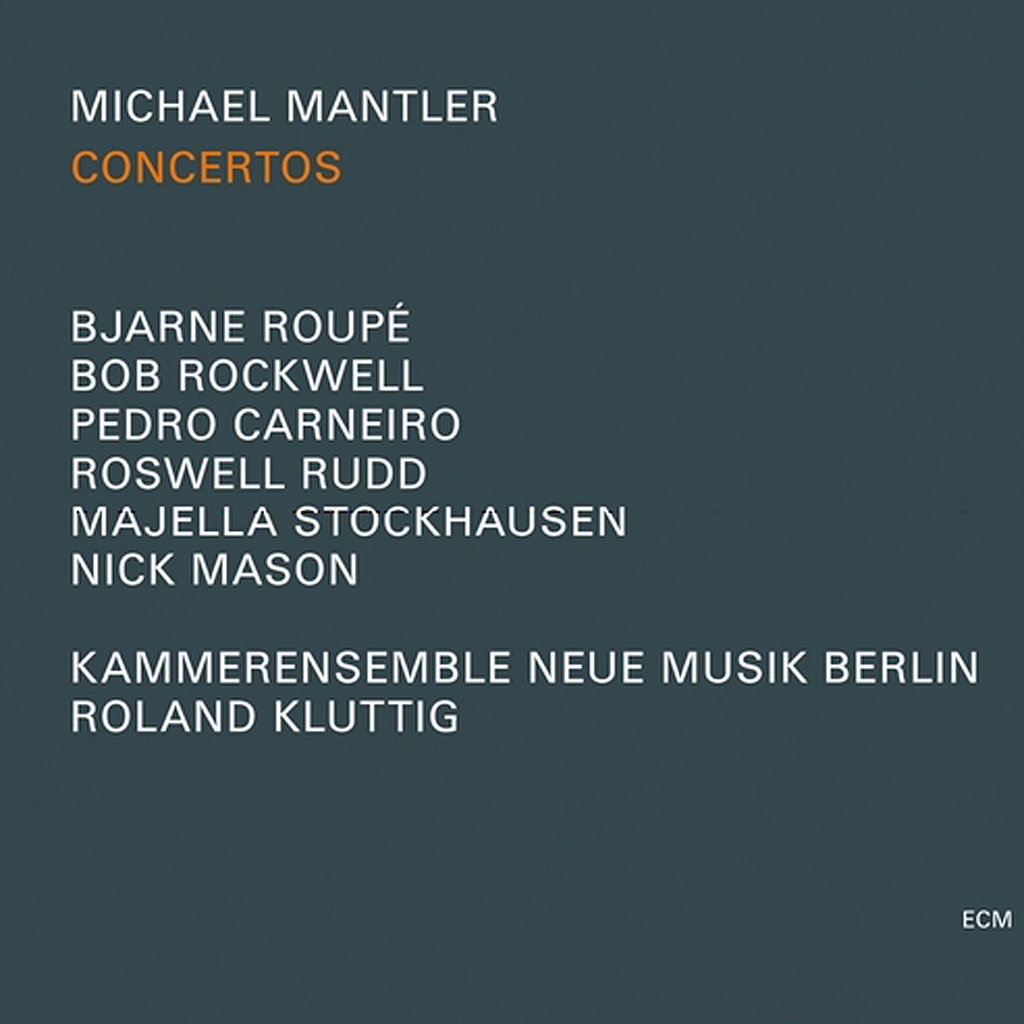
Michael Mantler: CONCERTOS (ECM 2054)


Michael Mantler
CONCERTOS

Michael Mantler trumpet
Bjarne Roupé guitar
Bob Rockwell saxophone
Pedro Carneiro marimba, vibraphone
Roswell Rudd trombone
Majella Stockhausen piano
Nick Mason percussion
Kammermusikensemble Neue Musik Berlin
Roland Kluttig conductor
Recorded November 2007
Kaleidoscope Sound, Union City, NJ
RBB Radio Studio 2, Berlin
Studios La Buissonne, Pernes-Les-Fontaines

As one who grew up in the polarized Vienna music scene, journeyed at 19 to New York (where he founded the Jazz Composers’ Orchestra and the WATT music label), and returned to Europe in 1991, Michael Mantler is, writes Bert Noglik in his liner notes, “truly nowhere at home, a drifter seasoned in the role of creative outsider, uniting the perspective of two continents and two cultures. He views music from the twin vantage points of the elaborated European tradition and the American rebellion in jazz—a rebellion that sought to topple every convention applicable to date.” This is Mantler’s first album of new material since 2000’s Hide and Seek and a lively testament to an ever-productive musical mind. Like the far-reaching constructions of Heiner Goebbels, Mantler never fails to work his indiscriminate way into our attention, even if his expressive quirks thrive on a rather different brand of theatricality.

The present album is a series of seven self-styled “concertos,” each scored for a different soloist along with a chamber ensemble under the direction of Roland Kluttig, whom Eberhard Weber listeners may remember from his Stages Of A Long Journey. All of the solo instruments are included (with the possible exception of the saxophone) in the ensemble at large at some point throughout the album, each surfacing like a jazz soloist in a protracted suite.

The first concerto, Trumpet, features Mantler himself as soloist. His improvisations are clear, acute, and vocal in character, acting with the confidence of a seasoned performer (somewhat ironic, given that Mantler is known for his reticence in this regard). Any agitation to be found in this piece is undercut by whimsy. Compelling Rypdal-like strains from Bjarne Roupé temper Mantler’s jagged lines while also providing a lovely segue into the guitar concerto that follows. The latter is a far more delicate piece relative to its surroundings. Brass and winds clamber for a view on the sidelines as piano and guitar frolic in the center toward a transcendent finish. Saxophone feels confined at first, but opens up as the violins gather clout. A marimba warms the air before taking center stage. MarimbaVibe is the most disturbed turn of phrase, caroming uncontrollably between disparate spheres of influence. It ends on another enigmatic note, made all the more ethereal for its indifference. Jazz Composers’ Orchestra veteran Roswell Budd is phenomenal in Trombone. His soulful sound cries with an almost street-savvy flair in the narrative of a life lived on the margins, yet which is anything but marginal in the centrality it occupies here. Its bursts of energy, always co-opted by a certain dismal zeitgeist, make for an honest though hard-to-swallow tale. Piano brings our attention to a voice that has been an integral presence for most of the album thus far. It is the instrument from which all of this music has sprung, yet which now desires its own liberation from acoustical symbiosis. It’s a rather “messy” piece, like a sharp image evenly smeared with finger-paints that attains its own abstract cohesion: an impossible kaleidoscope, devoid of symmetry. The dynamic performance here comes from Majella Stockhausen, daughter of the late Karlheinz. The final concerto, Percussion, is no less musical than its predecessors. Pink Floyd’s Nick Mason provides the beat, ringing out his snare with the conviction of a melodic battalion and bringing the album to a fine close with his delicate cymbal work.

Listening to Mantler is an experience that only grows with time. His music is fully invested in its own knowledge production and is never afraid to flaunt it in a world in which resonance has become a long-lost dream. It speaks in poetry, but moves in prose. Or is it the other way around?

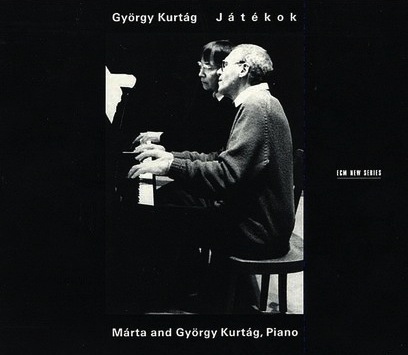
György Kurtág: Játékok (ECM New Series 1619)

György Kurtág
Játékok

Márta Kurtág piano
György Kurtág piano
Recorded July 1996, Mozart-Saal, Konzerthaus, Vienna
Engineer: Stephan Schellmann
Produced by Manfred Eicher

According to the classic formulation of Swiss psychologist Jean Piaget, play is a vital component of our preverbal development. As the child moves from away from mere imitation to more substantial activities in which representation plays a key role, s/he begins to develop a clearer sense of subjectivity, itself a game insofar as it requires a performance bound to both written and unwritten social guidelines. For Piaget, games can be classified as “practice” (pedagogical), “symbolic” (representational), or “games with rules.” What is most important about a game in the latter sense is that everyone involved agrees upon its parameters. This the whimsical challenge of György Kurtág’s Játékok (Games), which by its very titling and denouement seems to hollow out shelter in all of Piaget’s categories even as it sets a table upon which rules are served to be devoured. And while the task may fall upon its performers to uphold those rules throughout, this music also invites the listener to play along.

Játékok grew out of a snag in Kurtág’s own formative period, during which the seeds of this ever-expanding opus were planted. It consists primarily of miniatures, each bearing a dedication to an important figure in the composer’s life. Most hardly exceed one minute in length. Though begun as a collection of children’s etudes, not unlike Bartók’s seminal Mikrokosmos, the project soon grew into its own entity, and Kurtág found himself unable to staunch the wellspring it had uncovered. Over time it has donned more autobiographical clothing. Four pillars in the form of Kurtág’s own moving Bach transcriptions bolster these selections from eight volumes, ranging from the microscopic to the leviathan, the fleeting to the infallible. Between these are strung more pliable thematic ropes from which swings the blissful abandon that sustains them. These signposts, and especially “Gottes Zeit ist die allerbeste Zeit,” are thrown into fullest relief by the erratic chiseling of the two pianists. As husband and wife, György and Márta Kurtág bring their own lives to bear. Flirtations and arguments are, if you will excuse the pun, fair game here, all of which seek to reenact the stages of a life begun and ended at the piano. Theirs is a romantic performance of anti-romantic music, one that constantly trips over itself in its attempts to smile.

Játékok is an all-around delight. As an exercise in precision and trust in equal measure, it continually adapts to its own shape and self-awareness. As a veritable refinery of ideas, in it we may find plenty of jewels we might swear we’ve seen before. The recording is fresh and alive, the music even more so, and fully severs any roots it might ever have had in the avant-garde. Come to it as you are, and leave it content in knowing what you were.

<< Heinz Holliger: Lieder ohne Worte (ECM 1618 NS)
>> Shostakovich/Vasks/Schnittke: Dolorosa (ECM 1620 NS
)

Arvo Pärt: Alina (ECM New Series 1591)

Arvo Pärt
Alina

Vladimir Spivakov violin
Sergev Bezrodny piano
Alexander Malter piano
Dietmar Schwalke cello
Recorded July 1995, Festburgkirche, Frankfurt am Main
Engineer: Markus Heiland
Produced by Manfred Eicher

When this album was first released I was already a longtime listener of Arvo Pärt and quite accustomed to experiencing his sound in large-scale form. The grandiosity of other seminal ECM recordings, such as his popular Te Deum and epic Passio, left me with a vision of a composer with vast canvases to fill. Alina changed all that when I loaded it into my CD player, only to hear the most sublime understatement to ever issue from my speakers. Says Pärt, “I could compare my music to white light which contains all colours. Only a prism can divide the colours and make them appear; this prism could be the spirit of the listener.” And indeed, this album is a mise-en-abyme of airy beauty.

Tripartite structures abound in Alina.

First, they form the guiding principle of Pärt’s musical ideology, which embraces the triad as alpha and omega. It is no coincidence, then, that the album’s title piece marked the inauguration of his “tintinnabuli style,” which has since been his calling card, as it were, in a genre-hungry marketplace. Originally a two-minute piece, its extended treatment here peels away layers of possibility residing in the score. Recorded in the presence of the composer, each repetition seeks its own segue into silence.

Second, the tracks are symmetrically ordered:

1. Spiegel im Spiegel (violin and piano)
2. Für Alina (solo piano)
3. Spiegel im Spiegel (cello and piano)
4. Für Alina (solo piano)
5. Spiegel im Spiegel (violin and piano)

This rigidity ensures that any complex posturing is shunned in favor of direct communion. Despite their sparse instrumentation, the three versions of Spiegel im Spiegel comprise Pärt’s most spacious statement ever committed to disc. Each is like an edge of his metaphorical prism, bending light into hues that one can almost taste in the listening. One might easily criticize this approach as a halfhearted attempt to fill a disc were it not for the profound indeterminacy throughout. It is in this sense that the cello in the central incarnation sighs like an exhausted organ sending its final pulses straight into the heart of a period passed in quiet humility.

Third, the album is situated at the intersection of three planes of existence: the spatial, the bodily, and the vibrational. The piano’s own resonant interior speaks precisely of its external effect, thereby establishing a striking continuity between the details of its construction and the boundless receptacle that is the listener’s mind. The music speaks, because it knows no other way of communicating. It is the voice that whispers at the edge of sleep, that ever so slightly indecipherable instinct at the heart of selfless wishes.

As I listen to this album again, the patter of raindrops outside my window provides a fitting backdrop to the sheer grace of its first arpeggios. This weather lends the music a liquid shield around every note, turning each into an earthbound droplet. Alina is filled with more emptiness than substance, all the while forming through that emptiness a substance far greater than its own vocabulary can express. It enacts a unique sort of transfiguration which, through the quietude of its own coalescence, ends up turning into itself.

<< Erkki-Sven Tüür: Crystallisatio (ECM 1590 NS)
>> Arvo Pärt: Litany (ECM 1592 NS)

Giya Kancheli: Abii ne viderem (ECM New Series 1510)

Giya Kancheli
Abii ne viderem

Kim Kashkashian viola
Vasiko Tevdorashvili voice
Natalia Pschenitschnikova alto flute
The Hilliard Ensemble
Stuttgarter Kammerorchester
Dennis Russell Davies conductor
Recorded April 1994
Engineer: Peter Laenger
Produced by Manfred Eicher

My first exposure to the music of Giya Kancheli, with which the composer once said, “I feel more as if I were filling a space that has been deserted,” was through Exil, which remains in my opinion the finest ECM New Series release to date. Much in contrast to the tearful beauty of that most significant chamber album, the orchestral arrangements on Abii ne viderem—drawn as they are from the same thematic sources—lend extroverted articulation to essentially “monastic” material. This music may speak the same language, but in a far more distant dialect. The Life without Christmas cycle, from which two pieces bookend the present recording, is central to the Kancheli oeuvre. Not only is it his wellspring, but it also comprises, it would seem, the overarching worldview under which he musically operates. It is the gloom of a life of displacement, the full embodiment of what Hans-Klaus Jungheinrich calls “measured gravity,” which may perhaps be likened to the heavy emptiness of Tarkovsky’s Stalker. As in said film, every gesture makes a footprint, a remnant of human presence left to sink into the submerged wasteland of a silent future.

Morning Prayers (1990) is immediately distinguished by an angelic boy soprano, whose taped voice is never fully grounded but which hovers throughout. The piano adds another haunting element, seeming to pull at the barbed ends of nostalgia even as it pushes the orchestra down a flight of descendent chords. Occasional violent moments startle us into self-awareness and only serve to underscore the power of the prayers that surround them. The most profoundly effective moment occurs when the piano echoes in a dance-like theme, the orchestral accompaniment slightly off center—a distant memory ravaged by time and circumstance.

The title of the album’s central piece, Abii ne viderem (1992/94), translates to “I turned away so as not to see.” The more one listens to it, the question becomes not what is being turned away from but what is being observed upon turning. Its paced staccato bursts are linked by a profound silence, escalating with every reiteration. This silence eventually opens into a full orchestral statement, italicized again by the piano’s audible pulse. We find ourselves caught in the middle of a larger web of sentiments, until we can no longer see ourselves for who we are but only for who we have been. Personally, I find this piece to be a touch overbearing, if only because the import of its ideas is easily crushed by the heft of its dynamic spread.

The presence of the Hilliard Ensemble rescues Evening Prayers (1991) from the didacticism of its predecessor. It is a more fully unified narrative, linked by a lingering alto flute. A gorgeous “ascension” passage marks a rare contrapuntal moment for Kancheli, while David James’s voice creates magic, ever so subtly offset by a skittering violin. Occasional bursts, some punctuated by snare drum, break the mood and ensure that our attention is held. Inevitably, the piece ends like a ship sailing into a foggy ocean, leaving behind only a blank map to show for our travels.

Don’t let any comparisons to Arvo Pärt lure you astray. Kancheli’s music, while transcendent, cannot be divorced from its rootedness in upheaval. And while this album may be filled with beautiful moments, I cannot help but feel that something gets elided in these grander arrangements. I say this with the gentlest of criticisms, and perhaps only because my first foray into this world was on such a small scale. The sound of Exil stays with me, and sometimes I just cannot hear it in any other context, and for those wishing to hear this composer for the first time I would recommend starting there. That being said, the scale of these pieces makes them no less evocative for all their historical understatements and sensitivity. And perhaps that is Kancheli’s underlying observation: that, in our current climate of convalescent ideologies, all we have to hold on to are those rare flashes of fire in which our communion with something greater has transcended the rising waters of sociopolitical corruption.

<< Egberto Gismonti Group: Música de Sobrevivência (ECM 1509)
>> John Abercrombie Trio: Speak Of The Devil (ECM 1511)

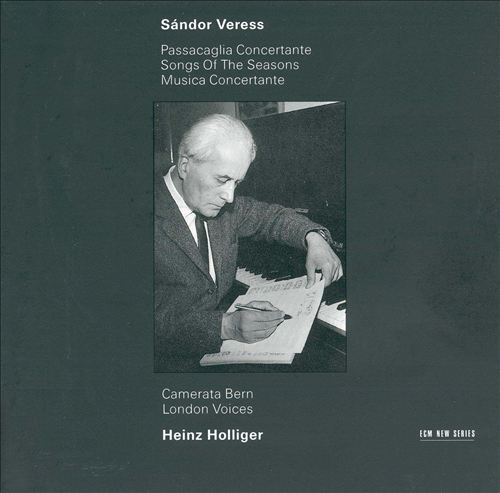
Sándor Veress (ECM New Series 1555)

Sándor Veress

Camerata Bern
London Voices
Heinz Holliger oboe and conductor
Recorded February 1993, Salle de Musique, La Chaux de Fonds
January 1992, BBC Maida Vale Studio, London
Engineers: Andreas Neubronner and John Whiting

I set off from my beautiful fatherland,
My little, glorious Hungary.
Halfway, I turned and looked back
And my eyes were filled with tears.

Hungarian-born Sándor Veress (1907-1992) is a sadly neglected figure in modern music. Despite his pupilage under Bela Bartók and Zoltán Kodály, and even his succession over the latter as professor of composition at the Budapest School of Music in 1943, Veress has never attained the same international recognition as his two most successful compatriots. One might blame his preference for solitude or his idiomatic methodology for keeping him in obscurity. Yet as one who made the most of his outlier status and ideological exile, he seems never to have been one to wallow in self-pity. Exposed to much of the folk music that also captivated his mentors, Veress nurtured that same spirit when sociopolitical upheaval exacerbated his emigration to Switzlerland in 1949. Whereas Kodály in particular saw cultural preservation as central to the musical act, Veress saw it as an incision to be teased open and unraveled.

Veress was as much a giver as he was a receiver of compositional heritage, and himself provided valuable tutelage throughout his career to such pioneers as György Ligeti, György Kurtág, and, most significantly here, Heinz Holliger, for whom the opening Passacaglia Concertante (1961) for oboe and string orchestra was written. Veress’s fondness for the oboist extraordinaire is palpable in every measure of this impassioned recording. The first plucked string is like an idea dropped into water, from which viola-heavy interpretations issue with the force of an approaching storm. The meticulous Allegro scherzando is an enthralling realization of concise melodrama, while the relatively protracted third movement maintains a dark tension throughout, ever heightened by Holliger’s circular sustains and tonal acuity. The piece’s somber ending leaves us with much to ponder as we wander into the seven madrigals known as Songs Of The Seasons (1967). These mixed choir settings of poems by Christopher Brennan (1870-1932), an Australian poet whose lack of affiliation and anti-lyricism primes him for the clustered treatment he receives here, are rife with potent themes: dreams and the fragility of time and place, the musicality of the body as an emotive instrument, the ever ineffable springtime, sunlight as soul and its expansion into the oneness of all, and flickering images of a past love all intermingle in a playful exposition of language. The “sweet silence after bells” of Part IV is especially redolent, and in it one can hear shades of Holliger’s own vocal writing just two decades later. Where the Songs are effervescent and whimsical, the Musica Concertante (1966) for twelve strings is highly centrifugal. As a chamber work modeled after Bach’s third and sixth Brandenburg Concertos, it looks beyond its own formulaic outline even as it cowers within it, happily merging disparate streams and leaving us with a river to be reckoned with as we continue to wade against the current of an unrelenting music industry in which such voices are all too easily forgotten.

<< Terje Rypdal: If Mountains Could Sing (ECM 1554)
>> Michael Mantler: Cerco Un Paese Innocente (ECM 1556)

Jan Garbarek/The Hilliard Ensemble: Mnemosyne (ECM New Series 1700/01)

Mnemosyne

Jan Garbarek tenor or soprano saxophones
David James countertenor
Rogers Covey-Crump tenor
John Potter tenor
Gordon Jones baritone
Recorded April 1998, Propstei St. Gerold
Engineer: Peter Laenger
Produced by Manfred Eicher

“And the strict lord Death bids them to dance.”
–Jof, The Seventh Seal

To anyone who ever wondered why the Officium project needed a successor, this album provides a formidable answer. Whereas in its first effort this fearless fivesome built a program around relatively structured material, hundreds of concert performances and subsequent additions to their repertoire led the Hilliard Ensemble and saxophonist Jan Garbarek to the veritable medicine bag of expansive ideas that is Mnemosyne. Their deeper surrender to the art of improvisation makes for an even more self-aware effort this time around, and the resulting double album is nothing short of remarkable.

Spanning over three millennia, the uncannily cohesive program takes the project to unexpected heights. Its opening Quechua Song epitomizes the inner harmony of this inimitable partnership; a union that, not unlike the music it produces, is fleshed out through countless fragments drawn from worldly sources. While familiar territories abound—among them pieces by Tallis, Dufay, and Tormis—the addition of tenor and soprano saxophones renders them beautifully arcane. Even during those pieces in which the Hilliards sing alone, Garbarek’s presence is ever felt, hovering like a shadow in the corner of our vision. A particularly impassioned rendition of an Antoine Brumel Agnus Dei provides one of the strongest cases for this vocal/instrumental combination, as Garbarek expels an intensely visceral song that both scales the highest reaches and plumbs the shallowest coves of his surroundings. Though the album may have its weak moments (the medieval Novus novus, for example, is a little too compact to allow much room for a “fifth voice”), these are few and far between. In any case, the commitment that binds them never wavers, so that by the end of the first disc, which is capped by Hildegard von Bingen’s stunning O ignis spiritus, we realize this project has attained an entirely new level of melodic unity and ethereality. As the pièce de résistance of this collection, O ignis rises in a class of its own, made all the more unrepeatable by Rogers Covey-Crump’s inscriptions of untold mythologies. The haunting Hymn to the Sun by Mesomedes of Crete (2nd century) is another radiant success that writhes in captivating pangs of resolution. I must also commend Garbarek for his own two compositional entries: Strophe and Counter-Strophe, which makes attentive usage of the Hilliards’ variegated range, and Loiterando, with its likeminded choral astuteness and finely attuned brassy ornaments, both widen the scope of possibilities to be discovered.

In his monograph The Passion of Ingmar Bergman, Frank Gado argues that The Seventh Seal “is not radically about death at all; rather, it focuses on the terror of emptiness in life.” Similarly, the music of Mnemosyne preaches transcendence even as it gazes quietly upon the earth at its feet. That the album artwork is plastered with images from the selfsame film is no mere coincidence. The synthesis of sound and silence is like that of life and death: the two can never be entirely separated. What we have here is neither fusion nor a hybrid musical form. It is a perfectly symbiotic meeting of minds that banishes the darkness of criticism with its vigorous light. David James shows particular strength with every step he takes down these newly indeterminate paths, Covey-Crump and John Potter form a beautifully harmonized center, and Gordon Jones is the ever-present anchor of this darkly striated vessel. As for Garbarek, one can only listen and be enlightened.

<< András Schiff: Schubert C-major Fantasies (ECM 1699 NS)
>> John Surman: Coruscating (ECM 1702
)