Steve Reich: Octet / Music for a Large Ensemble / Violin Phase (ECM New Series 1168)

Steve Reich
Octet / Music for a Large Ensemble / Violin Phase

Russ Hartenberger marimba
Glen Velez marimba
Gary Schall marimba
Richard Schwarz marimba
Bob Becker xylophone
David Van Tieghem xylophone
James Preiss vibraphone
Nurit Tilles piano
Edmund Niemann piano
Larry Karush piano
Steve Reich piano
Jay Clayton voice
Elizabeth Arnold voice
Shem Guibbory violin
Robert Chausow violin
Ruth Siegler viola
Claire Bergmann viola
Chris Finckel cello
Michael Finckel cello
Lewis Paer bass
Judith Sugarman basse
Virgil Blackwell clarinet
Richard Cohen clarinet
Mort Silver flute
Ed Joffe soprano saxophone
Vincent Gnojek soprano saxophones
Douglas Hedwig trumpet
Marshall Farr trumpet
James Hamlin trumpet
James Dooley trumpet
Recorded February 1980 at Columbia Recording Studios, New York; March 1980 at Tonstudio Bauer, Ludwigsburg (Violin Phase)
Engineer: Martin Wieland
Produced by Manfred Eicher

Have you ever repeated a word over and over again until it loses meaning? Cognitive science calls this “semantic satiation.” Now imagine that someone could do the same thing for instruments and you’ll have a clear idea of the power of a Steve Reich composition. In this selection of three longer examples, we get exactly that: an unraveling of music’s genetic code, transformed from within. It is for this more than any other reason that I’ve always been wary to use the word “minimal” in reference to Reich’s music, which is endlessly complex and never fails to engender new discoveries with every listen.

The instruments in Music For A Large Ensemble fit perfectly in a vast sequence of aural DNA, as logical as it is mystifying. Every voice is given ample breathing room in a piece that, while densely layered, is as airy and ordered as a puff of windblown dandelion. Strings waver with the unrelenting heat of a desert sun, horns ebb and flow in a brassy wash of equilibrium, and a vibraphone rings out like magic over all. Although the music moves mechanically, its feel is decidedly organic. This earthiness is maintained in the Violin Phase, which consists of a repeated motif that, as with all of Reich’s “phase” pieces, is knocked just slightly out of alignment by the doubling voice, like two turn signals rhythmically staggering and realigning. This is the most localized of Reich’s phases, clearly rooted as it is in the bluegrass fiddling tradition. The violin grinds like dirt or sand, small particles swirling and separating yet holding fast to some invisible predictability. After two such strikingly different pieces, the Octet somehow comes across as the most intimate. The inclusion of wind instruments, and in particular the clarinet and flute, adds a crystalline contrast in texture and melodic shifts, bringing us to a glorious and sudden silence.

Albums like this and Music for 18 Musicians will easily make one lose track of time. I am so often taken aback when this music ends, for it pulsates with such a robust sense of perpetual motion that its effect always seems to linger somewhere inside me. It is a tessellation in sound, each image shifting through time and space like an Escher print, so that what begins as a diamond ends up a bird in flight. Naturally, the sheer precision required to play Reich’s music is a feat in and of itself. That such a synergistic cast of musicians could arise out of the work of one composer is by all turns spectacular, and when so lovingly recorded their cumulative effect is all the more heightened. This is music that finds its expansiveness internally, charting the endless waters of our biological oceans until we come to our beginnings anew.

Wolfgang Dauner: Output (ECM 1006)

1006

Wolfgang Dauner
Output

Wolfgang Dauner piano, effects (ring modulator), keyboards (Hohner Electra-clavinet C)
Eberhard Weber bass, cello, guitar
Fred Braceful percussion, voice
Recorded September 15 and October 1, 1970 at Tonstudio Bauer, Ludwigsburg
Engineer: Kurt Rapp
Produced by Manfred Eicher
Release date: December 1, 1970

An early outlier in the ECM catalog, Output convulses with as much originality as it did when it was first released. Wolfgang Dauner, perhaps better known as founder of the United Jazz + Rock Ensemble (which saw ECM greats Eberhard Weber, Kenny Wheeler, and Charlie Mariano pass through its doors), assembles a modest trio of talent for this classic 1970 studio free-for-all. The end result is humor, brilliance, and chaos rolled into one. Most of the album flirts with any number of possible paths, the sole exception being “Nothing To Declare,” a straight-laced tangent into jazzy territory in which Dauner has a field day with his modulator. “Mudations” and “Brazing The High Sky Full” are cryptic bookends, while tracks like “Abraxas” whet our appetite with provocative flavors.

Output

Superb, if jumbled, musicianship and strong attention to detail are the order of the day. Dauner does wonders with limited means, Braceful sheds his skin whenever possible, and this is a far cry from the Weber of languid orchestral suites. Not an easy listen for the faint of heart, but one that will give back what’s put into it and, like the fully opened cover, gathers its power from another dimension.

<< The Music Improvisation Company: s/t (ECM 1005)
>> Jan Garbarek Quartet: Afric Pepperbird (ECM 1007)

The Music Improvisation Company: s/t (ECM 1005)

1005

The Music Improvisation Company

Derek Bailey electric guitar
Evan Parker soprano saxophone
Hugh Davies live electronics
Jamie Muir percussion
Christine Jeffrey voice
Recorded on August 25-27, 1970 at Merstham Studios, London
Engineer: Jenny Thor
Produced by Manfred Eicher
Release date: November 1, 1970

Derek Bailey is a pioneer of British free improvisation, and although this is one of his earliest recordings, it houses much of what he would come to be known for: microscopic precision, a love of empty space, a supremely fractured aesthetic, and a subtle disregard for the rules. As with his later solo outings and fruitful collaborations with John Zorn and other bastions of the avant-garde, Bailey brings full commitment to the table in this early, digitally reissued ECM recording. Yet how to describe it? A possessed duck call tripping down a flight of stairs into a pile of discarded instruments? A broken jack-in-the-box heavily amplified on cheap speakers? A radio being tortured to give up its innermost secrets? None of these comes close to mapping the album’s rambling course. Still, the results are consistent. So much so that track titles like “Packaged Eel” do nothing to deepen our understanding of the goings on. As can be expected from the roster, the musicianship is of indisputable quality. Evan Parker awes with his outbursts of indiscernible melody while Bailey cultivates an anonymous approach, cutting in and out from behind a surgeon’s mask.

The Music Improvisation Company is nothing more or less than what one makes of it. Its difficulties are also what make it go down smoothly. A mysterious morsel that yields a new flavor with every taste.

<< Marion Brown: Afternoon Of A Georgia Faun (ECM 1004)
>> Wolfgang Dauner: Output (ECM 1006)

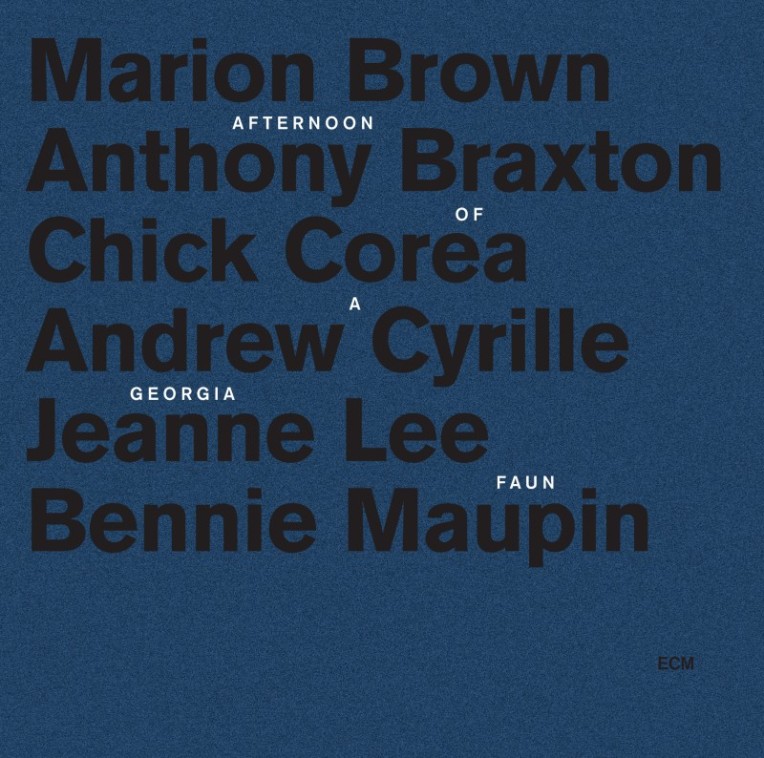
Marion Brown: Afternoon Of A Georgia Faun (ECM 1004)

1004

Marion Brown
Afternoon Of A Georgia Faun

Marion Brown alto saxophone, zomari, percussion
Anthony Braxton alto and soprano saxophones, clarinet, contrabass clarinet, Chinese musette, flute, percussion
Bennie Maupin tenor saxophone, alto flute, bass clarinet, acorn, bells, wooden flute, percussion
Chick Corea piano, bells, gong, percussion
Andrew Cyrille percussion
Jeanne Lee voice, percussion
Jack Gregg bass, percussion
Gayle Palmoré voice, piano, percussion
William Green top o’lin, percussion
Billy Malone African drum
Larry Curtis percussion
Recorded August 10, 1970 at Sound Ideas Studio, New York City
Engineer: George Klabin
Produced by Manfred Eicher
Release date: November 15, 1971

A subtle congregation of clicks, pops, breaths, and whistles eases us into this challenging yet rewarding recording from a mobile group of musicians, many of whom—Jeanne Lee, Anthony Braxton, Chick Corea, Bennie Maupin, and Marion Brown himself—are now household names in the avant-garde circuit. Over 35 minutes we are treated to a distilled experience that jumps, flies, and slithers its way through a forest of sounds. The arrangements are heavy on reeds and percussion, with star turns from one severely abused piano and a smattering of aphasic human voices who seem bent on reducing all communication to wit and circumstance. The music is indeterminate and uncompromising and unleashes its full torrent only in the second movement, “Djinji’s Corner.” Slide whistles, snares, and bass join in the cacophony as a voice intones, “Listen to me. Can you hear?”—at last giving us some vocabulary to latch on to as we suffocate under a voracious avalanche.


Original cover

Not an album for the faint of heart, Afternoon is indicative of the brave decisions ECM was already making on its fourth release, and on it one begins to hear inklings of the space for which ECM would soon come to be known. It is also meticulously recorded. Every detail comes through (for example, when a percussionist picks up bell and rings it, we clearly hear it being returned to a cloth-dampened surface). Describing the sound of this album is, I imagine, as difficult as it was to lay it down in the studio. The sheer range of implied space is impressive, made all the more so for its organic textures. A masterpiece of free jazz and well worth the chance for the adventurous listener.

<< Paul Bley Trio: Paul Bley with Gary Peacock (ECM 1003)
>> The Music Improvisation Company: s/t (ECM 1005)

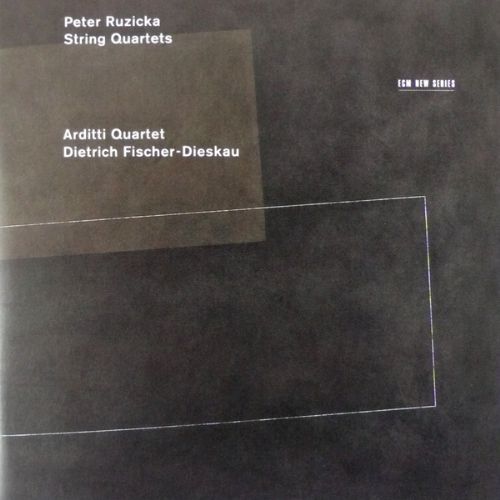
Peter Ruzicka: String Quartets (ECM New Series 1694)

Peter Ruzicka
String Quartets

Arditti Quartet
Irvine Arditti violin
Graeme Jennings violin
Garth Knox viola
Rohan de Saram cello
Dietrich Fischer-Dieskau speaker
Recorded December 1996 and October 1997, WDR Cologne and Immanuelkirche Wuppertal
Engineers: Mark Hohn and Christian Meurer
Produced by Harry Vogt (ECM co-production)

“Die Musik in mir.
Die Musik, die im Schweigen ist, potentiell,
möge sie kommen und mich erstaunen.”
–Paul Valéry

In astrophysics, basic string theory posits that the known universe can be understood through a successful marriage of quantum mechanics and general relativity. Each “string” represents a unique atomic signature with which all physical matter is composed through vibrational fields. In order to explain string theory to us laypeople, physicists analogize these vibrations with those of an instrument: each string is capable of producing a variety of notes depending on where the cosmic finger is placed on the fretboard. The string quartets of German composer and conductor Peter Ruzicka, collected for the first time in this landmark recording, demonstrate this theory with and without words. Through a distinct micropolitics of sound, Ruzicka uses instruments not to make a declamatory statement, but to evince an unstable question. The title of Ruzicka’s third quartet, …über ein Verschwinden (…about a disappearance), is about as succinct a description as one could hope to formulate in regards to his music. Ruzicka’s sound world is sparse, comprised as much by empty spaces as by audible gestures. These spaces, the very ether through which the music flows, are rich with conceptual integrity.

This is music that inhabits its own edges. It bids our silence when it speaks, provokes our speech when silent. The quartets are riddles in and of themselves, even if they contain everything we need for their solutions in plain view. The keys are in the titles. Klangschatten (Soundshadows) is more about effect than about process and seems to disavow its own origins by reflecting those of the listener, separating these two histories with a huge sheet of darkness. The second quartet, „…fragment…”, is a laconic pentaptych of self-styled “epigrams.” Introspezione, subtitled as a “documentation for string quartet,” navigates an introspective matrix filled with quotation marks, question marks, and exclamation points, but not a single period. The fourth quartet, „…sich verlierend” (…are losing) for string quartet and speaker, is an intriguing anomaly. Because so much of Ruzicka’s music is already “spoken,” the entry of a human voice seems quite natural, as if it had been there all along. The music is not incidental to the voice, but rather the voice incidental to the music.

In his liner notes, Thomas Schäfer informs us of Ruzicka’s disinterest in grand narratives and his preference for the in-between. For all their galactic reach, the quartets are utterly rooted in the terrestrial. The third quartet, for example, sounds like George Crumb’s Black Angels stripped of its explosive core and shredded by wind. Violins scratch out their incantation, figures moving in crude stop-motion. Other quartets abound in allusions from Gesualdo to Mahler to Webern in what the composer terms moments of “full identification.” Ironically, however, in such surroundings even the most familiar music seems to come from a distant planet, having reached us by some unimaginably powerful intergalactic signal. And when we do recognize it, we are awed to learn it has come from an abstract “out there.” In the end, it is silence that rules this album, so that any violence that erupts consumes us completely. These are the moments Ruzicka would seem to live for, when the intensity of experience can only be expressed by its sudden disappearance.

<< Evan Parker Electro-Acoustic Ensemble: Drawn Inward (ECM 1693)
>> Patrick and Thomas Demenga: Lux Aeterna (ECM 1695 NS
)

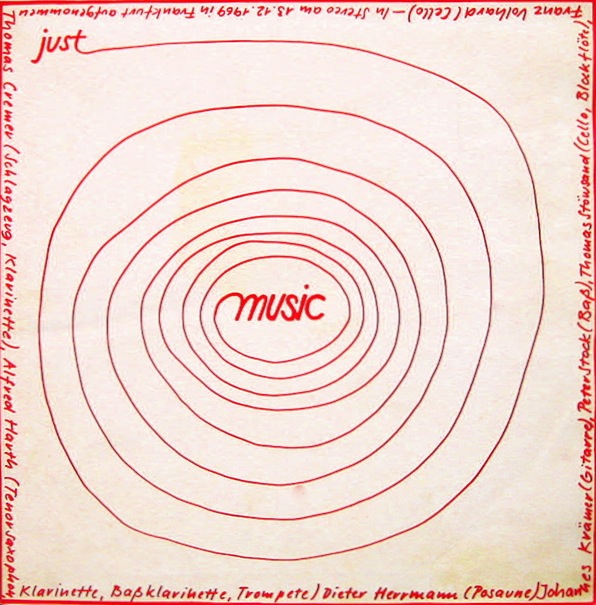
Just Music: s/t (ECM 1002)

1002

Just Music

Peter Stock bass
Franz Volhard cello
Thomas Stöwsand cello, flute
Johannes Krämer guitar
Thomas Cremer percussion, clarinet
Alfred Harth tenor saxophone, clarinet, trumpet
Dieter Herrmann trombone
Recorded on December 13, 1969 at the Nettekoven Studios, Frankfurt am Main
Produced by Just Music and Manfred Eicher
Release date: May 1, 1970

Just Music was the moniker for a rotating West German collective whose musical “happenings” were a nascent challenge to mainstream sociopolitical strictures. Although the classical training of these musicians is readily apparent from their technical prowess, the opening outburst tells us we’re in for something less rule-bound. Alfred Harth tears the ether with his sax amid wordless chanting as a cornucopia of musical ideas is thrown into our ears. That said, these two 20-minute free-for-alls weave a quietude broken only by the occasional peak of intensity.

Just Another Music
Alternate cover

Released in 1969, this self-titled date was the second for ECM Records and is still out of print. It remains a veritable zoo of musical languages in which each dialect is its own animal: caricature of an impossible ideal. Sax and trombone roar like elephants; the flute is a bird that would just as soon go into feathery convulsions as fly; the cellos are reptilian; the bass lumbers like a lion from its den; drums trip over themselves like a drowsy bear; and a guitar chatters with the insistence of an agitated monkey. This leaves only the human voices, a mockery in and of themselves. Just Music flips through a mental file of everything learned at the academy, scribbling in addendums of extended techniques for good measure. Where one moment finds us in our comfort zones, the next proves our power of direction to be fallible, forcing us to wander everyday streets as if for the first time.

I hesitate to call this controlled chaos, for it is no less illustrative of the chaos of control. We may not understand what we have just witnessed, but can’t help sifting through the wreckage with curiosity.

<< Mal Waldron: Free at Last (ECM 1001)
>> Paul Bley Trio: Paul Bley with Gary Peacock (ECM 1003)

Eleni Karaindrou: Elegy of the Uprooting (ECM New Series 5506 & 1952/53)

Eleni Karaindrou
Elegy of the Uprooting

Maria Farantouri voice
Vangelis Christopoulos oboe
Socratis Sinopoulos Constantinople lyra, laouto
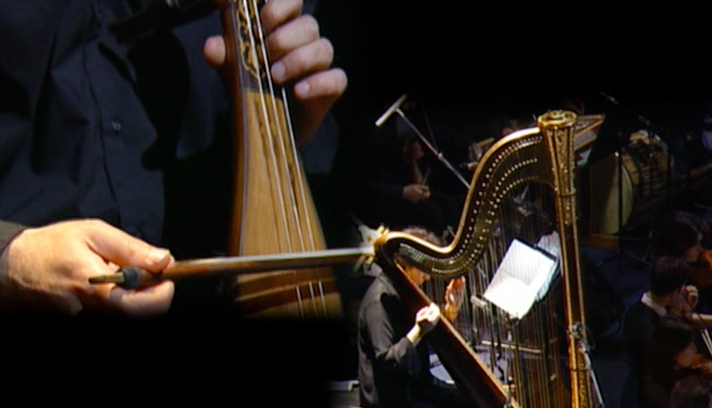
Maria Bildea harp
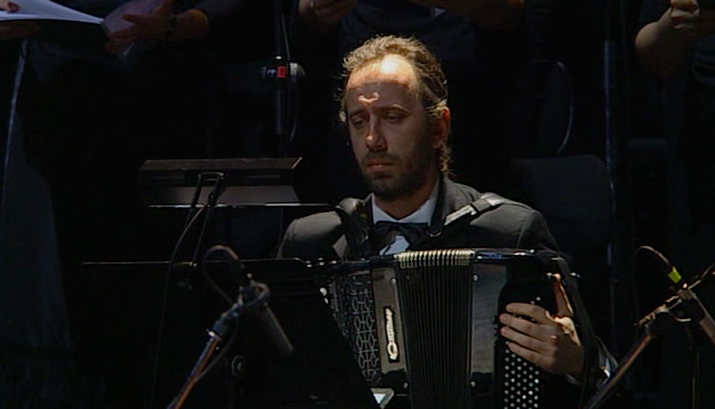
Konstantinos Raptis bayan
Sergiu Nastasa violin
Renato Ripo violoncello
Stella Gadedi flute
Nikos Guinos clarinet
Sopcratis Anthis trumpet
Spyros Kazianis bassoon
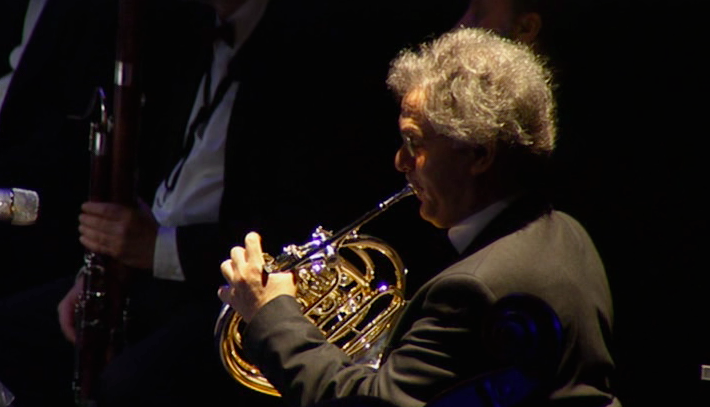
Vangelis Skouras French horn
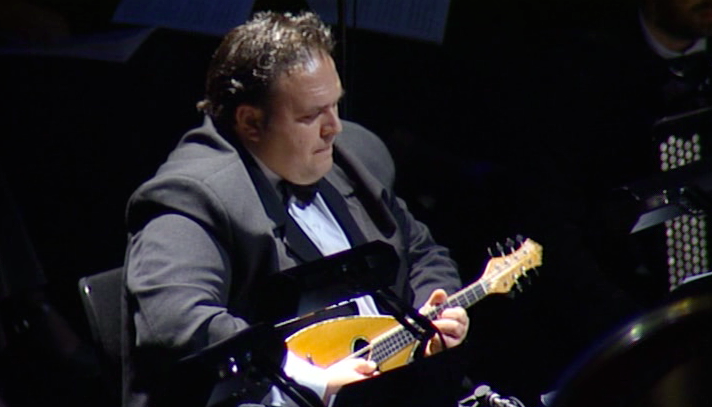
Aris Dimitriadis mandolin
Christos Tsiamoulis ney
Panos Dimitrakopoulos kanonaki
Andreas Katsiyiannis santouri
Andreas Papas bendir, daouli
Eleni Karaindrou piano
Hellenic Radio and Television Choir
Antonis Kontogeorgiou choirmaster
Camerata Orchestra
Alexandros Myrat conductor
Recorded live March 27, 2005 at Megaron (Hall of the Friends of Music), Athens
Engineers: Nikos Espialidis, Andreas Mandopoulos, and Bobby Blazoudakis
Produced by Manfred Eicher

“What am I, if not a collector of vanished gazes?”
–Theo Angelopoulos, Ulysses’ Gaze

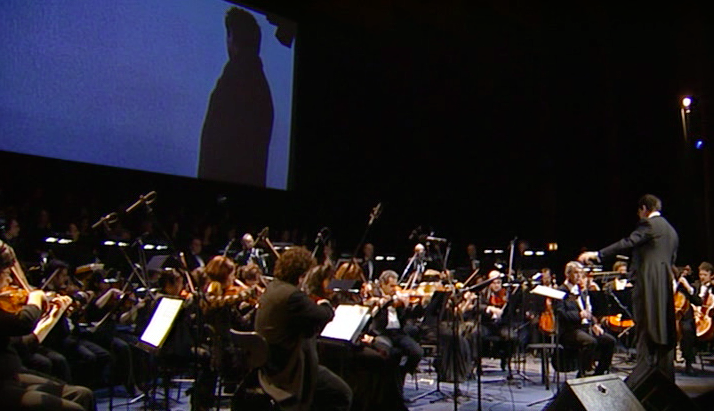
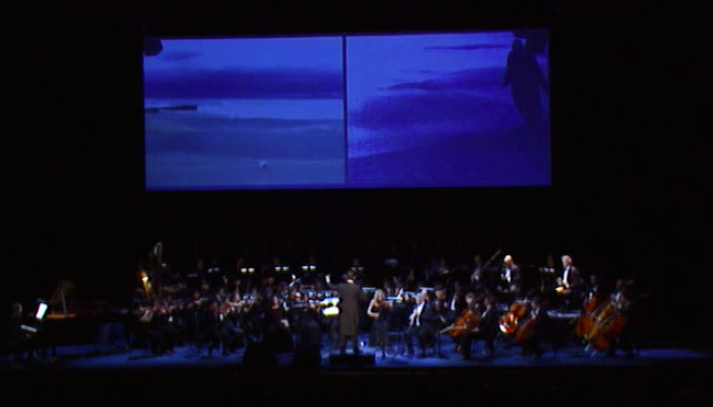
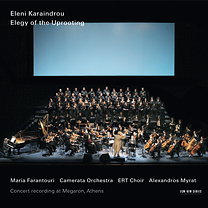
Elegy of the Uprooting condenses two decades of work by Eleni Karaindrou into what the Greek composer calls a “scenic cantata.” This is no mere retrospective, but a gravid musical statement in which the listener’s soul is carefully unfolded to reveal the sounds hidden within. Excerpting 13 scores for film and stage, this concert pulls out the red threads running through Karaindrou’s non-diegetic oeuvre with stunning video and audio clarity.

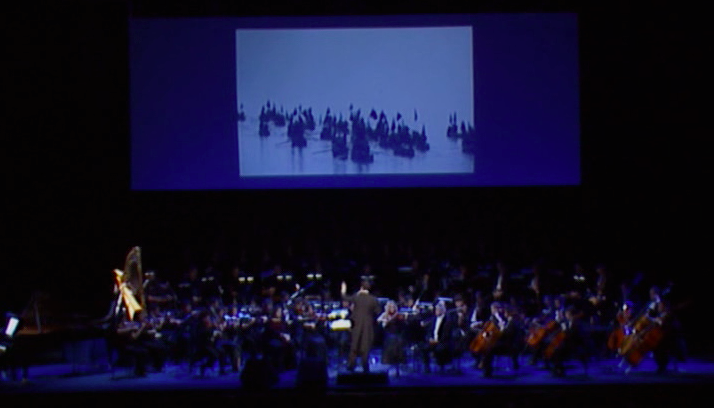
Of the 110 musicians seen in this live DVD—including an orchestra, chorus, and ensemble of traditional instruments—many of the soloists have been working with Karaindrou for many years, and their dedication shows. Of note are…

Vangelis Christopoulos on oboe:

Socratis Sinopoulos on the Constantinople lyra/Maria Bildea on harp:

Konstantinos Raptis on the bayan:

Vangelis Skouras on French horn:

Aris Dimitriadis on mandolin:

Panos Dimitrakopoulos on kanonaki/Christos Tsiamoulis on ney:

and the composer herself at the piano:

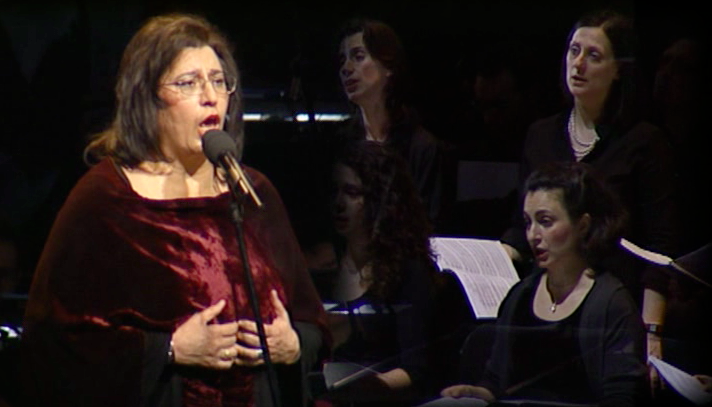
Much of the music will be familiar to ECM enthusiasts: Ulysses’ Gaze, The Suspended Step of the Stork, Eternity and a Day, The Weeping Meadow, and Euripedes Trojan Women feature heavily in this wide-ranging program, with the latter two in particular providing a larger thematic framework. Lesser known works such as the stunning Rosa’s Aria—from the film by Christoforos Christofis and reinterpreted here with total corporeal commitment by the legendary Maria Farantouri—should excite veteran and new listeners alike.

The staging was overseen by Manfred Eicher and is accordingly minimal. A large screen behind the musicians displays artfully arranged stills and clips from Angelopoulos’s films, as well as some computer generated imagery of swaying reeds, falling rain, and shooting flames.

It’s a joy and a privilege to see such a synergistic group of musicians banding together to share such doleful beauty, and to see the physical process of it all, the sheer assembly of talent and logistics required in putting together such a performance.

In all this rhetoric lately of carbon footprints and the detrimental impact of human activity on the physical environment, it’s easy to forget that our creativity often leaves the most “eco-friendly” impressions. Karaindrou has created for the world a statement without tangible shape, a visceral wave of melancholy into which we may project a semblance of ourselves. Like the water that figures so prominently in Angelopoulos’s films, her music ebbs and flows in spite of our foibles.

Elegy of the Uprooting is also available in this 2-CD set. I highly recommend both, for each is its own experience.

Kim Kashkashian: Neharót (ECM New Series 2065)


Neharót

Kim Kashkashian viola
Münchener Kammerorchester
Alexander Liebreich conductor
Boston Modern Orchestra Project
Gil Rose conductor
Kuss Quartett
Recorded between 2006 and 2008 in the USA, Poland, and Germany
Engineers: Peter Laenger, Lech Dudzik, Gabriela Blicharz, Joel Gordon, John Newton, Blanton Alspaugh
Produced by Manfred Eicher

Neharót Neharót (2006/7) for viola solo, accordion, percussion, two string ensembles and tape by Israeli composer Betty Olivero opens a haunting album from violist Kim Kashkashian. It is a slow awakening—not into light, but into twilight—and swells with the wounds of fresh tragedy. Kashkashian arrives as if by wind and with the raw imperfection of an unpreened bird. The tone and feeling are not unlike that of John Tavener’s The Protecting Veil at its tensest moments. The strings roil like turgid waters in which eddy the relics of an unseen war. Two women’s voices reach into the storm with tendrils of mimicry. This call and response blossoms into a profound moment of rupture, at which point the orchestra and percussion spill over one another. Fragments of the audible past come through as snatches of Monteverdi quoted from his Orpheus and eighth book of madrigals. These recycled motifs are like a dream that quickly consumes itself before waking again. The viola rises in their place, seeming to run around frantically in search of the voices that so enlivened it. When they are nowhere to be found, the outcast wallows in the hopes that nightfall will be her cloak. But then the voices come back: the viola prostrates itself, fearing to expend the ancestral legacy it breathes. It wants nothing more than to offer gratitude, but can only contort itself into a vowel of need.

After such a profoundly draining journey, the three Armenian selections that follow are a welcome rest, though one not without its internal travels. Tigran Mansurian gives us his Tagh for the Funeral of the Lord for viola and percussion, Three Arias (Sung out the window facing Mount Ararat) (2008), and Oror, a lullaby by Komitas (1869-1935) arranged and performed here by Mansurian at the piano. The “tagh” is an ancient Armenian song, and Mansurian’s breathes with organic vitality. Its lament echoes across cold plains, the percussion a mere accent to the viola-driven melody. The Three Arias are essentially a series of orchestral swells with viola interludes, an audio essay of the music’s own origins and possible futures. The viola acts like a lens over a film sheet, trying to find the one picture that most clearly articulates something that can only be remembered through image, but that can only be musically described. The viola struggles with an unseen force in spite of its orchestral inheritance. A dazzling ending is made all the more so for the effort required of us to get there. And this is precisely what the piece is about: seeking out those moments that, in a life remembered, also define that life most clearly. Mansurian’s interludes are like the passage between two days, a conduit between continents and cultures, a subtle diaspora of sound.

And so, by the time we return to Israel in Eitan Steinberg’s Rava Deravin (2003) for viola and string quartet (the tile means “Favor of Favors”), we feel more fully prepared for any and all emotional obstacles. The piece was originally scored for voice and a mixed chamber ensemble, but was transcribed as the current version at Kashkashian’s behest; hence the accordion-like opening harmonics that speak of bellowed breath. Yet even before the music begins, the instrumentation tells us so much about what we are about to hear. We know the viola soloist has a second self, a ghost presence amid its accompanying quartet, and yet here it is at once extracted and embedded in its periphery, singing with its own voice even while knowing it has been long aligned with the larger organism behind it. When the quartet takes a more syncopated stance, we never lose sight of the abstract milieu in which it is situated. The viola must resign itself to self-division, and toward the end it squeals and scatters snake-like through tall grasses of harmonics. The music dies not by lowering itself in volume, but by pushing us away so gradually that by the time we notice the music has gone, we are already too far away to catch up with it.

Were the orchestra to be analogized as body, the viola would most certainly be the throat, for the vibrations of song rattle its chambers more than those of any other. In this respect, Kashkashian has given more lucid breath to this recording than to any other she has made. She only seems to get better with every draw of her bow, and her dedication once again remains paramount. This is a cohesive program of some of the most original music to come out of ECM in a long time. Not to be missed.