Kit Downes piano, organ Tom Challenger tenor saxophone Lucy Railton cello Stian Westerhus guitar Sebastian Rochford drums
Recorded November 2018
at St. Paul’s Hall, University of Huddersfield
and St. John the Baptist, Snape
Engineer: Alex Bonney
Produced by Sun Chung
Release date: October 25, 2019
Following his 2018 ECM headliner debut, Obsidian, Kit Downes returns at the organ (and piano), this time among friends, including saxophonist Tom Challenger (heard for a spell on Obsidian), cellist Lucy Railton, and drummer Sebastian Rochford. The latter is heard prominently in the concluding “Blackeye,” a piece cowritten by Downes and Challenger. Its thicker brushstrokes fill a rather different sort of canvas than the ones preceding, albeit touched by the same palette.
“Sculptor” opens with Challenger’s bare tone, a kiss of sun on the morning glory of piano that then imbues the scene with its color. Also lurking is guitarist Stian Westerhus, a new addition to the Downes nexus who is rightly described by Steve Lake in his liner notes as, at times, a “near-subliminal participant.” Twinkling like starlight in “Bodes,” his guitar emotes under tension of utterly non-invasive strings. The latter tune is the album’s masterstroke: a fully narrative journey from cradle to grave that catches as many life experiences as it can before passing them on like an inheritance in faith of continuation.
Comforting about Downes as composer is his underlying sense of open-endedness. Titles such as “Pinwheel” and “Sunflower” suggest interconnections just beyond their titular surfaces—not only in Railton’s liquid threading, but also in their ability to turn melody into substance (if not the other way around). “Circinus” and “Twin” make sense of the organ as if it were a text to be interpreted in humility. Both elicit an undeniably cosmic feel, strangely rendered in textures of flesh and soil.
The only piece not by Downes is “M7.” Composed by his wife, bassist and vocalist Ruth Goller, this organ solo centers its energies in sustained pedal points while spreading open the periphery as one might a pair of hands. In its cradle, the entire album’s heart dents a pillow woven from old maps and cartographic sketches, each drawing closer to an undiscovered country but never quite reaching it. Content to float wherever the current may lead, it closes its eyes and redraws its path in the language of a dream, where the only songs that matter are those without words.
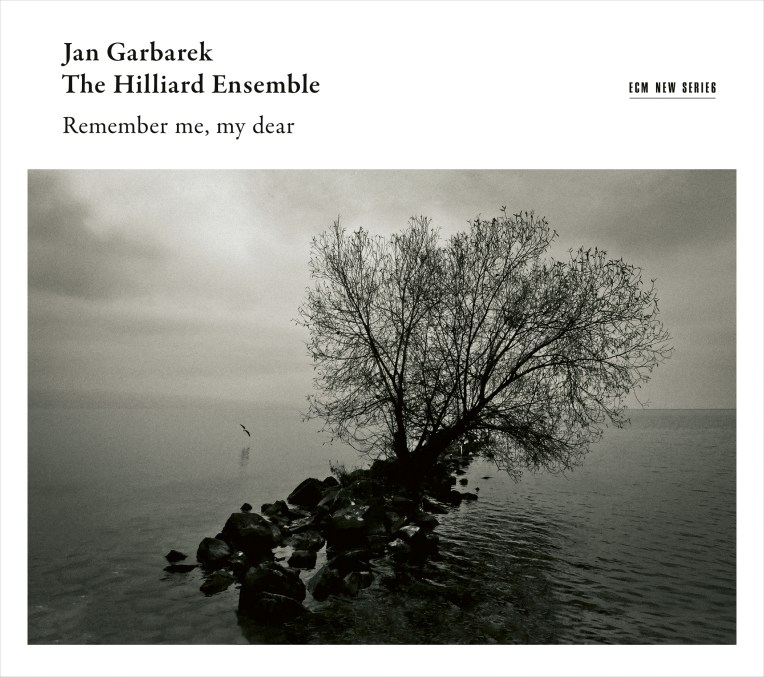
The Hilliard Ensemble
David James countertenor Rogers Covey-Crump tenor Steven Harrold tenor Gordon Jones baritone Jan Garbarek soprano saxophone
Concert recording, October 2014
Chiesa della Collegiata dei SS. Pietro e Stefano,
Bellinzona (Switzerland)
In the series “Tra jazz e nuove musiche”
by Paolo Keller for RSI Rete Due
Tonmeister: Michael Rast
Engineer: Lara Persia
Mixed at Auditorio Stelio Molo RSI, Lugano
by Manfred Eicher and Michael Rast
Produced by Manfred Eicher
Release date: October 18, 2019
When the Hilliard Ensemble and saxophonist Jan Garbarek first recorded for ECM in 1993, they opened as many—if not more—forces than they joined. It was a collaboration not only between each other, but also between them and engineer Peter Laenger, the Austrian monastery of St. Gerold, and producer Manfred Eicher, whose vision was so attuned to the possibility of it all that he would seem to have heard it in his head before those five breaths intertwined in reality. Twenty-five years after the release of their self-titled debut, the Officium project resurfaces with this document of their final performance in 2014.
The roots of this program’s oldest branches may be traced to the soil of past albums. In the opening “Ov zarmanali,” a hymn of Christ’s baptism by Komitas that was likewise our doorway into Officium Novum, Garbarek’s keening soprano is unmistakable in shape and color. In this setting he plays with the decay of notes, sharing more with sitar virtuosos than other reed players and taking into account every incidental effect as physical material for expression. It is the Hilliards, then, who enter into his delineation—not the other way around—and who plow a field just as ancient in preparation of a hybrid crop unlike any other. This progression is reversed in “Procurans odium,” one among a handful of anonymous medieval pieces that finds its seeds, split with time, restored in the nourishment of resuscitation. Garbarek’s role is nevertheless fully dimensional, drawing out from within rather than applying from without. Other unattributable turns, such as the wondrously ambient “Procedentum sponsum” and more lilting “Dostoino est,” speak to the power of memory. And in the “Sanctus,” not heard since their debut, we find a folding inward rather than expansion of concept.
Beyond the category of performer, Garbarek’s contributions fall under composer and arranger, finding solace all the same in this sanctuary. In the latter vein is “Allting finns,” wherein his exploratory nature is particularly evident, as one can feel Garbarek roaming the church in search of stone and warmth, while his setting of the Passamaquoddy poem “We are the stars” draws an unbreakable thread from one corner of the earth to another, likewise itinerant in spirit.
From the liturgical, as in the light-through-stained-glass effect of Nikolai N. Kedrov’s “Litany,” to the repentant shading of Guillaume le Rouge’s “Se je fayz deuil” (gazing back to Mnemosyne), the vocal nature of Garbarek’s saxophone and the reed-like qualities of the Hilliards have perhaps never been so dimensionally interchangeable. For even when the saxophone is absent, as in a most intimate rendition of Arvo Pärt’s “Most Holy Mother of God,” its soul lingers—a dream upon waking. The effect is such that, even when turning the brittle pages of more familiar material, like the “Alleluia nativitas” of Pérotin or the “O ignis spiritus” of Hildegard von Bingen, we are welcomed in the spirit of newness. And so, in the 16th-century Scottish folk song we find more than a title, but a poignant reminder that our minds are at once the tenderest and most robust vessels for honoring the past. For how can we not remember the impact this quintet has made on modern music, and the love with which listeners will continue to fill its crater for ages to come?
Avishai Cohen trumpet Yonathan Avishai piano
Recorded September 2018, Auditorio Stelio Molo RSI, Lugano
Engineer: Stefano Amerio
Produced by Manfred Eicher
Release date: September 6, 2019
Although trumpeter Avishai Cohen and pianist Yonathan Avishai have known each other and played together since they were teenagers in Tel Aviv, this is their first recording as a duo. The title refers to an offhand comment made by producer Manfred Eicher, who during the recording of Avishai’s Joys And Solitudes remarked, “Avishai [Cohen] should play this room.” The duo session documented here happened just a few days later, only now in the Auditorio Stelio Molo RSI at Lugano in place of Studios La Buissonne. And play the room they do. Not only in the sense of liberating a delightful mix of standards and original contributions to the modern songbook, but also because, like seasoned thespians, they inhabit their narrative roles with full physical commitment.
The set’s door is pushed open by said original contributions, starting with “The Opening” by Cohen, which seems to flower into audibility of its own volition to be heard. Piano and trumpet communicate so deeply, even when not playing at once, resulting in one of the more evocative beginnings to grace an ECM program quite some time. Avishai’s “Two Lines” is an equally introspective, if darker, companion, by whose gestures are activated shared memories. Cohen here is especially broad of emotional brush and paints with the abandon of a child.
John Coltrane’s “Crescent” kicks off the album’s airborne remainder, cycling through its own self-awareness and in that process attaching feather upon feather in anticipation of flight. Cohen rises and sets like the stars, while Avishai navigates by their movement. The effect is such that when Duke Ellington’s “Azalea” cracks open the scene like an egg of dawn, its classic sounds feel not so much reborn as reawakened. As in Ornette Coleman’s “Dee Dee” and Stevie Wonder’s “Sir Duke,” they approach the evergreen as an opportunity for pruning instead of replanting.
Whether in the comforting shades of “Ralph’s New Blues” (Milt Jackson) or the gorgeously rendering of “Kofifi Blue” (Abdullah Ibrahim), Cohen and Avishai stay true to form because they understand the form of truth. In their hands, and by the spatial allowances of Eicher and engineer Stefano Amerio, these tunes resonate with nothing more than what they were meant to be. All of which makes inclusion of “Shir Eres (Lullaby)” by Sasha Argov (1914-1995) poignant beyond measure. Not only because it’s an emotional touchstone in the hearts of the musicians, but also because it pulls the sky like a blanket over our ears, that we might better hear the sounds of our own heartbeats. Thus, Playing The Room is the sonic equivalent of the “moon illusion”—when our closest satellite appears bigger on the horizon than it does in the sky due to its visual proximity to earthbound objects. Once risen, however, it tells us just how far we’ve come, and how much infinitely farther we have to go.
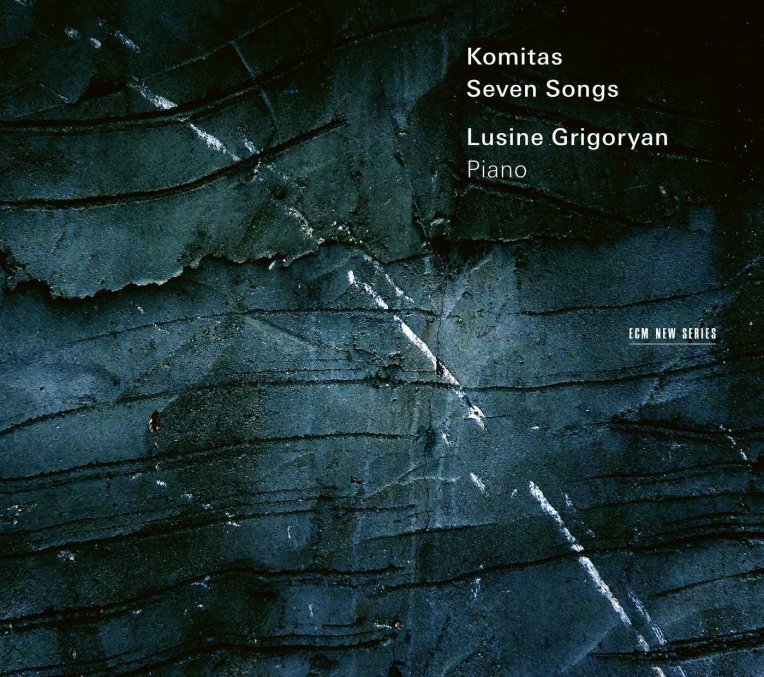
Lusine Grigoryan piano
Recorded February 2015, Auditorio Stelio Molo RSI, Lugano
Engineer: Markus Heiland
Produced by Manfred Eicher
Release date: September 22, 2017
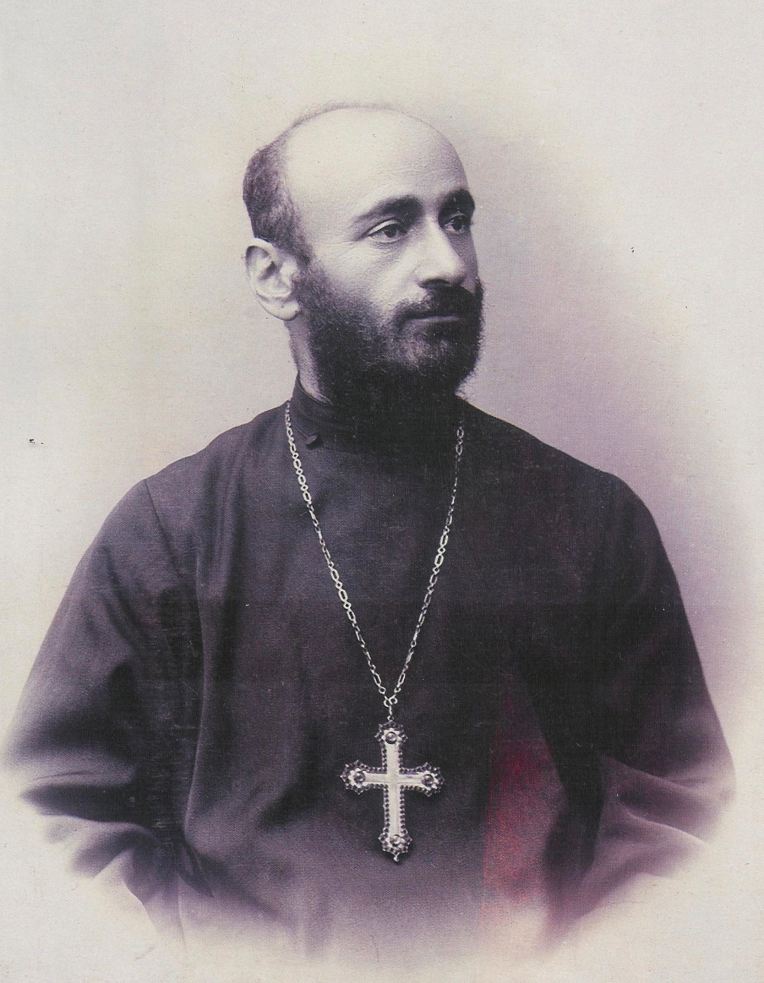
Armenian pianist Lusine Grigoryan makes her ECM debut with a program of music by her homeland’s most respected composer: Komitas Vardapet (1869-1935). Seven Songs is a companion to the Gurdjieff Ensemble’s Komitas, led by her husband Levon Eskenian, and was recorded during the same 2015 sessions. Where that previously issued album expanded upon the sonorities of Komitas’s piano music, here we encounter said sonorities nakedly. In each are shades of traditional instruments and dances, motifs regarded beyond time yet grounded in the familiar by their immediacy of offering.
Komitas was intensely interested in Armenian folk music, which he collected, studied, and arranged throughout his life. If not for the efforts of Grigoryan and likeminded artists, his music might remain sequestered in Armenia without ever transcending its borders. As Paul Griffiths writes in his booklet essay, “His is a torn page waiting to be sewn back into music history.” The eponymous heptad of 1911 is a veritable notebook of ideas, each the memory of a fleeting moment, dutifully bound at Grigoryan’s fingertips. Like an ancient soul seeking solace in modern sprawl, where physical contact—once the glue of the human volume—has now dissolved in a landscape of storm-blown leaves. Komitas-via-Grigoryan’s interpretations of innocence and sin, perfection and corruption, death and life are all here for us to examine. Their happiest moments, such as the last (titled “The water comes from the mountaintop”), are also its briefest, and speak of the honesty with which Komitas viewed the world around him. The latter’s geological inevitability is, like the music itself, indicative of his earthly pilgrimage and points to a perennial theme of landscape echoed in the painterly Toghik from 1915 and even in the twelve Pieces for Children (1910-15). Nowhere so vividly, however, as in Msho Shoror. Inspired by the mountainous region of Sasun, its rocky qualities indeed require deft footwork—or, in this case, handwork—to navigate. The shoror, or “sway dance,” is a navigation unto itself, every step woven into what the composer called an “ancestral” experience. Whether vigorous or reflective, each of its seven variations is spiritual in nature, reflecting upon the relationship between flesh and fate, and the connective tissue of experience between them.
The Seven Dances further nuance this sense of bodies in space and time. Komitas calls upon the performer to evoke timbral qualities of particular instruments, such as the daf and duduk. Grigoryan renders these with intimate attention to detail, deeply aware of the flow within them. The second of these dances, of Yerevan extraction, is a standout for its delicate pointillism. Likewise the fifth of Vagharshapat. Heard against the somber reflection of the final shoror, they remind us that vigor means nothing without the stillness awaiting its exhaustion.
Because this music feels at once so near and so distant, I conducted an email interview with Grigoryan, who kindly offered her own reflections…
Tyran Grillo: Can you tell me, in your own words, what Komitas means both to you and to Armenians in general?
Lusine Grigoryan: For me, Komitas is first and foremost a marvelous composer. His compositions are extremely valuable and give pianists the opportunity to discover and express their performing peculiarities. This music forces you to think, endlessly: its character can change from one bar to the next. In addition, it requires you to evoke Armenian traditional instruments through the piano. Komitas helps the performer with his meticulous indications (the approach of Baroque music to folk imagery has been a big help in this regard). For me, and for the Armenian people, Komitas is the founder of our national music. He preserved and defined what Armenian music is, setting the foundation for our approach to composition. The reflection of sacred music in his piano repertoire is more obvious in “Msho Shoror” (Shoror of Mush), a dance in which 300 pilgrims would take part at the Monastery of Saint Karapet in Mush. In the first part, the zurna and the drum would sound the call and gather the dancers, then a large circle would be formed and the prayer would start. This is a significant part of the cycle and has motifs that have been passed down orally for generations, going back to pagan times, as expressed in the leitmotif of the sun in Komitas’s “Pieces for Children.” We come across this theme also in our church hymns and in Armenian national music more broadly.
TG: I believe the music of Komitas has a uniquely timeless quality. Do you agree? If so, where do you think that quality comes from?
LG: Yes, Komitas’s music truly has a timeless quality to it. Listeners are frequently confused and think he is a contemporary composer. I believe this has to do with his minimal approach, his ornaments and motifs, all of which have their origin in folk music. It is also a manifestation of how powerful Komitas’s thinking as a composer is, of how he is able to transport a simple song to a classical instrument—the piano—while preserving its genuine rustic condition.
TG: How did you prepare yourself for this recording?
LG: The recording was done in parallel to that of the Komitas CD recorded for ECM by the Gurdjieff Ensemble. I sometimes would take part in their rehearsals and practice sessions. I would listen to how national instruments resounded and search for ways to achieve those sounds through the piano, because Komitas often indicates “in the style of tar,” “in the style of dap,” “in the style of nay,” and so on. Despite being an ethnic Armenian, what I had pictured as the performance style of these instruments was not always accurate. So taking part in the rehearsal and practice sessions of the ensemble was very informative. As a matter of fact, it was Manfred Eicher who advised me to do this and he who insisted that the recordings be carried out in tandem.
TG: How much do you know about Komitas as a person, and does your knowledge of his social and spiritual beliefs help inform the way you play his music?
LG: Komitas was a very down-to-earth, straightforward man with an immediate and uncomplicated personality, but at the same time deep and sensible; much like his music. He gave a lot of thought to these pieces before writing them down. He worked on them extensively, often producing many versions of the same piece. The more I play his music, the more I discover.
TG: If you could ask Komitas one question, what would it be?
LG: I would be reluctant to ask a question. But I know that he had a clear view of the Armenian school of composing, that he had started to work on his opera Anush, was composing string quartets, and thinking about the symphonic genre. But because his creative life was cut short, he wasn’t able to bring these projects to fruition. I would love to know: Had he had the time to lay the foundations, what direction would our composers have taken? Armenian composers have tended to write more in the European mode, using folk themes only occasionally. Maybe in Tigran Mansurian’s music we can find can find something more attuned to that cultural spirit. I am very much interested in this question.
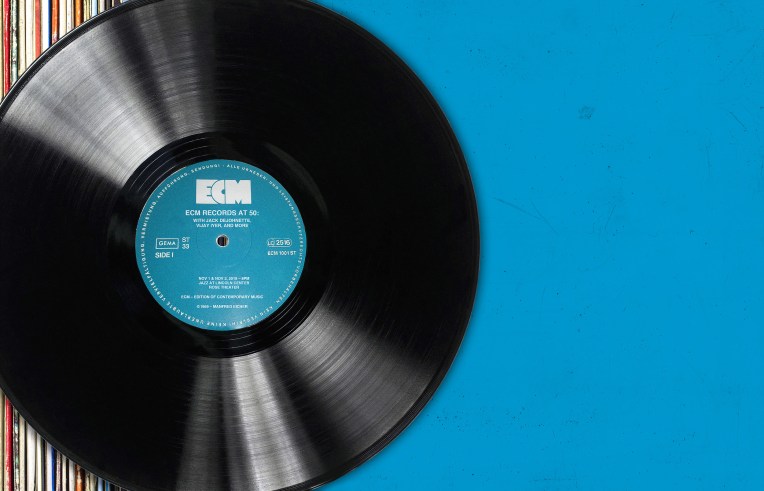
My latest review for All About Jazz is of the recent “ECM Records at 50” performance at Lincoln Center in New York City. Click the image below to read the full article.
Since its inception, Austin-based Destiny Records has documented a range of artists in their natural habitats, but perhaps none so intimately as Charlie Rauh. On Hiraeth, his second solo album for the label, the guitarist peels back emotional transparency after transparency until only the glowing ember of his heart remains.
The title is a Welsh word connoting one’s longing for a place to which one cannot return and which may never have existed in the first place. Fortunately for us, the music here is real and delineates a place to which we may return at any time.
Recorded in a wooden cottage during a residency for the Robert Rauschenberg Foundation in Florida, these tunes take inspiration from two years of European travels. The title track is an invitation to share in the acoustic signatures that bind performer to listener. Rauh’s gentleness and near-spiritual dedication is palpable. Some tracks, such as “Patience” and “May Came In Accompanied by Rain,” feel like songs without words, dangled over a vast expanse of possibility, while others share a one-to-one correlation with the places and figures they describe. In the latter vein, “Fanø,” named for a Danish island, evokes listing waters and a foggy horizon while “Norma & Wallace” lets in the sounds of rain outside the recording space. The album’s deepest passages are found in “Eleven Seventeen.” Composed as much of bones as of the flesh around them, it bleeds with the inevitability of watercolors. “Observer” likewise blurs boundaries between notes until only a compound color remains.
Tempting as it is to characterize these as sonic postcards, they are better thought of as pages in a cinematic diary. The images move at their own speed and in service of memories whose only reason for existing is to be conveyed, soul to soul. In this respect they invite listeners to move along in real time, as if in a dance of regard and interpretation. The result of all this is more of a beginning than an end—an implication of something beyond the edges of the screen to which our ears have been directed in service of an interpersonal story.
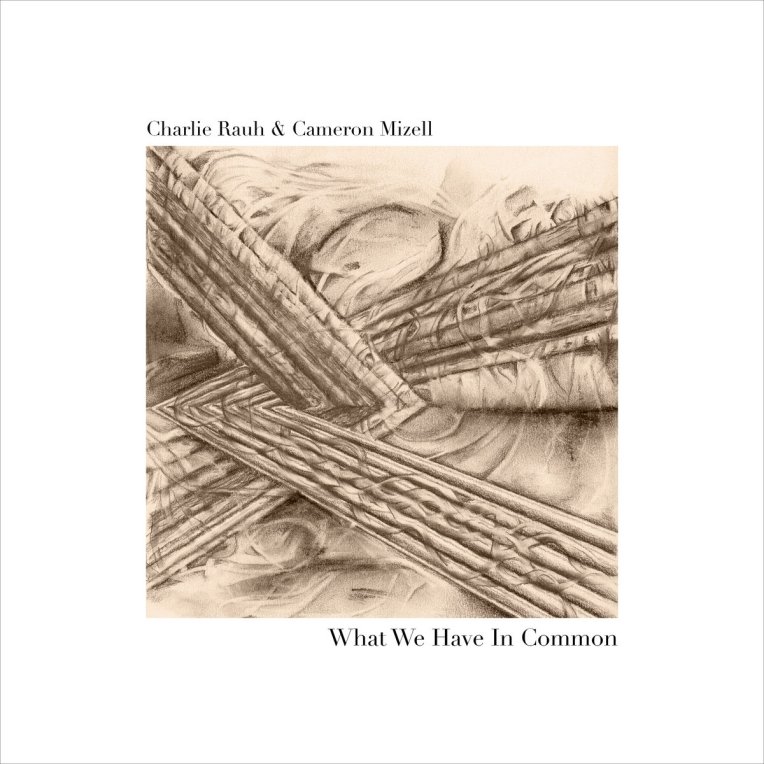
If Rauh’s solo work is the darker side of a creative moon, then we find its sunlit counterpart in What We Have In Common. This companion album of sorts pairs Rauh’s acoustic guitar with the electric of Cameron Mizell. The atmosphere is indeed brighter and in the opening “A Thousand Faces” renders the kind of nostalgia one would only expect to find in a shoebox of aging photographs. Whereas “Dogwood,” “A Song About A Tree” and “You Are Missing From Me” shine with distinctive Americana, each a hypnotic regression through childhood, the rocking-horse arpeggios and unified harmonies of “Kuksa” reveal fresher sheen. Rauh’s “Tomorrow Will Worry About Itself” and Mizell’s “I Didn’t Find It To Be That, Exactly” are highlights for their nocturnal moods, as are two songs with vocalist Ess See, who adds her own lyrics to “All Along The Way” and “A Thousand Faces.” Both are tender examinations of faith in something greater than blood: the very kinship of lived experience.
For more information on ordering, and to hear samples, check out the Destiny Records Bandcamp page here.
(This article originally appeared in the November 2019 issue of The New York City Jazz Record, a full PDF of which is available here.)
Recorded live at Moscow’s DOM Cultural Center in November 2017, Free Radicals documents the assembly of three master improvisers: American trumpeter Peter Evans, Catalan pianist Agustí Fernández and British bassist Barry Guy. While all have unleashed their unquenchable fires in other contexts, this is their first album as a trio and the results are both exactly what anyone familiar with them would expect and yet enchantingly surprising.
Over the course of two tripartite sets, we fall into a conversational category of sound, whereby opinion and assertion blend to the point of indistinguishability and the purpose at the core of it all sheds its skin in search of jagged horizons. The piano’s innards are subjected to an especially fascinating surgery as Guy illuminates the operating table with his bass and Evans melts his trumpet down into a scalpel.
Where the first set isn’t afraid to throw some vinegar into the baking soda, neither does it shy from ponderance, treating quietude as a breeding ground of undiscovered order. The second set is even more substantive, achieving astonishing congruence at almost every turn. Moments in which bonds seem to crumble are those in which unity would come across as hypocritical and which by its very ejection leaves room for listener engagement. Part Two of the latter set is a suspension of disbelief that runs back and forth along the top of the proverbial fourth wall until it erodes to the ground. The encore is more of a beginning than an ending and by its suggestions of eternity rips off the “im” from “impossibility” and skips it across the pond of expectation until the final plop is heard on a shore too distant to see yet close enough to hear.
(This article originally appeared in the November 2019 issue of The New York City Jazz Record, a full PDF of which is available here.)
Gianluigi Trovesi piccolo and alto clarinets Gianni Coscia accordion
Recorded January 2018, Night And Day Studio, Cascinagrossa
Engineer: Paolo Facco
Mixed and mastered by Guido Gorna and Stefano Amerio
An ECM Production
Release date: June 21, 2019
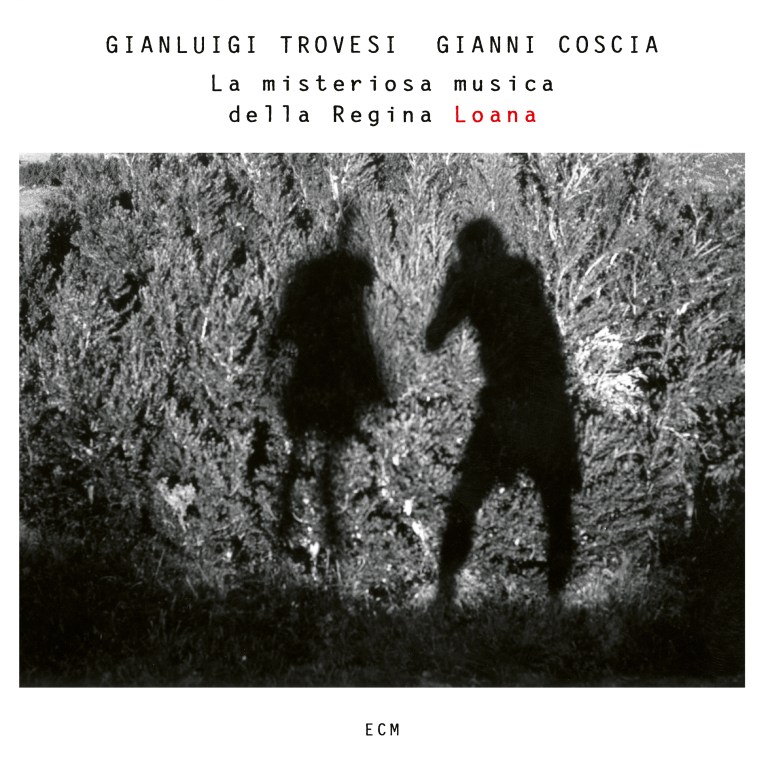
Umberto Eco (1932-2016) once said of Gianluigi Trovesi and Gianni Coscia, “On a street corner or in a concert hall, they would feel at home just the same.” For their fourth ECM installment, the clarinetist and accordionist prove that statement in a tribute to their departed friend, taking listeners on a sonic journey through Eco’s semi-autobiographical novelLa misteriosa fiamma della regina Loana(The Mysterious Flame of Queen Loana). Along the way, they riffle through the archives of a bygone era and recreate it with loving attention to detail and personal association. Most of the songs are mentioned in the novel itself, the centerpiece being the five-part “EIAR.” Titled in homage to Italy’s first radio station, the suite drips with nostalgia of the 1930s and 40s.
Despite being of literary genesis, the album carries a tender cinematic charge, evident already in Coscia’s opening solo “Interludio.” More overt connections to the silver screen abound on “As Time Goes By,” fromCasablanca, which spreads across the ears like butter over warm bread, and the mysterious yet emotionally transparent “Bel Ami,” from the 1939 German film of the same name. Other perennial favorites, such as “Basin Street Blues” and Glenn Miller’s “Moonlight Serenade,” evoke pure delight yet are infused with enough beauty to court the glint of a tear.
Three originals called “Nebjana” take their inspiration from Leoš Janáček’sIn the Mists, while “Umberto” and “Eco” are improvised around Trovesi’s gematria of the honored name. Their masterstroke comes in the form of “Gragnola” (Hail of Bullets). Moving from tragedy to triumph, it’s a film in and of itself, casting in its leading role the unabashed love that defines a grander story.
(This article originally appeared, in truncated form, in the December 2019 issue of DownBeat magazine.)
On November 1 & 2, 2019, Jazz at Lincoln Center will present two nights in celebration of ECM’s 50th anniversary. The lineup will be the same on both nights. I will be there to review the November 2 show for All About Jazz.
The roster is as follows:
Tenor Saxophone Ravi Coltrane, Joe Lovano, Mark Turner Trumpet Ralph Alessi, Avishai Cohen, Enrico Rava, Wadada Leo Smith Guitar Bill Frisell Guitar and Piano Egberto Gismonti Piano Fabian Almazan, Nik Bärtsch, Marilyn Crispell, Giovanni Guidi, Ethan Iverson, Vijay Iyer, Shai Maestro, Andy Milne, Craig Taborn Piano and Voice Meredith Monk Cello Anja Lechner Bass Dezron Douglas, Matthew Garrison, Larry Grenadier, Drew Gress, Thomas Morgan, Barak Mori Drums Carmen Castaldi, Andrew Cyrille, Jack DeJohnette, Mark Ferber, Ziv Ravitz, Nasheet Waits
Tickets are available here. Hope to see some of you there!





 Between Sound and Space: ECM Records and Beyond