Rudy Royston: Flatbed Buggy

flatbed buggy

With Flatbed Buggy, drummer Rudy Royston has come into his own as a composer. Joined by reedplayer John Ellis (chiefly on bass clarinet), accordion player Gary Versace, cellist Hank Roberts and bassist Joe Martin he channels influences as diverse as Bill Frisell and Ron Miles, tied together by memories of his partial Texas upbringing in a melodically rich chamber suite.

Tempting as it is to be enchanted by this unique combination, it feels as organic as the music itself. To be sure, each instrument has inherent qualities. Bass clarinet and cello form an especially flexible spine, accordion a robust pair of lungs, bass legs on which to stand and drums a brain to prompt every member into action. But it’s the way in which they combine in the guise of one body that makes them stand out. Between opener “Soul Train” and brief outro “I Guess It’s Time To Go,” listeners are led from sunrise to sunset with the vividness of a favorite childhood memory. The past is therefore a running theme of Flatbed Buggy, the very title evoking country life in a time buried under the detritus of recent history and which reaches fullest evocation in “Twirler” and “Hourglass.”

While there are obvious examples of virtuosity, such as the whimsical round of solos in “Bobblehead” and thoughtful contributions of Versace and Ellis in the title track, a collective spirit overrides concerns of individual expression. Likewise in the swinging contours of “The Roadside Flowers” and two starkly narrative tracks “boy…MAN,” which shuttles bass through a loom of block chords, and the more ponderous “girl…WOMAN.” Whether in these protracted examples or the three jauntier interludes sprinkled throughout, this music is sincere, vividly articulated and not afraid of a little dirt under the fingernails.

(This review originally appeared in the February 2019 issue of The New York City Jazz Record, a full PDF of which is available here.)

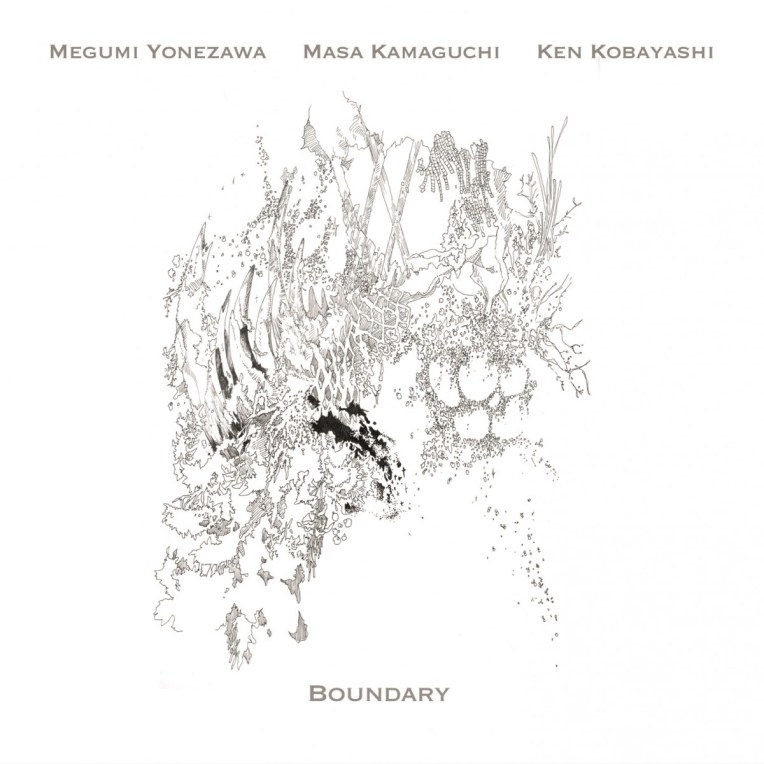
Yonezawa/Kamaguchi/Kobayashi: Boundary

Boundary.jpg

After scrimshawing a name for herself in the ivory of jazz as sidewoman for saxophonist Greg Osby and following her 2016 leader debut A Result of the Colors (see my review for All About Jazz here), pianist Megumi Yonezawa releases her deepest personal statement to date. Boundary triangulates her tactful artistry with bassist Masa Kamaguchi and drummer Ken Kobayashi in a set of nine freely improvised tunes, plus a lone standard for good measure. If said standard—Sammy Fain/Irving Kahal’s “I’ll Be Seeing You”—feels like a message that has traveled light-years to get here and shows the trio at its most resonant, then the spontaneous wonders cushioning it feel like messages yet to be revealed and show the trio at its most inward. As in the droplets of piano that open the title track, each turn of phrase makes known a realm that only the ears can grasp.

While other titles offer descriptors of what one encounters here, their truth is limited. “Alchemy,” for example, does indeed come across as a sonic conversion of base elements, even as one is constantly reminded of something far more precious than gold: namely, the coherence of flesh, bone and dedication that only musicians who listen to each other this closely can achieve. “Tremor,” too, despite an underlying quiver of spontaneity, names the album’s steadiest departure. Then there’s “Wavelength,” a duet between Kamaguchi and Kobayashi implying something greater than synergy: dialogue.

Even without such trail markers, one can hear the cartographic sincerity of “Reef” and tactile intensity of “Nostalgio” as if they were one and the same. The most absorbing promises are fulfilled in “Veil” and “Onement.” Where the former is as beautiful as it is intrepid, the latter swirls with life-giving immediacy. Mirroring the patient unfolding of “Meryon,” they seek catharsis on the path to getting there, so that by the end a new beginning has already opened its eyes for want of another day.

(This review originally appeared in the February 2019 issue of The New York City Jazz Record, a full PDF of which is available here.)

Scott Worthington / Renato D’Agostin: Orbit

cover

Orbit titles the intersection of bassist/composer Scott Worthington and Italian photographer Renato D’Agostin. Worthington’s minimal approach to sound, like D’Agostin’s to image, reveals the hidden complexities of interaction between bodies and the contexts of their transit. With an atmosphere that recalls the self-refractions of Stephan Micus, “A Time That Is Also A Place” fleshes out the flute of Rachel Beetz like vanes to a feather’s shaft, funneling into a quill hungry for a universal inkwell. Long tones beget longer drones to form a space in which the body retreats into itself. As multi-phonic light cradles shadows with aged hands, drawing static from its slumber into the foreground, the monochromatic heart of reality beats in the slowest of motions, as if to mark the passage of time beyond grasp of all measure. The effect is such that when the ambient “Interlude” opens its eyes against the sunlight of a thousand sun, we understand intimately the imperfection of the soul against a cosmos dripping with unity.

If we began with a circle, then “A Flame That Could Go Out” is another linking to it, resonating in a moan for all matter. In this bass-heavy flame, one encounters not a single flicker, but a steady flow of suicidal oxygen quietly accepting its fate. Each respiration is a word without speech, a simulacrum of mortality restored like an ancient instrument cleared of its corrosion. This leaves only the tracery of experience to communicate who we once were in the music of who we can never be again.

scott worthington - orbit - iikki 005_book_orbit 01 (outside front)

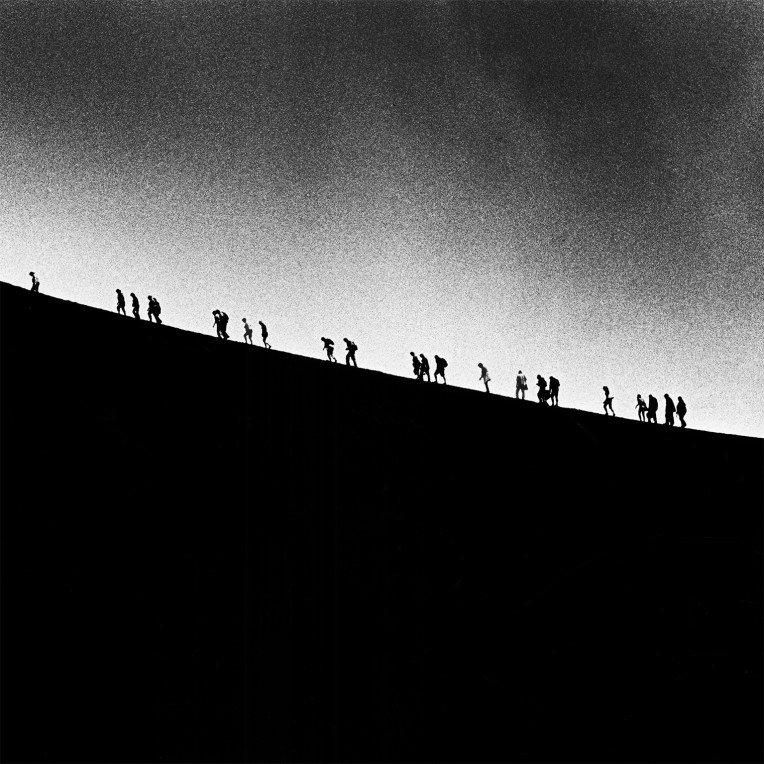
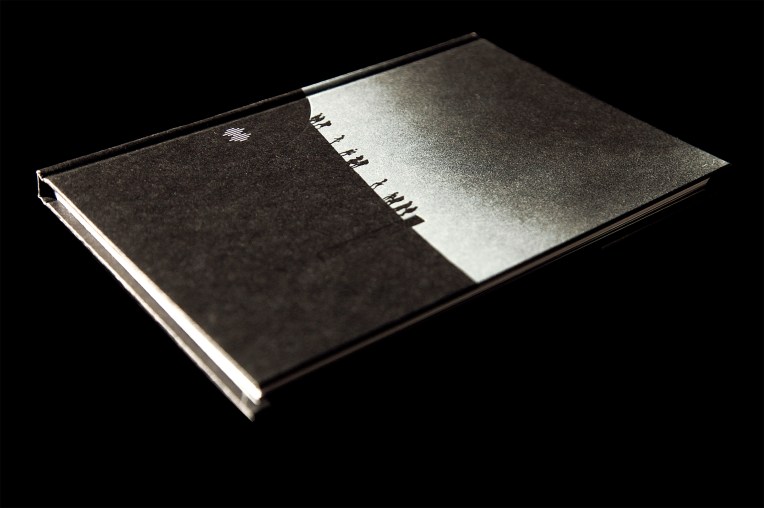
That all of this feels so downright terrestrial is due in part to the captivation of D’Agostin’s images, which grace the album’s accompanying book with nomadic coherence. Their high contrast reveals a mutual contradiction of flesh and spirit, even as it fortifies the connective tissue of art between them. In this sense, the dialogue here is not between individuals but within them, steering the self into waters of deeper self until only horizon remains.

(For ordering information, check out the IIKKI imprint here.)

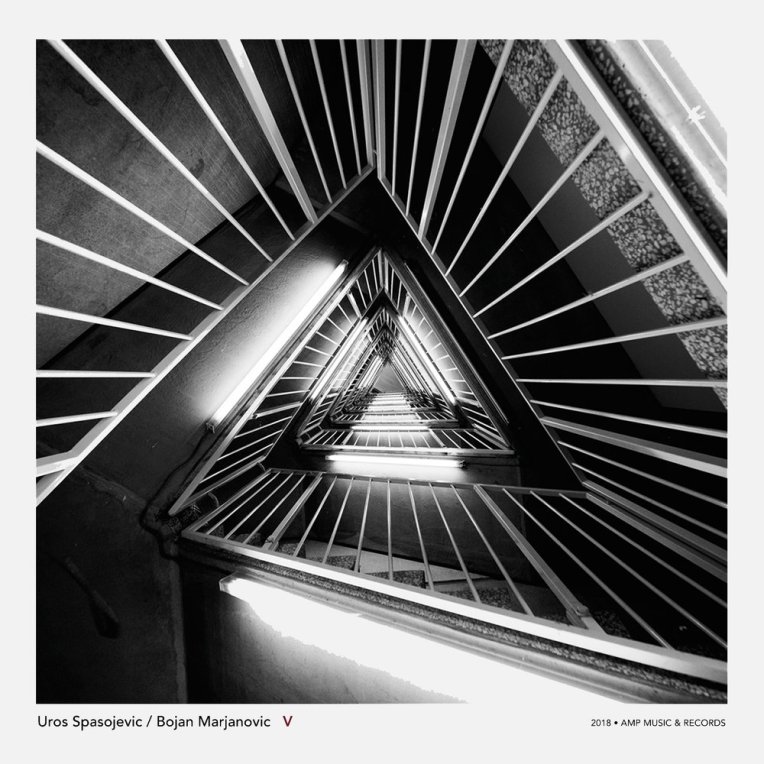
Uros Spasojevic / Bojan Marjanovic: V

v

Psychologist Mihaly Csikszentmihalyi defines “flow” as a oneness of performer and process, and on electric bassist Uros Spasojevic and pianist Bojan Marjanovic achieve precisely that. That said, the Serbian duo doesn’t so much combine forces as close the gap between them, like two hands from different religious traditions coming together in a single prayer.

Spasojevic is unique for drawing out the bass’ corporeal qualities. In his solo “North,” he opens the curtain in a gesture so holistic that it seems to inhale and exhale simultaneously. With a tone that’s rounded yet which pierces the heart, he drops higher notes into a blurry pond, every ripple like a newborn song in search of words. The piano’s entrance in “Senok” reveals, with quiet assurance, an underlying Ketil Bjørnstad influence. Yet while the Norwegian pianist-composer’s cinematic lyricism is paralleled, it’s filtered through a color scheme all its own. Such an association suggests an ECM connection, and by no coincidence, as Spasojevic—who writes all the music here—cites the label as a staple of his listening diet. Such respect is further enhanced by the fact that the album was mixed and mastered under the attentive hand of Jan Erik Kongshaug at Oslo’s famed Rainbow Studio, and by the familiar thematic fragment of “Water,” which seems to have been lifted sanctimoniously from Kenny Wheeler’s “Nicolette.”

The sonic footprint of Vis as non-invasive as it is expansive. In “Guide” and “Change,” it reaches deepest layers of emotional transference, rendering hidden dreams with the pigment of open realities. “Hope” is a prelude to the title track, of which a pianistic lattice offers its plot to Spasojevic’s melodic fruit. As Marjanovic heightens his freedom of expression in spiraling architectures, he uncovers more than the album’s mission statement, but a land without borders. “End of the hill” thus surveys the album’s most abstract territories, making use of electronic augmentations and spontaneous impulses, while “Sea” closes the circle with another lone journey, of which every step brings us farther from a destination, letting us float instead across a misty sea, thankful for the beauty of unknowing.

ECM Radio Shows

For those interested, I have consolidated all six ECM radio shows I did last year for WKCR. The first five provide offerings from ECM’s catalog on a decade-by-decade basis, from the 1970s to the present, while the sixth is a special compilation of world- and folk-leaning favorites:

ECM by the Decades: The 1970s

ECM by the Decades: The 1980s

ECM by the Decades: The 1990s

ECM by the Decades: The 2000s

ECM by the Decades: The 2010s

ECM: Between the Lines

Live Report: Klaeng Festival 2018

Now approaching its 10th year, Köln’s Klaeng Festival (Nov. 23rd-26th) has developed into a synaptic hub of local and international jazz talents. Fueled by seven musicians with a passion for seeking out the finest in improvised music, 2018’s incarnation brought out the collective’s most eclectic mission statement yet upon the Stadtgarten stage.

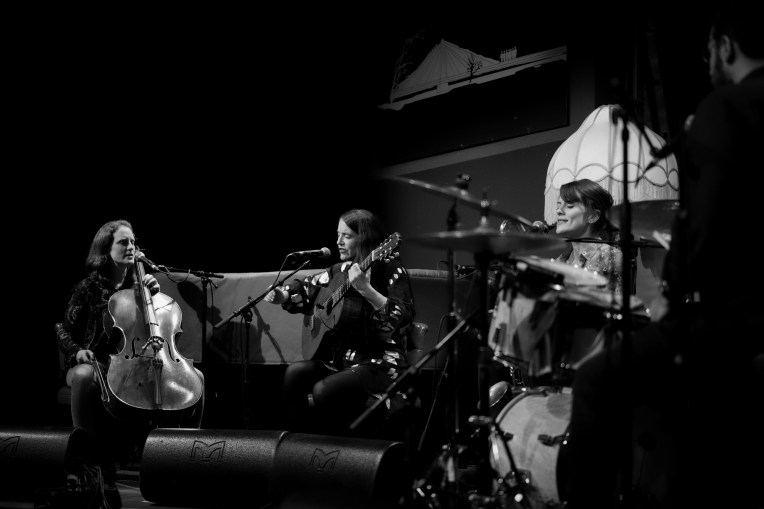
Throughout the three-day festival, a number of perennial themes clarified themselves. First and foremost was listening, as quintessentially expressed in the music of Clang Sayne. Led by vocalist/guitarist and principal composer Laura Hyland, the Irish band hung meticulously woven tapestries of song in celebration of life and death. Together with Judith Ring (voice/cello), Matthew Jacobson (drums) and Carolyn Goodwin (bass clarinet), Hyland crafted a tender yet restless atmosphere. Songs like “Thoughts from a Church Pew at a Mountain Cabin” and “The Round Soul of the World” revealed a lifetime’s worth of impressions with dirge-like pathos. Through it all, an awareness of silence as a physical substance of memory prevailed.
DSC02487-Edit-Edit

David Virelles and Marcus Gilmore showed us the art of listening within to bring meaning without. The pianist and drummer were more than that, as each had a modest arsenal at his disposal—Virelles on his Alesis MIDI keyboard fed with custom samples and Gilmore employing Sunhouse sensory percussion technology—to fill in the finer details.

DSC02498-Edit-Edit

Either musician could fill a room without these enhancements, which made their tasteful application thereof all the more joyful. Over the course of one long-form improvisation followed by something of a summary encore, the performance cycled through ambient grooves, massive block chords and solo relays in service of pathfinding music blurring the line between compression and decompression.

DSC02496-Edit

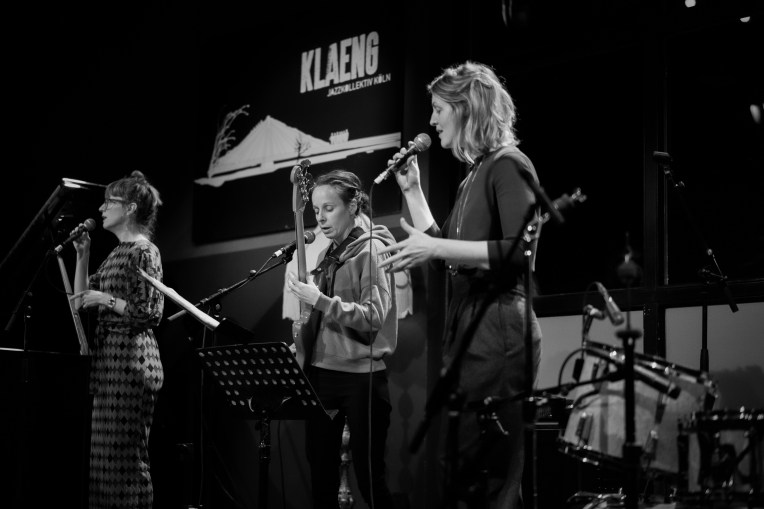
No mode of listening was as intense, however, as that brought to bear by bassist/vocalist Ruth Goller, whose Skylla (a new group playing its first live gig) gave pause to the relatively denser sound clouds preceding it. Flanked by the precise intonations and occasional aphasic turns of vocalists Lauren Kinsella and Alice Grant, Goller proceeded from humble intervals to unravel an intimacy so deep it felt almost blasphemous to be privy to its wonders. Bass kept things grounded in every sense, serving as an interpreter of dreams in a larger feedback loop.
DSC02654-Edit

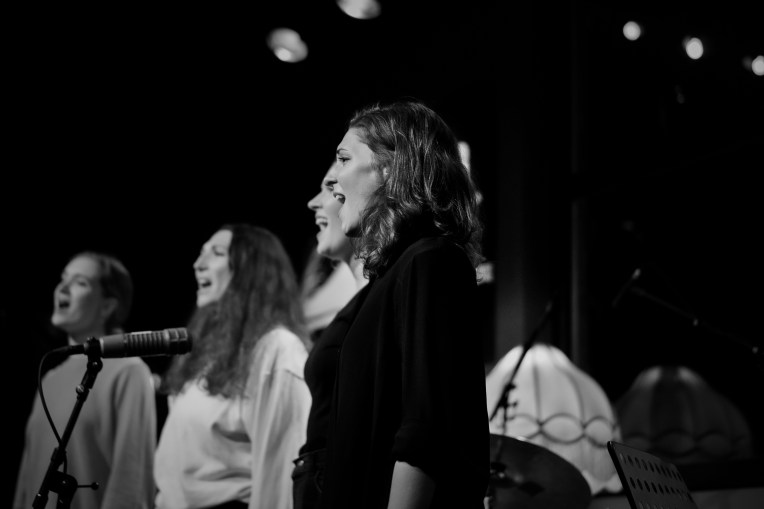
Likeminded inwardness abounded in Of Cabbage and Kings, a local “neo a cappella” quartet who opened for drummer Leif Berger’s sextet and whose spiritual arrangement of Laura Mvula’s “Overcome” gave a taste of what could easily have been an entire concert.
DSC02508-Edit

Berger and friends spotlighted a second major theme of the festival: communication. Here the focus was on gestures, motifs and improvisational strategies. Berger’s band was catalyzed by alto saxophonist Fabian Dudek, trombonist Moritz Wesp, pianist Felix Hauptmann, synth wizard Yannis Anft and bassist David Helm. Half of the tunes were so new as to have only numbers for titles. Of these, “Zwei” and “Sechs” evoked an arid, desert-like atmosphere. The moodier “Basilica” was a highlight for its vivid evocation of sun, stone and glass while “Pflanzem,” despite its nonsensical title, proved Dudek to be a sensible improviser.

This slideshow requires JavaScript.

Further outstanding communication came from violinist Harald Kimmig, bassist Daniel Studer, cellist Alfred zimmerlin and pianist Philip zoubek, who over two long takes fleshed out a fascinating hour of free improvisation. Shifting between contemporary classical music (at times veering into darker, George Crumb-like territories) and jazz (as when Studer rubbed a drum brush across his instrument), every extended technique felt natural and inevitable and proved the humility of a quartet willing to be nothing more than the sum of its parts.

This slideshow requires JavaScript.

The festival’s communication ambassador, however, was Soweto Kinch. The British alto saxophonist lifted his trio with bassist Nick Jurd and drummer Will Glaser to postmodern heights across a set of six original tunes, followed by a freestyle rap built around words suggested by the audience. Kinch’s forays into hip-hop firmly placed the cornerstones of his politics, worldview and harmony-seeking personality. His original blend addressed salient issues of division without proselytizing, yielding the most audience-aware act of the weekend.

DSC02578-Edit-Edit

A final binding theme was synergy. Philm set the tone in this regard as the festival’s opener. Comprised of Philipp Gropper (tenor sax), Elias Stemeseder (piano/synths), Robert Landfermann (bass) and Oliver Steidle (drums), the band spoke in poetry rather than prose and brought unforced flow to fruition in chains of subtle explosions. The band carefully framed one scene after another, if only to allow dialogue to flow unscripted. Thus, piano and drums conversed from either end of the stage. Like a spirograph in sound, they embodied a dichotomy of chaos and order, revealing a depth of design in every turn of the cog.

DSC02484-Edit-Edit

The Buoyancy Band, a new outfit from pianist and bandleader Pablo Held, took synergy to an even higher level. Boosted by the flair of Percy Pursglove (flugelhorn), Kit Downes (organ) and Sean Carpio (drums), Held sparked one beautiful fire after another. Pursglove was a special treat, as his stratospheric improvisations recalled the late Kenny Wheeler in the most heartfelt way imaginable. Downes was another key presence, bringing depth to tunes like “Floater” and a remarkable translucence overall.

This slideshow requires JavaScript.

Synergy incarnate came in the form of Gilad Hekselman’s Zuper Octave. Joined by keyboard player Aaron Parks and drummer Kendrick Scott, the guitarist closed the festival with mostly original music that was on-point and welcoming. Between the fast-fingered “VBlues” and downtempo encore “Stumble,” the trio made magic seem like second nature. Parks held the most unenviable post, providing basslines on a Korg microKEY while playing Rhodes underneath. Hekselman’s writing represented one of the band’s many strengths. Whether in the beautifully arranged rhythms of “Tokyo Cookie” or relief-oriented “It Will Get Better,” his love of life was as obvious as the smiles he exchanged with his bandmates were plentiful. Theirs was a wisdom of experience most bands would take a lifetime to achieve.

This slideshow requires JavaScript.

If nothing else, however, 2018’s Klaeng Festival was about sound as substance. This was nowhere so obvious as in the venue’s slogan, printed on the door opening into the concert space: “We eat music.” If so, then everyone was surely nourished to capacity, leaving room only for the dessert of reflection.

(This article in its original form appeared in the January 2019 issue of The New York City Jazz Record, a full PDF of which is available here.)

Kyoko Kitamura’s Tidepool Fauna: Protean Labyrinth

Protean Labyrinth

Protean Labyrinth is a tunnel burrowing into the linguistic soil from which we all sprout. It’s a sensation best expressed in a handful of tracks bearing the title “Push.” Of these, “Push Four” is the most emblematic, a spontaneous ramble, which, like the album as a whole, achieves coherence by virtue of its passage through time—pushing indeed against the temptation of meaning in favor of instinctive understanding. At the center of this aphasia is vocalist Kyoko Kitamura, who doesn’t so much lead the band as strike it like flint on rock. Tenor saxophonist Ingrid Laubrock, bassist Ken Filiano and drummer Dayeon Seok are chemically bound to her at every moment, tasting the air of possibility like a three-pronged tongue.

Despite the guiding scores from which the music is drawn, the quartet undermines any purchase of exposition. What starts as a bright groove one moment might morph into throaty sinews of darkness the next. That such changes occur without force or hierarchical touch is testament to these musicians’ willingness to smash their compass the moment it’s calibrated. The finest turns are “Deadbolt” and “No Exit,” both masterful containments of wildness. Each is a glass house filled with vocal stones—not thrown but handled so much that they’ve become rounded with care.

Kitamura’s voice, brimming with fierce humility, is central to these goings on. In “Lure,” each of her utterances is an Ouroboros of potential meaning sacrificed on the altar of its own becoming and in “Slide” she breaks out the vocal champagne, bubbling and frothing her way through a subterranean mythos. This is the underside of language, a sonic entity that grows and moves of its own accord.

(This review, in its original form, appeared in the December 2018 issue of The New York City Jazz Record, a full PDF of which is available here.)

Winged Serpents: Six Encomiums for Cecil Taylor

Winged Serpents

If the music of Cecil Taylor was a continent, this album is a chain of islands. Divided in magnitude yet sharing the same creative waters, each of its pianists offers one of six eulogies in praise of an artist who knew no bounds and whose powerful life is held in the balance of interpretation.

Craig Taborn’s “Genuflect” plays out a dialogue between the ethereal and the earthly. His feel for texture is savory enough to be edible and recalls the soul-filling starches that were staples of the Taylor diet. This catharsis sits comfortably next to Sylvie Courvoisier, who brings her knowledge of the piano’s interior to bear on “Quauhnahuac” as a linguist would phonemes: that is, creating meaning out of elements that in and of themselves have none. Her anatomical precision elicits solace and strength in equal measure. The humbly titled “Minor Magus” finds Brian Marsella scraping away the dirt of grief in handfuls. It’s an unrelenting piece that speaks of a biography struggling to catch up with its departed subject.

“Grass and Trees on the Other Side of the Tracks” is Kris Davis’ song of spontaneity. By turns prayerful and spasmodic, it struggles to breathe of its own accord, like a pair of lungs fighting the influence of a respirator. Aruán Ortiz’s “Unveiling Urban Pointillism” may just be the body housing said lungs, pulling away from a dream so adhesive that one begins to question the value of waking at all. Anthony Coleman swings from the rafters of a written score (the album’s only). Its title, “April 5th, 2018,” dates Taylor’s death, veering into improvised corners of renovation. The most somber of the set, it is also the most traditional, sprinkling fragments of ragtime, swing, and pop into its brewing vessel. A fitting end to one whose posthumous legacy is just beginning.

(This review, in its original form, appeared in the December 2018 issue of The New York City Jazz Record, a full PDF of which is available here.)

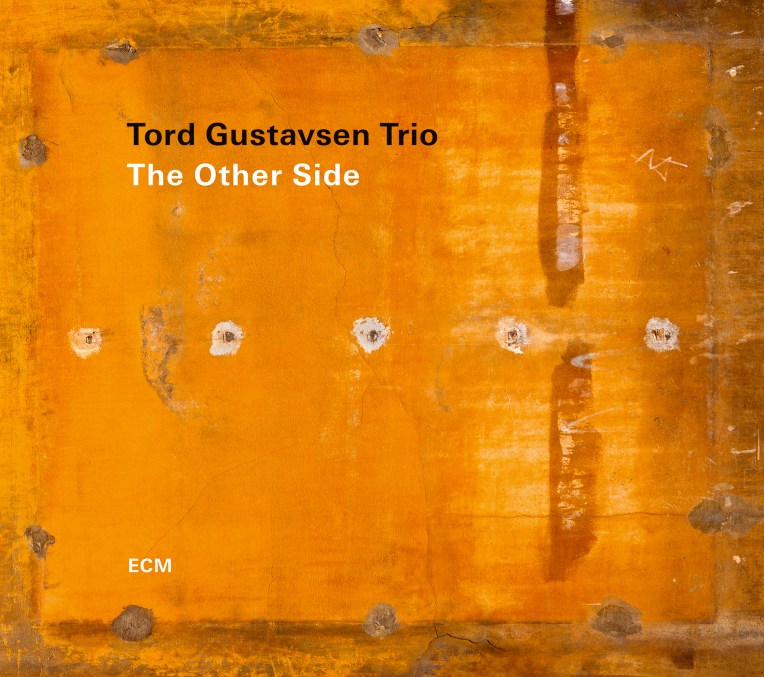
Tord Gustavsen Trio: The Other Side (ECM 2608)

2608 X

Tord Gustavsen Trio
The Other Side

Tord Gustavsen piano, electronics
Sigurd Hole double bass
Jarle Vespestad drums
Recorded January 2018 at Rainbow Studio, Oslo
Engineer: Peer Espen Ursfjord
Produced by Manfred Eicher
Release date: August 31, 2018

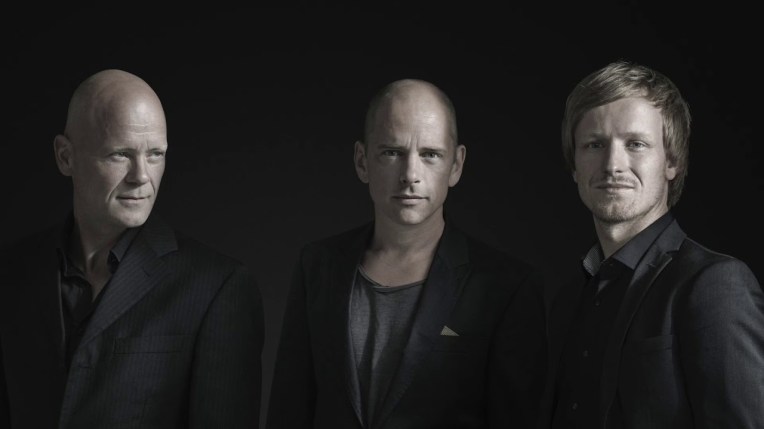
Following the success of three earlier ECM recordings and reeling from the death of bassist Harald Johnsen, Norwegian pianist Tord Gustavsen decided to pursue other sources of light. Here his trio is relit, carrying over the torch of drummer Jarle Vespestad and adding the new flame of bassist Sigurd Hole for a veritable candelabrum of poetic originals, folk songs and church music. Although 11 years separates this from the last trio session, Gustavsen’s self-styled approach of “radical listening” is more vibrant than ever—a mood only confirmed by the crispness of this album’s engineering and the humbling interactions it documents.

TGT
(Photo credit: Hans Fredrik Asbjørnsen)

Like a prism, colors change throughout The Other Side as a matter of perspective. Upon first listen, I find myself drawn to an anthemic subtlety such as only Gustavsen can articulate. It’s all there in the inaugural “The Tunnel,” which feels like a slow-motion flashback into the deepest corners of my happiest memories.

A slight change of angle highlights the band’s newest member. Hole is an intrepidly lyrical bassist whose approach to folk tunes and hymns alike reveals a buoyant physicality of execution. His spirited contributions to folklorist Ludvig Mathias Lindeman’s “Kirken, den er et gammelt hus,” for instance, reveal a heart rooted deeply in tradition. His arco whispers in “Duality” and “Taste and See,” both of which float on softest beds of electronics, are haunting and precise and the continuity of his playing in “Re-Melt” is nothing short of romantic.

Another shift brings out the deeper hues of three Bach chorales, lovingly arranged in dramatic braids. Of these, “Schlafes Bruder” teases out great joy from solemn hymnody and frames butterfly-winged drumming. The piano solo “Left Over Lullaby No. 4” is yet another band of a spectrum that speaks for itself and, like the title track and the concluding “Curves,” has a classic feel that beckons us into Gustavsen’s back catalogue. All of which yields a life-affirming record and a profound leap of faith for one of ECM’s most indelible trios. Welcome home.

(This review originally appeared in the September 2018 issue of The New York City Jazz Record, a full PDF of which is available here.)