Please join me and host Andrew Castillo tonight on WKCR’s Jazz Alternatives program, where I’ll be your guest for five shows to present “ECM by the Decades.” Each program has been specially curated by myself to reflect the more obscure and hidden gems of the ECM catalog, decade by decade. Tonight, from 6-9pm EST, we’ll be exploring the label’s formative forays of the 1970s. Click the logo below to be directed to the WKCR website, where you will find more information about tonight’s program, and where you may stream us live by clicking the “LISTEN” icon on the top-right corner of the screen. Even if you’re unable to tune in, we will be archiving the program here for future streaming and downloads.
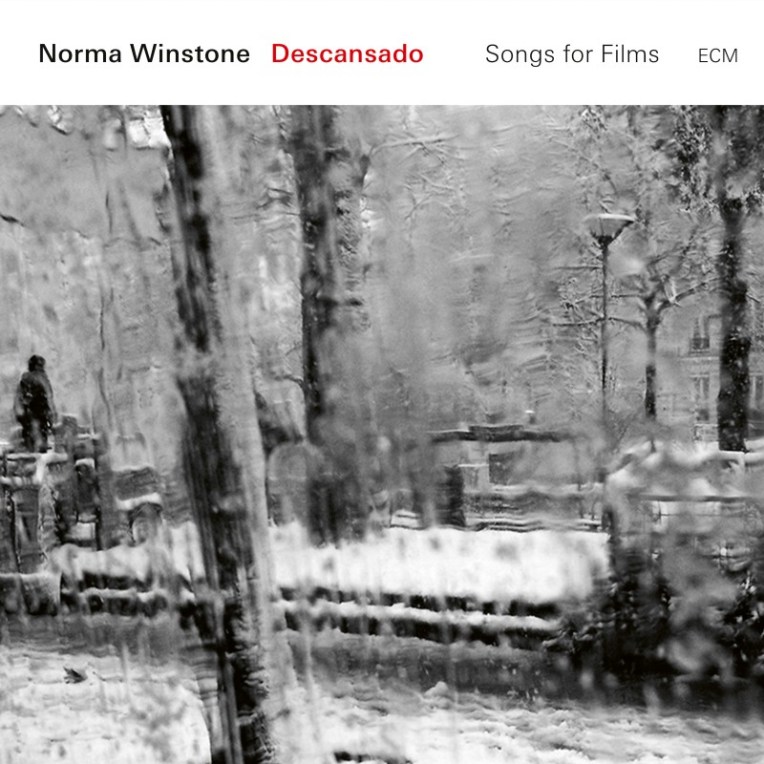
Norma Winstone voice Glauco Veneier piano Klaus Gesing soprano saxophone, bass clarinet Helge Andreas Norbakken percussion Mario Brunello violoncello
Recorded March 2017, ArteSuono Studio, Udine
Engineer: Stefano Amerio
Produced by Manfred Eicher
Vocalist Norma Winstone returns to ECM with pianist Glauco Venier and reedplayer Klaus Gesing to explore the relationship between song and cinema. Interpreting the scores of Legrand, Rota and Morricone, among others, and referencing such filmmakers as Godard, Fellini and Scorsese, the result is a collection of moving images in and of itself.
Winstone’s penchant for moody arrangements and organic insights into the human condition shares the silver screen’s existential concerns. Said concerns are made explicit as her trio, joined by percussionist Helge Andreas Norbakken and cellist Mario Brunello, flip through the pages of the human heart. The power of memory to shape how we live and love is a central theme. Whether toeing the line between past and future in “Il Postino” or weaving through the corridors of yearning in “Amarcord (I Remember),” Winstone’s voice knows where it stands at any given moment. Thus, “What Is A Youth?” and the opening “His Eyes, Her Eyes” set the tone for a plaintive emotional experience, like a dark filter placed over the lens of the mind through which she captures parries of affection.
Winstone’s musicians soliloquize the finer implications of her sentiment. Norbakken and Brunello add points and lines, respectively, setting the scene for every story, while Venier populates those backdrops with extras. Gesing, alternating between soprano saxophone and bass clarinet, is a protagonist on par with Winstone, responding to her every move in dialogic fashion. Four tracks in which Winstone sings wordlessly further highlight these infrastructural relationships. Of these, the jig-like comportment of “Meryton Town Hall” comes as a welcome splash of Technicolor in an otherwise noir-ish program.
Lyrically, too, this record stands out within an already-distinguished discography. Beginning with the title song, one of six for which Winstone penned her own words, and continuing on through to “So Close To Me Blues” (her take on the theme from Taxi Driver), she demonstrates a keen understanding of the magnitude of intimacy, thereby providing shelter for any soul craving refuge from its weary transit.
(This review originally appeared in the March 2018 issue of The New York City Jazz Record, a full PDF of which is available here.)
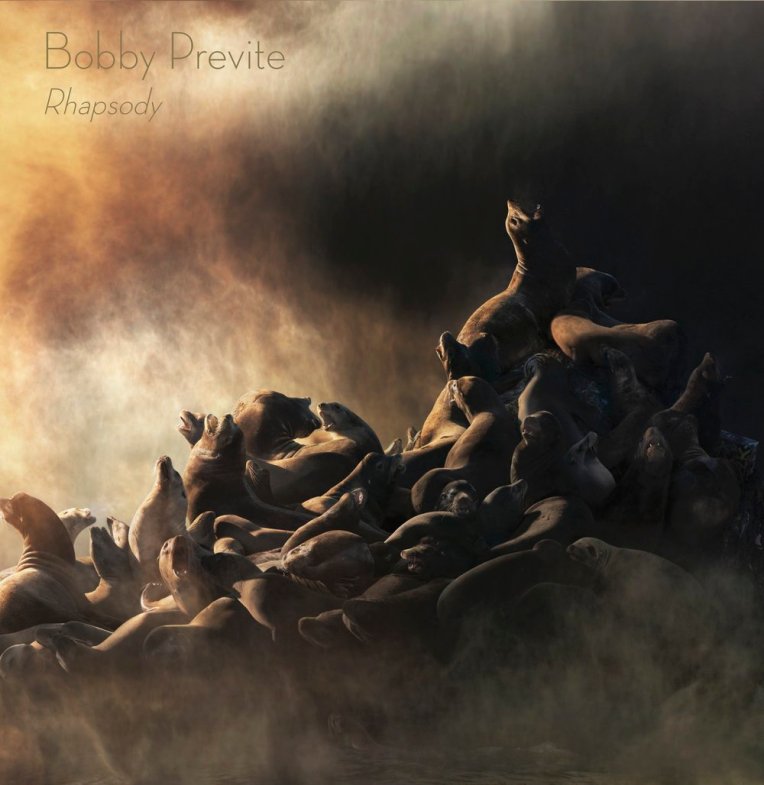
For the second installment of his Terminals trilogy, an ongoing ode to transit and migration, drummer Bobby Previte has convened a dream group. Although featuring musicians often found in electr(on)ic settings, Rhapsody unfolds a grand mise-en-scène by purely acoustic means. “Casting Off” and “I Arrive,” respectively, begin and end the album by threading the vocal delivery of Jen Shyu (whose erhu playing is another distinct color in this palette) through the netting of John Medeski’s piano and Fabian Rucker’s alto saxophone. As the center of the action, Shyu imbues Previte’s lyrics (a first for him) with theatrical punch, singing the role of an airplane traveler cycling through various stages of self-awareness until she reaches her unknown destination under cover of night.
That state of liminality—of hanging suspended between locations with only a thin layer of metal and composite between you and certain death—is beautifully rendered in Previte’s downright cinematic movements, each of which variously highlights the strengths of one or more of his bandmates. Medeski shines in “When I Land,” his precise syncopations seeming to chart every leg of the journey, and, in tandem with harpist Zeena Parkins, he renders the backdrop of tracks like “The Lost” and “The Timekeeper” while Ruckman carefully links his own chains of melody and abstraction. Hearing Parkins unplugged is an especial privilege; in this context, her crystalline beauty feels nearly all-consuming. Guitarist Nels Cline treads a parallel path and to highest effect in “All Hands,” in which his slide guitar sounds almost like a pipa. Previte himself completes the picture, playing an assortment of drums and percussion and, in “Last Stand/Final Approach,” autoharp and harmonica to boot. He treats himself no differently than his other musicians, letting his singular compositional voice ring over all, handing us a light to navigate the darkness in which he leaves us.
(This review originally appeared in the March 2018 issue of The New York City Jazz Record, a full PDF of which is available here.)
The Turtle Island Quartet presents a new program centered on the spirit of Charlie Parker. Although only one of his tunes is included, these four impeccable musicians share Bird’s penchant for expanding parameters and the results of their alchemy are just as golden. Like the other jazzy ingots herein—namely, “Subconscious-Lee” (Lee Konitz) and “Miles Ahead” (Miles Davis)—“Dewey Square” makes artful use of extended techniques. Violinist/founder David Balakrishnan employs scratch tones for a delightfully percussive effect while cellist Malcolm Parson (who, along with violinist Alex Hargreaves, is new to the group) plays the role of bassist via robust pizzicato. The in-house arrangements alone boast of interdisciplinary genius at play, allowing for plenty of improvisation to show the quartet’s combinatory properties.
The Modern Jazz Quartet’s “Django” gets a welcome spin and in its central section evokes the fluidity of Stéphane Grappelli, whom Balakrishnan calls a “patron saint” of the quartet. Yet Balakrishnan’s own compositions are the support beams of this soundly engineered structure. They sometimes reveal an underlying quirkiness, as in his “Rebirth of the Holy Fool,” which puns on Davis’s Birth of the Cool, and “Squawk,” taking its inspiration from a mysterious incident in 2011 when the town of Beebe, Arkansas awoke on New Year’s Day to find that 5,000 dead blackbirds had fallen from the sky. The composer navigates these images with delicate rigor. His “Aeroelasticity: Harmonies of Impermanence,” however, is the album’s centerpiece. A multivalent suite in four movements, it hums with the very propulsive energies that inspired it. Influences range from Indian classical music to mathematical properties (the piece is, after all, dedicated to his father, a UCLA professor of engineering), bringing solid returns on his emotional investments. There’s a backwater charm lurking within and a feeling of memory tying it all together. Violist Benjamin von Gutzeit’s “Propeller” is something of a sister piece, as it deals equally with mechanisms in motion, if on a more intimate scale. Its balance of curves and straights is emblematic of what this quartet is capable of at its finest.
(This review originally appeared in the March 2018 issue of The New York City Jazz Record, a full PDF of which is available here.)
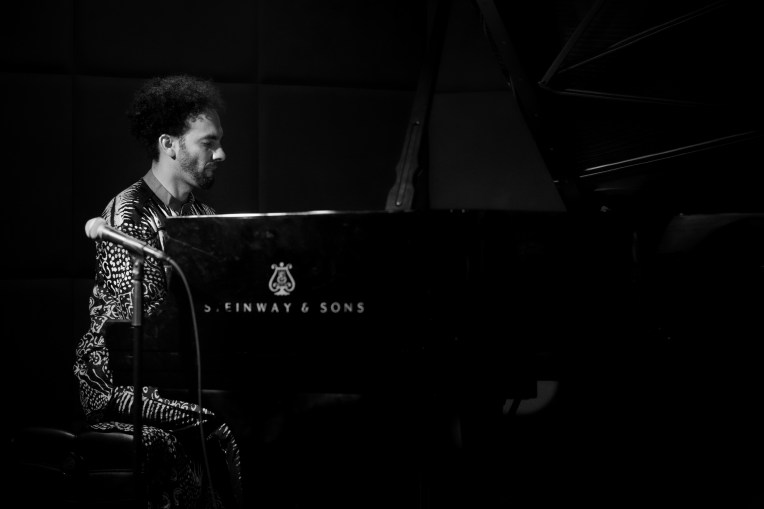
My latest review for All About Jazz is of a concert given by pianist David Virelles and Nosotros featuring Román Díaz at New York City’s Jazz Standard in celebreation of their new ECM album Gnosis. Click the photo below to read on.
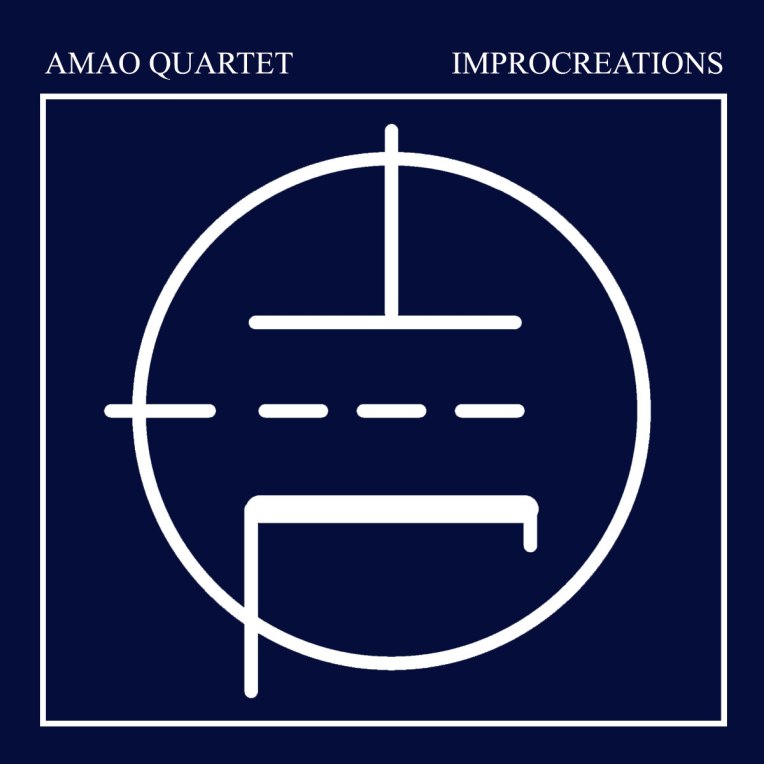
My latest CD review for All About Jazz is of the Amao Quartet’s self-produced Improcreations. A beautiful example of free improvisation (here featuring four Brazilian electric guitarists) that is neither overbearing nor confrontational. Click on the cover to discover!
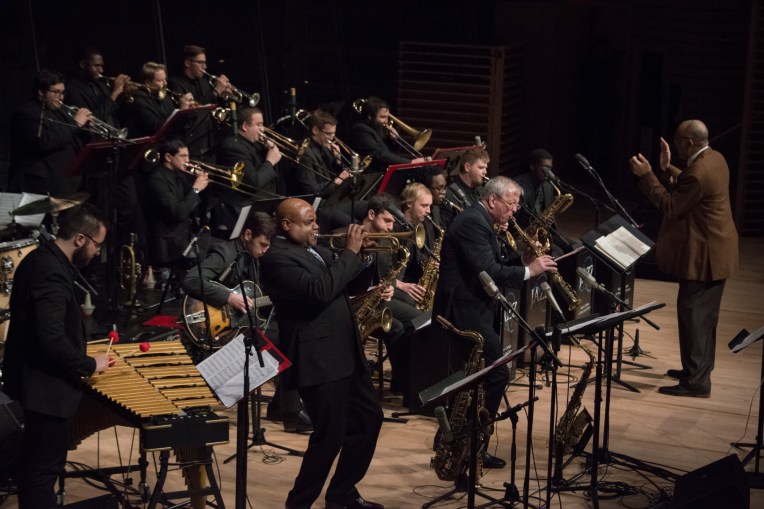
My latest live review for All About Jazz documents an unforgettable showcase by the Temple University Jazz Band, under the direction of Terell Stafford. Featuring special guests such as Joe Lovano, Jimmy Heath, and René Marie, it was intergenerational cross section of talent. Click the photo below (taken at the concert by Lawrence Sumulong) to read on.
My latest article for All About Jazz is an extensive report on the 2018 Winter Jazzfest, which included a handful of ECM-associated musicians, such as David Virelles, Aaron Parks, and Sylvie Courvoisier. Click the photo below to read on.
As some of my readers may be aware, I’ve been photographing semi-professionally for a few years. Only recently, however, have I begun to photograph musicians. Below is a slideshow of recent images. Hope you enjoy them.





 Between Sound and Space: ECM Records and Beyond