Nils Økland Band: Kjølvatn (ECM 2383)

Kjølvatn

Nils Økland Band
Kjølvatn

Nils Økland viola d’amore, Hardanger fiddle, violin,
Rolf-Erik Nystrøm alto and baritone saxophones
Sigbjørn Apeland harmonium
Mats Eilertsen double bass
Håkon Mørch Stene percussion, vibraphone
Recorded June 2012, Hoff Church Østre Toten, Norway
Engineer: Audun Strype
Executive producer: Manfred Eicher
U.S. release date: April 8, 2016

Since his 1996 solo debut, Blå Harding, Norwegian Hardanger fiddler Nils Økland has charted a range of melodic waters, always docking at the intersection of traditional and contemporary music. His relationship with ECM has produced a series of artistic statements, each more cohesive than the last. His first for the label was 2009’s Monograph, a solo album of great scope that led to 2011’s Lysøen, in duet with Sigbjørn Apeland. And now we have Kjølvatn, for which he has assembled a full band under his own name. Apeland rejoins the fray, here playing harmonium, along with saxophonist Rolf-Erik Nystrøm, bassist Mats Eilertsen, and percussionist Håkon Mørch Stene. Each has lived in that gray area between folk, jazz, and classical, and funnels his unique experiences into Økland’s sound-world like grains of sand through an hourglass.

Having worked with these musicians for years in some configuration or another (all except Nystrøm played on Bris, released in 2004 on Rune Grammofon), Økland revisits a trove of older material with special familiarity. A look at even a few of the tunes shows the breadth of his network. He wrote “Mali,” for instance, after attending a concert by Swedish rapper Timbuktu. The band’s profiles cohere evocatively in this opening piece, as in the album’s title track, a retroactive score for the 1933 Scottish silent film The Rugged Island. “Undergrunn” (Underground), too, feels quite integrated, arising as it did from a collaboration with the London Sinfonietta around folk motifs. Such diversity of origins suggests that Økland’s influences are as complex and fragmentary as life itself.
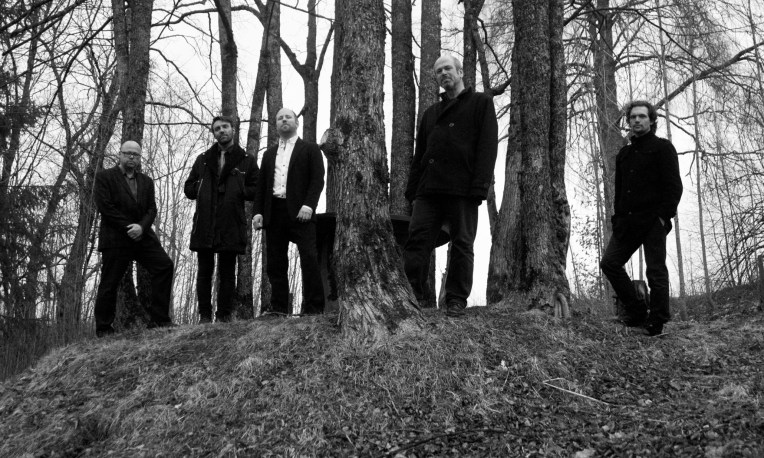
NOB
(Photo credit: Ellen Ane Eggen)

Økland employs a variety of open tunings on the album, each of which has its own special name. The “dark blue” tuning (D-D-A-D) is heard on the processional “Drev” (Drifted), wherein are bolded Stene’s percussive colors, and “Start” the so-called “troll tuning” (B-E-B-D#). In the latter, Økland combines ancient structures and modern minimalism, both of which he sees as relying on short motifs multiplied to form larger structures.

Økland has been increasingly inspired by the viola d’amore, which like his mainstay instrument has extra strings that vibrate sympathetically beneath the main four, and on tracks “Puls” and “Skugge” (Shadow) he draws a darker soul from this cousin. In the former piece, the heartbeat is evoked by Stene on kettledrum, while Eilertsen explores kindred frequencies. Over this, a flight from Økland’s bow touches the ocean with a wingtip in search of nesting territory.

Location matters a lot in Kjølvatn, which was recorded at the Hoff stone church in the countryside of Norway’s Oppland county. Økland’s go-to engineer, Audun Strype, captures the church’s resonant bounce, allowing the rougher, more organic aspects of the performance to exude clarity. One may hear this especially in “Fivreld” (Butterfly), an alluring piece of ambience in which the harmonium breathes like sunlight through foliage. Made for a ballet performance at Haugesund Theater in Økland’s hometown, it veritably dances.

Other references to Økland’s past are found in “Blå harding” and “Amstel.” Earlier versions of both appeared on the aforementioned debut. The first is something of a blues dedicated to his Hardanger fiddle teacher Sigbjørn Bernhoft Osa, while the second, which closes out the album, is greener, its organ-like harmonium reminding us of where we are.

Kjølvatn rarely bubbles beyond a simmer, but its flavors are all the purer for it. It’s a significant move in Økland’s career, and exemplifies an artist who, despite denying any underlying message, understands the value of careful construction. And in a way, that is its practice: to create art for its own sake, devoid of political baggage and free to roam in search of new and welcoming ears.

(See this review as it originally appeared in RootsWorld online magazine here.)
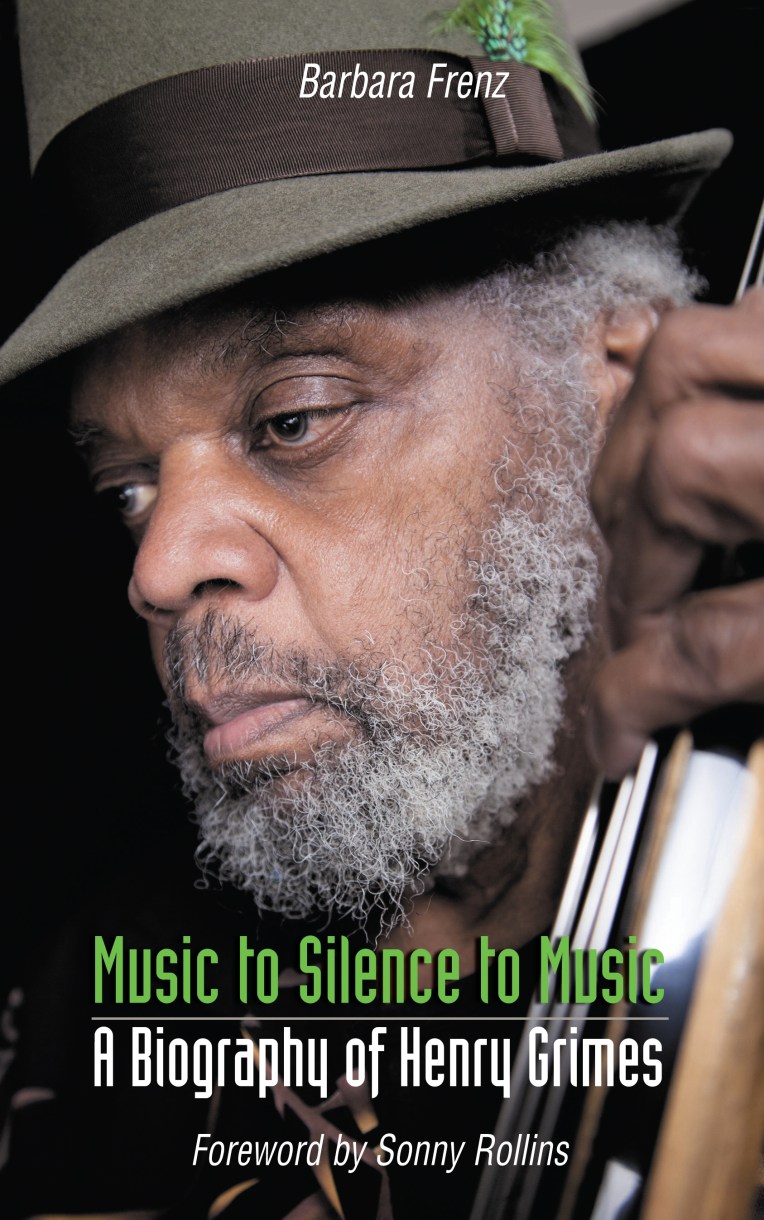
Book Review: Music to Silence to Music – A Biography of Henry Grimes

Music to Silence to Music

In his foreword to Music to Silence to Music: A Biography of Henry Grimes, Sonny Rollins recalls his first encounter with the young bassist in Philadelphia: “He seemed to hear and immediately respond…in an unbroken circuit between muse and man.” Likewise, German historian Barbara Frenz’s lovingly penned biography wires an unbroken circuit between reader and subject.

Frenz jumps improvisationally from reportage to interview. The resulting portrait is as multifaceted as the man himself. Grimes may not be interested in the anecdotal, but his memories yield a veritable résumé of iconic associations. By the early ’60s he was swimming in the deep end of New York City’s jazz scene, where collaborations with the likes of Albert Ayler unlocked his evolutionary potential. In 1967, just two years after his first leader date, he left the East Coast for the west and wasn’t heard from for nearly four decades. Grimes was forced to sell his bass in Los Angeles, where he sustained himself through odd jobs until he was rediscovered in 2002. He has been playing ever since, much to the glee of listeners and journalists alike, playing hundreds of concerts and surpassing even his own exalted reputation in the process. During the silence, he didn’t so much as touch an instrument. And yet, as Frenz makes clear, the music was always germinating inside him, along with a literary worldview that would feed back into his reprisal endeavors. His poetry is dark yet insightful and, like his soloing, focuses its attention on human interaction.

With this biography, Frenz has undone the misconception of Grimes as reticent ghost, arguing instead for his bold expressiveness while further emphasizing his versatility, go-with-the-flow attitude, and inner growth. His past contributions are obvious, but, as Frenz is quick to point out, his importance to the future of jazz even more so. Rather than an introvert who almost faded into obscurity, she wants us to see him as someone uninterested in attachments, living as he has—and always will—in the immaterial.

(This article originally appeared in the June 2016 The New York City Jazz Record, of which a PDF of the full issue is available here.)

John Zorn: Flaga

Flaga

Eight tunes from The Book of Angels make up Flaga, the 27th installment in a series exploring the parallel opus to John Zorn’s popular Masada series. His interpreters this time are pianist Craig Taborn, bassist Christian McBride, and drummer Tyshawn Sorey. “Machnia” puts listeners into the thick of things, highlighting the playing as much as Zorn’s prolific gift for melody.

What would appear to be a triangular relationship in theory turns into a pyramidal one in practice. The atmosphere is joyful and exciting and finds each musician grabbing the wheel in succession with idiosyncratic vigor. It’s a formula that leads to consistent piquancy in the remaining tunes, if at times dulled by the compactness of the engineering, which suffocates tunes like “Peliel” and “Katzfiel.” Other places it works beautifully, however, as in “Shiftier.” Here Taborn balances sacred and secular impressions, launching into his solos with territorial wanderlust. But not even a few misfires at the mixing board can reign in a double take on “Talmai,” of which the landscape is vast and the rhythm sectioning robust.

As may be expected in anything branded Zorn, abstractions are never too far away. Their wonders enliven “Katzfiel” and “Rogziel,” the latter recalling its composer’s fascination with the cartoon music of Carl Stalling. In this respect, the trio allows the spirit at hand to take the music where it needs to go, even if, like sand in an hourglass, every particle of improvisation eventually funnels into a steady passage of time. Which is not to say that reveries are absent: “Agbas” and “Harbonah” show sensitivity in kind, the latter an atmospheric gem that draws an arco bass thread through a stormy patchwork of piano and cymbals, teasing out the indestructible heart of the whole enterprise.

The way these veterans ease into and out of such eclectic themes is masterful, yielding a fresh take on Zorn that may just be the standout disc of the series and one that reasserts his position in the modern jazz canon.

(This article originally appeared in the June 2016 The New York City Jazz Record, of which a PDF of the full issue is available here.)

Mahsa Vahdat review for RootsWorld

My latest review for RootsWorld online magazine is of Mahsa Vahdat’s The sun will rise, a Norwegian coproduction that follows the Iranian singer unaccompanied in various locations around the world. A moving album about the power of song. Click the cover to read on and hear samples.

The sun will rise

Márta and György Kurtág: In memoriam Haydée (ECM New Series 5508)

In memoriam Haydée

Márta and György Kurtág
In memoriam Haydée
Játékok – Games and Transcriptions for piano solo and four hands
Piano Recital
Cité de la musique, Paris
22 September 2012

Márta and György Kurtág piano
Filmed September 22, 2012 at Cité de la musique, Paris
Directed by Isabelle Foulard
An LGM Télévision production in association with Cité de la musique
Producer: Sabrina Iwanski
Executive producer: Pierre-Martin Juban

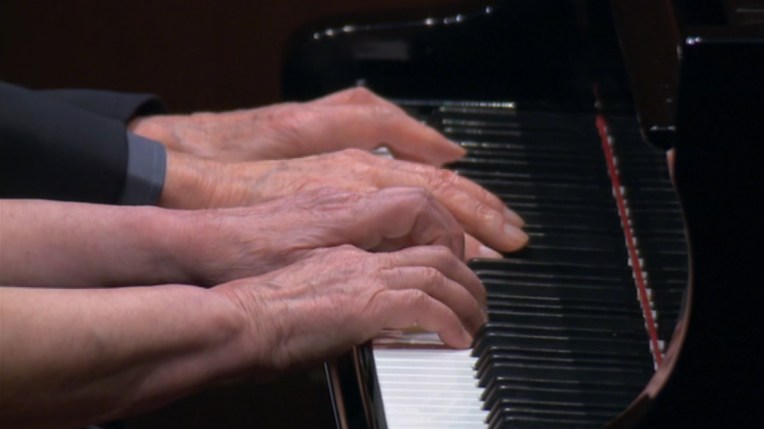
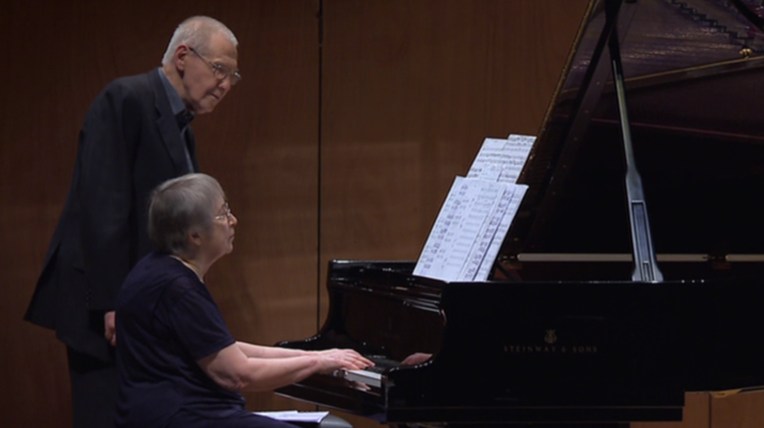
In September of 2012, Hungarian composer György Kurtág and his wife Márta gave a concert at Cité de la musique in Paris to honor the memory of a dear friend, musicologist Haydée Charbagi (1979-2008). Their program, as adventurous as it was delightful, combined piano transcriptions for two and four hands, exuding such intimacy that it’s a wonder the audience didn’t just melt away from all the love in the hall. For those not present, this DVD bears witness to the Kurtágs’ unbridled passion for each other and the music that passes between them. The program’s bulk is culled from György’s own Játékok (Games), an ever-growing miscellany of dedications to the living and dead alike. It’s also a tribute to classical roots on the whole, as indicated by the composer’s transcriptions of Bach chorales—each a towering trunk among his otherwise microscopic foliage.

2

There’s something dark yet wondrous about the first dissonances that creep from the stage. Saying hello with a farewell, György approaches the score as if it were a poem (such philosophies were, in fact, the subject of Charbagi’s thesis). And perhaps nothing so omnipresent as poetry could express either the compactness or vigor of each brushstroke. As observer, Márta stands like an appreciative statue before joining him at the keyboard. At times, she caresses him on the shoulder after he finishes a solo, an unspoken signal to connect the dots.

1

Those very points of light sparkle in pieces like Flowers we are…, which in conjunction with the pantheonic Baroque selections enables a poignant contradiction: namely, that Bach’s music eminently looks forward while György looks backward, leaving us in the middle like the binding of an open book. His own responsory is as much a reflection of the one to whom it is dedicated (Joannis Pilinszky) as the composer who vaulted the form.

3

With most at or under a minute, these concert selections are rife with inflection. There are moments of staggering beauty, especially in the Hommages, such as the Hommage à Christian Wolff, with its tip-toed notecraft, the resonant Hommage à Stravinsky – Bells, and the Hommage à Farkas Ferenc in its multiple incarnations, each more nuanced than the last and ideally suited to the composer’s greatest interpreter, Márta.

5

Campanule, as with so much of what transpires, expresses the pregnancy of emptiness, and the potential for healing amid broken motifs. This would seem to be the underlying message also of playful asides such as the fierce exchange of single notes that is Beatings – Quarelling and the kindred Furious Chorale. Another elliptical piece, Study to Pilinszky’s “Hölderlin, gives musical interpretation of a poem written for Mr. Kurtág and reinforces the concert’s overarching theme, while the dramatic (Palmstroke) and the programmatic (Stubbunny and Tumble-bunny) trip over one another in search of continuity.

4

Director Isabelle Soulard focuses on these passages in close-cropped framings, allowing the tender lattice of Aus der Ferne, written for the 80th birthday of Alfred Schlee, and the confectionary first movement of Bach’s E-flat major Trio Sonata (BWV 525) to shine all the brighter among this crowd of lamentations. For if anything, György’s art is about remembrance—a point driven home by the three encores, all of which reiterate pieces featured in the main program: the Hommage à Stravinsky and two of the Bach arrangements. Were it not for programs and obsessive musical minds, we might not even notice the repetition, as life consists of nothing but.

6

Nik Bärtsch’s Mobile: Continuum (ECM 2464)

Continuum

Nik Bärtsch’s Mobile
Continuum

NIK BÄRTSCH’S MOBILE
Nik Bärtsch
piano
Sha bass clarinet, contrabass clarinet
Kaspar Rast drums, percussion
Nicolas Stocker drums, tuned percussion
EXTENDED
Etienne Abelin violin
Ola Sendecki violin
David Schnee viola
Solme Hong cello
Ambrosius Huber cello
Recorded March 2015, Auditorio Stelio Molo RSI, Lugano
Engineer: Stefano Amerio
Produced by Manfred Eicher
U.S. release date: April 22, 2016

Swiss pianist and bandleader Nik Bärtsch makes no distinction between the old and the new, thriving instead on constant transformation. Freed of evocative titles, he writes in so-called “modules,” each of which combines through-composed and improvised material. This approach has yielded a series of albums for ECM under the name Ronin, but on Continuum he debuts his parallel ensemble, Mobile. Drummer Kaspar Rast and mononymous clarinetist Sha are familiar standbys, while percussionist Nicolas Stocker and a string section are the new recruits. Those familiar with Ronin will recognize certain tics in Mobile’s larger body. I ask Bärtsch to elaborate on their differences.

NB

“Mobile is acoustic and Ronin amplified, resulting in different consequences concerning power, pressure, volume, and listening behavior (for musicians and audience alike). We recorded Continuum in close proximity with each other while the Ronin sessions had us in different rooms. Mobile is also a music ritual group and often plays long concerts of several hours or even days. In Mobile we include rhythmic strategies of contemporary classical music, for example in ‘Modul 5.’ The band’s name refers to a ‘perpetuum mobile,’ while Ronin is a ‘groove generator.’ Mobile creates groove equilibriums and orchestral maneuvers while Ronin attacks with a paradoxical mix of empty meditative roughness and strong rhythmic energy: Zen-funk.”

The ritual foundations of said “Modul 5” reveal the virtuosity of their execution with patience. The same holds true for “Modul 60,” in which strings interlock with their surroundings like stairways in an Escher lithograph.

On Continuum, Bärtsch has taken his craft one step closer to an ideal that, while perhaps unreachable, is more audible than ever. Beyond my own idiosyncratic impressions, however, the music of Mobile is rooted in the presence of its musicians, as anyone who has seen them live can attest. Movement would seem to be central to “Modul 29_14” in particular, a force of suggestion made by its pairing with martial arts in a promotional video:

The binary relationship between Rast and Stocker in this piece unpacks bits of code into full-blown programs. High notes in the glockenspiel, doubling those of the keyboard, activate those programs in one artful sequence after another. Bärtsch, for his part, is careful to keep his own perceptions grounded the physical body. “A musical pattern, rhythm, or resonating structure is a sensual movement,” he says. “Sometimes, when I am practicing intensively, I dream of becoming such a musical being: a pure resonating energy of movement. We are all dancers in the universe.”

And is this dancing indicative of the project’s classical leanings?

“The music might seem more ‘classical,’ since we give the impression of a chamber ensemble. In principle we work the same way as with Ronin: I compose a piece, which in the context of the group develops its own instrumentation and dynamics. But in one respect your reception is probably correct: there is less obvious improvisation than in Ronin, although ‘Modul 12’ is completely improvised, if on the basis of a modular, coherent structure.”

That latter module is remarkable for Rast’s brushwork, by which he smooths out a layer of gravel over Sha’s tunneling contrabass clarinet.

Mobile

While most comfortable on the live stage, in this instance Mobile is uniquely bound to studio parameters. This does not, clarifies Bärtsch, equate to a reduction. “An album is a different genre altogether,” he notes. “It has and creates its own rules. But the group profits from the long-playing rituals, which leave us open to the situation of the recording: a new space-time continuum to be explored and created.”

To my ears, “Modul 18” is a well-rounded example of this brand of creationism. Its elements—metal, wood, air—come to life in a vibrational field of bowed strings against a repeating bass drum, Stocker shining like a constellation in its darker sky. Throughout “Modul 4,” too, the two drummers act as one as a high overlay of notes from Bärtsch foreshadows closure. Listening to such older modules, I can’t help but wonder how they’ve changed. Are they seeds for cultivation or do they become unique entities with every iteration?

“The modular way of composing allows a piece to evolve, while also retaining compositional coherence. The triangle of composition, improvisation, and interpretation should be connected and alive. Usually a pattern, piece, or musical strategy has more potential than you first recognize. You have to explore it for years through playing and observation. I see this as a natural, spiraling development forward into roots.”

Such is the modus operandi of “Modul 44,” in which Rast’s skins serve as palimpsests for musical poetry. The subtlety of his drumming is unexpected from such a robust figure. As in the gradual progressions of “Modul 8_11,” his interaction with the others results in so many orbits that the after-images of their playing form one glowing sphere. Despite the utter precision required to pull off this effect, a free-flowing, interdimensional quality prevails. If any message stays behind, it is Bärtsch’s own: “Trust your ears. They are the most sensitive antennas for the resonating inner and outer world.”