Lines for Ladies: Live!

Lines for Ladies

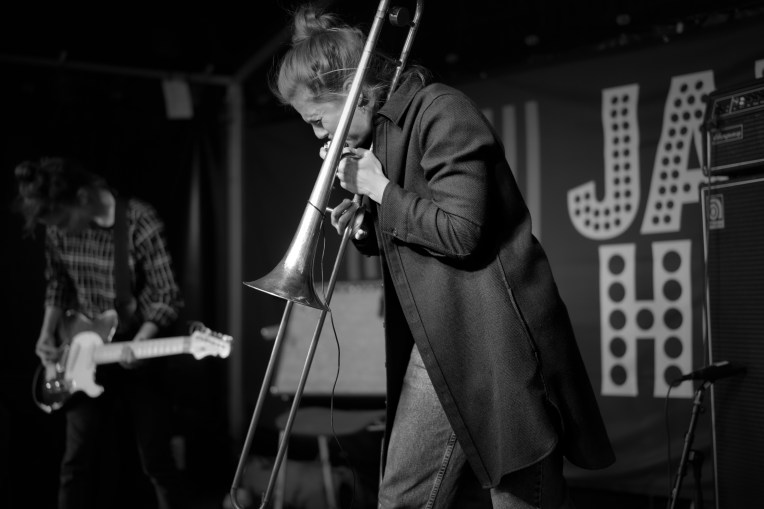
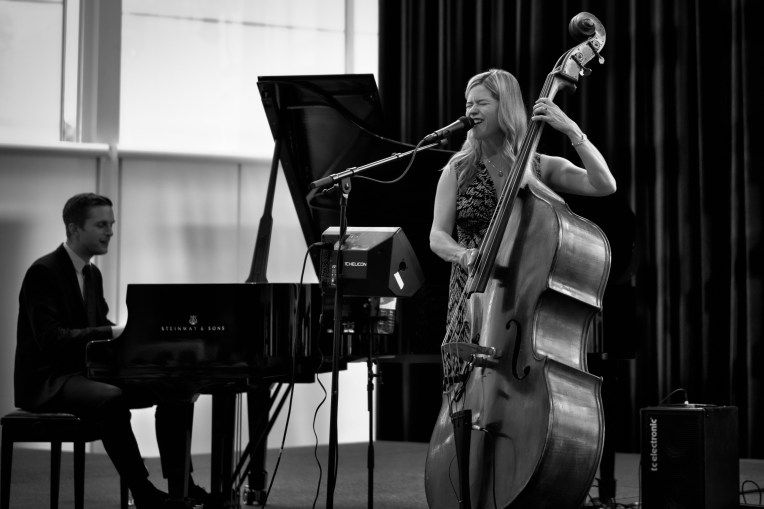
This live album from HGBS Blue Records documents the final performance of a two-week tour in 2014 by the ensemble known as Lines for Ladies. Special guest Sheila Jordan acts, in her words, as the band’s “spiritual mother,” shepherding in a younger generation of voices spreading their cohesive harmonies across canvases both familiar and new. To be sure, Kirstin Korb (bass/vocals), Anne Czichowsky (vocals), Sabine Kürlich (vocals/alto sax), and Laia Genc (piano/vocals) share more than the stage with Jordan. They carry on her alluring—or, as one song here would put it, “Delicious and Lovely”—tradition of jazz song as storytelling. Jordan has spent a lifetime and more perfecting her fashion of delivery, and among these women she is as a sun to the stars. Whether paying tribute to her Native American roots in the chant with which she opens “The Moon’s a Harsh Mistress” or unfolding a 13-minute mission statement in the largely adlibbed “Sheila’s Blues,” she churns emotion until it becomes soft as butter. “I sing the blues ’cause I paid my dues,” she croons, humbly failing to mention the profits she has reaped from subsequent dividends.

Likewise, the depths and breadths of Jordan’s spiritual children are not to be taken lightly. Czichowsky appends fresh, self-penned lyrics to standards “Killer Joe” and “Idle Moments” to delightful effect. The former song, suitably rebranded as “Ladies’ Show,” asserts its femme power in a male-dominated genre, while the latter highlights Czichowsky’s vocal trumpeting against Genc’s smooth pianism. Czichowsky relays with Kürlich’s French in a bilingual rendition of “I Wish You Love (Que reste-t-il de nos amours).” The two singers harmonize even more deeply in the above-mentioned “Delicious and Lovely,” a Kürlich original that boasts slick time changes and instrumental qualities all around.

Korb is ever the anchor of this set, and provides some of the strongest philosophies the performance has to offer. Between the Chet Baker-inspired vocalese of “But not for Me” and her duet with Jordan in “Dat Dere,” she brings audible smiles to everything she touches. Nowhere more so than in her original “Something to Celebrate,” which honors her fateful move to Denmark—where she has, since 2011, become a force of nature in the local jazz scene. Genc unravels many of the tune’s finer implications at the keys, reveling (as she does throughout the album) in every twist and turn.

Most wonderful (and unforgettable) about the record is the level of joy brought to every upbeat groove and downtempo swing alike. These are human beings who truly love what they do. Their passion is multifaceted, practiced as preached. And couldn’t we use a little more of that in today’s world?

Anat Fort review for All About Jazz

My latest review for All About Jazz is of pianist Anat Fort’s superb performance at the Rubin Museum of Art in New York City, where her trio, along with Italian reedman Gianluigi Trovesi, celebrated the release of her third ECM album, Birdwatching. Click the photo below to read on.

2016-07-08_anatfort-rubin7285
(Photo credit: Glen DiCrocco)

Latest translation published

My latest translation into English, of the science fiction masterpiece Mr. Turtle by Japanese author Yusaku Kitano, is now available! Read the description below and click the cover to be directed to Amazon, or click here to peruse the publisher’s page. If you are at all a science fiction fan, you won’t want to miss this.

What’s a cyborg turtle to do when his shell is torn in two?

It’s a fair question in the bizarre, compelling world of Mr. Turtle. Originally published under the name of its protagonist as Kame-kun, this English translation captures all the visionary integrity that won it the Nihon SF Taisho (Japan’s Nebula) Award in 2001. Acclaimed in Japan for his quirky brilliance, Yusaku Kitano explores notions of nonhuman life in novels as diverse as Crayfish Man (2001), Fox Possession (2011), and even a series of animal-themed picture books for children. His love of humor and the absurd only serves to emphasize the underlying seriousness of his work, which in Mr. Turtle plumbs its most cerebral depths. Kame-kun is a hero in a half shell of an altogether different sort, a killing machine designed for combat who wants to enjoy the simple pleasures of daily life—working his blue-collar job, going to the library, and typing on his laptop—even as he is haunted by vague memories of a war on Jupiter. To determine his future he must piece together his past, navigating an unsympathetic society toward revealing the novel’s philosophical heartbeat.

A character study of surreal wit, Mr. Turtle mixes equal parts action and insight, all the while crafting an homage to its chosen genre unlike any other.

Turtle Cover

Two Aaron Parks reviews for The NYC Jazz Record

In the summer of 2014, Aaron Parks held a ten-week DIVA (Danish International Visiting Artists program) residency in Denmark. By then, at the age of 30, the American pianist had already achieved an independent sound, but on these two albums arising from his Danish tenure he thrives on the unsolvable riddle of collaboration.

When Parks released his 2013 disc of solo improvisations (Arborescence, ECM), he earned knee-jerk comparisons to fellow pianist and ECM stalwart Keith Jarrett. Yet while their styles could hardly be more different, they do have one thing in common: a genuine respect for melody. It’s this sense of song and structure that balances Parks’ youthful optimism with patience.

Groovements

On Groovements, he shares a studio with bassist Thomas Fonnesbæk and drummer Karsten Bagge. Despite being the first time this trio had recorded together—playing tunes written especially for this session, no less—these virtual strangers make for a cohesive mesh.

As if in service of that point, the group improvisation “Shapes ‘n’ Colors” is among the more seamless tracks. No less groovy than its satellites, the tune hits all the right pressure points and is every bit as flexible as Parks’ distinctly New York-ian “Elutheria.” Fonnesbæk and Bagge contribute two originals apiece, the former’s “Winter Waltz” and “Forever This Moment” being special vehicles for the composer’s artistry while the latter’s “Alcubierre’s Law” and “A Rabbit’s Tale,” not surprisingly, capitalize on the rhythmic core. The trio does bare its traditional chops, however, when handling the swing of Cedar Walton’s “Bolivia” and evergreen “You And The Night And The Music” with tact. Even the two surprises, Bruce Springsteen’s “I’m On Fire” and Danish classical composer Carl Nielsen’s “Tit Er Jeg Glad,” proceed with confident logic.

Duets in June

Duets in June would seem to be the more intimate project on paper, but its unusual combination of guitar and piano reaches more broadly and adventurously, the pepper to Groovements’ salt.

Much credit goes to guitarist Thomas Maintz, who wrote all the music except for three improvisations. The latter are the highpoints of this date—exercises in unforced seeking from two musicians who don’t just react to, but converse with each other. Where the drunken “Absinthe” and photorealistic “East Village Waltz” are tongue-in-cheekily illustrative, “Six String Levitation” (featuring Parks on melodica) and ambient “Please Hum (A Hymn)” offer more cerebral delights. Maintz speaks most lucidly through his acoustic baritone guitar, as on “Nude in Red Armchair,” in which his adaptability comes to the fore. All that said, it is Parks whose underlying feel for mood and message rings truest. Whether singing at the keys in “Secret Hallway” or going solo for “Riddles Dressed in White,” he understands that tenderness in music is more than a pantomime. It’s a way of life.

(This article originally appeared in the July 2016 issue of The New York City Jazz Record, of which a full PDF is available here.)

Live Report: David Rothenberg and Friends at the Brooklyn Botanic Garden

On 21 June 2016, clarinetist David Rothenberg, cellist Hank Roberts, accordionist Lucie Vítková, and guitarist Charlie Rauh played a concert at an unlikely time (5 a.m.) with (given the hour) a less unlikely orchestra: a dawn chorus of birds at the Brooklyn Botanic Garden. In the waxing light of a cloud-obscured sunrise, trees vibrated with winged singers: the primary constant among otherwise spontaneous contributions by human accompanists. If the latter’s utterances seemed random and responsive, it was only because the former’s were so ordered and communicative—though if the performance sought anything, it was to ensure these two currents of sound production became as indistinguishable as possible.

DSC06150

The patter on leaves of a passing shower was its own sort of twittering as Rothenberg and friends shed the skins of their respective training in favor of an unencumbered style of play(ing). As the human quartet eased its way into the soundscape, a catbird joined in from a nearby bough. Though the creature’s body was as hidden as its song was naked, a thread of continuity drew itself between Rothenberg’s reed and that rogue throat, enacting a form of nostalgia that must surely have captured our ancestors long before the technology required to tell their stories was conceivable. Of said technology Rothenberg has been an artful proponent, as proven by his tactful use of an iPad preloaded with birdcalls summonable at will.

DSC06152

While each musician was in fullest support of the others, Vítková’s microscopy added much to the feel of the entire event. Whether playing the accordion, a string attached to a can, or a hichiriki (Japanese oboe), her colors meshed particularly well with Rothenberg’s. Roberts meanwhile flitted in and out of frame with his sensitive array of pizzicato and arco textures. The arpeggios by which he opened the second of two improvisations were especially moving, pointing as they did back to the magic already around us. This half of the performance was jazzier in flavor, for it manifested the interspecies blues pumping through the heart of it all. Rauh, for his part, was the most painterly of the ensemble, rendering broader scenes into which the other three might dot in their figures and villages. More than anyone, he fed on the visual aspect of the setting, attuned to the sunlight as it gained sway over fading drizzle.

DSC06155

If music predates us, it also postdates us. It is the proverbial cradle in which our brief existence raises a few melodic cries before returning to eternal slumber. And in the harmony of this experience, at least, one knew that circles of life can and do pop up when least expected, and that such opportunities are to be savored whenever they arise. This music was, therefore, not so much conversation as conservation, a chance to blur the lines between literal and metaphorical flights toward an integrated whole of which those gathered were the smallest particles.

Live Report: Method of Defiance at Roulette (Brooklyn)

MOD poster

On 20 June 2016, bassist and dark-matter stylist Bill Laswell convened the latest incarnation of his Method of Defiance outfit at the Roulette performance space in Brooklyn to celebrate the Downtown Music Gallery’s 25th anniversary. Joining Laswell were Dr. Israel (beats, vocals), Garrison Hawk (vocals), D.J. Logic (turntable, laptop), Josh Werner (bass, keyboards), Graham Haynes (cornet), and Guy Licata (drums), along with special guest Mike Sopko (guitar). The latter’s avant-leaning tendencies threw fistfuls of sparks at the audience, surpassed in heat only by Hawk’s incendiary spit and Laswell’s embers. Yet behind them was an invisible ninth member whose contributions were palpable throughout—the reflection of some connective spirit that drew everyone into the same line of purpose.

Ever at the core of whatever they attend, Laswell and his bass were a binary force of reckoning. Together they prepped the space with characteristic sagacity. Werner’s electronic detailing gave first indications of landscape, discernible though not yet solid until Licata’s drum ‘n’ bass vibes hit the ground running. His wake left an open wound in the earth, revealing an igneous groove, while Haynes sprouted a tree for every leaf burned by the force of the environmental disruption.

In this, the first of eight songs, innovations and comforts bled themselves in search of hybrid hemoglobin. Israel’s vocals, wrapped in heavy echo, proved that the Dr. was very much in the house when he negotiated crunchy dub textures as might a chameleon revel in a rainbow. And when the other wordsmith took to the stage, showing that hawks are every bit as cunning on the ground as in the air, he tempered flames with descriptions of raw deals and rawer emotions.

Sopko’s sere guitar kept things randomized, and only served to emphasize the importance of every utterance, so that whenever a mouth was opened, so too were listener’s minds to receive its wisdom. Some of the most gripping portions of the set, in fact, found Israel and Hawk involved in deeply semantic transactions, each a firebrand of his own design, sandwiched between gray destruction and lavender rebuilding. All the while, Laswell’s bass undermined the fragile house of convention.

Not all was so apocalyptic, as ambience prevailed along the way. Whether in Werner’s triadic lullabies or the bandleader’s swooping improvisations, such tenderer moments were calls to arms for those without them. During one memorable tune, Logic intertwined griot sampling with Laswell’s harmonic equations while Haynes channeled messages from seemingly nonhuman sources.

At one point, Werner traded keys for bass (even the sun needs to recover beyond the horizon), provoking comparable head nods through a haze of guitar marginalia (Sopko resolving monumental tensions with Buckethead-like release) and tight drumming. And as Israel dropped his champion’s badge in the pond to distort the face of one who needed it not for validation, the risk of it all paid its ultimate dividends through an apparent axiom: A strong core, no matter how distorted the surface surrounding it, compromises for no one.

MOD portraits

Matt Borghi & Michael Teager: Illuminating through Shadow

While feeding your eyes, why not feed your ears:

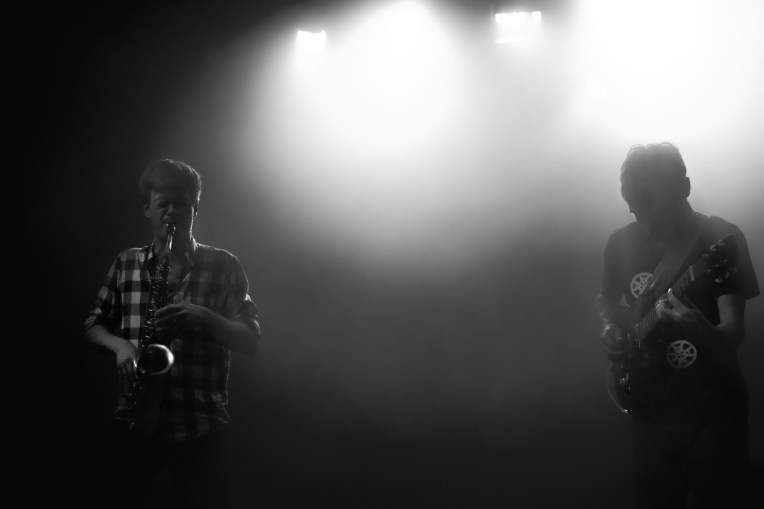
Guitarist Matt Borghi and saxophonist Michael Teager turn gasses into solids. Their process, however, goes beyond chemistry and physics, drawing as they do from a less definable well that some might call inspiration, others spirit, and still others ether. Separately, they have broadened their cartographies across continents. As a duo, they form their own by tender volcanism.

I spoke via e-mail with the musicians, both of whom were grateful in sharing their time and wisdom to illuminate the drift they have manifested. When I asked them to describe their relationship, Borghi likened it to a “combined meditation,” by which two become one through their non-traditional overlap. Teager, for his part, sees what they’re doing as a “contemplative improvised music,” forged not through a simple meeting of instruments but a more rhizomatic, orchestral sensibility.

While on paper their credits imply rock or jazz lineages, with respect to their instruments Borghi and Teager rest in a world apart. Despite a self-professed love/hate relationship with the guitar, Borghi manages to distill magic from its strings through an array of digital effects, but also, more importantly, an unrestricted approach. “That’s why I like improvisation so much,” he says. “It’s a constant exploration. Sometimes you find gold, sometimes you don’t, but each time you start there’s the possibility of hitting something that’s musically profound.” Teager, having more experience as an improviser, has overcome the challenge of owning his reeds, saying, “As a saxophonist in a stylistic continuum, I’m on my own island when it comes to our music. The name I get most often is Jan Garbarek, and while I do like Garbarek’s playing (particularly with Keith Jarrett), I don’t have a deep knowledge of his catalogue. (He’s my ECM blind spot, partially intentionally.) I try not to listen to other ‘ambient’ saxophonists too much. There are so few of us, and the last thing I want is to subconsciously encroach on another’s territory.”

If anything may be compared, it’s Teager’s likeminded patience for notecraft. To be sure, he has found a beautiful comfort in Borghi’s elastic netting, one in which he more often reacts than dictates in a real-time space that privileges atmospheric over egotistic expression. It’s a dynamic evinced in the 2013 album Convocation. Though an unscripted narrative, it develops from the title reverie to a slow-motion ballad (“Discern Descent”) with inchoate coherence. “Nebula Divide,” on the other hand, operates on a more cosmic scale, changing from monochrome to color and back again along an epic flight path. Such titles, among them also “Constant Apex,” help visualize the music’s ethos in all its asymptotic blush.

Convocation

For me, the most evocative drop takes shape in “Precipice.” Borghi wrenches an organic pulse from his guitar, like a light signaling a lone wayfarer from far off, while Teager echoes its promise of shelter in a darkening sky. I can’t help, if from the title alone, be reminded of a performance I once experienced of Japanese butoh dancer Min Tanaka, who barely moved a few inches from a wall over the course of an hour, as if standing on a cliff in contemplation of suicide. Though not so morbid, here the feeling is one of suspension, embraced by the grandeur of creation.

If my association suggests anything, it’s that these sounds welcome any interpretations listeners might bring to the table. The same is reflected in the artists of influence lurking in the background. Just as Borghi cites Claude Debussy, Pink Floyd, and Harold Budd as vital touchpoints in his growth, Teager’s range from Dave Liebman and Charles Lloyd to Richard Wagner and Smashing Pumpkins. And while you may not necessarily detect any of these on the surface, an emotional affinity lances them all.

So it is with 2014’s Shades of Bending Light, wherein mixtures born of experimentation yield integral new structures. “Joyce’s Fanfare” begins at dawn, flowing with the tide between binary chords, while Teager builds his wingspan one feather at a time. A similar approach—spreading the seeds and listening to them grow—blossoms through all that follows.

Shades of Bending Light

Whether in the desolation of “Daisy Chain” or the rhythmic fantasy of “Weird Minor,” or even the farewell energy of “Blue Sky Fades,” an environmental residue stays behind to remind us of what transpired. The album is, further, an enmeshment of contradictions. Teager lights up layers of gray and mist in “Watch Over” with virtuosic runs, even as Borghi tempers his searching with diffuse endpoints. And in “Nightdrive,” which feels like an orphaned folktale hitchhiking along a runway of solitude, one may feel a bodily connection taking place. Even the album’s title track, which despite being its longest feels like its most ephemeral, is as intimate as it is boundless.

The merging of these polar forces hints at their ultimate unity, as made even clearer in 2014’s Awaken the Electric Air. Played as a late-night (4-5am) radio broadcast for WXPN in Philadelphia, it references some Convocation material with lucidity and openness of heart. Ever the transient traveler, Teager’s saxophone pulls the very horizon like a blanket before slumber, his modal sopranism in “Bed of Ash / Coda” being especially moving.

Awaken the Electric Air

The album’s live setting gives the now-familiar motif of “Nebula Divide” (paired with “Somnolence”) and, like the title track, feels sacred by sheer virtue of audibility. Lit by heightened awareness, the paths before listeners remain visible even when the final torch is extinguished, as its smoke continues to guide us by the wrists into dimensions beyond.