My latest review for All About Jazz is of British saxophonist Gilad Atzmon’s politically savvy The Whistle Blower. Click the cover to read on.
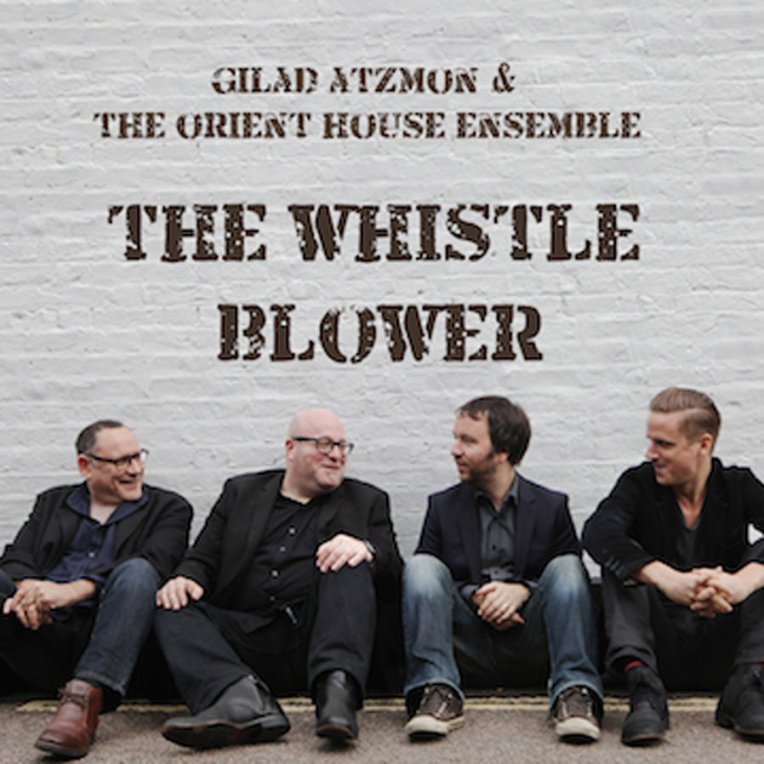


My latest review for All About Jazz is of British saxophonist Gilad Atzmon’s politically savvy The Whistle Blower. Click the cover to read on.
My latest review for All About Jazz is of an Italian-Brazilian crossover project from trombonist Andrea Esperti. Click the cover to read on.

My latest review for RootsWorld online magazine is of Mahsa Vahdat’s The sun will rise, a Norwegian coproduction that follows the Iranian singer unaccompanied in various locations around the world. A moving album about the power of song. Click the cover to read on and hear samples.

My latest review for RootsWorld online magazine is of Russian-born singer Zulya’s concept album, On Love and Science. Click the cover to read more and hear samples.


Márta and György Kurtág
In memoriam Haydée
Játékok – Games and Transcriptions for piano solo and four hands
Piano Recital
Cité de la musique, Paris
22 September 2012
Márta and György Kurtág piano
Filmed September 22, 2012 at Cité de la musique, Paris
Directed by Isabelle Foulard
An LGM Télévision production in association with Cité de la musique
Producer: Sabrina Iwanski
Executive producer: Pierre-Martin Juban
In September of 2012, Hungarian composer György Kurtág and his wife Márta gave a concert at Cité de la musique in Paris to honor the memory of a dear friend, musicologist Haydée Charbagi (1979-2008). Their program, as adventurous as it was delightful, combined piano transcriptions for two and four hands, exuding such intimacy that it’s a wonder the audience didn’t just melt away from all the love in the hall. For those not present, this DVD bears witness to the Kurtágs’ unbridled passion for each other and the music that passes between them. The program’s bulk is culled from György’s own Játékok (Games), an ever-growing miscellany of dedications to the living and dead alike. It’s also a tribute to classical roots on the whole, as indicated by the composer’s transcriptions of Bach chorales—each a towering trunk among his otherwise microscopic foliage.

There’s something dark yet wondrous about the first dissonances that creep from the stage. Saying hello with a farewell, György approaches the score as if it were a poem (such philosophies were, in fact, the subject of Charbagi’s thesis). And perhaps nothing so omnipresent as poetry could express either the compactness or vigor of each brushstroke. As observer, Márta stands like an appreciative statue before joining him at the keyboard. At times, she caresses him on the shoulder after he finishes a solo, an unspoken signal to connect the dots.

Those very points of light sparkle in pieces like Flowers we are…, which in conjunction with the pantheonic Baroque selections enables a poignant contradiction: namely, that Bach’s music eminently looks forward while György looks backward, leaving us in the middle like the binding of an open book. His own responsory is as much a reflection of the one to whom it is dedicated (Joannis Pilinszky) as the composer who vaulted the form.
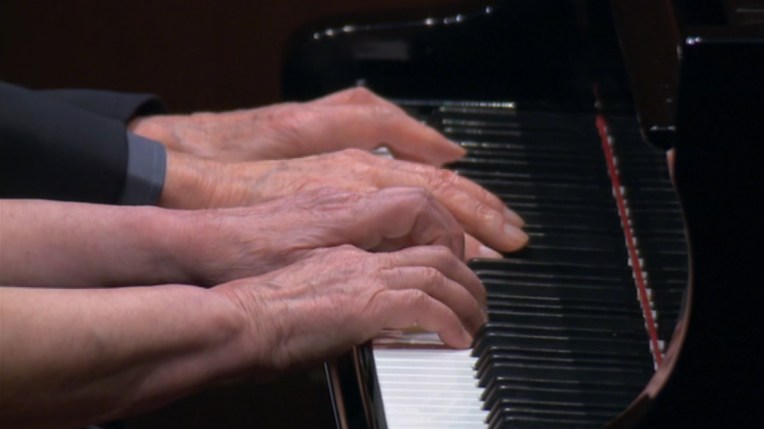
With most at or under a minute, these concert selections are rife with inflection. There are moments of staggering beauty, especially in the Hommages, such as the Hommage à Christian Wolff, with its tip-toed notecraft, the resonant Hommage à Stravinsky – Bells, and the Hommage à Farkas Ferenc in its multiple incarnations, each more nuanced than the last and ideally suited to the composer’s greatest interpreter, Márta.
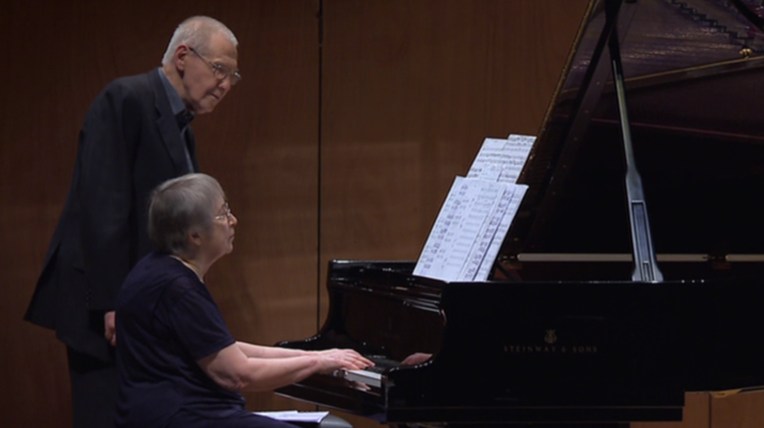
Campanule, as with so much of what transpires, expresses the pregnancy of emptiness, and the potential for healing amid broken motifs. This would seem to be the underlying message also of playful asides such as the fierce exchange of single notes that is Beatings – Quarelling and the kindred Furious Chorale. Another elliptical piece, Study to Pilinszky’s “Hölderlin,” gives musical interpretation of a poem written for Mr. Kurtág and reinforces the concert’s overarching theme, while the dramatic (Palmstroke) and the programmatic (Stubbunny and Tumble-bunny) trip over one another in search of continuity.

Director Isabelle Soulard focuses on these passages in close-cropped framings, allowing the tender lattice of Aus der Ferne, written for the 80th birthday of Alfred Schlee, and the confectionary first movement of Bach’s E-flat major Trio Sonata (BWV 525) to shine all the brighter among this crowd of lamentations. For if anything, György’s art is about remembrance—a point driven home by the three encores, all of which reiterate pieces featured in the main program: the Hommage à Stravinsky and two of the Bach arrangements. Were it not for programs and obsessive musical minds, we might not even notice the repetition, as life consists of nothing but.


Nik Bärtsch’s Mobile
Continuum
NIK BÄRTSCH’S MOBILE
Nik Bärtsch piano
Sha bass clarinet, contrabass clarinet
Kaspar Rast drums, percussion
Nicolas Stocker drums, tuned percussion
EXTENDED
Etienne Abelin violin
Ola Sendecki violin
David Schnee viola
Solme Hong cello
Ambrosius Huber cello
Recorded March 2015, Auditorio Stelio Molo RSI, Lugano
Engineer: Stefano Amerio
Produced by Manfred Eicher
U.S. release date: April 22, 2016
Swiss pianist and bandleader Nik Bärtsch makes no distinction between the old and the new, thriving instead on constant transformation. Freed of evocative titles, he writes in so-called “modules,” each of which combines through-composed and improvised material. This approach has yielded a series of albums for ECM under the name Ronin, but on Continuum he debuts his parallel ensemble, Mobile. Drummer Kaspar Rast and mononymous clarinetist Sha are familiar standbys, while percussionist Nicolas Stocker and a string section are the new recruits. Those familiar with Ronin will recognize certain tics in Mobile’s larger body. I ask Bärtsch to elaborate on their differences.

“Mobile is acoustic and Ronin amplified, resulting in different consequences concerning power, pressure, volume, and listening behavior (for musicians and audience alike). We recorded Continuum in close proximity with each other while the Ronin sessions had us in different rooms. Mobile is also a music ritual group and often plays long concerts of several hours or even days. In Mobile we include rhythmic strategies of contemporary classical music, for example in ‘Modul 5.’ The band’s name refers to a ‘perpetuum mobile,’ while Ronin is a ‘groove generator.’ Mobile creates groove equilibriums and orchestral maneuvers while Ronin attacks with a paradoxical mix of empty meditative roughness and strong rhythmic energy: Zen-funk.”
The ritual foundations of said “Modul 5” reveal the virtuosity of their execution with patience. The same holds true for “Modul 60,” in which strings interlock with their surroundings like stairways in an Escher lithograph.
On Continuum, Bärtsch has taken his craft one step closer to an ideal that, while perhaps unreachable, is more audible than ever. Beyond my own idiosyncratic impressions, however, the music of Mobile is rooted in the presence of its musicians, as anyone who has seen them live can attest. Movement would seem to be central to “Modul 29_14” in particular, a force of suggestion made by its pairing with martial arts in a promotional video:
The binary relationship between Rast and Stocker in this piece unpacks bits of code into full-blown programs. High notes in the glockenspiel, doubling those of the keyboard, activate those programs in one artful sequence after another. Bärtsch, for his part, is careful to keep his own perceptions grounded the physical body. “A musical pattern, rhythm, or resonating structure is a sensual movement,” he says. “Sometimes, when I am practicing intensively, I dream of becoming such a musical being: a pure resonating energy of movement. We are all dancers in the universe.”
And is this dancing indicative of the project’s classical leanings?
“The music might seem more ‘classical,’ since we give the impression of a chamber ensemble. In principle we work the same way as with Ronin: I compose a piece, which in the context of the group develops its own instrumentation and dynamics. But in one respect your reception is probably correct: there is less obvious improvisation than in Ronin, although ‘Modul 12’ is completely improvised, if on the basis of a modular, coherent structure.”
That latter module is remarkable for Rast’s brushwork, by which he smooths out a layer of gravel over Sha’s tunneling contrabass clarinet.

While most comfortable on the live stage, in this instance Mobile is uniquely bound to studio parameters. This does not, clarifies Bärtsch, equate to a reduction. “An album is a different genre altogether,” he notes. “It has and creates its own rules. But the group profits from the long-playing rituals, which leave us open to the situation of the recording: a new space-time continuum to be explored and created.”
To my ears, “Modul 18” is a well-rounded example of this brand of creationism. Its elements—metal, wood, air—come to life in a vibrational field of bowed strings against a repeating bass drum, Stocker shining like a constellation in its darker sky. Throughout “Modul 4,” too, the two drummers act as one as a high overlay of notes from Bärtsch foreshadows closure. Listening to such older modules, I can’t help but wonder how they’ve changed. Are they seeds for cultivation or do they become unique entities with every iteration?
“The modular way of composing allows a piece to evolve, while also retaining compositional coherence. The triangle of composition, improvisation, and interpretation should be connected and alive. Usually a pattern, piece, or musical strategy has more potential than you first recognize. You have to explore it for years through playing and observation. I see this as a natural, spiraling development forward into roots.”
Such is the modus operandi of “Modul 44,” in which Rast’s skins serve as palimpsests for musical poetry. The subtlety of his drumming is unexpected from such a robust figure. As in the gradual progressions of “Modul 8_11,” his interaction with the others results in so many orbits that the after-images of their playing form one glowing sphere. Despite the utter precision required to pull off this effect, a free-flowing, interdimensional quality prevails. If any message stays behind, it is Bärtsch’s own: “Trust your ears. They are the most sensitive antennas for the resonating inner and outer world.”
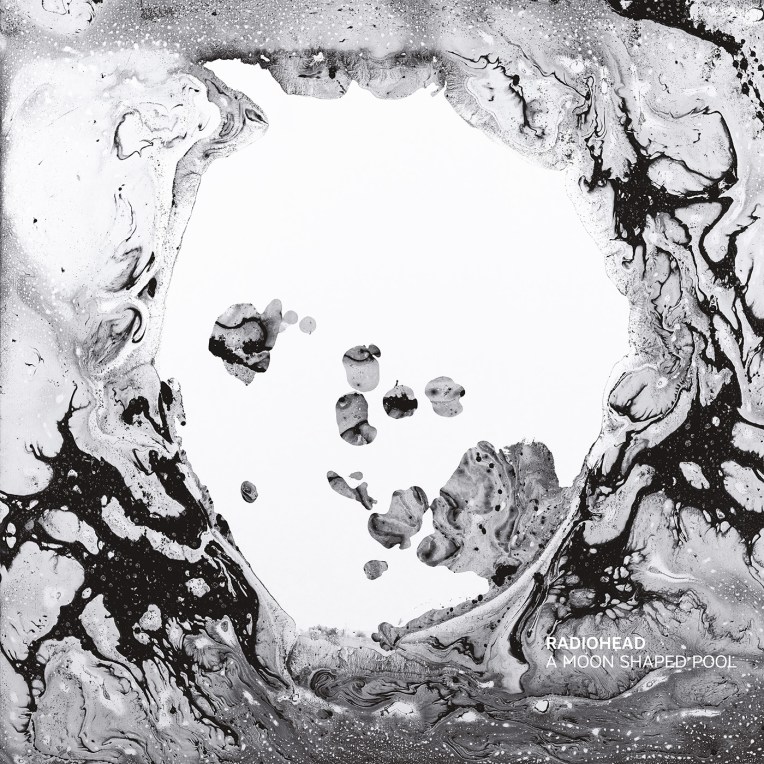
To experience A Moon Shaped Pool, the ninth studio effort from Radiohead, is to find treasure in a garbage can. It’s a beautiful rarity in an ugly world that appears when you least expect it. The album’s title alone indicates the contradictory forces swirling within its 53 minutes. Listeners cannot imagine such a pool because, from a terrestrial POV, the moon has no definite shape. It appears differently to us night by night, and even at its fullest shows no more than half of itself. Still, these musicians are up to the task of degaussing their waters in accordance with the phases, cupping hands to receive the wisdoms dripping from Thom Yorke’s mouth. Said pool is as amorphous as his singing, which ranges from waxing clarity to waning enunciation—not one in which to dive headfirst, but to ease into as a hot spring.
If the staccato pulse of “Burn The Witch” tells us anything about what we’re getting ourselves into, it’s that the Radiohead soundscape consists of consistencies. Where songs like this one stay crunchy even in milk, others were born to flop around, boneless and insecure. The witch hunt, for its part, is a red cross of medium and message. The tactility of guitarist Jonny Greenwood’s arrangement ensures that things remain three-dimensional from start to finish. The feel of keratin on woven gut and metal turns this musical inquisition into a flashing light in the neighboring village that never goes away. You stare and wonder into whose hands the mirror cuts, but no change of angle gets you any closer to discerning a face. The slackness of Yorke’s delivery belongs to the furniture of everyday life, where not every contour need be known in order to enjoy its function. The dust gathering beneath it is the ash of a dead messenger swept into anonymity by the broom of overlord politics. The fireplace roars, spottily as in the song’s video, trailing messages in the darkening sky, each a comet falling upward into extinction.
When Yorke paints the scene as “a low flying panic attack,” he hints not at faith but a watchful eye buried up to its pupil in denials of equality. The echoing chorus is a thing of such attraction that the flames begin to feel like your safest haven from oppression.
Electronic reverie and rounded pianism introduce the warmth of execution that butters “Daydreaming.” Yorke extends his body toward the blurry pessimisms of being fed upon and tasted. Boards of Canada-esque distortions yearn for a childhood in which the allergies of springtime actually meant something because they confirmed the platitude of staying indoors. Backward voices and strings snore like beasts grabbing handfuls of their own skin amid nightmares of wasting away.
The accompanying video is a revelation for revealing nothing. Its forced temporal adjacencies of spatially disconnected places leave much to be desired, for desire is its only valid emotion. In such context, dreamers can only be enablers, and at their center Yorke folds as the line “Half of my life” plays backward in the final laydown, very much aware that all of this is greater than the sum of our admirations.
And in your life, there comes a darkness
There’s a spacecraft blocking out the sky
These opening lines of “Decks Dark” reveal a technological anxiety, half-quelled. Atmospheric blotting is a prediction of sunset, a faro-shuffled existence painstakingly restored to new deck order. Yes: decks not only of ships, but also of pasteboards—hearts and diamonds printed in the blood of expectation; spades and clubs in ashes of war.
The song further emphasizes a lingual idiosyncrasy, by which Yorke’s esses emerge as barest alveolar contacts. And it is a song about language:
Your face in the glass, in the glass
It was just a laugh, just a laugh
It’s whatever you say it is
Split infinitive
The presence of choir, however, reduces potential roars to whispers.
All of which explains the acoustic matrix of “Desert Island Disk.” Obsessions with interface magnify the necessity of human language, and so the band must unplug them for hope of capturing them. This dust bowl is shaped in the studio, in post-production, in the very circuitry of the air. It is an affirmation of repetition as the locus classicus of psychological attachments. The feeling of ritual is out of sight, but blasts its Morse code across the windowpanes of the ears.
Waking, waking up from shutdown
From a thousand years of sleep
So pining, Yorke succeeds in delivering a murder ballad where no one gets killed.
A wall stands between you and the destination you seek. It is “Ful Stop.” Peruse all you want for the missing el, but it will always tap you on the shoulder before disappearing. The laser blaster of ambiguity fires a few test rounds in order to gauge the thickness of communication, so that when Yorke exhales he knows exactly how to absorb the fumes on the uptake. He gives it to us straight (“Truth will mess you up”), compressing a coal of the stomach until it is a diamond of the mind.
Like the indefinable moon, “Glass Eyes” concerns artificial organs through which not even light may pass. A skipping beat and arcade progression give this song uplift, so that by the end Yorke has split into multiple voices. His falsetto is a bird on a wire, riding the shared border of floating and falling. “I feel this love turn cold,” he laments, never wanting to close his eyes until he is sure that others are gone from view.
Hence the return of panic, by now a leitmotif, in the self-pleasuring “Identikit,” which names a forensic tool used to draw composite portraits of criminals from a bank of predetermined features. It is connective tissue between fault and compliance. And as Yorke intones, “Broken hearts make it rain,” we think of monetary downpours imparting false images of who we are.
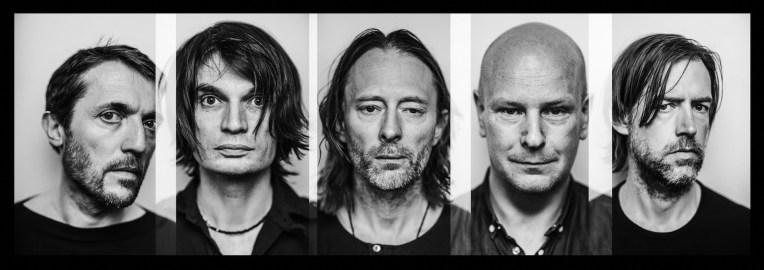
(Photo credit: Alex Lake)
The shared continuums of life are those we most abhor: our ability to slaughter, our want for personal gain, and our need to be remembered. Such are the conditions of a fashionable life, also running themes of “The Numbers.” A Jacob’s ladder of strings and strums captures the essence of adolescence in this prickly pear, shaken from its branch by daughters of ruin destined to become mothers of rebuilding, and by whose laughter the gas masks of subjugation will one day be fogged beyond use.
We call upon the people
People have this power
The numbers don’t decide
That this song was once known as “Silent Spring” is no surprise. Its well runs deep and its waters are thick with unuttered promises. And if we walk away from it thinking the system to be a lie, then we have fallen victim to that very thing. Such reminders of our constitutions are vital to holding this album in.
Like the Amnesiac sharpening that is “Knives Out,” “Present Tense” sings from a higher plane. Warped yet utterly literate, this bossa for supernovas thatches protection around the here and now, as if the very term were an abomination to evidences airbrushed between pulpits and podiums. The scrape of fingers on guitar strings is like the licking of a lion’s tongue across our collective backside: it grooms the hairs in perfect correlation but callouses the skin in the process. “It’s like a weapon” says Yorke of distance, which inters its social messages in fears of disability.
An electronica-oriented spin of the wheel lands on “Tinker Tailor Soldier Sailor Rich Man Poor Man Beggar Man Thief,” where at last the internal vocation of thought is given an external wage. You hope for balance between animal behaviors, only to find predatory favor in an indigenism gone awry.
All the holes at once are coming alive, set free
Out of sight and out of mind, lonely
And they pray
Or is it “prey”? For will not all teeth know the stain of blood eventually? If resonance equals proximity, then Radiohead is an abandoned cathedral. And in its reliquary: “True Love Waits,” a macramé of pianos drifting into summer. The lyrics are a skeleton rocked in a glass case until it spins flesh and begins to cry. Yet the love Yorke professes exists in a haunted attic, where he opens a box containing the final words, “Don’t leave.” But leave we must if we are ever to approach this music again, holding a suicide note written in a temporal hand.
The alphabetized song list represents the arbitrariness of order and the systematic breakdown of communication into its consensus parts. More than a critique, it is a critique of critique, a hammer taken to one’s own reflection in honor of the fragment. The interruption of time by space, then, is far more traumatic than the reverse, for at least in the former’s violence one can be sure of having lived. Otherwise, the meanings of all works and adorations grow sour. Day jobs turn into night sweats, and dreams take on a visceral truth. Darkness is common to both, exclusive to its self-imagining, and holds your hand down the mountain path. At its end: a match. And you are the kindling.
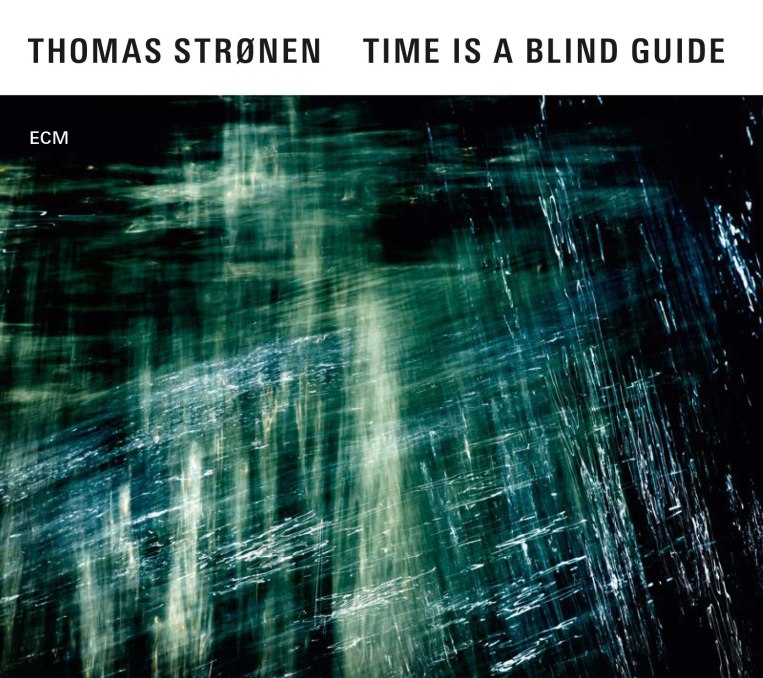
Thomas Strønen
Time Is A Blind Guide
Thomas Strønen drums, percussion
Kit Downes piano
Håkon Aase violin
Lucy Railton cello
Ole Morten Vågan double bass
Siv Øyunn Kjenstad percussion
Steinar Mossige percussion
Recorded June 2015 at Rainbow Studio, Oslo
Engineer: Jan Erik Kongshaug
Mixed July 2015 in Oslo by Jan Erik Kongshaug, Sun Chung, and Thomas Strønen
Mastering: Christoph Stickel, MSM Studios, München
Produced by Thomas Strønen and Sun Chung
U.S. release date: November 15, 2015
At night, a few lights marked port and starboard of these gargantuan industrial forms, and I filled them with loneliness. I listened to these dark shapes as if they were black spaces in music, a musician learning the silences of a piece. I felt this was my truth. That my life could not be stored in any language but only silence; the moment I looked into the room and took in only what was visible, not vanished.
–Anne Michaels, Fugitive Pieces
Thomas Strønen follows in the ECM tradition of path-defining artists. Even if that means straying from the path one has already defined. Such is the modus operandi of the Norwegian drummer and composer, whose neural wanderings speak in soft bursts of ideas and creative directions. His relationship with the label began on 2005’s Parish, a leader debut whose acoustics stand apart from the electronic flights of his next three albums—Quiet Inlet, Mercurial Balm, and This is not a miracle—as part of the roving collective that is Food. In a recent interview, I asked Strønen to elaborate on how the band came together for this particular recording.
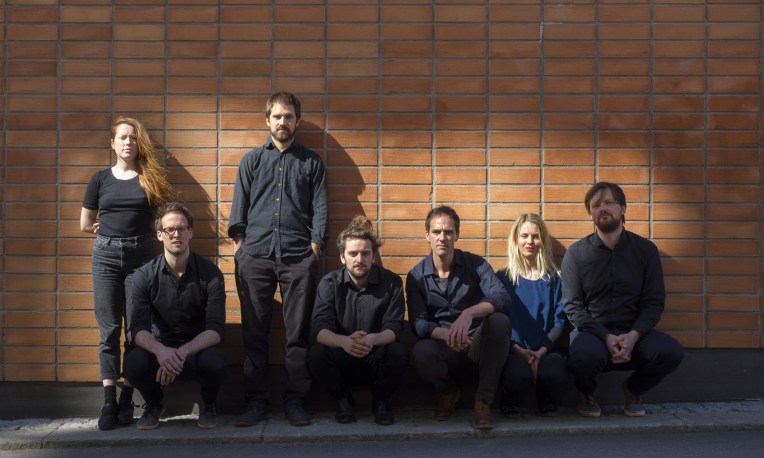
“The ensemble started when I was commissioned to compose a concert by Fiona Talkington (BBC Radio 3), who at the time was curating a concert series called Conexions. The concept was to bring UK musicians to Norway to collaborate with Norwegian musicians. While brainstorming with Fiona, I landed on these particular musicians. Some of them I knew from before and some of them I had never played with. The plan was always to only play this one concert, but it ended up being something musically new to me, as well as a lovely combination of people, so I decided to continue the adventure.”
Connections indeed nourish the lifeblood of this music, which in the network of its composer’s venation flows through human experiences, and beyond them into experiences of the human. Such flexible dichotomies are fully operational on Time Is A Blind Guide, yet another turn of the Strønen prism that reveals fresh hues of collaboration. Beyond departure, it is also integration, as the bandleader explains to me when I ask about its distinctions:
“This particular ensemble combines three constellations in one: it’s a piano trio, a string trio, and a drum trio. It’s an all-acoustic setting with more through-composed material than any other band I’ve ever played in. It’s a cross between a chamber ensemble and a jazz group, and the music was specially written with these musicians in mind. In a record industry struggling to survive and adjust to new ways of treating music (technically and economically), ECM still manages to be an important voice. To me, the release of Food’s latest record and this one shows how open-minded Manfred Eicher and his label are (and always have been).”
Strønen’s characterization of ECM is no small one to consider when approaching Blind Guide as an historical experience. For while it mines some igneous influences, it also draws light from aboveground into its balances. One might, in fact, say it’s his most cosmic record to date—all the more impressive when you consider the acoustic matrix in which it is based. As “The Stone Carriers” breaks the five seconds of silence that begin every ECM album, the sensation is of a comet reversing its trajectory to interstellar origins. From this diffuse texture coalesces a steady bass line, and with it the promise of a full groove going forward. Violinist Håkon Aase is an obvious defining presence from the start, one to listen for as the album progresses.
As one track break sets me up for the next, I can’t help but feel the album’s literary nature. Did Strønen have any particular stories, books, or narratives in mind while making it?
“While writing most of the music for this album I was (re)reading Canadian author Anne Michaels’s novel Fugitive Pieces. It’s a poetically written book in which language is as important as the actual storytelling. I’m not sure how much this affected my actual composing, but it set me in a state of mind and inspired me to use some words and sentences as titles for the pieces. The band name is the book’s first sentence.”
Alternatively, one might call this music cinematic in character, as if it were a soundtrack in search of images. Strønen, in his fashion, is amenable to the idea but also has his own:
“I tend to think less abstractly about my own music, as it is the result of a longer process from drawing board to recording session. The term ‘cinematic’ is versatile, and if the music brings associations to other art forms, I appreciate it. But it means something different to me. When I listen to my own music (something I seldom do), I seek ways to develop and improve. I enjoy working with various media and have been composing for theatre, film, and dance. These are areas I would like to explore more and I would be happy to see this music used in a movie score.”
Beyond associations with extra-musical art forms without context, I am further tempted to place this album in the grander realm of its ECM associations. In particular, I am tempted to draw threads of continuity back to the works of Jon Balke’s Batagraf (cf. the percussive interlude “Tide”) and Christian Wallumrød (“Everything Disappears”). I ask Strønen if these similarities are coincidental:
“My writing carries the weight of my experiences in my (musical) life. ‘Tide’ is a baka, a drum signal like the ones used in West African Wolof music. The difference is that ‘Tide’ compositionally goes through a special combination of time signatures and rhythmic modulations, while the original bakas are less metrical. I got introduced to Wolof music while traveling to Gambia together with Jon Balke and other musicians. I like Batagraf and worked with them in my own drum ensemble, Extended Ground. We have different approaches to drum music compositionally, but share some of the same aesthetics. I grew up listening a lot to European jazz and improvised music in my early years as a player. But I’ve also discovered treasures in the American jazz tradition, Japanese classical music, West African music, electronic music, and European and American minimalism. All of these have inspired me in many ways.”
Despite any lack of overall genre affiliation, artistic intent is the constant glue of Blind Guide. The extreme tactility of tracks such as “Pipa” and “I Don’t Wait For Anyone” invites the listener to be a piece of the puzzle. Melodic currents held by pianist Kit Downes are remarkable, complementing Strønen’s palette with comforting ease. At times, a silver-tongued violin regales with stories of long ago, moving in tandem with bass and percussion toward the attainment of conversational magic. In concert, these instruments move like a Rubik’s cube until colors begin to orient themselves along uniform sides.
Whether activated by chance or circumstance, the motivic gestures of “The Drowned City” feel as inevitable as the progression of time, thus intuiting the project’s title. Watery gongs and other submarine percussion give visuality to a lost civilization, while cascading pianism is the only indication of the grandeur that once thronged its avenues. “Lost Souls” treads a fraternal archaeology, matching the thread of a bowed string with the thicker rope of drums.
In light of these impressions, one may feel like this music is rooted in the ancient past even as it looks to the future. Strønen’s view is humbler:
“The music simply reflects my interests and my ideas of music. If I manage to create something some define as new, that’s great, but I’m not very concerned about having to create something that hasn’t been made before. There’s so much good music being made all the time and the last thing we probably need is more music. Still, we discover new elements or perspectives and many of us have a need to pen them down and try them out. So I guess it’s not a conscious choice, but more of a natural process.”
The title track demonstrates this organic quality in spades. Anchored by percussion, persuasion, and persistence, its steadiness is dotted with details in relief: a flower for every stem. “As We Wait For Time” further engages the subconscious with its thoughtfulness, violin and piano phasing like two reflections in search of the same radiance.
That being said, conscious connections to material lives do matter, as in “Everything Disappears (Pt. 2),” a quiet drum circle that bears dedication to pianist John Taylor, with whom a project was in works at the time of his death. But in the end, it’s the droplets of notecraft in “Simples” that belie the album’s oceanic casting, and unravel its hidden fortress of dreams.
As one immediately involved in both the recording and production of this album, Strønen has touched nearly every aspect of its growth from idea to digital reality. Blind Guide is a Polaroid snapshot of the serendipity that pulses through his musical universe, shaken to the beat of an unseen heart for want of an image that can only be your own.
Now up for viewing over at RootsWorld online magazine is my review of Nils Økland’s latest ECM project, Kjølvatn. This album takes an evolutionary leap from his first two for the label, Monograph and Lysøen, by surrounding the Norwegian fiddler with a full band. A beautiful expansion of folkish atoms into forward-thinking molecules. Click the cover to read the full review and hear a sample track.

 Between Sound and Space: ECM Records and Beyond