Thomas Strønen: Time Is A Blind Guide (ECM 2467)

Time Is A Blind Guide

Thomas Strønen
Time Is A Blind Guide

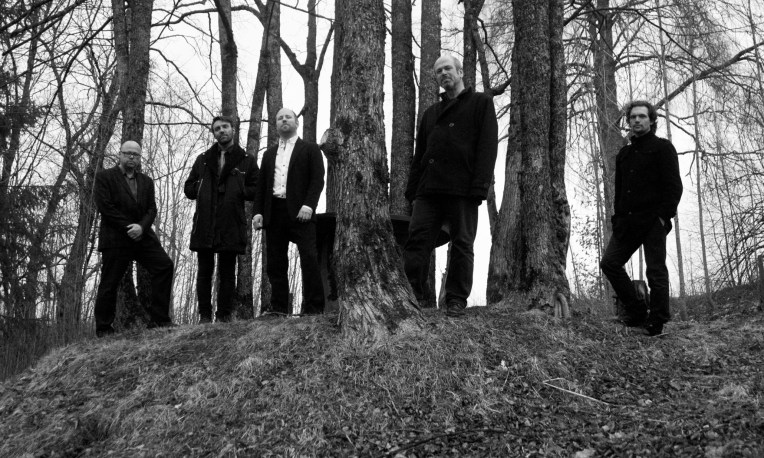
Thomas Strønen drums, percussion
Kit Downes piano
Håkon Aase violin
Lucy Railton cello
Ole Morten Vågan double bass
Siv Øyunn Kjenstad percussion
Steinar Mossige percussion
Recorded June 2015 at Rainbow Studio, Oslo
Engineer: Jan Erik Kongshaug
Mixed July 2015 in Oslo by Jan Erik Kongshaug, Sun Chung, and Thomas Strønen
Mastering: Christoph Stickel, MSM Studios, München
Produced by Thomas Strønen and Sun Chung
U.S. release date: November 15, 2015

At night, a few lights marked port and starboard of these gargantuan industrial forms, and I filled them with loneliness. I listened to these dark shapes as if they were black spaces in music, a musician learning the silences of a piece. I felt this was my truth. That my life could not be stored in any language but only silence; the moment I looked into the room and took in only what was visible, not vanished.
–Anne Michaels, Fugitive Pieces

Thomas Strønen follows in the ECM tradition of path-defining artists. Even if that means straying from the path one has already defined. Such is the modus operandi of the Norwegian drummer and composer, whose neural wanderings speak in soft bursts of ideas and creative directions. His relationship with the label began on 2005’s Parish, a leader debut whose acoustics stand apart from the electronic flights of his next three albums—Quiet Inlet, Mercurial Balm, and This is not a miracle—as part of the roving collective that is Food. In a recent interview, I asked Strønen to elaborate on how the band came together for this particular recording.

“The ensemble started when I was commissioned to compose a concert by Fiona Talkington (BBC Radio 3), who at the time was curating a concert series called Conexions. The concept was to bring UK musicians to Norway to collaborate with Norwegian musicians. While brainstorming with Fiona, I landed on these particular musicians. Some of them I knew from before and some of them I had never played with. The plan was always to only play this one concert, but it ended up being something musically new to me, as well as a lovely combination of people, so I decided to continue the adventure.”

Connections indeed nourish the lifeblood of this music, which in the network of its composer’s venation flows through human experiences, and beyond them into experiences of the human. Such flexible dichotomies are fully operational on Time Is A Blind Guide, yet another turn of the Strønen prism that reveals fresh hues of collaboration. Beyond departure, it is also integration, as the bandleader explains to me when I ask about its distinctions:

“This particular ensemble combines three constellations in one: it’s a piano trio, a string trio, and a drum trio. It’s an all-acoustic setting with more through-composed material than any other band I’ve ever played in. It’s a cross between a chamber ensemble and a jazz group, and the music was specially written with these musicians in mind. In a record industry struggling to survive and adjust to new ways of treating music (technically and economically), ECM still manages to be an important voice. To me, the release of Food’s latest record and this one shows how open-minded Manfred Eicher and his label are (and always have been).”

Group Time

Strønen’s characterization of ECM is no small one to consider when approaching Blind Guide as an historical experience. For while it mines some igneous influences, it also draws light from aboveground into its balances. One might, in fact, say it’s his most cosmic record to date—all the more impressive when you consider the acoustic matrix in which it is based. As “The Stone Carriers” breaks the five seconds of silence that begin every ECM album, the sensation is of a comet reversing its trajectory to interstellar origins. From this diffuse texture coalesces a steady bass line, and with it the promise of a full groove going forward. Violinist Håkon Aase is an obvious defining presence from the start, one to listen for as the album progresses.

As one track break sets me up for the next, I can’t help but feel the album’s literary nature. Did Strønen have any particular stories, books, or narratives in mind while making it?

“While writing most of the music for this album I was (re)reading Canadian author Anne Michaels’s novel Fugitive Pieces. It’s a poetically written book in which language is as important as the actual storytelling. I’m not sure how much this affected my actual composing, but it set me in a state of mind and inspired me to use some words and sentences as titles for the pieces. The band name is the book’s first sentence.”

Alternatively, one might call this music cinematic in character, as if it were a soundtrack in search of images. Strønen, in his fashion, is amenable to the idea but also has his own:

“I tend to think less abstractly about my own music, as it is the result of a longer process from drawing board to recording session. The term ‘cinematic’ is versatile, and if the music brings associations to other art forms, I appreciate it. But it means something different to me. When I listen to my own music (something I seldom do), I seek ways to develop and improve. I enjoy working with various media and have been composing for theatre, film, and dance. These are areas I would like to explore more and I would be happy to see this music used in a movie score.”

Beyond associations with extra-musical art forms without context, I am further tempted to place this album in the grander realm of its ECM associations. In particular, I am tempted to draw threads of continuity back to the works of Jon Balke’s Batagraf (cf. the percussive interlude “Tide”) and Christian Wallumrød (“Everything Disappears”). I ask Strønen if these similarities are coincidental:

“My writing carries the weight of my experiences in my (musical) life. ‘Tide’ is a baka, a drum signal like the ones used in West African Wolof music. The difference is that ‘Tide’ compositionally goes through a special combination of time signatures and rhythmic modulations, while the original bakas are less metrical. I got introduced to Wolof music while traveling to Gambia together with Jon Balke and other musicians. I like Batagraf and worked with them in my own drum ensemble, Extended Ground. We have different approaches to drum music compositionally, but share some of the same aesthetics. I grew up listening a lot to European jazz and improvised music in my early years as a player. But I’ve also discovered treasures in the American jazz tradition, Japanese classical music, West African music, electronic music, and European and American minimalism. All of these have inspired me in many ways.”

Despite any lack of overall genre affiliation, artistic intent is the constant glue of Blind Guide. The extreme tactility of tracks such as “Pipa” and “I Don’t Wait For Anyone” invites the listener to be a piece of the puzzle. Melodic currents held by pianist Kit Downes are remarkable, complementing Strønen’s palette with comforting ease. At times, a silver-tongued violin regales with stories of long ago, moving in tandem with bass and percussion toward the attainment of conversational magic. In concert, these instruments move like a Rubik’s cube until colors begin to orient themselves along uniform sides.

Whether activated by chance or circumstance, the motivic gestures of “The Drowned City” feel as inevitable as the progression of time, thus intuiting the project’s title. Watery gongs and other submarine percussion give visuality to a lost civilization, while cascading pianism is the only indication of the grandeur that once thronged its avenues. “Lost Souls” treads a fraternal archaeology, matching the thread of a bowed string with the thicker rope of drums.

In light of these impressions, one may feel like this music is rooted in the ancient past even as it looks to the future. Strønen’s view is humbler:

“The music simply reflects my interests and my ideas of music. If I manage to create something some define as new, that’s great, but I’m not very concerned about having to create something that hasn’t been made before. There’s so much good music being made all the time and the last thing we probably need is more music. Still, we discover new elements or perspectives and many of us have a need to pen them down and try them out. So I guess it’s not a conscious choice, but more of a natural process.”

The title track demonstrates this organic quality in spades. Anchored by percussion, persuasion, and persistence, its steadiness is dotted with details in relief: a flower for every stem. “As We Wait For Time” further engages the subconscious with its thoughtfulness, violin and piano phasing like two reflections in search of the same radiance.

That being said, conscious connections to material lives do matter, as in “Everything Disappears (Pt. 2),” a quiet drum circle that bears dedication to pianist John Taylor, with whom a project was in works at the time of his death. But in the end, it’s the droplets of notecraft in “Simples” that belie the album’s oceanic casting, and unravel its hidden fortress of dreams.

As one immediately involved in both the recording and production of this album, Strønen has touched nearly every aspect of its growth from idea to digital reality. Blind Guide is a Polaroid snapshot of the serendipity that pulses through his musical universe, shaken to the beat of an unseen heart for want of an image that can only be your own.

Nils Økland Band review for RootsWorld

Now up for viewing over at RootsWorld online magazine is my review of Nils Økland’s latest ECM project, Kjølvatn. This album takes an evolutionary leap from his first two for the label, Monograph and Lysøen, by surrounding the Norwegian fiddler with a full band. A beautiful expansion of folkish atoms into forward-thinking molecules. Click the cover to read the full review and hear a sample track.

Kjølvatn

Review of MPS Compilation for All About Jazz

My latest review for All About Jazz should be of special interest to ECM fans. The compilation Magic Peterson Sunshine chronicles the history of the German MPS label, a vitally important predecessor to ECM Records on which many familiar artists (including John Taylor, Eberhard Weber, and John Surman) made key appearances. This album is a vital cross-section of music history and belongs on the shelf of anyone who cares about the history of jazz in Europe and beyond. Click the cover to read on!

Magic Peterson Sunshine

Lee Scratch Perry: Rise Again

Rise Again

Lee Scratch Perry + Bill Laswell = a collaboration written in eons-old starlight. The pioneering Jamaican producer and shamanistic bassist have been approaching dub from different directions—one from the past, the other from the future—and at last meet in the here and now. Tunde Adebimpe, Gigi Shibabaw, and Hawkman throw their vocal legumes into this vegetarian stew, while Bernie Worrell (keyboards), Peter Apfelbaum (tenor sax and flute), Steven Bernstein (trumpet), Josh Werner (bass), and Hamid Drake (drums) extend their bodies toward an overlapping dimension in which to sing.

As a unit, these musicians render the studio a portal of insight into the human condition, crafting art as an effigy to be burned in offering. Only they can see the glyphs written in every trail of ganja smoke, swirling and separating into runways for alien landings. This revisionist history of life unfolds like a book not only bound in but also written on skin, burnished by hands whose shapes are much unlike our own. Instead of fingers: attracting forces. Instead of wrists: only skies, cocked to the angle of the sun’s passage at any given moment throughout the day. The compass is strong with this one, for its seeking is bound to the realm of the dead, if scrutinized only by the living.

Perry is a griot on stilts. He drops his beats and words from a higher place. In the rain of his exhalation, one feels a lifetime of atmospheres at play. From autobiography and politics to godliness and metaphysics, his themes interlock across vast spatial and temporal expanses, but always in service of the utterance in real time. It all begins in the narrative impulse of “Higher Level.” With animal wanderlust and anti-parasitic skin, Perry charts a course through this world of hunters and sinners, following ley lines along which Rastafarian secrets, scriptural wisdom, and the esotery of personal experience share borders.

In “Scratch Message,” Werner takes a ride in the captain’s chair, navigating this vessel with religious deference. It is a stroll through the valley of life, in which the waters of tolerance have run dry, yet where the footprints of many travelers before have laid a path of resistance. It is this which Perry follows beyond the oceans of his island and straight into the heart of “African Revolution.” This call of arms to rid the world of arms is a protest in the name of salvation. It bows to the same goddess of groove who in “Butterfly” dons a crown of blessings.

Though the peace cultivated by this crowd may be far from the madding others, Perry’s knowledge of the spider’s web runs deep. In both “Wake The Dead” and “E.T.” he gives listeners a private tour of conspiracy, flushing out toxins of ignorance with nutrients of awareness. The latter tune is especially reminiscent of Laswell’s Sacred System project, an early dub transmission from 1996 that still ripples across these waters. Through the governmental sacrament of blood and fire, he sharpens the blade honed by Perry decades before, now polished by millennia of intergalactic breeding and glinting in the bonfire of oppression.

Perry’s refusal to be pinned down by the weight of elitism comes from being supported and pushed ever upward by the hands of his ancestors. And in the songs “Orthodox” and “House Of God,” the former gilded by Shibabaw’s golden throat, he attunes his vibrational frequency to the rhythms of prayer. Laswell’s bass drops head and heart into poetic comportment, as Shibabaw gives her all to the inner science of these readings, singing with the knowledge that stillness is just an illusion resulting from perfect equilibrium between rising and falling.

Turning the kaleidoscope again, Perry shows us his whimsy, rapping through the televisual brilliance of “Dancehall Kung Fu” and spinning the roulette to land finally on “Inakaya (Japanese Food).” On the surface an ode to cuisine but in actuality a blood pact shared between two pricked geographic fingertips, it is an ice cube on the forehead in summer.

If you want to know where dub is heading, you must understand where it has come from. And on Rise Again, we get both in one circle. But let there be no talk of masterpiece, for Perry is a master, whole.

(For more information, click here.)

Last Exit: Iron Path

Iron Path

League-of-his-own guitarist Sonny Sharrock. Subterranean saxophonist Peter Brötzmann. Atmospheric bassist Bill Laswell. Former Albert Ayler drummer Ronald Shannon Jackson. Alone, each is a power tower of musical ideation. Together, they blind the sun. In 1988, these free-jazz atoms bonded to unleash their only studio molecule. Now remastered for the 21st century, it bleeds redder than ever.

Like Everyman Band before them or Krakatau after, Last Exit pummels through walls of expectation as if they were made of feathers. From these they fashion a giant pair of wings across 10 spines of reality. As Steve Lake so reverently describes in his liner notes: “There’s no false modesty in Last Exit, no false anything. The group is important precisely because its rush of sound is a heartfelt force. It sweeps away all the fakery that proliferates on both sides of the highbrow/lowbrow cultural divide.” None of that flavor has dulled these last three decades, and if anything has grown more piquant with age.

The most obvious politic at play on the scale of Iron Path is its balancing of opposites. “Prayer” feels like anything but as a growling bass eats into the foreground, one pathos-ridden chew at a time. But as the terminal illness of its build reaches a plateau, bells of immolation toll for those with water. Guitar and drums power through resistance like berserker prospectors panning for untranslated scriptures. And these they find in the proffered wisdom of Brötzmann’s horn, which by virtue of prophecy spews all of its treasures for the taking. So does “Marked For Death” reveal its hidden meanings with patience. Brötzmann’s soloing exemplifies the restraint required to unleash such morbid finality. In “Eye For An Eye,” too, Laswell blows smoke through gritted teeth: a mountain pushed through a chain-link fence, to the call of an interspace chant.

Some tracks are purposefully grounded in the everyday. “The Black Bat,” for instance, bears dedication to Japanese producer Aki Ikuta, who tragically died at the age of 33 as the result of a car accident the year this album was recorded. His restless spirit echoes throughout this piece, in which colors swirl into mournful timbre. Other passages are more obscure and require further peeling of the ears to appreciate. The title track, with its eastern infusions, whispers of simulacra slashed across time, while “Devil’s Rain” finds Sharrock rocking the cinematic edge as Brötzmann lobs the heart of a volcano into the exosphere.

“The Fire Drum” is one of two blatantly descriptive turns, boasting comet streaks of brilliance from the guitarist and reedman. “Sand Dancer,” on the other hand, is Laswell’s electric phoenix all the way. And if these seem too grounded in their spaces, one needn’t worry, as both “Detonator” and “Cut And Run” hybridize aggressive haunts with tidal preaching, until only one piece of advice remains: Structural failures are the birth of monumental impulse.

(For more information, and to hear samples, click here.)

Milford Graves & Bill Laswell: Space/Time Redemption

Space Time Redemption

The first studio duet of drummer Milford Graves and bassist Bill Laswell, both yielding warriors of their respective dark arts, is a selfless proclamation. Residing in their speech is the yin for the other’s yang, a drop of sun for moon.

In approaching this vessel, one does better to go below decks from the first sounding, interpreting this axis from its crux outward. And toward the end, we have that very intersection in the form of “Autopossession.” More than a title, it is a mission statement by which the body is rendered inert through spiritual process. Being a solo from Graves, it melts surrounding ice, stopping just before it reaches steam. Thought and action likewise turn into liquid. But the drummer’s is more than a beat-driven consciousness, for here the specter of regularity serves only as the reminder of a talismanic past. If the head nods at all, it is because the mind has left it behind.

Regressing a level of reality gives us “Eternal Signs,” one of four collaborative improvisations that include “Another Space” and “Another Time.” Each is a ring linked to the others in a multidirectional chain of being. Drums and bass serve as equal partners, connected by lightyears of shared experience. The energy seems violent in origin, even as it breeds nothing but harmony. A pliant strum or forceful tap: either closes the gate as easily as opening it, sealing terror exhaust from the inevitability of inhalation. The more such improvising develops, the more macroscopic it becomes, crumbling outward in an explosion of planetary dimensions. It is the repression of history, demystified in music.

Yet the most willful approach reverberates throughout the dedicatory “Sonny Sharrock,” which like its namesake unwinds the familiar into unexpected filament. Laswell applies an echo effect, allowing it to float above the ionosphere of influence over which his instrument’s dreams wander. Amid gamelan-like touches from Graves, he adds flame upon gnashing flame, so that oxygen expends itself at shaman’s touch. There is a shape to that fire, one that flits between human and animal with the unpredictability of an autumn leaf’s path. Percussive chemicals seep into those four heavy strings, while the drums eject prophecy from the pilot’s seat in favor of crash landings, leaving Laswell’s branch-bending scriptures to flutter alone in the final breeze.

There is no mystery, other than the space to which the album’s title refers. It would seem to be our own by virtue of our listening, organ-less and multiple, a mirror fogged by the breaths of gods too far away to see yet too close not to sense in the shifting of tress at night just before sleep shades your retinas. But on closer inspection the reflection is that of a star child breastfed on shadow, now spitting words of light for our foraging. It returns the gaze and whispers: Wings were not invented for flight, but flight for wings.

(Available at Amazon here.)

Kurt Riley: The Man Who Fell to Earth

Music and life start the same way: as a seed germinating until it is ready for the world. Many have beaten objects for want of rhythm; others have extended their bodies through instrumental prostheses in deference to melody. But the most primal search of the modern age is that of a voice for an amplifier. Ithaca, New York-based singer Kurt Riley is one such seeker, holding a microphone like a newborn whose umbilical cord twirls back into the electric womb where his second album Kismet has been incubating for over a year.

Mic

A student among a band of students, Kurt has balanced his academic life at Cornell University with a musical one on another planet, from which his sonic gatherings at last fell into place during his premiere performance on April 29, 2016.

At the mic

Teaming up with the glam rocker on this interstellar ride were drummer Olivia Dawd, bassist Charlie Fraioli, guitarists David Dillon and Sam Packer, keyboardist Ruth Xing, saxophonist John Mason, and backing vocalist Kristina Camille Sims. The latter added dialectical undercurrents to Riley’s over, balancing dichotomies not only of gender but also temporality and location in the grander context of his outreach.

Kristina

The band played the entire album from front to back, opening with the instrumental “Eternity,” a synth-heavy blush that plowed through stardust in a procession of songs without words. Wavering before a backdrop of endless galaxy, Kurt and his musicians prepared their earthly transmission with steady hands and fibrillating hearts. Not only was it a portal of insight into the emotional story about to unfold, but also a foreshadowing of hope: a touch of rain amid the brimstone to ease the pain of progress. More importantly, it lent sanctity to the venue, allowing us to forget we were sitting in nothing more than a university auditorium. Between the retro arpeggio, which flushed the audience of its insecurities in a space normally reserved for less intimate instruction, and the slack guitar floating above it all, a cosmos waited to unleash its primal scream.

Guitar face

In their rendition of “Eye of Ra,” the album’s first proper song (at least on human terms), Kurt and his astronauts stared into the face of something sinister and acknowledged lack of escape from that which knows us without sight. Hanging on to a kingdom by its lowest rungs, a realm where hardship is a prerequisite for the course of life, they nevertheless cradled this dire circumstance for what it was: a baseline of realism that allows lowly citizens to remember, in the end, just how far they’ve come beneath untouchable authority.

Hand

Like motivations flowed through the follow-up song, “Engines Are Go!” Here the narrative voice was youthful, almost naïve in its gradation from verse to chorus. Kurt pushed these images through the mesh of experience until they were unrecognizable as their former selves. This road trip through the unrequited jungle gave over to “Theft of Fire.” The first incision of an even more romantic surgery, it was a turning of tidal expectations from doom to failure, the key difference being that the latter involves a choice.

Alone 1

The first single off Kismet, “Hush Hush Hush,” provided the most classic sound. Its pianistic backbone flexed to the beat of a retroactive metropolis in anticipation of biting its own tail. As the ballade du jour, it was a singular passage of reflection, projected through a darkly loving lens of yearning. All of which fed into the first push of “Domino,” sending us all through a cavity of falling rocks.

The circularity of “As We Know It” came about through words of material destruction. “Humanity: Why so in love with the end of things?” Kurt sang, blowing his brains out through a harmonica at the end like a catharsis beyond false semantic promises. It was also a turning point in the program, which paled from black to red as the contours of “Whore” came into focus. For this, Kurt was joined by local rapper Asanté Quintana, whose delivery rose like gorge mist through safety netting.

Asanté

This sea change was further evident in “God’s Back in Action,” a piece of soul for the lonely sharpened to an edge of comfort. It was the very definition of the Kurt Riley experience, which behind the weathered leather and mascara teardrops cradled a motivation of care. As too in the all-reaching “Universe” especially, a Queen-like danse macabre for the soul, true love was never far behind.

Alone 2

And in “Human Race,” which sent balloons flying throughout the auditorium, Kurt pulled that hope into the present. A self-imagining broken into heated breath…

Red

…but nowhere more so than in “Burn It Up,” which gave that hope a vessel in which to soar.

Banksied

And with that benediction, closed like a fist around slippery assurances, Kurt and his mortal cohort closed up the castle, swept the blood and sweat under the carpet, and tread out into the galactic night with new followers in tow.

Galaxy

Toward the end of his life, David Bowie once characterized himself as a man lost in time, but Kurt is one who is just beginning to find himself in it. Should you wish to know more about his time on Earth, which is sure to breed noteworthy developments, click the album cover below.

Kismet

See you on the other side.

(Concert photos: Yours Truly)