

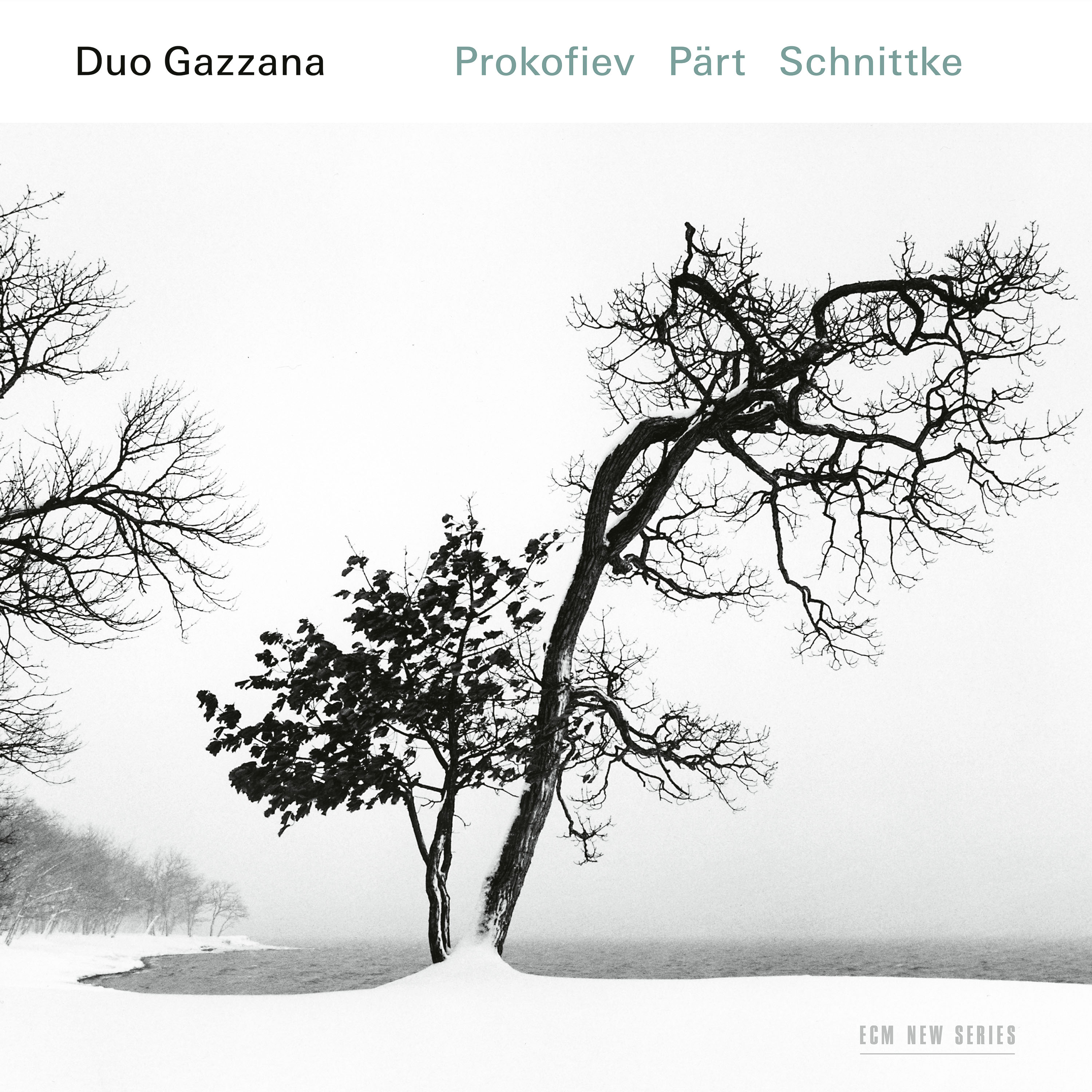
Duo Gazzana: Prokofiev/Pärt/Schnittke (ECM New Series 2854)

Duo Gazzana
Prokofiev/Pärt/Schnittke

Natascia Gazzana violin
Raffaella Gazzana piano
Recorded February 2025, Reitstadel Neumarkt
Engineer: Markus Heiland
Mixed September 2025
by Manfred Eicher and Michael Hinreiner (engineer)
Cover photo: Michael Kenna
Produced by Manfred Eicher
Release date: April 17, 2026

Since 2011, Duo Gazzana have occupied a rarefied space within the ECM New Series realm, where sound is uncovered as a relic from beneath layers of listening. Across their previous recordings, the sisters Natascia and Raffaella have cultivated a language of intimacy that resists spectacle, drawing the ear inward, toward a threshold where precision meets vulnerability. Their artistry thrives not on assertion but on trust, a quiet confidence that what is essential will endure without artifice.

This latest album extends that ethos while threading it through a program shaped by endurance, fracture, and the fragile grace of survival. The chosen composers speak across time not through stylistic unity but through shared confrontation with hardship. As Stefano Carucci observes in his booklet essay, these figures, despite their divergent origins and trajectories, all encountered forms of sociopolitical suffering that threatened to silence them, and yet found in music a passageway beyond constraint. What emerges, then, is not merely a collection of works but a meditation on resilience. Each piece becomes a chamber where pressure resonates.

Sergei Prokofiev (1891–1953)
Sonata for Violin and Piano No. 1 in f minor, op. 80

Written under the oppressive weight of the Stalinist regime, interrupted by war, and completed in 1946, this sonata bears the imprint of a mind navigating both external censorship and internal unrest. The opening Andante assai does not so much begin as seep into being. The piano murmurs from its lower depths, a shadowed resonance that seems to remember something it cannot name. The violin responds with a tremor, not quite a voice yet no longer silenced. Their exchange unfolds like a fragile correspondence between distant selves, each phrase arriving slightly worn by travel.

Textures accumulate slowly, their friction almost tactile. One senses thought grinding against itself. Then, unexpectedly, a glint of irony surfaces, a crooked smile glimpsed through fog. The piano drifts into an impressionistic shimmer, while the violin traces an erratic line above, a figure balancing along a fence that refuses stability. A final whisper of pizzicato settles the air before the Allegro brusco asserts its presence, not with brute force but with a taut clarity that holds its ground. The Gazzanas render this movement with astonishing poise, maintaining a paradoxical separation. It feels as though violin and piano inhabit parallel rooms, their dialogue conducted through walls that neither obstruct nor reveal entirely.

The subsequent Andante opens a window. A stream appears, modest and unassuming, its flow uninterrupted by spectacle. Yet even here, unease lingers beneath the surface. The music twists subtly, its beauty edged with something watchful. By the time the Allegrissimo erupts, the earlier calm reveals itself as prelude rather than respite. Motion accelerates into a language of leaps and surges, returning to earlier motifs not as closure but as transformation. The ending resists finality. It suggests continuation beyond hearing, as though the sonata persists in some unseen dimension, spiraling outward long after the last vibration fades.

After such intensity, the arrival of Arvo Pärt’s Spiegel im Spiegel feels like stepping into a space where time loosens its grip. This work, among the first articulations of Pärt’s tintinnabuli style, invites a relinquishing of self. The performers become vessels rather than agents, their gestures stripped of excess until only essence remains. The piano’s arpeggios unfold with crystalline patience, while the violin sustains a line that seems to hover between presence and absence.

In this interpretation, the Gazzanas uncover a depth that resists articulation. The music breathes within a threshold where the physical dissolves into the ineffable. It carries the faint suggestion of something sacred, not declared but intimated. Each note appears as if reflected in another, a mirror that does not duplicate but reveals hidden dimensions. The simplicity is deceptive. Beneath it lies an infinite regress, each tone containing the seed of another, extending endlessly into silence.

Prokofiev
Five Melodies, op. 35a

Originally conceived as vocalises for soprano and piano in 1920 and later transcribed for violin, these miniatures form a bridge between tradition and innovation. They are concise yet expansive, each piece a self-contained world that flickers into being and vanishes before it can be fully grasped. The Gazzanas approach them with a sensitivity that honors their dual nature.

The second melody stands out in particular. Its opening pizzicato gestures evoke a tactile immediacy, as though the music were being plucked directly from the air. The flowing ostinato that follows transforms this grounded beginning into something buoyant, almost dance-like. Yet the energy never settles into predictability. It shifts, folds inward, then reemerges with altered contours. The final Andante non troppo balances restraint and exuberance, its voice alternating between whisper and exclamation. The conclusion does not resolve so much as dissolve into a state of luminous equilibrium.

Alfred Schnittke (1934–1998)
Gratulationsrondo

Schnittke’s polystylistic language introduces a different kind of tension. Here, contrasts are not reconciled but allowed to coexist in uneasy proximity. Familiar gestures are tinged with unease, while dissonance acquires an unexpected radiance. The Gazzanas navigate this terrain with a delicacy that reveals the work’s inner vulnerability. Beneath its shifting surfaces lies a candid exposure, as though the music has shed its defenses and stands unguarded before the listener.

What ultimately defines Duo Gazzana’s performance throughout this album is a quality that might be called bareness, though the term hardly captures its fullness. Their playing does not impose meaning. It creates space for meaning to emerge. Each phrase feels unencumbered by expectation, as if the music were discovering itself in real time. Their sisterly connection is evident, yet it is not the focal point. Rather, it is the organic foundation upon which a more profound dialogue unfolds.

And perhaps this is where the album leaves us. Not with answers, nor even with questions, but with a shift in how we attend to sound itself. These works, shaped by hardship and carried forward through fragile persistence, remind us that music is not merely an object of listening. It is a mode of being, a way in which experience transforms into something that can be shared without being diminished. In the end, what lingers is not the echo of suffering but the realization that even in silence, something continues to resonate. Whether we call it memory, spirit, or simply presence, it carries us forward with hope.
Vincent Courtois: EAST (YAN.009)

Vincent Courtois cello
Mixing: Gérard de Haro at La Buissonne Studios
Mastering: Nicolas Baillard at La Buissonne Studios
Production: Gérard de Haro and RJAL for La Buisonne & La Cie de l’Imprévu
Marketed in cooperation with ECM Records
Release date: November 12, 2021

Although cellist Vincent Courtois is best known in jazz circles, his musical imagination was founded in classical discipline at the Conservatory of Aubervilliers. When the early days of the pandemic suddenly suspended ordinary time, he found himself alone with an instrument, a room, and a long-held desire to confront the monumental solo repertoire of the 20th century. This album is a chronicle of that isolation, a record of inward motion that gradually widens into something like spiritual travel.

Arthur Honegger’s rarely heard Paduana opens the program with a plunge into the cello’s subterranean depths. From that darkness emerges a voice at once grounded and restless, searching for a horizon it can almost taste. Courtois draws a tone that feels inhabited, a living current that runs beneath every phrase. The music breathes, pauses, and advances with a quiet inevitability.

Hans Werner Henze’s nine-part Serenade follows like a gallery of shifting faces. Each movement appears to illuminate another angle of an elusive figure as it comes into being. The central Vivace flares with kinetic brilliance, as if the music were hammering itself into form before our ears. Courtois moves effortlessly between bowed intensity and fleeting pizzicato gestures, revealing how much freedom resides in precision.

Krzysztof Penderecki’s Per slava begins as a whisper that refuses to remain small. Taut double stops hover in an uneasy suspension, suggesting a soul momentarily detached from its body. As the piece unfolds, sorrow gathers weight without ever softening into consolation. Courtois describes its difficulty as “a seemingly unclimbable mountain.” Yet his ascent feels less like a conquest than a patient persistence that carries him to the summit.

That hard-won clarity leads naturally into György Ligeti’s Sonata for Solo Cello. The opening slides glint with a folkish warmth before the music accelerates toward the incandescent Capriccio, where exuberance becomes almost ecstatic. The performance vibrates with alertness, every gesture sharpened by joy. Luciano Berio’s Les mots sont allés, built from the letters of dedicatee Paul Sacher’s name, follows as a kind of celebratory labyrinth. Its variations rub against one another until friction turns to flame.

Paul Hindemith’s Cello Sonata then arrives with immediate authority. From its first gesture, it strides forward rather than wanders. Courtois lets the music declare itself with unshakable resolve. Texture accumulates, yet the line never fractures.

The album ends with Dominique Pifarély’s pour Fernando Pessoa, a work of quiet turbulence. Tender passages give way to veiled unease. Courtois shapes its twists with restraint, allowing mystery to remain intact. What lingers most is not technique, however adventurous, but the sense of an instrument speaking plainly across time. These works belong to an era when the cello still carried the burden of narrative, capable of song, proclamation, and inner confession all at once.

Solitude has not narrowed this music; it has deepened it. In listening, we are reminded that art does not rescue us from isolation so much as reveal what we were always carrying within it.

Signum Quartett: A Dark Flaring (ECM New Series 2787)

Signum Quartett
A Dark Flaring

Signum Quartett
Florian Donderer
 violin
Annette Walther violin
Xandi van Dijk viola
Thomas Schmitz violoncello
Recorded March 2022, Sendesaal Bremen
Engineer: Christoph Franke
Design: Sascha Kleis
An ECM Production
Release date: July 18, 2025

A Dark Flaring marks the second ECM New Series appearance of the Signum Quartett, following their renditions of Erkki-Sven Tüür’s chamber music on 2020’s Lost Prayers. With an even more evocative title through which to guide our listening, they present a singular program of selections from South Africa. In her liner notes, journalist and music critic Shirley Apthorp sets the stage for us most vividly:

“In both Xhosa and Zulu tradition, a healthy relationship with your ancestors is a prerequisite for wellbeing in the present; modern psychology is still catching up with much of what older cultures have known for centuries. While it remains a challenge to find a common thread between South Africa’s many and diverse cultures, this awareness could be said to knit together both the rainbow nation’s populace and the works on this recording.”

And in Komeng (2002), by Mokale Koapeng (b. 1963), we begin to understand just how wide the gap between mind and body can be. The piece takes its inspiration from “Umyeyezelo,” a celebratory song by Thembu musician Nofinishi Dywili (1928-2002). Dywili was a master of the uhadi, a single-stringed bow played with a stick akin to the Brazilian berimbau (an effect replicated here con legno). The song’s title means “ululation” and refers to a Xhosa coming-of-age ritual, the circular nature of which is organically expressed in the music’s structure. A play of sunlight on a child’s face, a swaying reed, a tree standing tall on the horizon: images of past and future comingle in the present, rendering such divisions of time meaningful beyond measure (to say they do away with them would be to undermine the music’s committed sense of time). A rocking motion in the cello, fragile pizzicato, and other liminal gestures from the higher strings add vital details.

Next is (rage) rage against the (2018) by Matthijs van Dijk (b. 1983), which begins innocently enough before imploding. It is directly connected to loss (the composer having lost his mother when he was 18) and personal trauma, paying homage to both the Dylan Thomas poem “Do Not Go Gentle Into That Good Night” and the band Rage Against the Machine. Toeing the line between fury and dark resignation, it exploits the limits of the string quartet’s capacity for depth and breadth. Stomping feet add necessary punctuation. The piercing sirens of its final act are thrilling, like a rock song being fed through the meat grinder of Penderecki’s Threnody for the Victims of Hiroshima until the bleeding slows to a trickle. A subliminal drone woven into the ending gives hope of a life beyond the chaos.

From the newest to one of the oldest of the program, we switch to the Five Elegies for String Quartet (1940-41) of Arnold van Wyk (1916-1983), who, in the late 1930s, became the first South African composer to study at the Royal Academy of Music in London. He also knew loss, having suffered the death of his mother and oldest sister by age 17. Despite being his first compositions for string quartet, these elegies immediately evoke Shostakovich in their fiercely shaded lyricism and were among a handful of early works that earned him great renown in his day. The balance of fluidity and razor-sharp insight is immediately apparent in his examination of war. The lively second movement, marked Allegro feroce, grabs the hem of joy but never manages to defrock the dark zeitgeist that flaunts it. The central Adagio is the mournful heart of it all, a forlorn viola solo against a backdrop of aftereffect: bomb smoke, fire ash, and tear stains. Only toward the end does the cello answer the call as if from the grave. And in the final movement, we encounter the most lyrical motifs, which build into a Beethovenian drama before ending in a near whisper.

Péter Louis van Dijk (b. 1953) is the father of Xandi van Dijk, violist of the Signum Quartett. His iinyembezi (2000) draws from John Dowland’s “Flow My Tears” (1596), as indicated by the Xhosa title (meaning “tears”), refracting the theme until it becomes a chain of half-starts and unrequited remorse. At one point, pizzicato playing evokes the mbira (African thumb piano), and the musicians even tap their instruments in kind. Over the course of 16 and a half minutes, it traverses continents’ worth of terrain, giving itself over to jubilation but always falling back into a bed of tentative truth claims. Despite the expressive depth at hand, it draws an ever-tighter circle of influence around itself until, like an ouroboros, it must stop just shy of self-extinction. 

Robert Fokkens (b. 1975), who also studied at the Royal Academy of Music and has lived in the UK ever since, gives us Glimpses of a half-forgotten future (2012). An elegy to deaths in his own life, it too evokes the uhadi but bears further imprints of Cage, Feldman, Bach, and the French spectralists. Spaced out in three movements, the second of which leaps as if in an attempt to escape the clutches of grief, it finishes with microtonal contemplation, seemingly at odds with its surroundings.

The finale is an astonishing discovery in the form of the Quartet for Strings (1939) by Priaulx Rainier (1903-1986), another Royal Academy of Music graduate who studied with Nadia Boulanger, among others. Inspired by the music she grew up with in Zululand, she stayed on at the Academy as a professor of composition. Being a relatively early work, the Quartet for Strings eschews some of the technical challenges that would beset much of her later pieces, but it’s no less challenging for its emotional demands. Its opening movement, for one, teeters between lyricism and skepticism—or, if you will, between looking us straight in the eye and askance—while the trembling second movement dances at the edges of a fading memory. The third movement, marked Andante tranquillo, makes artful use of pizzicato cello and moves in flowing chords attached at the hip. Finally, a spirited Presto chews hard until it reaches bone in the viola. Sliding strings share the air with muted harmonics, a textural quality that makes me wonder whether she didn’t make an impression on composers like Boucourechliev later on.

If A Dark Flaring has a soul partner there in the universe, it is the Kronos Quartet’s seminal Pieces of Africa from 1992. If you admire that album as much as I do, then you’ll find plenty to savor in this one as well. Although born of a different stripe and spirit, it holds equally deep roots in its hands and refuses to let go of them from start to finish.