

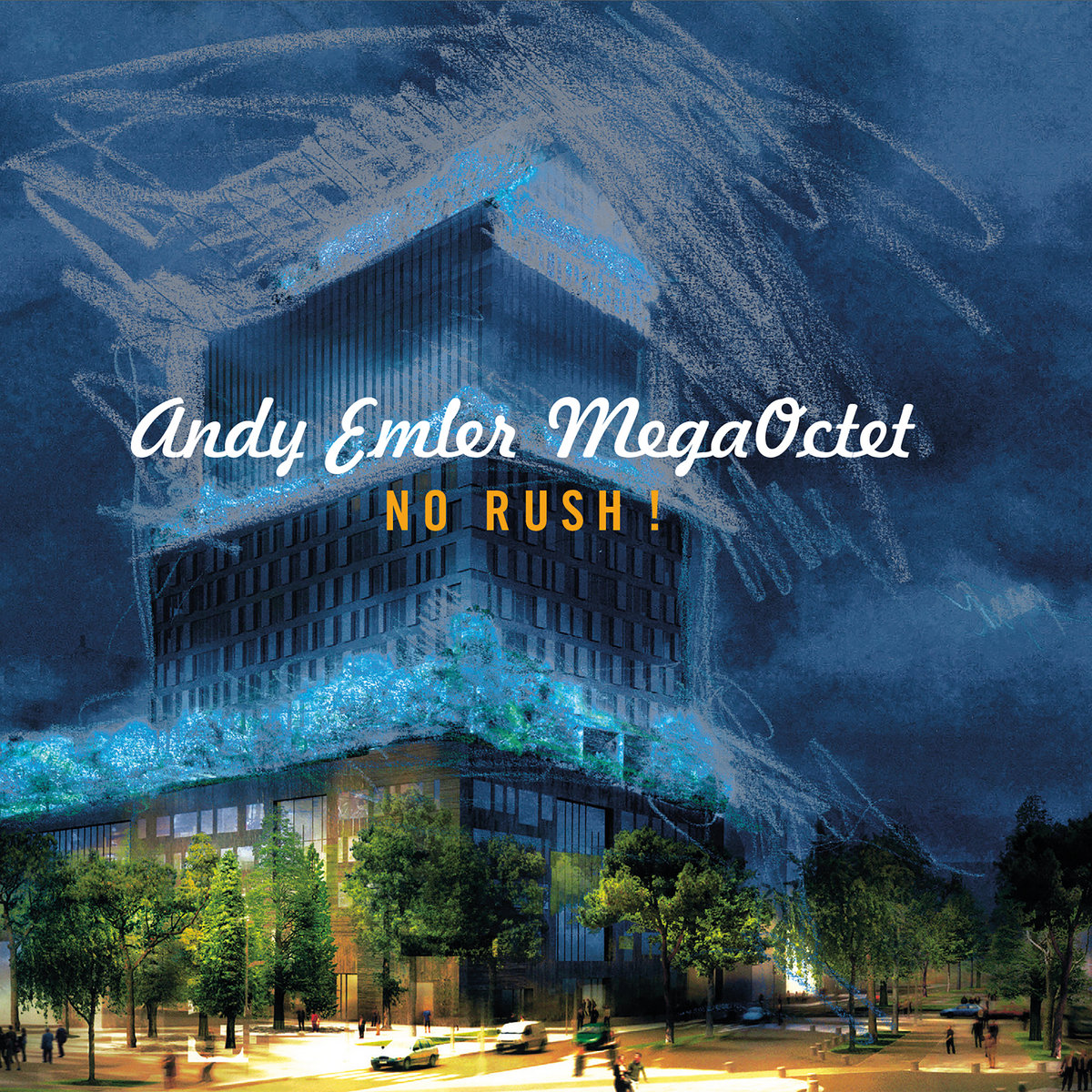
Andy Emler piano, direction
Laurent Blondiau trumpet
Philippe Sellam alto saxophone
Guillaume Orti alto saxophone
Laurent Dehors tenor saxophone, bass clarinet
François Thuillier tuba, saxhorn
François Verly percussion, marimba, tablas
Eric Echampard drums
Claude Tchamitchian double bass
Nguyên Lê guitar
Recorded August 30-31, 2021 at La Buissonne Studios by Gérard de Haro, assisted by Matteo Fontaine
Mixed by Gérard de Haro and Andy Emler at La Buissonne Studios, May 30 to June 1, 2022
Mastering at La Buissonne Mastering Studio by Nicolas Baillard
Steinway grand piano prepared and tuned by Sylvain Charles
Produced by Gérard de Haro & RJAL for La Buissonne and La Compagnie aime l’air
Release date: February 3, 2023
No Rush! arrives as the ninth testament from Andy Emler’s MegaOctet. Conceived in the suspended air of the pandemic, the suite took shape while Emler immersed himself in the labyrinthine architectures of 20th-century music. Schönberg’s fractures, Lutosławski’s veiled aleatorics, Ligeti’s shimmering densities, the spectral iridescence of Murail, the volatile lyricism of Cavanna, the tensile drama of Manoury and Ohana all seep into the soil here. One imagines the composer alone with these sounds and his thoughts, listening not for comfort but for provocation, as if each score were a sealed letter slipped under the door. Out of that solitude came eight facets of our collective survival instinct.
“Ouv’ la case” opens with an unveiling. The piano enters as a question breathed into a darkened room, chords suspended in air that seems to inhale with them. Wind instruments murmur as though testing the edges of a new climate. Gradually, the piano’s hesitations gather warmth, focusing light the way a lens courts fire from sunlit dust. The ignition that follows is intimate rather than explosive. The title track unfolds in a stepwise melody, tender as a hand feeling along a wall for a switch. Drummer Eric Echampard and bassist Claude Tchamitchian conjure updrafts that carry François Thuillier’s tuba into buoyant arcs, its low brass made improbably aerodynamic. Trumpeter Laurent Blondiau threads bright filaments through the texture while the piano chisels out a groove of crystalline angles. The ensemble moves like a murmuration that has memorized geometry.
Throughout the record, the music returns to a ritual of emergence: spark, ascent, transformation. François Verly’s percussion animates “Think or sink” with a tactile intelligence, marimba tones falling like polished stones into water, each ripple caught by a quicksilver drums-and-bass exchange. “Just a beginning” leans into its brassy musculature, horns flaring with declarative confidence while Nguyên Lê’s guitar sketches streaks of electricity across the sky. Such solos resemble sudden apertures in the architecture, revealing corridors of thought previously concealed.
Despite the mass of sound available to these virtuosic players, restraint is never far from reach. “Fondamental 6” hovers with the poise of a contemporary chamber suite, its textures diaphanous, its gestures measured as if drawn with a calligrapher’s brush. “Three thoughts for two” begins in hushed tones, a private meditation that slowly finds its pulse, marimba guiding the ensemble into a supple drive. When the groove subsides, Laurent Dehors steps forward on tenor, his lines wandering through nocturnal avenues, lamplight glinting off damp cobblestones of harmony. It is a solo that feels lived in, not merely performed. Even the concise “Minicrobe 2” compresses an ecosystem into two minutes, a microscopic drama teeming with mutations of rhythm and color.
“Good timing” closes the cycle with exuberance that borders on the cosmic. Saxophones blaze, rhythms surge with rocketlike insistence, and the band seems to graze the sun’s perimeter without losing its wit. There is virtuosity here, yes, but also a wink, a murmured “mmm” that suggests satisfaction without self-congratulation.
In an era defined by pause and isolation, Emler fashioned music that refuses haste while never standing still. Perhaps that is the quiet thesis of No Rush! Art does not conquer time, nor does it escape it. Instead, it inhabits time so fully that seconds dilate into landscapes. Listening becomes an act of dwelling. One leaves the album wondering whether urgency is a flaw in our perception rather than a fact of existence and whether, by opening our own hidden cases, we might discover that the richest movements occur when we allow them to unfold at their chosen pace.
 Between Sound and Space: ECM Records and Beyond